IQ, EQ, and AQ

The Lord Is My Chef Simbang Gabi Recipe, 18 December 2019

Jeremiah 23:5-8 ><)))*> ><)))*> ><)))*> Matthew 1:18-24

Mosaic at the Chapel of St. Jerome, underneath the Basilica of the Nativity in Bethlehem where St. Jerome lived while studying and translating the Bible into Latin. It is believed to be the place where St. Joseph received in a dream the message of the angel for him to take Mary as his wife. Photo by the author, May 2017.

First, we were told for a very long time the importance of IQ or “Intelligence Quotient” for anyone’s success in life.

Then came the EQ or “Emotional Quotient” this past decade that experts claim has more impact in determining one’s success in life than the IQ.

Now, scientists are claiming that more important than the IQ and the EQ is “AQ” or “Adversarial Quotient”, our ability to respond to various adversarial situations in life.

According to the proponents of AQ, the better we are able to deal with life’s troublesome situations like handling crises involving our many forms of relationships, the better we are equipped in having a more fuller life.

Dream of St. Joseph (Oil on canvas) by Francisco Goya. From Google.

Today we hear the story of St. Joseph facing an extremely adversarial situation when Mary who was betrothed to him was found pregnant with a baby not his!

This is how the birth of Jesus Christ came about. When his mother Mary was betrothed to Joseph, but before they lived together, she was found with child through the Holy Spirit. Joseph her husband, since he was a righteous man, yet unwilling to expose her to shame, decided to divorce her quietly. Such was his intention when, behold, the angel of the Lord appeared to him in a dream and said, “Joseph, son of David, do not be afraid to take Mary your wife into your home. For it is through the Holy Spirit that this child has been conceived in her.”

Matthew 1:18-20

IQ + EQ + AQ = HQ

St. Matthew describes St. Joseph a “righteous man” or, in Jewish thought, a holy man, a saint who lives his life according to the word of God. Also known as a zaddik in Hebrew, a righteous man delights in the Torah (Law), entrusting everything to God.

According to the Book of Psalms’ first chapter, a righteous man or a zaddik is like a tree planted near a river bank that symbolizes God’s words, growing into maturity with good fruits because he is filled with God, putting into practice the Sacred Scriptures and the Laws.

That is precisely what holiness is all about: being filled with God, not being sinless!

Though holiness means being perfect and whole as its Greek origin tells us, holiness as preached by Jesus Christ is an ongoing process when he commanded us to “be perfect as your heavenly Father is perfect” (Mt.5:48).

Holiness does not happen overnight; it takes time and a lot of cultivation on our part.

(One rule of thumb, though, that we must keep in mind: if you think or feel you are holy, definitely you are not. Saints do not know they are saints.)

IQ, EQ, and now AQ are in a sense, scientific expressions of holiness, of being filled with God to become better persons.

During the Solemnity of St. Joseph last year, Pope Francis issued “Gaudete et Exsultate” to reiterate Vatican II’s universal call to holiness by proposing practical ways in our modern time on how to be holy based on the beatitudes of Jesus Christ.

The Lord asks everything of us, and in return he offers us true life, the happiness for which we were created. He wants us to be saints and not to settle for a bland and mediocre existence. The call to holiness is present in various ways from the very first pages of the Bible. We see it expressed in the Lord’s words to Abraham: “Walk before me, and be blameless” (Gen 17:1).

Gaudete et Exsultate, 1

Very interesting in our Simbang Gabi is how the Pope mentions Abraham, the very beginning of Jesus Christ’s genealogy, as a model of holiness now being expressed in our gospel by the last person in that genealogy, St. Joseph!

St. Joseph bridged faith and practice

St. Joseph is exactly that kind of Jewish zaddik who lived in constant dialogue with God in praying the Scriptures, concretely living it minus the legalisms of the Pharisees and scribes of his time.

For him, the Torah was a good news meant to make life better, not bitter by applying it to daily living which is to love by preserving life.

In dealing with his extremely adversarial situation, St. Joseph did the most important step we have totally disregarded these days: silently pray to God for guidance and grace.

As a man, one can just imagine the many thoughts running through St. Joseph’s mind and heart when the woman he loves so much is found with a baby not his.

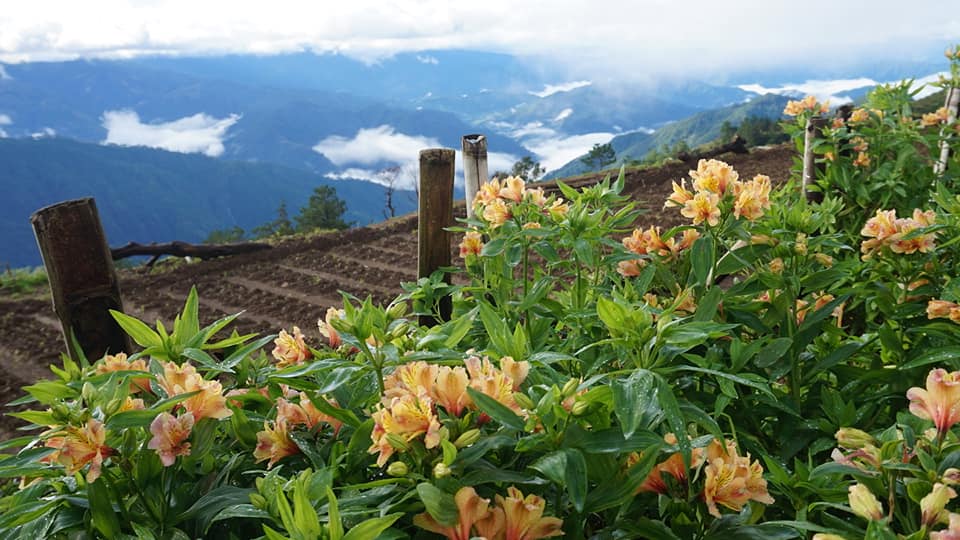
Sunrise at Atok, Benguet. Photo by Ms. Jo Villafuerte, September 2019.

His decision to silently leave Mary was due to his great love for her, not in disregarding the letters of the Law that declares that any woman betrothed to a man who bears a child not his must be stoned to death.

Read again St. Matthew’s account we have quoted above and you will feel the solemnity of the scene, of “how the birth of Jesus Christ came about” according to St. Matthew.

There was no sense of agitation or any other negative vibes, purely positive.

Very clear, St. Joseph’s holiness was not merely due to his bloodline or genealogy but his decision to bridge his faith and religion with his life and daily practice.

St. Joseph must be so purely absorbed in prayer that even at his sleep, there was his continuing communing with God that when he woke up, “he did as the angel of the Lord had commanded him and took his wife into his home. He had no relations with her until she bore a son, and he named him Jesus” (Mt.1:24-25).

Finding holiness in adversarial situations

Almost every month we find in social media so many videos and reports of road rage and people freaking out everywhere.

Sometimes I think that with the presence of too many CCTV’s and prevalence of smart phones around, people should be more well behaved, more kind. But the exact opposite is happening!

Life has become one big, giant TV show with everybody grandstanding, artificially creating their own limelight of fame that usually turns into five minutes of shame and notoriety.

Everybody wants to be on TV or Youtube but unknown to many, television screens tend to bring out the worst in us.

Whenever I would see people with their smartphones taking pictures, “talking alone” and doing all those crazy scenes, I fear how most of us have drifted away from our real gounding in life, God.

The story of St. Joseph reminds us of the need to resolve every issues in our lives by going back to our roots and grounding, God. And this happens by being deeply in touch with life and its realities! He was truly grounded and knew what could happen to Mary.

The more we experience life in each other, the more we experience God.

And the more we look at God, the more we see others.

Such was the holiness of St. Joseph that in bridging his faith with his daily life, the deeper his love for God and Mary grew! In looking up to God, the more he saw Mary and so Jesus Christ came too!

Photo from Forbes.com via FB, June 2019.

This is the problem of our time: we keep on looking outside, somewhere else to find meaning and life, answers to our many questions.

We just have to look inside our hearts where God truly dwells like St. Joseph.

His being “whole” as a righteous man is the reason why he could sleep soundly in the midst of many crises in life as he completely trusted God. Indeed, St. Joseph’s silence is his most remarkable sign of holiness that even in his sleep, he is filled with God.

There are four instances in the gospel of St. Matthew when the angel spoke to St. Joseph to deliver messages from God. He can sleep soundly because he never dilly-dallied with important decisions in life like secretly divorcing Mary.

We cannot sleep not because we have big problems but because we refuse to make decisions about them.

The word crisis is from the Greek krisis that means “requiring decision”; hence, critical situations require decisions.

St. Joseph was decisive because he was always grounded in God, discerning always his holy will.

Photo by GMA News editor Ms. JJ Jimeno of a man losing his head in prayer at the UP Diliman Parish, June 2019.

In the first reading we heard the prophecy of the coming Christ who shall be called “the Lord our justice” (Jer.22:6). Again, in Jewish thought, justice is not merely giving what is due but also means holiness.

The coming Christ is the Holy One of God, one who would completely entrust himself to the Father on the Cross. Very much like his foster father, St. Joseph who trusted God completely.

Sleeping and dying are essentially the same in the closing of our eyes when we entrust ourselves to God completely without knowing what will happen next, if we would still wake up or, in the case of death, really rise again.

Christmas happens, Jesus comes to us when like St. Joseph we abandon everything to God, especially our “adversarial situations” and go to sleep to be ready and prepared for new, unexpected, and even incredible things in this life. Sleep tight, and be surprised by the Lord! Amen.

Pope Francis, Gaudete et Exsultate, paragraph 32.

What is in a name?

The Lord Is My Chef Simbang Gabi Recipe, 17 December 2019

Genesis 49:2.8-10 ><)))*> ><)))*> ><)))*> Matthew 1:1-17

Parokya ng Banal na Mag-Anak, Violeta Village, Guiguinto, Bulacan. Photo by Arch. Philip Santiago.

Today we shift our focus in our Advent preparations to the first coming of Jesus Christ when he was born in Bethlehem more than 2000 years ago. Strictly speaking, the Christmas countdown officially starts only today especially with our very long but beautiful gospel from Matthew.

Maybe you are wondering what’s good with our gospel today when it is all about names that mostly sound very funny.

Importance of names: origin and mission

In ancient time, giving name to children was a very serious matter among peoples, especially the Jews.

For them, a name indicates two very important things about a person: one’s origin and mission in life, something parents of today have entirely forgotten, even ignorant because they are more concerned with fad and being unique in naming their children that always end up as a joke as it is always bizarre and weird.

And their poor kid suffers for the rest of his/her life like that man named “Fantastic”. All his life he felt so sad being called Fantastic that he told his wife when he dies, never put his name on his tombstone.

Eventually Mr. Fantastic died and the wife kept her promise not to put his name on his marker. But she felt the need to honor her beloved husband who was so good and honest that in lieu of his name, she asked a tribute written to honor him.

It said, “Here lies a very gentle and loving husband and father who never looked at other women except his wife.”

Every time passersby see and read that tribute, they would always exclaim “Fantastic!”

From Google.

Going back to the importance of giving names….

Corporations are more serious than parents in choosing names and trademarks to their products and services. Every trademark and brand always evokes deeper meanings than just being a product or entity that some of them have entered the vocabulary of many languages like Google, Xerox, and Frigidaire.

And the sad thing about this is how many babies are now being named to follow things and products than the other way around, giving more value to things than human beings!

The book of the genealogy of Jesus Christ, the son of David, the son of Abraham. Abraham became the father of Isaac, Isaac the father of Jacob, Jacob the father of Judah and his brothers.

Matthew 1:1-2
Detail of the ceiling of Parokya ng Banal na Mag-anak after the front or main door: the genealogy of Jesus Christ that starts with Abraham. Great concept by the Parish Priest, Fr. Ed Rodriguez. Photo by Arch. Philip Santiago.

Genealogy of Jesus as direction of Matthew’s Gospel

St. Matthew opens his gospel account with the genealogy of Jesus to settle right at the very start the question about the origin and mission of Jesus Christ.

Here we find the artistry and genius of St. Matthew, some 2000 years ahead of the late Stephen Covey’s third habit of highly effective people: “begin with an end in mind.”

By starting his genealogy with Abraham and David, St. Matthew gives us the whole gospel message in a glance because they are the two key figures in the beginning and realization of God’s promise to send Jesus Christ who would save us all.

Let us just focus on Abraham which means “he who is the father of many.”

It was to him that the story of God’s promise began after the dispersal of mankind following the collapse of the Tower of Babel.

From then on, Abraham points to what is ahead in God’s divine plan, not only for himself but also for the whole mankind for it is through him that blessings come to all. His journey from his birthplace of Ur into Canaan is symbolic of his journey from the present into the future, walking in faith following the Lord’s path and divine plan.

In Abraham we find God starting anew the history of mankind after the Fall that leads up to Jesus Christ who came to lead us all back into the Father.

With Abraham as the main header of Christ’s genealogy, we find not only the beginning but also the end of St. Matthew’s gospel which is the universality of God’s plan of salvation with Jesus telling his disciples to make disciples of all nations (Mt.28:19).

Detail of the ceiling near the sanctuary of Parokya ng Banal na Mag-Anak, the culmination of the genealogy of Jesus. Photo by Arch. Philip Santiago.

Imitating Abraham into our time

Last December 10 was a very important date for me and my parish: it was the ordination date of our first priest.

While waiting for the start of the Mass at the front door (which is actually the back of the Cathedral or any church), I just prayed in silence thinking about my role in the ordination of Fr. RA Valmadrid.

While I marveled at the beautiful renovations of our Cathedral, my sight was slowly moved towards the altar.

It was like an “Abraham experience” in Matthew’s genealogy for me: a wayfarer on a journey into the future, towards God, walking in faith.

In a quick glance, I kind of saw the future glory of every faithful coming to the altar to receive Jesus Christ in the sacraments especially the Holy Eucharist.

I just felt the beauty of entering the Cathedral, or any church which is more than stepping into a building but more of entering God himself, our point of origin and final destination.

Do we realize this tremendous blessing and grace of being baptized, of being a child of God, not only given with a name but most of all, of being counted into the family of God our Father?

In the first reading we have heard Jacob calling his 12 sons. What is so striking here is the blessing Jacob had bestowed upon Judah, instead of Joseph who was the best of all his sons, the holiest and most intelligent.

Like Abraham and Judah, or anyone in the genealogy of Jesus Christ, we can find our own selves too not as the vida or contravida but simply being called to be God’s instrument in fulfilling his plan in sending his Son Jesus Christ.

Truth is, God always comes in the most unexpected situations and peoples most of the time.

In Christ Jesus through our Baptism and faith, we find our genealogy – our origin and mission – as children of God.

If you want to get a feel of this reality, try reading aloud, very slowly, the genealogy of Jesus Christ. At the end, include your self, mention your name, your mother and father. Then close your eyes and let your life flash back in silence.

In the silence of your heart, do you find God coming more to you than you to God?

So amazing, is it not? We are all part of Christ’s genealogy. Let’s bring him forth into the world in our life of faithful witnessing like Abraham. Amen.

Malolos Cathedral. Photo by author.

Advent is joyful, patient waiting

The Lord Is My Chef Sunday Recipe for the Soul

Third Sunday of Advent or Gaudete Sunday, 15 December 2019

Isaiah 35:1-6, 10 ><}}}*> James 5:7-10 ><}}}*> Matthew 11:2-11

Malolos Cathedral, 10 December 2019. Photo by author.

For most people, our title is something odd and weird, perhaps even an oxymoron, for how can waiting be joyful and patient?

Many people hate to wait. Waiting for them is a waste of time because they believe it is an activity that is empty, full of risks of leading to nothing and disappointments. That is why they make all kinds of excuses in having all the devices and gadgets they need to busy themselves with while they are – after all – still “waiting”!

This Season of Advent is the most opportune time to rediscover the beauty and joy of patient waiting, especially this Third Sunday known as “Gaudete Sunday” from the Latin gaudere, to rejoice.

Advent teaches us that waiting is both joyful and patient; that it is more than an activity but a being that is always indicative of having something leading to fullness!

Our Parish altar, Gaudete 2019.

Patience is waiting that leads to fulfillment.

Pink is our motif this Third Sunday of Advent to signify joy in waiting for the Lord’s Second Coming. Waiting is an experience in itself filled with joy – if we really know how to wait patiently.

Patience is from the Latin word patior, to suffer. Its Greek origin is hupomone that suggests continuance and submission that literally means “submissive waiting”.

Both in its Latin and Greek origins, patience is a condition or a being of willing to wait because it knows there is something coming. It is never empty: you patiently wait because you already have something, you are holding onto something already. We wait in line whether in the grocery or at the doctor’s clinic because we know we would be attended to later. We wait precisely because we have something – almost – but not yet.

In this sense, patient waiting is more than an activity but more of a being and a condition that leads us to trust and faith, then into hope, and eventually into fullness.

Impatient people cannot wait because they do not see beyond the present condition. Their perceptions are very limited that they have to satisfy their wants immediately, just like our culture of instants these days or the so-called IGG for “Instant Gratification Generation”.

The desert and the parched land will exult; the steppe will rejoice and bloom. They will bloom with abundant flowers, and rejoice with joyful song. Strengthen the hands that are feeble, make firm the knees that are weak, say to those whose hearts are frightened: Be strong, fear not! Here is your God, he comes with vindication; with divine recompense he comes to save you. Then will the eyes of the blind will be opened, the ears of the deaf be cleared; then will the lame leap like a stag, then the tongue of the dumb will sing

Isaiah 35:1-2, 3-6
An oasis in the Dead Sea desert, May 2017. Photo by author.

Intimacy: the joy of patient waiting

There are three key personalities in Advent: Isaiah, John the Baptist, and the Blessed Virgin Mary. Isaiah saw the coming of the Christ from a very distant past while John pointed everyone that the awaited one has already come. Mary, on the other hand, celebrated Advent because she brought forth Jesus in her womb.

Today we are joined by Isaiah and John the Baptist to complete our joy of patient waiting that Christ in fact is already with us though not yet…

In our first reading we have seen the imagery of the desert like last Sunday in John’s preaching. The desert evokes the feeling of nothingness and emptiness like waiting itself as most people think.

But, in the bible since the time of Abraham, the desert is the favorite place where God would always meet with people. It was always in the desert where the prophets and the people waited and experienced God.

Wild flowers in the desert of Jordan, May 2019.

So you see, my dear reader and follower, the desert is more than a place but also the intimacy of God with his people and later with his Son Jesus Christ who would always go to the desert or deserted place to pray like in the Transfiguration, or when he prayed and fasted for 40 days and nights before being tempted by the devil after his baptism by John at Jordan. It was also in the desert where Jesus did many of his memorable conversations that led to conversions like at Jacob’s well where he met a Samaritan woman one hot afternoon.

Examine your lives, dear reader and follower: it is always in the desert of our lives, in its bareness and desolation, when we are empty and thirsty when we truly experienced God closest.

Isaiah spoke of this prophecy when the Israelites were at their lowest point of misery and defeat as exiles in a pagan country with no freedom, no temple, even no God.

When we are full of material things, full of ourselves, when everything is going so perfectly well in life, that is when we are ironically shallow and superficial. What really deepened us in life are those desert moments of tribulations and trials because that is when we have found and rediscovered true intimacy – with God and with our loved ones!

Patient waiting is a desert full of joy because that is where we experience intimacy and fullness, the tension of the already here but not yet, not only with God but also with one another.

Here we find St. James imagery of the farmer as finest example of patient waiting, of trusting in God that what we have sown would grow and be fruitful. Despite our culture of instants, there are so many things that cannot be rushed, when we have to patiently wait in time like intimacy.

How do we recognize our true friends? They are the ones who always stand by our side especially when we our down and out, the ones who accompany us in our patient waiting when we are in the middle of a storm, or in the desert, desolate.

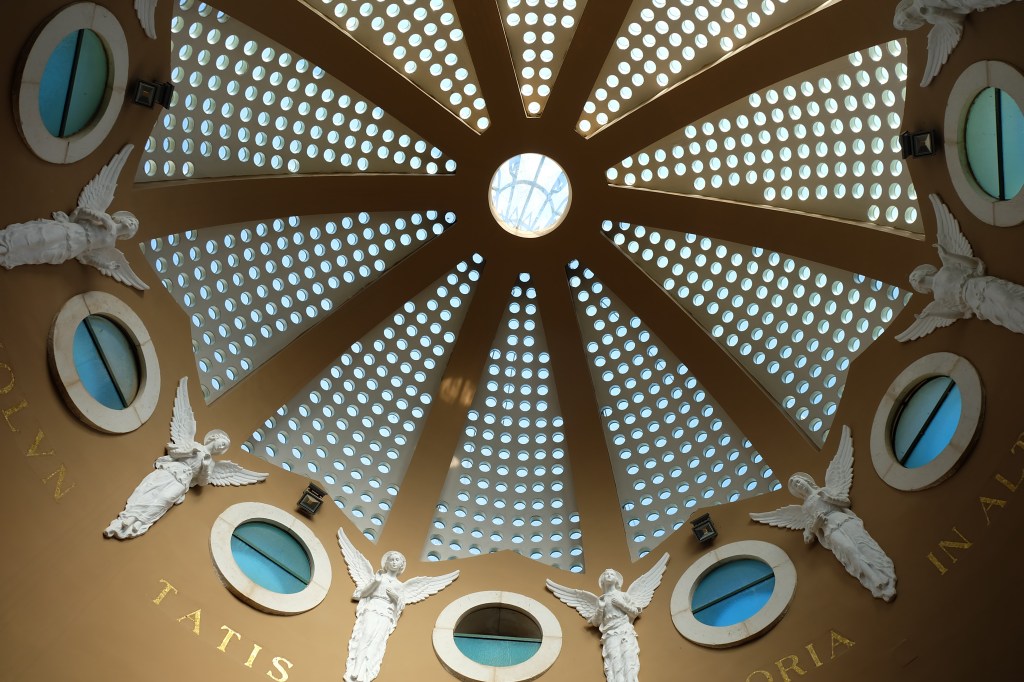
Malolos Cathedral Dome, December 2019. Photo by author.

Proceeding in joy in the presence of the Lord

One problem with waiting is when we are superseded by our so many expectations that may also be unrealistic. We hate waiting, we stop hoping because we feel disappointed and frustrated because we do not get what we really expect from our waiting.

The problem is with us, not with waiting itself. So often we await things instead of persons. To wait in joy with patience demands openness for the one who is coming not on what is coming.

True waiting is always about persons, not things. Waiting is beautiful and joyful because you are not alone in waiting, there is always another person waiting for you, waiting with you. And when we finally meet with the one we are waiting, then we have presence!

This is why the synonym for gift is also present, from presence.

Every waiting is directed to another person who also awaits the other person. When we focus our waiting on things than persons, then we miss everything in our waiting which is the presence of the other person.

This is the meaning of the response of Jesus to the emissaries of John.

Camp John Hay “Belen”, December 2017.

When John the Baptist heard in prison of the works of the Christ, he sent his disciples to Jesus with this question, “Are you the one who is to come, or should we look for another?” Jesus said to them in reply, “Go and tell John what you hear and see: the blind regain their sight, the lame walk, lepers are cleansed, the deaf hear, the dead are raised, and the poor have good news proclaimed to them.”

Matthew 11:2-5

Jesus was telling the emissaries of John that the one they have been waiting had come, already present among the people especially the sick and the poor. God had come in the midst of his people, healing them, consoling them, uplifting them.

This Third Sunday of Advent, Jesus is asking us like the crowds: what are we looking for, what are we waiting for? Set aside or totally forget all your expectations, open yourself, open your heart, open your eyes to see and experience the presence of the Christ who had come, who will come again, and always comes among us.

Indeed, we are so blessed because despite our being sinful, of being the least in the kingdom of heaven, we have Jesus coming to us day in, day out. Share his coming, share his healing, share his joy! Amen.

The priest is always a radical

Quiet Storm by Fr. Nicanor F. Lalog II, 10 December 2019

Homily for the First Mass of Rev. Fr. Roel Aldwin C. Valmadrid, First Priest from our Parish of St. John Evangelist, Bagbaguin, Santa Maria, Bulacan

In my 21 years of priesthood, I have found so many descriptions and interpretations of being a priest. But there is only one priesthood we all share — the Priesthood of Jesus Christ.

And that is why, every priest has to be a radical like Jesus.

From the Latin word radix which means “roots”, a radical is someone who is always rooted, grounded in being as we say in philosophy.

A priest is a radical because he always has to be rooted in Jesus Christ, our Eternal Priest. He alone is our model and everything in our lives and ministry. Everything and everyone must be seen in relation with Jesus Christ.

I am the true vine… I am the vine, you are the branches.

John 15:1, 5

It is the Caller, Not the Call

Since last year when I was invited to be a guest spiritual director of our School of Theology, I have realized how seminarians and eventually priests give more importance to the vocation or call to the priesthood than to Jesus Christ himself, the Caller.

When we priests and seminarians are focused on the call, we get so many excuses in life: we have every justification for everything like in acquiring material goods and gadgets, indulging in so many luxuries and lifestyles for the rich and famous simply because we are priests.

See how some seminarians and priests alike, despite the many immoralities in life, they cling to the vocation but never to Jesus.

Worst, when we are more focused with our call than with Jesus the Caller, that is when we see more of ourselves that soon enough we play gods and we start making our vocation an excuse for everything, even flaunting them in social media.

Call it triumphalism, exaggeration of devotions when in fact it is the start of a cult around the person of the priest. That is when we start having our own interpretations of everything, starting from Jesus Christ, on the liturgy, morality, scriptures and everything!

Sad and tragic. Most of all, a grave scandal of our time.

When we focus more on our Caller Jesus Christ, then we start praying and discerning.

That’s when everything gets clearer because when we examine things in the light of Christ, we become sensitive of others and sensible as well.

When we see Jesus more than our priesthood, that is when we see more of Christ among others, especially the poor and marginalized.

Yes, when we priests look at Jesus more, the better we see him in others that we get inspired to do more, to serve more with love and kindness.

“I Am”

We have learned in our studies of the scriptures that Jesus Christ’s declarations of “I AM” in all gospel accounts mean a lot, especially in the fourth gospel by our beloved Patron, Saint John the Evangelist. It is indicative in itself of Jesus being the Christ, the awaited Messiah.

Keep that in mind, keep that in your heart, Fr. RA: that “I AM” is Jesus Christ, not you.

A priest is always a radical because every day we have to go back to this very root of our being, Jesus. Without him our Caller, there is no call. No Jesus Christ, no priesthood.

Twice did Jesus declare this I AM: at the opening verse where he used the adjective I AM the true vine then at the fifth verse when he said I am the vine, you are the branches.

Most important part here is the I AM to show how Jesus has let himself planted on earth, never to be uprooted like that story of the vine producing sour grapes in the Book of Isaiah.

His I AM here is the very mystery of his incarnation mentioned by our Patron Saint, John the Evangelist at his prologue to his gospel account. Like what St. Paul had written to the Romans we always read in the Evening Prayer I of each week, “God’s gift and call are permanent and irrevocable.”

Jesus called us to the priesthood, he will never recall that. That is why we are celebrating tonight despite your many sins and heavy warnings in the seminary. He called you Fr. RA and he kept that.

Chapel of the Holy Family, Jesuit Novitiate and Retreat House, Novaliches, 2017.

Now you are priest, Fr. RA, let Jesus dwell in you as you keep grounded in him too.

Have an altar in your room, Father. Keep the TV set outside your bedroom. Upon waking up even if your bladder is full, kneel before your altar, say the Morning Offering, be with Jesus, hear him tell you every morning “I AM the true vine, you are the branches.”

People always ask me what is the most difficult in being a priest?

It is not really being celibate. In fact later in life, ask your married friends, it is a great blessing to be celibate!

Since my first year in the priesthood, I have always been telling people since then until now that the most difficult in being a priest is we have to pray every day. I mean, real prayer where we strip ourselves naked before Jesus. No ifs, no buts. Just our plain, ugly self before him.

It is difficult to pray every day because it means being true to one’s self that requires a lot of discipline and courage.

Bp. Dennis Villarojo ordaining Fr. RA, 10 December 2019, Malolos Cathedral.

Most of all, it is difficult to pray because that is surrendering one’s self to God. It is like being ordained every day when we keep on saying, “yes, Lord…yes Lord.”

Whatever is the fruit of our prayer, that is what we share in our homilies and talks to people.

That is when we come into the most difficult part of our prayer life as priests: when we preach, then people measure us, even judge us. They ask if we “walk our talk”.

When a priest does not preach anymore, when a priest avoids celebrating Mass, pray for that priest. Most likely he is no longer praying. He is already separating himself from the vine, forgetting the Caller.

Remember St. Augustine who told his deacon in De Catechizandis de Rudibus, “the catechist is the lesson himself”. In the same manner, the priest is the homily himself.

It is prayer where we grow deeper in our faith as priests. And people would right away notice this if we believe in God, if we believe in the Mother Church, if we believe in the sacraments we celebrate.

When we experience Jesus our true vine, it is always Jesus whom people would see and feel in us his priests.

“Remain in Me so you will bear fruit”

Our prayer life as priests keeps us one with Jesus our Caller and our true vine. In our gospel today, Jesus repeated the word “remain” about nine times, the most of any word in our gospel this evening.

Remaining in Jesus as a priest is imitating our Patron Saint John the Beloved, the only one who remained and stayed by our Lord’s side at his crucifixion.

To remain in Jesus is stay with him at the Cross.

Notice how Jesus reminded us that as branches, the Father has to prune us always. Pruning means sufferings. Pruning means carrying the cross daily.

Ten years ago I was invited to give a recollection to our students at the Theology Deaprtment with the topic, “The Cross as the Cost of Discipleship”.

People praying for Fr. RA after Holy Communion, 10 December 2019. Chinggoy Futol Photography.

I accepted the invitation to correct their topic because it is absolutely wrong: the Cross is not and should never be considered as a cost of discipleship. When you talk about costs, then you think of rewards and profits. Then it becomes a business. No longer a vocation.

The Cross is the life of a priest because that is the life of our Caller, Jesus Christ!

Remain in Jesus, bear all pains and hurts. Kneel always before his Cross and look at him to realize that before our sufferings came, Jesus was there first to suffer and die for you, Father!

Part of that Cross comes from those nearest to us priests, our family and brother priests!

Every day, especially Sunday, you celebrate life and death, health and sickness with people you hardly know, some of them even hurt you and malign you when you can not even be with your parents, sisters and nieces and nephews.

Worst, there are times it is your brother priests are the ones who would hurt you too!

Rejoice when you are being pruned, when you suffer, Father. Remember the beatitudes, “Blessed are you when people persecute you and malign you.”

Photo by Chinggoy Futol.


Be good and kind to your brother priests, Father RA.

Do not fight back if they hurt you.

Love your parish priest. Help him always in his Masses. Volunteer to him especially when you see the slightest of him catching colds!

When a priest is kind to his brother priest, that priest is surely a good priest, a kind priest.

By being good to fellow priests, you keep them remain in Jesus our true vine too.

And you become fruitful.

Being fruitful is different from being successful.

Sometimes, our failures are the very joys of our Lord Jesus Christ because that is when we are nearest to him.

To be fruitful is to rely more in the powers of God. Relying more on our powers is success.

And there is only one fruit Jesus wants from us: love.

Photo by Neil Jumaquio Adriano.

See how after Jesus declared himself as the vine and we are his branches, that is when he would speak eloquently about love, his commandment.

“I have told you this so that my joy might be in you and your joy might be complete. ?This is my commandment: love one another as I love you. No one has greater love than this, to lay one’s life for one’s friends.”

John 15:11-13
The new priest with his family. Chinggoy Futol Photography.

Love like Jesus Christ, Father RA.

Be a radical priest, not as a subversive but always go back to our very root, Jesus Christ.

Better, restore Jesus Christ.

Next year, I will be moving to another parish, Father RA.

When you are broken, when somebody maligns you again, you are most welcomed wherever I may be transferred and together, with our aching gouts, we shall kneel to before Jesus our vine, our root, our Caller. Amen.

Advent is for healing

The Lord Is My Chef Sunday Recipe for the Soul

Second Sunday of Advent-A, 08 December 2019

Isaiah 11:1-10 ><}}}*> Romans 15:4-9 ><}}}*> Matthew 3:1-12

Cathedral Basilica Minore of the Immaculate Conception, Malolos City, Advent 2019.

Advent is a season we are invited to look forward, to dream of the ideal, of the best things we wish we all have in this destructive world we live in.

It is the time for healing our wounds and brokenness as we look forward to the fulfillment of God’s promise of lasting peace brought by Jesus Christ’s coming more than 2000 years ago.

On that day, a shoot shall sprout from the stump of Jesse, and from his roots a bud shall blossom. The spirit of the Lord shall rest upon him… Not by appearance shall he judge, nor by hearsay shall he decide, but he shall judge the poor with justice, and decide aright for the land’s afflicted… Justice shall be the band around his waist, and faithfulness a belt upon his hips. Then the wolf shall be a guest of the lamb, and the leopard shall lie down with the kid; the calf and young lion shall browse together, with a little child to guide them. The cow and the bear shall be neighbors, together their young shall rest; the lion shall eat hay like ox. The baby shall play by the cobra’s den, and the child lay his hand on the adder’s lair. There shall be no harm or ruin on my holy mountain; for the earth shall be filled with knowledge of the Lord, as water covers the sea.

Isaiah 11:1-2, 3, 4, 5-9
“Peaceable Kingdom”, a painting based on Is.11:1-10 by American Edward Hicks, a Quaker pastor (1780-1849).

Jesus is coming again to heal our destructive world

Last November 28 we celebrated Red Wednesday to remember the more than 300 million Christians worldwide persecuted in various forms because of their faith in Jesus Christ. Many of them were tortured and/or murdered while others were denied of work, housing and liberty for carrying the cross and confessing their faith and love for Jesus Christ.

According to some reports, about 80% of wars and conflicts in the world today are due to religion. How tragic – and scandalous – that religion is tearing us apart than bringing us together as peoples believing in a God who is loving and merciful!

But despite all these destructions going on, Isaiah’s prophecy challenges us to keep our hopes alive for a better future, to look forward for the coming again of Jesus Christ, “the shoot that shall sprout from the stump of Jesse” to heal our destructive world.

Advent assures us that it is never too late for the Lord to make peace and justice spring forth in our dying world like a stump of tree.

Isaiah’s vision is an imagery of God’s test of faith to us all to make it Jesus Christ’s peace a reality in this fragmented world, calling us into conversion so that we shall be “filled with knowledge of the Lord, as water covers the sea.”

It is a call made louder and clearer by St. John the Baptist at the wilderness that still echoes to our own time today.

Healing our destructive world starts within me

Photo by Mr. Jim Marpa, September 2019.

When he saw many of the Pharisees and Sadducees coming to his baptism, he said to them, “You brood of vipers! Who warned you to flee from the coming wrath? Produce good fruit as evidence of your repentance… Even now the ax lies at the root of the trees. Therefore every tree that does not bear good fruit will be cut down and thrown into the fire.

Matthew 3:7-8,10

The season of Advent is not only inviting us to look forward for a new world order where there would be lasting peace and justice, when all our tears would be wiped out, with perfect joy replacing our pains and sufferings. Advent is calling on us to look forward in renewing our relationships with God and with one another by beginning within our own hearts.

And make no mistake that St. John’s preaching and call were not only meant for the Pharisees and Sadducees of his time but also to us all Christians of today to “produce good fruit of our repentance” because being sorry for our sins is just the first step to conversion.

Whenever there is true repentance in our hearts, there must also be a change in our very selves, in our living. And only then can we expect of a better and more beautiful world coming like Isaiah’s vision because from true repentance comes justice and mercy.

St. John was very clear: it is Jesus Christ who is coming whom we shall await and prepare to meet right in our hearts. He is coming not to destroy the world – and us – but to restore everything into life anew.

Skies over the desert of Sinai in Egypt, May 2019.

Meeting Christ in the desert

Sometimes we get discouraged by some people and many situations that throw us off-balanced, tempting us to abandon all our efforts to be healed of our wounds and brokenness, in striving to become better persons.

Like St. John the Baptist, we have our own desert of desolation and bareness that purifies us further in preparing the way of the Lord, in meeting the Lord to be healed.

It is in our own desert of desolation and bareness where we are healed as we learn to be empty of ourselves like St. John in order to conquer first our selfish desires with silence and prayer, not with activities as we are all bent in doing these days.

In our world saturated in media with cacophony of voices telling us to do everything to be rich and popular and famous, the more we become empty and lost, broken and wounded.

“St. John the Baptist Preaching in the Wilderness” by German painter Anton Raphael Mengs (1728-1779). From Google.

Like St. John the Baptist, we have to break free from the trappings of the world by retreating into our own desert right inside our hearts in order to listen more to the voice of the coming Christ we must proclaim fearlessly in words and in deeds.

St. Paul assures us that all that scripture foretold in the past has been fulfilled in Jesus Christ who is coming again at the end of time. Despite the many destructions in this world, despite the many setbacks we have in life, may we imitate St. John the Baptist in awaiting Christ in our own desert for he is most faithful in his promise and presence. Amen.

Advent is “putting on Christ”

The Lord Is My Chef Sunday Recipe for the Soul

First Sunday of Advent-A, 01 December 2019

Isaiah 2:1-5 ><}}}*> Romans 13:11-14 ><}}}*> Matthew 24:37-44

From Google.

A blessed first Sunday of Advent to you my dear reader and follower! Today we begin another new year in our Church calendar with this season of Advent. Both the word “Advent” and its concept were borrowed from ancient Rome when provinces prepared for the coming, or “adventus” of the emperor to visit the occupied territories of his empire.

But, Jesus is more than any emperor of the world for he is true God and King of kings, the one who had come, always comes, and will be coming again at the end of time to judge us, both the living and the dead. This Season of Advent gives us the opportunities to intensely prepare for the Lord’s adventus that always begins in our hearts.

Advent has a two-fold character: beginning today until December 16, the readings and prayers set our sights to the Second Coming of Christ at the end of time or the parousia. From December 17-24, focus shifts to the first Christmas when Jesus was born in Bethlehem more than 2000 years ago.

According to St. Bernard of Clairvaux, between these two comings of Christ is his third coming that happens daily in our lives, so ordinary but very sudden like in the time of Noah.

Photo by author, sacristy of our Parish, Advent 2018.

Jesus said to his disciples: “As it was in the days of Noah, so it will be at the coming of the Son of Man. In those days before the flood, they were eating and drinking, marrying and giving in marriage, up to the day that Noah entered the ark. They did not know until the flood came and carried them all away. So will it be also at the coming of the Son of Man.

Matthew 24:37-39

Staying awake, actively waiting for the Lord.

Jesus is definitely coming at the end of time. It is useless to be concerned when that would be because it will be sudden and unexpected. What matters most is our attitude of “staying awake, actively waiting” for the Lord’s coming again.

The Lord cites to us the example of Noah whom God had instructed to build an ark in the Old Testament for the coming great flood meant to cleanse the earth of sins and evil.

To actively wait for the Lord’s parousia means to be a sign of contradiction like Noah who faithfully obeyed God’s will in building an ark and later gathering into it all the animal species of earth.

Imagine the insults Noah had to endure from people laughing at him while building the ark. Yet, he never wavered and faithfully fulfilled his task before the Lord.

From Google.

Jesus cites three other instances of displaying the right attitude in actively waiting for his Second Coming: the two men out in the field, the two women grinding, and the master of the house.

One of the two men in the field was taken while one of the two women grinding was also taken because they were responsibly fulfilling their tasks when the parousia comes; their respective counterparts were most likely doing nothing or very lazy that they were left behind.

The mini parable Jesus inserted at the end shows us the imagery of the master of the house staying awake to keep the thief from breaking into the house in the middle of the night.

These are all about having the right attitude as disciples of Jesus actively awaiting his return. From Noah to the other man in the field, the other woman grinding, and the master of the house, we find from their attitudes of active waiting budding forth their hope in God.

Generally speaking, the way we live our lives determines also how we hope in the Lord.

And this we find in St.Paul’s exhortation to the Christians of Rome:

Brothers and sisters: you know the time; it is the hour now for you to awake from sleep. For our salvation is nearer now than when we first believed; the night is advanced, the day is at hand. Let us then throw off the works of darkness and put on the armor of light; let us conduct ourselves properly as in the day, not in orgies and drunkenness, not in promiscuity and lust, not in rivalry and jealous. But put on the Lord Jesus Christ, and make no provisions for the desires of the flesh.

Romans 13:11-14
Altar table at the Parokya ng San Juan Apostol at Ebanghelista, Bagbaguin, Santa Maria, Bulacan, Advent 2018.

Putting on Christ to show his light to dispel darkness.

St. Paul wrote the Christians in Rome more than 2000 years ago to remind them of the fierce spiritual warfare between good and evil, light and darkness while they were living in the midst of a pagan world and culture.

It was a very difficult time to be truly Christians but St. Paul felt the need to remind everyone of the ever-present reality of the parousia. Like in most of his letters, he captured by the grace of the Holy Spirit the beautiful imagery of disciples with the right attitude awaiting the Second Coming as “putting on the Lord Jesus Christ”.

Putting on our Lord Jesus Christ is not just a mere call to be morally perfect persons but for us to strive in making the light of Christ shine on us so that we may manifest Jesus more in us and in our lives.

Simply put, it is becoming “Christ-like”, a true Christian who is “dead to sin but alive for God in Christ Jesus” (Rom. 6:11), one who lives differently by making Jesus more present especially in these difficult and troublesome times.

The time of St. Paul was no different with our present age with growing materialism and consumerism among peoples, including Christians afflicted with Pope Emeritus Benedict XVI’s “dictatorship of relativism” that have removed God from every aspect of human life, including Christmas itself!

See how we are so focused on Christmas countdowns than with the very reason of the Season, Jesus Christ. See how the media equate Christmas with material things, sugarcoating it with sentimental feelings as most Christmas songs nowadays indicate.

Advent is seeing more of Jesus, than of time.

On this first Sunday of Advent, our sights are redirected anew into Christ’s Second Coming with our important task of making him present in our very selves.

As children of the light, we slowly discover and realize how our definitive salvation is slowly moving towards its fullness in Christ’s parousia when everything is totally changed by God with peace finally reigning supreme over all.

Violets on the pedestal of our Patron Saint, John the Evangelist.

This was the vision of Isaiah a long, long time ago.

It had been fulfilled in Christ’s first coming in Bethlehem over 2000 years ago and it is being fulfilled daily through people filled with hope in God’s justice and love.

In the days to come, the mountain of the Lord’s house shall be established as the highest mountain and raised above the hills. All nations shall stream toward it; many people shall come and say: “Come, let us climb the Lord’s mountain…” They shall beat their swords into plowshares and their spears into pruning hooks; one nation shall not raise the sword against another, nor shall they train for war again. O God of Jacob, come, let us walk in the light of the Lord!

Isaiah 2:2-3, 4-5

People who keep on wondering and asking when will Jesus come again are not really interested with the Lord’s Second Coming but only with themselves like the people during the time of Noah – oblivious to anything else and busy with their own pursuits.

The more we think of the WHEN, the less we think of the WHO of Advent. Let us put on the Lord Jesus Christ to be filled with his light until all darkness in life is dispelled. Amen.

The throne of Christ the King

The Lord Is My Chef Sunday Recipe, Solemnity of Christ the King-C, 24 November 2019

2 Samuel 5:1-3 ><}}}*> Colossians 1:12-20 ><}}}*> Luke 23:35-43

Photo by Pixabay on Pexels.com

The Cross is the throne of our Lord Jesus Christ, King of the Universe. It is also a lesson in itself, the most profound Jesus has given us that continues to unfold and unravel the “depth and breath” of God’s love for each of us.

Through his Cross, Jesus did not only enter humanity but also allowed humanity to enter him by putting into his heart its very symbolism which is death we all deny and are afraid of. By dying on the Cross, Jesus turned it into a blessing to now become the symbol of life.

Let’s make an illustration.

Yes, it is Bruce Willis from a scene in one of his popular series, “Die Hard” which I continue to watch whenever possible.

What I like most with Bruce Willis in all of his movies is his being so “human” – very vulnerable physically, emotionally and even psychologically. His roles never hide his being a frail human being despite his muscular strength and tactical acumen. Bruce never hides his weaknesses that he can get shot and wounded, dumped and divorced or cheated by his wife like in “The Last Boy Scout”, making him more believable than the other action stars.

And that’s our point here: Jesus never hid his humanity from us. The all-powerful God on whose everything was created according to St. Paul in the second reading became human like us in every aspect except sin.

He is the image of the invisible God, the firstborn of all creation. For in him were created all things in heaven and on earth… He is before all things, and in him all things hold together. He is the head of the body, the church. He is the beginning, the firstborn from the dead, that in all things he himself might be preeminent. For in him all the fullness was pleased to dwell, and through him to reconcile all things for him, making peace by the blood of his cross through him, whether those on earth or those in heaven.

Colossians 1:15-19
Carmelite Monastery, Guiguinto, Bulacan, 12 November 2019.

In becoming human like us, Jesus entered our humanity. He who is the Son of God became an infant and child so weak, entrusting himself to us humans.

And when he had grown into a man, he experienced leaving home and family to fulfill his mission like almost everybody. He had friends, some eventually became faithful while another had betrayed him.

Jesus went to almost every gathering like weddings and banquets, met everybody from the “who’s who” to the nobody like sinners and marginalized. He was manly enough to relate with every kind of people, be they children or women, rich and poor alike.

He had wept at the death of a good friend and the impending destruction of his beloved city of Jerusalem, felt hunger and thirst, got angry and was surprised in some occasions.

Jesus is truly human that we can also identify with him but in his dying on the cross, we were able to enter him to become like him when on his Resurrection, he took away the curse of death and turned it into pure grace in him.

Cross at the Dominican Hill in Baguio City, January 2019.

A very unique characteristic of Jesus as a human is his being a radical in its truest essence and meaning. From the Latin word “radix” that means roots, Jesus brought us back to our very roots, to our grounding of being who is God himself.

Too often, we think of radical people as rebels and revolutionaries leading movements and many changes in the society. They are the “game changers” because they radically change things to show us the more essential.

But in reality, radicals do not change things: they restore things to its original state and being. They get into the roots or “radix” of things to bring out its true meanings by doing away with the unimportant accidentals that have taken over the realities.

That is why Jesus is a radical: by dying on the Cross, he firmly reestablished his throne as King of the Universe because that is where evil ended and death is conquered.

It is on the Cross his throne where every new life begins because it is our very rootedness and “grounding of being” as beloved children of God in him.

Most of all, it is on the Cross his throne, our root and grounding from which comes our sole focus and attention in life – God in Christ Jesus.

The rulers sneered at Jesus… even the soldiers jeered at him. Now one of the criminals hanging there reviled Jesus, saying, “Are you not the Christ? Save yourself and us.” The other, however, rebuking him, said in reply, “Have you no fear of God, for you are subject to the same condemnation? And indeed, we have been condemned justly, for the sentence we received corresponds to our crimes, but this man has done nothing criminal.” Then he said, “Jesus, remember me when you come into your kingdom.” He replied to him, “Amen, I say to you, today you will be with me in Paradise.”

Luke 23:35, 36, 39-43

We have a beautiful expression in Filipino about a person described as “malalim” or deep. A radical is the truly deep person because he is rooted and grounded in his being who is God!

Anyone who truly recognizes Jesus Christ becomes a radical person too, a person of depth because he is rooted in God like the other thief hanging on the cross with Jesus.

See how the rulers or the elite like the priests and elders of Israel who sneered at Jesus: the more they poked fun on him as “the Christ of God”, the more they indict themselves of the grave crime of putting Jesus to death. Eventually at the death of Jesus, the Temple curtain would be torn from top to bottom to signal the end of temple worship and the start of worshipping God in “truth and spirit” in Christ.

The soldiers jeered Jesus too because they “know not what they were doing” because they were all pagans. But again, upon Christ’s death, we find one soldier there at the scene declaring “truly this is the Son of God.”

In any case, some members of Israel’s rulers and Roman soldiers eventually followed Jesus after the Resurrection to show us how the Cross is indeed the throne of Christ the King: it is also a door that opens anyone to conversion, to accept his reign and kingdom!

Most of all, the “good thief”, usually referred to as Dimas, shows us how at the cross any one can become radical like the Lord. While agonizing with Jesus on the cross, Dimas must have examined his life and got into his very core, his roots and realized that basic truth inside him was right there suffering also with him — Jesus whose name means “Yahweh saves”.

What is so surprising with his request from Jesus “to remember him he gets into his kingdom” is the fact that in the Old Testament, it is God who always remembers his people, remembers his promise, remembers his covenant.

Man always forgets God and his covenant that we always turn away from him to live in sin. But at the cross, the throne of Jesus our King, he enables us to remember our roots, our being children of God, our being loved and forgiven that we finally find our way back home.

And that home is God in eternity: “Today you shall be with me in Paradise.”

Every time we are at the cross, when we are getting through so many pains and sufferings, failures and disappointments, even darkness and sin, get into your roots – Jesus Christ – and you will never get lost.

Long before we got into all these crosses in life, remember Jesus was there first for us to suffer and die on his Cross. And that is why he is our King for he rose again so we can become like him in eternity. Amen.

How much do you love?

The Lord Is My Chef Sunday Recipe for the Soul

Week XXXIII-C, 17 November 2019

Malaci 3:19-20 ><}}}*> 2 Thessalonians 3:7-12 ><}}}*> Luke 21:5-19

The Wailing Wall of Jerusalem Temple, May 2019.

We are now at the penultimate Sunday of the year as Jesus continues to summarize his teachings today at the Temple area in Jerusalem about his final coming at the end of time.

While some people were speaking about how the temple was adorned with costly stones and votive offerings, Jesus said, “All that you see here — the days will come when there will not be left a stone upon another stone that will not be thrown down.” Then they asked him, “Teacher, when will this happen? And what sign will there be when all these things are about to happen?” He answered, “See that you not be deceived… “

Luke 21:5-8

On the surface, Jesus seemed like to be a “kill joy” in making those bold assertions about the coming destruction of the Temple while everybody was admiring it. But notice how the people reacted: instead of being worried, they asked when it would happen and what would be the warning signs before it takes place as if it is just an ordinary thing!

“Wala lang…” as the young would say these days. Nothing, duh…?

View of Jerusalem from the Church of Dominus Flevit where Jesus wept upon seeing the city from the Mount of Olives.

St. Luke tells us that before Jesus entered Jerusalem, “he wept over it” at the thought that it would be destroyed and that its enemies would not “leave one stone upon another” (Lk.19: 41-44).

If there is anyone deeply hurt and saddened with the Temple’s destruction, it is not other than Jesus Christ our Lord. He certainly shared the people’s admiration for the Temple which he had also claimed as “my Father’s house” (Lk.2:49) when he was accidentally left behind there by Mary and Joseph when he was 12 years old.

Imagine what Jesus must have felt when he spoke of the destruction of the Temple which is the heart of Jerusalem, the jewel of the city, and most of all, the sign of God’s presence among his chosen people!

There must be something deeper with his warning words of the Temple’s destruction that pertains not only to his people at that time but also to us today.

Wailing Wall of Jerusalem, may 2019.

For the Jews at that time, the destruction of the Temple is the end of the world, the signal of the apocalypse. More than a catastrophe involving the destruction of buildings and almost everything including life, it is judgment day that must not be taken lightly.

It is a day calling for conversion as the prophet Malachi in the first reading reminds us that every coming of God is a day of judgment and salvation.

Lo, the day is coming, blazing like an oven, when all the proud and all evildoers will be stubble, and the day that is coming will set them on fire… But for you who fear my name, there will arise the sun of justice with its healing rays.

Malachi 3:19-20

Christ had already come and will come again.

This was his promise and this is what he meant at the cleansing of the temple, “Destroy this temple and in three days I will raise it up” (Jn.2:19). At his Passion, Death, and Resurrection, Jesus Christ had replaced the old Temple worship with himself!

This is what we celebrate in every Holy Mass, God’s coming to us in Jesus Christ his Son.

Jesus comes in every here and now, and his every coming is a process of destroying our old temple of self to give rise to a new temple in Christ. Our concern need not be about a future date of his Second Coming or specific signs of its fulfillment.

Every day Jesus comes again and the challenge is for us to live authentically as Christians daily and not be bothered about the future. He warns us not to be deceived by all of these apocalyptic predictions and statements.

The key word is conversion, of living in the present. Jesus tells us so many things that can be very frightening and scary because what he wants us to do in preparation for his Second Coming is to love, love, and love.

And to love is to always suffer in Christ, with Christ.

He answered, “See that you not be deceived, for many will come in in my name… Do not follow them! When you hear of wars and insurrections, do not be terrified; for such things must happen first, but it will not immediately be the end.” Then he said to them, “Nation will rise against nation, and kingdom against kingdom. There will be powerful earthquakes, famines, and plagues from place to place; and awesome sights and mighty signs will come from the sky. Before all this happens, however, they will seize and persecute you… You will even be handed over by parents, brothers, relatives, and friends, and they will put some of you to death. You will be hated by all because of my name, but not a hair of on your head will be destroyed. By your perseverance you will secure your lives.”

Luke 21:8-19
From I.REDD.IT.

Yes, Jesus will definitely come again at the end of time. Like last Sunday, definitely, there is a resurrection of the dead and life everlasting. But both must be seen in the context of the present time, of the here and now.

When Jesus comes again to judge us at the end of time, he won’t be asking us about the things we have been so preoccupied with in this life like how much money we earn, what car do you drive, or how big is your house?

When Jesus comes again, he will be asking us questions we have always refused to answer in our daily lives like how much have you loved, how much have you sacrificed and suffered for a loved one, or how much have you shared to a stranger?

These are the questions we must be asking ourselves as we near towards the end of the year: how close have I followed Jesus Christ in his Passion and Death so I may be with him in his Resurrection?

May we imitate St. Paul in his second letter to the Thessalonians today to faithfully and calmly fulfill our daily tasks in this life, avoiding being idle for each day is the day of the Lord. Amen.

“Pick Up the Pieces” Live From Daryl’s House (2010)

The Lord Is My Chef Sunday Music, 10 November 2019

Photo by Mr. Chester Ocampo, October 2019.

Today’s Sunday gospel is admittedly very difficult: the resurrection of body and life everlasting.

In our gospel, the Sadducees tried to trick Jesus with their “levirite law” from Moses that decreed “If someone’s brother dies leaving a wife but no child, his brother must take the wife and raise up descendants for his brother” (Lk.20:28).

Right away, Jesus quashed their wrong argument because there is no point in having analogies and comparisons when it comes with the resurrection of the dead. Marriage is something of this world while resurrection is something beyond this world and life.

What Jesus is asking us this Sunday is to focus our sights on our loving and merciful Father because faith in resurrection is faith in a living God.

Moreover, faith in resurrection of the dead is borne out of an encounter and experience of God, moving us to forge on with life amidst all its difficulties and trials because we believe this life would be changed and perfected by God in the end.

And that change, that resurrection begins right here in this life – every time we try to pick up the pieces of our lives, when we try to start anew, whenever we rise again from every little death, that is when we experience our little resurrection.

From that experience we slowly gain passion for life because we are convinced deep inside there is something more bigger awaiting us because we have God on our side who would never forsake us and perfect us in eternity.

In reflecting these things of the above like heaven and resurrection of the dead, I always choose next to prayer the way of music, and believe me, not just meditative or classical music.

I do it with rock and funk and soul!

See how Daryl Hall and his musicians play with so much passion and gusto this classic by the Average White Band (AWB) called “Pick Up the Pieces”: it’s a natural high, feeding our soul deep within, transporting us to somewhere higher in realm and reality.

Released in 1974 by Scottish musicians AWB, Pick Up the Pieces is essentially instrumental with its title being shouted occasionally.

I prefer the version of Daryl Hall when he invited to his internet show Live From Daryl’s House AWB original Alan Gorrie jamming with them in his home-studio in New York state in January 2010.

Just enjoy and feel the music, feed your soul, be assured Jesus is always on your side who journeys with you through this life into eternity. Amen.

Faith in the Living God, Faith in the Resurrection

The Lord Is My Chef Sunday Recipe for the Soul, Week XXXII-C, 10 November 2019

2 Maccabees 7:1-2, 9-14 ><}}}*> 2 Thessalonians 2:16-3:5 ><}}}*> Luke 20:27-38

Jesuit Mirador House, Baguio City, January 2019.

Our gospel today helps us to further reflect the meaning of last week’s All Saints’ Day and All Souls’ Day when we honored our departed loved ones with prayers, believing and hoping that some day we shall be with them in heaven at “the resurrection of body and life everlasting”.

Every Sunday this is what we profess and so today, our readings invite us to reflect anew this last but crucial article of our faith, the resurrection of body and life everlasting.

Some Sadducees, those who deny that there is a resurrection, came forward and put this question to Jesus, saying, “Teacher, Moses wrote for us, If someone’s brother dies leaving a wife but no child, his brother must take the wife and raise up descendants for his brother. Now there were seven brothers; the first married a woman but died childless. Then the second and the third married her, and likewise all the seven died childless. Finally the woman also died. Now at the resurrection whose wife will that woman be? For all seven had been married to her.”

Luke 20:27-33
The Jewish Cemetery at the Mount of Olives facing Jerusalem, May 2019.

Jesus had finally entered Jerusalem. What an extraordinary manner for him to discuss death and resurrection right in the city he knew where he would eventually die and rise again in a few days later!

And the first to confront him there were the Sadducees, Israel’s elite from whose ranks came the high priests who later conspired with Rome to put Jesus to death.

Jews at the wailing Wall, May 2017.

Very conservative and rigorous in their practice of religion, the Sadducees were basically fundamentalists who refused to accept oral traditions on equal footing with the Pentateuch. They only accepted whatever was explicitly written on the Pentateuch, discarding anything that the Torah does not mention at all like the resurrection, existence of spiritual beings like angels and immortality of the soul.

Don’t we find ourselves into the same situation too when despite our professed religiosity, we subscribe to other beliefs like reincarnation and fortune-telling because of “proofs” we find about their veracity unlike the resurrection that seems to be so difficult to think of in the first place?

We have those vestiges of fundamentalism within, always searching and asking for proofs on so many things about our religious beliefs, especially about God and Jesus Christ.

Jesus said to them, “The children of this age marry and remarry; but those who are deemed worthy to attain to the coming age and to the resurrection of the dead neither marry nor are given in marriage. They can no longer die, for they are like angels… That the dead will rise even Moses made known in the passage about the bush, when he called ‘Lord’ the God of Abraham, the God of Isaac, and the God of Jacob; and he is not God of the dead, but of the living, for to him all are alive.”

Luke 20:34-38
Photo by Mr. Raffy Tima of GMA-7 News, 2018.

Notice how Jesus right away told them analogies and comparisons are not applicable because marriage and resurrection are of two different realms. The Sadducees were thinking on ground level when resurrection is definitely of a higher plane.

Jesus finds no need to prove anything at all to them – even to us! What he is more concerned is for us to “level-up” our thoughts, to set our sights to him, the Son of the Living God.

Now in Jerusalem to fulfill his mission, Jesus in the next two weeks will summarize for us all his teachings that lead to our coming home to the Father in heaven upon our death. Like Jesus Christ who died and rose again, we shall experience the same in the end.

How? Nobody really knows but our faith teaches us that resurrection is more than being restored to life; resurrection is life perfected in Christ. Life is surely changed and that is why it is on a different and higher level of existence.

Photo by Pixabay on Pexels.com

And it starts right here in this life.

Every time we experience our little deaths on our daily cross with Christ, we also experience our little resurrection when our lives are changed for the better. Amidst our many struggles in this life, we experience God’s loving presence, his very revelation of himself that moves us to deeper faith in him for indeed, he “is not God of the dead” – nor a dead God – because “for him all is alive” .

This faith in the resurrection is faith in the living God “who has loved us and given us everlasting encouragement and good hope through his grace” (2 Thes. 2:16) in Jesus Christ.

It is a faith borne out of our encounter with him as our loving and merciful Father that we are filled with passion to do everything for him because he is so true, so real, like in the experiences of the seven Maccabean brothers who heroically accepted death than sin against God in the first reading.

In 2013, I lost my best friend from high school to cancer.

One week before he died, I visited him three more times and that was when I noticed something so different: during the early months of his sickness, he would always cry to me, expressing his fears and anger but, during that final week of his life, I was the one crying to him while he was the one who would console and explain things to me!

Later, I experienced the same thing with some friends and parishioners I have accompanied in their final journey as a priest.

I have learned that the dying stop crying, stop fearing death because they could already see their final destination. They could feel God so close already that they no longer resist dying, so certain of their own resurrection. We who are left behind cry not only in losing our loved ones but unconsciously because we are afraid, unsure of where our lives are leading to.

Photo by Pixabay on Pexels.com

In one of the beautiful scenes of the Netflix series The Kominski Method, Sandy (Michael Douglas) told his friend Norman (Alan Larkin) how everyone else is also afraid because nothing is so certain in this life. But, Sandy added, we continue to live because we have others with us journeying together in this life.

Let that Other be Jesus Christ who has come to accompany us in this life and back to the Father in heaven. Amen.