Jesus is both the Sower and the seed – and so must we!


The Lord Is My Chef Sunday Recipe for the Soul by Fr. Nicanor F. Lalog II
Week XV, Cycle A in Ordinary Time, 12 July 2020
Isaiah 55:10-11 >><}}}*> Romans 8:18-23 >><}}}*> Matthew 13:1-23
“The Sower” painting by Van Gogh, photo from Wikimedia Commons.

Parables constitute the heart of Jesus Christ’s preaching. From the French para bolein which means “along the path”, parables are simple stories with deep realities that must be cracked open through prayers and reflections to uncover its meaning.

In fact, every parable by Jesus is a word of God that is like a seed that must be received, planted, and nurtured so we may eventually see and experience what is within it who is God himself!

On that day, Jesus went out of the house and sat down by the sea. Such large crowds gathered around him that he got into a boat and sat down, and the whole crowd stood along the shore. And he spoke to them at length in parables, saying: “A sower went out to sow. As he sowed, some seed fell on the path, and birds came and ate it up. Some fell on rocky ground, where it had little soil. It sprang up at once because the soil was not deep, and when the sun rose it was scorched, and it withered for lack of roots. Some seed fell among thorns, and the thorns grew up and choked it. But some seed fell on rich soil, and produced fruit, a hundred or sixty or thirtyfold. Whoever has ears ought to hear.”

Matthew 13:1-9
Photo by Onnye on Pexels.com

Jesus, the mysterious seed

Beginning today until the last Sunday of this month of July we shall hear different parables by Jesus taken from this 13th chapter of the gospel according to St. Matthew.

It is very interesting that as Jesus now begins to preach in parables, we also notice his usual usage of this image of the seed, especially of the mustard seed to stress to us what we have mentioned earlier about the significance of parables as simple things with deeper realities. Every seed is so small, easy to overlook and taken for granted. Yet, we all know how every seed is also the presence of what is to come in the future, of something so big and huge that we can never imagine.

That is how Jesus would always portray the Kingdom of God, which is himself, his very person who is always taken for granted but full of mysteries that later in the fourth gospel he would reveal a deeper reality of this seed akin his Cross:

“Truly, truly, I say to you, unless a grain of wheat falls into the earth and dies, it remains alone; but if it dies, it bears much fruit.”

John 12:24

That is the mystery of the seed, the mystery of Christ: something so ordinary we take for granted with immense possibilities when given up, when it dies. In this parable of the sower, Jesus shows us a hint of this profound truth about himself as a mysterious seed, someone who must be broken to die in order to grow and bear fruit.

If we read the full text of today’s gospel, we find Jesus explaining the meaning of this parable and we discover that he himself is both the sower and the seed: he goes out everyday to bring us the good news of salvation, providing us with seeds we must plant so we can have food in the future.

Every seed Jesus sows in us is always good as the first reading assures us.

Thus says the Lord: Just as from the heavens the rain and snow come down and do not return there till they have watered the earth, making it fertile and fruitful… so shall my word; my word shall not return to me void.”

Isaiah 55:10-11

Most of the time, we reflect on this parable on the importance of the soil on which the seed is sown.

This Sunday, let us reflect on what kind of a seed are we, of how we waste or put into good the enormous potentials packed in each of us by God.

Photo by Dids on Pexels.com

“A sower went out to sow. As he sowed, some seed fell on the path, and birds came and ate it up.

Jesus the sower does not make distinctions on different kinds of soil; he just scatters the seeds freely. His words concern everyone.

Unfortunately, there are some of us who do not care at all, as hardened as the path or pavement.

These are the people who has no plans in life, no directions, spending their lives watching days pass without knowing that they are really the ones passing by.

Sometimes, they just go wherever the winds would lead them while once in a while, they step out of themselves a little to join friends or peers wherever they may be going. Eventually they leave when the journey gets farther.

They are literally wasting their lives.

Some fell on rocky ground, where it had little soil. It sprang up at once because the soil was not deep, and when the sun rose it was scorched, and it withered for lack of roots.

They are the “spur of the moment” type who eventually end up as what we call ningas-cogon (a kind of local grass when dried is highly combustible; quick to start fire but quick to extinguish too).

Beware of them who are at the beginning very enthusiastic in every project and endeavor but when the goings get tough and difficult, they are the first to leave.

No roots, no foundations in life. Easy to give up. Just as hard as those seeds on the pavement.

Photo by author at Petra, Jordan, May 2019.

“Some seed fell among thorns, and the thorns grew up and choked it.”

These are the people who thrived a little but eventually the “thorns of the world” choked them that they eventually dried and died.

They are the kind of people we lament and sometimes grieve, wondering what have happened within them that their hearts have suddenly turned away from God and others with their noble causes we used to share with them at the beginning.

Oh, they are well represented in Congress, especially the party-list representatives of various advocacies for the marginalized and less privileged who eventually come out with their true colors and ugly features. Some of them simply stopped thinking and feeling the other persons, blinded with power and wealth selling off their souls completely to any golden calf willing to pay them.

The modern Judas Iscariots.

But some seed fell on rich soil, and produced fruit, a hundred or sixty or thirtyfold.

Photo by Ms. Jo Villafuerte, flower farm at Atok, Benguet, 2019.

We now come to the better seeds (because all are good seeds, remember?).

They are the ones who fell on rich soil and produced fruit because they were the ones who willingly gave themselves up to the Sower. They are the ones who let go and let God, those who let themselves “die” and fell on the ground to give way to new life.

They are fruitful, not successful; the former relied on the powers of God, patiently bearing all pains and sufferings while the latter relied on their own powers, own intelligence and even connections that on the surface may seem to have the upper hand but totally empty inside.

The fruitful seeds are those willing to fall and be broken by God according to his divine plan. Many times, what is fruitful to God may be failures to us humans. Being fruitful is not about results and accumulations we have made but what have we become.

Fruitful people are focused on with the future glory to revealed by God through our pains and sufferings as St. Paul reminds us in the second reading today.

Let us not put into waste this good seed sown in us by Jesus Christ, allow it to be cracked open and broken to let the new life within us spring forth and lead us to becoming fruitful. Amen.

A blessed week ahead to everyone!

What are you looking for?

The Lord Is My Chef Breakfast Recipe for the Soul, Tuesday, Easter Week-IV, 05 May 2020

Acts of the Apostles 11:19-26 +++0+++ John 10:22-30

Photo from Reddit

Our loving God and Father, as countless men and women are now searching for the cure and vaccine against this corona virus that have hit us, you have also given us opportunities to look inside ourselves to examine the things and persons we are searching for in this life.

Today’s first reading reminds us how Barnabas went to Antioch to see for himself the power and grace of the gospel of your Son Jesus Christ being preached there among the gentiles.

When he arrived and saw the grace of God, he rejoiced and encouraged them all to remain faithful to the Lord in firmness of heart, for he was a good man, filled with the Holy Spirit and faith. And a large number of people were added to the Lord.

Acts of the Apostles 11:23-24

Not only that: Barnabas also “went to Tarsus to look for Saul, and when he had found him he brought him to Antioch” (Acts 11:25).

What a remarkable attitude by Barnabas to search for the truth, to find the realities going on in Antioch!

Most of all, his efforts to look for Saul – a person feared and perhaps hated at that time – to bring him into the church in Antioch that eventually led to his baptism and adoption of the new name of Paul.

Give us, O Lord, the same desire for you! That we may always look for you in every situation we are into especially in this time of the corona. May we also look for those people we can bring closer to you through our communities, especially those suspected of so many things like St. Paul before.

How sad that sometimes, we are more like those in the gospel who kept on looking for you, Jesus, not because of a desire to really know you and follow you but to test you.

Give us a heart and the eyes of faith that truly search for what is true and good, that look for you in people and events because, like the deer that yearns for streams of water, our soul thirsts for you. Amen.

From FB/Be Like Francis.

Why believe?

The Lord Is My Chef Breakfast Recipe for the Soul, Memorial of St. Pius V, 30 April 2020

Acts of the Apostles 8:26-40 <*(((>< 000 ><)))*> John 6:44-51

Photo by Mr. Raffy Tima of GMA-7 News, 2020.

It is the last day of April 2020 and we still cannot rejoice, Lord, because we still have to continue with our enhanced community quarantine until the 15th of next month to further control the spread of the dreaded COVID-19 virus.

Yes, it is very difficult and sad for everyone but deep inside each one of us is the excitement too of seeing that day finally when the pandemic is finally over and the corona virus wiped away.

And that is why we have to believe in you, O God our Father for you alone is the God of history, you have the final say at how things are in this life and the good news is, you always ensure that even tragedies and miseries end for our own good.

“Amen, amen, I say to you, whoever believes has eternal life.”

John 6:47

Yes, Lord Jesus, we believe in you because we want to see how all these things will end, if not in this life then in the eternity.

We have to believe to understand further and accept how things are in this life.

Like St. Pius V, the first Dominican Pope, he believed in your presence and power in the praying of the Holy Rosary that helped the Spanish Armada crushed the Ottoman Turks in Lepanto Bay to finally stop them from getting into Europe any further.

Incidentally, every Rosary begins with the Credo, “I believe in God…”

He believed in your works, O Lord, that despite the gargantuan tasks ahead of him, St. Pius pushed for the reforms of the Council of Trent that revitalized the whole Church after the Protestantism movement that swept the whole of Europe at that time.

We have to believe because believing is the starting point of everything in you; without it, we can never see through and look beyond to discover more meanings in life here and thereafter. Amen.

Photo by Pixabay on Pexels.com

One mind, one heart, one mission in Jesus

The Lord Is My Chef Breakfast Recipe, Tuesday, Easter Week-II, 21 April 2020

Acts of the Apostles 4:32-37 ><)))*> +++ 0 +++ <*(((>< John 3:7-15

Posted by Marivic Tribiana on her Facebook 18 April 2020 when a huge fire hit “Happyland” in Tondo district, Manila, leaving 450 families homeless with one fatality.
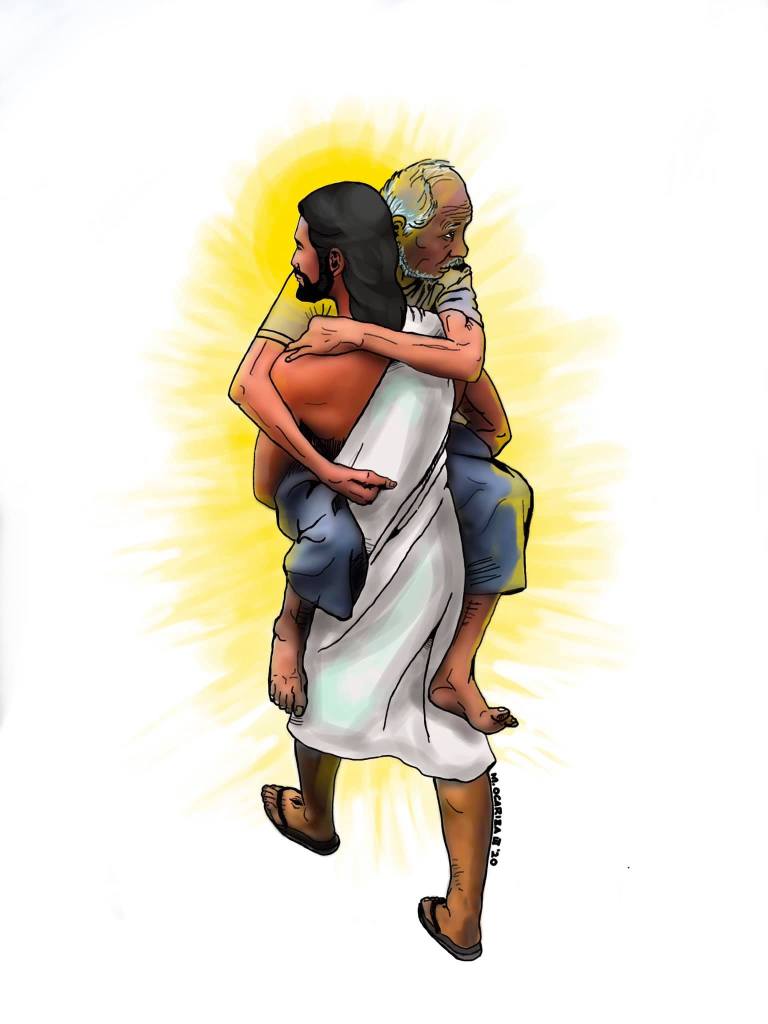
Artwork by Fr. Marc Ocariza using Digital Art Timelapse after seeing photo at left, claiming it was like seeing Jesus Christ carrying the old man as he contemplated the Divine Mercy that Saturday.

Glory and praise to you, O Lord Jesus Christ for coming to us, and continuing to come to us most especially amid this COVID-19 pandemic.

Increase our faith in you, awaken our being “born from above” in you in the Holy Spirit so that we may continue to find you and follow you in the ordinary things that happen to us.

It is not enough that we as a “community of believers be of one heart and mind, having everything in common” (Acts 4:32).

As a community united in you, Lord Jesus, keep us strong in fulfilling our mission from you.

Remind us always that we merely represent you in this mission.

We are not the ones who will change the world but you, O Lord.

Give us the grace to forget ourselves and carry our cross daily so we can follow you more closely every day.

Most of all, give us the courage to seek your ways and follow wherever your Holy Spirit leads us to so we can best serve you without ever thinking of our very selves or anything in return except that we are doing your most holy will. Amen.

The Facebook post by Marivic Tribiana that inspired Fr. Marc to make a digital representation of the scene amid the huge fire with thick, black smokes billowing above visible kilometers ahead in a city under an extended lockdown due to Covid-19.

He dubbed his artwork “Nag-aalab na Pag-Ibig” (Burning Love), an interplay between the raging fire in the area and the burning love of Jesus to the old man being carried.

That is why we need to be “born from above” to be able to understand teachings of Jesus about heavenly things on earth (Jn.3:12), remaining open to leading of the Holy Spirit to follow the Lord closely, not our selves, nor our plans, nor our personal agenda.

What Jesus looks for and how we see

The Lord Is My Chef Breakfast Recipe for the Soul

Friday, Week XXIX, Year I, 25 October 2019

Romans 7:18-25 ><)))*> ><)))*> ><)))*> Luke 12:54-59

Photo by Noelle Otto on Pexels.com

What a beautiful way to end the week of work and studies, O Lord, when you asked us to read the signs of the times.

Jesus said to the crowds, “When you see a cloud rising in the west you say immediately tat it is going to rain — and so it does; and when you notice that the wind is blowing from the south you say that it is going to be hot — and so it is. You hypocrites! You know how to interpret the appearance of the earth and the sky; why do you not know how to interpret the present time? Why do you not judge for yourselves what is right?”

Luke 12:54-57

In this age of social media where everything is being shown and seen by everyone, it is very unfortunate that we still fail to see beyond the physical realities.

In an age when everything and everyone is seen, we have become more superficial than ever and have refused to see more deeper than what appears to the eyes.

We look outside of us to explain everything like in the news and in the internet, at YouTube and Facebook, Google and Wikipedia.

Rarely do we look deep inside ourselves like St. Paul to realize the greater battle going on deep within each one of us between good and evil.

Teach us Lord to see more the spiritual meanings of the things happening in us and around us, to always look deep into our hearts to see and realize the need to be good and just, kind and loving.

Maybe if we can look more often into our hearts and look piercingly into the heavens to find you, perhaps we can have a better world with lesser crimes and hatred among peoples. Amen.

“Beautiful in My Eyes” by Joshua Kadison (1994)

The Lord Is My Chef Sunday Music, 29 September 2019

Our gospel today speaks a lot about our eyes, of what we see and recognize, of sights and vision. For the third straight consecutive Sunday, we hear again another parable by Jesus proper only to St. Luke called “the rich man and Lazarus”.

Jesus said to the Pharisees: “There was a rich man who dressed in purple garments and fine linen and dined sumptuously each day. And lying at his door was a poor named Lazarus, covered wit sores, who would gladly have eaten his fill of the scraps that fell from the rich man’s table. Dogs even used to come and lick his sores. When the poor man died, he was carried away by angels to the bosom of Abraham. The rich man also died and was buried, and from the netherworld, where he was in torment, he raised his eyes and saw Abraham far off and Lazarus at his side.”

Luke 16:19-23

The rich man went to hell because amid his affluent lifestyle, he did nothing to help the poor Lazarus. He was so blinded by his wealth that he was so oblivious of the plight of Lazarus. Sadly, the same scene continues in our days despite the social media around us.

The famous blind American Helen Keller wrote, “the only thing worse than being blind is having sight but no vision.”

Very true!

Many people are like the rich man who only have sight that can only see what is material and temporary, failing to see the face of God especially among brothers and sisters in need. Only a few people are like Lazarus with a vision who dare to look at things beyond what can be seen, even beyond time. They are the visionaries who dream with eyes wide open, working hard to make their dreams a reality.

Having a vision, of seeing beyond what is material and physical is essential in being a Christian tasked with a mission to lovingly serve others especially those living at the margins of the society.

No one can truly love and serve without having a vision, of seeing beyond the ordinary and the present moment. This is the reason why I always tell young people in choosing a wife or a husband, choose someone with a vision who would always look beyond sights and time.

This is the message too of American singer-songwriter Joshua Kadison’s 1993 hit “Beautiful in My Eyes” that delighted the romantic side of us Filipinos in 2009 and 2007 when Christian Bautista and Jericho Rosales respectively covered the song.

The song speaks of the great vision of the lover in seeing in his beloved everything wonderful and lovely. Most of all, the man is also a dreamer and a visionary who could see their future as a couple still in love because she’s always “beautiful in his eyes”.

You’re my peace of mind,
in this crazy world.
Your’re everything I’ve tried to find,
your love is a pearl.
You’re my Mona Lisa, you’re my rainbow skies,
and my only prayer, is that you realize,
you’ll always be beautiful, in my eyes.
The world will turn,
and the seasons will change.
And all the lessons we will learn,
will be beautiful and strange.
We’ll have our fill of tears, our share of sighs.
My only prayer, is that you realize.
You’ll always be beautiful, in my eyes.
You will always be, beautiful in my eyes.
And the passing years will show,
that you will always grow,
evermore beautiful, in my eyes.

Our eyes that see God in others

The Lord Is My Chef Sunday Recipe XXVI-C, 29 September 2019

Amos 6:1.4-7 ><)))*> 1 Timothy 6:11-16 . ><)))*> Luke 16:19-31

Photo by Mr. Jim Marpa, 2018.

Last Sunday we focused on our hands that we use to pray and serve in reflecting the parable of the wise steward. Today, let us “look” into our eyes that see God in others as we reflect on another parable only St. Luke has, the rich man and Lazarus.

Eyes are the “windows of one’s soul”.

Eyes reveal what is inside us: how we look and move our eyes, the sparkle or dullness in our eyes indicate the kind of person within. Eyes never lie for they reveal if we are telling the truth or not. Most of all, eyes do not only direct us to sights outside but even visions to beyond what we can see.

This is very clear in the parable of the rich man and Lazarus, inviting us to take a deeper look into ourselves, on others, and with the things we possess like money and wealth.

Jesus said to the Pharisees: “There was a rich man who dressed in purple garments and fine linen and dined sumptuously each day. And lying at his door was a poor man named Lazarus, covered with sores, who would gladly have eaten his fill of scraps that fell from the rich man’s table. Dogs even used to come and lick his sores. When the poor man died, he was carried away by angels to the bosom of Abraham. The rich man also died and was buried, and from the netherworld, where he was in torment, he raised his eyes and saw Abraham far off and Lazarus at his side.”

Luke 16:19-23
Photo by Mr. Jim Marpa, September 2019.

For the third consecutive Sunday, we again heard another well-known parable proper to St. Luke like the prodigal son two weeks ago and the wise steward last Sunday. Today’s parable of the rich man and Lazarus follows the same thread of last week’s wise steward which is about the thorny issue of money. But again, there is something deeper than that which is the call for daily conversion by always looking beyond what we can see.

In this parable, Jesus never said the rich man was bad that is why he went to hell or the “netherworld”. Neither did he also claim that the poor man was holy that led him into the “bosom of Abraham” which is heaven. Jesus only described their daily life: the rich man lived in affluence with fine clothings and sumptuous meals while the poor was very destitute feeding on scraps falling from the former’s table as dogs licked the sores that covered his body.

The only critical clues Jesus gives us are the name of the poor man – Lazarus – which means “God has rescued” or El’azar in Hebrew and the final scene in the afterlife.

Let it be clear that the issue here is how people, rich and poor alike, can be blinded by money and wealth that they fail or even refuse to see God and others as brothers and sisters that lead them into evil and sins.

Abraham replied (to the rich man), “My child, remember that you received what was good during your lifetime while Lazarus likewise received what was bad; but now he is comforted here, whereas you are tormented. Moreover, between us and you a great chasm is established to prevent anyone from crossing who might wish to go from our side to yours or from your side to ours.”

Luke16:25-26
Photo by Noelle Otto on Pexels.com

The sad reality is that this parable continues to happen in our days when so many of us are oblivious of the poverty and miseries afflicting many of the poor among us.

We are that rich man who has no name but have eyes that refuse to see and recognize Jesus in everyone especially the poor and suffering. How tragic in this age of social media where everything and everyone is exposed and seen, we have become blind to the plight of those around us. No need to look far but right in our own family when members are on their own without bothering to know how everyone is doing in life.

In my 21 years of priesthood, I have realized that most often, the people who truly suffer are often the Lazarus among us who prefer to be silent, to bear all their pains trusting only in God who would vindicate and raise them in the end. The Lazarus are the poor not just in material wealth but “poor in spirit for theirs is the kingdom of heaven” (Mt. 5:3) who completely trust in God.

Reading further that version of the Beatitudes of St. Matthew, we find Jesus saying

Blessed are the clean of heart, for they will see God.

Matthew 5:8
Photo by Pixabay on Pexels.com

The clean of heart are the Lazarus, the poor who try to find God in this life even amid the many sufferings. Our minds and intellect, including our eyes can never see God. As the Little Prince would say, “what is essential is invisible to the eye; it is only with the heart that one can truly see”. Very true!

A clean heart is a loving heart. When we speak of the heart, we also mean person for the heart embodies the whole person. Therefore, a loving heart is the Lazarus, the one who tries to see God, the one who envisions the end that he is willing to sacrifice, to forgive and to welcome the lost.

Lazarus the poor beggar went to heaven because he has a clean heart unlike the rich man who refused to see beyond himself and his affluence. They are the ones being reprimanded in the first reading by the Prophet Amos, the “complacent” people who may have also included the priestly class of Israel unmindful of the real situation of the people because they have been insulated from realities by the perks and good life of wealth and power (Amos 6:1).

Most people have eyes that have sights but only a few have a vision in life. People with a vision in life are the ones who can see beyond the ordinary, they are the dreamers who dream with eyes wide open working hard to make their dreams happen in reality.

Lazarus is a visionary and a dreamer who saw beyond the door of the rich man, beyond his hunger and sickness the glory of God in eternal life. The rich man on the other hand only had sights for what is “here and now”; and, that is what he is so afraid of with his five brothers still alive who have no vision of the afterlife, no vision of God among others in the present life like him.

My dear friends, Jesus is inviting us today while there is still time to go back to the path of conversion, to see beyond ordinary things and see the more essential, the more lasting things that according to St. Paul in the second reading prepare us for eternal life like “righteousness, devotion, faith, love, patience, and gentleness” (1Tim. 6:11).

Let us listen to the words of God found in the Sacred Scriptures that Abraham referred to in the parable as “Moses and the prophets” (Lk.16:29).

Most of all, let us listen to Jesus Christ, the only one who had risen from the dead (cf. Lk. 16:31) who enables us to see him on the face of everyone we meet, giving us a vision of heaven by helping us in fulfilling our mission as his disciples in proclaiming the coming of the kingdom of God. Amen.