The Lord Is My Chef Sunday Music, 16 February 2020
From Google.
I have always been a big fan of Rod Stewart since my elementary days when his 1977 hit “You’re In My Heart” was released. Since then I have followed his career, saving on my baon to buy some of his records and cassette tapes that some of my relatives doubted if I would ever become a priest with my kind of music!
But, when I entered the high school seminary in 1979 and heard our rector and spiritual director playing Rod Stewart’s music, that’s when I realized I could still become a priest with my kind of music.
And so, I finally became a priest in 1998 after leaving the seminary in 1982 – not because of rock music – that 21 years after, here still rockin’, now blogging to relate secular music with our Sunday gospel.
Pilgrims entering the Church of the Beatitudes with a painting of the Jesus giving his Sermon on the Mount. Photo by author, May 2019, the Holy Land.
This Sunday, Jesus continues his Sermon on the Mount, inviting us to look deeper into our hearts to see how much love and respect we have there for God and for others.
He cites four grave sins – murder, adultery, divorce, and lies – that all begin in our hearts.
Like what Jesus would later tell us, it is not what enters us that defile us but what comes from our hearts.
All troubles and sins outside like the wars and famines, the corruption and injustices that happen begin right inside our hearts.
And that is why we have chosen Rod Stewart’s classic “You’re In My Heart” that speaks of the great love – perhaps a crush or first love to a high school classmate.
Rod Stewart wrote this song and the lyrics are not only poetic but also playfully true that we can all identify with it, especially us men who have gone through the same feelings and experiences when we think of girls and sports at the same time while always lagging in our academics (LOL).
It is something like what our teachers used to tell us in elementary and high school: “boys will always be boys but girls turn into ladies and then into women”.
Have a heart, bask in the feeling of loving, and mature in our love in Christ!
You’re in my heart, you’re in my soul You’ll be my breath should I grow old You are my lover, you’re my best friend You’re in my soul
My love for you is immeasurable My respect for you immense You’re ageless, timeless, lace and fineness You’re beauty and elegance
You’re a rhapsody, a comedy You’re a symphony and a play You’re every love song ever written But honey, what do you see in me?
You’re in my heart, you’re in my soul You’ll be my breath should I grow old You are my lover, you’re my best friend You’re in my soul
You’re an essay in glamor Please pardon the grammar But you’re every schoolboy’s dream You’re Celtic, United, but baby I’ve decided You’re the best team I’ve ever seen
The Lord Is My Chef Sunday Recipe for the Soul, Week VI-A, 16 February 2020
Sirach 15:15-20 ><)))*> 1 Corinthians 2:6-10 ><)))*> Matthew 5:17-37
Photo by author of pilgrims entering the Church of the Beatitudes with a painting of the Sermon on the Mount above the door, May 2019.
Jesus continues his Sermon on the Mount this Sunday, expounding the meaning of his teachings called the Beatitudes. As we have reflected last week, the Beatitudes tell us the person of Jesus Christ as being “poor, merciful, clean of heart” whom we must all imitate to become the salt and the light of the world.
Most important of all, Matthew presents to us at the Sermon on the Mount that Jesus is more than the new Moses as giver of laws like at Mt. Sinai in the Old Testament: Jesus himself is the Law, who is both our Teacher and Redeemer.
This we see in his teachings today when he claims to be the fulfillment of the Laws and the Prophets from God in the Old Testament.
Jesus said to his disciples: “Do not think that I have come to abolish the law or the prophets. I have come not to abolish but to fulfill it. Amen, I say to you, until heaven and earth pass away, not the smallest letter or the smallest part of a letter will pass from the law, until all things have taken place.”
Matthew 5:17-18
Essence of the Laws: reflection of God, the good of man
Today, Jesus is teaching us to see the laws in the right perspectives, in the light of the will of God for the good of every person. Throughout his ministry, Jesus has always been consistent in reminding everyone that the laws were made for man, not the other way around.
During Christ’s time, people have lost the real meaning of the Commandments of God as priests and religious leaders focused more on its letters than in its essence and spirit that in the process, the laws have become burdensome. It has continued in our own generation with laws taking precedence over God and persons.
Photo by author of the Church of the Beatitudes at the Holy Land, May 2019.
At the Sermon on the Mount, we find Jesus restoring and recalibrating the laws so that these become more relevant and powerful as reflections of God in the service of man.
Jesus “relectures” us the laws in this part of his Sermon on the Mount by adding more righteousness (holiness), declaring that,
“I tell you, unless your righteousness surpasses that of the scribes and Pharisees, you will not enter the kingdom of heaven.”
Matthew 5:20
By using a pattern where he would cite Laws, saying, “You have heard that it was said”– Jesus shows us his fidelity and obedience to Judaism, contrary to his enemies’ accusations that he had abolished their laws. Moreover, in fulfilling the laws, Jesus put himself in the midst of every law and precept by declaring, “Amen, I say to you” or “but I say to you”.
In following that formula, Jesus gave the laws with a human face and a human heart in himself as its fulfillment so that from then on at his Sermon on the Mount, Christ made every law, every tradition, everything else to be seen always in his person.
Black and white photo by Mr. Jay Javier in Quiapo, 09 January 2020.
Performative powers of the laws in Jesus Christ
With Jesus in the midst of every law and precept as its fulfillment, God’s laws then become not only informative but most of all, performative to borrow one of Pope Emeritus Benedict XVI’s favorite expression. This we find Jesus teaching us in three stages in our long gospel this Sunday.
Education of the heart.
The first two laws cited by Jesus in this long list of commandments are “You shall not kill” and “you shall not commit adultery”. Both laws bring us to the very core of our personhood, of what is in our hearts and in our minds. The Lord explains that being angry as well as saying bad words against another person is like murder while looking lustfully at a woman is a form of adultery because in both cases, we have ceased to regard the other individuals as persons to be loved and respected, created in the image and likeness of God.
From Google.
It is an invitation for us to purify our hearts and minds for what defiles man is not what enters him but what comes out from him (Mt.15:11). Whatever is within us will always have an effect in all of our actions, for better or for worse.
What a tragedy that right here in the middle of our wired world of social media and instant communications, we have actually grown apart than together in the last 35 year with so much animosities fed on by lies and misinformation.
How ironic also that despite the information explosion from the Net, we have more benighted souls today than ever before who have actually gone to schools who know nothing of our history and geography?!
Education of the heart is formation of the whole person, not just a training of skills. One problem we have these days is when information is geared on data and facts without integration that we forget our relationships as well as the values we keep like respect, kindness, and dedication. Unless we have an education of the heart, a wholistic and integral formation, we can never be transformed into like Jesus Christ.
2. Get into the roots of our sins.
In telling us to pluck out our right eye or cut off our right hand if these cause us to sin, Jesus is inviting us again to probe deep into our hearts and being to understand what causes us to sin.
Photo by author, water plants in my room at the Fatima Parish and National Shrine, Valenzuela City, 2010.
The key here is to be totally free. In the first reading, Ben Sirach counsels us to “choose” rightly what is good and avoid what is evil.
We can only exercise our true freedom when we have clearer knowledge and understanding of ourselves and of things within us. We fall into vices and sins because we do not know what is going on inside us; hence, we are enslaved by our desires and sins to be not free at all.
Once we understand our sins, we commit them less often. Most of all, when we understand our sins, our struggles against committing these become more persevering, resulting to more triumphs than defeats.
The Season of Lent is near. Once again, we shall be busy with fasting and abstinence, contrition and confession of sins, almsgiving and other spiritual works that make us holy. But too often, these acts become mechanical that sooner, we sometimes reach that point when we cannot find meaning in doing them anymore that we sink deeper into sins and evil.
This happens when we get focused with letters of the laws and we forget its spirit that we become mechanical because we have failed to understand our very selves as well as our sins.
3. Be true.
Jesus said it perfectly well at the end of his teachings today,
“Let your ‘Yes’ mean ‘Yes’ and your ‘No’ mean ‘No.’ Anything more is from the evil one.”
Matthew 5:37
In this last installment of reviewing the laws, Jesus underscored the problems with divorce as well as with lies that continue to this day because we always choose not to be true at all with ourselves, with God, and with others.
Photo by author of the last two Stations of the Cross at the chapel of my niece Ms. Babs Sison in Los Baños, Laguna 13 February 2020.
See the wisdom of Jesus in putting together divorce and oaths, the two great lies that until now continue to mislead so many among us who refuse to accept and carry the cross of Christ, preferring only the Easter Sunday minus the Good Friday.
Being true is embracing the Cross of Jesus Christ like St. Paul in the second reading. It is something we cannot deny in this life. There will always be pain and sufferings. As Dr. Scott Peck put it in his book The Road Less Travelled, “life is difficult.”
At his Sermon on the Mount, Jesus clearly showed in his Beatitudes that he and his values are in sharp contrast to the wisdom of the world. And this wisdom is only accessible to those willing to embrace the crucified Christ and the scandal of the cross.
It is there on the Cross with Jesus Christ we truly find the fulfillment of the laws as well as our fullness as persons. Amen.
Quiet Storm by Fr. Nick F. Lalog II, 13 February 2020
Photo by author, Mt. St. Paul, Trinidad, Benguet, 04 February 2020.
At the Ascension of the Lord, St. Luke tells us something very unique and unusual: the disciples returned to Jerusalem filled with joy.
Unusual and unique because when someone leaves us, either permanently like death or temporarily due to change of residence or jobs, we always feel sad.
But not the Apostles of Jesus along with the other disciples including Mary who were filled joy!
And so are we today because when someone dies, the person or our beloved does not leave us entirely. Though we do not see and feel them physically anymore, we continue to experience them personally.
Sometimes, we even grow more personal that there are people we feel getting closer with them after they have died.
Photo by author, Mt. St. Paul, Trinidad, Benguet, 05 February 2020
As I have been telling you, 2020 for me is tough with so many deaths in our Parish, in my family, and among my friends. Since last week of Christmas until the other week, I have been praying and celebrating funeral Masses almost everywhere.
This week, funeral Masses continue while at the same time, I have started celebrating the 40th days of those relatives and friends who have died last month.
In 1995, my father’s younger sister was stricken with pancreatic cancer. Being the eldest at that time among his nine surviving siblings, another aunt called me to ask my dad’s decision regarding their sick sister, if she would still go through surgery and just go home to Los Banos and wait for the inevitable.
He simply told me, “tell your Tita to just bring home Tita Rose; she had suffered enough and had lived a full life.”
Photo by author, Los Banos, Laguna, 13 February 2020.
That is when I realized that coming to terms with death iscoming toterms with life, and vice versa.
I know it is easier to say but that is how life is: we are often afraid to die because we know we have not fulfilled something yet, a mission or a promise made.
People who enjoy life, people with a sense of contentment are always the ones without regrets, always fulfilled, and ready to go.
And always, they are the ones who truly love that is why they live fullest, Valentine’s day or not.
God bless you and keep loving!
Photo by author, Collegeville Subd., Los Banos, Laguna, 13 February 2020.
Monday, St. Scholastica, Week V, Year II, 10 February 2020
1 Kings 8:1-7, 9-13 ><)))*> 0 <*(((>< Mark 6:53-56
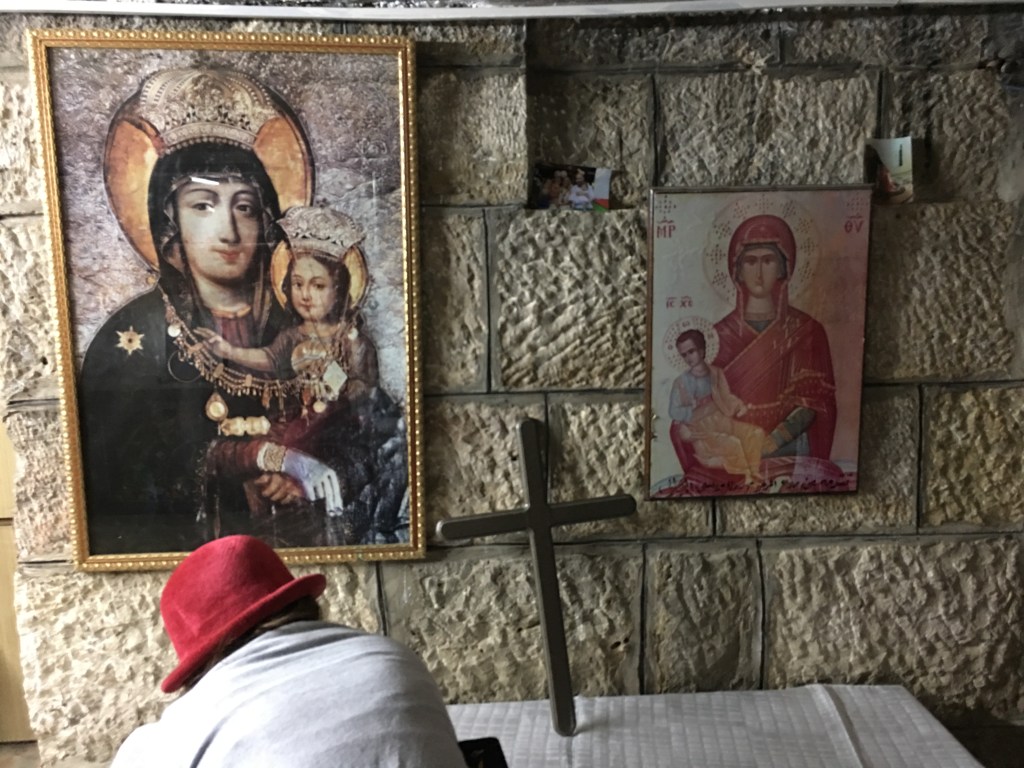
Photo by author of a pilgrim writing prayer petitions in a Marian room of Greek Orthodox Basilica of St. George in Madaba, Jordan, May 2019.
Praise and glory to you O Lord for the gifts of church buildings where we can gather in your name especially on Sundays to praise and worship you. Thank you for the religious articles and images we have that also remind us of your being with us.
They all remind us of the relationships we keep with you our God expressed through our brothers and sisters around us.
Like the Ark of the Covenant and the Temple of Jerusalem mentioned today in the first reading, may your Holy Spirit dwell in us through these religious things to remind us of your presence in us and among us so that we may strive to live harmoniously as brothers and sisters in Christ.
May we have that kind of faith and trust in you like those crowds who followed Jesus everywhere in the gospel just to touch his cloak so they may be healed of their afflictions.
And like St. Scholastica whose feast we celebrate today, may we cultivate the relationships we keep in you and with one another through our actual presence. Amen.
The Lord Is My Chef Sunday Music, 02 February 2020
Photo by Mr. Jim Marpa, Bohol, 2019.
Welcome, followers and readers to this Sunday edition of our The Lord Is My Chef Sunday Music as we feature a double-header from singer-composer Todd Rundgren: his first solid hit “I Saw the Light” and “Hello It’s Me” that are both from his 1972 album Something/Anything?
We are featuring two songs today because both are related with our celebration of the Feast of the Presentation of the Lord which falls on February second.
And besides, Todd’s music has always been my favorite while growing up in the 1970’s.
First, we choose I Saw the Light because it is very close to our liturgical feast today also known as Candlemass or Candelaria with Jesus Christ being the Light of the world. St. Luke tells us when Joseph and Mary brought the child Jesus to the temple in Jerusalem 40 days after Christmas, an old man of God named Simeon carried him in his arms and sang:
“Now, Master, you may let your servant go in peace, according to your word, for my eyes have seen your salvation, which you prepared in sight of all the peoples, a light for revelation to the Gentiles, and glory of your people Israel.”
Luke 2:29-32
Jesus is the Light of the world, the only one who can dispel all darkness in our lives.
In I Saw the Light, Todd tells us the story of a young man probably groping in some darkness in his relationship – actually a fling according to the song – with a girl and he does not know if that is really love.
Though we had our fling I just never would suspect a thing ‘Til that little bell began to ring in my head In my head But I tried to run, though I knew it wouldn’t help me none ‘Cause I couldn’t ever love no one, or so I said But my feelings for you were just something I never knew ‘Til I saw the light in your eyes
But I love you best It’s not something that I say in jest ‘Cause you’re different, girl, from all the rest In my eyes And I ran out before but I won’t do it anymore Can’t you see the light in my eyes
Meanwhile, in our second song Hello It’s Me, we find another man so in love with a woman who is also into some darkness.
Like in I Saw the Light, there is no recognition and hence, no meeting here in Hello It’s Me.
Hello, it’s me I’ve thought about us for a long, long time Maybe I think too much but something’s wrong There’s something here that doesn’t last too long Maybe I shouldn’t think of you as mine Seeing you, or seeing anything as much as I do you I take for granted that you’re always there I take for granted that you just don’t care Sometimes I can’t help seeing all the way through It’s important to me That you know you are free ‘Cause I never want to make you change for me
Both songs show us the important lesson taught to us by the Feast of the Presentation of the Lord: like anyone else, Jesus also comes but we on our part have to cultivate a relationship with him in order to always recognize him and eventually meet him to be one with him.
Just like the people we love.
Have a wonderful Sunday of prayer, food and drinks, and good music.
Quiet Storm by Fr. Nick F. Lalog II, 13 January 2020
Photo by my high school seminary friend, Mr. Chester Ocampo, taken at the UST Senior High where he teaches art (2019).
Life goes on, long after the thrill of living is gone..
John Mellencamp, “Jack & Diane” (1982)
Maybe this is part of getting old, of maturing. Of learning to grapple with life’s mortal realities and still be excited with living. It is a grace that is both fulfilling but also deeply moving and often, chilling.
An uncle and a friend have commented to me in our recent chats how 2020 had come in hard and difficult with so many sickness and deaths in the family.
Some relatives have to fly to Singapore on New Year’s Day to support a cousin whose husband had an office accident that left him in comatose for five days following a brain surgery. He eventually died and had to be cremated a few days later.
December 11 I had to drive to Manila to visit and anoint the father of my best friend from high school seminary who arrived December 2 from the States, fell ill December 4, and had to spen Christmas and New year in the hospital.
Less than 24 hours after being discharged January 3, he died the following morning after talking with my friend based in Chicago, three days short before eldest daughter arrived to accompany him and wife back to New Jersey this week.
Meanwhile last January 2, I had to rush again this time to Quezon City for the wake of our high school seminary classmate Rommel who had died of multiple complications morning of December 31.
He is the third to “rest in peace” in our batch of 18 men who graduated the minor seminary in 1982. We last saw him in our reunion, September 9, 1990 (9-9-90).
Suddenly, I felt myself in some kind of a time warp when everything seemed to be not too long ago, as if we have just graduated recently, or that my dad and their dads have just passed away one after the other these past months.
Death can sometimes be magical when life is lived in love
I realized that when we have so much love for everyone like relatives and friends, including parishioners in the last eight years, time stands still after their deaths. You do not count the days and weeks and months and years you were together and when they have all gone.
They all seem to be still present because you are focused on how those departed have enriched your very life, your very person no matter how fleeting or long ago you were together.
Death can sometimes be magical, most of all grace-filled, when our lives are lived in love.
Life goes on, long after the thrill of living is gone…
John Mellencamp, “Jack & Diane” (1982)
Photo by author, our sacristy 2019.
Memories and knowledge fade, but love remains
Finally I had the chance to visit my mom – for Christmas! – evening of January 6. It was so good that just before leaving, a cousin arrived with his family to visit also my mother who is the younger sister of his mother, my Tita Celia.
It was only at that evening we have finally confirmed that Tita Celia has Alzheimer’s, the reason why her ways and attitudes have been noticeably erratic in 2019 as she was slowly losing grip of her senses.
And now, it is almost all gone according to my cousin whose sadness I strongly felt as he narrated to me the deterioration of his mother, of forgetting and losing so many things, of not recognizing familiar people like relatives and friends.
That same night, we also learned from him how our moms’ younger brother seem to be having signs of the onset of Alzheimer’s disease that are very similar with Tita Celia.
Again, I found myself in a “time warp” while they were happily conversing I was silently trying to recall the last time I have seen my mother’s siblings now afflicted with Alzheimer’s disease, wondering if they will still recognize me if I visit them later.
Moreover, I also realized how afraid I am with the prospects of getting sick in old age than of dying, sooner or later!
In fact, I was so scared that I had a nightmare that same night: in my dream I found myself lost, apparently with Alzheimer’s as I was searching for my parish rectory, looking for my bedroom, asking people about my parish staff, crying like a child.
What a relief when I woke up Tuesday morning that it was just a dream, that I was in fact in my bed, inside my room, in my parish rectory, so alive and still whole!
It seems it is easier to think and accept of one’s death than of getting sick and incapacitated later in old age. It is something we have to slowly come to terms with while still younger and stronger, and perhaps wiser.
How?
As I recalled our conversations with my cousin Louie that Monday night at home, I was amazed at his great love for his mother, Tita Celia. I remembered how he would always have pasalubong for his mother even upon coming home from school!
Maybe that is why even she had forgotten most of us her relatives, she always remembers Louie her son because he is the one who has truly loved her next to the late Tito Memo, her husband. The same is true with others taking care of their old parents afflicted with Alzheimer’s: they are recognized and remembered because they love.
Our memories and knowledge may be erased but the love we have in our hearts, the love we have experienced always remain even if everything has failed in life. That is why St. Paul declared that “love is the greatest of all gifts of God”.
Life goes on, long after the thrill of living is gone…
John Mellencamp, “Jack & Diane” (1982)
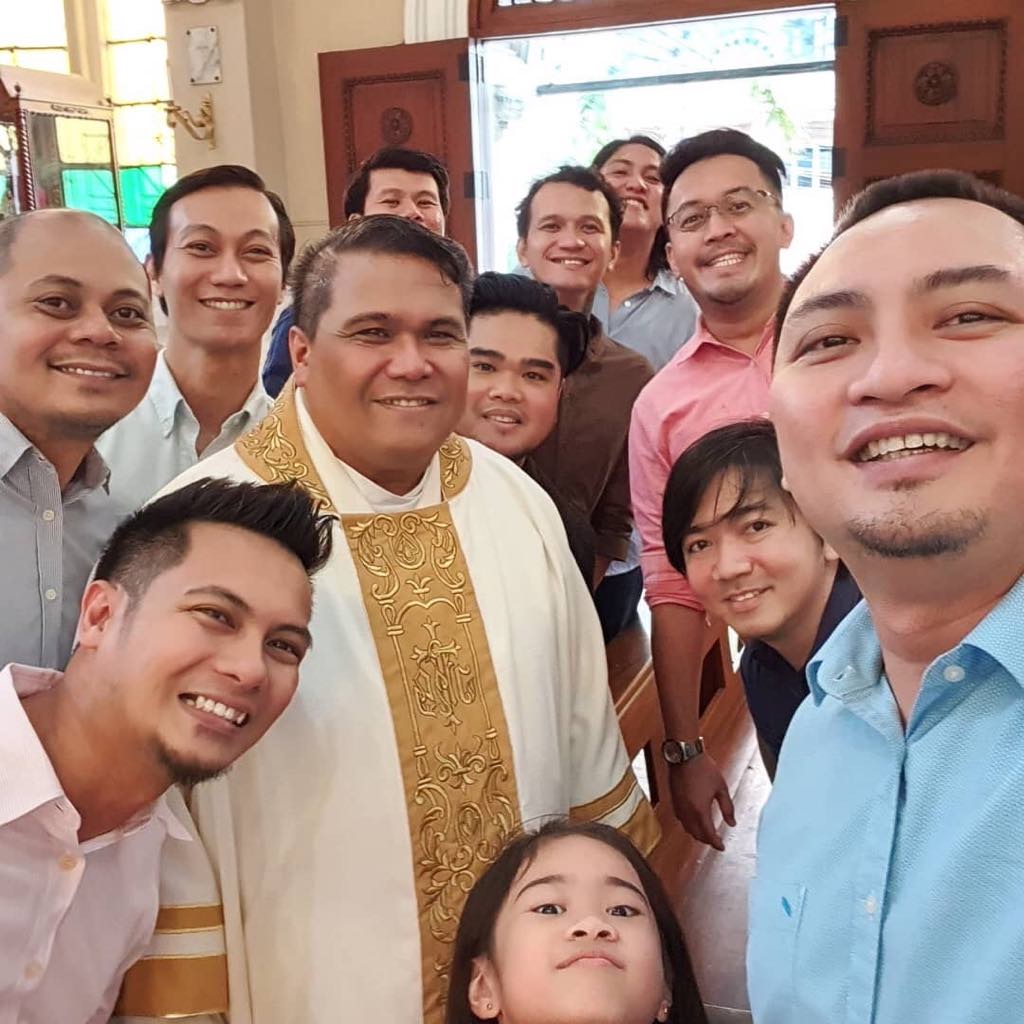
With my former students at the Cubao Cathedral after the wedding of their classmate. I felt so proud, and old, that afternoon seeing them all with their career and family, of how they have maintained their friendships all these years like brothers, of they love one another. Photo by Peter dela Cruz, one in blue.
To live is to love
December 2019 and January 2020 are perhaps my most “marrying months” in my 21 years of priesthood.
Aside from the weddings of friends and students I have officiated these past two months, three more are coming next month of February.
Again, as I saw friends and especially former students getting married, I could not believe at how fast time had passed.
Should I really be surprised when I find out my former students already in their early 30’s, some with families of their own and children whom they instruct to kiss my hand, calling me Lolo Fr. Nick?
It was a very “existential” experience that they are already old, and most of all, I am really that old after all!
Maybe that is what my married friends are telling me of the joy of fatherhood, of having your kids getting married, of having grandchildren, of the inner satisfaction that you have brought life to fruition.
That you have truly loved and now being loved.
It is perhaps the joy of getting old, of maturing, of dying or even forgetting everything when afflicted later with Alzheimer’s that you start to fade from the scene and hand over the stage to the next generation, thinking that life will still go on after us because you have loved much.
What really matters in the end is how we have lived and loved the people around us, of how we have enriched each other’s lives so that as the young ones discover life’s meaning in love, we who are older find life’s fulfillment still in the love from the relationships we keep.
Here’s a hill-billy rock music about love to drive your Monday’s blues away.
Quiet Storm by Fr. Nicanor F. Lalog II, 28 December 2019
Italian artist Giorgione’s “Adoration of the Shepherds” (1510) showing an intimate scene set up against a distant landscape. The shepherds’ gently kneeling and bowing their heads down show their humility and fascination with the Infant Jesus while the long road behind them shows the long and tiring journey they have taken before reaching their destination.
We continue with our enumeration of the best gifts of Christmas which is above all the coming of our Lord Jesus Christ. And because of his coming as human like us, we have come to share in his dignity and glory, thus, making us also the best gifts to share and receive every Christmas!
We await Christmas every year because we await Jesus Christ, the most beloved person of all we can know and have as friend.
We wait only for persons, not things.
Waiting is beautiful because we never wait alone. There is always another person waiting with us, waiting for us. And when we finally come and meet with the other person also awaiting us, then we become present, a gift for one another.
In our presence with each other comes the wonderful gift of intimacy.
“God became a human being so that in one person you could both have something to see and something to believe.”
St. Augustine, Sermon 126, 5
The spot where Jesus Christ is believed to have been born now covered and protected by this hole under the main altar of the Church of the Nativity of the Lord in Bethlehem. May 2019
Christmas is a story about persons called by God to bring us his Son Jesus Christ. It is a living story that continues to our own time. Here are some of the best gifts of Christmas coming from the gift of our personhood.
The gift of family. Christmas happens in a family of husband and wife and children. Very much like Joseph, Mary, and Jesus. Remove one and the Nativity scene becomes incomplete. Let us be thankful for our family, let us pray for the unity of our family. When Jesus was lost at the age of 12, Joseph and Mary decided to return to Jerusalem – symbolizing God – and eventually found him there in the temple. Let us always turn to God, ask for his guidance and protection of every family, for the healing of our family, for the mending of our broken relationships. Let us pray for all broken families whose members from the husband and wife to their children are all aching deep inside for the pains of separation.
The gift of women and of motherhood. When God created man, he found “it is not good for man to be alone” that is why he created the woman as man’s “suitable partner” (Gen.2:18). What a beautiful term for woman, part-ner, a part of man who is never complete by himself alone. How sad that until now, it is right inside the home where every woman first experience physical, verbal and emotional pains. Women are the best signs of fidelity and faith: Elizabeth called Mary “blessed” because she believed the words spoken to her by the angel from God will be fulfilled. Let us pray for the women in our lives especially own own mother and sisters, lola and aunties, cousins and nieces. Remember, the way we relate with women reflect to a great extent the way we relate with God. Love and bless the women!
The gift of men and fatherhood. When Jesus taught us how to pray, he taught us that God is like a “Father” whom we shall call “Our Father”. There is a crisis in fatherhood and manhood these days because many men have forgotten to be truly man enough like God our Father: a giver of life and protector of life as well. Most of all, when children lose this gift of life, it is the father who restores the life lost like the merciful father of the prodigal son in Luke’s gospel chapter 15.
Aleteia, December 2019.
This Christmas break, spend time with your family, hug your mommy and your daddy tightly and feel their presence again.
Thank your family, your mom and dad.
Pray for your departed loved ones, visit the cemetery and say a prayer for them, talk to them. Most of all, listen to them and feel them again.
The Lord Is My Chef Simbang Gabi Recipe, 16 December 2019
Isaiah 56:1-3. 6-8 ><)))*> ><)))*> ><)))*> John 5:33-36
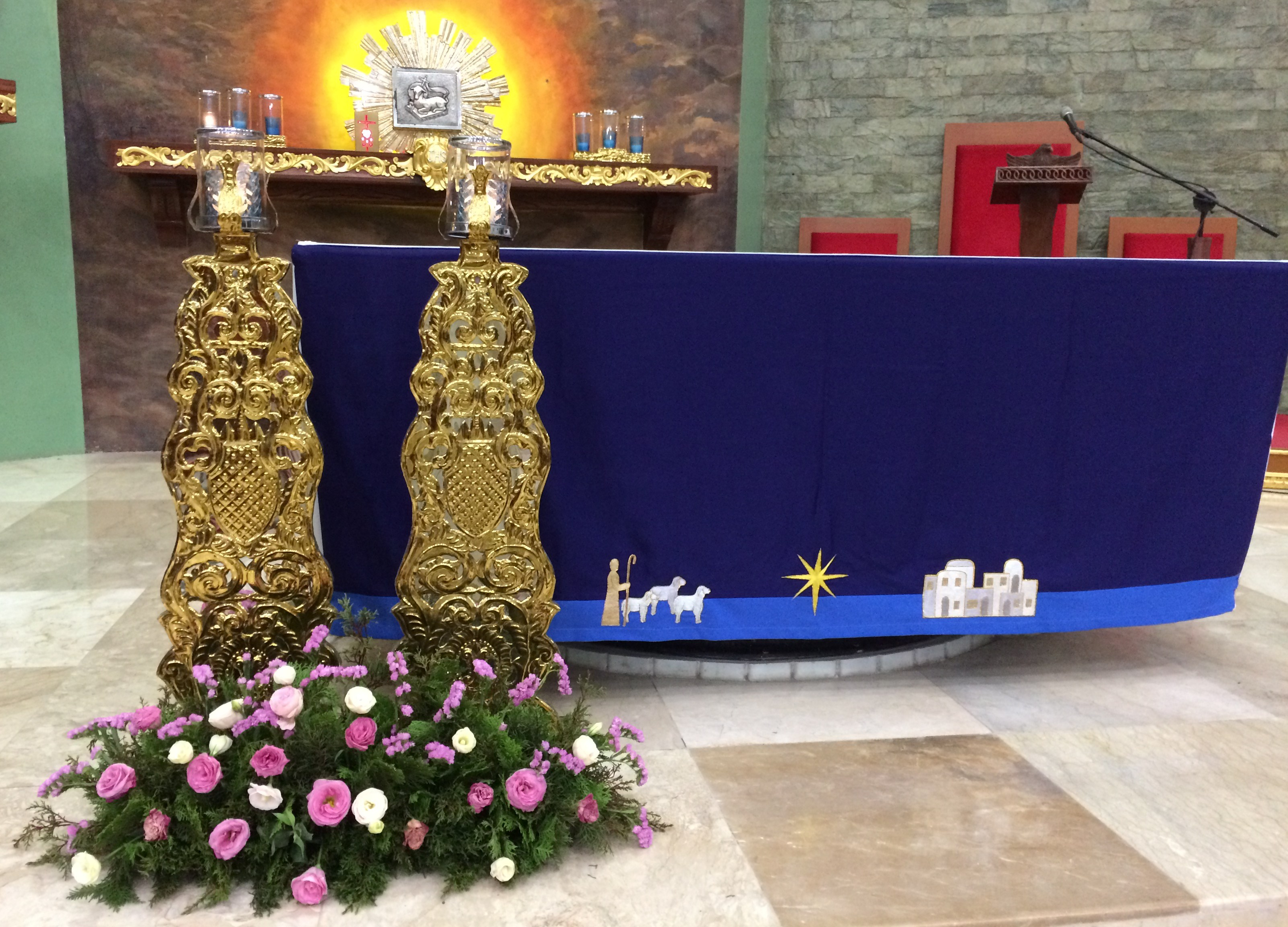
Our Parish Altar, Simbang Gabi 2018. Photo by author.
When we were still seminarians, our spiritual director became a victim of “hold-up” while walking home from an evening mass nearby. He is now a Trappist monk at Guimaras, a very kind and gentle priest we fondly call “Fr. Esteng”.
According to Fr. Esteng, everything happened so fast. But, after taking all his money, the suspect demanded Fr. Esteng’s big bag too, his “mass kit”. This time, Fr. Esteng refused to give into the demand of the hold-up man, insisting there’s nothing of value inside because they are things for celebrating the Mass of which no one would really buy.
To convince the hold-up man, Fr. Esteng got the “brilliant idea” of inviting the suspect to come with him to the seminary to get some food so he would no longer need more money.
Good that the hold up man did not accept the “invitation” of our good priest who got some “scolding” the following morning from his brother priests the following day after learning his brilliant idea, telling him to never to invite thieves into the seminary again!
“For my house shall be called a house of prayer for all peoples. Thus says the Lord God, who gathers the dispersed of Israel: Others will I gather to him besides those already gathered.”
Isaiah 56:7b-8
Inclusive God, exclusive people.
Praying at the Wall of Jerusalem Temple, 2017.
Welcome everyone!
It’s the start of our Simbang Gabi, our nine-day novena before the Lord’s birthday on Christmas.
God tells us in the first reading how he welcomes everyone into his house without any exceptions. That is how good and loving our God who is not contented in calling us all into his house but even sent us his only Son Jesus Christ to gather and lead us back to him.
Our God is very inclusive, always including everyone especially those rejected, those in the margins.
So unlike us people who are very exclusive and judgmental of others too.
We want everything exclusively ours. Just us. And when we meet strangers, those who do not look like us or do not speak and dress like us, we feel uncomfortable.
Worst is when we meet people of different faith and beliefs that we feel uneasy and even threatened simply because they are not like us!
It is good that for this final year before we celebrate our 500 years of Christianization, our bishops have dedicated 2020 to be the “Year of Ecumenism, Interreligious Dialogue, and Indigenous Peoples”.
This is to “celebrate human fraternity by promoting the culture of dialogue as a path of peace.” The Church wants to “work for unity and harmony while respecting diversity and to recognize peoples’ identities, spiritualities and ancestral domain.”
Logo for the Year of Ecumenism, Interreligious Dialogue, and Indigenous Peoples.
Jesus told the crowd, “But I have testimony greater than John’s. The works that the Father gave me to accomplish, these works that I perform testify on my behalf that the Father has sent me.”
John 5:36
See everyone and everything in Christ.
In our gospel today, Jesus was questioned by the Jews for healing a man sick for 38 years on a sabbath day at Bethesda.
Jesus was so different from them who have fallen into rituals and replaced God himself with their laws and traditions. They wanted Jesus stopped and even put to death simply because he did things so differently when, in fact, he was trying to bring back what was lost like the precedence of God and human life over laws and rituals.
Pope Francis reminds us that the Church exists to remind us that God loves and welcomes everyone. He is absolutely right that so often it happens right in our churches, in our celebrations we go on our own exclusivistic ways forgetting we are supposed to be a community.
On this first day of our Simbang Gabi, let us focus more on Jesus so we may find him among other people easily because when we are focused with our “work” and ministry, the more we see ourselves and forget Christ among the poor and marginalized.
Do we find Jesus when we serve and celebrate the liturgy or do we simply have ourselves?
Is it Jesus Christ whom we share with others in our dealings and service in the Church or our proud self?
Where is Jesus really in our lives today that we simply do things for the sake of doing it, because it is a tradition and not because of a personal conviction and relationship with him?
Thursday, Memorial of the Presentation of Mary to the Temple, 21 November 2019
Zechariah 2:14-17 ><)))*> <*(((>< Matthew 12:46-50
Feast of the Presentation of Mary at the Temple originated from the Eastern Church where it is known as “The Introduction of the Theotokos (Mother of God) to the Temple”. Photo from Google.
Dearest Lord Jesus Christ:
As we celebrate the memorial of your Mother Mary’s presentation at the Temple, I am deeply struck by the gospel scene for this feast.
Someone told Jesus, “Your mother and your brothers are standing outside, asking to speak with you.” But he said in reply to the one who told him, “Who is my mother? Who are my brothers?” And stretching out his hand toward his disciples, he said, “Here are my mother and my brothers. For whoever does the will of my heavenly Father is my brother, and sister, and mother.”
Matthew 12:47-50
This is so striking to me, Lord because here you are asserting your authority outside your family circle. Here you are telling us of the need to eventually leave our family and friends in order to join you in your mission and journey.
It is very true that we find our first sense of belonging in our family and circle of friends but as we get older like you in Nazareth, our larger sense of belonging to God our Father can only happen when we break free from our family and friends.
Not because we do not love them but primarily because each of us has a calling and mission from you that must be followed and fulfilled. And to do so, we have to leave our family and friends in order to heed and follow your call, O Lord.
In this age of social media, there are some family and friends who get the wrong notion that belonging and possessing or ownership go together, that parents own their children, and friends own each other.
I pray for all parents to imitate St. Joachim and St. Anne who clearly knew they did not own Mary their daughter, that she is God’s that they have to offer her to him at the temple.
May we all grow into maturity that there comes a time when we have to leave our family and friends, even say “no” to them to be like you to freely say “yes” to the Father. Amen.
Quiet Storm by Fr. Nick F. Lalog II, 20 November 2019
A chef is basically a person who loves people. And that is why for any chef, cooking is both a passion and an art. His menu are not only meant to feed the body but most especially enrich the heart and soul of every diner.
Welcome to Netflix original series “Midnight Diner: Tokyo Stories”!
Each episode is exactly like every recipe the main character called “Master” dishes out to his patrons and customers who come from all walks of life with their unique burdens and story to share and eventually, resolve after tasting his fresh and easy to cook meals.
Midnight Diner is as Japanese as the ramen and sake the Master serves his guests. Everything is in Nihongo with English subtitles that demand one’s total attention to understand the conversations briefly interspersed with first person accounts by the Master.
At the opening, the Master gives us the warm and nice ambience of the series set at midnight until seven in the morning for people who do not wish to go home straight after their office hours.
It turns out that they are not only looking for good food but for warm company as well which the Master ably provides with his total attention and communion.
Very interesting to note that the Master is a celibate, reason why he can devote himself wholly to his diners, listening to their joys and sorrows, victories and defeats. So far, from what I have seen in its two seasons, he has no love interests although it won’t be surprising if in the third season he turns out to be a character from one of Murakami’s novels or short stories.
Though he is a fictional character, he is rightly called “Master” for his commanding presence that is not intimidating but so warm and gentle, so unlike the celebrity chefs we see on TV.
The Master can cook anything, including fancy corndogs and pancakes that are very American. He always has a “menu of the day” as title of each episode.
Should anyone ask for any kind of dish, he willingly prepares it subject to availability of ingredients that turns out he always has or sometimes, like a true chef, finds other alternatives just to fulfill a customer’s cravings. In one episode, a patron comes nightly with his own three pieces of bread so the Master can make him “yakisoba sandwiches” — exactly how we Filipinos eat pancit with another carbohydrate!
What makes the series so good is that the Master is more than a chef — he is the Tokyo counterpart of Paris’ Cafe Anglais famed lady chef “Babette” of the 1987 Danish film “Babette’s Feast” and James Taylor’s 1977 hit single “Handy Man” rolled into one.
More than the food he passionately serves, the Master delights and comforts every troubled heart and lonely soul longing for love and relationships, forgiveness and kindness they finally find in his Midnight Diner.
Most of all, neither the Master nor his food is the main focus of each episode but the story of every customer who comes to his diner at the most unholiest hours – between 12 midnight and seven in the morning – searching for food for their souls!
Mainstays of the Midnight Diner.
Helping the Master in processing every customer are his interesting mix of characters of regular patrons: LGBTQ members, career ladies mostly single, retirees, professional gamblers and of course, Yakuza gang members.
They are the Master’s “secret spices” who bring out all the flavors and aroma of every customer’s life story like a widowed lawyer searching for his lost step brother to a nightclub stripper sought and saved from miserable life by her high school teacher suffering the early stage of Alzheimer’s disease. Sometimes they act like the Master’s garnishings, adding taste and beauty with some sprinklings of life lessons to lost customers.
Though most stories are understandably peculiar to Japanese culture, they all touch a common chord within us for our basic need of acceptance which the Master warmly provides like his steaming hot dishes.
Unlike most TV series, Midnight Diner’s pacing is so fast and without any pretensions that prevent it from becoming dragging and boring. In less than 30 minutes, each episode is deftly resolved just as magically how the Master came out with a superb meal from his limited resources and tiny kitchen.
But the best attraction of the show is how the viewer eventually finds one’s self warmly welcomed into the diner, laughing or crying, sympathizing or objecting to whatever situation is presented by every guest.
It is a very lovely series that transcends language barriers and cultures because it nourishes and warms our soul that never rest nowadays due to the demands of modern living. Somehow, inside the little Midnight Diner, there is always a space welcoming everyone including us viewers to unwind and be fulfilled with good food, nice people, and meaningful conversations.