Today’s gospel speaks about the end of time, the Second Coming of Jesus Christ when he predicted the fall of Jerusalem and destruction of its Temple in 70 A.D.
Every coming of Jesus Christ is a day of judgment and salvation, a call to love, love, and love.
When Jesus comes again at the end of time, he won’t be asking us how much money we have but how much do we share?
He won’t be asking us what car do we drive but how we move people with our kindness and warmth?
Jesus will not ask us those questions we are so preoccupied in this life but instead ask us the basic question we have always avoided answering, “how much do you love”?
Everything follows from that question because only those who truly love are the ones willing to suffer and sacrifice, even give life so others may live.
And that is why we have chosen this very poetic song, When It Was Done by the famed American composer Jimmy Webb in 1969 and first recorded by Winter Wanderley that same year.
There are other artists who have covered this beautiful song but Hugo Montenegro’s version is the best, giving it a more ethereal quality despite its poignant character.
It is a story of a man’s love presumably to a very lovely woman he never had the chance to express his feelings because she had been taken by somebody else.
If I could bind your mind to mine in time, to keep you from that world of his If I could change the strangers in your kind, then I’d know where your soul is Then I’d know what song I’d have to sing, to touch that chord within you Then I would weave such wondrous songs, and when it was done, I’d win you
If I could stand with the stars on either hand, and say girl this ain’t the answer If I had been where you’re going, but then I’ll never be no dancer If I was I’d know what step to take, and laugh at what had freed me And smash the great wall down girl, and when it was done, you’d need me
Too late… but the gentleman pins his hopes to the end of time when probably on judgment day he could have the chance to finally have that lovely woman.
If I can face the fate that waits to cast me into shambles And sit across the velvet boards from God then I would gamble And if I could, I’d know what chance to take and before the devil sold you I’d bet my soul against the stars, and when it as done, I’d hold you
Of course, it is all wishful thinking. And that is why – “when all was done” – there’s no more going back because it is judgement day. So let’s do whatever good we can in the here and now where Christ comes again.
Meanwhile, enjoy this lovely piece and shower your loved ones with all the love you now have.
Romans 15:14-21 ><)))*> ><)))*> ><)))*> Luke 16:1-8
Photo by Mr. Jim Marpa in Carigara, Leyte last September 2019.
Before everything else, O loving Father as we praise and thank you for this new day, we fervently pray for our brothers and sisters severely affected by the rains and floods up north in Cagayan as well as those displaced by the effects of earthquakes last two weeks in Mindanao.
Take care of them and make us more sensitive to their plights that we may be moved to do something concrete for them.
Like St. Paul, fill us with the same Holy Spirit, with zeal and enthusiasm to always do your work, Lord.
But I have written to you rather boldly in some respects to remind you, because of the grace given me by God to be a minister of Christ Jesus to the Gentiles in performing the priestly service of the Gospel of God, so that the offering up of the Gentiles may be acceptable, sanctified by the Holy Spirit.
Romans 15:15-16
Fridays for everyone is the end of school and/or work, a time to celebrate and have fun; the most welcome break of the week. But with you, Lord, you never stop working for us, with us, and in us.
Like St. Paul, fill us with yourself, O God which is the literal meaning of “enthusiasm” from the two Greek words, “en theos”, “be filled with God”.
Like St. Paul, may we never stop proclaiming you and your salvation joyfully even among those who have known you, Lord.
In this world of so much competition and rat race with no clear winners at all, make us realize like the shrewd steward in today’s gospel that being wise is giving more importance to people and persons and relationships than money and wealth. Amen.
Love can never be defined because it is a reality that cannot be restricted to certain parameters unlike other words or virtues or concepts for that matter.
The most we can do about love is describe it.
And, live it — as St. Paul has been telling us this week in our daily readings.
Let love be sincere; hate what is evil, hold on to what is good; love one another with mutual affection; anticipate one another in showing honor.
Romans 12:9-10
Photo by Ms. Jo Villafuerte, Atok, Benguet, 01 September 2019.
There lies the beauty of love, in being sincere, being true.
Not fake as we know and must have experienced somehow.
Sincere literally means “without plaster” that came from two Latin terms, sin for without and cerofor plaster.
In ancient Rome, good sculptures were highly prized, must be “sin cero” – no plaster and purely carved out from wood or stone. Like in the usual practice today, some sculptors “fake” their work with plasters (masilya) to cover uneven surface or disfigured portion that eventually wears out.
To love sincerely means loving like Jesus without strings attached, not expecting anything in return.
But, how can we love sincerely when others are so untrue with their love to us? How can we hate evil and hold on to what is good when people continue to hurt us, or oblivious to their wrongdoing and sins? Most of all, how can we anticipate one another with honor when nobody seems respectable at all these days?
It is always difficult to love because it is also difficult to be true when everything is artificial these days.
And that makes love beautiful not only because it is true but it is something we assert and insist despite the many evils around us.
Violets in our old sacristy, 2016.
Love becomes more beautiful when it is hurt and rejected, continuing to love, doing good and showing kindness even if others are not true because it is only then in pains and sufferings when more love is born and summoned from within us.
The more tears we shed, the more love flows to clean the mess.
Love never runs out, never dries up like a well or a river. It is the greatest virtue and gift we can have as St. Paul tells us in another letter because in the end, only love remains as it is from God who is Love himself.
When our love is true, no matter how untrue are the people around us, for as long as we love in Christ, the more we are able to love, the more love we have to share and give. The more we love, the more love we receive; withhold love, keep love to yourself, that is when you lose love.
Photo by Mr. Chester Ocampo, multi-media artist, and teacher (October 2019).
Brothers and sisters: owe nothing to anyone, except to love one another; for the one who loves another has fulfilled the law.
Romans 13:8
During his last supper, Jesus mentioned to his Apostles about his new commandment of loving each other as “I have loved you”.
Though other ancient sages have taught about love or similar attitudes especially in the East long before Jesus Christ’s coming, his commandment was new because it is a love rooted in God. More than a moral prescription or a code of conduct as seen in other religions and cultures, Christian love is so unique because it is rooted in God who is love himself.
Pope Emeritus Benedict XVI’s first encyclical issued on Christmas 2005.
Love is the only thing asked of us by God; hence, any failure to love is always a sin.
How sad that in this age of affluence and sophistication in terms of technology and knowledge, men and women are getting more isolated and alienated, giving rise to hosts of mental illnesses that lead into rising incidence of suicides worldwide.
One usual complaint of many people, young and old alike, is the lack of love. They always ask “where is the love?” even in the midst of every relationship that have become transactional in nature, forgetting the human face longing for affection, crying inside, alone.
Owe nothing to anyone except to love one another because it is love that defines us; without love, we are nothing.
To live is essentially to love.
If you have love in your heart, you have been blessed by God; If you have been loved, you have been touched by God.
Friday, Solemnity of All the Saints, 01 November 2019
Revelation 7:2-4. 9-14 ><}}}*> 1 John 3:1-3 ><}}}*> Matthew 5:1-12
“Mary with the Child and the Angels and the Saints” by Duccio Di Buoninsegna (d. 1319).
Glory and praise to you, O Lord our almighty and loving Father in heaven!
Thank you very much for this celebration of the Solemnity of All Saints — of those all ahead of us and have died now enjoying your company in heaven.
Whenever we think of holiness, we always think of men and women not committing sins, of moral exemplars.
Remind us always that holiness is being filled with you, O God, and that saints are givers of life.
“Blessed are the clean of heart, for they will see God.”
Matthew 5:8
Fill us with your Holy Spirit, Lord, cleanse us of our sins and evil desires and inclinations as we strive to bear all pains and sufferings to lead holy lives.
It is in purifying our hearts, our very selves, when we are able to truly offer our lives for the loving service of the poor and needy so that while still here on earth, we may already see your face, Lord, among the people we meet until that day we are one in you in eternity. Amen.
We have reflected last week that prayer is an expression of our faith by citing Dione Warwick’s 1967 hit, “I Say a Little Prayer”.
When there is faith expressed in prayer, there is also love.
And when there are faith, prayer and love, then we have a relationship like family and friends, and community.
Today in our gospel, Jesus tells us the right attitude we must have in maintaining our relationships, not only with him but also with others.
Jesus addressed this parable to those who were convinced of their own righteousness and despised everyone else. “Two people went up to the temple area to pray; one was a Pharisee and the other was a tax collector. The Pharisee took up his position and spoke this prayer to himself, ‘O God, thank that I am not like the rest of humanity – greedy, dishonest, adulterous – or even like this tax collector.’ But the tax collector stood off at a distance and would not even raise his eyes to heaven but beat his breast and prayed, ‘O God, be merciful to me, a sinner.’ I tell you, the latter went home justified, not the former.”
Luke 18:9-11, 13-14
From Dione Warwick’s 1967 “I Say a Little Prayer”, we move to the following year when Sylvia Robinson and Bert Keyes composed Love on a Two-Way Street recorded by The Moments as a filler for their 1968 album Not on the Outside, But the Inside, Strong!
It did not fare well in the charts and was released again as a single in 1970 when it spent five weeks at number one on Billboard’s Soul Singles chart. It become one of the greatest R&B song of that year that was later covered by other artists.
In 1981, 14-year-old Staci Lattisaw did a cover of the song that became so popular that others have thought it as her original.
But with all due respect to Staci, I have also always felt her version very cheesy that I prefer the originals singing it because they give more character and soul to the song.
I found love on a two way street and lost it on a lonely highway Love on a two way street and lost it on a lonely highway
There was no specific experience behind the composition of Love on a Two-Way Street except that it was just a product of a play on words and poetry by Robinson supported by Keyes’ music.
The moment we become convinced of our righteousness that we despise everyone else (cf. Lk.18:9), then we shut ourselves in and leave no space for others even God.
Love as a two-way street based on today’s parable by Jesus requires three attitudes so our relationships would mature and grow deeper: a sense of sinfulness, self-surrender, and self-offering.
No love and faith would ever grow on a lonely highway, with no one else to relate with. That’s when we stop communicating and relating until we break up with others and end up alone and isolated.
That is when we become a “lonely highway” with nobody else but I, me, and myself.
Go back to the two-way street of God and others.
Though crowded with some traffic jams, there is always a space for everyone.
It’s a lovely Sunday especially for all married couples.
I am officiating the 40th Wedding Anniversary later today of a dear cousin when I remembered the 1997 movie “My Best Friend’s Wedding” with one of its most romantic scene with the singing of I Say a Little Prayer.
Composed by Burt Bacharach and Hal David in 1966 for Dionne Warwick, the song is meant to convey the woman’s sentiment for her man serving at the Vietnam War. It was finally released in 1967 and became an instant hit not only in the US but around the world. Since then, I Say a Little Prayer has been covered so many times even by male vocalists and went back to the charts again in 1997 as one of the tracks in the romantic comedy that starred Julia Roberts.
Prayer is the expression of our faith that always presupposes the presence of love. If there is love, there must be a community, a relationship.
Like people who love each other, believing in each other, they always speak and communicate even in silence. What matters most is their being together, their being one in faith and in love.
Exactly like in prayer.
If we love God, then we must always speak to him and most of all, be one with him, like most people who truly love.
We have chosen that lovely scene from “My Best Friend’s Wedding” singing I Say a Little Prayer because it evokes a lot about prayer: faith and love and relationships.
Most of all, in that movie, the prayer was heard loud and clear for Julia’s best friend.
See the movie again and have those kilig moments back with your loved one 22 years ago.
Our gospel this Sunday of the parable of the prodigal son speaks so well of what we may describe as the “wildness and wideness” of God’s love and mercy for each one of us, especially the lost and rejected. It is a love that goes “time after time”….
Lying in my bed I hear the clock tick And think of you Caught up in circles Confusion is nothing new Flashback, warm nights Almost left behind Suitcase of memories Time after
Sometimes you picture me I’m walking too far ahead You’re calling to me, I can’t hear What you’ve said Then you say, go slow I fall behind The second hand unwinds
If you’re lost, you can look and you will find me Time after time If you fall, I will catch you, I will be waiting Time after time
Written and originally performed by Cyndi Lauper, “Time After Time” is her second single she co-wrote with Rob Hyman that was released in January 24, 1984. It was an instant hit and earned very positive reviews for Lauper.
It is a story of unconditional love despite its being over.
The lover promises to continue loving her beloved despite their separation.
It is a kind of love that is so divine like the merciful father in the parable of the prodigal son. A love so true as it recognises the other person as a “somebody”, a part of the lover. A love that persists time after time because we remain a family despite our separation of distance or even of feelings.
We have chosen the 1988 cover by the jazz duo of husband and wife Tuck and Patti because of its more solemn rendition. The guitar and voice ensemble of the duo for me is one of the music world’s great treasure we are so thankful not only in delighting our senses but most of all in making us experience some of the most beautiful songs of our time.
The Lord Is My Chef Sunday Recipe, Week XXIV-C, 15 September 2019
Exodus 32:7-11, 13-14 ><)))*> 1Timothy 1:12-17 ><)))*> Luke 15:1-32
Camp John Hay, Baguio City, 23 August 2019.
Today we conclude the series of “table talks” by Jesus with three parables narrated while dining; but, unlike the other Sunday when he was with prominent people, this time we find the Lord among the notorious ones of his time.
Tax collectors and sinners were all drawing near to listen to Jesus, but the Pharisees and scribes began to complain, saying, “This man welcomes sinners and eats with them.”
Luke 15:1-2
It is the perfect setting where Jesus bared what we may call as “the wildness and wideness” of God’s love and mercy for everyone, especially the lost and rejected. This explains why Luke 15:1-32 is the “heart” of the third gospel also known as the Gospel of Divine Mercy. So, please bear with me reflecting today’s long but lovely gospel.
The first two parables are about things – a sheep and a coin – that were lost and later found. There is nothing extraordinary about losing things that we also experience today. But, in narrating these parables, Jesus ended both with a saying to explain their meanings and significance to introduce the third parable of the lost son.
“I tell you, in just the same way there will be more joy in heaven over one sinner who repents than over ninety-nine righteous people who have no need of repentance.”
“In just the same way, I tell you, there will be rejoicing among the angels of God over one sinner who repents.”
Luke 15: 7, 10
Photo by Ms. Jo Villafuerte, Atok, Benguet, 01 September 2019.
For the past two Sundays, we have been reflecting about the importance of our personhood, of how God comes first to our very persons, of the need for us to be true and humble because God meets us right in our weaknesses and sinfulness. Jesus warned us the other Sunday that “for everyone who exalts himself will be humbled, but the one who humbles himself will be exalted” (Lk.14:11). As they say, bloom wherever you are planted for God’s grace is more than enough for each one of us!
Such is God’s love us that Jesus demands total faith in him that “if anyone comes to me without hating his father and mother, wife and children, brothers and sisters, and even his own life, he cannot be my disciple” (Lk.14: 26). In our lives as his disciples, there would be countless times when no explanations, no reasons are enough why we choose to love and forgive, to be kind and understanding except the very person of Jesus Christ. That is what we call as communion, oneness with the Lord, of always preferring Jesus above anyone and anything!
This is the very reason why the Pharisees and scribes were complaining against him: the tax collectors and sinners were turning to Jesus and not to the Laws they represent! And that continues to happen in our time when some people insist more on religion and vocation, roles and rituals, totally forgetting and even disregarding the very person of God who calls us to himself in Christ!
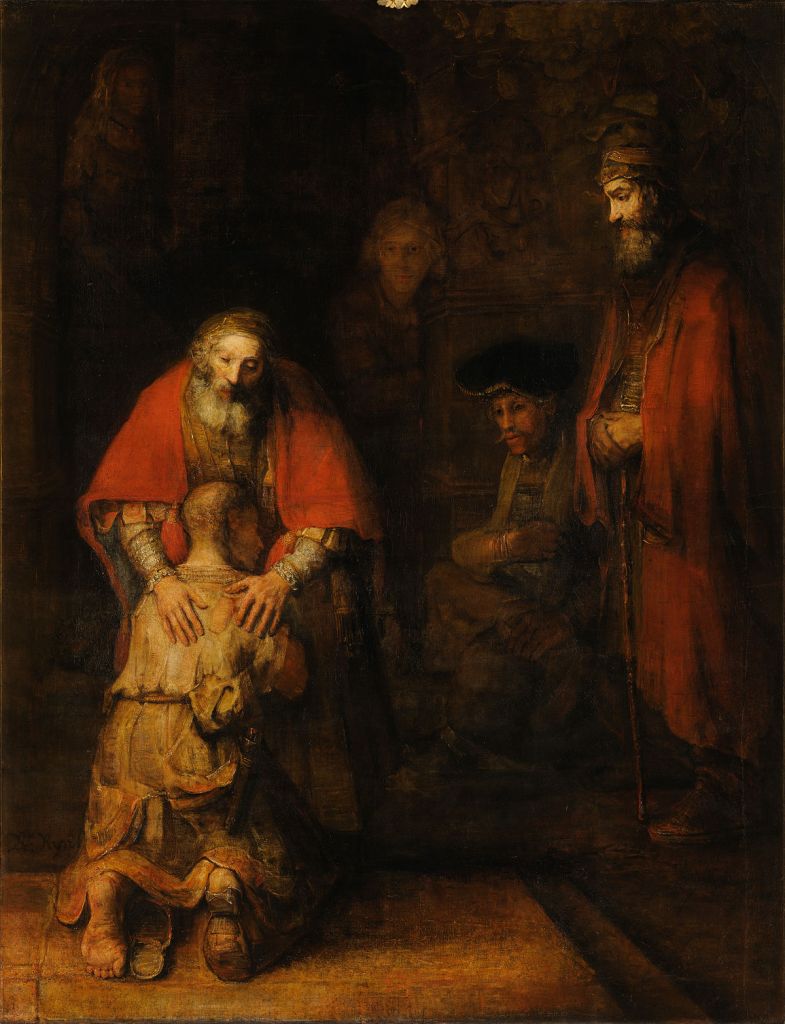
The Return of the Prodigal Son by Rembrandt (c.1661-1669). From Google.
Then he said, “A man had two sons, and the younger son said to his father, ‘Father, give me the share of your estate that should come to me.’ So the father divided the property between them. After a few days, the younger son collected all his belongings and set off to a distant country where he squandered his inheritance on a life of dissipation.”
Luke 15:11-13
Feel the solemnity of Jesus in introducing this parable, shifting from lost sheep and lost coin to lost son, from things to persons because the elder son is also lost. It is the father who eventually restored the lost personhood of the two sons when he lavished them with his love and mercy towards the end of the story. And that is why this parable is so lovely as it reminds us of how unconsciously we are “dumping” our own personhood despite our bloated egos. Slowly we are becoming robots or worst, even zombies without feelings and personal relations with others and with one’s self.
Just like the two sons in our parable who both define sonship in terms of servile obligations that is utilitarian and contractual in relationships, not as a family.
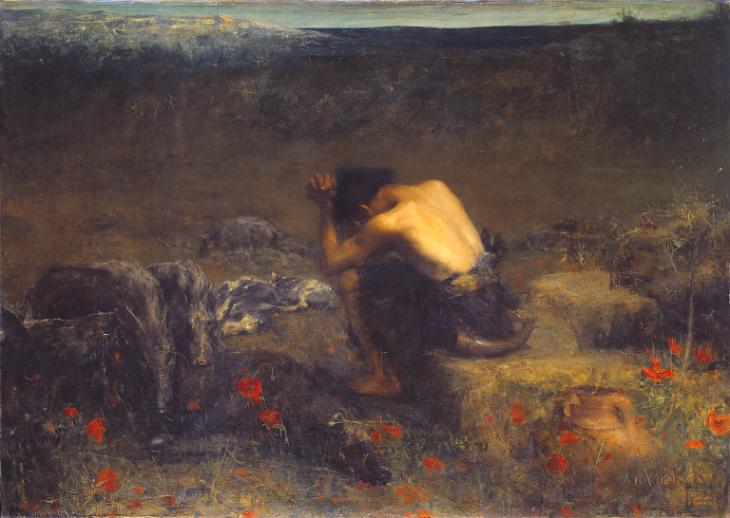
The Prodigal Son by John Macallan Swan, 1888. From Google.
Coming to his senses he thought, ‘How many of my father’s hired workers have more than enough food to eat, but here I am, dying from hunger. I shall get up and go to my father and I shall say to him, “Father, I have sinned against heaven and against you. I no longer deserve to be called your son; treat me as you would treat one of your hired workers.”
He (elder son) said to his father in reply, “Look, all these years I served you and not once did I disobey your orders; yet you never gave me even a young goat to feast on with my friends. But when your son returns who swallowed up your property with prostitutes, for him you slaughtered the fattened calf.”
Luke 15:17-19, 29-30
The prodigal son remembered his father when he was starving, thinking more of the food he could have if he returns home as a servant, not as a son. See how in the midst of sin, he never thought of his father as his parent, of himself as a son. He was convinced that the path to reconciliation with his father was becoming a hired worker, forgetting the very fact he is the youngest son.
The same is true with the elder son who refused to join the celebration when his brother had returned home, feeling so bad that his long years of service to his father deserve him a reward. In a sense, he is worst than the prodigal son: no father, no brother – just himself alone!
Both sons have a slanted view of their father, a very truncated one that is self-isolating, very constricting like the Pharisees and scribes who have forgotten their being persons, of being interrelated with one another in God. Very much like us today that slowly as the ties that bind us as family and friends are slowly being severed by so many things, we also start to lose many of our values like “malasakit” or concern for one another.
The father redefined their – and ours, too – relationships as family that lead to joy and celebration.
He (father) said to him, “My son, you are here with me always; everything I have is yours. But now we must celebrate and rejoice, because your brother was dead and has come to life again; he was lost and has been found.”
Luke 15:31-32
Santorini. Photo by Dra. Mai Dela Pena, 2016.
Today, Jesus reminds us, and assures us too that no matter what happens with us, we will always be his brothers and sisters, beloved and forgiven children of the Father.
We call and relate with God as Father because as his children, he is our giver and keeper of life.
And should this life get lost, God as our Father, can also be so “prodigal” to “wastefully” love us and bring back this life to us for we are more valuable than anything else in this universe. That’s how wild and wide is his love and mercy. Amen.
The Lord Is My Chef Sunday Music, 08 September 2019
Photo by Ms. Jo Villafuerte at Atok, Benguet, 01 September 2019
Our gospel today is so personal.
Sometimes, we have to be unreasonable — and be personal — when the only explanation and justification we can have for continuing to love and forgive, to care and accept people is “because of Jesus Christ”.
“If any one comes to me without hating his father and mother, wife and children, brothers and sisters, and even his own life, he cannot be my disciple.”
Luke 14:26
There are times in our lives when we are so down and everything is so dark when all we need is the warmth of a loving heart and a loving face of another person. No ifs, no buts but just because of you.
This is the reason Jesus is very clear today with his words, “hate” one’s self as well as those closest to us to stress that when things get worst, our only reason is him alone. We love, we forgive, we care despite all the pains and hurts because of our communion in Jesus Christ.
Jesus is the only one who would really stand us, offering himself up on the Cross for you and for me.
That is why for this Sunday we have chosen Beng E. King’s 1961 hit “Stand By Me” that was rereleased in 1986 as theme of a movie with the same title.
The song speaks of the undying love and fidelity of a man to the woman he loves. It is partly the same story of the friendship of those for boys in the said movie.
King’s music has been covered by so many other artists over the years for its reflective music and poetry that evoke deep personal love that transcends reason and conventions. No wonder, it was sang at the wedding last year of Prince Harry and American Meghan Merkle, a true-to-life love story that seems can only happen in Hollywood.
But that is the beauty of the song and Christ’s gospel: everything can happen when we are willing to give up everything including our very selves in the name of love for another person.
The Lord Is My Chef Sunday Recipe, Week XXIII-C, 08 September 2019
Wisdom 9:13-18 ><)))*> Philemon 9-10, 12-17 ><)))*> Luke 14:25-33
Photo by Ms. Jo Villafuerte at Atok, Benguet, 01 September 2019
“A loveless world is a dead world, and always there comes an hour when one is weary of prisons, of one’s work, and of devotion to duty, and all one craves for is a loved face, the warmth and wonder of a loving heart.”
Albert Camus, “The Plague”
I always tell people not all days are bright and sunny but, there comes a time when we are so down, when all is so dark and even hopeless that the only thing left for us is to believe, to hope, and to love.
There is really nothing we can do except to patiently wait for the storm to pass while we suffer alone and cry alone. That is when we are surprised and even shocked at how the gospel of Jesus and the commandments of God can sometimes be so rigid that we want it modified even a little because we want to get even, we want to fight back. If we are not busy thinking of revenge, we complain, asking God why me who should suffer?
But, the more we pray and submit ourselves to God, the more we realise that God’s ways are not our ways. That despite the difficulties, we feel deep inside God is with us, guiding us, leading us to something better!
“Who can know God’s counsel, or who can conceive what our Lord intends? Or who ever knew your counsel, except you had given wisdom and sent your holy spirit from on high? And thus were the paths of those on earth made straight.”
Wisdom 9:13, 17-18
Photo by Ms. Jo Villafuerte at Atok, Benguet, 01 September 2019
Here we find the importance of Christ’s teaching last Sunday, of the need to be humble, to be our true selves by being where we should be for “those who humble themselves will be exalted and those who exalt themselves shall be humbled.”
It is in our poverty, in our weakness, even in our incomprehension when the Holy Spirit works well to reveal to us the higher realities of life often wrapped in every pain and suffering we go through. And that is why sometimes in life, it is best to be unreasonable when the only explanation and justification we can have in still being loving and forgiving, merciful and understanding, kind and patient is the person of Jesus Christ.
“If any one comes to me without hating his father and mother, wife and children, brothers and sister, and even his own life, he cannot be my disciple.”
Luke 14:26
Photo by the author, Holy Family Chapel, Sacred Heart Novitiate (Novaliches), July 2016.
Our gospel today is a continuation of last Sunday when Jesus was invited to a Sabbath dinner by a Pharisee. After giving them some “table talks”, Jesus told them another parable about the great feast to stress that God’s mercy is so vast that there is room for everyone in heaven.
People started to follow him after that meal and lesson on heaven, wanting to become his followers and disciples. To further motivate them in following him, Jesus challenged them with these powerful words using a figure of speech. The word “hate” may be too strong and harsh but such is the gravity of discipleship: we have to lose our very selves even those dearest to us when we have to see everything and everyone in the person of Jesus. To “resolutely follow Jesus in his journey to Jerusalem”, we must be ready to be totally his with him alone as the basis in every decision that can be sometimes foolish like St. Paul who claimed in one of his writings he was a fool for Christ!
See the “foolishness in Christ” of this great apostle: St. Paul was in prison at Rome awaiting trial and judgement. A slave named Onesimus escaped his Christian master named Philemon. It was definitely against the law to harbor escaped slaves yet St. Paul welcomed Onesimus in his prison as his companion and servant! More than that, without really knowing him well, St. Paul baptised Onesimus to become a Christian!
Imagine St. Paul’s adherence to the gospel of Christ even to the point of being unreasonable when he could have just told Onesimus to go back or go somewhere else and spare him all the troubles! But no. It was very clear with St. Paul in asking Philemon to receive Onesimus back that he was not sticking to any moral standards or laws but solely on the person of Jesus Christ, in our communion in him as brothers and sisters.
“Perhaps this is why he was away from you for a while, that you might have him back forever, no longer as a slave but more than a slave, a brother, beloved especially to me, but even more so to you, as a man and in the Lord. So if you regard me as a partner, welcome him as you would me.”
Philemon 15-17
Photo by Ms. Jo Villafuerte at Atok, Benguet, 01 September 2019.
Next Sunday we shall hear the very long but beautiful parable of the merciful father also known as parable of the prodigal son. Like God our Father, the merciful father would reassure his two sons of his immense love for them despite their sins because of their very persons as his sons.
Today in our Sunday Eucharist, Jesus welcomes us all as persons, his brothers and sisters despite our sins and weaknesses. Like Mary whose birth we also celebrate today inspire us to receive Jesus our Savior in his total person in ourselves by receiving the persons around us in him. Amen.