Quiet Storm by Fr. Nicanor F. Lalog II, 19 April 2021
The beauty of this movement
sweeping our country
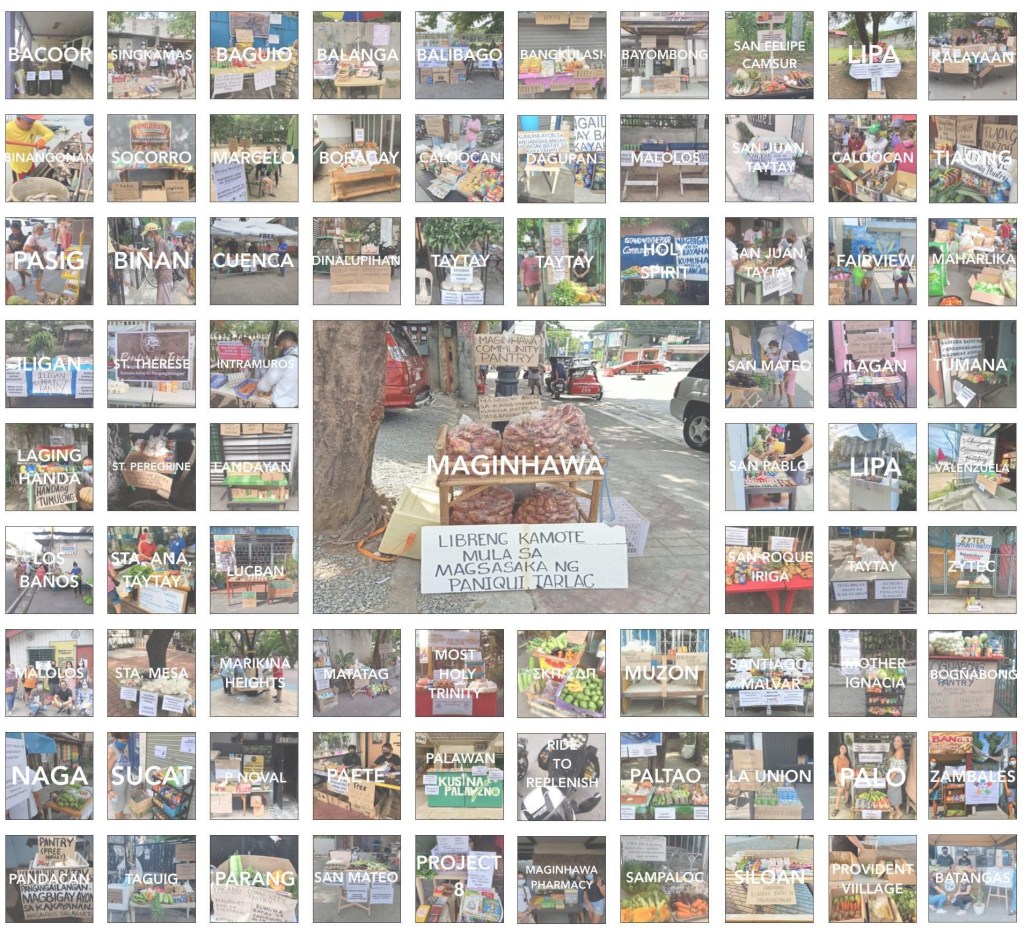
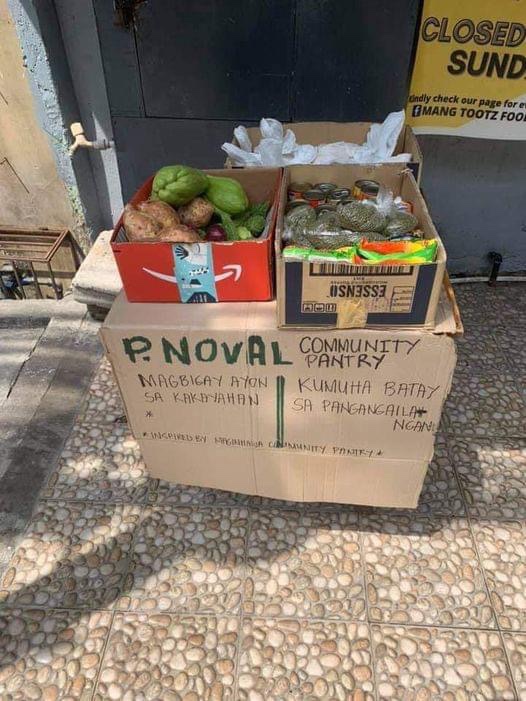
called "Community Pantry"
is its essential Christianity:
"The community of believers
was of one heart and mind,
and no one claimed that any
of his possessions was his own,
but they had everything in common."
(Acts 4:32)
Earlier in our Church history
the esteemed theologian Tertullian
was so delighted to see
how the early Christians
loved one another
and how they were ready
to die for each other
exactly the same scenery
we are having in our country this 21st century.
It all started simply
when in the street translated loosely
as living comfortably (Maginhawa)
somebody suddenly see
"any body" as a "some body"
can help alleviate our poverty
when we start to see "every body"
as a brother and a sister living simply
with one community pantry so "no body" goes hungry.
And the rest was history
as the story of good deeds inspired many
putting up their community pantry
and the best part of the mystery
there is no talk of money and popularity
plain and simple spirit of humanity
in the spirit of fraternity and equality
fulfilling the minimum requirement of charity
that is justice and mutuality.
There is a saying that
"Necessity is the mother of invention"
but this community pantry that I see
is more than an invention or an innovation
but an extension of the fellowship of the table
where Jesus Christ is the invisible guest
appearing, speaking, and sharing a meal
that fills our stomach and delights our soul
animating our hopes for a better future.
This community pantry
is a bright ray of hope,
a silver lining in the storm
that hit our nation last year
when this administration
not only belittled but was also
unprepared for the pandemic.
Is it a new kind of people power revolution?
Then, by all means, let it bloom!
Posted by Jean Palma on Facebook, 18 April 2021 with the caption: “All these community pantries in four days, and counting. What a powerful movement.” #CommunityPantry
*All photos used are from the Philippine Daily Inquirer, 17 April 2021.
The Lord Is My Chef Sunday Music by Fr. Nick F. Lalog II, 18 April 2021
Photo by author, 2020.
Don't want to open your heart
You're afraid from the start
That a new love's gonna let you down
There is something you should know
Before you give up and go
I don't believe in the run around
I just want to define myself
And show you how I feel
Yes! We’re feeling so romantic this Sunday because of this great love we’re feeling deep inside.
Like you, we have fallen in love, we have been hurt and disappointed, even felt betrayed and forgotten by a beloved that too often, we have closed our doors to new love, new relationships out of fear of being hurt again.
But, as Daryl Hall and John Oates sang in 1997 from their Marigold Sky album we thought would be their last (thankfully not!)….
If a promise ain't enough
Then a touch says everything
Got to hold you in my arms
Till you feel what I mean
Know that my heart just tells me what to say
But words can only prove so much
If a promise ain't enough
Hold onto my love
No… we’re not talking of a special relationship with anyone.
We’re feeling so good today because it is our 23rd year of Ordination to the priesthood – a love relationship like those of between a husband and wife that demands fidelity and trust, respect and kindness, mercy and forgiveness.
And a lot of prayers!
Human love is imperfect; only God can love us perfectly.
Too often in life, we we get hurt in so many ways, some so severe, others may be dismissed but still, every pain always leaves a mark in us that sometimes prevents us from loving again.
The disciples of Jesus felt the same: they thought he was gone after seeing his Crucifixion on Good Friday that when he suddenly appeared to them, they were so amazed and could not believe it so true that the Lord had risen (https://lordmychef.com/2021/04/17/jesus-in-our-midst/).
The same feeling we have when we love again.
When we forgive, when we move on, when we let go and let God.
Whenever we go back to our “Jerusalem” – to our crucifixion and sufferings, we are purified by Jesus, opening our minds and our hearts of how despite all the pains, the gains still outweigh the past that we can look forward to better days ahead as we share in his new life now.
So many times in our lives, in our relationships with one another, Jesus comes as the invisible guest, always appearing, speaking, and sharing meal with us. And after sometime, as we look back to our past, we feel deep inside how our hearts burned during those times we were not aware of Christ’s presence.
It is true, we humans make so many promises to be broken but only Jesus is keeping them.
Welcome him especially amid the many pains and darkness, let his love be perfected in your perseverance and you shall see…
It took a lifetime to find what I want
I won't let it get away
If a promise ain't enough
Then a touch says everything
Got to hold you in my arms
Till you feel what I mean
Know that my heart just tells me what to say
But words can only prove so much
If a promise ain't enough
Hold onto my love
If a promise ain't enough
Hold on
If a promise ain't enough
Hold onto my love
This is one of Hall and Oates’ most loved love songs that tells us the basic truth about love: it is best expressed in actions than in words.
The Lord Is My Chef Sunday Recipe for the Soul by Fr. Nicanor F. Lalog II
Third Sunday in Easter, 18 April 2021
Acts 3:13-15, 17-19  ><)))*>  1 John 2:1-5  ><)))*>  Luke 24:35-48
After listening to the accounts of the beloved disciple John, we now reflect on Luke’s story of the Resurrection which is a continuation of the gospel proclaimed in the afternoon of Easter, the Road to Emmaus.
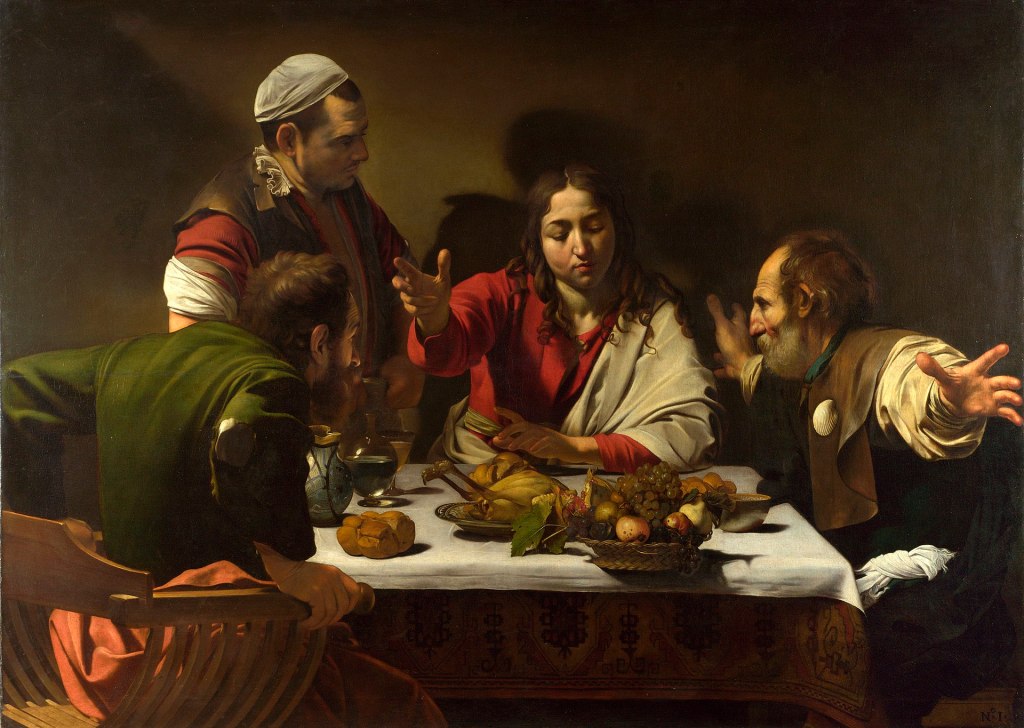
Recall how the two disciples did not recognize the Risen Lord when he joined them on their way back to Emmaus saddened with his death, doubtful of his resurrection. Upon reaching home, they invited the Lord for a meal when after breaking the bread, they recognized it was Jesus who had then vanished from their sights!
Both hurried back to Jerusalem to tell the rest of the disciples of their encounter with the Risen Lord.
While they were still speaking about this, he stood in their midst and said to them, “Peace be with you.” But they were startled and terrified and thought they were seeing a ghost. Then he said to them, “Why are you troubled? And why do questions arise in your hearts? Look at my hands and my feet, that it is I myself. Touch me and see, because a ghost does not have flesh and bones as you can see I have.” And as he said this, he showed them his hands and his feet. While they were still incredulous for joy and were amazed, he asked them, “Have you anything here to eat?” They gave him a piece of baked fish; he took it and ate it in front of them.
Luke 24:36-43
Painting by Caravaggio of the Emmaus Meal from commons.wikimedia.org.
Many times in life
 we feel it more "fearful" in the positive sense
to believe in God than in ghosts
because God is very real
when ghosts are not true at all.
Jesus appearing, speaking, and sharing meal
Both evangelists John and Luke consistently tell us in their Easter stories the three manifestations of the Risen Lord to the disciples: appearing, speaking, and sharing meal. All three acts belong together as one to remind the disciples of what transpired during their Last Supper, fulfilled on Good Friday.
But, there is something deeper in the dynamics of these three acts when seen from the perspective of Luke. And we have to look back to the beginning of this story on the road to Emmaus where we find Luke using a pattern of presenting an outward sign of Jesus appearing, speaking and sharing meal with the disciples who were then led to an inner recognition of the Risen Lord.
Notice that outwardly while walking, the disciples did not recognize Jesus as the man walking with them, speaking to them about the scriptures. Inwardly, something was happening with them: Then they said to each other, “Were not our hears burning within us while he spoke to us on the way and opened the scriptures to us?” (Luke 24:32)
This pattern of outward signs and inner recognition becomes strongest when Jesus shared meals with the disciples: And it happened that, while he was with them at table, he took bread, said the blessing, broke it, and gave it to them. With that their eyes were opened and they recognized him, but he vanished from their sight (Luke 24:30-31).
Exactly the same thing happened in this manifestation we now have in Jerusalem: the outward signs of the Risen Lord appearing to the disciples, showing them his hands and his feet. The disciples were amazed, could not speak at all upon seeing Jesus Christ alive, speaking to them, reminding them of his teachings before and most especially, shared meal with them by eating a baked fish to prove he is not a ghost.
Then, he spoke again to remind them of his earlier teachings of the scriptures being fulfilled in him through his Passion, Death and Resurrection, leading to the inner recognition by the disciples: Then he opened their minds to understand the Scriptures (Luke 24:45).
Painting by Frenchman James Tissot “Appearance of Christ at Cenacle Room” from commons.wikimedia.org.
Many times in life we feel it more fearful in the positive sense to believe in God than in ghosts because God is very real when ghosts are not true at all. “Mas nakakatakot maniwala sa Diyos kesa multo kasi ang Diyos ay totoong-totoo habang ang mga multo ay hindi.”
Amid the many outward signs we see unfolding right before our eyes, we could not help but believe as we are overwhelmed with God’s presence, with his love and mercy for us in the most personal way. The German Lutheran theologian Rudolf Otto called it as “mysterium tremendum” and “mysterium fascinans” when we feel so small like a tiny speck of dust in this vast universe yet so special, so loved by the almighty God.
There is that realization of our sinfulness, of our shortcomings before the Lord and yet still loved and forgiven like what Peter taught the people in his teaching after Pentecost at Jerusalem. Four times in four verses Peter spoke to the people with the second person pronoun YOU to stress their complicity in the crucifixion of Jesus, “you handed over and denied (v.13); you denied the Holy (v.14); you put to death (v.15)”; and finally, the saving declaration:
“Now I know, brothers, that you acted out of ignorance, just as your leaders did; but God has thus brought to fulfillment what he head announced beforehand through the mouth of all the prophets, that his Christ would suffer.”
Acts 3:17-18
Whenever we commit sins. when we refuse to love others, we become that “YOU” of Peter who hand over and deny Jesus, putting him to death whenever we reduce persons into things or take God’s blessings like food for granted.
From the Facebook page of artist Mr. Dengcoy Miel, 01 April 2021.
The “essential” table fellowship
Aside from proving to his disciples that he is risen, Jesus Christ’s appearance, speaking, and sharing of meals with them continues to our time in the Holy Eucharist where he brings us to a new covenant in the table fellowship with him and the Father in heaven.
In the Holy Eucharist, Jesus gives us a share in his very life, allowing us to participate in his Resurrection through the purifying power of his Passion and Death.
From the days of the Apostles up to our own time, the celebration of the Mass had gone through many changes and reforms but its very essence has always remained as the Real Presence of Jesus Christ among us in outward signs perceptible to our senses like the proclamation of the Word, the sharing in the Lord’s Body and Blood, and the communion of members of the community gathered in every celebration.
Like the disciples of the Lord during that Easter evening, we continue to experience an inner awakening within us of his presence, of his very self.
That is why Vatican II as well as St. John Paul II had always insisted that the Eucharist is the summit of our Christian life, that everything in our lives and in our parish especially must flow from the Eucharist. This is the reason that even with the COVID-19 lockdowns, Masses continue to be celebrated by priests even in private without the congregation because it is our source of nourishment especially in these times of crisis.
These community pantries now sprouting
are in itself extensions of table fellowship with Jesus as the unseen guest -
appearing, speaking, sharing meals with us -
literally giving us food for the stomach, delighting our souls.

  It is another Easter and Pentecost happening in our midst,
of Jesus coming to us,
truly alive in the Holy Spirit among people
gathered in loving service for one another,
a perfection of the love of God in us!
Photo from Elijah San Fernando, Philippine Daily Inquirer, 16 April 2021.
See the recent “miracles” happening lately about this “community pantry” that started in Maguinhawa Street in Quezon City now fast spreading to other areas in Metro Manila with some farmers from the provinces giving their share of farm produce.
What a beautiful proof of the fulfillment of John’s words in our second reading today: “But whoever keeps his word, the love of God is perfected in him” (1Jn.2:1-5)!
These community pantries now sprouting are in itself extensions of table fellowship with Jesus the unseen guest – appearing, speaking, sharing meals with us – literally giving us food for the stomach, delighting our souls.
It is another Easter and Pentecost happening in our midst, of Jesus coming to us, truly alive in the Holy Spirit among people gathered in loving service for one another, a perfection of the love of God in us!
Photo by Toots Vergara, Philippine Daily Inquirer, 16 April 2021.
This Sunday, let us experience Jesus our guest right in our family, in our homes as we gather in our table without our gadgets and prejudices against each other, having only our very presence and fellowship in love and mercy, kindness and care as we feed our bodies as well as our souls. Amen.
*Please say a prayer for me and my six other classmates today as we celebrate our 23rd year of ordination to the priesthood (18 April 1998, Malolos Cathedral by Abp. Rolando J. Tria-Tirona). Salamuch and God bless you all! fr nick
The Lord Is My Chef Breakfast Recipe for the Soul by Fr. Nicanor F. Lalog II
Wednesday in the Second Week of Easter, 14 April 2021
Acts 5:17-26   ><)))*> + ><)))*> + ><)))*>   John 3:16-21
Photo by Mr. Red Santiago, 2019.
But during the night,
the angel of the Lord opened the doors of the prison,
led the Apostles out and said,
"Go and take your place in the temple area,
and tell the people everything about this life."
When they heard this, they went to the temple area
early in the morning and taught.
(Acts 5:19-21)
Your words today, O Lord Jesus are so encouraging: “Go and take your place in the temple area, and tell the people everything about this life.”
Oh yes, dearest Jesus, give us the courage and zest to go and take our place where you have designated us to proclaim your good news about this life especially in this time of the pandemic.
Take away our fears and doubts, our complacencies and laziness in stopping and putting on hold our mission from you, your plans for us because of this pandemic. Let us focus on you, Jesus, and forget all about fame and rewards nor faintest recognition in “taking our place” to do your work.
During your mortal life here on earth, Lord, you could not proclaim the kingdom of God beyond the Holy Land. Now you have risen from the dead and seated at the right hand of the Father, those bonds and barriers have been broken through your apostles down to us your modern disciples. Keep us faithful in telling the people everything about this life which is so beautiful, so precious, so worth saving!
Like you who have faithfully took your place to tell us everything about this life, may we share you to everyone we lovingly serve.
God so loved the world
that he gave his only-begotten Son,
so that everyone who believes in him
might not perish but might have eternal life.
(John 3:16)
Photo by author, Chapel of the Holy Family, Sacred Heart Spirituality Center, Novaliches, 2016.
Dearest Lord, please bless and keep safe those who continue to take their place the Father has reserved for them like you our Savior. We pray for their well-being and safety, for their fulfillment in you our Lord and God.
Bless first of all our medical frontliners, everybody working in the hospitals who continue to take their place and tell people everything about this life despite the great dangers and risks of getting sick.
Bless all Dads and Moms, couples and their children who remain faithful to you, avoiding sins, seeking you in prayers daily amid the great difficulties of balancing economics and well-being.
Bless all teachers and students in this difficult period of on-line classes as well as those in their limited face-to-face classes that all their efforts will someday bear fruit in their professional lives and earn them eternal rewards too.
Bless your priests, Lord Jesus, especially those faithfully serving your flock, celebrating the Holy Mass even without your people, giving the sacraments and praying for those lost and weak souls due to this pandemic. Wake up your tepid priests, awaken the moral fiber of your unfaithful priests.
Bless those in news and social communications that despite the dangers of this pandemic they continue to search and report the truth. Encourage those being harassed and threatened like your Apostles before in telling the truth, in exposing and unmasking evils in government and the society.
Bless everyone of us, Lord Jesus Christ, that we may be faithful to your call, that we may always have the courage to take our place amid this pandemic and continue to lovingly serve one another, especially the weak and the poor. Amen.
Quiet Storm by Fr. Nicanor F. Lalog II, 05 April 2021
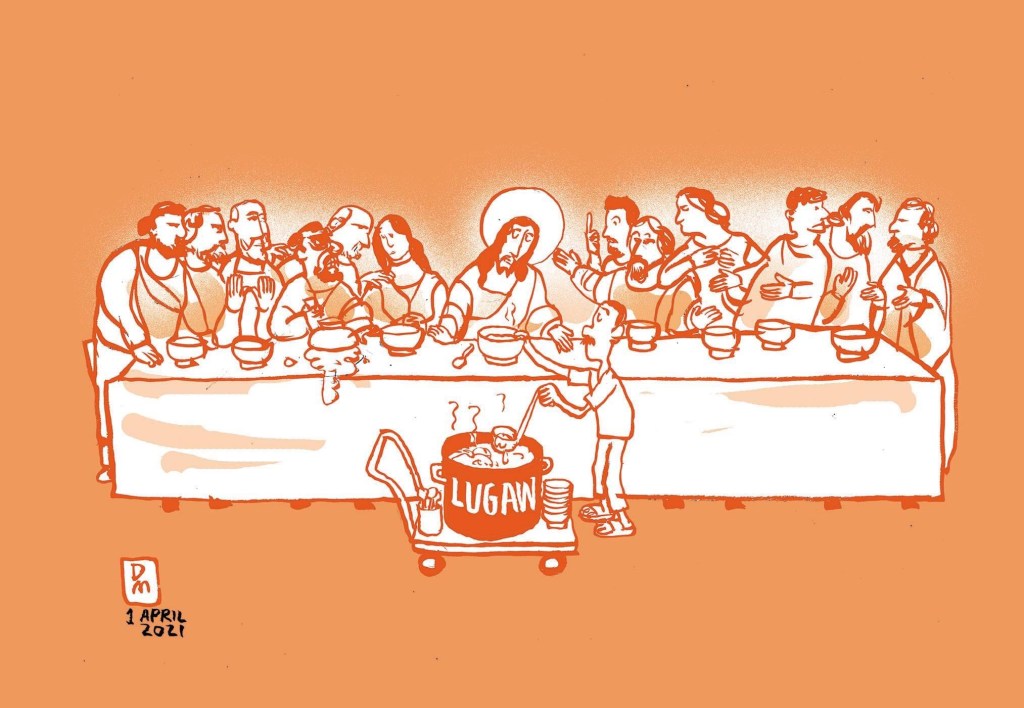
“An Essential Holy Thursday Transubstantiation” by artist DengCoy Miel posted on his Facebook, 01 April 2021.
It was a Holy Wednesday when the incident went viral as picked up by network news that evening when the previous night some barangay officials in Muzon, San Jose Del Monte, Bulacan insisted that lugaw is “not essential”, that man can live even without lugaw.
The timing was so perfect being a “Spy Wednesday” or the night of traitors when Judas Iscariot struck a deal with the chief priests to hand them over Jesus for 30 pieces of silver (Mt.26:15).
And so, there were the three barangay officials handing over to their power trip the common lugaw not knowing they have in fact betrayed us Filipinos in their arrogant insistence that lugaw is a non essential food.
The following Holy Thursday, another Judas Iscariot not only betrayed but crucified si lugaw as non-essential without knowing his remark was a self-indictment of this government’s preoccupation with politics, disregard for the people and lack of any definitive plan regarding the year-old pandemic. Trying to sound a smart aleck and clown rolled into one this administration has too much of, his explanations only made him look like the lowest kind of lugaw – rice leftovers boiled in water.
The benighted souls who have denigrated our favorite food have just proven that this pandemic is something we have to see in the light of spirituality and morality, not just a medical and social issue to be addressed.
Any food is always essential because every food signifies a person, has life and sustains life.
Recall that during his Last Supper on the night before he was betrayed, Jesus had chosen the most ordinary but very essential food to be the sign of his loving presence among us until the end of time – the bread. An unleavened bread, to be exact, which was the food taken by the Jews during their exodus from Egypt at the time of Moses.
The bible teems with so many references to the lowly food of bread as something divine with deeper meaning as a sign.
Consider that Jesus was born on a manger which is an open box or a trough for animals like horses and cattle to eat from to signify his being our very food in this life journey. He was born in Bethlehem that literally means “house of bread”; thus, at his last supper, Jesus gave himself to us under the sign of a bread.
In establishing the Sacrament of the Holy Eucharist which St. John Paul II emphasized in 2002 by adding the Mysteries of Light in praying the Rosary, Jesus elevated the meal into the most sublime human activity making our food divine and holy. As a result, the table had become one of the most intimate places in our lives that every time there is a meeting or any gathering, there is always the meal to be shared. I used to tell my students before that every first date is always in a restaurant – if possible a fine dining one – because what matters most is the moment to be shared together by you and your date.
It is always easy to know when couples and parents are not in good terms with each other: they never eat together or during meals, they do not talk or speak to each other. The same is true when people decline our invitations for dinner or party or simple meal: they do not want to be with us. Period. That is why Judas Iscariot had to leave and not finish the Lord’s supper!
See that we never call people as “enemies”: like Jesus Christ, as much as possible we welcome everyone to our table to share meal with us and it is only then when we realize who is our enemy when like Judas, some people stab us in our backs while sharing meal.
When we eat and share food and drinks, we actually share our very selves to our guests and friends. We host parties because we want to share our very selves with our family and friends, to share and be a part of our lives, of our achievements, of our important stages in life. Their coming signify the same willingness to share us their lives too.
Photo by desiringgod.org, April 2019.
The food we share are signs of our bonding, of our relationships, of how we care and respect for one another. It does not really matter what food we share. More often, the most simple and ordinary food are the ones that truly delight us like tuyo. Or lugaw!
How I wish parents today would bring back those days of old when nobody is supposed to waste not even a single grain of rice or any food for that matter because it is from God.
When we were growing up, every meal was the most awaited family time not because of the food but more of the bonding and exchanging of stories. As we age, it has become more truer than ever! That is why we all wish this pandemic would end so we could all eat together as families and friends, is it not?
Any food is always essential because every food signifies a person who has life and sustains life of others.
Every one of us is a companion to each other. From the two Latin words “cum panis” that mean someone you break bread with, a companion is a friend, a fellow traveler who sustains and nourishes you like food in your journey!
In that beautiful story of the road to Emmaus when Jesus appeared to two disciples disappointed with his death and news of his empty tomb on Easter, they recognized him only after he had broken bread but simultaneously disappeared because at the table of the Lord, we also become his Body meant to be shared with everybody.
The recent issue that went viral on whether lugaw is a non-essential or not is a tragic indication of the kind of people we are, of how we categorize persons like food.
There seems to be a direct correlation
between food and humans:
when there are plenty of food,
that is when people are taken for granted,
while where there is scarcity of food, people are valued.
Take the case of ice cream. When somebody is rich and young and beautiful or handsome, they are the “flavor of the month” or the “all-time favorite” and “classic” or “premium”.
And how do we call our ordinary ice cream peddled by Mamang Sorbetero? “Dirty ice cream” – dirty because ordinary and cheap like the street kids, the poor, the “wa-class” and opposite of the more expensive sosyal ice cream.
Worse, with so much food available these days unlike before when we valued every food so much because we can only have apples (and softdrinks) when sick or chocolates when relatives from the States sent packages or some rich neighbors brought you as pasalubong from Dau’s PX stores outside Clark Air Base in Pampanga, things today have also changed in the way we relate with one another.
There seems to be a direct correlation between food and humans: when there are plenty of food, that is when people are taken for granted while where there is scarcity of food, people are valued.
As more food are readily available these days, the more we have become choosy, the more we categorize food as essential and non-essential that at the same time, the more we denigrate humans.
Such was the plan of Satan with his first temptation to Jesus – turn stones into bread after fasting for 40 days in the wilderness.
For Satan, let us have more food and things to satisfy our body so we forget God and one another, and everything of higher value. When food is retained in the stomach and becomes an end in itself, it then becomes an occasion for sin like gluttony, exactly what Satan was pushing for so that we just keep on filling our stomachs with food, satisfying the cravings and desires of the body until we destroy ourselves and our image as likeness of God.
Jesus put food into the right perspective that God is our real and true food that in two instances at least, he fed vast crowds of people in the wilderness after seeing them rightly disposed for material food.
Call it as generation gap but I am shocked when I hear some people especially the young describing handsome men and pretty women as “yummy” and “delicious” like food. Problem with that kind of mentality is how it shows we have come to regard everybody like food that if we are no longer “fresh” or “new”, becoming “old” and stacked in the cold fridge, later to be discarded or thrown out like old people being sent to retirement homes totally unknown to us 40 years ago.
Worst of all is how this administration launched its bloody campaign against drugs when addicts and other criminals were considered as non-essentials to be eliminated or killed like animals – exactly the deeper implication of what that government official kept saying last Holy Thursday that “non essential si lugaw”!
Since last year’s Holy Week when we first went into this lockdown, I have been telling friends to avoid as much as possible posting their lavish food on Facebook as a sensitivity to others with almost nothing to eat. And I maintain it is still valid to this time of this worsening crisis.
Let us be food to everyone as source of strength and nourishment, of inspiration. We do not have to make extraordinary efforts. Simply be human as yourself. Be present with a text or a phone call to those suffering. Pray for them and let them know you care for them.
Be a lugaw who could warm someone’s cold body freezing in fear and anxiety, offering quick relief from whatever suffering others may be going through.
Most of all like a hot, steamy lugaw, giving hope that Jesus is with us, his salvation is coming soon.
Remember, friends, lugaw is essential.
And so is everyone.
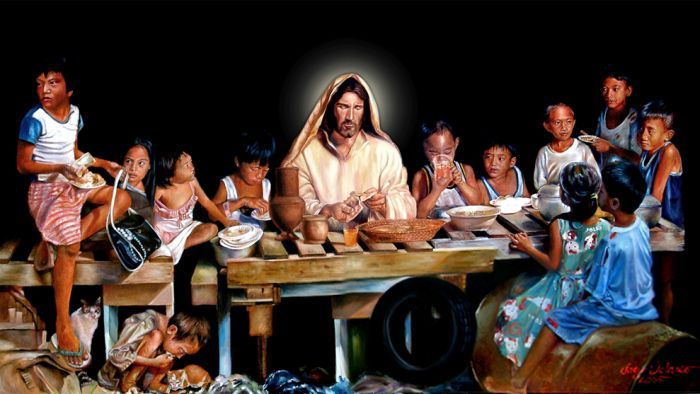
The late Joey Velasco’s 2005 painting “Hapag ng pag-Asa”.
The Lord Is My Chef Good Friday Recipe by Fr. Nicanor F. Lalog II, 02 April 2021
Isaiah 52:13-53:12  +  Hebrews 4:14-16; 5:7-9  +  John 18:1-19:42
Photo by Marc Angelo Nicolas, January 2020.
"Biyernes Santong Biyernes Santo."
(A popular expression among us Filipinos.)
Perhaps, today we can truly feel the meaning and gravity of our favorite expression when somebody looks so sad and gloomy, when somebody seems to have been totally lost: “Biyernes Santong Biyernes Santo”.
That is how we are today – stuck in our homes, others in hospitals while others almost about to give up as this new wave of COVID-19 gets stronger with about 15000 infections today!
As I have been saying since Palm Sunday, this could be our holiest Holy Week in our lives in this most unholy time of our history when we are given the opportunity to be holy, to be good and kind, to be forgiving and caring with others. Side by side every post in Facebook we find prayer requests for sick family and friends, help for those trying to find a hospital that would admit their sick, or buy much needed medicines and equipment like oxygen.
For the second straight year, churches are empty and everyone is home due to COVID-19 pandemic. Perfect example of “Biyernes Santong Biyernes Santo”… so bad… so negative.
That is often how we think of Good Friday – so negative in the sense it is so sad and gloomy, so painful and too difficult.
Ultimately, Good Friday is so negative for us because it means death. Even of the Son of God, Jesus Christ. Nothing would be more sad than that.
Photo by author, Chapel of the Holy Family, Sacred Heart Spirituality Center, Novaliches, QC, 2015.
Lately due to this COVID-19 pandemic we have been living inversely or “baligtad” as we say.
We would always pray at every swab test for the virus that we be “negative”.
Never has been thinking negative has become so positive, so good, in fact!
And it all began more than 2000 years ago at the calvary when Jesus offered himself for us on the cross.
That is why Good Friday is called “Good”: the cross of Jesus Christ is a sign not of death but of the good news or gospel of life, hope, and eternal life. The cross of Jesus Christ is not a negative sign (-) but a positive sign, a plus sign (+).
We celebrate in the most solemn and unique way because the cross is no longer a sign of condemnation but honor. Before, it was a symbol of death but now a means of salvation. The cross of Christ has been the source of countless blessings for us, illuminating our path with light when our lives are so dark with sins and mistakes, sickness and disappointments. Most of all, the cross of Christ has brought us closer to God again and with one another despite our sins and past, promising us a bright a joyful Easter.
Yes, for some the cross of Christ is so negative: why display the body of the Lord everywhere in our churches and homes, bloodied and defeated, lifeless and dead?
See, my servant shall prosper, he shall be raised high and greatly exalted. Even as many were amazed at him – so marred was his look beyond human semblance and his appearance beyond that of the sons of man – so shall he startle many nations, because of him kings shall stand speechless; for those who have not been told shall see, those who have not heard shall ponder it.
Isaiah 52:13-15
Many times in life, and we have proven this, God uses of many of “negative” experiences lead us to more positive outcome and results.
Yes, we may be Biyernes Santong Biyernes Santo in sadness and fear, even anxieties.
But, we continue to pray and forge on with life’s trials and difficulties because we see the cross of Jesus Christ leading us to the light and life, joy and celebration of his Resurrection at Easter.
A very good Good Friday to you. Amen.
Photo by author, Chapel of the Holy Family, Sacred Heart Spirituality Center, Novaliches, QC, 2015.
The Lord Is My Chef Easter Triduum Recipe by Fr. Nicanor F. Lalog II
Maundy Thursday, 01 April 2021
Exodus 12:1-8, 11-14 ><)))*> 1Corinthians 11:23-26 ><)))*> John 13:1-25
"A journey of a thousand miles
begins with a single step."
- Lao Tzu
We often hear and use this wise saying that is also most applicable to our celebration of the Holy Triduum of the Lord’s Passion, Death and Resurrection also known as the “Sacred Paschal Triduum”.
From the Hebrew word pesach, a pasch is a passing over. It is a journey which is a long trip taken over long period of time to different places. A journey does not necessarily involve physical distance as it can be something within one’s self like an inner journey to God dwelling within us. Hence, a journey is also a process that leads us to growth and maturity from the many difficulties and trials we experience as we travel, entailing a lot of sacrifices from us.
And whatever journey we take outside or within our selves, we always need a companion to travel with. From the Latin words cum panis that literally mean “someone you break bread with”, a companion is someone who helps us in our journey, a friend who shares life with us, guiding us, protecting us. Like the bread we break and share, a companion sustains and nourishes us in our journey.
Let us keep these three words of journey, companion, and bread in reflecting our celebration tonight of the Lord’s Supper that begins the Sacred Triduum.
We are all pilgrims on a journey to heaven
More than 40 days ago on Ash Wednesday, we said Lent is a daily journey to Easter where we find our very selves, others, and God who is our ultimate origin and end. It is a journey that reaches its summit in the Holy Eucharist where we make present the pasch or passover of Jesus Christ
Every Mass is a journey into heaven, a dress rehearsal of our entrance into heaven when we have a foretaste of eternal life we all hope for until Christ comes again. It is the Passover of the New Testament, a perfection of the Jewish Passover when God’s chosen people led by Moses went into exodus from Egypt into the Promised Land.
This “heavenly” journey had its ancient roots among nomadic Semites who used to celebrate a feast on the first full moon of spring as they prepared to lead their flocks to summer pastures. They ate a roasted lamb from the flock with unleavened bread and bitter herbs. It was an important event of migration filled with many dangers for those nomads who marked their tent-pegs with the blood of the lamb to keep their journey safe.
Eventually this found place in the Jewish Passover which we heard in our first reading when God told his chosen people to begin their journey of exodus from Egypt “on the tenth of their first month” that happens on the second full moon of the spring equinox.
Notice that it happens at night that is coincidentally the usual start of every journey we usually make!
Before their Exodus, each family was told to roast an unblemished lamb to be eaten with unleavened bread and bitter herbs “with your loins girt, sandals on your feet and your staff in hand, you shall eat like those who are in flight. It is the passover of the Lord” (Ex.12:11). It has to be done in a hurry, as in a flight, a journey.
And to keep them safe in their journey, God instructed them to paint their door posts with the blood of the slaughtered lamb so that when his angel comes at night to strike death of every first born male child and animal, their homes would be “passed over” and be saved from death that night.
We are all travelers and journeyers on earth;
our true home is in heaven with God our Father.
We are merely "passing over" this planet temporarily.
Photo by author, Egypt, 2019.
Jesus our companion and family in the journey
The Jewish Passover or Exodus became the actual event of God’s covenant with Israel as his people on a journey to their Promised Land. Unfortunately, they would break this covenant with God so many times that it would take them 40 years of wandering in the desert before finally got into the Promised Land.
And their stubbornness continued when they would always turn away from God with sins that led to the division of their nation until its conquest by foreign powers that led them anew into another exile. God would restore them as a nation but, again, they would turn away from him until the Romans ruled over them when Jesus came to perfect God’s covenant.
In perfecting and fulfilling the Jewish Passover, Jesus became the new and everlasting Lamb, perfect without any blemish, offering himself to God for the forgiveness of our sins and our liberation from all forms of evil especially sickness and death. It is no longer the blood of the lamb that we now offer but Jesus Christ’s Body and Blood which he established in the Sacrament of the Eucharist “on the night before he was betrayed” on Holy Thursday.
By celebrating the Lord’s Supper that Thursday evening with his disciples who represented all peoples of all time, Jesus established for us the everlasting memorial of his loving presence as our companion and our very Bread and Wine in the journey back to the Father always filled with darkness and sufferings.
What he did that Thursday evening foreshadowed what he would do on Good Friday when he did his greatest act of love for us by dying on the Cross at about 3PM, the same time when the lambs were being slaughtered in the temple for the coming passover feast.
Brothers and sisters: I received from the Lord what I also handed on to you, that the Lord Jesus, on the night he was handed over, took bread, and, after he had given thanks, broke it and said, “This is my body that is for you. Do this in remembrance of me.” In the same way also the cup, after supper, saying, “This cup is the new covenant in my blood. ?Do this in remembrance of me.”
1 Corinthians 11:23-25
Here we find again the darkness of the night as the beginning of our journey back to God perfected by Jesus Christ as our companion and very bread of life to sustain and nourish us.
What is most beautiful meaning we can find here is the importance of communion, of oneness as a community, as a family.
In the Old Testament, God instructed his people to take the passover meal together as a family; at the Lord’s supper, Jesus celebrated it with his “friends”, the Twelve Apostles. Even Judas Iscariot was present at the start but had to leave in the “darkness of the night” when he broke off from the unity of Jesus.
Perhaps, one reason why we are again together this Holy Thursday not in churches but in our homes, with our family so we may be one again in Jesus Christ in prayers and celebrating Mass on-line.
Therefore, do not be a Judas Iscariot! Go back to your family, to your loved ones – your most faithful and truest companions in this journey of life. You’ll never get to heaven, as Dionne Warwick sang, if you break somebody’s heart, when you refuse to love by turning your back from those who love you.
Holy Thursday reminds us in the Eucharist that no one is saved alone. Every journey becomes wonderfulwhen done in the context of a community, with true companions beginning in our very family.
Photo from wikipediacommons.org of Christ’s washing of feet of Apostles at Montreale Cathedral in Palermo, Italy
The commandment of love
Completing the picture of our celebration tonight with the key concepts of journey, companion and bread is LOVE, the very essence of everything in this life, the reason why we are in a journey in the first place since the Exodus up to this time.
At the very core of every companionship, of every community is LOVE.
To become bread for someone in a journey is to become LOVE.
Jesus Christ as the bread broken, as the cup of wine shared is essentially LOVE.
Love can never be defined but merely described.
And on the night before he was betrayed, Jesus described to us in his actions a very beautiful expression of his love we all must imitate:
So, during supper, fully aware that the Father had put everything into his power and that he had come from God and was returning to God, he rose from supper and took off his outer garments. He took a towel and tied it around his waist. Then he poured water into a basin and began to wash the disciples’ feet and dry them with the towel around his waist.
John 13:3-5
When Jesus washed his disciples’ feet, he showed us one beautiful aspect of LOVE which is tenderness.
Yes, I have been speaking about tenderness lately as something we badly need these days of the pandemic. Tenderness is an expression of love when we realize amid our own suffering the sufferings of others too. To be tender and loving amidst many sufferings is to offer rest to fellow journeyers like what Jesus did on that Holy Thursday evening.
Again, we find here something prevalent during that time which is the concept of “restaurants” where travelers used to stop during their journey not only to eat but to rest that meant soaking their feet on a basin of water. It was therapeutic that gave travelers enough strength to travel far again.
Remember there were no other modes of transportation at that time and not everybody could afford an animal to ride on. Any hiker and mountaineer can attest that after so much trekking, one thing you would always hope for is a stream or tiny brook with cool, crisp, running water to dip your feet and rest!
Photo by Mr. Raffy Tima of GMA-7 News, April 2020.
Everybody is tired of this journey in the pandemic, almost exhausted.
What a shame especially when local officials like that one who refused food delivery because she considered the lowly lugaw as non essential. Lest we forget, Jesus chose one of the most lowly food, the unleavened bread, as the sign of his loving presence among us until the end of time when he comes again.
Indeed, this could be the holiest Holy Week of our lives in this most unholy time of history as it gives us great opportunities to love.
Just be tender with those around you!
Never get tired of loving, of understanding, of caring as everyone is already tired with this journey of ours in the pandemic that seems to be still far from over.
“Do you realize what I have done for you? You call me ‘teacher’ and ‘master’, and rightly so, for indeed I am. If I, therefore, the master and teacher, have washed your feet, you ought to wash one another’s feet. I have given you a model to follow, so that as I have done for you, you should also do.”
John 13:12-15
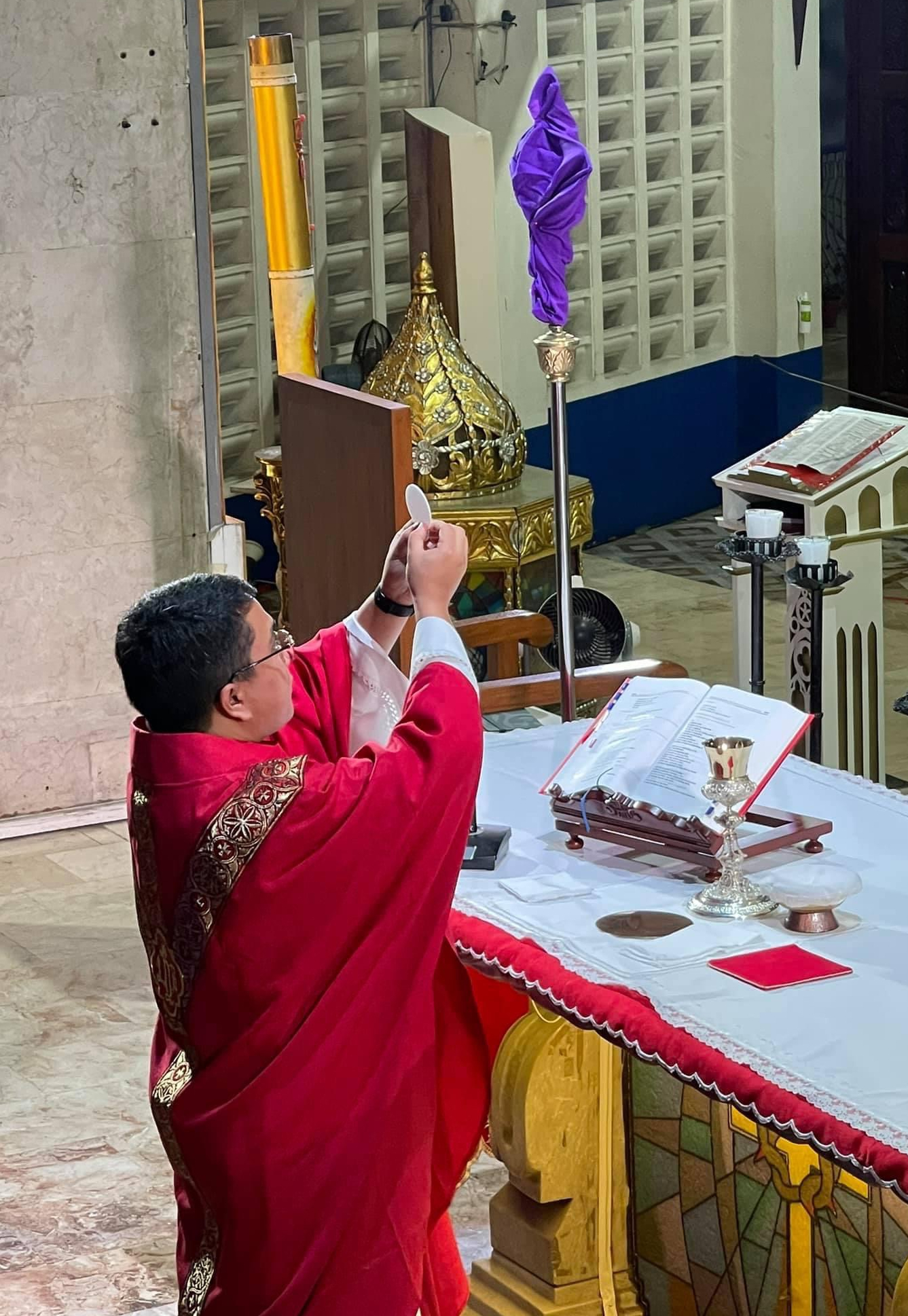
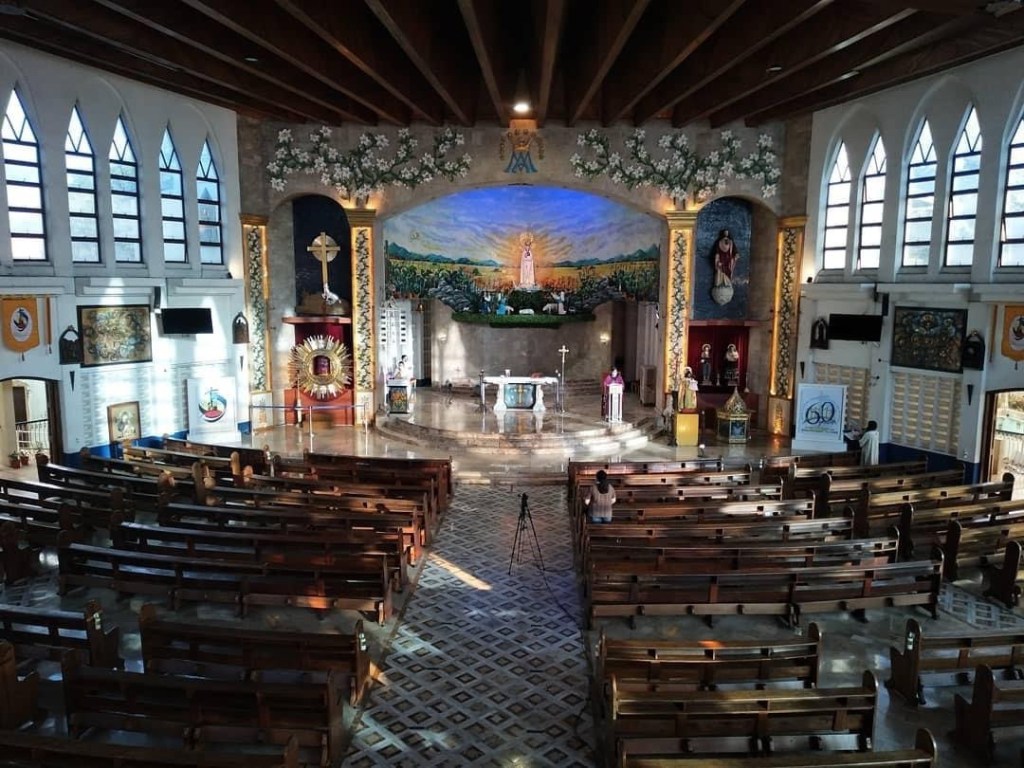
One of the most moving images of the pandemic for me lately is the one taken by our parishioner on the first day of the ECQ last March 22 when our Parochial Vicar, Fr. Howard John celebrated Mass without a congregation. He said, “the table of the Lord is full, but the pews are empty.”
And that is what we will continue to do in this pandemic. Even without the people, we shall continue to journey in Christ by still celebrating the Mass to give us all nourishment and sustenance and rest in this prolonged journey in the pandemic.
May we never get tired walking in love as a companion and bread to one another in Christ and like Christ by giving rest to others already tired and about to give up. Let us all be together in welcoming Easter! Amen.
El anda que en amor ni cansa ni se cansa.
(The soul that walks in love neither tires others nor grows tired.)
Saint John of the Cross
Photo by Ms. Kysia Cruz, National Shrine of Our Lady of Fatima, Valenzuela City.
40 Shades of Lent by Fr. Nicanor F. Lalog II
Holy Tuesday, 30 March 2021
Isaiah 49:1-6   ><}}}*>   John 13:21-33, 36-38
Photo by author, December 2020
Though I thought I had toiled in vain,
and for nothing, uselessly, spent my strength,
yet my reward is with the Lord,
my recompense is with my God.
(Isaiah 49:4)
So many times, dear Father in heaven, I feel like your “Suffering Servant” feeling that nothing is happening with all my efforts, with things I persevere, as if they are all useless until I realize what matters most is my being faithful to you.
Thank you for the sign of the Cross of Jesus Christ your Son, our Lord and Master: when things become so difficult and frustrating for me, I just look at him there on the cross, “dead” like me who had failed in your mission.
But as I contemplate his Cross, I remember how before all my sadness and sufferings, Jesus was there first for me to be good with others, to be kind, to be understanding, to be merciful and forgiving, to be patient, and most of all, first to be holy in being faithful to you and your call, Father.
Remind me the words of St. Mother Teresa of Calcutta that we are called to be faithful, not successful.
Let me focus more on you, Lord, instead of wondering how I have been doing, how good I have been.
Let me stop competing with others, asking who is not faithful to you, who is going to betray you like Peter during the last supper when he told the beloved disciple to clarify it with Jesus:
He leaned back against Jesus' chest
and said to him,
"Master, who is it?"
(John 13:25)
How lovely is the context of that question when what we must contemplate with is whether we have been faithful to Jesus in his Holy Eucharist.
How sad, O dear Father, that we are most unfaithful to you when we betray you right in the Eucharist – when do not listen to your words and message to us, when we do not live and practice the essence of thanksgiving to you by being faithful in witnessing Christ’s sacrifice on the Cross in our daily lives. Amen.
40 Shades of Lent by Fr. Nicanor F. Lalog II
Holy Monday, 29 March 2021
Isaiah 42:1-7   ><}}}*>   John 12:1-11
Photo by author, December 2020.
Here is my servant whom I uphold,
my chosen one with whom I am well pleased,
upon whom I have put my spirit;
he shall bring forth justice  to the nations,
not crying out,
not shouting,
not making his voice heard in the street.
A bruised reed he shall not break,
and a smoldering wick  he shall not quench.
(Isaiah 42:1-3)
On this Holy Monday of our holiest week, we pray to you, O God, for gentleness for us to be holy like your “Suffering Servant” according to Prophet Isaiah and fulfilled in your Son Jesus Christ our Lord.
In this world saturated in a cacophony of many voices and noises competing to be heard in the various social media platforms, teach us to be gentle, to never view ourselves better than someone else when we would rather be silent to listen more, “not crying out, not shouting, not making our voices heard in the street.”
In this world where “size always matters” while power is always expressed in force and violence, teach us to be gentle with them who are actually weak and soft inside, even broken like the reed or a smoldering wick.
Teach us holiness in gentleness through Jesus Christ who showed us the path to real power is in weakness, that instead of asserting superiority, we would rather help others to assert their innate goodness especially when the weak come forward to express their gentleness too like Mary who poured oil and perfume on his feet.
Give us the grace to dwell today on his words, “Leave her alone. Let her keep this for the day of my burial. You always have the poor with you, but you do not always have me” (Jn.12:7-8).
O how foolish we can be, dear Father, to miss this essential truth that we can only love the poor in you and through Jesus your Son. Take away that attitude of Judas Iscariot among us of “thinking the poor” yet always feeling superior to them, even to Jesus our Lord!
Make us gentle in our thoughts and in our words, most especially in our actions so that everyone may feel your gentle mercy and compassion in Christ. Amen.
40 Shades of Lent by Fr. Nicanor F. Lalog II
Palm Sunday of the Passion of the Lord, 28 March 2021
Isaiah 50:4-7  +  Philippians 2:6-11  +  Mark 14:1-15:47
Photo by Mr. John Karol Limjuco, Parish of the National Shrine of Our Lady of Fatima, Valenzuela City, 26 March 2021.
For the second straight year, we are again celebrating our holiest week in the most unholy time of our lives in this COVID-19 pandemic. The timing could not escape everybody’s suspicion of something so sinister, if not diabolic, that religious gatherings are again limited.
But on a closer look and deeper reflection, we find what is happening right now is something similar with what Jesus went through that made these days so holy.
Notice that the official designation of our celebration today is “Palm Sunday of the Lord’s Passion” when Vatican II fused the two earliest preparations by the Church for Easter: the palm procession by Christians at Jerusalem in the fourth century and the proclamation of the long gospel of the Passion of the Lord in Rome by the Pope in the fifth century.
Both ancient celebrations set our sights to the Paschal Mystery of Jesus beginning this Sunday stretching it through this whole week to remind us of the triumph and tragedy, of darkness and light, of death and life. These contrasts shall be most pronounced when we enter the Triduum of the Lord’s Passion, Death, and Resurrection on Holy Thursday evening, Good Friday, and Easter Vigil.
Then everything becomes light and pure joy in Easter!
And the key to understanding, appreciating, and deeply imbibing the meaning of all these confluences of mixed emotions and feelings, colors and hues like our situation while under this time of the corona is to have the same attitude of Jesus Christ expressed so beautifully by St. Paul in our second reading:
Have among yourselves the same attitude (mind) that is also yours in Christ Jesus, though he was in the form of God, he did not regard equality with God something to be grasped. Rather, he emptied himself, taking the form of a slave, coming in human likeness; and found human in appearance, he humbled himself, becoming obedient to death, even death on a cross.
Having the mind and heart of Jesus Christ is opening ourselves to the Father by trying to see everything in his light as we go through life especially during this pandemic. It is what Jesus has always reminded us of “reading the signs of the times”.
God is telling us something in this pandemic but we are not listening to him as we continue to see it as a medical and social issue, refusing to recognize its spiritual and moral implications. In a lot of senses, this pandemic and quarantine we are undergoing is similar with situation when Jesus entered Jerusalem more than 2000 years ago when Israel under Roman rule and life was so difficult but nobody recognized him as the Christ and Savior!
In his entire life here on earth, Jesus always saw everything in the light of his Father in heaven. He never got involved into politics and other temporal concerns or subject but throughout the course of history since then until now, his teachings remain relevant in addressing our social issues and problems.
Seeing things and events in our lives and history in the light of God demands that we have the same attitude of Jesus of opening ourselves to be empty of our pride, of our plans and agenda, of our self-interests as well as of our illusions and insecurities in life.
We will never see God nor find him when we are filled with our selves, especially with our bloated egos when we think we know everything, when we presume we are always right, when we play gods.
Like the people who welcomed Jesus entered Jerusalem holding palms, singing “Hosanna in the highest!”, soon we would also be shouting “Crucify him!” unless we get emptied of ourselves and be filled with God.
St. Paul could eloquently present the mind and heart of Jesus in this beautiful hymn because he himself went through a process of kenosis, of self emptying. He had experienced in himself how when Jesus emptied himself and went down to his lowest point obediently accepting death on the cross, that is also when he was at his closest union with the Father who raised him to his highest glory at Easter.
That is why St. Paul called it the “scandal of the cross” for when we empty ourselves and offered everything to God out of love for him and for others that we are willing to go down to our lowest point in life, that is when God raises us up to “meet” him, to be one in him that miracles begin to happen, when things change for the best not only for us but also for others and those around us.
Hence, while we are in the most unholy period of our history, the Lord is giving us every chance to have the holiest Holy Week of our lives by examining our very selves in this time of quarantine to cleanse and empty ourselves of sins and evil to be filled with God of his holiness and grace through Christ’s cross.
Photo by author, St. Joseph Parish, Baras, Rizal, 15 January 2021.
The logic of the Cross
As we go to another Enhanced Community Quarantine (ECQ) or lockdown like last year, I am convinced that while we are sad at how things are going on, it is actually God who is most “sad” of all as we go through all these pains and difficulties due to the COVID-19 pandemic.
God cannot suffer because he is perfect; but, he can suffer with us that is why he sent his Son Jesus to become human like us to join us in all our sufferings including death and thus, “console” us in Christ.
“To console” is from the Latin terms “con” (with) + “solatio” (solace/comfort) that means not only to comfort or delight those in suffering but to also “strengthen” or make strong those weakened by trials and difficulties which is the literal meaning of cum fortis, with strength.
And here lies the “logic” of Christ’s Cross: Jesus died by the hatred of others so that we may live again by his love. Only God can give us the evidences of his love to render us capable through Jesus Christ to forge on amid our pains and sufferings, hoping against all hope that love is always stronger than suffering, death, and sin.
When we persevere in our sufferings, especially in silence for the sake of others out of love, imitating the self-emptying of Jesus, that is when God showers us with more of his love and mercy, strength and vigor to overcome everything in Christ.
This he had promised and fulfilled in Christ who is the “Suffering Servant” we heard in the first reading from the Prophet Isaiah:
The Lord God has given me a well-trained tongue, that I might know how to speak to the weary a word that will rouse them. Morning after morning he opens my ear that I may hear; and I have not rebelled, have not turned back. I gave my back to those who beat me, my cheeks to those who plucked my beard; my face I did not shield from buffets and spitting. The Lord God is my help therefore I am not disgraced; I have set my face like flint, knowing that I shall not be put to shame.
Isaiah 50:4-7
See how everything Isaiah had written was fulfilled in Jesus as we heard in the gospel today when at the praetorium “They clothed him in purple and, weaving a crown of thorns, placed it on him. They began to salute him with, ‘Hail, King of the Jews!’ and kept striking his head with a reed and spitting upon him. They knelt before him in homage” (Mk.15:17-19). It went on up to the calvary when “They gave him wine drugged with myrrh, but he did not take it. Then they crucified him…” (Mk.15:23-24).
In my reflections this Lent, I have been dwelling lately on tenderness and compassion as mercy of God in action, as mercy of his hands. To be tender and compassionate is to be one with the suffering even if you are suffering too – just like our medical frontliners who risk not only their very lives but even their families.
Last Friday I was asked to give a talk via webinar about development of compassionate teachers and staff at Our Lady of Fatima University where I serve as chaplain. A doctor asked if there is such a thing as “over compassion” wherein she can already feel chest pains in seeing and hearing all the sufferings of their patients in this time of the pandemic.
I was so touched by her question because I felt it too; I told her she is not alone feeling that way when I also feel overwhelmed with the sufferings of the people but cannot do so much. I told her it is a grace to feel that way, that she had to find ways how her mercy in the heart can flow to mercy of the hands while ensuring safety protocols as a doctor.
But that is where the grace of God works fullest, when we believe and trust more in Jesus Christ when the chips are already down, when we feel defeat is inevitable that we just surrender everything to Divine grace and intervention.
“Ecce Homo” by Murillo from wikipediacommons.org.
That is the meaning of Palm Sunday of the Lord’s Passion when we see life in its total weakness and even wreak, whether in our selves or among others, and yet we continue to persevere, to hope against hope because deep in us we know God is with us, God is working in us, and God will save us.
French poet Charles Péguy wrote in one of his great poems at the turn of the century that hope is God’s favorite virtue because “hope surprises him”.
Péguy described hope like the end of a play or a movie in our time; we know the show had ended but we stay on refusing to leave the theater because we believe that something is still coming up like a preview or a surprise scene!
See how St. Mark tells us at the end of his Passion Story when everything was so dark after Jesus had died when “he breathed his last” that the centurion standing there believed that “Truly this man is the Son of God!” (Mk.15:39)
Sometimes in life, God becomes clearest and most truest when we have lost everything, including what is most precious and dearest to us.
Have a heart with a lot of faith, hope and love that this may be the holiest Holy Week in our lives because it is the most unholy period in our history like when Jesus entered Jerusalem more than 2000 years ago. Amen.
Keep safe, be blessed, and be a blessing to others!