40 Shades of Lent by Fr. Nicanor F. Lalog II
Solemnity of the Annunciation of the Lord, 25 March 2021
Isaiah 7:10-14, 8:10  +  Hebrews 10:4-10  +  Luke 1:26-38
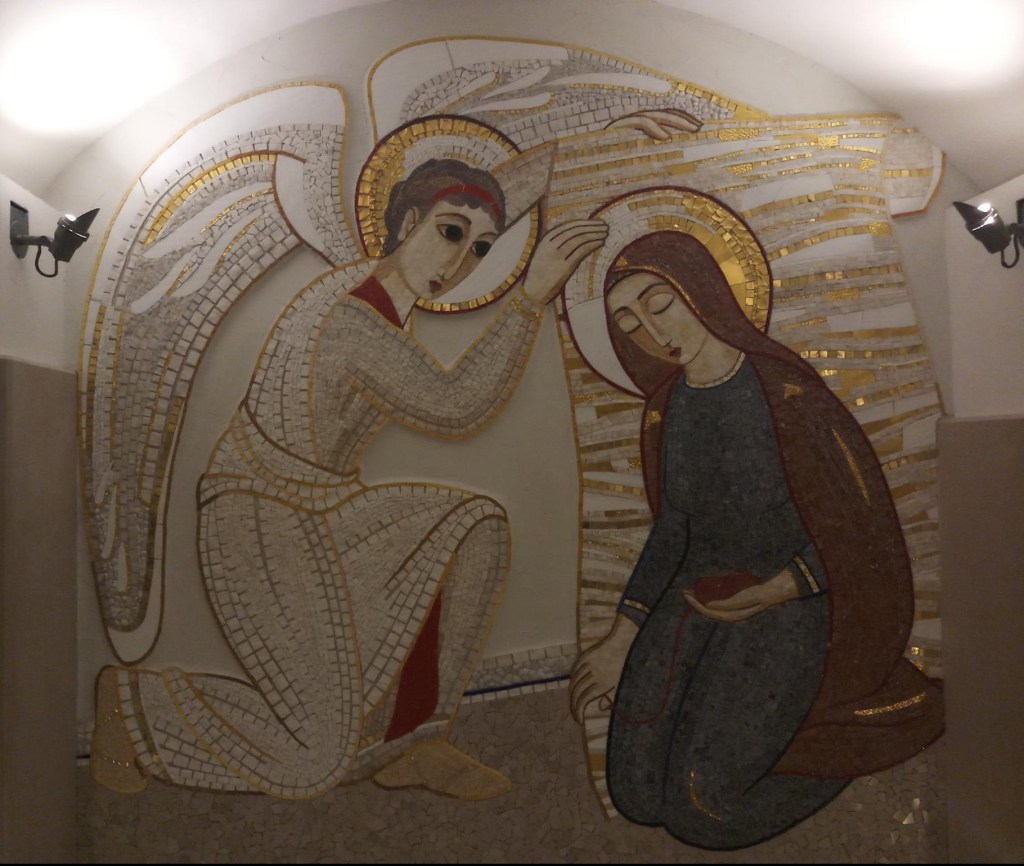
Photo by Arch. Philip Santiago of a mosaic of the Annunciation at the Shrine of St. Padre Pio at Rotondo, Italy, 2018.
Praise and glory to you, O God our Father on this Solemnity of the Annunciation of the birth of our Savior Jesus Christ! Thank you very much in fulfilling your promise, in sending us the perfect offering we can have to be one with you again.
Brothers and sisters: It is impossible that the blood of bulls and goats take away sins. For this reason, When Christ came into the world, he said, “Sacrifice and offering you did not desire, but a body you prepared for me; in holocausts and sin offerings you took no delight. Then I said, ‘As is written of me in the scroll, Behold, I come to do your will, O God.’” By this “will,” we have been consecrated through the offering of the body of Jesus Christ once for all.
Hebrews 10:4-7, 10
In his becoming human like us, your Son Jesus Christ taught us the value and beauty of obedience to you, O God, even unto death on the cross to restore our relationships with you and with one another destroyed by sin.
Teach us, O God, as we celebrate the Annunciation of the Lord, that more than the many things we expect in this life like our plans and dreams are the relationships and ties that bind us together as family and friends, as a nation and your people.
Give us the grace to offer our very selves, to let go of our many plans and agenda in life like the Blessed Virgin Mary as well as her most chaste husband St. Joseph to always say “yes” to your words, to your calls and invitations.
Mary said, “Behold, I am the handmaid of the Lord. May it be done to me according to your word.” Then the angel departed from her.
Luke 1:38
May we be like Mary giving flesh to your Word Jesus Christ, bringing his peace and mercy to this world so wounded by our many divisions and self-interests even in the midst of a pandemic. Amen.
Photo by author, site of the Annunciation, Basilica of the Annunciation at Nazareth, Israel, 2019.
40 Shades of Lent by Fr. Nicanor F. Lalog II
Friday, Solemnity of St. Joseph, Spouse of the Blessed Virgin Mary
2 Samuel 7:4-5, 12-14, 16  +  Romans 4:13, 16-18, 22  +  Matthew 1:16, 18-21, 24
Photo by author of the site believed to be the workshop of St. Joseph in Nazareth, 2017.
Today’s celebration of the Solemnity of St. Joseph as most chaste spouse of the Blessed Virgin Mary is a very special one being in the “Year of Saint Joseph” that began last December 8, 2020 until December 8, 2021 in commemoration of the 150th year anniversary of Pope Pius IX’s declaration of the beloved saint as Patron of the Universal Church.
In launching this Year of Saint Jospeh last year, Pope Francis wrote in his Apostolic Letter “Patris Corde” (With a Father’s Heart) how the COVID-19 pandemic has helped us see more clearly the importance of “ordinary” people who, though far from the limelight, exercise patience and offer hope every day.
The Holy Father explained that the “ordinary” people like those who kept our lives going especially during the lockdowns resemble Saint Joseph, “the man who goes unnoticed, a daily, discreet and hidden presence,” who nonetheless played “an incomparable role in the history of salvation” (Vatican News, 12 December 2020).
I really hope you can have time to read today this very short letter by Pope Francis who is a known devotee of Saint Joseph having popularized among us during his 2015 Papal Visit the image of “Sleeping Saint Joseph”.
In Patris Corde, Pope Francis gives us some helpful points on how we can love with the heart of God our Father like Saint Joseph during this time of the COVID-19 pandemic. One of these traits the Pope invites us to imitate from Saint Joseph is his “creative courage” in loving God and loving others.
If the first stage of all interior healing is to accept our personal history and embrace even the things in life we did not choose, we must now add another important element: creative courage. This emerges especially in the way we deal with difficulties. In the face of difficulty, we can either give up and walk away, or somehow engage with it. At times, difficulties bring out resources we did not even think we had.
Pope Francis, Patris Corde #5
A creative person is always someone who is deeply in love with another person or with one’s craft, art, career or whatever passion.
The most loving person is always the most creative like Saint Joseph who sought ways expressing his love for Mary and her child by deciding to silently divorce her as the gospel tells us.
This is how the birth of Jesus Christ came about. When his mother Mary was betrothed to Jospeh, but before they lived together, she was found with child through the Holy Spirit. Joseph her husband, since he was a righteous man, yet unwilling to expose her to shame, decided to divorce her quietly.
Matthew 1:18-19
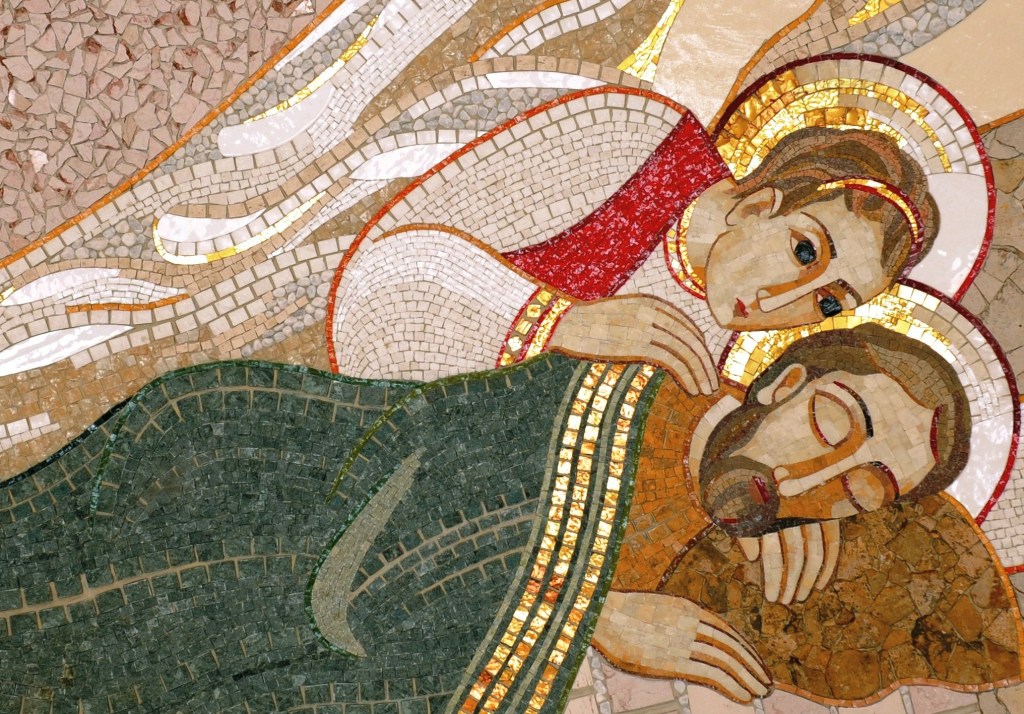
Photo by Arch. Philip Santiago of a mosaic at the San Padre Pio Shrine at Rotondo, Italy of the angel appearing to Saint Joseph in his dream.
Holiness is having creative courage like Saint Joseph.
Notice how the Pope’s description of Saint Joseph is not far from St. Matthew’s calling him a “righteous man” – a holy man – who obeys the Laws of God handed down to them by Moses, including their other traditions meant to keep them clean and pure before God.
Problem during that time is how people have lost sight of God and of others that they were so focused on the letters of the law than its spirit, becoming impersonal in the process as we have seen in instances when they would ask Jesus why he healed the sick even on sabbath day. Worst is when people brought to Jesus a woman caught committing adultery, reminding him of Moses’ instruction to stone her in public.
Such was the dilemma faced by Saint Joseph with Mary being pregnant with a child definitely not his!
In deciding to silently leave Mary, Saint Joseph expressed his righteousness or holiness wherein he showed the true interpretation of their Laws by upholding the dignity of every person, respecting life above all. Like Jesus Christ, Saint Joseph showed that real holiness is authentic love that is willing to sacrifice for the beloved by having the courage to be in pain in giving up or losing a beloved.
Here we find Saint Joseph was not only courageous in facing the painful truth about Mary having a baby not his but also very creative in the sense that because of his great love for the Blessed Virgin, he did not want her exposed to shame and public humiliation in allegedly breaking the seal of their betrothal.
Having courage is more than being able to do death-defying acts that is more on physical strength; courage is a spiritual virtue, a spiritual strength when we do extraordinary things because of higher ideals and values like the love of Jesus who offered us his life on the Cross.
Courage is from the Latin word “cor” for heart which is the seat of our being. And to have courage is to be true and loving that we have such expressions to speak from the heart, to listen to our heart, and to act from our heart when we dare to lose ourselves because of love.
Photo from Aleteia.org of “Let Mum Rest” image St. Joseph nursing the Infant Jesus while Mary sleeps, 2019.
A person who truly loves is always creative,
finding ways in expressing one's love even sometimes
it may be painful and difficult.
A “creatively courageous” person like Saint Joseph is someone so deeply in love with Mary and with God: after learning the circumstances surrounding Mary’s pregnancy, St. Matthew tells us “When Joseph awoke, he did as the angel of the Lord had commanded him and took his wife into his home” (Mt.1:24).
Saint Joseph’s love for Mary found ways to spare her all the pains and hurts that may result if found with a baby not his; but after learning the truth, the more we find him creatively courageous when he sought many ways to save Mother and Child from all harm and even death like bringing them to Egypt in the time of Herod.
See that when Saint Joseph accepted Mary, Jesus came forth to us while at the same time, when Saint Joseph accepted God through the angel as expression of his deep faith and love, he took Mary as wife.
And this is what Pope Francis further explains in Patris Corde that at the end of every account in which Saint Joseph plays a role, the Gospel tells us that he gets up and takes Jesus and Mary who are the most precious treasure of our faith.
Taking Jesus and Mary like Saint Joseph as creative courage calls us Christians to always love the Church and in loving the Church, we love the poor for whom Jesus came and Mary identified herself with in her Magnificat which she sang after accepting the Annunciation by the Angel of Christ’s birth which we celebrate next week on March 25.
In this time of the pandemic, we are called to be creatively courageous in finding Jesus among those people too familiar with us as well as with those so different from us. Don’t you find it so funny that the people we always take for granted are those either so close to us like family or completely strangers?
Being creatively courageous in this time of the pandemic means being more sensitive with others especially in our words and actions like Saint Joseph.
I was wondering during prayers why did he not ask Mary about the truth of her pregnancy so that he would have been spared with all the thinking and praying? That is when I realized the value of Saint Joseph’s silence: he did not speak at all to Mary as a sign of his love and oneness with her who must have been into some difficulties too with the situation of being the Mother of Christ. sympathy.
In his silence, Saint Joseph expressed his complete trust in Mary and in God. And in his being silent, Saint Joseph was creatively courageous expressing aloud his tenderness and care for Mary and her Child, something we need so much in this time of the pandemic.
Let us pray to Saint Joseph in this time of social distancing that like him, we may have the creative courage in touching others with the love of God, especially those who are sick and suffering, those in difficult situations, and those forgotten by their families and friends and even by the society. Have a blessed Friday, everyone!
Saint Joseph, Patron of the Universal Church, pray for us!
Photo from Vatican News, St. Joseph and the Child Jesus, 14 December 2020.
The Lord Is My Chef Sunday Music by Fr. Nick F. Lalog II, 07 March 2021
Photo from turbosquid.com.
The Season of Lent is like a refresh or reset button of the computer: it is a time when we “reboot” ourselves with prayers, fasting and abstinence, and alms giving to be connected anew with God and with one another. It gives us another chance to make things better in our lives marred by sins and many pains and hurts in the past.
And that is why for this Sunday we have chosen American R&B group Champaign’s 1983 single “Try Again” from their album Modern Heart. It peaked at number 23 on the Billboard Hot100 of that year.
I find the song very lenten in character. The music is sober but not bland. In fact, the cool instrumentation especially at the start kept ringing in my ears as I prayed over the readings this whole week, kind of convinced me of how truly sorry was Pauli Carman to his beloved in failing to be more loving, more intimate, and more personal to her.
I been starin’ at your photograph Wondering where you’re at today And I’ve been hanging by the telephone Hopin’ that you’d call home and stay
You told me you needed More walks, more talks More feelin’ close to me I want to be close to you
I didn’t know you needed Some roses, some romance A little candlelight and slow dance That’s not how it’s been But maybe we can try again Try, try, maybe we can try again
Sometimes in life, we take people around us for granted, we always presume everything is given, everything is well and good, that our loved ones know or assured that we love them so much. Worst is how we sometimes forget that in our love for our family and friends, we have been so focused in our other pursuits purportedly for them that in the process we actually forget them. Things can never replace persons who need to be loved and cherished.
I always tell couples that after years of living together with the coming of kids and career and problems, always remember, first there was your wife or husband for you. No matter what happens, God first called you to each other. Continue the courtship, keep surprising each other with expressions of your love for each other. Watch movies, have romantic dinners together.
The same with us priests: before all the demands of the ministry and apostolate came, there was first Jesus Christ who had come to call us, loving us that every day we have to pray, make time for him.
Try Again exactly tells us what the readings this Sunday teach us: of how we must cleanse ourselves to find our first love again, the person dearest to us. And the good news from God is that we can always try again and make up for our past sins and shortcomings to him and to one another.
Refresh, reset or reboot your self this Lent by making time for your loved ones for intimate and personal moments.
Have a blessed and refreshing week ahead!
Music video by Champaign performing Try Again. (C) 1981 Sony Music Entertainment
40 Shades of Lent by Fr. Nicanor F. Lalog II
Third Sunday of Lent in Cycle B, 07 March 2021
Exodus 20:1-17  ><}}}*>  1Corinthians 1:22-25  ><}}}*>  John 2:13-25
Parish Church of St. Joseph in Baras, Rizal.
One thing we notice in Lent is the “noble simplicity” of celebrations: no flowers at the altar, simple music without percussions, without Gloria no Alleluia meant to refocus our attention back to God in a more personal level.
That is why during Lent, our faith is refreshed or rebooted in order to “reset” it back to God himself than with rites and rituals and other formalisms that have made our relationships with him and with one another stagnant.
When faith and religion get fixated on formal codes of worship and belief, detached not only from God but even with people like those in the margins, then it had become an idolatry.
Since the Passover of the Jews was near, Jesus went up to Jerusalem. He found in the temple area those who sold oxen, sheep, and doves, as well as the money-changers seated there. He made a whip out of cords and drove them all out of the temple area, with the sheep and oxen, and spilled the coins of the money changers and overturned their tables, and to those who sold doves he said, “Take these out of here, and stop making my Father’s house a marketplace.” His disciples recalled the words of Scripture, “Zeal for your house will consume me.”
John 2:13-17
Photo from turbosquid.com.
Our personal, relating God
On this Third Sunday of Lent until its final Fifth week, we turn to the fourth Gospel of John to deepen our personal relationship with the Father in Christ when each gospel is compacted with signs and language rich in meanings to reignite our faith with “zeal” that “consume” us like Jesus.
Observe John’s formal introduction of this episode of cleansing of the temple by presenting to us its chronemics, the non-verbal communication of time and space to indicate the presence of God in Passover (time), Jerusalem, and temple (space/place). Keep in mind that the fourth gospel is called “the book of signs” because John would always use events, buildings and places, and people as signs pointing to Jesus as the Christ, the Son of God.
In this episode that immediately happens at the start of the Lord’s ministry as seen by John, something very wrong have happened with the very signs of God’s presence so revered by the people during their important feast of Passover right in their temple in Jerusalem: God had been eased out from the lives of the people and from their worship itself!
The gospels teem with many references at how the people at that time led by the temple officials and religious leaders have turned into worshipping rites and rituals than God himself, forgetting to serve the people by sticking to the letters than to the spirit of the Laws that Jesus always attacked.
It is similar to our own time where our faith and church worship have become empty of God and spirituality filled with human inanities led by some priests who tinker with liturgy, forgetting its noble simplicity, that less is always more. In our efforts to make God “present” with so many “shows” and gimmicks in the liturgy and church buildings, the more we have removed the Divine, unconsciously creating a cult around ourselves.
Notice some churches devoid of the holy with all the flat screens and tarpaulins all over. Worst is how priests have promoted this culture of shouting and clapping of hands during and after Mass as if God were deaf!
So many other things are sadly going in our celebrations where emotions are heightened without really stirring the hearts nor souls with God’s presence. Good liturgy flows from our personal and faithful relationship with God anchored in prayer life, not with shows and activities.
In the first reading, God reminds us in his Commandments that more than laws, these are meant to bring us into a relationship with him our God. See God speaking in the first person, addressing everyone with conversational personal pronouns, “I am the Lord your God” or “I am the Lord thy God”.
More than a mere body of commandments, the Decalogue are a covenant by God with people he had freed from slavery, pledging his unfailing fidelity to them who are expected to be wholeheartedly attached with him as their Lord and God. The Decalogue is first of all a call to intimacy with God expressed with our respect for one another.
This Lent, God invites us to renew our personal relationship with him in Jesus who had come to bring equilibrium in our lives through his Cross where our vertical relationship with the Father is intersected by our relationships with one another in Christ, through Christ, and with Christ. Without this, our faith or any religion will drift to extremes, either to joyless conformism as seen in fundamentalism and traditionalism or exaggerated expressionisms happening nowadays, disregarding the norms of liturgy and of sanity as well. In both instances, there is human manipulation strongly present that pretend to serve God but actually massage somebody’s ego, totally forgetting the people who suffer most.
Photo by author, 2019.
Jesus himself as the new temple
When Pope Emeritus Benedict XVI was newly elected in office, he wrote a bishop in Europe suffering with cancer. According to reports, the former Pope tried to uplift the spirits of the sick bishop by telling him that “Jesus saved the world not with activities but by suffering and dying on the cross.”
Beautiful words from one of the most spiritual and theological man of our time! Here lies too the fullness of our relationship with God expressed in our worship when our “zeal” for him is consumed in our oneness in Jesus Christ, our new temple.
At this the Jews answered and said to him, “What sign can you show us for doing this?” Jesus answered and said to them, “Destroy this temple and in three days I will raise it up.” The Jews said, “This temple has been under construction for forty-six years, and you will raise it up in three days?” But he was speaking about the temple of his body. Therefore when he was raised from the dead, his disciples remembered that he had said this, and they came to believe the Scripture and the word Jesus had spoken.
John 2:18-22
John now presents to us Jesus more than a prophet cleansing the temple with full authority, being the perfection of every worship that is “in Spirit and truth” (Jn.4:23) because as the Messiah of God offered on Good Friday which is also the feast of the Jewish Passover, his Body becomes the new temple.
Of course, sacred buildings are still important as well as rites and rituals but they are signs pointing to the realities of Jesus Christ, the Emmanuel or God-is-with-us truly felt in ourselves, in our lives when we have that oneness, that intimacy in him in our personal and communal prayers that flow down to our interpersonal relationships with others especially the poor and the suffering.
Last October, I had the most severe test in life when my only brother was diagnosed with an ailment affecting his spine, becoming immobilized for three months. I took him to my parish so I can look after him. What was most difficult for me was seeing him suffer, writhing in pain even in the middle of the night, sometimes begging me to ask God to take him so his sufferings may finally end.
I thought already knew how to pray, that I was tough and strong especially in my faith but, like a child, I would always hide and cry to God for my only brother who in his entire life has always been sickly and afflicted with many illnesses.
One morning in our daily Mass, tears swelled in my eyes during consecration as I held the Body of Christ in my hands with my voice breaking as I said, THIS IS MY BODY WHICH WILL BE GIVEN UP FOR YOU.
How I wanted to stop the Mass at that moment to cry in joy as I felt Jesus so true, in his flesh and blood, truly alive and personal!
Until now I could not explain what or how I felt that I cried at that time except that the night before, I assisted my brother in bed and cleaned him up. It was very difficult and even messy but a great moment of God’s grace and mercy for me expressing my love for him through my brother. That is when I realized that to truly touch Jesus is first of all to touch him among our sick brothers and sisters; that there is an intimate connection between the real presence of Jesus in the Eucharist and everyone especially the sick and suffering. And, for us to truly receive the Body of Christ, to experience the Holy Communion in him, we must first have his eyes and heart and hands among those deprived around us (https://lordmychef.com/2020/10/28/the-body-of-christ/).
Photo by Ms. Ria De Vera, Good Friday 2020.
Brothers and sisters: Jews demand signs and Greeks look for wisdom, but we proclaim Christ crucified, a stumbling block to Jews and foolishness to Gentiles, but to those who are called, Jews and Greeks alike, Christ the power of God and the wisdom of God. For the foolishness of God is wiser than human wisdom, and the weakness of God is stronger than human strength.
1 Corinthians 1:22-25
Faith in God is not meant to be explained nor analyzed. Though we do not stop studying and learning our faith doctrines and teachings, we are reminded this third Sunday of Lent to keep our zeal for God burning. Let us pray to Jesus that like him, may our zeal for the Father consume us by seeing him in persons not on things that are often self-serving. Amen.
Have a blessed and refreshing Sunday in the Lord with your family and loved ones!
40 Shades of Lent by Fr. Nicanor F. Lalog II
Ash Wednesday, 17 February 2021
Joel 2:12-18   >><)))*>  2Corinthians 5:20-6:2  >><)))*>  Matthew 6:1-6, 16-18
Photo by author, chapel at Franciscan Monastery at Mt. Nebo in Jordan overlooking the Promised Land or Holy Land, May 2019.
Today we begin our annual Lenten pilgrimage with Ash Wednesday in the very different situation and conditions of the COVID-19 pandemic now in its first full year. Although this may be the most unusual, both unreal and surreal Lent since the end of Second World War, this could also be our most real Lent so far.
Being real means getting into the very core of our very selves, focusing on the more essential that are invisible to the eyes. Since the popularity of social media and smart phones, life has become more of a big show than of living that we care more of lifestyles than life itself.
All three readings today invite us to get real, to confront our true selves, stop all pretensions by letting go of our many excuses and alibis. No more ifs and buts. Just our bare selves before God for tomorrow or later may be too late. St. Paul’s words perfectly express the challenge and beauty of Lent 2021:
Brothers and sisters: We are ambassadors for Christ, as if God were appealing through us. We implore you on behalf of Christ, be reconciled to God. Behold, now is a very acceptable time; behold, now is the day of salvation.
2 Corinthians 5:20, 6:2
Lent is a journey into inner self
to reach out to God through others.
The forty days of Lent are a journey characterized by three important acts so central not only to Christianity but also to the other two great faiths of the world, Judaism and Islam. These are fasting, prayer and alms giving. Through these acts, we journey back into our very selves in order to reach out to God through others.
And we start by cleansing our very selves through the putting of dry ashes on the crown of our head instead of the more usual imposition on forehead to prevent the spread of COVID-19.
The use of ashes as an outward sign of our inner cleansing beautifully tells us of its being natural cleansing agents long before the invention of chemical solutions. As such, being closest to earth, ashes remind us so well of our mortality, “for dust thou art and unto dust shall you return”!
However, though we are all marked for death as the ashes signify, they are blessed at the start of today’s Mass to remind us too that we die in Jesus Christ because ultimately, we return to God who is our true origin and end.
Hence, the need to cleanse our very selves by emptying ourselves of all the dirt and filth of sin inside that have marred our image and likeness in God. More than the outward appearance of putting ashes on our heads to signify cleansing is its internal significance of cleansing within by self- emptying through fasting.
In fasting, we cleanse our inner selves by denying ourselves not only of food but also of the usual things that fill us especially in this age of affluence and consumerism. Not only of material things but anything that make us forget God and others, that make us forget that we are mere mortals, weak and imperfect.
By fasting, we empty ourselves of our pride to be filled with Christ’s humility, justice, and love so we realize the world does not revolve around us. That we do not need so many “likes” and “followers” like in social media that inflate our ego but still leave us empty and lost.
And now is the perfect time, as St. Paul reminds us.
When we look back in this past year, so many of our relatives and friends have died, some alone, due to COVID-19 and other illnesses. The pandemic had grimly reminded us of life’s fragility and the need to be more loving always because we’ll never know if we can still be with everyone.
Fasting reminds us who and what are most essential in this life like God, life, and loved ones. Not likes or followers, luxuries, money, fame, or food.
In Tagalog, the word for meat is “laman”; to fast and go without meat literally means “walang laman” which also means “empty”!
When we fast and become empty, then we create space for God and for others.
That is why it is easier to pray and be one with God in meditation and contemplation when our stomach and senses are empty because we become more sensitive to his presence in Jesus. Silence in itself is a kind of fasting, the very key to any form of prayer.
Who needs to look gloomy when fasting when we are filled with the most wonderful and essential in this life who is God as Jesus tells us in the gospel, “When you fast, do not look gloomy like the hypocrites” (Mt.6:16).
In the same manner, whatever we save in our fasting, whatever we deny ourselves, we give and share with others in alms giving. Try opening your Facebook. What fills up your page? Your selfies? Your me-time? Your work and errands? Whatever fills your FB page, most often it always gratifies you for better and for worse. And yes, of course, they all indicate how glamorous and fabulous is your life.
This Lent 2021, so many people have lost their jobs. So many are struggling to make ends meet. Others’ sufferings have become more unbearable not only with financial difficulties but simply due to difficult conditions traveling to undergo chemotherapy or dialysis.
Life has been so unreal, even surreal for all of us since last year. And God is the one most sad of all in what we have been going through in this pandemic. But he cannot do anything for us because we still rely so much with our very selves, with our science and technology that all feed on to our pride and selfishness. Every day we hear of news of all kinds of abuses and lack of kindness going on, even among states and governments in the allocation of vaccines.
The pandemic is not purely medical and biological in nature but something spiritual.
Now, more than ever, is the Prophet Joel’s call more true:
Even now, says the Lord, return to me with your whole heart, with fasting, and weeping, and mourning. Rend your hearts, not your garments, and return to the Lord, your God. For gracious and merciful is he, slow to anger, rich in kindness, and relenting in punishment.
Joel 2:12-13
If there is anyone who wishes this pandemic to end so we can see and be near with each other without any fear of getting sick, of dying, that must be God. Like St. Paul, let us implore everyone to be reconciled with God right in our hearts by taking our fasting, praying, and alms giving seriously. Amen.
The Lord Is My Chef Breakfast Recipe for the Soul
Monday, Sixth Week in Ordinary Time, Year I, 15 February 2021
Genesis 4:1-15, 25     >><)))*>  >><)))*>  >><)))*>     Mark 8:11-13
Photo by Ms. Jo Villafuerte at Atok, Benguet, 01 September 2019.
Last Saturday, Lord, you surprised us as we prayed over the deeper meaning of the question “where” like “where are you?” and “where are we going to get?” The question where always implies something that is lost or about to lose, missing or denied.
Today, we pause for the more usual question of “what” like your question to Cain in the first reading:
The Lord then said: “What have you done? Listen: your brother’s blood cries out to me from the soil!”
Genesis 4:10
In the gospel, the enemies of your Son Jesus were also asking, in effect, about “what” signs he can show them from heavens to prove he is the Christ you have sent.
How funny it is, dear God our Father that in your asking Cain as in most cases, you ask us with WHAT because you knew what had happened, you know everything and merely want us to admit the truth and be sorry— but we would not!
For you, the what is already known for you know everything! Nothing can be hidden from you.
On the other hand, for many of us like the Pharisees, we keep on asking you with WHAT because we refuse to recognize or acknowledge what is present, what is existent, what is there because we prefer to accept what is in our minds than what is revealed and true.
What a silly world at how we have made the objective question of what very subjective, depending on what we wish to know and accept or believe. May the question what lead us closer to recognizing every person as a subject to be loved and cherished because we are indeed, our brothers’ keepers. Amen.
Photo from Facebook posted by Ms. Marivic Tribiana, 17 April 2020 during fire in Tondo area.
The Lord Is My Chef Sunday Music by Fr. Nick F. Lalog II, 14 February 2021
Photo by author, 2019.
A blessed happy Valentine’s to everyone! Strictly speaking, every Sunday celebration of the Holy Mass is a celebration of God’s great love for each of us. This Sunday is so special not only because it falls on the day of the hearts but most of all because of that lovely and touching story of the healing of a leper by Jesus.
A leper came to Jesus and kneeling down begged him and said, “If you wish, you can make me clean.” Moved with pity, he stretched out his hand, touched him, and said to him, “I do will it. Be made clean.” The leprosy left him immediately, and he was made clean.
Mark 1:40-42
This is a very unique story because lepers were forbidden at that time to get near people not only for fear of contagion but because of the terrible meaning of their disease that evoked sins of the Egyptians before the Exodus of the Hebrew people (https://lordmychef.com/2021/02/13/to-be-loved-is-to-be-touched-by-god/).
It is so touching because Jesus welcomed the leper, touched him and healed him, making him a totally “brand new” person, exactly like the one mentioned in the 1974 hit by the Stylistics You Make Me Feel Brand New. It was the first love song I had learned to memorize its lyrics after finally saving enough money to buy a song hits while in grade five.
The song elegantly speaks in simple beauty and sincerity the great relationship of true love experienced by a man with a wonderful woman who loved him so much, who must have touched him so much that made him feel brand new.
My love I’ll never find the words, my love To tell you how I feel, my love Mere words could not explain
Precious love You held my life within your hands Created everything I am Taught me how to live again
Only you Cared when I needed a friend Believed in me through thick and thin This song is for you, filled with gratitude and love
And what I like most with this song is how it thanked God for this wonderful gift of love who is after all, love himself!
God bless you You make me feel brand new For God blessed me with you You make me feel brand new I sing this song ’cause you Make me feel brand new
It is now a classic covered by so many great artists through the years. We have chosen Simply Red’s version recorded at the Sydney Opera House in 2010 with Mick Hucknall’s moving interpretation, full of emotion and passion. They first released You Make Me Feel Brand New in 2003 as part of their album Home, reaching the #7 spot in the UK hit list.
You Make Me Feel Brand New is one song that had really touched so many of us, reminding us of the power of love to transform us, to change us, to make us better persons like that leper in the gospel. An anonymous writer had said that “If you have love in your heart, you have been blessed by God; if you have been loved, you have been touched by God.”
As you relive your most touching and loving moments while listening to this classic covered by Hucknall, think also of concrete ways to touch somebody with God’s love this Valentine’s — not just with flowers or chocolates.
The Lord Is My Chef Sunday Recipe for the Soul
Sixth Week in Ordinary Time, Year B, 14 February 2021
Leviticus 13:1-2, 44-46  >><)))*>  1 Corinthians 10:31-11:1  >><)))*>  Mark 1:40-45
The word “touch” is a very touchy one…
It can either be literal or figurative but can mean both at the same time like when we experience that proverbial “pat on the shoulder” – we feel it literally speaking but deeply within we feel so touched that we feel so good, we feel affirmed.
We say “we are touched” by words, by gestures and sights, by acts of kindness and love, by persons, by music, by poems, by so many things that touch both our senses and innermost being.
Touch can be fleeting, sometimes so brief but its impact can last a lifetime. Experts say that 30 seconds of touch is equivalent to more than 300 words of encouragement. That is why in our liturgy and sacraments, we employ the sense of touch extensively in imitation of Jesus in his many healings and interactions with everyone during his time.
And even up to our time, Jesus continues to touch us with his words, with his Body and Blood in the Holy Mass and through our family and friends, even strangers he sends us so we may experience his love through his healing touch, his merciful touch, his tender, loving touch.
Today we hear a very touching story on this Valentine’s day of how Jesus touched a leper and touched his life forever!
A leper came to Jesus and kneeling down begged him and said, “If you wish, you can make me clean.” Moved with pity, he stretched out his hand, touched him, and said to him, “I do will it. Be made clean.” The leprosy left him immediately, and he was made clean.
Mark 1:40-42
Photo by author, Lake of Galilee, May 2019.
Leprosy: a terrible disease, an image of sin
After healing Simon’s mother-in-law and those who were sick last Sunday, Mark told us how before dawn the following day Jesus went to a deserted place to pray then left Capernaum with his four disciples to preach and heal throughout the whole of Galilee.
As they were walking, a leper came to meet Jesus and begged him to be healed. This scene is very unusual for lepers were not supposed to get near anybody during that time. They have to warn people of their presence so they can be avoided lest others get infected.
But more than the fear of contagion, the first reading tells us why people were not supposed to interact with lepers because leprosy was seen so terrible as an image of sin that anyone afflicted must see the priest first, short of saying a leper was also a sinner. See how Moses described the wounds that evoked memories of those festering boils and lesions that afflicted the Egyptians and their cattle before the Exodus. Such was the gravity and seriousness of this sickness that those afflicted were totally separated from the rest of the populace, literally and figuratively speaking.
In this scene, we find not only a glimpse of another typical day in the life of Jesus but most of all, we see his very person filled with love and compassion for the least in the society like the leper. Here again is the Lord going to unknown territories to find and heal – to touch – the poorest of the poor.
And that is precisely the good news Mark is telling us this Sunday: Jesus wills our well-being, wants to touch us to be cleansed and healed from all our infirmities whether physical or spiritual or emotional.
Like the crowds following Jesus at that time, we also have to follow the Lord in his preaching to be healed from our sickness and be cleansed from sins. Anyone who believes in his power to heal like that leper must rely in his kindness and mercy because Jesus had removed all barriers that prevent us from meeting him, touching him.
See how Mark described Jesus being “moved with pity” which is more than an emotion or feeling but a stirring within called “miserecordia” in Latin and Spanish that means to move (miseor) the heart (cor) or do something with what he had seen and felt.
Do not be afraid or shy to come to Jesus; he is very approachable, no need for appointments like us humans as he welcomes us all, very open to us all, so willing to meet and be with us in our joys and sorrows, victories and defeats, triumphs and miseries.
Then, warning him sternly, he dismissed him at once. He said to him, “See that you tell no one anything, but go, show yourself to the priest and offer for your cleansing what Moses prescribed; that will be proof for them.”
More than a healer, an exorcist, and a doer of miracles, Mark presents to us for the third consecutive Sunday the very person of Jesus Christ as our Savior. One thing we shall notice in Mark’s gospel is his extensive use of the so-called “Messianic secret” wherein he reports Jesus warning those he had healed and exorcised not to tell it to anyone, to keep it a secret lest people regard him as a miracle worker or provider of every human needs.
And that is because who Jesus Christ is really is — our Savior who gave himself up for us all to be healed by sin symbolized by leprosy. His touching and healing of that leper vividly shows us that this Jesus is the Christ who came to renew and bring us back to God as his beloved children. It is the most touching image of God becoming human like us, getting so close to us to touch us and be one with us so we can be cleansed from all dirt of sin and evil because that is how much he loves us.
To be touched by Jesus is to be loved by God. And anyone touched and loved by God becomes a brand new person who finds himself whole and one anew with others around him, sharing with them his newfound love and joy and meaning in life. That is the surest sign of being touched and being loved; hence, the command by Jesus to the leper to present himself to the priests to be reintegrated to the community and eventually commune again with others.
But the leper could not contain his joy that according to Mark, “The man went away and began to publicize the whole matter, spread the report abroad so that it was impossible for Jesus to enter a town openly, remaining outside in deserted places as people kept coming to him from everywhere” (Mk.1:45).
By his very life, the healed leper gave glory to God as admonished by Paul in our second reading today. For Paul, to glorify God in whatever we do is to imitate Jesus Christ (1Cor. 10:31) by dealing with or resolving conflicts and issues among us in the most personal manner instead of theoretical principles.
During that time, the early Christians in Corinth and elsewhere for that matter were confused if the consumption of animals offered by pagans to their idols and later sold in the market constituted their participation to idolatry.
Paul explained that idols are nothing and therefore, the sacrifice of animals in the sanctuaries does not give the meat sold in the markets any particular qualification. Those who can understand this can it eat without scruple but— if it can cause scandal among those weak in faith and understanding, they must renounce this freedom.
For Paul, morality and propriety must have their origin and motivation in God, not just any precepts or standards that sometimes difficult to accept. Again, here we have to consider sensitivity – the touchiness of certain acts and things so that when we give glory to God, even the weakest among us may be encouraged to do the same.
There is no “middle ground” as the wokes are implying these days in the US especially in that recent Super Bowl Jeep commercial with Bruce Springsteen, implying America can only be a ReUnited States through “compromises”.
Love is not like politics or diplomacy that seek detente among different parties of people as Jesus warned us to “Let your ‘yes’ be ‘yes’ and your ‘no’ be ‘no’. Anything apart from this is from the evil one” (Mt.5:37).
To love is to be touched by someone, especially by God. When we love, when we touch, there are no ifs nor buts, no middle grounds nor compromises because it is either you love or do not love. That is what Jesus showed us when he touched and healed the leper who came to him along the road.
That is also what Jesus showed us later by dying on the Cross for us so we may be cleansed from our sins and be new again so we can reach out to touch others with his immense love that is full of joy.
On this most joyous day of hearts we call Valentine’s, get real with our love by touching someone with the love of Jesus in the most concrete way of kindness and care, mercy and forgiveness. Not with flowers and chocolates that are very temporary. A blessed week to you!
The Lord Is My Chef Breakfast Recipe for the Soul
Saturday, Sixth Week in Ordinary Time, Year I, 13 February 2021
Genesis 3:9-24    +++  >><)))*> + <*(((><<  +++     Mark 8:1-10
Photos by Dr. Mylene A. Santos, MD, at Katmon Harbor Nature Sanctuary, Infanta, Quezon (2020).
Our dear, loving Father, bless all those people and things we have lost, and are about to lose. Bless us too that we may dare to confront ourselves truly the meaning of the question “where”.
In your words today, we heard twice the adverb “where” was mentioned: in the first reading when you were looking for man after the fall, “Where are you?” (Gen.3:9) and in the gospel when the disciples answered Jesus who was thinking of giving food to the crowds who have followed them in the wilderness, “Where can anyone get enough bread to satisfy them here in this deserted place?” (Mk.8:4).
Most of the time, we dread hearing and asking the question “where” because it implies somebody or something is missing or lost. Or worst, when someone is hiding like us!
Sorry, dear Father, that you have to continue asking even to this day after the fall “where are you?” because we always hide from you, we always turn away from you in sins.
Worst, when we refuse to see others as our brothers and sisters in Christ, we ask “where?” can we find or get food and other needs to share when we simply refuse to give whatever we have.
We are so sorry, Lord. Please give us the courage to confront the many questions that begin with “where” like “where is the love?” and “where am I really?” in relation with all the love you have poured on us in the loving presence of your Son Jesus Christ.
May we finally find in him the many “where” of this life. Amen.
The Lord Is My Chef Breakfast Recipe for the Soul
Tuesday, Fifth Week in Ordinary Time, Year I, 09 February 2021
Genesis 1:20-2:4     >><)))*>   +   <*(((><<     Mark 7:1-13
Photo by Mr. Raffy Tima of GMA7-News, March 2020.
Praying over your words today, O Lord our God, made me rejoice and thank you in giving us the face masks that remind us of our being “created in your own image and likeness (Gen.1:26-27)”, helping us heal our broken relationships as brothers and sisters in Christ.
Thank you Lord for this face mask because we now look longer into the eyes of one another, trying to recognize everyone but most of all, trying to find you in every face we meet each day. Before the pandemic, we have taken everyone for granted. We would hardly even look into each one’s face and eyes but now, with masks covering our faces, we strive to recognize each one by looking into each other’s eyes, trying to listen to each one’s voice, trying hard to recall how we have met, trying to figure out how have we known each other.
Suddenly with the face masks, we have finally tried to look into each other’s face again to recognize each one as a friend, a brother and sister in you and to finally find you, too, sweet Jesus!
But there is still another blessing in disguise for us in the wearing of these face masks when we finally learned to become silent and appreciate silence too!
Before the pandemic without the face masks, we spoke too much, never looking into one another. We would rather speak and speak and speak without hearing nor listening nor feeling the other person, hardly looking into each other’s eyes, numbing our selves of our connectedness in the invisible ties that bind us as your children, almighty God our Father.
So true are your words today, Lord Jesus, especially before the pandemic when our mouths were exposed without masks that we have become a people more on lip service, “honoring you with our lips while our hearts are so far from you and from others that we nullify your words in favor of our traditions empty of meaning” (Mk.7:6, 13).
May we learn to internalize in our hearts the words we are about to speak so that like you, may we share in the power of your words that create than destroy, enlighten than darken so that one day, sooner or later, may contribute to the end of this pandemic.
Help us realize, God our Father, during these trying times that a more lasting solution to this pandemic is to go back to you in paradise, to experience true sabbath of having you as our God at the center of our lives, always listening and trusting in your voice and words. Amen.