Advent is allowing God to overshadow us like Mary

Lord My Chef Simbang Gabi Recipe for the Soul by Fr. Nicanor F. Lalog II
Saturday, Simbang Gabi-V, 20 December 2025
Isaiah 7:10-14 <*((((>< + ><))))*> Luke 1:26-38

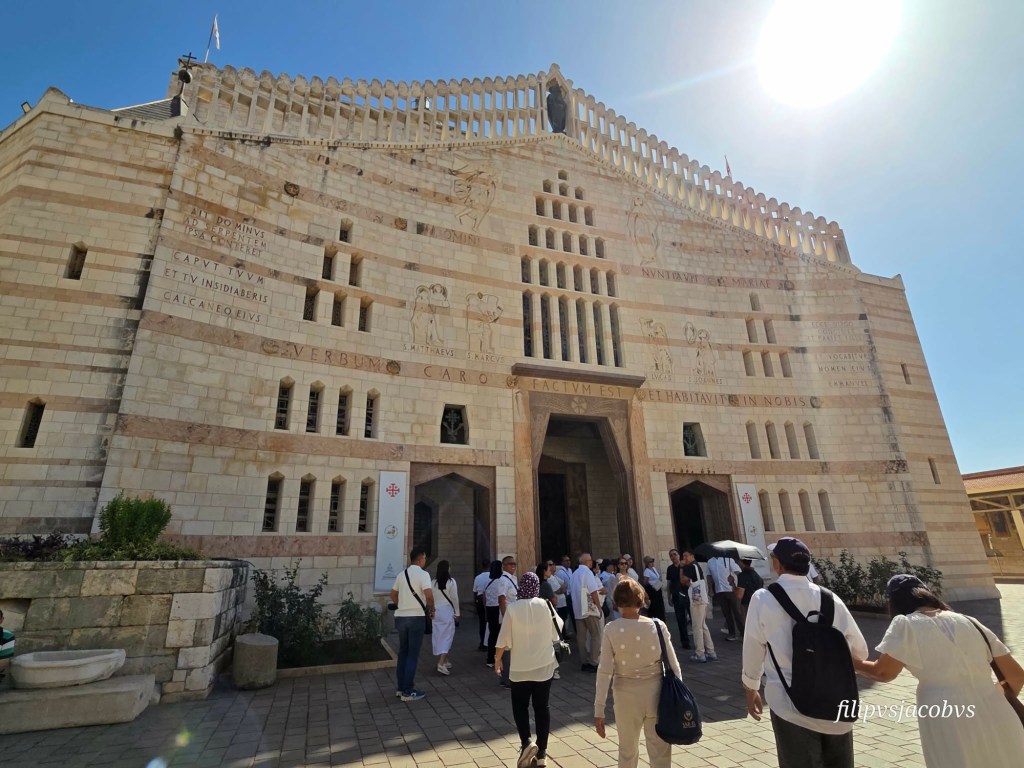
Basilica of the Annunciation in Nazareth, Israel; photo by Ar. Philip Santiago, October 2025.

On this fifth day of our Simbang Gabi we hear the second Christmas story by Luke, telling us how six months after announcing to Zechariah the coming of their son John, the angel Gabriel went to Nazareth to announce the birth of our Savior Jesus Christ to the Blessed Virgin Mary who was betrothed to St. Joseph.  Unlike Zechariah who doubted the angel’s message, Mary was more open with her response by asking how it would all take place.  

And the angel said to her in reply, “The Holy Spirit will come upon you, and the power of the Most High will overshadow you.  Therefore the child to be born will be called holy, the Son of God” (Luke 1:35).

We reflected the other day how Matthew ended his story of the genealogy of Jesus Christ with Mary to show her as the new beginning of everything in the world. Through Mary’s giving birth to Jesus, we now share with Him one common origin in faith who is God as our Father so that despite our many sins and failures, we are given with a fresh start, new opportunities in life daily. Luke bolsters this today with his account of the annunciation of the birth of Jesus to Mary. 

Photo by Ar. Philip Santiago, Annunciation Basilica in Nazareth, October 2025.

As a Jew, Mary must be totally aware of the words of the angel about herself being “overshadowed by the Most High” like in the Old Testament stories of God’s presence in the cloud during their journey in the wilderness after their exodus from Egypt.  Even Moses could not enter the tent when “the cloud covered it and the glory of the Lord filled the tabernacle” (Ex.40:34-38). 

To be filled and overshadowed by the presence of God is to be to be possessed by God and eventually to be transformed by God. 

Remember how in the movie “The Ten Commandments” when the face of Moses was transformed after meeting God. In the New Testament, the three synoptic gospels record a similar incident of God’s presence in a cloud hovering with Jesus during His transfiguration at Mount Tabor witnessed by Peter, James and John. The two great prophets of Israel were there, Elijah and Moses conversing with Jesus when a cloud overshadowed them with a voice declaring “this is my beloved Son, listen to Him.” Matthew, Mark and Luke tell us how the apostles were all terrified at the sight of the Transfiguration. 

And we can also surmise how terrifying it must be to experience God’s presence, to be filled with God.  But that is how grace works! 

Photo by Ar. Philip Santiago, Annunciation Basilica in Nazareth, October 2025.

At the start of our Simbang Gabi we have reflected how under the light of Christ we are able to see our sinfulness and weaknesses that sometimes we feel so sorry for ourselves but that is actually when grace works in us – the moment we change our sinful ways, then we grow!

When we see our limitations as humans yet still forge on in life to achieve greater things, to become better persons, that is God working in us. That is why Luke tells us today how the angel greeted Mary during the annunciation using the Greek words “kaire” which is to rejoice and “charis” or “karis” for grace:  “Hail (or rejoice), full of grace!  The Lord is with you” (Lk.1:28). 

This is actually unusual because Jews greet each other with “shalom” for peace; why did Luke use kaire? Because wherever and whenever there is grace, surely there is rejoicing like in our Third Sunday of Advent called Gaudete Sunday: we rejoice because the Lord who is pure grace is near!

The late American spiritual writer and monk Thomas Merton rightly said, “We live in a time of no room, which is the time of the end.  The time when everyone is obsessed with lack of time, lack of space, with saving time, conquering space… The primordial blessing, ‘increase and multiply’ has suddenly become a hemorrhage of terror… In the time of the end there is no longer room for the desire to go on living.  Why?  Because they are part of a proliferation of life that is not fully alive, it is programmed for death” (Raids on the Unspeakable, pp. 70-72).

Photo by Ar. Philip Santiago, Annunciation Basilica in Nazareth, October 2025.

Advent is the time to get real, to stop pretending. Advent is the time for us to finally admit our own limitations, to create a space in our hearts and in our lives to let God fill us, to let God possess us. 

Can we, like Mary allow God’s power “hover over us” to renew our lives in welcoming Jesus Christ? This was the problem of Isaiah with King Ahaz in the first reading who pretended to refusing God giving signs of his presence when actually he had already entered into alliances with other pagan kings in the region as the Babylonians were closing in them; that is why Isaiah uttered the prophecy to insist that God is our protector: “Listen, O house of David! Is it not enough for you to weary men, must you also weary my God? Therefore the Lord himself will give you this sign: the virgin shall be with child, and bear a son, and shall name him Emmanuel” (Is.7:13-14).

Let me end this reflection by inviting you dear friends to pray for Fr. Flavie Villanueva, an SVD priest so active in caring for the poor especially the orphans left by victims of tokhang. He was recently awarded the Ramon Magsaysay Award considered as Asia’s equivalent of Nobel Peace Prize for his works for the poor.

Yes, he had a very dark past, being a former drug dependent but God used that chapter in his life to make him turn around and become a missionary priest. Fr. Flavie had never hidden nor sanitized his dark past because it was during those years when he also found the light and grace of God’s love and mercy for him. Perhaps, he is most effective in his works among the poor and the addicts precisely because he used to be one of them! He is now under attack for his works by the dark elements of the past administration, the most decadent in our history.

From Facebook via Political Insight Today, 18 December 2025.

Fr. Flavie is no Virgin Mary but like her, he opened his heart to God who eventually overshadowed him with His powers to do all these great things for the poor who now feel Christ’s presence.

Recall now the many instances in our lives where we have learned our most important lessons in life and most surely, these were also the moments we have faced many hardships and sufferings but, instead of being down, these have inspired us and transformed us into better persons.

Let us imitate Mary in saying yes to God – “Behold I am the handmaid of the Lord.  May it be done to me according to your word!”  Let us open our hearts to God so the Holy Spirit may hover on us to fill us with Jesus Christ we can share with others broken like us. Amen. A blessed weekend everyone! 

Advent is patient transformation to joy

Lord My Chef Sunday Recipe for the Soul by Fr. Nicanor F. Lalog II
Third Sunday in Advent-A (Gaudete Sunday), 14 December 2025
Isaiah 35:1-6, 10 ><}}}}*> James 5:7-10 ><}}}}*> Matthew 11:2-11
Photo by author, December 2019.

Our churches are bursting in hues of pink this Third Sunday of Advent rejoicing not only in the fast approaching Christmas but most especially in the Lord’s Second Coming already happening in our midst.

Like John the Baptist in today’s gospel who was imprisoned at the time, we could feel in our own waiting for Jesus his saving presence in the many good things happening within us and around us.

When John the Baptist heard in prison of the works of the Christ, he sent his disciples to Jesus with the question, “Are you the one who is to come, or should we look for another?” Jesus said to them in reply, “Go and tell John what you hear and see: the blind regain their sight, the lame walk, lepers are cleansed, the deaf hear, the dead are raised, and the poor have the good news proclaimed to them” (Matthew 11:2-5).

Photo by shy sol on Pexels.com

Remember our reflection last Sunday of John’s preaching in the desert of Jordan signifying our own desert where amid the dryness and emptiness Jesus comes to us, Jesus is most present with us and in us. That is because more than an imagery of nothingness and death, the desert signifies too our intimacy with God. Many times in life, God brings us or allows us to get lost in our own desert to experience his intimacy with us, his immense love for us because when we are sufficient and strong, we rarely feel him nor even desire him. But, when we are like in a desert with nothing, that is when we long for God, and most especially feel him present.

That is why every prophet in the Bible including our Lord Jesus Christ frequented the desert and wilderness to show their intimacy and communion with God. The desert is thus transformed into a greenery filled with life like what Isaiah prophesied in the first reading today:

The desert and the parched land will exult; the steppe will rejoice and bloom. They will bloom with abundant flowers, and rejoice with joyful song. The glory of Lebanon will be given them, the splendor of Carmel and Sharon; they will see the glory of the Lord, the splendor of our God… Then will the eyes of the blind be opened, the ears of the deaf be cleared; then will the lame leap like a stag, then the tongue of the dumb will sing (Isaiah 35:1-2, 5-6).

Photo by Walid Ahmad on Pexels.com

See now the transformations found in our readings: in the last two Sundays we heard Isaiah speaking of the dried and barren desert but today he spoke of its transformation into a lush and verdant stretch of land; in the gospel we find John still in the desert, firm and unchanging in his preaching though his situation had changed a lot.

Last Sunday John was freely proclaiming the coming of the Christ in the desert as he sternly warned the Pharisees and Sadducees of their judgment; this Sunday, John was still in the desert but imprisoned awaiting death when he reproached King Herod in taking his brother Philip’s wife Herodias. But despite that clear danger daily hanging on his head, John was not disturbed at all as he patiently awaited the coming of the Messiah that he sent emissaries to Jesus to ask if he is already the Christ.

Here we find something so human in John the Baptist, so much like us when we sort of doubt ourselves not because we lack faith but simply we just want to be sure of what we are hearing, what we have seen, of what God is really doing.

Photo by author, December 2021.

Let it be clear: like John, most often we doubt ourselves not really God when things happen not according to our plans or expectations. Inasmuch as life is a mystery, God is more mysterious! Most of the time, we cannot understand his ways because he moves so differently, even unpredictably from what we know and expect.

Perhaps, John had a different scenario in his mind about the arrival of the Messiah like in the Old Testament tradition of judgment day, of action-packed events punishing evil people. Recall how called the Pharisees and Sadducees “You brood of vipers…Even now the ax lies at the root of the trees. Therefore every tree that does not bear good fruit will be cut down and thrown into the fire (Mt.3:10). 

But something totally different was happening at that time as he heard while in prison – many people and their lives were being transformed. John realized something deeper than expected was going on in Judea and Galilee. And when his emissaries relayed to him the reply of Jesus, John realized that indeed the Christ he was proclaiming had arrived in Jesus. As a prophet well-versed with the scriptures, John found Jesus as the fulfillment of the prophecy by Isaiah when the blind can see, the lame can walk, dead are raised and the good news proclaimed to the poor.

It must have been a Nunc Dimittis experience of Simeon for John that soon enough, he died a martyr ahead of his Lord and Master Jesus Christ. John indeed prepared the way of the Lord in his birth and in his death, showing us the importance of patience in awaiting Christ and in experiencing the joy in his coming.

Be patient, brothers and sisters, until the coming of the Lord. See how the farmer waits for the precious fruit of the earth, being patient with it until it receives the early an the late rains. You too must be patient. Make your hearts firm, because the coming of the Lord is at hand (James 5:7-8).

Photo by author, December 2020

Before the COVID pandemic, my brother and I used to rest at Camp John Hay in Baguio where he would buy in one of the shops there a line of local and organic perfumes. His favorite scent was called “Patience” but one time when we went there, it had ran out of stock that he said wryly, “maski ba naman pabango na patience, wala na rin?”

So true! Patience seems to have been almost extinct in this age of instants. Nobody wants to be patient anymore especially if one can have almost everything instantly. Even during the time of the early church, people have been impatient in life that St. James wrote them on the importance of patience in our journey of faith, in awaiting the Lord’s return.

From the Latin word patior that means to suffer, patience is a kind of suffering, of bearing the pain of waiting especially over a long period of time that we doubt if it is still worth the waiting at all. But we fail to “see” or realize as St. James pointed out like the farmer that waiting is never passive nor empty; there is always something wonderful happening that we do not see like the germination, growth and blooming of crops and plants. The more patient we are, the more suffering in waiting, the greater always the joy that comes when our waiting is finally fulfilled!

Advent teaches us this third Sunday that we need to be patient for waiting itself is a holy ground where we experience God’s coming and intimacy. Though patience tests our limits, it transforms us too!

Think of the stalactites and stalagmites in caves formed millions of years by drops of water. Or the great natural wonders of earth that took thousands of years of formation, transformation. Most of all, our very selves. Who we are and what we are today are long years of patient efforts to be healthy or successful or simply be alive. And that’s a great reason to rejoice.

Photo by author, December 2020.

Patience is so difficult to practice like in our daily experiences of horrendous traffic everywhere but with patience, we arrive at our destination. Patience transforms us into better persons and disciples of Jesus, enabling us to rejoice no matter what is the situation we are into. It is in the midst of sufferings and waiting, of patience and impatience that Jesus calls us to experience his silent and steady presence resting upon us like the rains every farmer is so familiar with. Our joy is doubled, becoming a rejoicing when we practice patience in our endeavors, in life itself.

Let me end this reflection with a quotation I memorized as a child on the wall of our former family dentist’s office in Meycauayan, Bulacan that said:

Time is fast for people who rush;
time is slow for people who wait;
time is not for people who love.

The most loving persons are also the most patient ones. Always. And first among them is Jesus Christ who patiently awaits us to return to him so we can experience his joy. Amen. Have a joyful week ahead!

Advent is the joy of our union in the Lord

The Lord Is My Chef Sunday Recipe for the Soul by Fr. Nicanor F. Lalog II
Third Sunday in Advent (Gaudete Sunday), Cycle C, 15 December 2024
Zephaniah 3:14-18 ><}}}}*> Philippians 4:4-7 ><}}}}*> Luke 3:10-18
Photo by author, Gaudete Sunday, Advent 2018.

Our altars are bursting in shades of pink this third Sunday in Advent known as Gaudete Sunday from the entrance antiphon in Latin of today’s Mass meaning “Rejoice in the Lord”.

To rejoice means to intensify joy which is a world apart from “happiness” many have mistaken as synonym for joy and rejoicing. Happiness is fleeting and superficial, dependent on the outside “stimulus” that makes us happy while joy comes from within one’s heart.

Joy is that feeling of certainty that no matter what happens to us, God would never forsake us, leading us to serenity and peace. That is why one can still rejoice and be joyful even in pain and sufferings like the elderly, the sick, or those struck with tragedy and failures. We can only rejoice when we have that deep faith in God, filled with hope that even if things get worst, our final salvation is in Jesus Christ who had come, would come again, and continues to come to us.

Photo by author, Advent 2021, BED Chapel, Our Lady of Fatima University, Valenzuela City.

Joy and salvation always come together as expressed by the Prophet Zephaniah in the first reading today which is fulfilled in Jesus Christ who renewed us all in the love of God our Father.

Shout for joy, O daughter Zion! Sing joyfully, O Israel! Be glad and exult with all your heart, O daughter Jerusalem! The Lord has removed the judgment against you, as he turned away your enemies… The Lord, your God, is in your midst, a mighty savior; he will rejoice over you with gladness, and renew you in his love (Zephaniah 3:14-15, 17).

True rejoicing can only happen in Jesus our Savior as St. Paul insisted in our second reading today, “Brothers and sisters: Rejoice in the Lord always. I shall say it again: rejoice!” (Phil. 4:4).

In His sermon on the mount about the beatitudes, Jesus taught us that true blessedness that leads to joy is not in having everything but in being empty and poor for God, being free from the trappings of this material world. Just ask those above 50 years old today: we have less of material things when growing up but we have so much fun so unlike these days of so many gadgets and things when suicides and mental cases are on the rise. People may be happy today but not joyful.

With our Campus Ministry members after our Advent Recollection, 12 December 2024, Chapel of the Angel of Peace, RISE Tower, Our Lady of Fatima University, Valenzuela City.

At His Last Supper as well as after Easter in His appearances to His disciples, Jesus assured us of joy and peace if we remain in Him by keeping His commandments especially the celebration of the Eucharist until He comes again. But, in a recent Christmas party I attended, a parlor game surprised me when the host asked participants to “bring him” the first thing we look for upon waking up when everybody rushed to him bringing their cellphones!

I thought the answer were eye glasses which I first look for upon waking up to check the time. As a result, I made an informal survey when I took the elevator and during our Mass at the university when I asked the students, “what is the first thing you look for upon waking up?”

And, cellphone again was their unanimous answer which I find very alarming. Is the cellphone the new god of our modern time, replacing not only Jesus but even ourselves! It has slowly robbed us of our true joy, often caused many of our sorrows and breakdown of relationships.

We rejoice because of Jesus Christ and in our union in Him, we become one with others in whom we experience joy and rejoicing too.

Photo by Mr. Jim Marpa, 2018.

Now we go to another dimension of joy and rejoicing – its personal and relational aspect. Have you experienced there are times we find it difficult to rejoice with others having fun or enjoying something while on the other hand, we are easily moved to sympathize with anyone crying or feeling api and forlorn even if we do not know them?

Is it not ironic we easily unite with strangers in sadness but not in joy? I think that perhaps, God designed us to sympathize with anyone in pain because there is a thread that connects and binds us together in times of sorrow. It is a lot different with rejoicing which presupposes a relationship, a sort of oneness to experience the others’ joy. Joy is never solitary unlike sadness that is often kept inside by the person. Joy to be really joyful has to be made known. That is why we can easily share in the joy of others when we know them. We turn sarcastic even jealous when we find others we do not know rejoicing simply because we are not part of them nor of their joys.

Photo by author, Gaudete Sunday, Advent 2019.

Rejoicing is not about what we or anyone can do but all about relationships as Luke shows us in his account on John’s baptism at Jordan that is so upbeat that we too could feel the rejoicing of the people in John’s coming and preaching that some of them thought John was the Messiah. The people felt a deep sense of belonging, of relating and knowing that they asked John what they must do to continue rejoicing!

The crowds asked John the Baptist, “What should we do?” Even tax collectors came to be baptized and they said to him, “Teacher, what should we do?” Soldiers also asked him, “And what is it that we should do?” Now the people were filled with expectation, nd all were asking in their hearts whether John might be the Christ… Exhorting them in many other ways, he preached good news to the people (Luke 3:10, 12, 14, 15, 18).

In telling us how John answered the queries of the people on what they must do to experience the coming of the Messiah, Luke teaches us that God is not asking great things from us but only simple acts of charity and mercy for one another like being kind and loving because we are already related in Him in the first place. Hence, we all can rejoice in Christ!

Here is our common misconception that if we do what is good and right, then we shall be filled with joy. Wrong. We are already filled with joy and we just have to intensify that into rejoicing because we are already God’s beloved children in baptism. When we live out our status as beloved children of God in Christ, everything follows.

Don’t you feel rejoicing just before communion, praying, “Lord, I am not worthy to receive you under my roof but only say the word and I shall be healed”?

Imagine that immense love of God in Christ for us when nobody among us even the priest officiating the Mass is worthy to receive Jesus and yet, He came and made it a reality because He loves us so much! All we have to do is be sorry for our sins, reform our lives, apologize to those we have wronged, forgive those who have sinned against us… it is God who does everything for us in Jesus Christ. We do only so little but sadly, we could not even do the little things so well like coming on time for the Mass every Sunday, much less be silent to pray and listen to Jesus coming to us in Holy Communion because we are so busy conversing with those beside us or checking our cellphones.

This third Sunday in Advent, Jesus invites us to imitate John the Baptist His precursor who “preached good news to the people” with his warm and joyful presence. Spread the joy of Jesus by being kind and warm to others especially those in pain, those alone, those who are lost. After all, we are all one in Christ who is our joy and salvation. Amen.

Photo by author, Gaudete Sunday, Advent 2019.

Grace & joy, together. Always.

The Lord Is My Chef Daily Recipe for the Soul by Fr. Nicanor F. Lalog II
Thursday in the Twenty-fourth Week of Ordinary Time, Year II, 19 September 2024
1 Corinthians 15:1-11 ><))))*> + <*((((>< Luke 7:36-50
Photo by author, St. Scholastica Spirtuality Center, Tagaytay City, 21 August 2024.
Praise and glory
to you, God our loving Father!
Thank you for your unending
gifts of grace for us
despite our many sins
and our being undeserving.

Truly like St. Paul,
we too feel so small,
"the least" for our so many sins
yet you never denied us with
that immense grace of
mercy and forgiveness,
redemption and new life in
Christ Jesus our Lord
that we so often forget.

Let us affirm
and be grateful
by cultivating this great grace
you have given us in Jesus
be who we are in your sight,
never making your grace "ineffective"
like the Pharisees in today's gospel
who could not stand
the sight of Jesus
interacting with a sinful woman,
of Jesus speaking to a sinner,
of Jesus forgiving so great a sin.
May we keep in our
heart and mind your tremendous
gift of grace to be near you,
to be like you,
to be filled with you
by living out your grace
in grateful witnessing
of loving and joyful service
to others.
Help us remember 
that like in the Annunciation
to Mary, rejoicing and grace
are always together:
from the Greek words
charis for grace and
chara for rejoicing,
rejoicing and joy
are clearest signs of
grace anywhere
like that woman
who washed
and anointed
the Lord's feet.
Amen.
From orthodoxpebbles.com

“Baby Says No” by Christopher Cross (1983)

The Lord Is My Chef Sunday Music by Fr. Nicanor F. Lalog II, 17 December 2023
Photo by author, Gaudete Sunday 2019.

Glad to be back with our Sunday music offering but unfortunately, our choice is neither a Christmas song nor carol. But, we find Christopher Cross’ Baby Says No from his 1983 second studio album so perfect this Sunday because our homily is something about saying “no” (https://lordmychef.com/2023/12/16/saying-no-leads-us-to-rejoicing/).

We have always loved Mr. Cross since 1979 with his great debut album that featured his first hits Sailing and Ride Like the Wind. Truly an artist gifted with superb musical talents, we were so worried in 2020 when news came out of his being stricken with COVID-19 that resulted in some complications that almost left him unable to walk for a time. 

Baby Says No is a touching story of a love lost despite one’s great efforts and how far can a man go despite the great setback.

Baby says no, she can’t let go this soon
Doesn’t feel right, not tonight
Even though I gave her the stars and the moon
I really think I’ve got it bad this time around
Baby says yes but I must confess
It really doesn’t seem to matter
‘Cause I’d follow that girl all around the world
Even if I never had her
I really think I’ve got it bad this time
Really think I’ve got it bad this time
Really think I’ve got it bad this time around

This is where we find Baby Says No very related with our gospel this Sunday also known as Gaudete Sunday or Rejoice Sunday. Many times in life, we are able to rejoice after experiencing losses and failures, after being down. It is in the nos and nots where great rejoicing burst forth like when we receive the negative answer to our offers like what the man is claiming here after being turned down with his love.

Gonna show ’em what love can do
Gonna tell ’em ’bout me and you
Gonna show ’em what love can do when it’s right
And this time, it’s right
Love is the light that can shine so bright
But sometimes it fades away
Then you find one that can shine like the sun
She comes up for you every day

Many times in life, love comes forth after we receive or make the “no” answers to sin and evil and selfishness. Here is Christopher Cross with his classic Baby Says No. Have a blessed Sunday!

From YouTube.com.

Saying “no” leads us to rejoicing

The Lord Is My Chef Sunday Recipe for the Soul by Fr. Nicanor F. Lalog II
Third Sunday in Advent Week III-B, Gaudete Sunday, 17 December 2023
Isaiah 61:1-2, 10-11 ><}}}*> 1 Thessalonian 5:16-24 ><}}}*> John 1:6-8, 19-28
Photo by author, Gaudete Sunday 2018.

Our church is bursting with pink shades this Third Sunday of Advent known as Gaudete (Latin for rejoice) Sunday following calls from our antiphons and readings for us to rejoice in Jesus who had come more than 2000 years ago in Bethlehem.

We also rejoice on this date, the 17th of December, as we shift our focus to enter Advent’s second phase when we remember and reflect the events surrounding Christ’s birth on that first Christmas. Today is also the second day of our Simbang Gabi and without sounding a Scrooge, I wish to propose in my reflection this Sunday for us to examine those moments in the scriptures and in our lives when saying “NO” leads us too into great rejoicing.

It is normal most of the time that rejoicing comes after every big “YES” in life like when a woman finally says “YES” to her suitor or when a boss says “YES” to promote an employee. The reason mankind rejoices at Christmas is because of the Blessed Virgin Mary’s “YES” to be the Mother of Jesus Christ our Savior.

Photo by author, Gaudete Sunday 2019.

However, history and our own experiences have taught us also that the key to rejoicing is when we say “NO” or receive or do something in the negative like during the pandemic when we prayed for “negative results” whenever we would get COVID tests. A lot often in life, a negative can be positive like what we see in our gospel today:

A man named John was sent from God. He came for testimony, to testify to the light, so that all might believe through him. He was not the light, but came to testify to the light. And this is the testimony of John. When the Jews from jerusalem sent priests and Levites to him to ask him, “Who are you?” he admitted and did not deny it, but admitted, “I am not the Christ.”

John 1:6-8, 19-20

See the progression of the negatives in the fourth gospel’s Prologue: after establishing “In the beginning was the Word” who is Jesus Christ the “life” and “light” in verses 1-5, John the Baptist is introduced with the immediate declaration “He was not the light, but came to testify to the light” in verses 6 and 8. In the following questioning by the priests and Levites sent from Jerusalem, John twice told them “I am not the Christ… not Elijah”, insisting with a strong “No” if he were the Prophet in verses 21-22 before wrapping up the scene with a solemn statement that “there is one among you whom you do not recognize, the one who is coming after me, whose sandal strap I am not worthy to untie” in verses 26-27.

Photo by author, Gaudete Sunday 2019.

What a lovely scene of negatives, of nots and nos!

Recall those moments in our past filled with painful rejections and humiliating failures that we now look back with rejoicing because of the valuable lessons we have learned and made us stronger today. We realize too that the past negative moments darkened by sin and evil were not totally bad at all as these have led us into the light of Jesus Christ that we now rejoice in being forgiven and loved. When we remember those trials and difficulties we have hurdled in life, we do not feel ashamed but actually feel so proud, being sources of rejoicing for all our victories and successes today.

As we have been saying, Jesus was born during the darkest night of the year, a big negative so we can see the great positive, Christ our Savior, our Light. He is the fulfillment of that great prophecy by Isaiah in the first reading which Jesus himself proclaimed at the start of his ministry in their synagogue in Nazareth on a sabbath. 

The spirit of the Lord God is upon me, because the Lord has anointed me; he has sent me to bring glad tidings to the poor, to heal the brokenhearted, to proclaim liberty to the captives and release to the prisoners, to announce a year of favor from the Lord and a day of vindication by our God.

Isaiah 61:1-2
Photo by author, Gaudete Sunday 2019.

Luke tells us in his account how “the eyes of all in the synagogue looked intently” at Jesus who then said, “Today this scripture passage is fulfilled in your hearing” (Lk.4:20-21).

When there is fulfillment, rejoicing follows because that is when we say no to the many negatives holding and preventing us from welcoming Jesus in our lives.

When we feel poor and inadequate and try to find Christ beyond what we do not have, that is when we rejoice to find everything in him who fulfills, enriches and enables us in this life and beyond.

Rejoicing happens when we finally say no to our toxic relationships with people who break our hearts with their infidelities and say yes to Jesus who remain faithful and true to us in our family and old friends who truly loved us ever since.

True joy and rejoicing happen when we finally say no to unforgiveness of self and others, when we say no to the past sins and mistakes, baseless guilt-feelings that have held us captives for so long to find mercy and forgiveness in Jesus.

Every day is a part of the year of favor from the Lord, calling us to say no to hopelessness and despair, to say no to cynicism and indifference because Jesus always vindicates though slowly all our efforts and sacrifices, strivings and perseverance in being good and honest in a world that honors thieves and criminals.

Many times in life, rejoicing bursts when we say no to sin, when we say no to disrespect, when we say no to injustice and inequality. More rejoicings will surely come our way the moment we start saying no to violence and war, no to discrimination, no to deaths and violence, no to selfishness and vanities.

Photo by author, Gaudete Sunday 2019.

The list of the no’s we can say and affirm in Jesus Christ is endless for us to truly rejoice. But of all the great rejoicing in Christ that we need is to everyday have a firm and big NO to all our fears in loving. 

One main reason our lives are miserable because we choose not to love for fears of being hurt, of losing, of separation, of death. St. Paul asks us in the second reading to rejoice always simply by choosing to love always too.

Brothers and sisters: Rejoice always. Pray without ceasing. In all circumstances give thanks, for this is the will of God for you in Christ Jesus. Do not quench the Spirit. Test everything; retain what is good. Refrain from every kind of evil.

1 Thessalonians 5:16-19, 21-22

Recall how the great apostle Paul described to us in 1 Corinthians 13 what is love and what is to love; what he told us today in his letter to the Thessalonians are basically the same: love, love, and love. And the first expression of love of God is praying. Just like in human love, we always talk with the one we love. If we truly love, then we must keep on praying which is beng one with God who is love.

To love is simply to be good, to avoid sin and evil. True rejoicing can happen only when we love, when we shun and say NO to sin which is a refusal to love. 

Photo by author, Gaudete Sunday 2021, Basic Education Department chapel, Our Lady of Fatima University, Valenzuela City.

That is why throughout his ministry, Jesus chose to dine and be with sinners, never afraid of what others would say about him because he truly loved. His enemies could not rejoice for they chose to reject Christ’s calls for them to say no to judging others, say no to legalisms, say no to their self-righteousness and conceit. In their refusal to say no to their pride that have closed their minds and their hearts to God and others, they have chosen not to love and thereby failed to meet Jesus the Christ.

Until now, life continues to be miserable to many people because they could not accept Jesus Christ and his Cross, the very sign of his immense love for us. An essential part of the joy of this Christmas is the Cross of Good Friday looming behind that manger in Bethlehem. Before Christ, the cross used to be a big negative but with Jesus, it literally became a plus sign – a positive when he chose to suffer and die in order to rise again on Easter because he loves us so much. Like him, let us say no to sin and evil so we can rejoice in him and in love. Amen. Have a blessed final week towards Christmas Day!