It is where we stand that matters most, not where we sit

Christ_washes_apostles'_feet_(Monreale)
During His Last Supper, Jesus rose from His seat to wash the feet of His apostles to show them what position is all about:  loving service to one another.  See in this icon from Google there are only 11 apostles present; Judas left the Last Supper to “unseat” the Lord.  Above is the word “mandatum”, Latin for “command”, Christ’s command for us to love by leaving our seats of power and comfort to stand with Him at His Cross.
Quiet Storm by Fr. Nicanor F. Lalog II, 22 February 2019
If you are a Catholic and a regular Mass-goer, most likely you always follow the “Roman seating position” – that is, you always sit at the back, avoiding the front seats even in other gatherings outside the church.

According to Msgr. Gerry Santos who used to give us retreats and recollections while we were seminarians, the “Roman seating position” is a carry-over from the martyrdom of the early Christians who were always seated at the front rows of the Colosseum in Rome who were forcibly pushed to be devoured by hungry lions and beasts below.

Of course it is a joke but it holds so much grain of truth because we often refuse to take the front row seats for fears of being put on the spot, of making a stand.  How ironic that in this age when seating positions matter so much for us, we have forgotten that more important than the position and prestige that come with the seats we occupy – literally and figuratively speaking – is the stand we take in every issue we face.  Protocols dictate in so many occasions how seats indicate power and authority; the throne is always reserved to the highest in rank like kings and presidents.  And the closer one is seated to the one in command, the wider is one’s sphere of power and influence too.  Unfortunately, this is not everything because every seat of power and authority is always a call to serve, to make a stand for what is true and what is good.

Jesus Christ showed us the true meaning of our seating positions during the Last Supper on Holy Thursday evening when He rose to remove His outer garments to wash the feet of His apostles (Jn.13:1-15).  It was a task left for slaves only but Jesus used it as a gospel parable in action to show us that what matters most in life is not where we are seated with Him but where we stand with Him.  It was exactly what He meant when He said that anyone who wishes to be the greatest must be the least and the servant of all.

Recall my dear readers how during that evening of the Holy Thursday when John the beloved disciple sat not only beside Jesus but even rested his head on His chest to signify their intimacy as friends (Jn. 13:23).  That touching gesture of friendship and love took its summit the following Good Friday when John the beloved was the only one of the Twelve who remained standing with the Lord at the foot of His Cross with the Blessed Mother Mary.  In that scene we see how John literally stood his ground as the beloved disciple by remaining faithful and loving with the Lord from His Last Supper to His Crucifixion.  Peter, the prince of the Apostles, was nowhere to be found on Good Friday after denying Jesus thrice during His trial before the Sanhedrin the night of His arrest.  Very interesting was Judas Iscariot who committed suicide after realizing his grave sin in betraying the Lord.  See how he had left the Lord’s Supper to deal with His enemies for His arrest.  What an image of the traitor who could not stay on his seat during the Lord’s Supper was the same one who could not stand to face Him again at the foot of the Cross.  See how those people who refuse to sit with us are also the ones who never stand with us, stand for us like Judas, a traitor!

I tell you these things even if Holy Week is still more than six weeks from now but in the light of the Feast of the Chair of St. Peter which is about the Primacy of Rome or the Pope as Vicar of Christ and successor of St. Peter.  We celebrate this Feast to remember St. Peter and his successors love and service to the Church as examples we must all emulate.  In 110 AD, St. Ignatius of Antioch wrote the Christians in Rome to describe to them the Church of Rome as the “primacy of love” and the “primacy of faith”.  Every power and every authority signified by the chair or cathedra in the Church as well as in the world when we speak of “seat of power” must always be seen in the light of Jesus Christ’s example of loving service at His Last Supper.  This is especially true for us priests who are united in Christ and with Christ in the Eucharist.

This festering problem of sexual abuse in the Church is largely due to our deviation from this primacy in love for Jesus as priests.  We have been so focused with our seats – positions and titles – that we have forgotten to stand with Christ at the foot of His cross, standing for what is good and true, just and right.  We have been so focused with the “party” of the Supper of the Lord and have forgotten Jesus Himself.  Seminarians have been so focused with the vocation and the call, with ordination, forgetting the more essential, the Caller Jesus Himself!  And that explains why some in the clergy and those in the hierarchy come up with so many excuses and alibis for the many things we do in our ministry, in our churches, in our parishes, and in our lives because we are only concerned with our office and position but never the Master.

When we love Jesus or any other person, we do not have to justify our actions.  Love that is true and pure does not need justifications.  But the moment we start making justifications, something is wrong like when we justify our special relationships, no matter how deep or shallow it may be for clearly, there is no primacy in love for Jesus and the Church.

When we justify our vices, our lifestyles, our business endeavors that Canon Law prohibits, clearly there is no primacy in love for we cannot be poor for Christ.

There is no problem with having advocacies as priests but when we are aligned with ideologies contrary to Christ, or when we play in partisan politics, there is neither primacy of faith nor primacy of love.  It is the Lord who changes the world, not us, not our programs, not our ideas.

It is our duty as priests to love like Christ but to adopt children and raise them as our own children using our names, there is no celibacy, only stupidity.

Like Jesus, we need money to get our programs going but when we lack transparency and accountability, that is stealing and banditry.

When all we have is the ministry, the priesthood without prayer periods, without the Eucharist, we only have the call but not the Caller Jesus Christ Himself.

More than ever, today Jesus Christ is asking us all His priests to make a stand for Him, to stand with Him, to suffer with Him and to die with Him by leaving our seats of comfort and seats of power.


Our Seat, Our Stand?

SOD-0222-ChairofSaintPeter-790x480
The Chair of St. Peter at the high altar of the Basilica of St. Peter at the Vatican flanked below by the two teachers of the East, St. John Chrysostom and St. Athanasius with the two Latin Fathers of the Church St. Ambrose and St. Augustine.  All four saints showed us how love stands on faith; that,  without both love and faith, everything falls apart in the Church.  Photo from Bing.
The Lord Is My Chef Breakfast Recipe for the Soul
Friday, Feast of the Chair of St. Peter, 22 February 2019
1Peter 5:1-4///Matthew 16:13-19

             Glory and praise to you, O Lord Jesus Christ as we celebrate today a most unique feast, the Chair of St. Peter!

             It is so unique O Lord especially in this age when the world is so concerned with seating arrangement whether at home, in school, in offices, in buses… everywhere seats matter these days because every seat is about position, rank, power and convenience.

             And we have forgotten that more important than our seating position is where we stand.

             On this Feast of the Chair of St. Peter, remind us Lord especially your priests of that beautiful example you have shown at the Last Supper when you left your seat to wash the feet of the Apostles.

             How sad and shameful, O Lord, when we your priests fail to realize that the throne of the Eucharist is not a seat of power or prestige but a seat of loving service to everyone.

             So true were the words of St. Ignatius of Antioch in his Letter to the Romans in the year 110 that the Primacy of Rome is the Primacy of Love because primacy in faith is always primacy in love, two things we can never separate.

             May we your priests heed the call of St. Peter, the designated “owner” of that Chair, that we “Tend the flock of God in your midst, overseeing not by constraint but willingly, as God would have it, not for  shameful profit but eagerly.  Do not lord it over those assigned to you, but be examples to the flock” (1Pt.5:2-3) Amen.  Fr. Nicanor F. Lalog II, Parokya ng San Juan Apostol at Ebanghelista, Gov. F. Halili Ave., Bagbaguin, Sta. Maria, Bulacan. 

Thinking Like Jesus

jesusrainbow
Photo from Bing.
The Lord Is My Chef Breakfast Recipe for the Soul
Thursday, 21 February 2019, Week VI, Year I
Genesis 9:1-13///Mark 8:27-33
My dearest God and Father, today you remind me of the beautiful story of Noah, of how you had promised through him never again to destroy earth.

What a joy always to my eyes to see your rainbow, its beautiful colors without any definitive origin nor end, reminding me of how you have given us more than a promise but a covenant.

When I was a child, I always heard that at the end of every rainbow is a pot of gold that would make anyone who would find it very wealthy.  As I matured, I realized O God that the pot of gold of your rainbow is your Son Jesus Christ our Lord:  whoever finds Him becomes wealthy indeed!

Like the song of the psalmist today, “From heaven the Lord looks down on the earth”, Jesus became your rainbow, your new covenant who stretched  His arms on the Cross to save us.

Give me the grace O God to think like Jesus as the Christ who willed to suffer and die for us in accordance with your Holy Will.

Give me the grace O God to think like Jesus as the Christ so that my life and those around me are enriched in your love and mercy.  Amen.  Fr. Nicanor F. Lalog II, Parokya ng San Juan Apostol at Ebanghelista, Gov. F. Halili Ave., Bagbaguin, Sta. Maria, Bulacan.

Patient Like Jesus

dscf1400.jpg
A street performer at the Tamsui Fisherman’s Wharf in Taiwan must have tried and failed so many times before getting his permit from Taipei officials to perform in public.  Photo by the author taken last January 29, 2019
The Lord Is My Chef Breakfast Recipe for the Soul
Wednesday, 20 February 2019, Week VI, Year I
Genesis 8:6-13, 20-22///Mark 8:22-26

Lord Jesus Christ, yesterday you taught me of your great love and mercy through your fidelity and patience in my being too slow in understanding your signs of presence.

Thank you very much, Lord, for bearing with my mindlessness.

But today, I praise and thank you twice, even thrice, in giving me the grace of being patient like you in my persevering to keep on trying and hoping for your love and mercy, healing and grace.

Like that blind man in Bethsaida you have healed gradually, you have taught me how things are not that clear right away at your coming.  Sometimes, everything seems to be so blurred when “I see people looking like trees and walking” (Mk.8:24).

Like Noah in the first reading after the rains and the floods, it takes time before plants sprout and bloom again.  So many times, I just have to be like Noah, always waiting, always trying until the floods have subsided.

Let me offer you a sacrifice of praise today O Lord through my kindness and patience with others just like you.   Amen.  Fr. Nicanor F. Lalog II, Parokya ng San Juan Apostol at Ebanghelista, Gov. F. Halili Ave., Bagbaguin, Sta. Maria, Bulacan.

The Beatitudes of Jesus, Paradoxes Of Discipleship

DSCF1155
Dome of the beautiful Church of the Beatitudes in Israel.  Photo by the author, April 2017.
The Lord Is My Chef Sunday Recipe
17 February 2019, Week VI, Year C
Jeremiah 17:5-8///1Corinthians 15:12, 16-20///Luke 6:17, 20-26

            A paradox is a statement that seems contradictory but may be true in fact.  From the Greek words para for beyond and doxa for opinion, a paradox promotes critical thinking and deep introspection or reflections.  Christian living is a life of paradoxes as we often hear Jesus our Lord telling us to lose our lives in order to gain it.  St. Francis of Assisi knew it so well that in his prayer to be an instrument of peace, he rightly claimed that “it is in giving that we receive, it is in pardoning that we are pardoned and it is in dying that we are born into eternal life.”  We shall have a taste of some paradoxical teachings by Jesus Christ beginning today until the next two Sundays before we get into the Season of Lent as we listen from the account by St. Luke of the Lord’s “Sermon on the Plain”.  For this Sunday, we hear the centerpiece of His sermon on that day, the Beatitudes.

            And raising his eyes toward his disciples, he said:  “Blessed are you who are poor, for the kingdom of God is yours.  Blessed are you who are now hungry, for you will be satisfied.  Blessed are you who are now weeping, for you will laugh.  Blessed are you when people hate you, and when they exclude and insult you, and denounce your name as evil on account of the Son of Man.  Rejoice and leap for joy on that day!  Behold, your reward will be great in heaven” (Lk.6:20-23).

            Beatitudes are words of promise that have a strong link from the long line of tradition of Old Testament teachings like the one we heard from the first reading today from Jeremiah:  “Blessed is the one who trusts in the Lord, whose hope is the Lord” (Jer.17:7).  Recall how last Sunday Jesus called His first four disciples led by Simon whom He had asked to be “fishers of men” (Luke chapter 5).  As Jesus went around Galilee preaching and healing the sick, He gained some disciples or followers.  In chapter six, St. Luke tells us Jesus departed to a mountain to pray for the night and upon coming down the following morning, He chose 12 men among His disciples whom He called apostles.  This is now the setting of our gospel today when a vast crowd have followed Jesus, many of whom are poor people with some pagans from Tyre and Sidon who all wish to listen to Him about the word of God and to be healed from their sickness.

             Speaking to His community of disciples that include us now, the Beatitudes by Jesus express the meaning of discipleship which is paradoxical because they run directly against the values of the world.  For Jesus Christ, true blessedness and the way of happiness for us His disciples is being poor, hungry, weeping, and hated.  What a paradox indeed!  Yet, we know deep in our hearts, in our love for Christ and for others especially to those dear to us, we are willing to live with these promise of trials and sufferings because it is the only way to follow Jesus who said “anyone who wishes to follow Him must deny himself, take up his cross daily and follow Him” (Lk.9:23).  The paradox becomes deeper and more paradoxical that we are willing to go through all pains and trials for our love for Jesus and others because we trust in the Lord’s promise that “He will provide us with wisdom in arguing with our enemies… and most of all, not a hair on our head will be destroyed.  By our perseverance we shall secure our lives” (Lk.21:14-19).  We forge on with the Beatitudes because we are convinced in the words of Jesus about the complete reversal of fortunes when that “day” comes for our “rewards in heaven shall be great!” (Lk.6:23)  And that “day” is the “now” when the scriptures are fulfilled in our hearing, when despite the many hardships we go through, we have that firm assurance within of meaning and joy in life because like St. Paul, we firmly believe in our resurrection in Jesus Christ.  Every day we die in our sins, in our sufferings, we share in the passion and death of Jesus; but every day too, we experience rising to new life in Christ in this little deaths we go through in daily living.

              It is along this line that we discover how the Beatitudes reveal to us the mystery of Jesus Christ Himself who calls us into communion with Him and in Him.  When we examine the  Beatitudes, we find Christ being referred to as the one who is poor, hungry, weeping, and hated for He is the first to be so blessed and filled with God when we recall His baptism at Jordan.  In His life, Jesus showed us true blessedness as prophesied by Jeremiah, the one “who trusts and hopes in the Lord… like a tree planted beside waters that despite drought, it shows no stress and still bears fruit” (Jer.18:8).  Without doubt, Jesus was the first to go through all the sufferings and pains of the Beatitudes and the first to resurrect from the dead as St. Paul insisted to the Corinthians.  In following the Beatitudes, we become true fishers of men who catch nothing all night without Christ; but, with Jesus, despite our many losses in life, we continue to cast our nets into the deep so our lives may be fulfilled in Him always.  Life is a mystery, filled with paradoxes that make it so wonderful and beautiful in God.  A blessed week ahead to you!  Amen.  Fr. Nicanor F. Lalog II, Parokya ng San Juan Apostol at Ebanghelista, Gov. F. Halili Ave., Bagbaguin, Sta. Maria, Bulacan.

DSCF1153
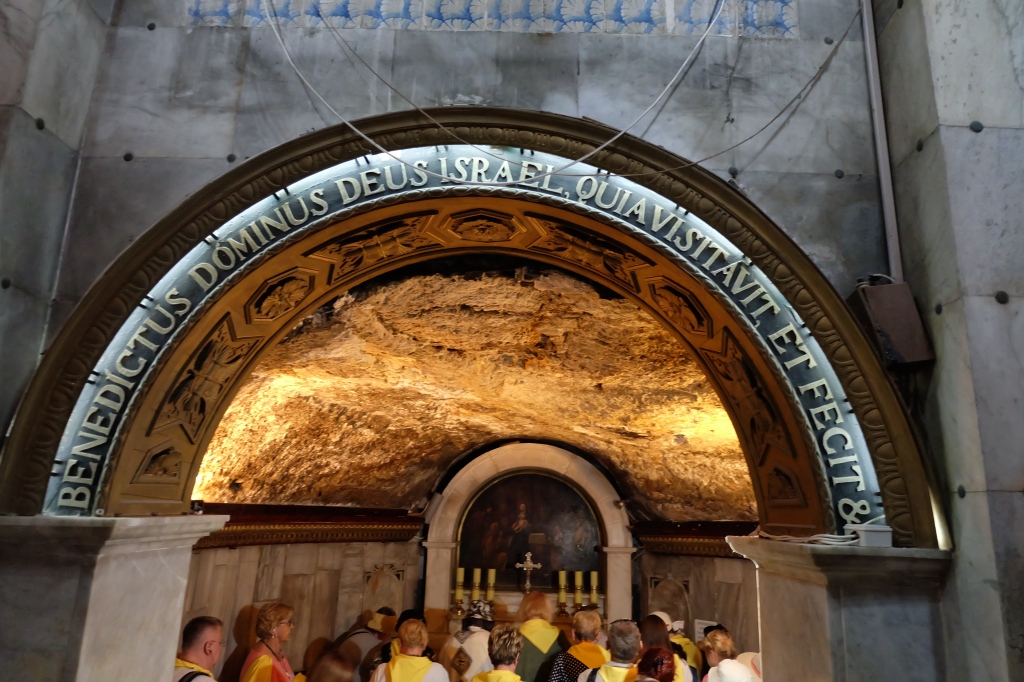
Sanctuary and altar of the Church of the Beatitudes in Israel.  Photo by the author, April 2017.

Listening With Our Hearts

openheart
Image from Google:  Open ears, Open hearts, Open minds.
The Lord Is My Chef Breakfast Recipe for the Soul
Friday, 15 February 2019, Week V, Year I
Genesis 3:1-8///Mark 7:31-37

Our dearest God and loving Father, thank you very much for this month of February when we celebrate Valentine’s, the day of hearts. 

It must had been your Holy Spirit guiding us these days when we prayed the other day that we may look inside our hearts to see you and follow your holy will; yesterday as we celebrated Valentine’s, we prayed for the grace to see with our hearts.

Today we pray for the grace to listen with our hearts so we may not repeat the sin of Adam and Eve when they listened to the voice of the serpent who misled them into believing that the moment they eat the fruit of the tree of in the middle of the garden, “their eyes would be opened and they would be like gods who know what is good and what is evil” (Gen.3:5).

Give us the grace to separate ourselves from the crowd, from all the noise and different voices of the world, to listen with our hearts in silence with Jesus Christ like that deaf man brought to Him in Decapolis.

“Ephphatha!” (Mk.7:34)

Let our ears and our hearts be opened to you O Lord.

Let us be “deaf” sometimes to the cacophony of sounds in the world, competing for our attention, listening intently with our hearts to your tiny voice deep within us, telling us to love freely and truly by avoiding sins and doing only what is good.  Amen.  Fr. Nicanor F. Lalog II, Parokya ng San Juan Apostol at Ebanghelista, Gov. F. Halili Ave., Bagbaguin, Sta. Maria, Bulacan.

heart-reason

Seeing With Our Hearts

little-prince-quotes-03-830x467
The Lord Is My Chef Breakfast Recipe for the Soul
Thursday, 14 February 2019, Week V, Year I
Genesis 2:18-25///Mark 7:24-30

             A blessed day of the hearts to you O God our loving Father!

             Everybody is greeting happy Valentine’s in honor of your saint who found ways of bringing together in holy matrimony lovers forbidden by so many circumstances.  On the other hand, our liturgy reminds us on this day the holiness of two brothers, St. Cyril and St. Methodius who preached the gospel among the Slavs.

             All three saints showed what true love is, a love that is rooted in you expressed in their love for others.  This is the love that your Son Jesus Christ had concretely showed us, to make us experience anew that we are all one, brothers and sisters in you our Father despite our different colors and beliefs.

             On this day of hearts, remind us O Lord to always see with our hearts so we can be filled with awe and joy in seeing one another like the first man, saying “This one at last, is bone of my bones and flesh of my flesh” (Gen.2:23).  Give us also the courage of that Syrophoenician woman who came to beg Jesus to heal her daughter possessed by the devil by admitting her being a foreigner and different in race yet the same in stature as a child of God (Mk.7:28).

              Like the first man and the Syrophoenician woman who saw with their hearts the other persons and Jesus, then we can destroy the walls that separate us from one another and build bridges of love that bring us together in kindness and respect.

                May we always look with our hearts, O Lord Jesus, because it is only with the heart that we can truly see.  Amen.  Fr. Nicanor F. Lalog II, Parokya ng San Juan Apostol at Ebanghelista, Gov. F. Halili Ave., Bagbaguin, Sta. Maria, Bulacan.

To See More of God, We Need to See More of What is Good

DSCF1437
Shifen Waterfall in Pingxi District, New Taipei City, Taiwan.  Photo by the author, 29 January 2019.
The Lord Is My Chef Breakfast Recipe for the Soul
Tuesday, 12 February 2019, Week V, Year I
Genesis 1:20-2:4///Mark 7:1-13

            Everyday O God we praise you in our prayers and most especially when we see your majesty in nature.  You never fail to remind us of your presence in your wonderful creation as we have heard in the first reading today (Gen.1:20-31).  Indeed like the psalmist, we always exult of “how wonderful your name in all the earth” (Ps.8).

            However, too often like the Pharisees and some scribes in the gospel today, we tend to look for what is missing or lacking that we perceive to be not good:  When the Pharisees with some scribes who had come from Jerusalem gathered around Jesus, they observed that some of his disciples ate their meals with unclean, that is, unwashed, hands (Mk.7:1-2).

            Like those Pharisees and scribes, we “nullify the word of God in favor of our tradition that we have handed on.”  And yes,  Jesus, it is so true with us today like the Pharisees and scribes, “we have many such things” (Mk.7:13).  We make so many rules and precepts, traditions and beliefs that eventually supersede your Laws and worst, have even replaced you O God!

            Forgive us O Lord in worshiping traditions and other practices than You.

            Forgive us O Lord in disregarding persons, the crown of your creation, and giving more importance with our beliefs and other concepts so detached from You.

            Teach us O Lord to see more of you our God and Creator by seeing more of what is good around us and among us.  Amen.  Fr. Nicanor F. Lalog II, Parokya ng San Juan Apostol at Ebanghelista, Gov. F. Halili Ave., Bagbaguin, Sta. Maria, Bulacan.

Our Joy In Mary As Mother

51705716_417611242320476_2911087373909491712_n
Our Lady of Lourdes Grotto in France.  Photo by my former student at ICSB-Malolos, Architect Philip Santiago during his pilgrimage there last September.  Used with permission.
The Lord Is My Chef Breakfast Recipe for the Soul
Monday, 11 February 2019, Memorial of Our Lady of Lourdes
Isaiah 66:10-14///John 2:1-11

            God our loving Father, when your Son Jesus Christ came to save us, He did not only give Himself for us but even gave us His Mother, Mary to be our Mother too.  How wonderful that three years before His “hour” on the Cross, Jesus showed us a glimpse of His immense love for us through His mother at the wedding feast of Cana.

            His mother said to the servants, “Do whatever he tells you” (Jn.2:5).

            Most of all, what is most beautiful on this memorial of Our Lady of Lourdes when she appeared there in 1858 to St. Bernadette Soubirous as the Immaculate Conception, we also celebrate today the World Day of the Sick to remind us “to see in our sick brothers and sisters the face of Christ who, by suffering, dying and rising, achieved the salvation of humankind” as per St. John Paul II in his later on May 13, 1992.

            Help us O Lord to do whatever you tell us especially for the sick, giving them comfort “like a mother to her son so that their bodies shall fluorish like the grass” (Is.66:13-14).  May we be a mother like Mary to everyone, always “concerned” with the good of each one like during that wedding at Cana.

            O what a joy indeed for us to have Mary as our Mother too like a spring leading us to Jesus who refreshes us, heals us, and frees us.  Amen.  Fr. Nicanor F. Lalog II, Parokya ng San Juan Apostol at Ebanghelista, Gov. F. Halili Ave., Bagbaguin, Sta. Maria, Bulacan.

“Still in Love” by Seawind (1980)

jesusbytheshore
Photo from Bing.
The Lord Is My Chef Sunday Music, 10 February 2019

            It is a very lovely Sunday despite the very warm weather.  Perfect for listening to the music of Seawind with vocals by Fil-Am Ms. Pauline Wilson who would surely touch your heart and delight your soul with “Still in Love” from their self-titled album “Seawind” released in 1980.

            How lovely to realize that after all these years, you are still loved by someone you have loved.  Exactly the kind of love of Jesus Christ to us all.  In the gospel today, we find Jesus calling His first apostles while preaching by the shores of Lake Gennesaret after being rejected at their synagogue in Nazareth.  That is how true and faithful Jesus is with His mission to reach out to everyone proclaiming His good news of salvation.  Jesus is the only one who would always still be in love with us no matter how often we turn away from Him or reject Him.

            Are you still in love with someone special?  Or with Jesus?

            Rejoice because most likely, you are still loved by that someone.

            And definitely by Jesus!