Today, O Lord, I pray for my hardening heart. I have a festering anger deep in my heart against some people who have hurt me. And I am harboring a grudge against them like Herodias, the mistress of Herod.
Herodias harbored a grudge against John the Baptist and wanted to kill him but was unable to do so. She had an opportunity one day when Herod, on his birthday, gave a banquet for is courtiers, his military officers, and the leading men of Galilee. Herodias’s own daughter came in and performed a dance that delighted Herod and his guests. The king said to the girl, “Ask of me whatever you wish and I will grant it to you.” So she went out and said to her mother, “What shall I ask for?” She replied, “The head of John the Baptist.”
Mark 6:19, 21-22, 24
What is so shameful, O Lord, like Herodias, I want to have the heads of those people. I want to get even with the pains they have inflicted against me. I want revenge.
But more shameful, Lord Jesus, is, unlike Herodias, I have not done anything wrong against these people. And no amount of pain can justify my grudge, my anger, my hatred against them.
This is what makes it more painful with me: the festering anger in my heart is slowly poisoning my soul, my very being.
Teach me, Jesus, to bear all pains like John the Baptist, suffering for you, suffering with you.
Give me the courage and strength to “gird my loin” as you told the Prophet Jeremiah so I may be able to control myself and be on guard against becoming like Herodias or, worst, Herod, who beheaded John in prison.
Let me rise above my instincts and feelings to be not like the evil doers and fake people who fight and malign me because you have assured me that they will never prevail over me, that you will deliver me for you are always with me. Amen.
“The Severed Head of John the Baptist”, a sculpture by the French artist Auguste Rodin in 1875. This is probably a representation of a guillotined criminal’s head during that time. From Google.
After the last Mass tonight in every parish, the Paschal Candle is extinguished and from the ambo where it had stayed since the Easter Vigil, it is brought back to the baptistry to signal the start of Ordinary Time tomorrow.
As we have been reflecting these past days, life is a series of coming than of leaving. This is very true in today’s celebration of the Solemnity of the Pentecost: when Jesus ascended into heaven last Sunday, the Holy Spirit now comes to fire up the disciples to continue God’s presence in the world. Last Sunday we said the Ascension does not mean Jesus going to a particular place “up there” but his entry into a higher level of relating with us. Today is the fulfillment of that promise he made, that he would remain with us until the end of time in the power of the Holy Spirit sent by the Father.
Pentecost means fifty. After God handed to Moses the Ten Commandments at Sinai, the Israelites ratified that covenant 50 days after. Eventually when they entered the Promised Land, Pentecost became an agricultural celebration of their harvests that eventually extended into a celebration of weeks. When the Holy Spirit came on that Pentecost day in Jerusalem, it became the “coming out party” of the Church when the Apostles were emboldened to proclaim the good news of Jesus Christ to everyone.
In this evolution of the Pentecost from Sinai to Promised Land to the early Church, it has remained true to its essence as life in God. As such, we must keep in mind it is not an isolated event in the past but a reality we must allow to happen every day in our lives. If there is one thing very much missing in the Church these days, it is the Holy Spirit. We need a “perennial Pentecost” to fill us with life and zest in living the Gospel, from the bishops to the priests to every baptized Catholic. See the vibrancy among other Christian denominations. They are so alive while we Catholics as so rigid and lethargic. We need to be “fired up” by the burning fire of the Holy Spirit everyday. It is Pentecost or nothing!
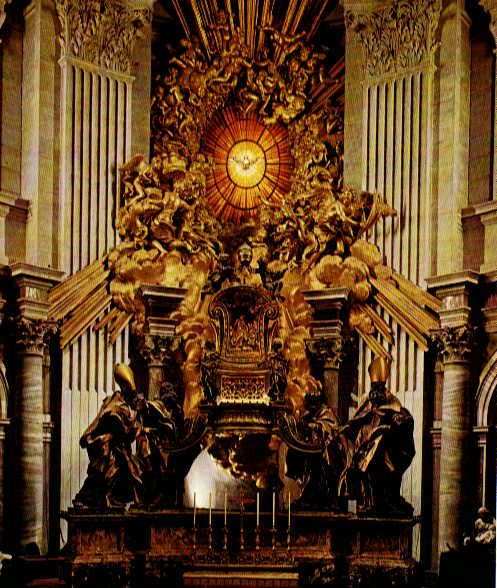
Chair of St. Peter at the High altar of St. Peter’s Basilica in Rome. From Google.
Above the Chair of St. Peter at the Vatican is a stained glass depicting the coming of the Holy Spirit like a dove. According to Pope Emeritus Benedict XVI, that is in essence the Church which is like a window where God and man get in contact. At the middle of that meeting point or contact of God and man is the Holy Spirit. Without the Holy Spirit, we can never be in touch with God and with others. The Holy Spirit is the spirit of love that binds us all with each other and with God in the same manner it unites the Three Persons of the Blessed Trinity to remain as One God. This explains why we heard again today the Gospel three Sundays ago of Jesus teaching about love at the Last Supper.
Jesus said to his disciples: “If you love me, you will keep the commandments. And I will ask the Father, and he will give you another advocate to be with you always. Whoever loves me will keep my word, and my Father will love him, and we will come to him and make our dwelling with him.”
John 14:15-16, 23
These words are repeated today to present to us the new and definite context of the Pentecost flowing from that Last Supper discourse of Jesus about love, keeping his commandments, and coming of the Holy Spirit.
During his Last Supper, Jesus clearly showed that in the new covenant sealed by his blood, the Law is more than the personification of God: obedience to his commandments and to the Father is first of all an expression of love. Jesus is the new Torah, the new law of love found in his oneness with the Father. On this Pentecost Sunday, we hear again the Last Supper discourse of Jesus to remind us that being Christian is becoming united as one in him as “indwelling of the Father and the Son.”
That can only happen when we allow ourselves to be small. See that at the Ascension, we were presented with an upward movement that called for the need to be light and powerless in order to rise above. Now, Pentecost’s downward movement shows us the need to be small in order to be mixed or fused with God and with others. Every downward push leads to spreading out, of thinning out, of getting small.
As limited beings, our greatness can only be found in our ability to share, to be small to participate and become a part of a larger whole. In our very selves, we cannot do anything. I am so amused to realize this basic truth while watching those crime shows in Netflix like Narcos and Bad Blood where even the most evil men need to be small, to band together to be powerful. We all need conversion which is very essential to be truly great!
For true conversion to happen, there has to be love, even at least, an openness to love. It is no wonder that love is always presented in the fiery shades of red and orange because almost everything is purified and broken into little particles by fire. When love is intense, expect fire to be hotter with its hues of red and orange more aglow. Only when we are willing to be subjected to love’s purifying fire can we be truly filled with the Holy Spirit and its gifts, particularly joy.
Conversion and love demand constant dying into one’s self, of living in the spirit and not in flesh that St. Paul explained in the second reading. We can never be one in Christ without conversion, without getting off our ivory tower of pride and arrogance. We need to go down, if we have to lie face down, so be it. Most of all, oneness with others is impossible without conversion because we cannot insist on ourselves on others. We need to be broken, we need to smash our high walls that keep us away from others. That is what the Holy Spirit’s fire did on that Pentecost Sunday in Jerusalem, the very same thing needed to happen these days in our Church.
Every Sunday when we gather like the Apostles at the Upper Room during the Lord’s supper, we are invited to keep his commandments in love. This can only happen when we pray for conversion through the fire of the Holy Spirit. Let us be open to receive this fire of the Holy Spirit again every Eucharistic celebration so that after our gathering, we may set the world anew in fire with Jesus Christ’s loving presence. Amen.
40 Shades of Lent, 5th Sunday-C, 07 April 2019
Isaiah 43:16-21///Philippians 3:8-14///John 8:1-11
From Google.
Sunrise at Lake of Galilee. Photo by author April 2017.
Today is the last Sunday of Lent. It is hoped that by this time since Ash Wednesday, we have slowly acquired or even regained our contemplative spirit of prayerful silence. It is something very essential not only during these 40 days and in the coming Holy Week. It is only in silent prayers can we truly find balance in life as we discover what is valuable and what is worthless, things that last and things that pass. Prayerful silence teaches us to slow down, to be more discerning, and more trusting. The contemplative spirit thus leads us to grow deeper in our faith, hope and love in God. It is in the contemplative spirit where God works best in us.
We find this invitation to a contemplative spirit in our beautiful gospel today of a woman caught committing adultery whom Jesus refused to condemn. Unlike the previous four weeks when we heard all gospels taken from Luke, this Sunday’s story is from John that perfectly fits last week’s parable of the prodigal son to show us God’s immense love and mercy for us sinners. Every conversion, every contrition of sins presupposes silence. Recall how the lost son last Sunday realized his sinfulness while silently tending swine in a far away land.
From Google.
Jesus went to the Mount of Olives. But early in the morning he arrived again in the temple area, and all the people started coming to him, and he sat down and taught them. Then the scribes and the Pharisees brought a woman who had been caught in adultery and made her stand in the middle. They said to him, “Teacher, this woman was caught in the very act of committing adultery. Now in the law, Moses commanded us to stone such women. So what do you say?” They said this to test him, so that they could have some charge to bring against him. Jesus bent down and began to write on the ground with his finger.
John 8:1-6
From Google.
We have seen how Jesus foiled other insidious plots against him through tricky questions but this one involving a woman caught committing adultery shows us a fine image of him as the Christ. His silence, his bending down and his writing on the ground are moving moments that touch our hearts and make us wonder all the more, who is this man?
More than addressing a question that concerns the many dilemmas we face in life, this episode shows us that it is something that directly concerns Jesus Christ himself, his being our Savior. Notice at the start of the story where Jesus is presented always going to the Mount of Olives to pray, to be one with the Father. This episode happened after he had entered Jerusalem on Palm Sunday, showing us how Jesus became more intense in praying, in being one with the Father when his final days were approaching. That is the contemplative spirit.
Now feel the atmosphere of those tense moments when people brought the woman caught committing adultery to Jesus: everybody was saying something, emotions were running high, just like us in our own time with social media around us. We live in so much noises where everybody and everything is talking that we fail to listen to our very selves, to others and most especially to God always silent. See how Jesus was so cool – or “chillax” as young people would say. It was an astonishing reaction to the situation. Only a person with deep contemplative spirit like Jesus can be so composed and silent in a tense situation like that. It is always easier to react and say something than be silent to weigh everything. Too often in the world today, words are so empty that they have to be shouted all around and repeated so often in the hope they become true, exactly what every election candidate is doing!
From Bing.com.
Jesus chose to be silent so we may realize that issues of sin and evil are best resolved in a contemplative spirit where we find the value of every person that we condemn the sin not the sinner. History has shown time and again how wars and violence or any other harsh methods like death penalty have proven ineffective in correcting any injustice or wrongdoing and preventing crimes. Where there is severity in measures against evil, we find only more deaths and burials happening but never peace and justice.
Now more than ever in Jesus Christ, we have found and experienced God’s mercy so abounding and closest to us sinners if we are truly sorry and ready to change. Like the woman caught committing adultery or the prodigal son last Sunday, we have to reach out to Christ to be forgiven from our sins. He assures us of never being condemned, of deleting our past sins and assuring us with a bright future to receive his promises if we “go and sin no more.”
We have to stress that Jesus does not approve sins. Never. He recognized the sinfulness of the woman when he told her “go and sin no more.” Likewise, Jesus never asked us to stop fighting sins. When he dared the people of whoever has no sin be the first to cast the stone, Jesus never meant us to be silent with the evil and wrongdoings happening around us. This encounter between Jesus and the woman committing adultery invites us to examine first, our own attitudes toward others guilty of serious sins. And secondly, to examine our own reactions when our misery meets with God’s mercy especially in the sacrament of penance or reconciliation.
Do we choose to be harsh like the crowd or be gentle like Christ?
How sad that even with our very selves we are so unforgiving, so severe that we hardly move on in life. Only in a contemplative spirit can we truly experience God’s liberating mercy and forgiveness within us and with others. The contemplative spirit enables us to trust God that no matter how sinful we are, his love and mercy are more powerful, able to transform us all into better persons, even saints! This is the promise of God in the first reading that he would do something greater than what he had done in liberating his people from Egypt – that he would send our Savior not only to forgive our many sins but even to share in his glory as saints.
Assumption Sabbath Baguio, January 2019.
St. Paul in the second reading could speak of “considering everything as a loss in knowing Christ Jesus” because of the contemplative spirit he acquired after his conversion. His letters all reveal to us St. Paul’s contemplative spirit and intimacy with Jesus Christ that flowed out into his daily life, reaching its summit in his martyrdom.
As the season of Lent comes to a close on this fifth Sunday, we are reminded of the path of conversion we have followed these past four weeks under St. Luke’s guidance. Conversion leads to contemplation, a daily communion with God in prayerful silence and allow him to suffuse us with his love. Its fruits are seen in our daily lives. It is the work of God, not us. It is God who renews us in silence into a new creation. We simply have to remain in Christ and strive always “to go and sin no more”. Amen.
It’s a very humid third Sunday of Lent, perfect for a New Wave music from the 80’s to remind us of the season’s call for conversion. But before going to our music, a little background about our gospel today that sounds like our news headlines.
Pontius Pilate massacred a great number of Galileans while many others were killed in an accident at Siloe. People were talking about the tragedies, blaming all victims as sinners being punished by God. But Jesus stopped all their blaming games, warning them that unless they repent and change their ways, they could also perish and suffer the same fate.
For Jesus, all the problems and sufferings in the world are either directly or indirectly caused by sins. He is not trying to offer a simplistic approach but invites us to see events in history as well as in our personal lives as calls to conversion, that is, turning our hearts back to God so we may experience the deeper meaning of life.
How sad that since His coming, after offering Himself on the Cross and rising to new life on Easter, mankind has continued to ignore Jesus Christ and His call to conversion. This is the reality presented by the English band Tears for Fears in their 1985 hit “Everybody Wants to Rule the World”. Wit its superb instrumentation and vocals, this signature song by Tears for Fears next to “Shout” (1984) can immediately catch our attention with its lyrics that confront us with the shameful truths and realities within each one of us like dominion and power, arrogance and corruption, wealth and fame, and total disregard for the environment. Its message remains very true to this day that ironically, has fallen on deaf ears. May its lyrics finally hit us and move us to a conversion of the heart!
Welcome to your life There’s no turning back Even while we sleep We will find You acting on your best behavior Turn your back on mother nature Everybody wants to rule the world
It’s my own desire It’s my own remorse Help me to decide Help me make the most Of freedom and of pleasure Nothing ever lasts forever Everybody wants to rule the world
There’s a room where the light won’t find you Holding hands while the walls come tumbling down When they do, I’ll be right behind you So glad we’ve almost made it So sad they had to fade it Everybody wants to rule the world
I can’t stand this indecision Married with a lack of vision Everybody wants to rule the world
Say that you’ll never, never, never, need it One headline, why believe it? Everybody wants to rule the world
All for freedom and for pleasure Nothing ever lasts forever Everybody wants to rule the world
From the desert of temptation to the mountain of transfiguration, the gospel on this third Sunday of Lent dives directly into its central message of conversion by bringing us closer to realities of life that are as timely as the news headlines.
Some people told Jesus about the Galileans whose blood Pilate had mingled with the blood of their sacrifices. Jesus said to them in reply, “Do you think that because these Galileans suffered in this way they were greater sinners than all other Galileans? By no means! But I tell you, if you do not repent, you will all perish as they did! Or those eighteen people who were killed when the tower at Siloam fell on them – do you think they were more guilty than everyone else who lived in Jerusalem? By no means! But I tell you, if you do not repent, you will all perish as they did!”
Luke 13:1-5
Conversion is confronting our true selves by admitting and owning our many sins that may have contributed to the worsening crises we are facing in our personal lives, in our family as well as in the church and in the society. It is doing away with our favorite past time, the blaming game. Since the fall of Adam and Eve, we have always been blaming somebody else including God for every bad thing that happens to us and in the world. We tend to forget or even refuse to accept that every misery in our lives and on earth are the direct or indirect results of our sins like sickness and diseases, wars and terrorism, famines as well as economic and environmental disasters. Everything is by our own doing when our sins mar the human face including Mother Earth.
Jesus Christ in today’s gospel is not offering us with a simplistic view on the many sufferings and problems we have for that would also be getting into our own blaming game. He has no intentions of getting involved with our political and economic discussions to solve our many problems. What Jesus is telling us with His strong words only Luke had recorded is for us to read everything from the spiritual point of view by finding God in our human and personal history. And that is conversion, finding God first in our hearts to find Him in our history and in our world.
In the first reading, we are reminded how the whole earth is a sacred ground, the abode of God who told Moses to remove his sandals as he approached the burning bush in the desert. Moreover, God introduced Himself to Moses in the burning bush as the perfect presence, the “I AM WHO AM” who is all encompassing directing our history into His divine will and plan. With Jesus Christ’s coming as the Emmanuel or “God-is-with-us”, God has become more present among us not only on earth but right in every person.
And that is conversion, having Jesus in our hearts in order to find Him among others. Conversion does not mean we change into another person but more of reorienting our life directions in Christ by allowing Jesus to dwell in our hearts. How sad that so often, we would look into others to blame and to change when we forget the fact that the only heart we can convert is ours. It is said that anyone wishing to change the world must first change one’s self. And that is what Jesus is telling us today.
Jesus came to the world so we may experience the Father’s gentle mercy, kindness and forgiveness. By following His direction in our conversion, it is hoped that we find better ways in solving our many social and personal problems. The recent terrorist attacks in New Zealand that killed almost 50 people, the gruesome rape and murder of that young lady in Cebu, the worsening problems on drugs and crimes as well as traffic and the environment invite us all to a conversion of our hearts in Christ to experience His humility and tender, loving care for the lost, the sick and the suffering. See how our arrogance and harshness have only worsened the many social ills throughout history, not to mention man’s continued alienation from self and from one another.
Throughout history, God has always revealed Himself to us in so many ways through Jesus Christ to show us that the only way to salvation in all forms of human life is the way of conversion, to always find Him in the many events happening around us, in the world, and most especially in our hearts. Let us heed Paul’s warning that “whoever thinks he is standing secure should take care not to fall” (1Cor.10:12) by learning from the lessons of powerful men and women in the past now gone and forgotten. As we walk in history, God walks with us too, listening to us, sharing with us Himself. Sometimes, changes do not happen right away or as we want it to be but in His time, God’s plans always prevail. In the mean time, He patiently awaits our conversion in Him.
40 Shades of Lent
Saturday after Ash Wednesday, 08 March 2019
Isaiah 58:9-14///Luke 5:27-32
Our loving Father, we are now about to enter the first Sunday of Lent. We have been trying to be serious with this season with our prayers and fasting. But, let us not lose sight of the fact that Lent is a joyous season too as we wait for Easter!
There are times O Lord some of us feel like Levi, sitting alone at the customs post, surrounded with all the wealth and trappings of the world, longing for some meaning in life. Maybe like Levi in that little customs post, some of us feel trapped in our sinfulness with no help in sight.
But, then you came, O Lord Jesus, like a shaft of light amid the darkness, just passing by, saying “follow me” (Lk. 5:27) without even asking our sins or work or world. You asked us nothing but you know everything about us. And that is the mystery that caught us!
What a joy being called to follow you, despite our sinfulness. Remind us always of that joy of Lent that in the midst of our sinfulness and darkness, you still come to call us to follow you.
Help us, O Lord to “remove oppression from our midst, false accusation, and malicious speech… bestow bread to the hungry and satisfy the afflicted” (Is.58:9-10). Help us to sustain our efforts in following you in every direction by being good and just with one another. Amen.
The Calling of St. Matthew (Levi), a painting by Caravaggio which is one of the favorite masterpieces frequently visited by Pope Francis in Rome while still a student and Archbishop of Buenos Aires. Let us keep in mind that Lent, despite it penitential character, is a joyful season of Christ’s coming. Images from Google.
God was the true spirit of EDSA 1986; may we find our way back to Him again in our modern EDSA. Photo from Google.
The Lord Is My Chef Breakfast Recipe for the Soul
Monday, 25 February 2019, Week VII, Year I
Sirach 1:1-8///Mark 9:14-29
O God our Father, today I praise and thank you for the 33rd anniversary of the People Power Revolution that happened at EDSA.
I am proud O Lord of that historic moment in our history because I was there with my sister.
But I also feel so sad today, O Lord, because we have wasted your gift at EDSA. I feel betrayed by many of our leaders there who have left us. I feel betrayed by many of the other veterans of that bloodless coup who have left our cause.
EDSA 86 was our moment of Exodus from our own Egypt but due to our many idolatrous ways, here we are as a nation still wandering in the wilderness when EDSA has become the symbol of everything wrong in us.
Help us to return to you again as our Lord and only Master.
Let us turn back to you for more wisdom to finally set our course right on track as a nation, giving priority to the value of every person and of human life.
God our Father, sometimes I really can’t figure out anymore what went wrong with EDSA because I know I also have a part in its failure.
I still do believe in the ideals of EDSA and most especially in you, the God of history.
Yes, like that father of an epileptic, “I do believe, help me in my unbelief!” (Mk.9:24)
Amen.Fr. Nicanor F. Lalog II, Parokya ng San Juan Apostol at Ebanghelista, Gov. F. Halili Ave., Bagbaguin, Sta. Maria, Bulacan.
EDSA today, the image of everything wrong with us. Photo from Inquirer.net via Google.
Friday, 25 January 2019, Feast of the Conversion of St. Paul
Acts 22:3-16///Mark 16:15-18
Today we thank you O Lord for your gift of St. Paul whom you converted from being a persecutor of the early Christians to becoming your “Thirteenth Apostle” who stands at equal footing with St. Peter in the growth of your Church.
What made him truly great and effective as an apostle, O Jesus, is not his brilliant rhetoric and sophisticated strategies but his willingness to suffer so much for you and your gospel. He had shown us the essence of discipleship which is to live one’s life completely in you alone – “I have been crucified with Christ; yet I live, no longer I, but Christ lives in me; insofar as I now live in the flesh, I live by faith in the Son of God who has loved me and given himself up for me” (Gal. 2:20).
St. Paul was able to accomplish this by showing us true conversion that we always misunderstand as something like changing into another person completely like turning around a shirt, from being proud and violent to becoming meek, or from being so shy to becoming daring or being impulsive to almost timid. While his letters teem with so many gems in teaching us how he was converted into loving you until the end, his imposing images with his sword remain his most beautiful symbol of conversion.
All his life as his images rightly portray him everywhere, he had kept that sword: when still called Saul, he had that sword to express his zeal and fire for the Law that he persecuted Christians; but on the way to Damascus, you called him and after a period of prayers and studies, he picked up again his sword to preach your gospel with the same fire and zeal that eventually in the end, he willingly accepted death by the sword in your name. From the sword that inflicted pain on others, it became a sword that slew his defects until later at the end of his life in Rome, it caused his martyrdom.
Help me Lord to keep my sword – my weaknesses and shortcomings – not for their own sake but because that’s me, that’s my personality. Help me to change my ways not my heart by using this same sword to slay the defects within me without extinguishing that fire for you and your gospel. Let these defects I have remind me always like St. Paul that “whatever gains I had, these I have come to consider a loss because of Christ… everything as a loss because of the supreme good of knowing Christ Jesus my Lord” (Phil 3:7-8). Let me fight, O Lord, for your gospel, for your Spirit as I fight pride and other sins within me. Amen. Fr. Nicanor F. Lalog II, Parokya ng San Juan Apostol at Ebanghelista, Gov. F. Halili Ave., Bagbaguin, Sta. Maria, Bulacan.
*Photo from Google, statue of St. Paul in front of the Major Basilica of St. Paul Outside-the- Walls, Rome.
One of my unforgettable experiences in my parish is when a husband and wife quarreled during the baptism of their child. When I asked the father the name to be given to their son right before baptism, he gave another name and instantly, his wife hit him with her elbow and snapped, “who’s that baby again!?”
In the rites of baptism, it is the father who is asked by the minister on the name to be given to the child. It is the father who gives the name because he is the origin of life, the giver of life; hence, every child uses the father’s family name to show his paternity. This is in essence the reason God asked Joseph “to be not afraid to take Mary as his wife” so he would be the legal father of Jesus Christ. Though it is very clear in the account of Matthew yesterday and today that Jesus is truly the Son of God and not of any human, the evangelist shows us how through Joseph, Jesus belongs by law – legally – to the house of David as fulfillment of God’s promise. At the same time, in giving name to Jesus, Joseph proves more than ever his holiness which is the meaning of his description as a “righteous” or “just” man. This is how the birth of Jesus Christ came about. When his mother Mary was betrothed to Joseph, but before they lived together, she was found with child through the Holy Spirit. Joseph her husband, since he was a righteous man, yet unwilling to expose her to shame, decided to divorce her quietly (Mt.1:18-19).
Holiness for the Jews or being righteous and just is primarily obedience to the Laws of God handed down through Moses. However, during the time of Christ this perception became so limited to mere obedience to the letters of the law that even Jesus later on would try to correct. His legal father, St. Joseph, in fact would exactly do that when he showed that holiness is a constant dialogue with God when one is nourished by His words like a tree planted near the streams of water, bearing fruits of love for God and for others. This imagery is found in the Book of Psalms that says men who are just and righteous are those who “delight in the law of the Lord, like a tree planted near streams of water, that yields its fruit in season; its leaves never wither; whatever they do prospers” (Ps.1:2-3). When St. Joseph decided to quietly divorce Mary after learning about her pregnancy, it was the height of his love for her as he was very willing to walk away and let her marry whoever fathered that child in her womb than subject her to public shame and humiliation as their laws prescribed. In that aspect alone, we find St. Joseph very holy indeed! But it did not stop there: after being informed by the angel in a dream of the divine nature of Mary’s pregnancy, St. Joseph proved anew his holiness with his deep love for God by eventually taking Mary as his wife that paved the way for the first Christmas we now celebrate. St. Joseph’s holiness shone brightly in this aspect when his love for Mary was never diminished but even deepened when his love for God moved him to take “his wife home.” Here are the fine prints of St. Joseph’s holiness that in his love for God, he had to take Mary as his wife and in doing that, he eventually brought forth in a sense the birth of Jesus Christ. Every time we love God, it always leads us to love others too. It is when we live in love that Jesus Christ truly comes into our lives and Christmas happens always.
But there is something bigger and better, lovelier and holier to unfold in St. Joseph’s role as legal father of Jesus Christ. Notice how Matthew repeated the verb “to name” twice: “She will bear a son and you are to name him Jesus, because he will save his people from their sins (Mt.1:21)” and “When Joseph awoke, he did as the angel had commanded him and took his wife into his home. He had no relations with her until she bore a son, and named him Jesus (Mt.1:24-25).” Giving of names in general connotes authority. In Genesis, God gave man the authority to give names to the animals He had created. Parents give names to their children as a sign of their authority. Bullies in classrooms and anywhere always try to assert their authority by giving funny names to their victims while lovers always have unique names given to their beloved as terms of endearment. In this respect, St. Joseph did not merely give up that authority of giving name but must have also realized within him the awesome reality of things about to unfold in the birth of Mary’s child who “will save his people from their sins” (Mt.1:21).
Three weeks ago I read in the news how a popular American airlines apologized to a mother when their ground crew at the boarding gate laughed and insulted her daughter named “Abcde” which is pronounced as Ab-city. I have baptized a baby in my parish with a similar name, “Wxyz”. The parents never complained or filed charges against me when I questioned them for their choice of name for their son, warning them of negative repercussions in the future. Giving of names is a very serious duty among the Jews (and it should be for everyone!) because a name always indicates the person’s mission. In giving the child of Mary the name “Jesus” that means “God is my salvation”, St. Joseph must have realized not only the mission of Christ but most of all fully accepted it as one that the world needs so badly. Recall that during the ministry of Jesus, religious leaders of His time always questioned His forgiving of sins because only God can forgive sins. Problem with them like the Pharisees and the scribes, they have refused to recognize Jesus as the Christ, the Son of God sent to forgive sins. Right from the start during his dream, St. Joseph was already aware of the mission of Jesus Christ which is to forgive sins. And his obedience to the instruction of giving the name “Jesus” is indicative of his holiness because the first step to being holy is to admit our sinfulness, our need for forgiveness by God. This is the problem of the world today, the lack of sense of sinfulness among most of us even among us priests as shown by the sex scandals. The mark of true holiness is the humility to admit and accept one’s sinfulness and need for forgiveness. When Pope Francis was interviewed for the first time for a magazine, he was asked how he would describe himself and his quick answer was, “I am a sinner.”
Sin is a turning away from God, the absence and failure to love. It is the opposite of holiness which is being filled with God. Unless we realize that our sinfulness is the first and most important thing needed to be fixed within us, we will never move forward, we will never grow, and we will never experience Christ’s coming. This is the very reason Christ was born, to forgive our sins so that we may return and go back to God who is our fundamental relationship in life. No healing, no life in general will ever come and prosper when this relationship with God is out of order because of sins. St. Joseph is a righteous or just man, a holy man, because in recognizing the need for the forgiveness of our sins, he cooperated with God in His plans by naming the child of Mary as “Jesus” and that is why we now celebrate Christmas. God bless you! AMEN. Fr.NicanorF.LalogII,Parokya ng San Juan Apostol at Ebanghelista, .Gov. F. Halili Ave., Bagbaguin, Sta. Maria, Bulacan.
*Photo by author, Church of St. Joseph at Nazareth, the Holy Land, April 2017.
“Behold, the Lord will come, and all his holy ones with him; and on that day there will be great light” (from the entrance antiphon of today’s Mass).
Has this day come, Lord? It is supposed to have been fulfilled a long time ago in your birth, Lord Jesus, after Isaiah had prophesied of how a “shoot shall sprout from the stump of Jesse, and from his roots a bud shall blossom.” (Is.11:1) But it has not happened yet, remaining only a dream and a sight to behold in our imaginations when there would be peace and harmony at your coming, “when the wolf shall be a guest of the lamb, the leopard shall lie down with the kid, the calf and the young lion shall browse together with a little child as their guide, the cow and the bear with their young resting as neighbors, the lion eating hay like ox, and the baby playing by the cobra’s den as he lay his hand on the adder’s lair.” (Is.11:6-8)
It is a beautiful sight, a reality we are all wishing for but has never happened despite your coming to us, Lord Jesus Christ. And we know why: because we have not truly welcomed you in our hearts like children.
Give us the grace to be filled with your Holy Spirit, that we may be childlike so that this blessed season of Advent may dispose us to conversion and single-mindedness in you alone. Fill us with your Holy Spirit so we may attend to our deepest needs and hopes like peace and justice by being more compassionate with those who are suffering like the poor and the weak. Let us bring your light in this world darkened with sin and individualism, marred by senseless wars and petty competitions and rivalries among us. Hear our prayer, Lord, that we learn “to judge wisely the things of earth and hold firm to the things of heaven” (from today’s prayer after Communion). AMEN. Fr. Nicanor F. Lalog II, Parokya ng San Juan Apostol at Ebanghelista, Gov. F. Halili Ave., Bagbaguin, Sta. Maria, Bulacan 3022.
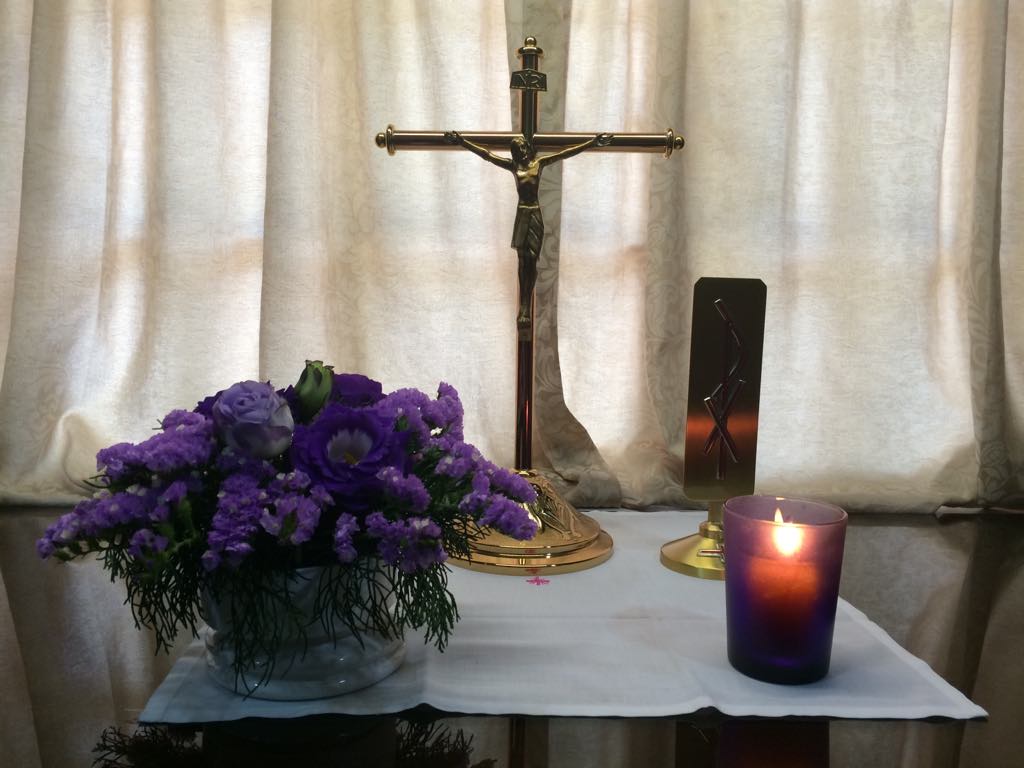
*Photo by the author, altar inside our parish sacristy, 03 December 2018.







 lordmychef.com