When Advent is also a Sabbath

The Lord Is My Chef Sunday Recipe for the Soul by Fr. Nicanor F. Lalog II
First Sunday of Advent-A, 27 November 2022
Isaiah 2:1-5  ><}}}}*>  Romans 13:11-14  ><}}}}*>  Matthew 24:37-44
Photo by author, November 2022.

A blessed happy new year to everyone!

Yes, our new year in the Church begins this Saturday evening as we usher Advent Season, the four Sundays before Christmas which also falls on a Sunday this year. What a truly blessed Christmas we are having this year since COVID-19 came in 2020. For the first time in two years, we are celebrating Christmas face-to-face which is the essence of the event when the Son of God became human like us in everything except sin so we may experience God in person!

Like a light piercing through the darkness of the night – here and today – we experience Jesus Christ’s coming to us this Christmas 2022 most true that his call in the gospel is so appropriate especially at this time.

Jesus said to his disciples: “As it was in the days of Noah, so it will be at the coming of the Son of Man. They did not know until the flood came and carried them all away. So will it be also at the coming of the Son of Man. Two men will be out in the field; one will be taken, and one will be left. Two women will be grinding at the mill; one will be taken, and one will be left. Therefore, stay awake! For you do not know on which day your day will come.

Matthew 24:37, 39-42
Photo by author, November 2022.

“Therefore, stay awake!”

Staying awake does not mean not going to sleep. In fact, for us to be awake, we have to sleep and be fully rested always to be awake and alert whether at night or at day.

That is why Advent is a sabbath, a day of the Lord when we pause to rest and allow God to fill us with his breath and spirit so we may be more attuned with Christ’s coming.

To rest in Filipino is “magpahinga” that literally means to be breathed on. Sabbath as a day of rest is to be breathed on by God, “magpahinga sa Diyos, mahingahan ng Diyos”. Unless we are filled with the breath of God, with his spirit, we will never experience Christ’s coming to us this Advent nor this Christmas nor at any time.

This is the whole point of Christ’s teaching today. Advent is an invitation for us to examine and review our attitudes to life, to God, and to others. Like in the gospel, Jesus reminds us how we conduct ourselves in this life, of being attuned to the Holy Spirit, lest “one is taken and the other one will be left”.

Life has been so difficult for everyone these past two years. Some of us have lost a loved one or relatives and friends to COVID. Many have lost their businesses or career and many other opportunities in life. And sadly, there are others who have lost or wounded and bruised relationships too.

But, have we also lost ourselves that in the process lost God too that we have lost all sense of decency and kindness with one another?

Photo by author, November 2022.

The other day, a former classmate suddenly texted me, saying hi and asking when she and her husband may visit me. Such messages coming out of the blue from anyone – especially her – make me wonder what’s wrong? What’s her problem this time?

She said she just wanted to keep in touch, reminding me how she has always been grateful for my help and prayers. However, she insisted that if we can’t meet, can I send her a prayer via text message because according to her, my prayers and blessings have “magic” as they always come true considering her prospering business and finally, her youngest child about to finish medicine.

I did not answer her until afternoon by sending her a prayer she had requested. And a reminder to her that my prayers have no magic powers nor lucky charms. I told her, “you are blessed abundantly by God because he loves you very much. Because he knows how well you pray hard and strive to be good and fair in your dealings with others. Most of all, because you are grateful. Keep serving the Lord.”

Many times even in our faith and spiritual life, we believe more in luck or swerte than in God as a person loving us, blessing us. That is why our faith has no communal dimension at all because we remain self-centered even in our worship and faith without even finding and experiencing God himself in Jesus Christ who had come to us more than 2000 years ago in Bethlehem.

On this first Sunday of Advent, we are reminded to rekindle in our hearts that ardent desire for God and his kingdom, for the return or Second Coming of Jesus Christ who had come and remains with us, and for the guidance of the Holy Spirit to keep us awake in finding God always in us and in others.

This first Sunday of Advent is calling us to fine tune our attitudes to God anew, to recall the beautiful lessons of this COVID-19 pandemic we now seem to have forgotten totally like importance of God and prayers, of one another, and value of life.

Like the prophecy of Isaiah in the first reading, we find ourselves today in the same situation of many wars going on not only in Ukraine or Mindanao but also in our families and communities yet, we continue to march forward to God’s final fulfillment of his promises. Imagine and feel the prophecy of Isaiah:

“Come, let us climb the Lord’s mountain, to the house of the God of Jacob, that he may instruct us in his ways, and we may in his paths. He shall judge between the nations, and impose terms on many peoples. They shall beat their swords into plowshares and their spears into pruning hooks; one nation shall not raise the sword against another, nor shall they train for war again. O house of Jacob, come, let us walk in the light of the Lord!

Isaiah 2:3, 4-5
Photo by author, November 2022.

What a lovely imagery of beating swords into plowshares and spears into pruning hooks as we walk in the light of the Lord that is happening NOW!

That is one of the challenges of our Advent preparation which is to open our eyes, our minds and our hearts (and arms too!) to find and welcome Jesus Christ already present with us, right here and right now!

That can only happen if we can rest this Advent in the Lord through prayers and meditations of his words that are so rich these days; of having silent moments to find ourselves anew instead of going back to our old ways of crazy Christmas rush shopping and the many external preparations that have become more of a show or a palabas.

Advent is a sabbath calling us to come home to God, to find him in Jesus Christ who had come and comes daily inside us, in our family and friends, in everyone and in various occasions and event in our lives. When we find God, that is also when we find our true selves. And that is Christmas – the coming together of man and God.

Advent is a sabbath when we go back to paradise which last Sunday we find also on the Cross with Jesus Christ as he promised Dimas with “today you shall be with me in Paradise” when God takes charge of everything and we just follow him.

Advent is a sabbath when we recover that original attitudes of man and woman to obey God always, to find more of our goodness and of others and nature, and to live in God’s presence.

Let us heed the call of St. Paul to struggle not only to be morally upright in life but most of all to share the light of Christ when he asked us “to put on the Lord Jesus Christ, and make no provision for the desires of the flesh” (Rom.13;14) so that we become his very presence in this world.

Let us rest in Jesus so we may be awake in his coming in every here and now. Amen. Have a blessed and restful week, everyone!
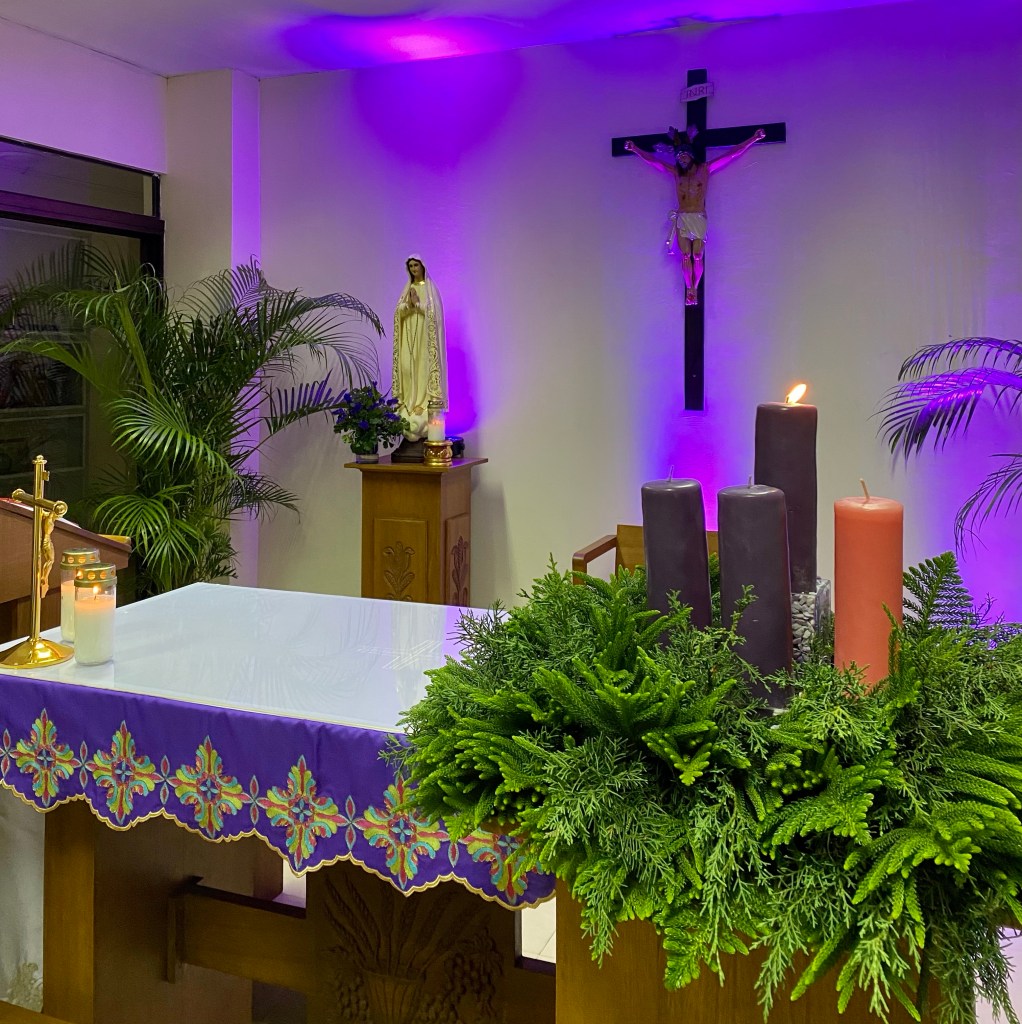

Photo by author, Advent 1, 2021.

Praying for a holy attitude

The Lord Is My Chef Daily Recipe for the Soul by Fr. Nicanor F. Lalog II
Thursday in the Eleventh Week of Ordinary Time, 16 June 2022
Sirach 48:1-14   ><]]]]'> + ><]]]]'> + ><]]]]'>   Matthew 6:7-15
Photo by author, October 2020.
God our loving Father,
today I pray for the grace of
having not just the right or 
positive attitude in life but 
most of all, an attitude
that is is holy and blessed.
It is not enough, Lord,
that we have a positive attitude
in life; that attitude or disposition
must always be holy and blessed,
inclined into your heart and will,
dear Father because so often,
the right attitudes of the world do
not agree with your ways, O Lord.
It is not enough we are happy and 
positive; there are times we have
to stand for what is right and true,
just and fair like Elija and Elisha.

Like a fire there appeared the prophet Elijah whose words were as a flaming furnace. How awesome are you, Elijah! Whose glory is equal to yours? You sent kings down to destruction, and nobles, from their beds of sickness. You heard threats at Sinai, at Horeb avenging judgments. You anointed kings who should inflict vengeance, and a prophet as your successor… O Elijah, enveloped in the whirlwind! Then Elisha, filled with a twofold portion of his spirit, wrought many marvels by his mere word. During his lifetime he feared no one, nor was any man able to intimidate his will. In life he performed wonders, after death, many marvelous deeds.

Sirach 48:1, 4, 6-8, 12, 14
What a blessed attitude you
have bestowed on Elijah and
Elisha you have bestowed upon us
too in Jesus Christ's coming
and sending of the Holy Spirit.
In Jesus Christ, we have
become your beloved children,
dear God our Father but too 
often, we lack the blessed attitude
we must have before you as shown
to us in the Our Father, our most
common prayer recited but taken
for granted.  Help us, dear Jesus, 
to acquire and imitate this holy
attitude you have taught us in how
to pray by always addressing God
"our Father", recognizing his holiness,
praying to make his kingdom come
by doing his will always and 
forgiving those who have sinned
against us.
Amen.

Beatitudes of Jesus, attitudes of his disciples

The Lord Is My Chef Sunday Recipe for the Soul by Fr. Nicanor F. Lalog II
Sunday Week VI-C in Ordinary Time, 13 February 2022
Jeremiah 17:5-8 ><}}}}*> 1 Corinthians 15:12, 16-20 ><}}}}*> Luke 6:17, 20-26
Photo by author, monastery inside the compound of the Church of Beatitudes, the Holy Land, 2019.

From the shores of Lake Gennesaret in Capernaum, Jesus now takes us to the plains for his first series of teachings called “sermon on the plains”. In Matthew’s gospel, it is called “sermon on the mount” due to his different emphasis and audience, his fellow Jews while Luke situated it on the plains based on his own focus directed to gentiles or non-Jews.

But, whether it was on the mount or on the plains, one thing remains clear: Jesus taught important lessons specifically for his disciples called the Beatitudes.

Last Sunday Jesus called his first four disciples to become “fishers of men” and as he travelled preaching along the shores of Galilee, they grew to Twelve in number.

On the night before this scene of sermon on the plains, Jesus went up a hill with the Twelve to pray before appointing them as Apostles. It was the first “face-to-face” class of the Twelve with the Beatitudes labelled as Discipleship 101.

And raising his eyes toward his disciples he said: Blessed are you who are poor for the kingdom of God is yours. Blessed are you who are now hungry for you will be satisfied. Blessed are you who are now weeping, for you will laugh. Blessed are you when people hate you, and when they exclude and insult you, and denounce your name as evil on account of the Son of Man. Rejoice and leap for joy on that day! Behold, your reward will be great in heaven. But woe to you who are rich, for you have received your consolation. Woe to you who are filled now for you will be hungry. Woe to you who laugh now, for you will grieve and weep. Woe to you when all speak well of you, for their ancestors treated the false prophets in this way.”

Luke 6:20-26
Photo by author, Church of the Beatitudes, the Holy Land, 2019.

Beatitudes, the meaning of discipleship

The Beatitudes tell us the meaning of discipleship, of not simply following Jesus but making a choice, taking a stand to be like him. Each “blessedness” is actually Christ who is described as the poor, the hungry, the weeping, and the hated.

Again we find in the Beatitudes of Jesus the contrasts and contradictions we have reflected three Sundays ago when he was rejected by his own folks at a synagogue in Nazareth (see https://lordmychef.com/2022/01/29/living-loving-amid-contradictions/).

See the set of “Blessed” followed by a corresponding set of “woes”, giving us a hint that the Beatitudes were patterned by Jesus to Jeremiah’s pronouncements to the people we heard in the first reading,

“Cursed is the man who trusts in human beings, who seeks his strength in flesh, whose heart turns away from the Lord. Blessed is the who trusts in the Lord, whose hope is the Lord. He is like a tree planted beside the waters that stretches out its roots to the stream: it fears not the heat when it comes, its leaves stay green; in the year of drought it shows no distress, but still bears fruit.”

Jeremiah 17:5, 7-8

Both in Jeremiah and in the Beatitudes by Jesus, there is the promise of blessings in the future; however, it is not something we only hope to achieve in the future but something realized in the present IF we trust in the Lord.

Photo by author, pilgrims entering the Church of the Beatitudes, 2019.

More than a promise of hope in a future glory, the Beatitudes by Jesus are directions every disciple must take as path in life, guides or criteria in discerning the will of God for us in this life. It is said that the word beatitude is from “be attitude” or the attitudes of a disciple.

That gesture of the Lord looking up to his disciples that include us today while teaching the Beatitudes indicates his recognition of our present situation by speaking in the present tense with “Blessed are you who are now poor, hungry, weeping and hated”.

Are we not feeling poor and hungry, actually weeping and hated in this intensely heated politics in the country where everyone seems to be lacking reason and shame, everyone going insane and worst, salaula (filthy) without any sense of shame at all?

At the same time, all those pronouncements of having the Kingdom of God, of being satisfied, of laughing, and of being rewarded greatly in heaven are not things we get in the future if we suffer now; these we can NOW have amid our sufferings when we are one in Jesus Christ.

The saints have shown us in their lives most especially St. Paul how while being poor, hungry, weeping and hated they have experienced fulfillment and joy at the same time. We ourselves have proven them right that with St. Paul we can “boast” like him, “Therefore, I am content with weaknesses, insults, hardships, persecutions, and constraints, for the sake of Christ; for when I am weak, then I am strong” (2 Cor. 12:10).

The key is union in Jesus Christ because the Beatitudes not only reveal to us his very person but also his Paschal Mystery of Passion, Death and Resurrection. It is therefore an imperative that every disciple must be immersed in Christ because discipleship is the imitation of Christ. Again, we borrow from St. Paul who said, “It is no longer I who live, but Christ who lives in me” (Gal.2:20).

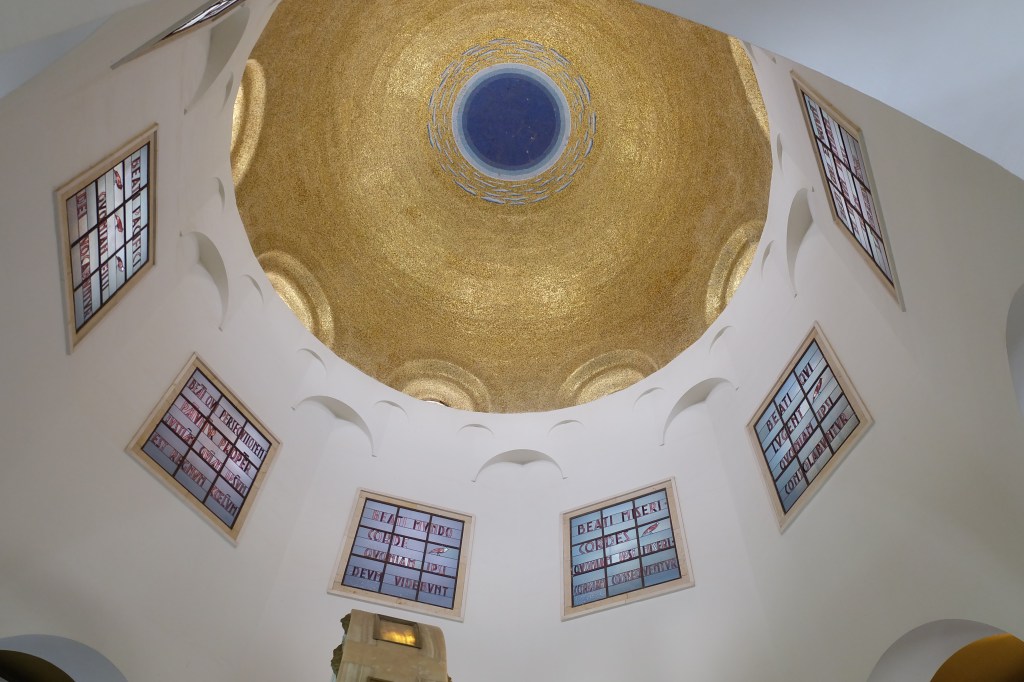
Photo by author, dome of the Church of Beatitudes, the Holy Land, 2019.

Woes of not following Jesus

Contrary to claims by many philosophers and filosofong tasyo alike who are atheists and anti-Church, God is not a sadomasochist who delights in seeing his people suffer and die. Nothing bad can come from God for God is love (1 Jn. 4:8).

Unbelievers continue to question God, most especially Jesus and his Beatitudes that are clearly about sufferings with its apparent dislike or rejection of wealth and fame like what Jesus spoke of the woes in the second part of his Beatitudes.

There is nothing wrong with being rich, being filled, of laughing and being spoken well by others per se; in fact, these are all good in themselves. However, Jesus spoke of them as woes based on the pattern we have seen from Jeremiah’s pronouncements in the first reading: “Cursed is the man who trusts in human beings, who seeks his strength in flesh, whose heart turns away from the Lord.”

See how Jesus was more “soft” and gentle in his woes than God in Jeremiah’s instruction to the people that was so harsh, saying “cursed” is the man who trusts in human beings, whose heart turns away from the Lord.

Photo by author, altar in the Church of Beatitudes, 2019.

But here we find its true context too: it is a warning sign, a reminder of the dangers that can happen to anyone who trusts in himself more and turns away from God.

Here we find something truly happening in the future – not now – unlike in the Beatitudes wherein the future blessings are experienced in the present moment if we suffer in communion with Christ.

Very clear in Jeremiah and in the woes of Jesus, turning away from God surely leads to disaster because it is the opposite path of blessings.

At the same time, since God does not punish, the woes by Jesus are not a condemnation of those who are rich, filled, laughing and well spoken of others. His woes are not expressions of hatred nor hostilities but warning against the dangers of being so proud, of being filled with one’s self, of playing god because it is the path to destruction. Or even perdition as we shall see later this year in the parable of Lazarus and the rich man found only in Luke’s gospel.

The Greeks have a more precise term for that called hubris – an excessive pride and defiance of the gods that leads to one’s nemesis. Clearly, God does not punish nor condemn anyone of us. It is always our choice that we are lost and end in woes, as Shakespeare immortalized in the words of Cassius in Julius Caesar,

"The fault, dear Brutus, 
is not in our stars 
But in ourselves, 
that we are underlings".

Have a blessed week ahead, everyone. God bless you all. Amen.

Imitating the attitude of Christ

The Lord Is My Chef Breakfast Recipe for the Soul by Fr. Nicanor F. Lalog II
Tuesday, Memorial of St. Martin de Porres, Religious, 03 November 2020
Philippians 2:5-11  +++ ||| +++   Luke 14:15-24
Photo by author, Chapel of the Holy Family, Sacred Heart Center for Spirituality, Novaliches, 2018.

Brothers and sisters: Have among yourselves the same attitude that is also yours in Christ Jesus. Who, though he was in the form of God, did not regard equality with God something to be grasped.

Philippians 2:5-6

God our Father, I feel too small, even ashamed before you today as I prayed on your words through St. Paul; it is not just a very tall order but the sad part is the fact that we have all known it all along since our catechism days in school or the parish but rarely put into practice.

We admit it is the fundamental rule of Christian life, to be like Jesus Christ your Son who had come to show us the way back to you is by emptying one’s self for others, to be one with others especially in their pains and sufferings, of being the last, being the servant of all, being like a child.

Unfortunately, we always find it so difficult to learn.

Partly because we lack the very attitude of Jesus Christ we must first imitate according to St. Paul.

And that is the attitude of being small, being the least.

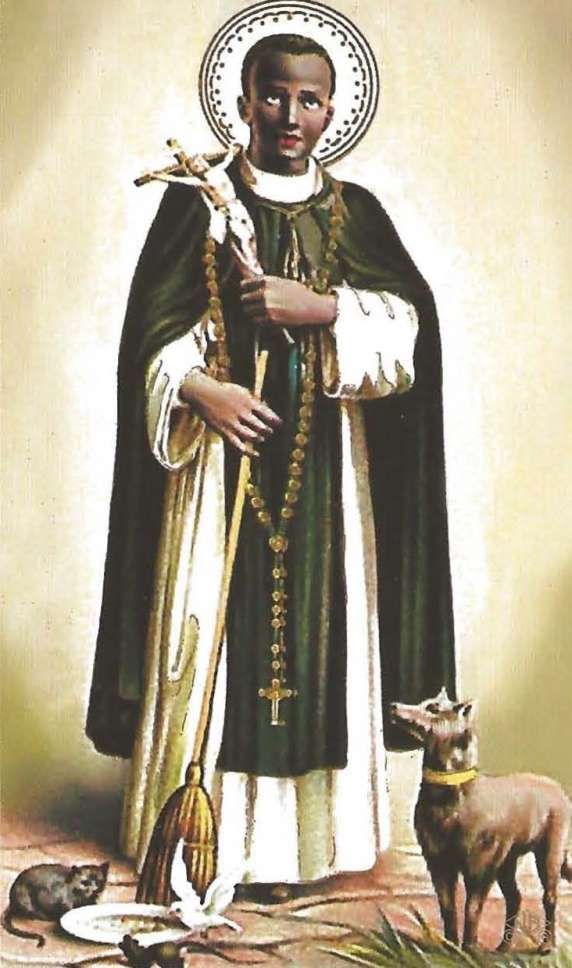
Exactly like St. Martin de Porres:

From Pinterest.com

Such was his humility that he loved them even more than himself and considered them to be better and more righteous that he was. He did not blame others for their shortcomings. Certain that he deserved more severe punishment for his sins than others did, he would overlook their worst offenses. He was tireless in his efforts to reform the criminal, and he would sit up with the sick to bring them comfort. for the poor he would provide food, clothing and medicine.

Homily by St. Pope John XXIII at the Canonization of Saint Martin de Porres in 1962

So often, our attitude is like with those invited by the king to his great dinner: feeling great, feeling so important with themselves that they find no need to be with others that they all turned down the invitation.

Sometimes our arrogance and high regard for ourselves miserably fail us in being like Jesus; hence, we continue to be divided into factions because no one would give way for others that lead to peace and harmony.

Teach us Lord to change that attitude of greatness in us with an attitude of smallness, of leaving a space for others in our lives so we can all work together as one community of believers in you like St. Martin de Porres and all the other saints. Amen.

Our attitudes before God

The Lord Is My Chef Breakfast Recipe for the Soul by Fr. Nicanor F. Lalog II
Thursday, Week XI, Year II in Ordinary Time, 18 June 2020
Sirach 48:1-14 ><)))*> ><)))*> ++0++ <*(((>< <*(((>< Matthew 6:7-15
Photo by author, Malolos Cathedral, 2019.

Your sage Ben Sirach today reminds us, O God, about the greatness of your two prophets, Elijah and Elisha who both worked wondrous deeds in your name before the mighty and powerful of their time.

They were so powerful in words and in deeds, both in life and in death.

In fact, Elijah never tasted death as you took him up to heaven on a fiery chariot while you granted Elisha’s wish to have twice the powers of his mentor.

How awesome are you, Elijah, in your wondrous deeds! Whose glory is equal to yours? You brought a dead man back to life from the nether world, by the will of the Lord. You sent kings down to destruction, and nobles, from their beds of sickness. You were taken aloft in a whirlwind, in a chariot with fiery horses. O Elijah, enveloped in the whirlwind! Then Elisha filled with a twofold portion of his spirit, wrought many marvels by his mere word. during his lifetime he feared no one, nor was any man able to intimidate his will. Nothing was beyond his power; beneath him flesh was brought back to into life. In life he performed wonders, and after death, marvelous deeds.

Sirach 48:4-6, 9, 12-14

Are there really people you have gifted with special powers and favors, Lord?

But, the more I prayed over Elijah and Elisha along with your other prophets and saints who have followed up to our own time, I have found one distinctive characteristic they all have: their attitudes of submission and of gratitude to you as Lord and Master.

You are the one who calls us, Lord, and always you are aware of our weaknesses and limitations, even our sins. Yet, what impresses you most is our attitude of submission and gratitude: the first is self-emptying to allow you to work in us, Lord, and the second is to always recognize you, never to claim anything on our own.

No wonder, the only prayer taught to us by your Son Jesus Christ our Lord is the “Our Father” which encapsulates those attitudes of submission and gratitude.

If only we could be more willing and more thankful to you, God our Father, maybe we could have changed the world with just the Lord’s Prayer. Amen.

The Church of te Our Father outside Jerusalem believed to be the site where Jesus taught the Lord’s Prayer to his disciples. Photo by author, 2017.