Lord My Chef Sunday Music by Fr. Nicanor F. Lalog II, 20 April 2025
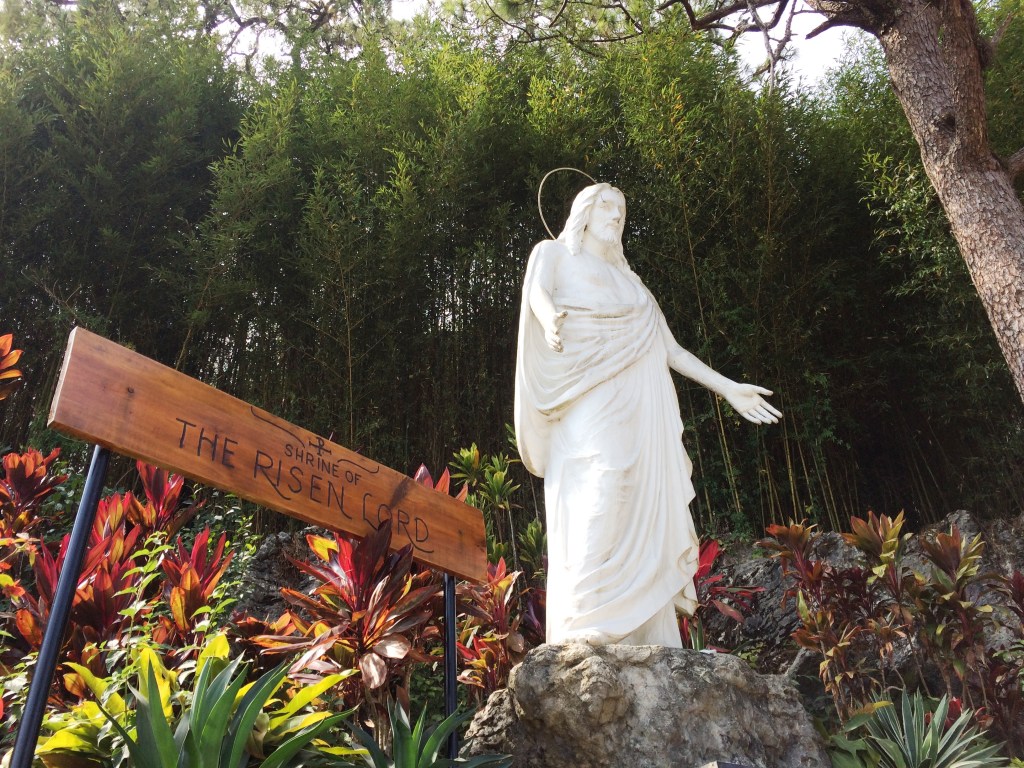
Photo by author, Atok, Benguet 27 December 2024.
Blessed happy Easter everyone!
We have long been planning to have this instrumental piece in our featured music every Sunday but it was only now we have realized this is most perfect during Easter when Jesus Christ in his Resurrection is telling us to “pick up the pieces” of life amid its many darkness and emptiness.
That is the grace and surprise of Easter: in Christ’s dying and rising to life, death has become a blessing to us all as we have come to share in his glorious resurrection too.
Despite that feeling of emptiness within and in our homes, of the irrevocable reality they are gone forever never to join us in our meals and bonding like Christmas, of never hearing their voices again nor be able to hug and embrace them can be shattering, the angel’s reminder to Mary Magdalene and companion women at the empty tomb echoes in our hearts too: “Why do you seek the living one among the dead? He is not here, but he has been raised. Remember what he said to you while he was still in Galilee, that the Son of Man must be handed over to sinners and be crucified, and rise on the third day.” And they remembered his words (Luke 24:5-8).https://lordmychef.com/2025/04/20/easter-is-god-surprising-us/
Released in 1974 in the UK by a group of Scotsmen musicians who called themselves as Average White Band or AWB, “Pick Up the Pieces” did not perform well in the charts until it was released later in October that same year in the US where it stayed on the top singles in February 1975. According to the late Molly Duncan who was the band’s saxophonist, he had disagreed in releasing the song that had no lyrics only other than the shout “pick up the pieces.”
Moreover, the title spoke so well of their situation at that time when they were hardly noticed in the music scene, not making any money at all until it was released in the US where radio stations took notice of its funky beat’s good vibes. The single eventually became AWB’s turning point that is why the more we find it so appropriately Easter in nature.
We have been aware of the music itself in the 1970’s but it was only in 2010 when we found out its artists –AWB – after Daryl Hall guested AWB bassist-guitarist and co-founder Alan Gorrie in his internet show Live From Daryl’s House. It was a superb performance as usual by Daryl Hall and his musicians but of course, we always prefer the original. Here is AWB with their classic “Pick Up the Pieces” which we believe Jesus would also approve as part of his Easter soundtrack. Amen.
Lord My Chef Sunday Recipe for the Soul by Fr. Nicanor F. Lalog II Easter Sunday of the Lord's Resurrection, 20 April 2025
Sunrise and flowers at Angels’ Hills, Tagaytay City, Holy Saturday, 19 April 2025.
A blessed happy Easter to everyone! The joy of Easter is God surprising us of Christ’s Resurrection as our resurrection too even in the midst of emptiness and darkness of this life here on earth.
Surprisingly, it is only now that it occurred to me after 27 years as priest how our Holy Week readings began and ended with the women disciples of Jesus honoring his death. Actually, the readings of Holy Week and Easter do not change except for the three cycles of Easter Vigil and the two Masses of Easter.
On Holy Monday we heard the gospel about Mary of Bethany recognizing the coming sacrifice of Jesus by pouring “a liter of costly perfumed oil made from genuine aromatic nard” on the feet of the Lord and then dried them with her hair that “the house was filled with the fragrance of the oil” (Jn. 12:3). Last night and this morning we heard from Luke and John how Mary of Magdala with other women went to the tomb “early in the morning, while it was still dark” to anoint Christ’s body with oil but found him nowhere!
Here is our God of surprises at work; but, unlike those funny and annoying surprises from the pranks we see on TikTok and social media, God’s surprises are real, so true, and so touching because they are life-changing which began in that Easter morning!
Illustration of the empty tomb of Jesus.
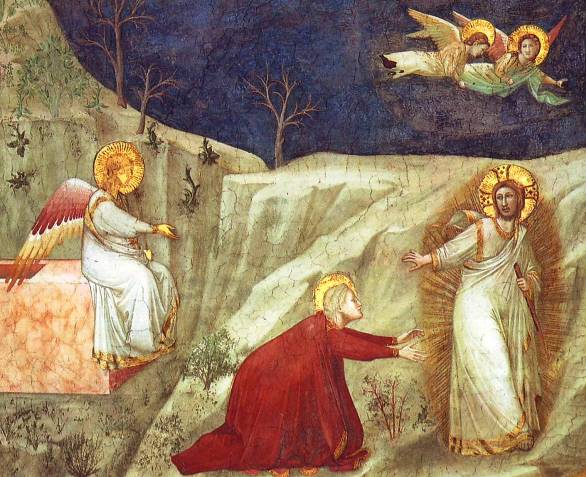
Mary Magdalene at Easter.
Mary Magdalene and another woman on the way to the tomb of Jesus early Sunday morning.
Jesus appearing to Mary Magdalene on Easter morning.
During my recent annual retreat, my spiritual director asked me to pray and write the blessings I have received in the past twelve months. After five days of praying, I listed only six but they were mostly ordinary things I have taken for granted in life except the fourth one – my mother’s death last May 7.
I was surprised when that came to my prayers because it was painful and difficult time for me. So many things have changed in my life since mommy left us and there lies the paradox and mystery of life and death. It was in her dying when I felt anew so close to God.
First, God surprised me with the tremendous outpouring of love and support from so many people during her wake. Second, despite the grief and depression that followed a few months later, I still felt so blessed and closest to God with the unique intensity of the relationships we keep and instilled by our mom which we have taken for granted all these years. And third, I have experienced and realized how death is profoundly good in so many ways because it was after mommy’s death when I found the answers to my many questions about life. With her death, the more I appreciated the grace of my father’s sudden death 25 years ago right on her birthday.
That is the grace and surprise of Easter: in Christ’s dying and rising to life, death has become a blessing to us all as we have come to share in his glorious resurrection too.
Despite that feeling of emptiness within and in our homes, of the irrevocable reality they are gone forever never to join us in our meals and bonding like Christmas, of never hearing their voices again nor be able to hug and embrace them can be shattering, the angel’s reminder to Mary Magdalene and companion women at the empty tomb echoes in our hearts too: “Why do you seek the living one among the dead? He is not here, but he has been raised. Remember what he said to you while he was still in Galilee, that the Son of Man must be handed over to sinners and be crucified, and rise on the third day.” And they remembered his words (Luke 24:5-8).
Photo by author, Mirador Jesuit Retreat House, Baguio City, 2017.
Every deceased loved one is a testament of Easter, of Christ’s resurrection because they all assure us they are alive and living, never to die again like Jesus. That feeling of somehow seeing them again is a tension borne out of the reality of Easter as supranatural and non-logical. Hence, the call for us like Mary Magdalene to always remember!
Remember!
Not only the painful Good Friday but most of all the words of Christ, the experiences with Christ, the love and hope of Christ there in our hearts. Every time we remember the words and memories of our deceased loved ones, they too point us to the realities of Christ’s resurrection. Jesus and our loved ones will always be one of us, among us.
The word remembering literally means to make a person and an event a “member” of the present moment again, that is, “RE” + “MEMBER”.
That is the greatest surprise of Easter – in the Resurrection of Jesus, there has now come a bond among us all, both living and deceased that cannot be broken, that continues today and hereafter.
That is what Peter was telling his fellow Jews on Pentecost Sunday, asking everyone to remember the words and life of Jesus Christ for that is where we find the surprising moments of life we never realized because we took them for granted.
That is why Paul tells us in the second reading to “seek what is above” – the spiritual things and not the material things because that is where we truly belong. That is where we experience again in the most unique and surprising way the presence of Jesus and of our deceased loved ones.
Great surprises happen on the unseen realms of realities giving meaning to what we see and perceive and feel. In that moment we are surprised that we are suddenly enlightened of why deaths and loss happen because there is something better, more real about to unfold. That moment is a hairline between the temporal and eternal when we get a rare glimpse and taste of the Lord risen, of heaven itself.
Photo by author, Mary of the Poor, Sacred Heart Novitiate, Novaliches, QC, 17 March 2025.
When my mother died last May, I must confess how I had to swallow many of the homilies I have shared in the past because they are so far from the realities of losing a loved one. That is when we realize too the great surprising truth of how death makes us more whole than before. We feel transformed when what we know and what we feel become one and integrated. It is like the feeling of “a basta!” in Tagalog.
Our task and mission is to be like Mary Magdalene, to proclaim the Lord is risen, to awaken everyone of the many surprising moments of God with us in Jesus which we have taken for granted.
Not every death is the same but all deaths are one in Jesus Christ – a grace, a blessing, a reminder of Easter, of our own resurrection. Now, right here.
With mommy’s death last year, now I have realized too why Jesus appeared first to women on Easter and that is because they, especially mothers have the most intimate link with us here on earth. The umblical cord is never cut off because mothers are the first to believe in their children, the first to believe in God that is why they are our first catechists too. Women and mothers especially are the most intimate persons that they have visions that go beyond sights, enabling them to be surprised most often. Has God ever surprised you in unexpected ways like Easter? Or death and loss? Amen.
From Facebook, 04 April 2021: “There is an urgency to announce the Joy, the joy of the Risen Lord.”
Lord My Chef Sunday Music by Fr. Nicanor F. Lalog II, 13 April 2025
Photo by author, Sacred Heart Novitiate, Novaliches, QC, 17 March 2025.
Today we begin the Holy Week with the celebration of Palm Sunday in the Lord’s Passion.
See how since the entry of Jesus to Jerusalem more than 2000 years ago, nothing much have really changed among us – we are still the same fickle-minded people who would sing “Hosanna in the highest” and later shout “crucify him! crucify him!”.
Everybody wants to become better, each one wishing for so many things without really realizing the good things we are hoping for are all right in front us if we could just open our eyes or listen more or perhaps have a change of heart to realize everyday is a Palm Sunday too for us when God comes right into us to fulfill us.
However, many times whether in our wishful thinking or future-looking and planning, it is highly probable that what we long for is already present to us.
As we begin the Holy Week with the celebration of Palm Sunday in the Lord’s Passion, we are reminded by the liturgy with its long readings how so often in life, we just need to see with different eyes, hear with different ears, expect with different hearts to find fulfillment, peace and joy.
The night before I wrote my homily yesterday, I was posting some reels in my Instagram account when one of the music I used was the Style Council’s 1984 hit “My Ever Changing Moods”. Composed by the group founder Paul Weller who shot to fame in the 1970’s as lead singer and guitarist of the British rock band The Jam, “My Ever Changing Moods” is the Style Council’s fifth single.
Aside from Weller’s superb vocals, “My Ever Changing Moods” is so remarkable in what shall we describe as “subtle intensity” – ang tindi ng dating as we say. Despite the message conveyed by its title, the song is heavy in meanings that can stir one’s soul with its light and easy poetry yet so penetrating. That is why we right away felt its direct link with Palm Sunday.
Daylight turns to moonlight and I'm at my best Praising the way it all works, and gazing upon the rest, yeah The cool before the warm, the calm after the storm The cool before the warm, the calm after the storm
I wish to stay forever, letting this be my food Oh, but I'm caught up in a whirlwind And my ever changing moods, yeah
Many times in life, we forget that reality of how everything is like the weather that shifts and changes in a rhythmic pattern, “Daylight turns to moonlight…the cool before the warm, the calm after the storm.” The key is openness to these changes happening in us and around us.
Though Weller and critics claim of the song’s political undertones, we see something deeper, something spiritual that we find it so appropriate in this time as we enter the holiest days of the year. Notice these final four stanzas how they convey love and order, something so similar to Jesus Christ’s first words when crucified more than 2000 years ago, “Father, forgive them for they know not what they do” (Lk.23:24).
Teardrops turn to children who've never had the time To commit the sins they pay for through another's evil mind The love after the hate, the love we leave too late The love after the hate, the love we leave too late
I wish we'd wake up one day, an' everyone feel moved Oh, but we're caught up in the dailies And an ever changing mood, yeah
Evil turns to statues and masses form a line But I know which way I'd run to, if the choice was mine The past is knowledge, the present our mistake And the future we always leave too late
I wish we'd come to our senses and see there is no truth In those who promote the confusion For this ever changing mood, yeah
Photo by author, Sacred Heart Novitiate, Novaliches, QC, 17 March 2025.
What do we really know at all that we continue to crucify Jesus today, nailing him on the cross with our many sins as we pretend and assume to know so many things in life?
To know in the Jewish mind is to have a relationship, an activity more of the heart than of the mind. To know is to love, to care. Therefore, when Jesus prayed to the Father to forgive them for they know not what they do is to forgive them because they refuse to love which is what sin is all about. And that is what we still do not know until now – to love, to care for one another that we keep on crucifying Jesus Christ.
Until now, we pretend to know a lot that some nations resort to wars while some blind followers insist on what they know as right while evading the truth with their fake news being spread to cover crimes and atrocities. Until now we pretend to know what we are doing that everyday everywhere is a road rage happening often costing lives senselessly because many insist on their rights. And the confusions and quarrels and deaths continue because we do not know what we are doing. Like Paul Weller, we pray to Jesus that we’d come to our senses and see there is no truth// In those who promote the confusion// For this ever changing mood, yeah.
For this piece, we chose the slow version on piano of Style Council’s “My Ever Changing Moods” to be more attuned with Palm Sunday; you may check their original music video which is equally excellent.
Lord My Chef Sunday Music by Fr. Nicanor F. Lalog II, 06 April 2025
This is the second time we have featured Ms. Yvonne Elliman’s I Don’t Know How to Love Him in our Sunday Music at this time of the year when the Sunday gospel is about the woman caught committing adultery.
Every time that story comes up, my mind automatically links it with this song sang by Ms. Elliman in both the Broadway and movie versions of the rock-opera Jesus Christ, Superstar where she played the role as Mary Magdalene who was believed for a long time as the woman caught committing adultery. Modern biblical scholarships have long debunked that belief but that song by Andrew Lloyd Weber and Tim Rice plus Elliman’s amazing interpretation has given us with so many perspectives about the gospel itself.
One thing we realized this year is how we – like the woman caught committing adultery meet Jesus Christ face-to-face to experience his immense love and mercy and forgiveness.
We encounter Jesus when we disarm ourselves of our false securities and pretenses, masks and camouflages that all cover our sins. It is when we come face-to-face with our sinful self when we eventually meet Jesus face-to-face too because that is when we surrender in silence like the woman caught in adultery and the mob to some degree because all the charges against us are true.
See also that it is only the fourth gospel that Jesus is portrayed “bending” low – first here before the woman caught committing adultery and secondly at the washing of the feet of his Apostles at their Last Supper. How lovely is that sight to behold, dear friends! Imagine God bending before us, giving us like the sinful woman and the mob that space for us to confront our true self, to realize and accept the whole realities we are all interconnected in love.
Only the woman remained – like the eleven Apostles at the Last Supper – because she was the only one willing to change, probably sorrowful and contrite for her sins. Contrary to our fears, Jesus has only love and mercy, kindness and forgiveness to anyone contrite and sorrowful of one’s sin that so unlike with the people’s wrath and anger, judgment and condemnation. St. Augustine perfectly described that moment in today’s gospel, Relicti sunt duo; misera et miserecordia (Two were left; misery and mercy).https://lordmychef.com/2025/04/05/lent-is-encountering-jesus/
Now, look at the first two stanzas of I Don’t Know How to Love Him:
I don't know how to love him What to do, how to move him I've been changed, yes really changed In these past few days When I've seen myself I seem like someone else
I don't know how to take this I don't see why he moves me He's a man He's just a man And I've had so many Men before In very many ways He's just one more
See the conversion and transformation of the woman caught in adultery expressed by Ms. Elliman in the song: I’ve been changed, yes really changed/ In these past few days/ When I’ve seen myself/ I seem like someone else. It is one of the great ironies in life: when we are most vulnerable and weakest, that is when we are also most truest to our self, that is when we truly grow and mature in life!
And this was all possible because of the gift of love and mercy of Jesus Christ, of encountering the Lord and Savior Himself in our own brokenness which the song and the singer captured so perfectly, He’s just a man/ And I’ve had so many men before/ In very many ways/ He’s just one more.
How amazing that the lyrics and the rendition blended perfectly, making us realize how Jesus is just like any other man but not just another additional man; Jesus is MORE than any one because He is the only who truly loves us most, offering us forgiveness once we strip ourselves naked before Him of all our sins and pride and pretensions. God’s love in Jesus Christ is beyond imagining. This we have seen in the parable of the prodigal son and now in the story of the woman caught committing adultery. Do not let your past sins prevent you from meeting Jesus face-to-face to finally experience that inner peace and joy you have been missing and searching for so long.
We are now in the final Sunday in Lent, next week is Palm Sunday, the start of the Holy Week. We can never experience the joy of Easter unless we join Christ’s Passion of emptying ourselves of sins and pride to be filled with His humility, justice and love.
Here is the lovely Ms. Elliman with her superb singing of I Don’t Know How to Love Him, hoping this helps you prepare in this final week of Lent.
40 Shades of Lent by Fr. Nicanor F. Lalog II Fifth Sunday in Lent, Cycle C, 06 April 2025 Isaiah 43:16-21 + Philippians 3:8-14 + John 8:1-11
Photo by author, Sacred Heart Novitiate Main Chapel, 17 March 2025.
Our gospel on this last Sunday in Lent is so similar in its beauty and simplicity -and drama – with last week’s parable of the prodigal son. In fact, some believe the style of the woman caught in adultery is very much like Luke but, let’s leave that to the experts.
On this beautiful Sunday, it is John’s turn to invite us to enter into the scene of his story set at the temple area shortly before the arrest of Jesus Christ.
Jesus went to the Mount of Olives. But early in the morning he arrived again in the temple area, and all the people started coming to him, and he sat down and taught them. Then the scribes and the Pharisees brought a woman who had been caught in adultery and made her stand in the middle (John 8:1-3).
Photo by author, Sacred Heart Novitiate, 17 March 2025.
Try entering the scene. See the woman who most likely almost naked draped only in a piece of cloth as proof of her committing adultery. The Pharisees and the scribes were ganging up on her to Jesus whom they wanted to test, “Teacher, this woman was caught in the very act of committing adultery. Now in the law, Moses commanded us to stone such women. So what do you say?”
Imagine being there, standing close to Jesus and the woman. How would you feel? Would you be able to look at the woman straight on her face? Nah… seems not good. Perhaps, glance only as you feel also her pain and shame. But, can you look straight at the angry mob? Probably for a while with much fears and trepidation along with a deep anger within you cannot express.
Most likely, it is only at Jesus you can look intently and longer because he is not looking at you. Tensions were rising and Jesus simply bent down, writing something on the ground with his finger while the Pharisees and scribes raised up their attacks against him and the lowly woman standing listlessly, so embarrassed, so ashamed. Even in tears.
Recall those moments when we too were caught in the midst of an undeniable transgression like her or, simply being a witness, someone caught in between of another person without any way out of his/her predicament. It must be so dark. So scary. And shameful.
Then, the unexpected happened: But when they continued asking him, he (Jesus) straightened up and said to them, “Let the one among you who is without sin be the first to throw a stone at her.” Again he bent down and wrote on the ground. and in response, they went away one by one, beginning with the elders. So he was left alone with the woman before him (John 8:7-9).
Photo by author, Sacred Heart Novitiate Main Chapel, 17 March 2025.
Many times, we encounter Jesus in our most vulnerable situation when we let go of our guards so to speak.
It is one of the great ironies in life: when we are most vulnerable and weakest, that is when we are also most truest to our self. And that is when we truly grow and mature in life.
That is when we feel peace and joy and freedom within when we are left alone with Jesus still looking down, writing with his finger on the ground to give us more space literally and figuratively speaking. It is not that Jesus wants to shame us or whatever but simply wants us to be true as he has always been true to us, full of love and mercy. Most of all, with all of Christ’s humility in bending, that is when we finally admit the need for a Savior, the need to be converted in him.
We encounter Jesus when we disarm ourselves of our false securities and pretenses, masks and camouflages that all cover our sins. It is when we come face-to-face with our sinful self when we eventually meet Jesus face-to-face too because that is when we surrender in silence like the woman caught in adultery and the mob to some degree because all the charges against us are true.
See also that it is only the fourth gospel that Jesus is portrayed “bending” low – first here before the woman caught committing adultery and secondly at the washing of the feet of his Apostles at their Last Supper. How lovely is that sight to behold, dear friends! Imagine God bending before us, giving us like the sinful woman and the mob that space for us to confront our true self, to realize and accept the whole realities we are all interconnected in love.
Only the woman remained – like the eleven Apostles at the Last Supper – because she was the only one willing to change, probably sorrowful and contrite for her sins. Contrary to our fears, Jesus has only love and mercy, kindness and forgiveness to anyone contrite and sorrowful of one’s sin that so unlike with the people’s wrath and anger, judgment and condemnation. St. Augustine perfectly described that moment in today’s gospel, Relicti sunt duo; misera et miserecordia (Two were left; misery and mercy).
Then Jesus straightened up and said to her, “Woman, where are they? Has no one condemned you?” She replied, “No one, sir.” Then Jesus said, “Neither do I condemn you. Go, and from now on do not sin anymore” (John 8:10-11).
Stations of the Cross, Fatima University & Medical Center, Valenzuela City, 28 March 2025.
We are now on the final Sunday of Lent. Next week will be the Palm Sunday of the Lord’s Passion that ushers in the Holy Week leading to the Sacred Triduum of Holy Thursday Evening, Good Friday and Easter Vigil and on to the Mother of all Feasts, Easter.
As we get closer to the holiest week of the year, our liturgy invites us to intensify our Lenten practices to be “conformed to Christ’s death” as St. Paul urged us in the second reading which opened with these beautiful confession:
“Brothers and sisters: I consider everything as a loss because of the supreme good of knowing Christ Jesus as my Lord. For his sake I have accepted the loss of all things and I consider them so much rubbish, that I may gain Christ” (Philippians 3:8).
The pillars of Lent – prayer, fasting and alms-giving – aim to empty us of our very selves, of our pride and sins that all prevent us from encountering Jesus Christ always coming to us full of love and mercy. On this final stretch of Lent, are we ready to let go of ourselves and to let God?
Today, Jesus assures us of his love and forgiveness for our sins. The first reading tells us of God asking us to forget the events of the past. Just come home to him. And never leave him like the woman caught committing adultery. Amen.Have blessed week ahead.
Stations of the Cross, College of Maritime Engineering, Our Lady of FatIma University, 28 March 2025.
Lord My Chef Sunday Music by Fr. Nicanor F. Lalog II, 30 March 2025
Photo by author, ceiling lights, Canyon Woods Resort, Batangas, 16 March 2025
Glad to be back dear friends with our Sunday music featuring secular music that echoes the good news of Jesus Christ. So excited with today’s feature because it is by one of our favorite musicians, Michael McDonald.
McDonald is that most unique voice in many of Steely Dan’s hits in the early 70’s where he got recognized, thus becoming the most sought partner of other great artists like Christopher Cross before settling with the Doobie Brothers with their signature song What A Fool Believes.
After leaving the Doobies in the early 80’s, McDonald came up with his first solo album called If That’s What It Takes from which came out our featured song I Keep Forgettin’ in 1982.
I keep forgettin' we're not in love anymore I keep forgettin' things will never be the same again I keep forgettin' how you made that so clear I keep forgettin'
Everytime you're near Everytime I see you smile Hear your "hello" Saying you can only stay a while
And I know that it's hard for you To say the things that we both know are true But tell me how come
While praying over our beautiful gospel this fourth Sunday in Lent (Laetare or Rejoice Sunday), I could hear McDonald singing this lovely song at the back of my mind that became the inspiration for our Sunday homily:
We do not tell God and our family and friends that we don’t love them but our walking away from them tells that so clearly. However, as we refuse to love when we sin, that is also when we deny the love right in our hearts, that we cannot stop loving because whatever we take after we have left are actually the very love of God and of our family and friends!
There is nothing truly ours in this world and because of God’s Mystery, we never lose His gift of love within us that when things get worst in our lives, it is the same love that gives us the spark to hope and believe again. It was that love that the youngest son missed and realized despite all his dramas as he went home to his loving father just like us too (https://lordmychef.com/2025/03/29/mystery-of-god-mystery-of-sin/).
Can we really forget or delete permanently a love that is especially so true, so great? In the parable of the prodigal son heard in churches this Sunday, Jesus reminds us that every time we sin – that is, when we refuse to love – we deny His very love in our hearts that remains there, only to be recognized or rediscovered by us when we are down like the prodigal son. That love of God we keep denying eventually is the very same love that gives us the spark to hope and believe again when we realized the foolishness we have done with our sins.
In this song by McDonald, we are reminded too of the same truth: we cannot forget nor deny the love we have especially to a beloved sweetheart even if things do not turn out well, when we part ways because our relationship wouldn’t work. The love remains there, is it not? Most often, we simply mature in our perceptions and relationships and yes, love because that love remains there.
How much more with God’s love?
Now, imagine Jesus Chris singing this McDonald hit?
And yes, that’s how He feels for us: God “keeps forgettin’ we’re not in love anymore” when we sin and yet, He keeps blessing us. Because, God simply loves us so much that even if we refuse to love Him, He still loves us, waiting for us to return to him like the loving father in the parable of the prodigal son.
That is why – rightly – the Doobies got another hit called Jesus Is Alright With Me but that’s for another piece perhaps this Holy Week.
Here now is Michael McDonald in his first solo hit, I Keep Forgettin’…. have a blessed, rockin’ week ahead, everyone.
40 Shades of Lent by Fr. Nicanor F. Lalog II Third Week in Lent, Cycle C, 23 March 2025 Exodus 3:1-8, 13-15 + 1 Corinthians 10:1-6, 10-12 + Luke 13:1-9
Photo by author, Sacred Heart Novitiate, Novaliches, QC, 17 March 2025.
Thank you very much for all your birthday greetings yesterday, my 60th. Until now my heart overflows in joy from your expressions of love to me that confirmed God loves me so much in the most personal manner. Hence, my firm resolve in these senior years of my life to be able to love like God, to desire always the Cross for the love of our Crucified Lord Jesus Christ.
Yes, it is very ambitious, too idealistic but, that is God’s love for each one of us! Jesus became human like us so we may finally experience God’s immense love for each of us. And that is the invitation of Lent to us – that we go back to God, our very first love. Very often, we experience that very personal love of God for us in the desert of our lives when we are in darkness and emptiness like Moses in today’s first reading.
Moses was tending the flock of his father-in-law Jethro, the priest of Midian. Leading the flock across the desert, he came to Horeb, the mountain of God. There an angel of the Lord appeared to Moses in fire flaming out of a bush. As he looked on, he was surprised to see that the bush, though on fire, was not consumed (Exodus 13:1-2).
Fire is a very powerful sign not only in the Holy Bible but in every culture for the warmth it generates and the light it illuminates the surrounding. Fire signifies power because of its unique abilities to cleanse, purify and transform materials into something better. It is history’s most significant discovery of all time, facilitating our growth and development as peoples and nations with the advent of cooking that gave us food that delights and nourishes us.
That is the fiery love God has for each one of us we often find when we least expected like Moses in the first reading. Moses ended up in the wilderness tending sheep after fleeing from Egypt when he learned it was widely known that he had murdered an Egyptian maltreating a Hebrew slave.
What a beautiful image here of God’s love so fiery yet not burning us! In the burning bush, God revealed Himself as the omnipresent One always with us we are rarely aware of. There in the burning bush, God also reminded Moses and us today how this whole planet Earth is a sacred ground, His dwelling-place that we keep on desecrating with our sins.
And there lies the great paradox of our lives where God lighting us, straightening our crooked path to help us find our way back to Him, to life and to meaning. God is the fire burning the impurities in us without us knowing in many instances while He prevents us from being consumed like the burning bush. In fact, many times unknown to us, the fires of our failures and disappointments, pains and trials have actually brought out the best in us. Unconsciously to us, we are like the burning bush aflame with God’s fiery love that transforms us into better persons and more committed disciples of Christ.
Some people told Jesus about the Galileans whose blood Pilate had mingled with the blood of their sacrifices. Jesus said to them in reply, “Do you think that because those Galileans suffered in this way they were greater sinners than all the other Galileans? by no means! But I tell, if you do not repent, you will perish as they did! Or those eighteen people who were killed when the tower of Siloam fell on them – do you think they were more guilty than everyone else who lived in Jerusalem? By no means! But I tell you, if you do not repent, you will perish as they did!” (Luke 13:1-5)
How timely is our gospel today, reminding us to go deeper into our very selves, into those dark places in our hearts to realize too God’s message to us in the light of recent turn of events in the country.
What a mess we are now into that we easily blame on others except us. We have become so divided as a nation that we have refused to find the face of God, choosing to remain in the level of personalism and worst, of politics.
Sin is not just a turning away from God nor a breaking of any law but a complete refusal to love. When there is no love, there is no trust, there is no other person, there is no God. Just one’s self. Sin, therefore, is selfishness, the thinking more of one’s self, not of others.
That was the very sin of the people after the exodus when they refused to love one another, grumbling against Moses and even God most of the time. St. Paul has a grim reminder to each of us this Sunday as he recalled that desert experience of the Israelites when he wrote:
I do no want you to be unaware, brothers and sisters, that our ancestors were all under the cloud and all passed through the sea… Yet God was not pleased with most of them, for they were struck down in the desert. These things happened as examples for us, so that we might not desire evil things, as they did. Therefore, whoever thinks he is standing secure should take not to fall (1 Corinthians 10:1, 5-6, 12).
Five years ago I celebrated my birthday on a Sunday, the fifth in Lent just before Palm Sunday. That was very memorable to me because it was the first Sunday during the COVID lockdown when public Masses were prohibited.
That afternoon, I decided to go on a motorized procession of the Blessed Sacrament around my parish with a handful of our parish volunteers using a borrowed F-150 truck of a generous parishioner. Oh how the people knelt while lining up the main highway and inner streets as we passed by with the Blessed Sacrament.
Halfway through our libot, it started to rain but I instructed my companions to still go on even if it there would be a downpour. As we approached the last purok of our parish, I saw a rainbow. And cried as I felt God telling me at that moment like Noah after the floods that He would not forsake us in that time of COVID.
God kept that promise until I left Parokya ni San Juan Ebanghelista in Bagbaguin, Sta. Maria, Bulacan that was the least affected barangay by COVID in the whole town during my term.
Reflecting on that scene of Moses before the burning bush, I remembered that rainbow during my 55th birthday at the start of the COVID pandemic and lockdown. God often comes to us in many disguises, enlightening us to see the present situation we are into especially when it is all dark. It is the time we look inside our hearts to find God and experience His love; if we can’t find God or feel His love, let us be converted. Let us do penance as Jesus told the people in the gospel. Only with a contrite heart that one can truly find love again because being sorry for one’s sin is the beginning of loving.
That is the surest sign of God’s love for us – when everything especially us and our relationships become visibly clear , no matter how slowly it may be, one step at a time. The more we experience the love of God, the more we resolve to love; that is when this life and world become brighter. Let us love like God by returning to Him in His love. Amen. Have a blessed week ahead.
40 Shades of Lent by Fr. Nicanor F. Lalog II Second Sunday in Lent, Cycle C, 16 March 2025 Genesis 15:5-12, 17-18 + Philippians 3:17-4:1 + Luke 9:28-36
Photo by author, the metropolis at night from Timberland Highlands Resort, San Mateo, Rizal, 08 March 2025.
Both our first reading and gospel this Second Sunday in Lent are set in the darkness of the night. Despite being the favorite setting to portray evil and horror not only in movies but even in the Bible, the darkness of the night has a unique charm of its own.
It is in this darkness of the night when the moon and the stars shine brightest. It is in this darkness of the night when we are delighted with the most wonderful ensemble of sights and sound no stage could duplicate when a sparkle of fireflies outline a treetop while crickets and geckos – tuko – with all the other insects and animals sound like a live symphony orchestra.
So many things in this world and in this life are best seen and experienced in the darkness of the night to be truly appreciated. And that is the call to us this second Sunday in Lent – that we enter the darkness in our hearts with the light of Jesus Christ for us to be transformed and transfigured in his image as his disciples.
Jesus took Peter, John, and James and went up the mountain to pray. While he was praying his face changed in appearance and his clothing became dazzling white. And behold, two men were conversing with him, Moses and Elijah, who appeared in glory and spoke of his exodus he was going to accomplish in Jerusalem (Luke 9:28-31).
Mosaic inside the Basilica of the Transfiguration on Mt. Tabor, Israel from commons.wikimedia.org.
We have been saying since Ash Wednesday that life is a daily Lent, a daily exodus from darkness into light, from sin into forgiveness, from slavery into freedom.
Every day we “pass over” to many darkness in life like sickness, loss of a loved one, failures and other trials and sufferings that come our way. Sometimes so dark, sometimes not so dark. But most dark of all darkness we go through are those darkness of sin and evil along with its many scars left right in our hearts following the constant temptations by the devil for us to turn away from God, for us to refuse to love others and even our very selves.
Photo by author, St. Paul Spirituality Center, Mt. Pico, La Trinidad, Benguet, 06 January 2025.
Our readings this Sunday assure us that in that it is in those darkness we find God who had come nearest to us in Jesus Christ. It is during those darkness like an exodus that we pass from passion and death to resurrection where Christ is calling us; hence, the need for us to listen to him and follow him. It is from this passing over the darkness of sins and trials when we are purified and transformed, transfigured into better persons and disciples of Jesus because that is where his light is most visible too.
To enter into these dark places in our hearts is the beginning of our conversion, of our daily Lent when we return to God, to his covenant we keep on breaking in sin.
Photo by Ms. Analyn Dela Torre, 12 February 2024 in Bgy. Caypombo, Santa Maria, Bulacan.
Lent as a preparation to Easter is also a renewal this covenant we have in our baptism which we renew every year at the Masses of Easter. That is why we have the story of the covenant of God with Abraham in the first reading that was set at night with the darkness signifying the trials we go through in life.
As the sun was about to set, a trance fell upon Abram, and a deep, terrifying darkness enveloped him. When the sun had set and it was dark, there appeared a smoking brazier and a flaming torch, which passed between those pieces. It was on that occasion that the Lord made a covenant with Abram, saying: “To your descendants I give this land, from the Wadi of Egypt to the Great River, the Euphrates” (Genesis 15:17-18).
Feel the terrifying character of the event as narrated by the author of Genesis; but, remember also how God remained with Abraham that night. It was after this episode that God first promised Abraham to become the father of all nations with children as many as the stars above.
But it was not all light with Abraham after this episode as he went through a lot of darkness in life like when he wondered when God would finally give him his own son as he grew older. When Isaac was finally born and had grown, God tested Abraham, asking him to sacrifice to him Isaac. Abraham willingly obeyed God that as he was about to kill Isaac, an angel stopped him and told him how God was so pleased with him that he was doubly blessed anew! Abraham passed over that very dark night in his life by completely trusting God who never abandoned him in life! Most of all, because Abraham never backed out from darkness.
Photo by author, St. Paul Spirituality Center, Mt. Pico, La Trinidad, Benguet, 06 January 2025.
That is the charm of darkness: it can bring us fears and anxieties but as one poet said, only the brave who dare to walk the darkness of the night shall see the beauty of the moon and stars above. In a little while after all the uncertainties and difficulties of the night, we arrive at a new day. Darkness is the prelude to light and day.
Entering into those dark places in our hearts can be terrifying but it is the only path towards true freedom with Jesus as our companion in our exodus. Refusal to go into those dark places in our hearts will keep us only deeper in darkness – anxious and afraid, always wondering when we shall see light which will never come unless we come out and pass over the night.
Recent turn of events in our country are so Lenten in nature, our own passover and exodus – hopefully – from darkness into light.
After those long six years of darkness in the deadly war on drugs of the past administration, we finally saw the light of God’s mercy and justice coming with the arrest of the former president.
It must have been so tortuously painful to the families left behind by the thousands of victims of tokhang.
Though I feel so glad with the turn of events, I still refuse to celebrate nor even join the heated discussions. I feel more the need for us to pray and reflect, to find God and where he is leading us — maybe into those dark places in our hearts to see how we too have contributed to that dark period in our history.
A reporter-friend who volunteered in the care for orphans of the tokhang victims recently shared her reflections in these turn of events where she claimed “we are Duterte”.
Huh? It is chockful. And shocking.
As I prayed and reflected on it, I agreed with her. Prior to Duterte’s coming to power, we as a nation have allowed the forces of darkness to come upon us with the RH bill later followed by bills and proposals for divorce, same sex marriage, and return of capital punishment. There was already this great darkness hovering above us even before Duterte came to power.
Sad to say, that darkness started in our hearts which St. John Paul II referred in his encyclical Evangelium Vitae as “culture of death”.
Let us heed the calls by St. Paul in today’s second reading to “stand firm” in Jesus (Phil. 4:1) because to conduct ourselves as “enemies of the cross” of Christ will surely lead only to “destruction” (Phil. 3:18-19). Let us avert our total destruction as a nation by finally confronting the many darkness within us in Jesus Christ. Amen.Have a blessed week ahead.
*Photos in the collage are not mine but from various sources like TIME magazine and Mr. Howie Severino of GMA7 News.
On this first Sunday in Lent, we find our Lord Jesus Christ led into the desert by the Holy Spirit after his baptism at Jordan for forty days to pray and later tempted by the devil. It is exactly the picture of our daily life wherein the closer we come to God, the more we strive to be good and holy, the more we are intensely tempted by the devil.
Indeed, life is a daily Lent of spiritual battles with the devil and as we enter the first Sunday of this 40-day journey, Jesus reminds us we too can overcome this temptations if we remain in God by taking into heart his words that give life.
Of course, Jesus was tempted by the devil not just thrice but many times until his crucifixion; however, turn your attention my dear friend to the first and third temptations that are very similar:
The devil said to him, “If you are the Son of God, command this stone to become bread.” Jesus answered him, “It is written, One does not live by bread alone” ….. Then he led him to Jerusalem, made him stand on the parapet of the temple, and said to him, “If you are the Son of God, throw yourself down from here, for it is written: He will command his angels concerning you, to guard you, and: With their hands they will support you, lest you dash your foot against a stone.” Jesus said to him in reply, “It also says, You shall not put the Lord, your God, to the test” (Luke 4:3-4, 9-12).
In this scene that comes right after the baptism of Jesus at Jordan by John the Baptist, Luke wants us to see how the devil would always challenge the identity of Jesus Christ, “If you are the Son of God.”
Recall that after his baptism while praying, the heaven opened with the Holy Spirit descending on him in the form of a dove with a voice declaring “You are my beloved Son; with you I am well pleased” (Lk. 3:22). Everyday the devil tempts us too in that way, always challenging us with the same line, “if you are the Child of God, do this, do that” as if our identity is on doing than being.
In our baptism, we have become the beloved children of God in Christ which is our identity and being that is an inherent gift from God no one can take away which the devil works so hard to destroy. The devil’s devious line of challenging us “if you are the child of God” to prove ourselves by doing certain actions is designed to wear us off and eventually for us to self-destruct for not keeping up with the demands of the world and of others.
Our worth is not found in what we can do; we are worthy because God made us in his own image and likeness, giving us the unique identity as his beloved children in Jesus Christ. Even when we get old and sick in the future, not able to do anything worthwhile for the economy or the family, we remain worthy and valuable in God’s eyes.
Photo by author, Sakura Farm, Atok, Benguet, 27 December 2024.
Like Jesus we face intense spiritual battle with the devil daily, tempting us in various ways with desires for wealth and fame, power and pleasures. He tempts us in our personal and professional lives, in our relationships with God and with others, even with our very selves with long lists of things to do to prove our worth.
Remember, the devil tempts us not just to sin but ultimately to destroy our lives by separating us from our grounding, our root who is God our Father.
The devil’s dare to Jesus that “If you are the Son of God… turn this stone into bread” is echoed daily in our own temptations when the evil one through people aided by the consumerist culture ask us to prove our worth by doing many things without any regard to the values of life and human person, or the importance of virtues and spirituality.
When the devil repeated the same line of temptation to Jesus “If you are the Son of God… throw yourself down from the parapet of the temple”, the same trick is played on us by the world luring us to forget morals, to disregard traditions that in the process we already deny the value of life and persons by pushing the crazy, modern ideas of relativism and wokism.
How sad in this world today when everyday we are dared to prove our worth in doing not realizing that our worth remains even if we can’t do so much. That is why youth and strength are glorified while sickness, disability and old age are frowned upon these days simply because we can’t do as much, including life in its earliest and weakest stage in the mother’s womb. Our worth as a person is in our being, not doing.
It is so crazy that eventually we have replaced life with lifestyles, while persons are degraded as objects and commodities to be possessed than loved and cherished. In our desire to prove our worth with everything we can do and accomplish, we end up more empty and lost in the process, reduced to nothingness.
Now see the ways of Jesus which is the theme of Lent every year – conversion of sinners, a return to God our Father by trusting his words again as our source of life and being.
When Jesus answered the devil that man does not live by bread alone, the Lord is inviting us to have a more wholistic view on life, on those hidden and not seen, on the mysterious that makes us experience life more not just skin-deep but within no one can snatch nor steal. In a world so amazed with big, spectacular things, the truth remains that the most wonderful things in life are those found within our hearts and lips, those words that build and comfort us as St. Paul tells us in the second reading.
In the third temptation, Jesus thwarted the devil completely when he declared you must not put God to the test. It is a clear reminder for us to keep in mind always that we are the creatures not the creator, telling us all those vain attempts of playing God since time immemorial have gone to nothing.
We can’t just do anything nor everything in this world and in this life. All of the mysteries around us and within us are not meant to be solved but simply accepted and embraced, allowing ourselves to be wrapped in God to find him deep inside us that in itself a vast universe of beauty and majesty.
This is what Moses was telling the people in the wilderness as they prepared to enter the Promised Land. See how the first reading is like a dream sequence, of the many beautiful scenarios that could happen once they entered the Promised Land. Moses was telling his people and us today to be ready with God’s many surprises if we abide in him and trust him. No need to test God nor play God because we are all covered in God’s grace!
This first Sunday, Jesus invites us back to the wilderness of our lives to be still, to rest in God, to trust his words as we experience and appreciate our giftedness in him even if we can no longer move and do things because more than anything else in this world, each of us is precious in God’s sight and presence. Amen. Have a blessed week! Keep yourself hydrated this summer.
Photo by Dra. Mylene A. Santos, MD, somewhere in Palawan, 2023.
The Lord Is My Chef Sunday Recipe for the Soul by Fr. Nicanor F. Lalog II Eighth Sunday in Ordinary Time, Cycle C, 02 March 2025 Sirach 27:4-7 ><}}}}*> 1 Corinthians 15:54-58 ><}}}}*> Luke 6:39-45
The last time we have celebrated the eighth Sunday in Ordinary Time Cycle C was in 2001 when just like this year, the Season of Lent started late in March. In fact, the other last two Sundays of sixth and eighth in Cycle C were last celebrated in 2010 and 2007, respectively.
It is worth noting this because as Jesus delivered his Sermon on the Plain, we find that contrary to claims by many in this modern time, the teachings of Christ are actually taken directly from life as he reveals to us the truth in our hearts. Two Sundays ago, Jesus taught us the paradoxical happiness of our lives, of being poor, hungry, weeping, and maligned than rich, filled, laughing and well-spoken of; last Sunday, he taught us of the need to love truly that is rooted in God by loving without measure, loving even our enemies.
This Sunday, Jesus tells us something we often debate about as it usually puts us into a bind even a quandary on what to say and do.
Jesus told his disciples a parable, “Can a blind person guide a blind person? Will not both fall into a pit? Why do you notice the splinter in your brother’s eye, but do not perceive the wooden beam in your own eye? How can you say to your brother, ‘Brother, let me remove that splinter in your eye,’ when you do not even notice the wooden beam in your own eye? You hypocrite! Remove the wooden beam from your eye first; then you will see clearly to remove the splinter in your brother’s eye” (Luke 6:39, 41-42).
Photo by author, Hidden Valley Springs Resort, Calauan, Laguna, 20 February 2025.
Very often in many instances, most of us choose to be quiet than speak out against evil and other irregularities among us and in our society because of this teaching of the Lord. Many are afraid to notice the splinter in the brother’s eye lest they too might have a wooden beam blocking their views of themselves.
And that is why, evil persists everywhere that eventually, many of us become silent partners in the many sins happening around us which is very far from the demands of Jesus for us to choose what is right and good, to always make a stand for him even on the Cross.
See the flow of the Sermon on the Plain, of how Jesus is first of all never condemning nor judgmental of anyone. We have reflected his four “woes” were actually invitations for the rich et alii to change their ways in life, to think more of things that do not pass like wealth and other material things.
Secondly, last Sunday, Jesus directed our intentions into our hearts, to probe our hearts and find his grace of supernatural or divine love poured in there so that we can love selflessly without measure like him.
This Sunday, Jesus still directs us into our hearts, to examine whether we are truly his disciple or a hypocrite as someone who says something yet does the opposite. It is not opposite his exhortation last week for us to be merciful like God our Father rather a challenge to examine what we practice, our Christian praxis.
“A good tree does not bear rotten fruit, nor does a rotten tree bear a good fruit. For every tree is known by its own fruit. For people do not pick figs from thornbushes, nor do they gather grapes from brambles. A good person out of the store of goodness in his heart produces good, but an evil person out of a store of evil produces evil; for from the fullness of the heart the mouth speaks” (Luke 6:43-45).
Photo by Mr. Lorenzo Atienza, leftmost section of the stained glass at the National Shrine of Our lady of Fatima in Valenzuela City, 25 February 2025.
It is clearly a lesson in holiness, in integrity of every disciple! Do we walk our talk? The most basic norm of morality is that what we know in our mind and what we feel in our heart is what we say and therefore what we do.
Where are we now? Everybody is speaking about corruption while the devils celebrate everywhere as we are all entangled in all forms of corruption not only in the streets and government offices but even in our homes, in schools and offices and yes, right inside the church in many parishes.
Now we come full circle with Christ’s opening to his parable, Can a blind person guide a blind person? And this is what is now happening in the world, in our lives, in our country and in our parishes. Nobody would want to speak because nobody would want to examine one’s heart and follow the path of Jesus.
It is in our deeds that one is recognized as a true disciple. Let us not forget that. And let us not be afraid to examine constantly the value of our many ways and practices.
Photo by author, St. Paul Spirtuality Center, Pico, La Trinidad, Benguet, 05 January 2025.
One of the famous bishops and saint both recognized by the Eastern and Western Churches is St. John Chrysostom who served as Archbishop of Constantinople until the early 400’s. He is called the “golden mouthed” because of his gift in eloquence most true in his witnessing Christ, always meaning what he said like in this homily that sounds so 2025:
The Church is in an extremely critical state, and you think that all is going well. The fact is that we are plunged into countless sins, and we do not even know it!
You wonder why. We hav e churches, money, and everything else. There are places for assembly, people come there everyday; surely this is not nothing?
But it is not thus that we judge the state of the Church. Then how?, you ask.
Whether we lead a truly Christian life. Whether everyday we make ourselves spiritually more rich, bearing fruit, whether great or small; if we are not content simply with flfilling the law and expediting our religious duties.
Who is a better person, after having frequented the church all month?
This is what we must look for! After all, even what appears to be a good action is only a bad action, when one does not follow it up… If we bring nothing to fruition through it, it would be better to stay home (from Days of the Lord, vol. 6, page 62).
Photo by Mr. Lorenzo Atienza, 25 February 2025.
The kind of life we lead is the final test of our discipleship, the proof of what is in our hearts. St. Francis of Assisi used to tell his followers whenever they would preach to use only their mouth if necessary. Our actions speak louder than our words.
This is the biggest problem in the Church today: our lack of credibility as bishops and priests when our lives are far from what we say and teach.
God shared with us his power of the words. In the Bible, we find how his words and his being are always one since the story of creation into the coming of Jesus Christ who could heal with just mere words being the word who became flesh.
This is the whole point of Ben Sirach in our first reading this Sunday, reminding us that inasmuch as the potter knows the quality of his work after it has passed through fire, the same thing is most true with our words. We have to harness and master our speech, our words so that we walk what we talk.
We master our power of the words in our prayer life as St. Paul assured us in today’s second reading how in the Lord our labor is not in vain (1 Cor. 15:58). Let us pray to the Holy Spirit especially this Sunday as we approach the Season of Lent with Ash Wednesday. Let us keep our zeal for Christ not nonly for his words and teachings but most especially in his life and witnessing. Amen.See you at Ash Wednesday.
Campus Ministry, Our Lady of Fatima University, Valenzuela City.