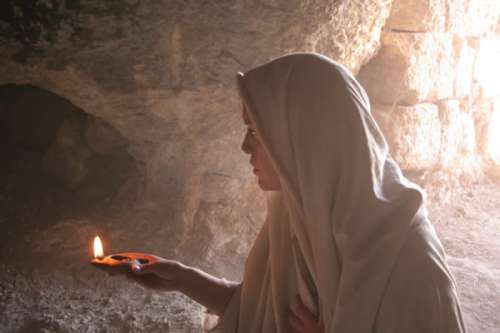
Beloved children of God led by the Good Shepherd

The Lord Is My Chef Sunday Recipe for the Soul by Fr. Nicanor F. Lalog II
Fourth Sunday In Easter, Good Shepherd Sunday and 
World Day of Prayer for Vocations, 25 April 2021
Acts 4:8-12  ><)))">  1 John 3:1-2  ><)))">  John 10:11-18

After listening to the Easter stories by John and Luke these past three weeks, we are now initiated into the implications of Christ’s Resurrection as the Father’s beloved children belonging to him led by Jesus our Good Shepherd.

Jesus said:
"I am the good shepherd,
and I know mine and mine know me,
just as the Father knows me
and I know the Father; 
and I will lay down my life for the sheep."
(John 10:14-15)
Photo by Dr. Mylene A. Santos, MD, March 2021.

Image of shepherd pasturing the weak

Since Easter we have been reflecting on Jesus as our Lord and Savior who comes as our invisible guest in almost every aspect of our lives especially in the Holy Eucharist where he appears, speaks and shares meal with us despite the lockdowns due to COVID-19 pandemic.

In our country where the sheep is only beginning to be known as an excellent food, better than pork and beef especially Abes’s lamb adobo, the image of the shepherd is hardly known, even irrelevant for many especially for those in urban areas.

But, it is important that we try to bridge this gap even a little to appreciate and understand Jesus Christ’s words this Sunday being the Good Shepherd.

One very important aspect we have to keep in mind with the imagery of a shepherd in the Near East region where Israel is located is its symbolism of the relationship between the king and his subjects. Pasturing sheep was clearly an image of the task of every king in the region in ancient times not only in Israel but even in the pagan kingdoms of Babylonia, Assyria, and Sumer. This is the reason we find books in the Old Testament teeming with many references to God as the true king and shepherd of Israel, taking care of the people, leading them in green pastures and clear waters.

When the kings including the priests of Israel abused their roles, forgetting their mission to pasture especially the weak and the poor as they turned to pagan gods like Baal, God became so angry with them that he vowed to come himself to shepherd his flock fulfilled in the coming of Jesus Christ.

This decadence of the image of the shepherd continued in the time of Christ when shepherds were looked down and typecast as thieves and trouble-makers who belonged to the lowest level of the poor who could not even afford to attend temple worship due to their poverty.

Here we find the stage perfectly set for Jesus to restore and fulfill this degeneration of the beautiful and noble image of the shepherd while teaching after his healing of the man born blind that created a very big stir among peoples and temple authorities at that time in Jerusalem.


Knowing and belonging are interrelated:  
one knows because he/she owns like when we claim things as ours.  
When we possess, we know because we have.  
But, Jesus is speaking here not of owning and taking control an object or any material thing.  
Jesus and the Father know each other as they belong to each other as one 
in a perfect relationship but never because they "own" nor "possess" one another.

Photo by Mr. Lorenzo Atienza, Malolos Cathedral, 12 June 2019.

Knowing God, belonging to God

When Jesus declared “I am the good shepherd”, notice that he goes beyond simile: he did not say “I am like a good shepherd” but declares emphatically, repeating thrice the words “I am the good shepherd” – twice in verse 11, and again in verse 14.

His knowledge of the sheep is not from casual nor in-depth observations and study of the sheep but from a totally different and transcendent order when he declared, “I know mine and mine know me, just as the Father knows me and I know the Father”.

Here, Jesus is clearly re-establishing our lost relationship with God as our Father and we his children that is emphasized in our second reading, “Beloved: See what love the Father has bestowed on us that we may be called the children of God. Yet so we are” (1Jn.3:1).

Unlike the monarchs of the world, Christ our King is the Good Shepherd because his relationship with us is based on love and concern especially for the weak and the lowly as the Father had intended since the beginning! Jesus is the good shepherd because his is a relationship of unity in God as our Father.

Knowing implies relationship because it connotes belonging.

Knowing and belonging are interrelated: one knows because he/she owns like when we claim things as ours. When we possess, we know because we have. But, Jesus is speaking here not of owning and taking control an object or any material thing. Jesus and the Father knows each other as they belong to each other as one in a perfect relationship but never because they “own” nor “possess” one another.

To illustrate, we belong to our parents, we belong to a church or a community, we belong to an organization. There is always a degree of knowledge in every belonging not because we are possessed or owned in the same way we own our house, our car, or any gadget for that matter. Owning, possessing or having persons and even pets are of higher degree of knowing and belonging, of something deeper about invisible links that tie us with someone we believe “belongs” to us.

Is it not funny that sometimes we claim how our possessions also seem to be like persons that try to get to know whoever is using it as in “nangingilala” wherein if somebody borrows our car or any thing, sometimes they do not function well? And we say, maybe because the car or the thing did not know who’s driving or using it!

Pope Francis last year mentioned a very beautiful trait of St. Joseph that speaks so well about this very positive kind of “possession”, of knowing and belonging like his relationship with Jesus Christ and Mary. The Pope described it as St. Joseph’s being “a father in the shadows”.

In his relationship to Jesus, Joseph was the earthly shadow of the heavenly Father: he watched over him and protected him, never leaving him to go his own way… Being a father entails introducing children to life and reality. Not holding them back, being overprotective or possessive, but rather making them capable of deciding for themselves, enjoying freedom and exploring new possibilities. Perhaps for this reason, Joseph is traditionally called a “most chaste” father. That title is not simply a sign of affection, but the summation of an attitude that is the opposite of possessiveness. Chastity is freedom from possessiveness in every sphere of one’s life. Only when love is chaste, is it truly love. A possessive love ultimately becomes dangerous: it imprisons, constricts and makes for misery. God himself loved humanity with a chaste love; he left us free even to go astray and set ourselves against him. The logic of love is always the logic of freedom, and Joseph knew how to love with extraordinary freedom. He never made himself the centre of things. He did not think of himself, but focused instead on the lives of Mary and Jesus.

Pope Francis, “Patris Corde” (08 December 2020), #7

What a beautiful way of describing this sense of knowing and belonging – like St. Joseph and very much like Jesus our Good Shepherd!

See that Jesus never forces us into being one with him nor in following him. He simply calls us, inviting us to follow him, to be one with him. That is why we heard him also telling us today that he has “other sheep that do not belong to this fold” that he must lead and care too.

Jesus is the shadow of the Father who leads us back to him as his beloved children. He does not coerce us nor demands us even though he “owns” us as his sheep. In his Passion, Death, and Resurrection, Jesus had shown us how he had become the foundation, the cornerstone we have always rejected in many instances in our lives now pasturing us back to greener pastures.

To know and to belong in the light of Jesus as the Good Shepherd is for us to regard one another as a family, as a brother and a sister we love and trust, allowing them to be free and faithful to God and one another instead of manipulating people like what some parents do to their children or dictators in the government and military.


Knowing and belonging like the Good Shepherd 
is less of controls and more of trust with one another 
because you see them as brothers and sisters in Christ 
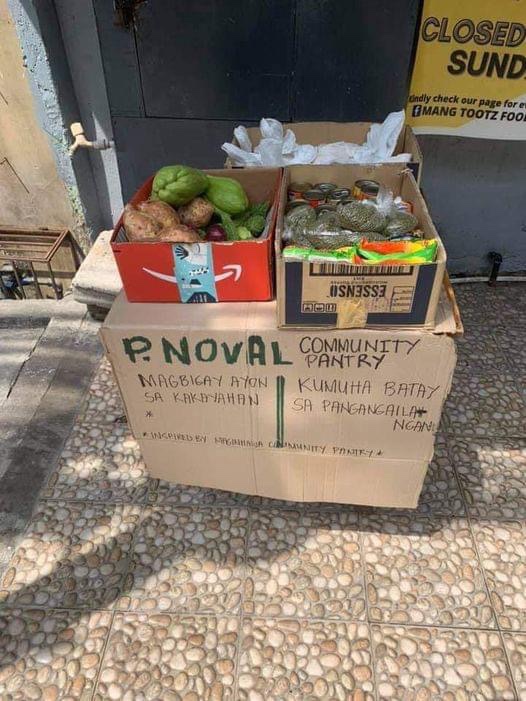
perfectly expressed in the Community Pantry dictum, 
"magbigay ayon sa kakayahan, kumuha batay sa pangangailangan" 
(give whatever you can, take only what you need).

Knowing and belonging like the Good Shepherd is less of controls and more of trust with one another because you see them as brothers and sisters in Christ perfectly expressed in the Community Pantry dictum, “magbigay ayon sa kakayahan, kumuha batay sa pangangailangan” (give whatever you can, take only what you need).

What Ms. Ana Patricia Non and her followers did was become like Jesus the Good Shepherd when she said this community pantry is “not about charity but more of mutuality like helping the needy” which is about seeing each other as a brother and a sister belonging to one family under God our Father. Charity happens where there is first a relationship of persons respecting one another.

No wonder, she had perfectly called her effort as “community pantry” because every home has a pantry where everyone goes when hungry. And what is more, her community pantry has become a steady source of kindness and tenderness we have missed so much during this pandemic!

How beautiful that a shepherdess from Maginhawa Street led us to realize that we are one big family – brothers and sisters in Jesus Christ and beloved children of the loving and merciful Father in heaven.

May this be the start of a beautiful journey for our country when we see more our belonging to one nation, one country we collectively “own” and therefore, we must ensure its bright future by seeing each other in the light of Christ our Good Shepherd – not us possessions to be manipulated or even sold for personal interests alone.

Have a blessed week ahead!

Posted by Jean Palma on Facebook, 18 April 2021 with the caption: “All these community pantries in four days, and counting. What a powerful movement.” #CommunityPantry

“Promise Ain’t Enough” by Hall and Oates (1997)

The Lord Is My Chef Sunday Music by Fr. Nick F. Lalog II, 18 April 2021
Photo by author, 2020.
Don't want to open your heart
You're afraid from the start
That a new love's gonna let you down
There is something you should know
Before you give up and go
I don't believe in the run around
I just want to define myself
And show you how I feel

Yes! We’re feeling so romantic this Sunday because of this great love we’re feeling deep inside.

Like you, we have fallen in love, we have been hurt and disappointed, even felt betrayed and forgotten by a beloved that too often, we have closed our doors to new love, new relationships out of fear of being hurt again.

But, as Daryl Hall and John Oates sang in 1997 from their Marigold Sky album we thought would be their last (thankfully not!)….

If a promise ain't enough
Then a touch says everything
Got to hold you in my arms
Till you feel what I mean
Know that my heart just tells me what to say
But words can only prove so much
If a promise ain't enough
Hold onto my love

No… we’re not talking of a special relationship with anyone.

We’re feeling so good today because it is our 23rd year of Ordination to the priesthood – a love relationship like those of between a husband and wife that demands fidelity and trust, respect and kindness, mercy and forgiveness.

And a lot of prayers!

Human love is imperfect; only God can love us perfectly.

Too often in life, we we get hurt in so many ways, some so severe, others may be dismissed but still, every pain always leaves a mark in us that sometimes prevents us from loving again.

The disciples of Jesus felt the same: they thought he was gone after seeing his Crucifixion on Good Friday that when he suddenly appeared to them, they were so amazed and could not believe it so true that the Lord had risen (https://lordmychef.com/2021/04/17/jesus-in-our-midst/).

The same feeling we have when we love again.

When we forgive, when we move on, when we let go and let God.

Whenever we go back to our “Jerusalem” – to our crucifixion and sufferings, we are purified by Jesus, opening our minds and our hearts of how despite all the pains, the gains still outweigh the past that we can look forward to better days ahead as we share in his new life now.

So many times in our lives, in our relationships with one another, Jesus comes as the invisible guest, always appearing, speaking, and sharing meal with us. And after sometime, as we look back to our past, we feel deep inside how our hearts burned during those times we were not aware of Christ’s presence.

It is true, we humans make so many promises to be broken but only Jesus is keeping them.

Welcome him especially amid the many pains and darkness, let his love be perfected in your perseverance and you shall see…

It took a lifetime to find what I want
I won't let it get away
If a promise ain't enough
Then a touch says everything
Got to hold you in my arms
Till you feel what I mean
Know that my heart just tells me what to say
But words can only prove so much
If a promise ain't enough
Hold onto my love
If a promise ain't enough
Hold on
If a promise ain't enough
Hold onto my love

This is one of Hall and Oates’ most loved love songs that tells us the basic truth about love: it is best expressed in actions than in words.

Hold onto God’s love always. Amen.

Jesus in our midst

The Lord Is My Chef Sunday Recipe for the Soul by Fr. Nicanor F. Lalog II
Third Sunday in Easter, 18 April 2021
Acts 3:13-15, 17-19  ><)))*>  1 John 2:1-5  ><)))*>  Luke 24:35-48 

After listening to the accounts of the beloved disciple John, we now reflect on Luke’s story of the Resurrection which is a continuation of the gospel proclaimed in the afternoon of Easter, the Road to Emmaus.

Recall how the two disciples did not recognize the Risen Lord when he joined them on their way back to Emmaus saddened with his death, doubtful of his resurrection. Upon reaching home, they invited the Lord for a meal when after breaking the bread, they recognized it was Jesus who had then vanished from their sights!

Both hurried back to Jerusalem to tell the rest of the disciples of their encounter with the Risen Lord.

While they were still speaking about this, he stood in their midst and said to them, “Peace be with you.” But they were startled and terrified and thought they were seeing a ghost. Then he said to them, “Why are you troubled? And why do questions arise in your hearts? Look at my hands and my feet, that it is I myself. Touch me and see, because a ghost does not have flesh and bones as you can see I have.” And as he said this, he showed them his hands and his feet. While they were still incredulous for joy and were amazed, he asked them, “Have you anything here to eat?” They gave him a piece of baked fish; he took it and ate it in front of them.

Luke 24:36-43
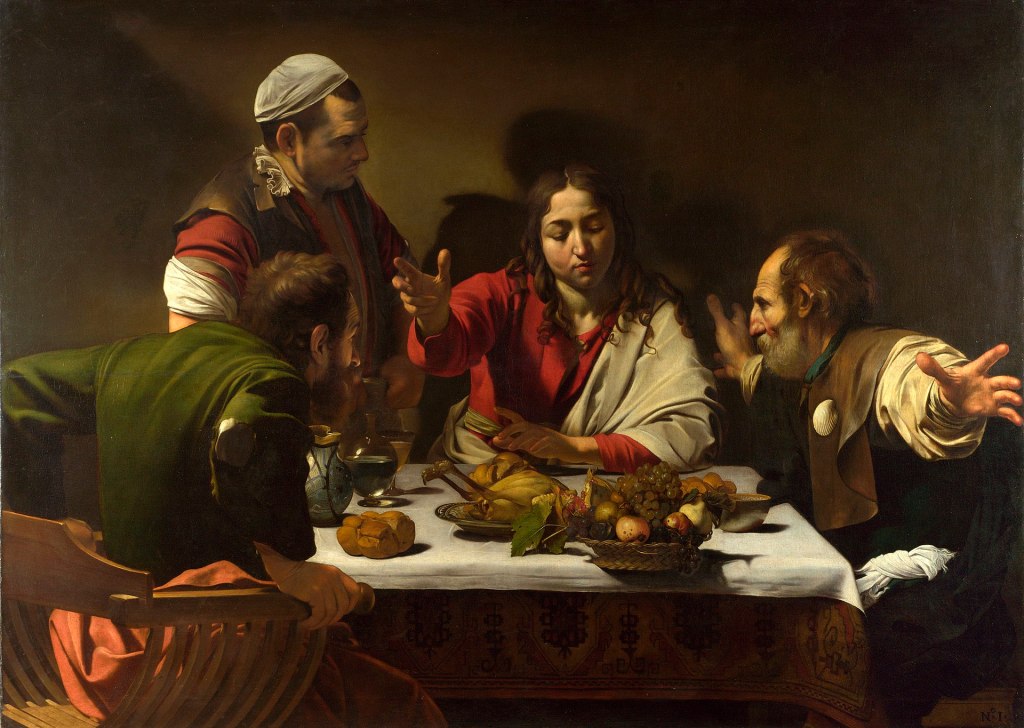
Painting by Caravaggio of the Emmaus Meal from commons.wikimedia.org.

Many times in life
 we feel it more "fearful" in the positive sense 
to believe in God than in ghosts 
because God is very real 
when ghosts are not true at all.

Jesus appearing, speaking, and sharing meal

Both evangelists John and Luke consistently tell us in their Easter stories the three manifestations of the Risen Lord to the disciples: appearing, speaking, and sharing meal. All three acts belong together as one to remind the disciples of what transpired during their Last Supper, fulfilled on Good Friday.

But, there is something deeper in the dynamics of these three acts when seen from the perspective of Luke. And we have to look back to the beginning of this story on the road to Emmaus where we find Luke using a pattern of presenting an outward sign of Jesus appearing, speaking and sharing meal with the disciples who were then led to an inner recognition of the Risen Lord.

Notice that outwardly while walking, the disciples did not recognize Jesus as the man walking with them, speaking to them about the scriptures. Inwardly, something was happening with them: Then they said to each other, “Were not our hears burning within us while he spoke to us on the way and opened the scriptures to us?” (Luke 24:32)

This pattern of outward signs and inner recognition becomes strongest when Jesus shared meals with the disciples: And it happened that, while he was with them at table, he took bread, said the blessing, broke it, and gave it to them. With that their eyes were opened and they recognized him, but he vanished from their sight (Luke 24:30-31).

Exactly the same thing happened in this manifestation we now have in Jerusalem: the outward signs of the Risen Lord appearing to the disciples, showing them his hands and his feet. The disciples were amazed, could not speak at all upon seeing Jesus Christ alive, speaking to them, reminding them of his teachings before and most especially, shared meal with them by eating a baked fish to prove he is not a ghost.

Then, he spoke again to remind them of his earlier teachings of the scriptures being fulfilled in him through his Passion, Death and Resurrection, leading to the inner recognition by the disciples: Then he opened their minds to understand the Scriptures (Luke 24:45).

Painting by Frenchman James Tissot “Appearance of Christ at Cenacle Room” from commons.wikimedia.org.

Many times in life we feel it more fearful in the positive sense to believe in God than in ghosts because God is very real when ghosts are not true at all. “Mas nakakatakot maniwala sa Diyos kesa multo kasi ang Diyos ay totoong-totoo habang ang mga multo ay hindi.”

Amid the many outward signs we see unfolding right before our eyes, we could not help but believe as we are overwhelmed with God’s presence, with his love and mercy for us in the most personal way. The German Lutheran theologian Rudolf Otto called it as “mysterium tremendum” and “mysterium fascinans” when we feel so small like a tiny speck of dust in this vast universe yet so special, so loved by the almighty God.

There is that realization of our sinfulness, of our shortcomings before the Lord and yet still loved and forgiven like what Peter taught the people in his teaching after Pentecost at Jerusalem. Four times in four verses Peter spoke to the people with the second person pronoun YOU to stress their complicity in the crucifixion of Jesus, “you handed over and denied (v.13); you denied the Holy (v.14); you put to death (v.15)”; and finally, the saving declaration:

“Now I know, brothers, that you acted out of ignorance, just as your leaders did; but God has thus brought to fulfillment what he head announced beforehand through the mouth of all the prophets, that his Christ would suffer.”

Acts 3:17-18

Whenever we commit sins. when we refuse to love others, we become that “YOU” of Peter who hand over and deny Jesus, putting him to death whenever we reduce persons into things or take God’s blessings like food for granted.

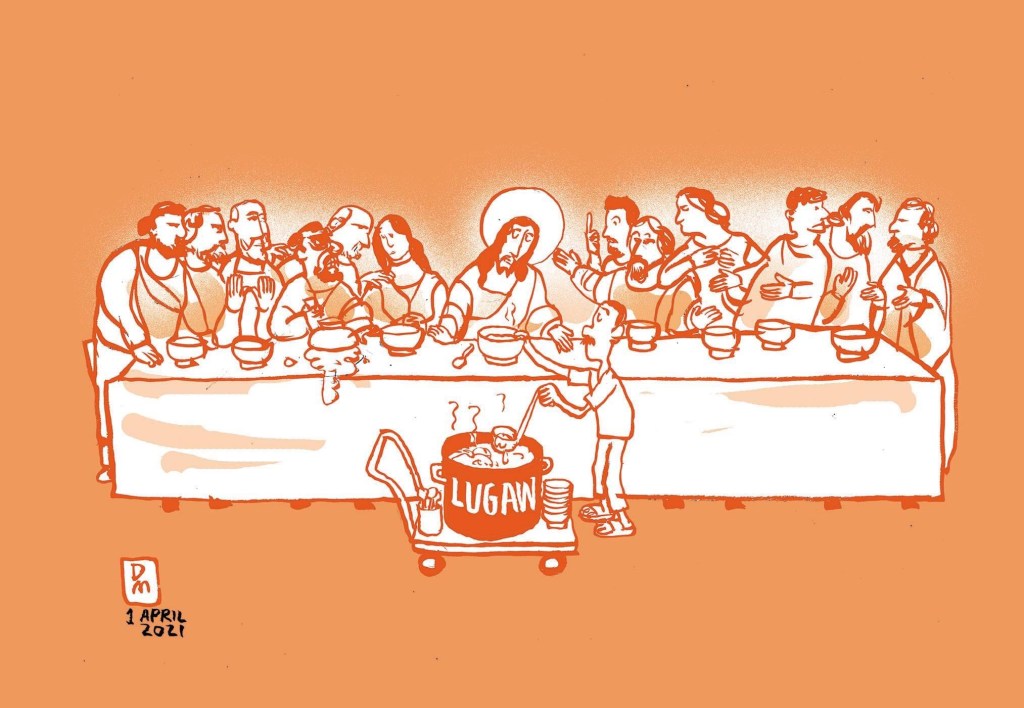
From the Facebook page of artist Mr. Dengcoy Miel, 01 April 2021.

The “essential” table fellowship

Aside from proving to his disciples that he is risen, Jesus Christ’s appearance, speaking, and sharing of meals with them continues to our time in the Holy Eucharist where he brings us to a new covenant in the table fellowship with him and the Father in heaven.

In the Holy Eucharist, Jesus gives us a share in his very life, allowing us to participate in his Resurrection through the purifying power of his Passion and Death.

From the days of the Apostles up to our own time, the celebration of the Mass had gone through many changes and reforms but its very essence has always remained as the Real Presence of Jesus Christ among us in outward signs perceptible to our senses like the proclamation of the Word, the sharing in the Lord’s Body and Blood, and the communion of members of the community gathered in every celebration.

Like the disciples of the Lord during that Easter evening, we continue to experience an inner awakening within us of his presence, of his very self.

That is why Vatican II as well as St. John Paul II had always insisted that the Eucharist is the summit of our Christian life, that everything in our lives and in our parish especially must flow from the Eucharist. This is the reason that even with the COVID-19 lockdowns, Masses continue to be celebrated by priests even in private without the congregation because it is our source of nourishment especially in these times of crisis.


These community pantries now sprouting 
are in itself extensions of table fellowship with Jesus as the unseen guest - 
appearing, speaking, sharing meals with us - 
literally giving us food for the stomach, delighting our souls.

  It is another Easter and Pentecost happening in our midst, 
of Jesus coming to us, 
truly alive in the Holy Spirit among people 
gathered in loving service for one another, 
a perfection of the love of God in us!

Photo from Elijah San Fernando, Philippine Daily Inquirer, 16 April 2021.

See the recent “miracles” happening lately about this “community pantry” that started in Maguinhawa Street in Quezon City now fast spreading to other areas in Metro Manila with some farmers from the provinces giving their share of farm produce.

What a beautiful proof of the fulfillment of John’s words in our second reading today: “But whoever keeps his word, the love of God is perfected in him” (1Jn.2:1-5)!

These community pantries now sprouting are in itself extensions of table fellowship with Jesus the unseen guest – appearing, speaking, sharing meals with us – literally giving us food for the stomach, delighting our souls.

It is another Easter and Pentecost happening in our midst, of Jesus coming to us, truly alive in the Holy Spirit among people gathered in loving service for one another, a perfection of the love of God in us!

Photo by Toots Vergara, Philippine Daily Inquirer, 16 April 2021.

This Sunday, let us experience Jesus our guest right in our family, in our homes as we gather in our table without our gadgets and prejudices against each other, having only our very presence and fellowship in love and mercy, kindness and care as we feed our bodies as well as our souls. Amen.

*Please say a prayer for me and my six other classmates today as we celebrate our 23rd year of ordination to the priesthood (18 April 1998, Malolos Cathedral by Abp. Rolando J. Tria-Tirona).  Salamuch and God bless you all!  fr nick

“Love Never Felt So Good” by Michael Jackson, Justin Timberlake (2014)

The Lord Is My Chef Sunday Music, 11 April 2021
Photo by Dr. Mylene A. Santos, MD, at Rhode Island, 10 April 2021.
It was the best of times, it was the worst of times, 
it was the age of wisdom, it was the age of foolishness, 
it was the epoch of belief, it was the epoch of incredulity, 
it was the season of Light, it was the season of Darkness, 
it was the spring of hope, it was the winter of despair, 
we had everything before us, we had nothing before us, 
we were all going direct to Heaven, we were all going direct the other way
 – in short, the period was so far like the present period, 
that some of its noisiest authorities insisted 
on its being received, for good or for evil, 
in the superlative degree of comparison only.
(Charles Dickens, "A Tale of Two Cities")

I know this blog is supposed to be music but Charles Dickens’ famous lines opening his novel “A Tale of Two Cities” are in fact very lyrical and musical. And with our Dickensian situation especially in the way this government has mishandled the pandemic since the very start, we have chosen for our music this Sunday of Divine Mercy something so lively and upbeat, so intense like our Risen Lord who broke free from death and sin, able to enter any locked door and person.

It is a song “resurrected” in 2014 with Justin Timberlake after Michael Jackson suddenly died in 2009, earning so much popularity and acclaim as if MJ were back in life again with this posthumously released hit, Love Never Felt So Good.

Originally written and recorded in a demo track in 1980 with Paul Anka, Love Never Felt So Good was the first single released from Jackson’s second posthumous album, Xscape.

The song is the second collaboration between Jackson and Anka to be released since Jackson’s death in 2009 with This Is It being the first. (Interesting trivia: Anka rearranged the song in 1984 for Jackson’s longtime friend Johnny Matthis who recorded it in his 1984 album A Special Part of Me.)

We chose Love Never Felt So Good primarily for its feel good, positive vibes so infectious which we all need this Easter 2021 with all the deaths and sickness happening due to the pandemic.

There is also the semblance with Easter in a sense with MJ being “resurrected” with the reworked version of the song with Timberlake, another intense artist who can surely drive away the blues today.

Most of all, we find the lyrics very apt with our gospel story of St. Thomas who doubted Christ’s appearance to his fellow apostles (not his Resurrection).

Let us not take doubt as lack of faith; in fact, doubts lead us to deeper and stronger faith like with what happened to Thomas. What matters is we remain in the Lord, keeping ourselves open to his coming like St. Thomas (https://lordmychef.com/2021/04/10/easter-the-intensity-of-jesus/).

In Love Never Felt So Good, Jackson mentions his doubts many times if he is also loved by the woman he desires; but in spite of those doubts, he believed deep in his heart that love never felt so good if they would be together.

The same thing is true with us: amid our doubts are also the strong conviction something good can still happen with the grace of God. What matters is that we learn to balance the many twins in our lives like Thomas: the joys and sorrows we experience, the light and darkness that come our way, the triumph and defeats we face, and lately, the births and healing and deaths we experience in this pandemic.

Trust in Jesus always who promised us his Divine Mercy overflowing despite our sins and sufferings.

Easter, the intensity of Jesus

The Lord Is My Chef Sunday Recipe for the Soul by Fr. Nicanor F. Lalog II
Second Sunday of Easter (Divine Mercy Sunday), 11 April 2021
Acts 4:32-35  >><)))*>  1John 5:1-6  >><)))*>  John 20:19-31

Today’s gospel shows us the unique intensity of Easter wherein God broke through human limitations by conquering death to open for us new realms and vast expanse of realities never before imagined (https://lordmychef.com/2021/04/04/breaking-into-new-realities/).

More than the “resuscitation” of a dead person, Jesus Christ’s Resurrection opened us to a new dimension and new possibilities of human existence that leads us all to a new kind of future now.

At Easter, Jesus broke out into an entirely new form of life with his glorified body that it is not just an event in the past we remember but something that continues up to now (cf. Pope Benedict XVI, Jesus of Nazareth, Part II, page 244; Ignatius Press, 2011).

On the evening of that first day of the week, 
when the doors were locked, 
where the disciples were, 
for fear of the Jews, 
Jesus came and stood in their midst 
and said to them, "Peace be with you."  
When he had said this,
 he showed them his hands and his side.  
The disciples rejoiced when they saw the Lord.  
(John 20:19-20)
Photo by icon0.com on Pexels.com

Easter is not an ending 
but a beginning still continuing 
in our lives, in our time.

The Intensity of Easter

Easter is not an ending but a beginning still continuing in our lives, in our time. It is a reality so intense that even now we feel deep within us especially in the darkest moments of our lives like during this COVID-19 surge proving to be more dangerous and fatal than last year.

Its intensity comes from the Risen Lord Jesus himself who had conquered death and sin for our salvation. Such is the meaning of his ability to enter the room where his disciples gathered on that Easter Sunday night, despite their doors and windows were all locked for fear of the Jews outside.

This is also the reason that even the evangelists did not have to record so much his every appearance but remain simply noble and grand in their stories because adding details did not matter at all. Most important for them especially to the beloved disciple was the inexpressible intensity of the Lord’s appearances which he mentioned twice, first at the end of this episode and at the conclusion of his gospel account.

Now Jesus did many other signs in the presence of his disciples that are not written in this book. But these are written that you may come to believe that Jesus is the Messiah, the Son of God, and that through this belief you may have life in his name.

There are also many other things that Jesus did, but if these were to be described individually, I do not think the whole world would contain the books that would be written.

John 20:30-31; 21:25

Many times in our lives, the Lord is not asking us to be intense like him.

Only Jesus can remain that intense in his love and mercy for us. He only wants us to be there always, even if we come in late like his apostle Thomas Didymus.

Like Thomas, what we really need are silence and adoration before the Lord who remains with us, comes to journey with us amid the darkness and gloom that envelop us like these days of the pandemic as we now see with everybody posting on Facebook the need to be silent, to be contemplative in spirit.

Thomas Didymus, balance and harmony

Now a week later his disciples were again inside
 and Thomas was with them.  
Jesus came, although the doors were locked, 
and stood in their midst and said, "Peace be with you."  
Then he said to Thomas, "Put your finger here and see my hands, 
and bring your hand and put it into my side, 
and do not be unbelieving, but believe."  
Thomas answered and said to him, 
"My Lord and my God!"  
Jesus said to him, 
"Have you come to believe 
because you have seen me?  
Blessed are those who have not seen 
and have believed."  
(John 20:26-29)

First, let us not take the doubts of Thomas negatively. Some accounts claim that his name Didymus or “Twin” in both Aramaic and Greek may refer to his twin characteristics of having doubts and faith at the same time.

Thomas was not an unbeliever when he doubted the news told by his companions that the Lord had risen. In fact, when he said he will not believe them unless he sees and puts his hands into the mark of the nails in the Lord’s hands and side was already an expression of his faith in Jesus. He already knew at that time that the Lord can only be recognized by his wounds from the cross and not by his face which is the usual and ordinary way of knowing another person.

Here we find Thomas having deep faith in Jesus though not so intense. When Jesus told him “do not be unbelieving, but believe”, he was not reproaching Thomas but more of exhorting him to cling more in that faith in him. And that exhortation applies to us to this time too!

Caravaggio’s “Doubting Thomas” from en.wikipedia.org.

Yes, it is not enough to see in order to believe for there are times that it is in believing that we are able to see.

But in this episode with Thomas, we are reminded that our faith lies more in our personal acknowledgment of Jesus Christ alive in us, is risen among us. Even if we can enumerate so many reasons for believing in him along with the proofs by other reliable witnesses attesting to us, what is most crucial is always our own, personal conviction that Jesus Christ is “my Lord and my God.”

That is the giftedness of our faith that John tries to tell us in the second reading: all of our sight and faith in God beginning with the commandments rest in Christ Jesus affirmed to us daily by the Holy Spirit as we slowly inch closer to our future glory in heaven with him in the Father.

Through the Holy Spirit, our faith in God in Jesus Christ is led onto the horizontal dimension of our relationships with one another in love as a “community of believers of one heart and one mind where no one claimed any of his possessions as his own, but had everything in common” (Acts 4:32).

On this eight day of Easter that signifies the continuation of Easter, may we experience the intensity of our Risen Lord Jesus anew in his Divine Mercy working in us, working through us.

We are not asked to be intense like Jesus who can break every barriers in life. He knows our weaknesses and limitations, especially our doubts and insecurities.

In his Divine Mercy, Jesus comforts us amid the grave sufferings we are going through in this pandemic surge, encouraging us to persevere in our faith, hope, and love in him.

Let us imitate the Apostle Thomas to always strike that balance and harmony of our faith and doubts, joys and sadness, glory and sorrows so that we keep ourselves awake and responsive to Christ’s calls to share in his wounds and healing especially in this time of the pandemic. May we keep the commandments of God, walk in the truth of the Spirit and live in faith and love of Jesus for others. Amen.

Stay safe and have a blessed week ahead!

“Every Breath You Take” by The Police (1983)

The Lord Is My Chef Sunday Music by Fr. Nick F. Lalog II, 04 April 2021
“The Three Marys” by Henry Ossawa Tanner, from womeninthebible.net.

Blessed happy Easter to everyone!

This is perhaps the only year when it is so difficult to greet others with “Happy Easter” due to this ongoing lockdown following the worsening surge in COVID-19 infections with hospitals now beyond capacity.

But, that is the mystery of Easter: it is an event that truly happened in our history but something more than the usual thing like in Christmas when God became a child like us. At Easter, God broke through all human limitations to enter a new realm, a vast expanse of unknown realities beyond our imaginations, beyond our most dreaded thing in this life we call “death” (https://lordmychef.com/2021/04/04/breaking-into-new-realities/).

Like Mary Magdalene and the rest of the apostles except for John the Beloved, there are times we see nothing at all and say things we hardly think or process because everything seemed to have been lost when suddenly from within we realize life bursting forth, new hope, new beginnings!

And that is Easter!

Like this great song composed by Sting with his former group The Police, Every Breath You Take from their penultimate album Synchronicity released in 1983.

Sting was surprised with the great reception by people worldwide to this song that became their most recognized piece, spending so many weeks in almost every music chart around the globe. It is a song filled with negativities, according to Sting who wrote it in 1982 while on a retreat at Jamaica in the Caribbean following his separation from Frances Tomelty when he got involved romantically with her best friend and neighbor, Trudie Styler. The affair was so controversial, even condemned by many. Complicating things was the brewing rift among them in The Police.

But, that’s how Easter is: death becoming gateway to new life!

Imagine Jesus Christ now singing this to us in the midst of the pandemic, assuring us in every breath we take, he is not only watching us but in fact, with us!

Breaking into New Realities

The Lord Is My Chef Sunday Recipe by Fr. Nicanor F. Lalog II
Easter Sunday of the Lord's Resurrection, 04 April 2021
Acts 10:34, 37-43  +  1Corinthians 5:6-8  +  John 20:1-9
Photo by author, Paschal Candles outside the Lord’s tomb in the Church of the Holy Sepulchre, Jerusalem, 2017.
Clear out the old yeast,
so that you may become a fresh batch of dough, 
inasmuch as you are an unleavened.  
For our paschal lamb, Christ, has been sacrificed.  
Therefore, let us celebrate the feast, not with old yeast, 
the yeast of malice and wickedness, 
but with the unleavened bread of sincerity and truth.  
(1 Corinthians 5:7-8) 

A blessed, happy Easter to everyone in this most unholy time of the COVID-19 pandemic! I know, many of us are at a loss at how can we truly celebrate and experience Easter of the Lord’s Resurrection from the dead when those among us are dying or have actually died in this recent deadly surge of corona virus infections.

Unlike Christmas which we could easily identify with the signs and symbols of birth and babies plus the cool climate of December, Easter has always been a problematique especially among us Filipinos now in the heat of the dry season. Making matter worse this year is the pandemic and its ECQ.

Christmas is always delightful. We are always drawn and attracted to the idea and reality that God became a child, making so many things great for us humans.

But, unlike Easter which is so different in the sense that here, God did not enter a familiar stage and state in our human life and existence. On the contrary – which is also its biggest plus factor and enigma – God broke through all human limitations to enter a new realm, a vast expanse of unknown realities that are beyond the most dreaded thing of all which is death!

That is why Easter to much extent is difficult to celebrate because it is hard to comprehend and explain or grasp with our limited reasons and yet, at the same time, it is so real, so true as something we have experienced deep within us!

More than those egg hunts and bunnies now gone – hopefully forever – due to the pandemic, Easter 2021 calls us for a deep, inner renewal of our selves. As we have been saying since Palm Sunday, this may be the holiest Holy Week of our lives in the most unholy time in history as it gives us many opportunities to pray and reflect this great mystery of Jesus risen from the dead.

If we truly wish to find the Risen Lord in our lives in this unholiest time of the pandemic with deaths and sufferings surrounding us, we need to go inside our selves as St. Paul tells us in the second reading, to commit ourselves anew to Christ in the sacraments of Baptism and the Eucharist where we share his Body under the sign of bread.

Recall how last Thursday we were reminded how Jesus perfected and fulfilled the Jewish Passover with his very Body given to us on Good Friday. This Easter after having risen from the dead, Jesus our Bread of Life calls us to discard the old bread that is corrupted and spoiled; Christ has given us himself as our new yeast, new leaven penetrating the dough to make rise in us a fresh and wonderful bread even in the midst of this pandemic!

We have to discard the old leaven – our old selves and way of life in sin – to break new realities in Jesus and through Jesus. Easter is a passing over, a pasch when like Jesus Christ, we dare to cross and pass over life’s challenges and risks to achieve not only we are wishing for but sometimes, we have never even imagined – like the Lord’s rising from the dead!

“The Three Marys” by Henry Ossawa Tanner, from womeninthebible.net.
On the first day of the week, 
Mary of Magdala came to the tomb early in the morning, 
while it was still dark, and saw the stone removed from the tomb.  
So she ran and went to Simon Peter 
and to the other disciple whom Jesus loved, 
and told them, "They have taken the Lord from the tomb, 
and we don't know where they put him." 
(John 20:1-2)

A few days before Ash Wednesday in February, we moved into our new assignments just in time for the start of the Lenten Season or 40-day preparation for this great feast of Easter. I have been assigned as chaplain to Our Lady of Fatima University and the Fatima University and Medical Center in Valenzuela plus its five other branches at Quezon City, Antipolo City, San Fernando City, Cabanatuan City and Sta. Rosa, Laguna.

I have been conducting my ministry basically “on-line” like Masses and talks and recollections.

And lately, praying over our sick and dying patients especially this past week with the surge of COVID-19 cases.

Due to the situation at the hospital and in compliance with the health protocols, we have devised a plan where the nurse on duty would text me for those requesting prayers for the sick with details of the patient and telephone number of the guardian. I would then call the guardian to ask him/her to bring the phone near the patient’s ear so I can pray aloud, and most of all, give the much needed absolution and commendation of the dying. Each nurse station is provided with a bottle of Holy Water for the guardian to sprinkle the patient at my signal.

After that, I pray over the guardian and bless him/her.

So far, for the past month since we have been doing this, nobody had called me what have happened to their patients, if they survived or not. I have stopped following up on them because usually, when I asked the guardian how was their patient, they would always tell me “buhay pa po siya” (he/she still alive), as if I were waiting for their death.

However, there were times some of the guardians have called me back to express their gratitude, telling me how they were relieved knowing their loved ones have been prayed for by a priest.

Last Holy Thursday at the height of so many COVID cases, I prayed over two patients successively.

That was very amazing and inspiring for me. They were “little moments of Easter” as people experienced deaths so close to home these days, even in the most surreal way, still believing, still hoping. We too have felt it one way or the other with requests for help and prayers by relatives and friends with patients sick with COVID and with other ailments lately when we felt so helpless, with nothing else to do and contribute except pray and worry.

That is the grace of Easter so abounding in this pandemic. Let us hope that with ongoing inner renewal among us of hoping against hope that love after all conquers death. Always and certainly as we have seen lately.

Like Mary, there are times we see nothing at all and say things we hardly think or process.

We feel at a loss, almost about to give up yet a tiny sparkle of faith and hope keeps us running to others for help whom we think could do something, maybe used by God to change or remedy our “lost” cause or situation.

That is where the grace of Easter is found every day: something very true and real within us keeps us believing in life and meaning, in God through Jesus Christ when all is gone and even lost.

Why still go to the tomb at all like Mary? If Jesus were already dead, what is the use of going to anoint him with oil and perfumes? Was Mary feeling something even so little, so tiny like hope against hope that Jesus could still be alive?

It was beyond her that she was terrified and ran to Peter upon seeing the empty tomb! She had felt that what was deep inside her was true after all, that there is a greater life beyond this that exists – exactly like what we believed – that there is Resurrection of the dead in Jesus Christ because he himself we can feel deep inside us!

Like Peter on that Pentecost Sunday, we may not go on a discourse explaining what had happened because we have not witnessed the Resurrection like him but we speak out, we believe because we experienced life bursting forth amidst deaths and losses. Like Peter, we have witnessed so many other things, little moments of Easter that showed us signs of God’s abiding presence and love.

Like the light of the new day piercing through the darkness, there is the Risen Jesus touching us, assuring us, loving us and telling us that Easter is not an ending in itself for it continues now and shall continue until the end when Christ comes again to definitively put an end to death when we live eternally with him in the Father in heaven. Amen.

Blessed happy easter!

Photo by author, Mirador Center of Spirituality, Baguio City, January 2019.

“Pagtingin” by Ben&Ben (2019)

The Lord Is My Chef Sunday Music by Fr. Nick F. Lalog II, 21 March 2021
Photo from GMA Network of a scene from Ben&Ben’s music video “Pagtingin” with Gabbi Garcia and Khalil Ramos, 25 February 2021.

We go OPM this final Sunday in Lent to ease everyone with the alarming surge of COVID-19 infections happening in our country especially at the National Capital Region. Stay home, be safe, pray and listen to some good music from our homegrown local band Ben&Ben as we try to link the Sunday gospel to their recent hit “Pagtingin”.

I know… Ben&Ben is not my generation but that is the wonder and joy of music as food of the soul: it always strikes a chord in anyone’s heart that reaches to the soul, enabling us to see more beyond the material and natural realities.

Like with their 2019 hit called “Pagtingin” which means in English as “feelings, a sort of crush and attraction to a woman or a man.” Its Filipino root is “tingin” or “see” in English. Remember when we were growing up, feeling drawn to someone so special that we would look at her or steal glances just to see the woman we adore? And the kilig moments when your sights meet?

But of course, the moment you reveal those secret feelings, that is also when you begin to see the bigger picture: your object of pagtingin will either accept or reject you. There is always that risk because sometimes in life, what we see is not what we truly get.

Dami pang gustong sabihin
Ngunit ‘wag na lang muna
Hintayin na lang ang hanging
Tangayin ang salita

‘Wag mo akong sisihin
Mahirap ang tumaya
Dagat ay sisisirin
Kahit walang mapala’

Pag nilahad ang damdamin
Sana ‘di magbago ang pagtingin
Aminin ang mga lihim
Sana ‘di magbago ang pagtingin

Bakit laging ganito?
Kailangang magka-ilangan
Ako ay nalilito, ooh-ooh-ooh
Ooh-ooh-ooh, ooh

Pagtingin speaks similarly with the gospel this final week in Lent wherein some pagans requested the Apostle Philip “to see” Jesus (https://lordmychef.com/2021/03/20/lent-is-seeing-jesus/).

Seeing in the bible means believing. There are times when we see, we believe; but, ultimately, it is in believing first that we are able to see the whole picture in life especially Jesus in the light of his dying on the Cross. And this is what the song Pagtingin is hoping in the end that amid the pains and hurts with some prayers, the man with special feelings will finally see closely with him the woman he sees from afar.

Pahiwatig
Sana ‘di magbago ang pagtingin
Pahiwatig
Sana ‘di magbago ang pagtingin

Iibig lang kapag handa na
Hindi na lang kung trip-trip lang naman
Iibig lang kapag handa na
Hindi na lang kung trip-trip lang naman

‘Pag nilahad ang damdamin
Sana ‘di magbago ang pagtingin
Aminin ang mga lihim
Sana ‘di magbago ang pagtingin

Subukan ang manalangin
Sana ‘di magbago ang pagtingin
Baka bukas, ika’y akin
Sana ‘di magbago ang pagtingin

A blessed week ahead of everyone. Stay safe always. Amen.

Lent is “seeing” Jesus

40 Shades of Lent by Fr. Nicanor F. Lalog II
Fifth Sunday in Lent-B, 21 March 2021
Jeremiah 31:31-34  +  Hebrews 5:7-9  +  John 12:20-33
Photo by author, details of the Seventh Station of the Cross at the St. Ildephonse Parish Church in Tanay, Rizal, January 2021.

In the beautiful church of the town of Tanay in Rizal is found a most unique Seventh Station of the Cross where one of those depicted when Jesus fell for the second time is a man with dark glasses looking afar. Local residents say the man with sunglasses is Caiaphas, the chief priest during the time of Jesus who led the Sanhedrin at his trial leading to his crucifixion.

Nobody can explain exactly why the artist portrayed that man wore sunglasses that was popular among people of stature and position in the country when the carving was made in 1785. Also interesting aside from the man in shades are the soldiers with him shown with Malay features of brown color and wide eyes opened, all looking somewhere except for one looking at the Lord while clutching his garment as he fell looking heavenwards.

I remembered this piece of work of art inside the Tanay Parish Church declared by the National Museum as “National Cultural Treasure” because our gospel today speaks about a request by some pagans to see Jesus. Seeing has many meanings, always leading to believing. And sometimes, it is in believing we are able to see most of all!

Some Greeks who had come to worship at the Passover Feast came to Philip, who was from Bethsaida in Galilee, and asked him, “Sir, we would like to see Jesus.” Philip went and told Andrew; then andfrew and Philip went and told Jesus. Jesus answered them, “The hour has come for the Son of Man to be glorified. Amen, amen, I say to you, unless a grain of wheat falls to the ground and dies, it remains just a grain of wheat; but if it dies, it produces much fruit. Whoever loves his life loses it, and whoever hates his life in this world will preserve it for eternal life.”

John 12:20-25

Seeing to believe

Photo by Dr. Mylene A. Santos, MD, Infanta, Quezon 2020.

As we have been mentioning three Sundays ago, the fourth gospel uses poetic expressions and symbolisms to convey deeper truths and realities about Jesus and our very selves, our having or lacking faith in God. Like the act of seeing by those Greeks who requested Philip “to see Jesus”.

If they simply wanted to catch a glimpse of Jesus, they could have easily seen the Lord who was always at the temple area at that time. Jesus had always been available to everyone like last Sunday when Nicodemus went to see him at night.

But, John often used the verb to see in many senses that also mean to believe like in his appearance a week after Easter to his disciples along with doubting Thomas: Jesus said to him “Have you come to believe because you have seen me? Blessed are those who have not seen and have believed” (Jn.20:29).

Most mysterious for me in John’s use of the verb to see is in the call of the Lord’s first disciples led by Andrew: He said to them, “Come, and you will see.” So they went where he was staying and saw where he was staying… Andrew followed Jesus. He first found his brother Simon and told him, “We have found the Messiah” (Jn.1:39-41).

What did Andrew see that he later told his brother Simon that they have found the Messiah?

Of course, John’s most notable use of the verb to see is from that scene at the empty tomb on Easter Sunday when the perfect model of the believer is the “other disciple” whom Jesus loved “went in, and he saw and believed” (Jn.20:8).

Very clear in the mind of John that the request of those Greeks to see Jesus was one of faith, of meeting and speaking with Jesus to be enlightened more like Nicodemus last Sunday. Here we find our important role of being another Philip and Andrew, leading other people to see Jesus.

Those Greeks described as “God-fearing” were pagans attracted to the teachings of Judaism and came to Jerusalem to observe the Passover Feast. They already have faith in God that must have been awakened further when they heard the teachings of Jesus; hence, their request to see Jesus.

It happens so often that when by the grace of God people are illuminated with faith even in the most personal manner, they still need Philips and Andrews who would enable them “to see” Jesus to grow and be deepened in faith. There will always be a need for an apostle who could lead others to “see” Jesus because faith happens within a community, within the Church and through others’ mediation.

And here lies the bigger challenge for us disciples for us to make Jesus “seen” in our lives and in our community.

Believing to see.

Photo by Onnye on Pexels.com

Jesus answered them, “The hour has come for the Son of Man to be glorified. Amen, amen, I say to you, unless a grain of wheat falls to the ground and dies, it remains just as a grain of wheat; but if it dies, it produces much fruit. Whoever loves his life loses it, and whoever hates his life in this world will preserve it for eternal life. Whoever serves me must follow me, and where I am, there also will my servant be. And when I am lifted up from the earth, I will draw everyone to myself.” He said this indicating the kind of death he would die.

John 12:23-26, 32-33

In a sudden twist, John tells us nothing if those “God-fearing” pagans saw Jesus at all because the Lord immediately went on a discourse after being told by Andrew and Philip of the request, briefly interrupted by God’s voice speaking from heaven that everybody heard in the temple area.

Speaking in the parable of the grain of wheat dying first in order to produce much fruit, Jesus tells us how we can lead others to truly see him in us and through us by having the same determination and perseverance to follow him, stay with him, and be like him by dying to ones self for others. For the grain of wheat to die and spring forth to new life, it has to be detached. And so are we.

Notice Jesus repeating that sign of his being lifted up on the cross he mentioned last Sunday to Nicodemus. John mentions it again in this part of his gospel adding an explanation at the end because for him, the Crucifixion is Christ’s greatest sign and revelation of his glory, opening a path for us back to God in his Cross, through his Cross.

In teaching us about the parable of the grain of wheat dying and linking it with his being “lifted up”, Jesus now tells us and every “God-fearing” person that we can only “see” him in the scandal of the Cross.

Did those God-fearing Greeks remained in Jerusalem and saw Jesus on the Cross?

We do not know but we are sure that anyone who requests to see Jesus always sees him if we believe first in his crucifixion which is when everyone is drawn to him as he had said. We must first believe Christ died so we may see him risen to life.

It was on Christ’s dying on the cross when God established a “new covenant” among us as prophesied by Jeremiah in our first reading today, giving us all an access to him in Jesus, through Jesus, with Jesus which we celebrate daily in the Holy Eucharist.

Photo by author, 2020.

Grappling with death to see life

We have never seen the crucifixion of Jesus except in its portrayals in the many movies we used to watch in Holy Week; but, its realities are etched and impressed in our hearts through the many trials and difficulties we have gone through in life that we believe Jesus truly died. And because of that, we have also seen him alive!

Such is the reality of seeing Jesus that every time we describe something so difficult, so trying, we equate it with death like when we say “we felt like dying” taking the exam. And the good news is when we overcome the tests that we use again the word or concept of death to describe something so good as it leads us to glory like when we say a pizza or a steak or a cake to die for.

Such is the paradox and scandal of the Cross of Jesus: we can never see him risen in glory if we avoid and refuse seeing his Passion and Death right in our own selves, in our painful experiences.

Going back to that unique Seventh Station of the Cross at the Tanay Parish Church, I realized how the unbelievers and others among us could not see Jesus as the Christ because they have refused to believe in him first especially when they are down with all kinds of problems and trials, looking somewhere else instead of seeing Jesus fallen in front of them.

Let us believe in Jesus so we may see him in this final week of Lent as we prepare for Palm Sunday next. Amen.

A blessed week to everyone!

Photo by author, January 2021.

“Up Where We Belong” (1982) OST of “An Officer and A Gentleman”

The Lord Is My Chef Sunday Music by Fr. Nick F. Lalog II, 14 March 2021
Photo by Dr. Mylene A. Santos, MD, at Rhode Island, February 2021.

We are now halfway through to celebrating another Easter amid the darkness of the COVID-19 pandemic worsening anew with a recent surge in infections. But today’s Sunday readings especially the gospel give us so many reasons to celebrate and rejoice for the gift of life and love, light and hope in Jesus Christ who had come not to condemn us but to save us (Jn.3:16-17).

By his dying on the Cross, Jesus had opened a path for us back to the Father by uplifting us from our sins and miseries, becoming our light that dispelled the many darkness that enveloped us if we follow him with our sacrifices and efforts to be good like him (https://lordmychef.com/2021/03/13/the-joy-of-lent-4/).

This we find in our gospel story of Jesus conversing with Nicodemus under the cover of darkness of the night, reminding us of the 1982 hit Up Where We Belong by Joe Cocker and Jennifer Warnes from the equally smash hit movie of that year, “An Officer and A Gentleman” starring Richard Gere and Debra Winger.

The movie is also interesting for us because of some references to the Philippines with the opening scenes of Zack played by Gere growing up with his father who was a Navy officer assigned at the Subic Naval Base.

Like Nicodemus in the gospel, Zack had so many darkness within him following his mother’s suicide and his living with his father who initially refused to take him, afraid he would not be a good father after separating from his mother earlier in childhood. After graduation in college, Zack went to train to become a Naval aviator where he encountered more darkness in life especially from their tough and hard-driving Marine training officer played by Louis Gosset Jr. that earned him an Academy Award for Best Supporting Actor for the film (the first African-American male to do so).

More instances of darkness in Zack were also shown in the film like the suicide of a fellow trainee and friend whose marriage proposal was rejected when his girlfriend learned he had left Naval training. Zack almost quit his training because of that but was prevailed upon by Gosset after an unsanctioned fight bout.

After graduation, Zack went to see his girlfriend at work (Debra Winger), declaring his love for her. And when she said yes to his love, they kissed, after which he carried her in his arms as he walked out of the factory while her co-workers clapped their hands in a round of applause.

The scene is so touching, so lovely. And that is when Jennifer and Joe began their duet.

Who knows what tomorrow brings
In a world few hearts survive
All I know is the way I feel
When it’s real, I keep it alive
The road is long
There are mountains in our way
But we climb a step every day
Love lift us up where we belong
Where the eagles cry
On a mountain high
Love lift us up where we belong
Far from the world below
Up where the clear winds blow
Some hang on to used to be
Live their lives looking behind
All we have is here and now
All our lives, out there to find
The road is long
There are mountains in our way
But we climb a step every day
Love lift us up where we belong
Where the eagles cry
On a mountain high
Love lift us up where we belong
Far from the world we know
Where the clear winds blow

The song is very Lent, in fact very spiritual that some Christian stations in the States have reportedly adapted it into some religious variations as it speaks so well of overcoming every obstacle in life with determination and perseverance. And of course, with a lot of help and light from above, Jesus Christ. Have a joyful and blessed week ahead, everyone!

*Video was uploaded by Roadvideo 404.