Photo by Atty. Polaris Grace Rivas-Beron atop Mt. Sinai, Egypt, May 2019.
The husband and wife duo of Billy Davis, Jr. and Marilyn McCoo enlivens our Sunday with their signature tune “You Don’t Have To Be a Star (To Be In My Show)” released in September 1976 from their album I Hope We Get To Love In Time. It stayed on top of the music charts for six months until 1977 becoming a crossover success that also gave the duo a Grammy that same year.
Billy and Marilyn are former members of The 5th Dimension where they first met where their friendship blossomed into a love that has kept them together as married couple for more than 40 years until today.
It is a fitting song to our readings this Sunday wherein God healed even pagans afflicted with leprosy: General Naaman of Syria in the first reading from the Old Testament and the Samaritan, the only one of the ten lepers healed who came back to thank Jesus.
Jesus assures us in the gospel that the gift of faith is always freely given to us by God regardless of who we are. We just have to cultivate and grow deeper in that faith to fully experience his blessings and salvation.
It is like Jesus singing this song to you, telling you don’t have to be somebody or so perfect to be loved by him. God’s love is so immeasurable that even the most sinful, the most unloveable Naaman and the ten lepers can always be given a chance to new life if he/she simply believes.
Baby come as you are with just your heart And I’ll take you in You’re rejected and hurt To me you’re worth what you have within
Now I don’t need no superstar Cause I’ll accept you as you are You won’t be denied cause I’m satisfied With the love that you can inspire
You don’t have to be a star, baby, to be in my show (2x)
Somebody nobody knows could steal the tune That you want to hear So stop your running around cause now you’ve found What was cloudy is clear, oh honey
The Lord Is My Chef Sunday Recipe Week XXVIII-C, 13 October 2019
2 Kings 5:14-17 ><}}}*> 2 Timothy 2:8-13 ><}}}*> Luke 17:11-19
Photo by Mr. Jim Marpa, September 2019.
This Sunday readings tell us about the skin, the healing of people afflicted with the dreaded “Hansen’s disease” or leprosy. Since ancient time, it has always been seen with deeper implications than mere wounds on the skin that scars not only the leper but also the community. At its worst, it is regarded as a divine punishment that lepers have to be separated from others to live in designated areas for their treatment.
Skin plays a major role in our social status and mobility. Being the largest organ of the human body, the skin is always the first to be seen and noticed that whatever its condition would always have a big impact on the person, for better or for worst.
This is specially true for us Filipinos who are so concerned with our skin color that we still regard being white or maputi is maganda (beautiful) and having dark skin or maitim is pangit (ugly). No wonder everybody is going crazy to get whiter skin with all those soaps and creams and medicines advertised on billboards everywhere!
In a very funny twist unknown to most Filipinos who idolise white skin, many of our popular devotions in the Catholic faith actually have dark skin like Quiapo’s Black Nazarene and Our Lady of Antipolo?!
But, that’s another story of how skin-deep we can be…..
Going back to our reflection of today’s readings, Jesus is inviting us to go deeper than the skin to realize the richer meaning of having faith in him.
As Jesus continued his journey to Jerusalem, he traveled through Samaria and Galilee. As he was entering a village, ten lepers met him. They stood at a distance from him and raised their voice, saying, “Jesus, Master! Have pity on us!” And when he saw them, he said, “Go show yourselves to the priests.” As they were going they were cleansed. And one of them, realizing he had been healed, returned, glorifying God in a loud voice; and he fell at the feet of Jesus and thanked him. He was a Samaritan.
Luke 17:11-16
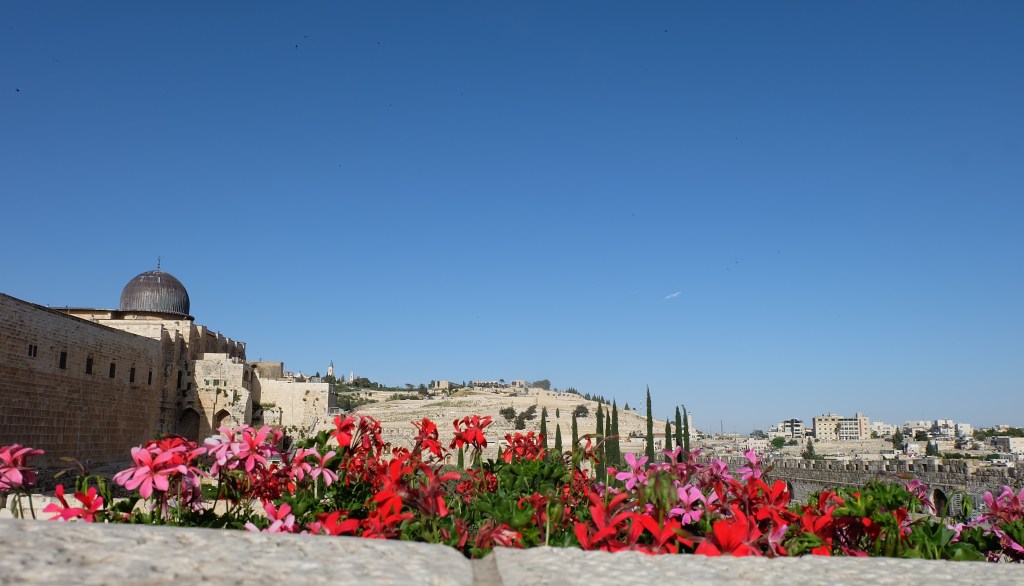
View from the walled city of ancient Jerusalem, May 2019.
Since June 30 of this year, the 13th Sunday of Ordinary Time, we have been following Jesus when “he resolutely determined to journey to Jerusalem” (Lk.9:51). More than a destination to reach, Christ’s journey to Jerusalem is about directions in life because it is spiritual and theological in nature than spatial or geographical.
It is the same truth every pilgrim to the Holy Land realizes too!
And now that Jesus is nearing Jerusalem to fulfill his mission, his teachings are getting clearer and closer to home, indicating also our own “passing over” or pasch with him with the many verbs and movements found in our gospel scene today.
Let’s try reflecting on them one by one. Please bear with me…
“As Jesus continued his journey to Jerusalem” …. Jesus never stops in his journey to Jerusalem to suffer with us, to cry with us, to die with us. He is committed in being one with us in our many struggles and battles in this life until we make it with him to heaven.
“he travelled through Samaria and Galilee.” This is beautiful. Samaria and Galilee are the regions where the poor and marginalized lived, where sinners abound. But, that is where Jesus would always come. When we are in our darkest moments in life due to sickness, failures and disappointments, especially sin – that is when Jesus comes closest to us! In the first reading, we have heard how God’s Prophet Elisha told the Syrian Army General Naaman to bath in the Jordan River to be healed of his leprosy even if he were a pagan and an enemy of Israel! God loves us all.
“As he was entering a village, ten lepers met him.” Keep in mind that Jesus came for the lost like us. Be open and ready for him for he is always passing by. Jesus surely comes to those who patiently wait for him.
“They stood at a distance from him, and raised their voice, saying, ‘Jesus, Master! Have pity on us!’ and when he saw them, he said, ‘Go show yourselves to the priests.’ As they were going they were cleansed.” This episode of the healing of ten lepers can only be found in St. Luke’s gospel filled with many meaningful expressions. First is how “the lepers stood at a distance from Jesus.” This is our usual stance with the Lord when we are full of sin, so ashamed to look at him. But, it does not really matter with the Lord who looks more into is our hearts full of contrition than into our ego full of pride as we shall hear three weeks from now in the parable of the Pharisee and tax collector (Lk. 18:9-14).
The lepers cried to him, “Jesus, Master! Have pity on us!” and when Jesus saw them, he told them to see the priests and they were cleansed. This is an extraordinary profession of faith in Christ by the ten lepers who were crying out not only for pity but also mercy. There are only three instances in the gospels when Jesus is addressed in his name, once in Matthew and twice in Luke. This is the first and the second is when Dimas the thief called on him saying, “Jesus, remember me when you come into your kingdom.” To say his name “Jesus” in itself is a prayer, an admission of guilt and sin. That is why, as the ten lepers went their way to the priests, they were “cleansed” like Dimas on the cross was instantly promised with paradise.
“And one of them, realizing he had been healed, returned, glorifying God in a loud voice; and he fell at the feet of Jesus and thanked him. He was a Samaritan.”
Here we find every encounter with Jesus in prayer and the sacraments as well as in various events in our life is a passage to salvation and new life. See the transition from being cleansed into being healed: that is something deeper than the skin, so to speak. The Samaritan was not merely cleansed of his skin blemishes but most of all, his soul and inner being that Jesus later told him to “Stand up and go; your faith has saved you.”
Sometimes in life, we stop at being cleansed by the Lord; after obtaining our prayers and wishes, we never go back to him until we face another problem again. Are we willing to keep on going back to Jesus to kneel before him and to thank him?
Last Sunday we prayed to Jesus to increase our faith and today like the ten lepers from a distance, we cry out to him as our Master to have pity on us. We always have that gift of faith in us but we have to deepen and cultivate it daily in our prayer life and most especially in the Sunday Eucharist, the highest expression of giving thanks to God.
Let us live in our faith and trust in God’s gift freely given to everyone regardless of who we are. Let us rely in the words of St. Paul that
“if we have died with him we shall also live with him; if we persevere we shall also reign with him. But if we deny him he will deny us. If we are unfaithful he remains faithful, for he cannot deny himself.”
“See that you do not despise one of these little ones, for I say to you that their angels in heaven always look upon the face of my heavenly Father.”
Matthew 18:10
Almost all the religions in the world believe in the existence of guardian angels who guide people and protect them from harm.
From the Greek angelos that means “messenger”, angels are exactly that: messengers from God or “divine apps” who work like Messenger!
Last summer break, I have learned something “millennial” and at the same time very theological or spiritual when some of our former teachers in a school where I used to be assigned reprimanded me – even scolded me – for putting them always on “seen zone”. If you are a dinosaur like me, seen zone is when you send somebody a message (PM) and that person sees it but refuses to give any reply, to the extent of ignoring not only your message but most of all, you. I still have contentions against this but, that’s how most of people take a seen zone: a kind of disrespect, that you are not important.
What was so embarrassing with my new learning was the realization of how stupid I have been until recently when I would “seen zone” people with pathetic late response saying, “sorry just saw your message now”. How I wish I could turn back the time…
Anyway, I have learned my lesson so well that since May I have been very careful with “PM’s” as I tried to be more kind and gentle in Messenger.
But, there is something very interesting in this popular app in relation with our celebration today of the memorial of the guardian angels.
So many times, we give our guardian angel or God’s messenger with the “seen zone” like in Messenger. We ignore the angel’s admonition to avoid sin and do what is good. Like in Messenger’s seen zone, we totally ignore and disregard our guardian angel until we get into the “sin zone”.
Ignore what you have read in Messenger, you go into a seen zone that may be temporary and not really that serious at all. But, lo! worse is the “sin zone” when you ignore the Divine messenger because you ignore God who sent us his angels with his messages of love and mercy, peace and salvation!
Today we are reminded that inasmuch as we try to behave properly in social media where we interact virtually in real time, God and his angels do relate with us in real time but not in virtual but actual reality.
If we try hard doing everything not to hurt our friends with seen zone, all the more we must try to avoid the sin zone that have more serious repercussions up to eternal life. Amen.
The Lord Is My Chef Sunday Recipe XXVI-C, 29 September 2019
Amos 6:1.4-7 ><)))*> 1 Timothy 6:11-16 . ><)))*> Luke 16:19-31
Photo by Mr. Jim Marpa, 2018.
Last Sunday we focused on our hands that we use to pray and serve in reflecting the parable of the wise steward. Today, let us “look” into our eyes that see God in others as we reflect on another parable only St. Luke has, the rich man and Lazarus.
Eyes are the “windows of one’s soul”.
Eyes reveal what is inside us: how we look and move our eyes, the sparkle or dullness in our eyes indicate the kind of person within. Eyes never lie for they reveal if we are telling the truth or not. Most of all, eyes do not only direct us to sights outside but even visions to beyond what we can see.
This is very clear in the parable of the rich man and Lazarus, inviting us to take a deeper look into ourselves, on others, and with the things we possess like money and wealth.
Jesus said to the Pharisees: “There was a rich man who dressed in purple garments and fine linen and dined sumptuously each day. And lying at his door was a poor man named Lazarus, covered with sores, who would gladly have eaten his fill of scraps that fell from the rich man’s table. Dogs even used to come and lick his sores. When the poor man died, he was carried away by angels to the bosom of Abraham. The rich man also died and was buried, and from the netherworld, where he was in torment, he raised his eyes and saw Abraham far off and Lazarus at his side.”
Luke 16:19-23
Photo by Mr. Jim Marpa, September 2019.
For the third consecutive Sunday, we again heard another well-known parable proper to St. Luke like the prodigal son two weeks ago and the wise steward last Sunday. Today’s parable of the rich man and Lazarus follows the same thread of last week’s wise steward which is about the thorny issue of money. But again, there is something deeper than that which is the call for daily conversion by always looking beyond what we can see.
In this parable, Jesus never said the rich man was bad that is why he went to hell or the “netherworld”. Neither did he also claim that the poor man was holy that led him into the “bosom of Abraham” which is heaven. Jesus only described their daily life: the rich man lived in affluence with fine clothings and sumptuous meals while the poor was very destitute feeding on scraps falling from the former’s table as dogs licked the sores that covered his body.
The only critical clues Jesus gives us are the name of the poor man – Lazarus – which means “God has rescued” or El’azar in Hebrew and the final scene in the afterlife.
Let it be clear that the issue here is how people, rich and poor alike, can be blinded by money and wealth that they fail or even refuse to see God and others as brothers and sisters that lead them into evil and sins.
Abraham replied (to the rich man), “My child, remember that you received what was good during your lifetime while Lazarus likewise received what was bad; but now he is comforted here, whereas you are tormented. Moreover, between us and you a great chasm is established to prevent anyone from crossing who might wish to go from our side to yours or from your side to ours.”
The sad reality is that this parable continues to happen in our days when so many of us are oblivious of the poverty and miseries afflicting many of the poor among us.
We are that rich man who has no name but have eyes that refuse to see and recognize Jesus in everyone especially the poor and suffering. How tragic in this age of social media where everything and everyone is exposed and seen, we have become blind to the plight of those around us. No need to look far but right in our own family when members are on their own without bothering to know how everyone is doing in life.
In my 21 years of priesthood, I have realized that most often, the people who truly suffer are often the Lazarus among us who prefer to be silent, to bear all their pains trusting only in God who would vindicate and raise them in the end. The Lazarus are the poor not just in material wealth but “poor in spirit for theirs is the kingdom of heaven” (Mt. 5:3) who completely trust in God.
Reading further that version of the Beatitudes of St. Matthew, we find Jesus saying
Blessed are the clean of heart, for they will see God.
The clean of heart are the Lazarus, the poor who try to find God in this life even amid the many sufferings. Our minds and intellect, including our eyes can never see God. As the Little Prince would say, “what is essential is invisible to the eye; it is only with the heart that one can truly see”. Very true!
A clean heart is a loving heart. When we speak of the heart, we also mean person for the heart embodies the whole person. Therefore, a loving heart is the Lazarus, the one who tries to see God, the one who envisions the end that he is willing to sacrifice, to forgive and to welcome the lost.
Lazarus the poor beggar went to heaven because he has a clean heart unlike the rich man who refused to see beyond himself and his affluence. They are the ones being reprimanded in the first reading by the Prophet Amos, the “complacent” people who may have also included the priestly class of Israel unmindful of the real situation of the people because they have been insulated from realities by the perks and good life of wealth and power (Amos 6:1).
Most people have eyes that have sights but only a few have a vision in life. People with a vision in life are the ones who can see beyond the ordinary, they are the dreamers who dream with eyes wide open working hard to make their dreams happen in reality.
Lazarus is a visionary and a dreamer who saw beyond the door of the rich man, beyond his hunger and sickness the glory of God in eternal life. The rich man on the other hand only had sights for what is “here and now”; and, that is what he is so afraid of with his five brothers still alive who have no vision of the afterlife, no vision of God among others in the present life like him.
My dear friends, Jesus is inviting us today while there is still time to go back to the path of conversion, to see beyond ordinary things and see the more essential, the more lasting things that according to St. Paul in the second reading prepare us for eternal life like “righteousness, devotion, faith, love, patience, and gentleness” (1Tim. 6:11).
Let us listen to the words of God found in the Sacred Scriptures that Abraham referred to in the parable as “Moses and the prophets” (Lk.16:29).
Most of all, let us listen to Jesus Christ, the only one who had risen from the dead (cf. Lk. 16:31) who enables us to see him on the face of everyone we meet, giving us a vision of heaven by helping us in fulfilling our mission as his disciples in proclaiming the coming of the kingdom of God. Amen.
They always reveal something about us. Medical doctors say our hands’ texture and color indicate our health condition. Psychics always read our palms to see our past, present and future. And every suitor always asks for the hand of his beloved for marriage.
In fact, it is always fascinating to observe the hands of a man courting a woman. See how he would always hide his hands inside his pockets or at his back as he puts his best foot forward to impress the lady he is courting. If he wins her heart, they get engaged and that is when they keep on holding each other’s hands until they get married.
There are a lot great beauty and profundity in our human hands that always come in handy for daily living!
“It is my wish, then, that in every place the men should pray, lifting up holy hands, without anger or argument.”
1 Timothy 2:8
I love St. Paul’s expression of men praying “lifting up holy hands” which is the sum or integration of prayer and action. Very picturesque, showing us how we must conduct ourselves with God and one another by living in peace and harmony as brothers and sisters in Jesus Christ. That is why today until next Sunday, our gospel from St. Luke would be challenging us on how authentic our life is as seen from last week’s parable when we experienced God as a loving Father embracing us despite our sins.
This Sunday, the Lord is asking us, “what’s in our hands”?
What are we holding on, literally and figuratively speaking?
Whatever our hands touch and hold are always linked with our whole selves. They cannot be separated from our body for our hands extend us to other people and even with things. Our hands reveal the balance or imbalance within us, the truth and lies we hold on deep inside us.
Photo by Jim Marpa in Carigara, September 2019.
“No servant can serve two masters. He will either hate one and love the other, or be devoted to one and despise the other. You cannot serve God and mammon.”
Luke 16:13
In our gospel today, Jesus is not asking us to “dirty our hands” with sin. What he wants us to realize from his parable is to be like the wise steward or “hired hand” who used all his resources and intelligence in securing a sound future by doing something finally good to those he had cheated.
Like that hired hand, what are the main concerns of our hands? Do we use our hands for good or for evil? Would we dare to use our hands extensively to achieve eternal life by entering through the “narrow door” Jesus told us last month by keeping our hands busy in doing good, serving the poor and needy?
Our hands are a blessing from God, including the fruits of its labor.
How unfortunate that like during the time of the prophet Amos whom we have heard in the first reading today, we use these very blessings from God to curse and trample others especially the poor and the weak. How ironic and sad that the very hands we use to care for others are the very same hands that beat and even kill others perfectly expressed in the term “blood in one’s hands”. Worst of all, the very hands that pray to God are the same hands that hurt others!
Betania Tagaytay, August 2017.
The late Jaime Cardinal Sin of Manila used to narrate a short story about the gracious hands of God. He said that most of the time, the hands of God caress us, pat our shoulders and even soothe us whenever we are in pain. But, sometimes, the hands of God tap us, even “spank” us when things do not seem to favor us. What matters most, according to Cardinal Sin, whether we are caressed or tapped, the same touches come from God’s loving and healing hands always filled with grace.
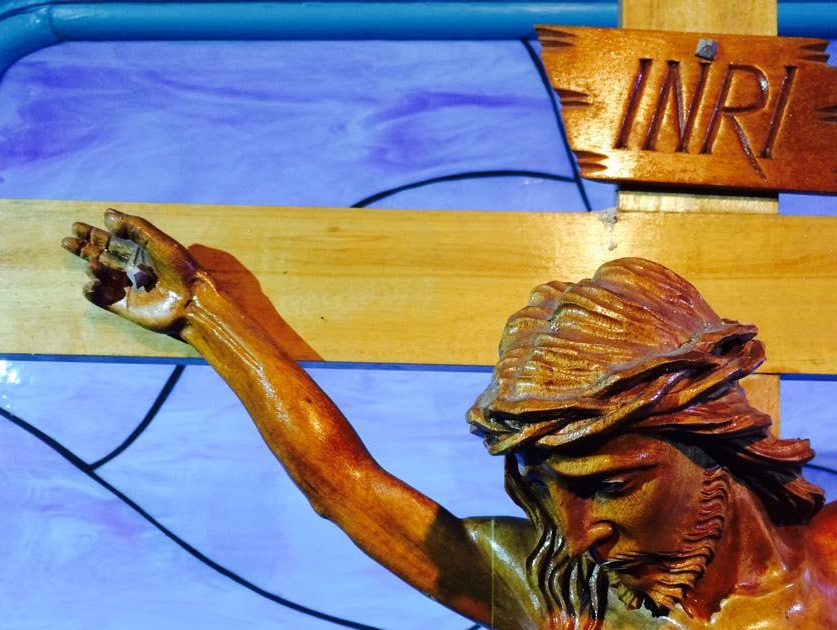
In the gospels, we find many instances of Jesus using his hands to raise the sick, to touch the eyes and mouth in restoring senses, and to bless, break and share bread with his friends and sinners alike. When he expressed his immense love for us and the Father, Jesus stretched out his arms and offered his hands on the cross on Good Friday.
Just imagine how with all our sins, God with a stroke of his hand can make us all vanish but chose not to do so and let our trespasses pass. Like the master in the parable we have heard, God is giving us all the opportunities to work with our hands in lovingly serving the people he has entrusted to us in our homes and offices, school and parish, and community.
But unlike that master who still fired his hired hand despite his resourcefulness, God is not judging us into doom. In is infinite love, God gave us Jesus Christ his Son to bring us back to him in eternal life. It is for this that we lift up our hands to him every day, especially in the Holy Mass we celebrate. The best prayer we can offer God is for these “blessed hands” to reach out to everyone in love and forgiveness, kindness and peace. Amen.
The Lord Is My Chef Sunday Recipe, Week XXIV-C, 15 September 2019
Exodus 32:7-11, 13-14 ><)))*> 1Timothy 1:12-17 ><)))*> Luke 15:1-32
Camp John Hay, Baguio City, 23 August 2019.
Today we conclude the series of “table talks” by Jesus with three parables narrated while dining; but, unlike the other Sunday when he was with prominent people, this time we find the Lord among the notorious ones of his time.
Tax collectors and sinners were all drawing near to listen to Jesus, but the Pharisees and scribes began to complain, saying, “This man welcomes sinners and eats with them.”
Luke 15:1-2
It is the perfect setting where Jesus bared what we may call as “the wildness and wideness” of God’s love and mercy for everyone, especially the lost and rejected. This explains why Luke 15:1-32 is the “heart” of the third gospel also known as the Gospel of Divine Mercy. So, please bear with me reflecting today’s long but lovely gospel.
The first two parables are about things – a sheep and a coin – that were lost and later found. There is nothing extraordinary about losing things that we also experience today. But, in narrating these parables, Jesus ended both with a saying to explain their meanings and significance to introduce the third parable of the lost son.
“I tell you, in just the same way there will be more joy in heaven over one sinner who repents than over ninety-nine righteous people who have no need of repentance.”
“In just the same way, I tell you, there will be rejoicing among the angels of God over one sinner who repents.”
Luke 15: 7, 10
Photo by Ms. Jo Villafuerte, Atok, Benguet, 01 September 2019.
For the past two Sundays, we have been reflecting about the importance of our personhood, of how God comes first to our very persons, of the need for us to be true and humble because God meets us right in our weaknesses and sinfulness. Jesus warned us the other Sunday that “for everyone who exalts himself will be humbled, but the one who humbles himself will be exalted” (Lk.14:11). As they say, bloom wherever you are planted for God’s grace is more than enough for each one of us!
Such is God’s love us that Jesus demands total faith in him that “if anyone comes to me without hating his father and mother, wife and children, brothers and sisters, and even his own life, he cannot be my disciple” (Lk.14: 26). In our lives as his disciples, there would be countless times when no explanations, no reasons are enough why we choose to love and forgive, to be kind and understanding except the very person of Jesus Christ. That is what we call as communion, oneness with the Lord, of always preferring Jesus above anyone and anything!
This is the very reason why the Pharisees and scribes were complaining against him: the tax collectors and sinners were turning to Jesus and not to the Laws they represent! And that continues to happen in our time when some people insist more on religion and vocation, roles and rituals, totally forgetting and even disregarding the very person of God who calls us to himself in Christ!
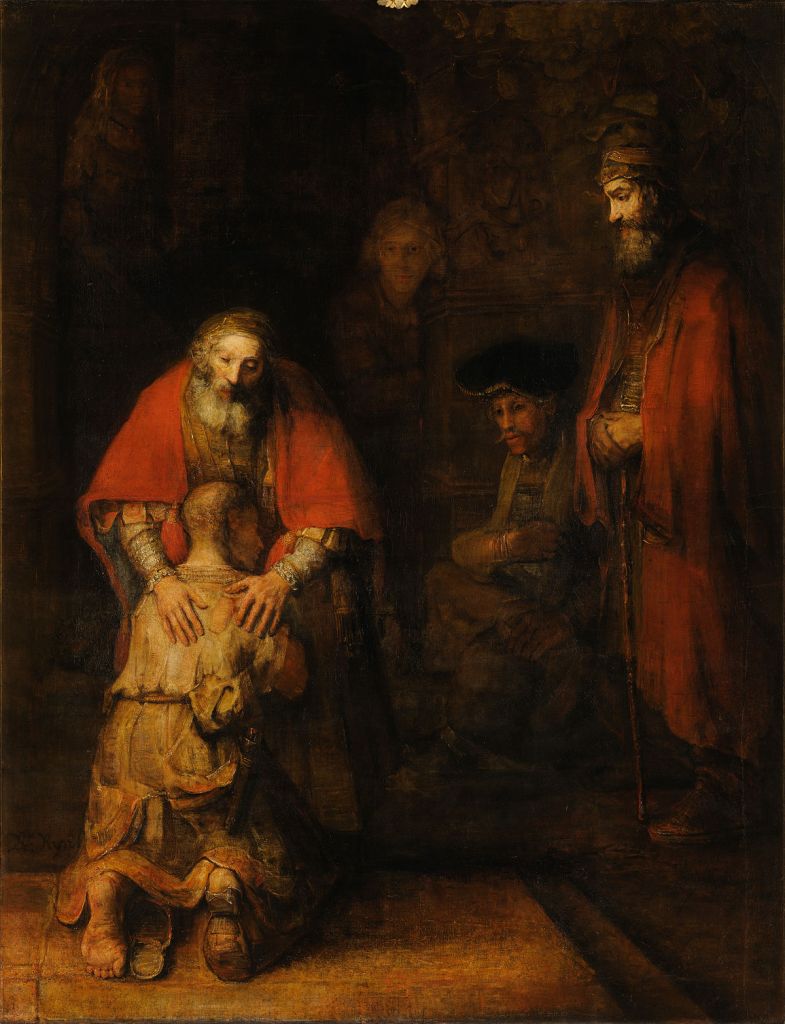
The Return of the Prodigal Son by Rembrandt (c.1661-1669). From Google.
Then he said, “A man had two sons, and the younger son said to his father, ‘Father, give me the share of your estate that should come to me.’ So the father divided the property between them. After a few days, the younger son collected all his belongings and set off to a distant country where he squandered his inheritance on a life of dissipation.”
Luke 15:11-13
Feel the solemnity of Jesus in introducing this parable, shifting from lost sheep and lost coin to lost son, from things to persons because the elder son is also lost. It is the father who eventually restored the lost personhood of the two sons when he lavished them with his love and mercy towards the end of the story. And that is why this parable is so lovely as it reminds us of how unconsciously we are “dumping” our own personhood despite our bloated egos. Slowly we are becoming robots or worst, even zombies without feelings and personal relations with others and with one’s self.
Just like the two sons in our parable who both define sonship in terms of servile obligations that is utilitarian and contractual in relationships, not as a family.
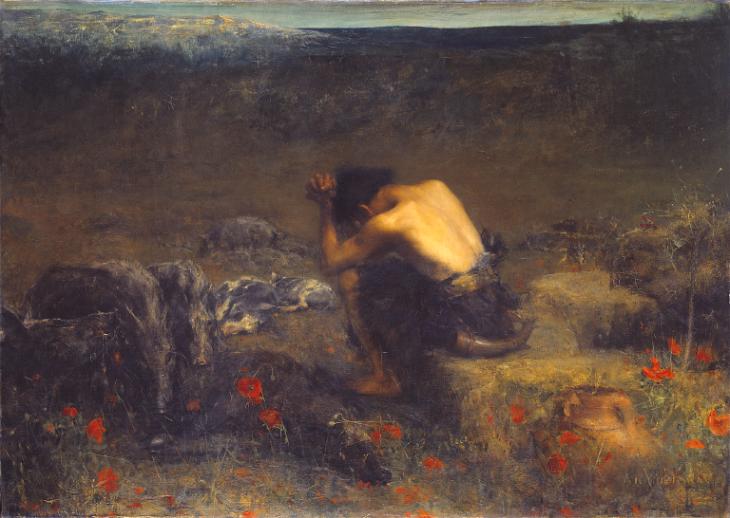
The Prodigal Son by John Macallan Swan, 1888. From Google.
Coming to his senses he thought, ‘How many of my father’s hired workers have more than enough food to eat, but here I am, dying from hunger. I shall get up and go to my father and I shall say to him, “Father, I have sinned against heaven and against you. I no longer deserve to be called your son; treat me as you would treat one of your hired workers.”
He (elder son) said to his father in reply, “Look, all these years I served you and not once did I disobey your orders; yet you never gave me even a young goat to feast on with my friends. But when your son returns who swallowed up your property with prostitutes, for him you slaughtered the fattened calf.”
Luke 15:17-19, 29-30
The prodigal son remembered his father when he was starving, thinking more of the food he could have if he returns home as a servant, not as a son. See how in the midst of sin, he never thought of his father as his parent, of himself as a son. He was convinced that the path to reconciliation with his father was becoming a hired worker, forgetting the very fact he is the youngest son.
The same is true with the elder son who refused to join the celebration when his brother had returned home, feeling so bad that his long years of service to his father deserve him a reward. In a sense, he is worst than the prodigal son: no father, no brother – just himself alone!
Both sons have a slanted view of their father, a very truncated one that is self-isolating, very constricting like the Pharisees and scribes who have forgotten their being persons, of being interrelated with one another in God. Very much like us today that slowly as the ties that bind us as family and friends are slowly being severed by so many things, we also start to lose many of our values like “malasakit” or concern for one another.
The father redefined their – and ours, too – relationships as family that lead to joy and celebration.
He (father) said to him, “My son, you are here with me always; everything I have is yours. But now we must celebrate and rejoice, because your brother was dead and has come to life again; he was lost and has been found.”
Luke 15:31-32
Santorini. Photo by Dra. Mai Dela Pena, 2016.
Today, Jesus reminds us, and assures us too that no matter what happens with us, we will always be his brothers and sisters, beloved and forgiven children of the Father.
We call and relate with God as Father because as his children, he is our giver and keeper of life.
And should this life get lost, God as our Father, can also be so “prodigal” to “wastefully” love us and bring back this life to us for we are more valuable than anything else in this universe. That’s how wild and wide is his love and mercy. Amen.
The Lord Is My Chef Sunday Recipe, Week XXIII-C, 08 September 2019
Wisdom 9:13-18 ><)))*> Philemon 9-10, 12-17 ><)))*> Luke 14:25-33
Photo by Ms. Jo Villafuerte at Atok, Benguet, 01 September 2019
“A loveless world is a dead world, and always there comes an hour when one is weary of prisons, of one’s work, and of devotion to duty, and all one craves for is a loved face, the warmth and wonder of a loving heart.”
Albert Camus, “The Plague”
I always tell people not all days are bright and sunny but, there comes a time when we are so down, when all is so dark and even hopeless that the only thing left for us is to believe, to hope, and to love.
There is really nothing we can do except to patiently wait for the storm to pass while we suffer alone and cry alone. That is when we are surprised and even shocked at how the gospel of Jesus and the commandments of God can sometimes be so rigid that we want it modified even a little because we want to get even, we want to fight back. If we are not busy thinking of revenge, we complain, asking God why me who should suffer?
But, the more we pray and submit ourselves to God, the more we realise that God’s ways are not our ways. That despite the difficulties, we feel deep inside God is with us, guiding us, leading us to something better!
“Who can know God’s counsel, or who can conceive what our Lord intends? Or who ever knew your counsel, except you had given wisdom and sent your holy spirit from on high? And thus were the paths of those on earth made straight.”
Wisdom 9:13, 17-18
Photo by Ms. Jo Villafuerte at Atok, Benguet, 01 September 2019
Here we find the importance of Christ’s teaching last Sunday, of the need to be humble, to be our true selves by being where we should be for “those who humble themselves will be exalted and those who exalt themselves shall be humbled.”
It is in our poverty, in our weakness, even in our incomprehension when the Holy Spirit works well to reveal to us the higher realities of life often wrapped in every pain and suffering we go through. And that is why sometimes in life, it is best to be unreasonable when the only explanation and justification we can have in still being loving and forgiving, merciful and understanding, kind and patient is the person of Jesus Christ.
“If any one comes to me without hating his father and mother, wife and children, brothers and sister, and even his own life, he cannot be my disciple.”
Luke 14:26
Photo by the author, Holy Family Chapel, Sacred Heart Novitiate (Novaliches), July 2016.
Our gospel today is a continuation of last Sunday when Jesus was invited to a Sabbath dinner by a Pharisee. After giving them some “table talks”, Jesus told them another parable about the great feast to stress that God’s mercy is so vast that there is room for everyone in heaven.
People started to follow him after that meal and lesson on heaven, wanting to become his followers and disciples. To further motivate them in following him, Jesus challenged them with these powerful words using a figure of speech. The word “hate” may be too strong and harsh but such is the gravity of discipleship: we have to lose our very selves even those dearest to us when we have to see everything and everyone in the person of Jesus. To “resolutely follow Jesus in his journey to Jerusalem”, we must be ready to be totally his with him alone as the basis in every decision that can be sometimes foolish like St. Paul who claimed in one of his writings he was a fool for Christ!
See the “foolishness in Christ” of this great apostle: St. Paul was in prison at Rome awaiting trial and judgement. A slave named Onesimus escaped his Christian master named Philemon. It was definitely against the law to harbor escaped slaves yet St. Paul welcomed Onesimus in his prison as his companion and servant! More than that, without really knowing him well, St. Paul baptised Onesimus to become a Christian!
Imagine St. Paul’s adherence to the gospel of Christ even to the point of being unreasonable when he could have just told Onesimus to go back or go somewhere else and spare him all the troubles! But no. It was very clear with St. Paul in asking Philemon to receive Onesimus back that he was not sticking to any moral standards or laws but solely on the person of Jesus Christ, in our communion in him as brothers and sisters.
“Perhaps this is why he was away from you for a while, that you might have him back forever, no longer as a slave but more than a slave, a brother, beloved especially to me, but even more so to you, as a man and in the Lord. So if you regard me as a partner, welcome him as you would me.”
Philemon 15-17
Photo by Ms. Jo Villafuerte at Atok, Benguet, 01 September 2019.
Next Sunday we shall hear the very long but beautiful parable of the merciful father also known as parable of the prodigal son. Like God our Father, the merciful father would reassure his two sons of his immense love for them despite their sins because of their very persons as his sons.
Today in our Sunday Eucharist, Jesus welcomes us all as persons, his brothers and sisters despite our sins and weaknesses. Like Mary whose birth we also celebrate today inspire us to receive Jesus our Savior in his total person in ourselves by receiving the persons around us in him. Amen.
The Lord Is My Chef Sunday Music, 01 September 2019
Showa Kinen National Park, Japan. Photo by Dra. Mai Dela Pena, 2016.
“For everyone who exalts himself will be humbled, but the one who humbles himself will be exalted.”
Luke 14:11
Our gospel this Sunday is very timely as our headlines lately with the case of a transgender insisting on using the female toilet. Immediately, politicians jumped into the controversy for the media mileage without really reflecting more on its nature.
And the sad part of it all is perfectly hit again by our gospel today: when people choose places of honour, the more the disadvantaged members of the society are pushed to the margins.
“Rather, when you hold a banquet, invite the poor, the crippled, the lame, the blind; blessed indeed will you be because of their inability to repay you. For you will be repaid at the resurrection of the righteous.”
Luke 14:13-14
It is for this reason we have chosen Cyndi Lauper’s 1986 hit “True Colors” written by Billy Steinberg and Tom Kelly. The song was covered by Phil Collins in 1998 with a more jazzy beat which I prefer than the original.
Since its release, True Colors has become the unofficial music of the gay community especially with its message of showing one’s true colors.
But here we find the beauty of music that is always an expression of love, of what is good and true. True Colors speak so well of the gospel today which is about building our relationships with God and with others that starts with self-acceptance.
Jesus assures us that we all have “assigned seats” here on earth and in heaven; we simply have to accept who we really are for that is when we grow, when his grace and mercy work. True Colors is not about insisting on gays’ rights or the use of female toilets. It is about the gospel truth of accepting who we really are.
When Jesus said those who exalt themselves shall be humbled and those who humble themselves shall be exalted means be who you are and be your best self. If you are a father or a mother, be the best father or mother. If you are a priest, be the holiest priest. If you are a docotor, be the best doctor. If you are a husband or a wife, a brother or a sister, be your best self. If you are a male, be man enough to be your true self. If you are a female, be the loveliest woman.
In the end, everything and each one of us will be falling into our right places. No need to alter our bodies and everything just to insist who we really are.
And when we have become our true selves and better selves, that is when we are able to give ourselves to others in loving service.
See, when we choose other seats than those assigned to us and become an “epal” like most politicians, that is when we lost touch with those really in need among us. That is when we forget about humility which is being truthful to our very selves. It is only in being truthful to our selves can we truly be free to love and serve others to start building on our true relationships as brothers and sisters in Christ.
Instead of going to anybody for our concerns and problems, it is always best to come to Jesus always. And that starts right in our hearts first where we find our true colors, our true value as persons so loved by God inspite and despite of everything.
While praying over today’s gospel during the week, I came across this photo of Ms. Rosa Parks in my Facebook feed saying something like, “Rosa Parks made a stand for her rights by refusing to give up her seat in a bus 60 years ago.”
I love the caption and the play of words of the photo that convey the same message of our Sunday gospel: it is not where we seat but where we stand that matters most.
On a sabbath, Jesus went to dine at the home of one of the leading Pharisees, and the people there were observing him carefully. He told a parable to those who had been invited, noticing how they were choosing the places of honor at the table.
Luke 14:1, 7
For the next three Sundays beginning today while Jesus resolutely decided to journey to Jerusalem, he will be teaching us with some “table talks” as he spoke about the heavenly banquets as expressions of God’s vast ocean of mercy where everyone is welcomed. But, more than lessons on table manners and etiquette, Jesus is also teaching us of finding our own places in his kingdom here on earth where everybody is welcomed just like in heaven.
Key to appreciating our gospel today is found in the first reading:
My child, conduct your affairs with humility, and you will be loved more than a giver of gifts. Humble yourself the more, the greater you are, and you will find favor with God.
Sirach 3:17-18
From Google.
Remember that very central in the teaching of Jesus is the need to be like a child when he would always remind us that “unless you become like a child, you will never inherit the kingdom of heaven.” Being like a child is being humble and obedient, being open to learning new things that are all necessary in building relationships that lead to communion with God and with others. Heaven is the perfect communion of God and everyone but it has to start here on earth among us.
Jesus lived at a time when society and people were so fragmented, just like now. Everybody feels being entitled to heaven and on earth, to every position and honor everywhere even in the church.
While at a sabbath dinner hosted by a Pharisee, Jesus took the occasion to teach the people of the need to be humble to be accepted anywhere. According to St. Teresa of Avila, humility is walking in truth. Humility is being real!
“For everyone who exalts himself will be humbled, but the one who humbles himself will be exalted.”
Luke 14:11
Photo by Jim Marpa, 2018.
Jesus is telling us that for his grace and mercy to truly work on us, we have to be really who we are. In this age when life has been replaced with lifestyle and people have usurped the power and authority of God as well as the natural order of things, everybody feels entitled to everything insisting on their rights forgetting their responsibilities. Homosexuality is not a sin; what is sinful are homosexual acts. The challenge is for the person to accept his/her true self as a beloved child of God doing his/her best to be the bestest person. No need to alter one’s body nor be somebody else he/she is not. Homosexuality is not about insisting on something just for the sake of insisting or making a statement for one’s self regardless of others like in the use of toilets. We have a Tagalog expression that perfectly captures the Lord’s lesson, “lumagay ka sa dapat mong kalagyan”. Loosely translated, it means simply be where you are supposed to be.
Last Wednesday we celebrated the memorial of St. Augustine, one of the most famous and colorful saints of the Church. His life is a gospel in itself, showing us that nobody is too late to change and be a better person. Most of all, nothing is too late for God. Like St. Augustine, we must first accept who we are, be humble for our weaknesses for it is only when we accept that we start to grow and everything follows like acceptance by others. How can we expect others to accept us if we cannot accept first our very selves? This is the most beautiful mark of humility of children that make them so irresistible to adults: they have no guile, all-natural and no plasticity or synthetic fronts to be loved and appreciated.
More than table manners and etiquette, Jesus is teaching us that if we can be humble and accept who we are, we can definitely find our place in the kingdom of God, here on earth and in heaven. God loves us so much he has a plan for each on of us if we play our roles wholeheartedly. We will never experience his mercy and grace unless we become humble.
Photo by Reuters, 2018.
“Rather, when you hold a banquet, invite the poor, the crippled, the lame, the blind; blessed indeed will you be because of their inability to repay you. For you will be repaid at the resurrection of the righteous.”
Luke 14:13-14
To further ensure the lesson of his parable about each of us having a place in his kingdom here on earth, Jesus reminds us too while in the context of his sabbath dinner that for us to be able to establish a more humane society, we have to guard against stereotypes of peoples that we tend to box them into categories.
Jesus is asking us to radically change our prevailing social mores, suggesting a very different value-system in the here-and-now kingdom of God. Far from the cries of the communists for a classless society, Jesus tells us to see the value of every person rather than focusing on the few powerful, wealthy, and influential people we always deal with in exchange of so many favors.
It is a patronage system so prevalent everywhere especially in politics and in our social relationships like the compradazo system of getting ninong and ninang who are rich and famous to get influence and other perks and rewards. It is so unfortunate that some clergymen are so guilty of this that the Church’s credibility has eroded so much for the mistakes and sins of a few.
In this manner of patronage system, the poor and the weak are always left out to the margins, forgotten and even disregarded. What kind of Christianity do we have when we are so concerned with Christmas carols and counting the days before Christmas and be oblivious to the plight of the farmers and fishermen?
Lorenzo Atienza, June 2019.
What Jesus is telling us today is that those who have less in life should have more of God because, truly in the end, they are the ones who shall be exalted!
In these parable and admonition by Jesus, St. Luke our guide these Sundays is not only giving us an advice on how to prepare for the end times but also on how to live according to the Lord’s vision of a just and humane society in our imperfect world.
We in the Church play a very vital role in bringing about this change by witnessing the gospel that often brings about a reversal of fortunes in the end.
The author of the Letter to the Hebrews reminds us that the ultimate goal of our Christian life is communion with God made possible by Christ’s offering of himself on the Cross. Do our Sunday Mass celebrations and Parish set-ups witness to the gospel values of a just and a humane city of God here on earth?
The Lord Is My Chef Sunday Recipe Week XXI-C, 25 August 2019
Isaiah 66:18-21 ><)))*> Hebrews 12:5-7, 11-13 ><)))*> Luke 13:22-30
The small door leading to the Church of Nativity in Bethlehem, symbolic of the need to be lowly, to bow to meet our Lord Jesus Christ who became human like us to save us. Photo by author, May 2019.
The Lord concludes his series of “shock preaching” today with a big bang by dousing us with a big disappointment…
Someone asked him, “Lord, will only a few people be saved?” He answered them, “Strive to enter through the narrow gate, for many, I tell you, will attempt to enter but will not be strong enough. After the master of the house has arisen and locked the door, then will you stand outside knocking and saying, ‘Lord, open the door for us.’ He will say to you in reply, ‘I do not know where you are from.'”
Luke 13:23-25
It is very disappointing that after joining Jesus as he resolutely determined to journey to Jerusalem these past four Sundays in taking into our hearts his many earth-shaking lessons about the “end” only to find out that we could end up being locked out of the door to heaven. More shocking than the lessons last week is the disturbing revelation today that we have to be strong enough to enter through the narrow gate to eternal life.
How strong? We really do not know. But, we have learned from the Old Testament of the need to patiently obey and faithfully keep the commandments of God while the gospels remind us clearly to deny ourselves and carry our crosses even up to the point of dying with Christ.
Very difficult, huh…? And here’s more! Striving hard to enter the “banquet hall of heaven” is keeping in mind the important lessons we have heard these past three Sundays: life does not consist of possessions but of what matters to God (Lk.12:15,21; Aug. 04); that we must always gird our loins to be ready for death that comes like a thief at night (Lk.12:35,39; Aug.11); and, most of all, we have to go through our own passion and death like Jesus to be filled with the fire of the Holy Spirit to bring the peace of Christ into world (Lk.12:49-51; Aug. 18).
It is useless to count how many would be saved for there is enough room for us all in heaven. Through the Prophet Isaiah in the first reading, God wants us all to be with him in heaven despite his knowledge of our sins by sending us his Son Jesus Christ!
Thus says the Lord: I know their works and their thoughts, and I come to gather nations of every language; they shall come and see my glory.
Isaiah 66:18
The small door to the Church of the Nativity from the inside.
See again in our gospel today an apparent contradiction in the teachings of our Lord like last Sunday with his bringing of fire and division among us. When Jesus refused to give that man a definitive answer to his question “if only a few people would be saved”, the Lord in fact revealed something deeper than the initial disappointment we have felt about the gate of heaven being narrow that would be closed when the time comes. Again, he mentions the Eucharist, our Sunday Mass as the wonderful opportunity to be strengthened in order to get inside the heavenly banquet.
“And people will come from the east and the west and from the north and the south and will recline at table in the kingdom of God. For behold, some are last who will be first, and some are first who will be last.”
Luke 13:29-30
It is during the Sunday Mass when the Lord gathers us all together after a very difficult and disappointing week to refresh us, to strengthen us for another week of hurdling more problems, more trials in life. This is why before receiving him, we say, “Lord I am not worthy that you should enter under my roof, but only say the word and my soul shall be healed.” The Father gave us his Son Jesus Christ so we may have that strength needed to enter the narrow gate to heaven by doing more loving service to others, being kind and forgiving, being honest and generous. Yes, these are easier said than done but doable in Christ.
What is so surprising in our many experiences are the many times when in our many disappointments Jesus comes to guide us to new doors, new routes and new openings that mysteriously lead to new life for us!
Grotto of our Lady of Lourdes, Baguio City, January 2019.
Brothers and sisters: You have forgotten the exhortation addressed to you as children: “My son, do not disdain the discipline of the Lord or lose heart when reproved by him; for whom the Lord loves, he disciplines; he scourges every son he acknowledges.” Endure your trials as “discipline”; God treats you as sons. For what “son” is there whom his father does not discipline?
Hebrews 12:5-7
That is the mystery of God’s universal plan of salvation for us: the path may be filled with so many hardships and obstacles, the gate may be so narrow and difficult to pass through but he has made it possible for us to make it through by sending us Jesus Christ our Lord in leading this way to the heavenly Jerusalem. Authentic faith always involves pains and sufferings. When we embrace death like Jesus Christ, we also ensure life.
In every setback in life, we only have two choices always: either to be better or bitter. Choose to be better and that can only be through the narrow door of Jesus Christ by letting go of our anger and hatred, resentment and bitterness to give way to joy and peace, love and forgiveness. That is when God begins to surprise us!
Tam-Awan, Baguio, January 2019.
The author of Amazing Grace, John Newton was once challenged by a man after he had delivered a homily about heaven. Remember that Newton, as he claimed in Amazing Grace, was a “wretch” being a former slave trader after being a slave himself.
Newton was asked by a man to give something that would surprise him when he gets to heaven.
The former wretch replied that there would be three great wonders in heaven: first, he would see many people he never expected to be there; second, he would not find many church-goers he expected to see there; and third – which is the biggest surprise of all – is to find himself there in heaven when he knows very well his sinfulness.
Yes, my dear brothers and sisters, we are all sinners, now feeling disappointed with so many things in life. Just strive to be good and better persons as we celebrate every Sunday the Lord’s Supper and he will do the rest. And be ready to be surprised even before going to heaven! Amen.
















 lordmychef.com