The Lord Is My Chef Daily Recipe for the Soul by Fr. Nicanor F. Lalog II
Tuesday, Memorial of Our Lady of Lourdes & World Day of Sick, 11 February 2025
Isaiah 66:10-14     <'000>< + ><000'> + <'000>< + ><000'>     John 2:1-11
Photo by author, Our Lady of Lourdes Parish, Bignay, Valenzuela City, 03 February 2025.
Thank you,
dearest God our loving Father
in sending us your Son Jesus Christ
who gave us his Mother
the Blessed Virgin Mary
to be our Mother too!
From the very beginning of
his ministry to our modern time,
Mary has always been close with
Jesus who showed us your great signs
of your loving presence,
generosity and mercy,
life and joy first anticipated
at the wedding at Cana,
his first miracle.
On the third day there was a wedding in Cana in Galilee, and the mother of Jesus and his disciples were also invited to the wedding. when the wine ran short, the mother of Jesus said to him, “They have no wine.” Jesus said to her, “Woman, how does your concern affect me? My hour has not yet come.” His mother said to the servers, “Do whatever he tells you” (John 2:1-5).
From stillromancatholicafteralltheseyears.com, January 2022.
How lovely that Jesus Christ's
first sign (miracle) happened
 "on the third day" -
a prefiguration of Easter -
the fullness of your coming to us,
the fullness of our healing and salvation,
the third day after his "hour";
how prominent that
at his "hour" on the Cross,
blood and water flowed out
from Jesus' side pierced by a lance
while there at the wedding at Cana,
Jesus transformed water into
an excellent wine.
Both at Cana and at Lourdes
 there was water,
 the sign of life;
most of all,
 in both instances
 like at the Cross,
 Mary was present
bringing us healing
and joy.

At Cana,
 water became an excellent wine
 to prefigure the Lord’s Supper
 we celebrate each day in the Holy Mass
 as a foretaste of our promised glory in heaven
 while at Lourdes,
 water transformed
and healed the sick.
Photo by author, Grotto of Our Lady of Lourdes at St. Paul Spirituality Center in Pico, La Trinidad, Benguet, 06 January 2025.
Thank you
most Blessed Virgin Mary
to your witness of faith in Christ;
your example enabled us
to encounter
the gift of God in Jesus,
to create the feast of joy
of communion,
of healing,
of fulfillment
that can only be made possible
by God’s presence
and his gift of self
in Christ;
in Cana and on to Lourdes
and wherever we may be,
every day is God’s coming,
the “hour” of Jesus
in every “here” and “now”
when we experience the sign
of God’s overflowing generosity
to us all who are so tired
and exhausted
most especially
so sickly;
you, O Blessed Virgin Mary,
are the fulfillment
of Isaiah's prophecy of God
sending us a mother who shall
comfort us in moments of
sickness and darkness;
continue to help us,
most Blessed Virgin Mary of Lourdes
to get through these times
of many diseases and sickness;
get us closer to Jesus your Son
who is our true peace and joy
by doing whatever he tells us
like the servants at Cana.
Amen.
The Lord Is My Chef Daily Recipe for the Soul by Fr. Nicanor F. Lalog II
Thursday, Week II in Ordinary Time, Year I, 23 January 2025
Hebrews 7:25-8:6     <*{{{{><  +  ><}}}}*>     Mark 3:7-12
Photo by author, St. Paul Spirituality Center, Pico, La Trinidad, Benguet, 06 December 2024.
Let me come to you,
Jesus, with confidence
and humility to express
to you my deepest longings
and desires,
my deepest needs
and cries you know so well
but I always deny or too shy
to tell you completely.
Though I know very well
how your death on the Cross
is the single most important event
in history for all times
and for all peoples,
I balk its realities not for lack
of faith but due to low self-esteem,
lack of self-acceptance
that you do love me truly.
The main point of what has been said is this: we have such a high priest, who has taken his seat at the right hand of the throne of Majesty in heaven, a minister of the sanctuary and of the true tabernacle that the Lord, not man, set up. Now he has obtained so much more excellent a ministry as he is a mediator of a better covenant, enacted on better promises (Hebrews 8:1-2, 6).
Let me follow you,
Jesus like the people in
the gospel:
let me not follow you only
to the sea but even to the
Cross to be one in you,
one with you
for you alone
is truly one with me
everywhere,
all the time.
Amen.
Photo by author, Mount Olis, Atok, Benguet, 27 December 2024.
The Lord Is My Chef Good Friday Recipe, 29 March 2024
Isaiah 52:13-53:12  > + <  Hebrews 4:14-16;5:7-9  > + <  John 18:1-19:42
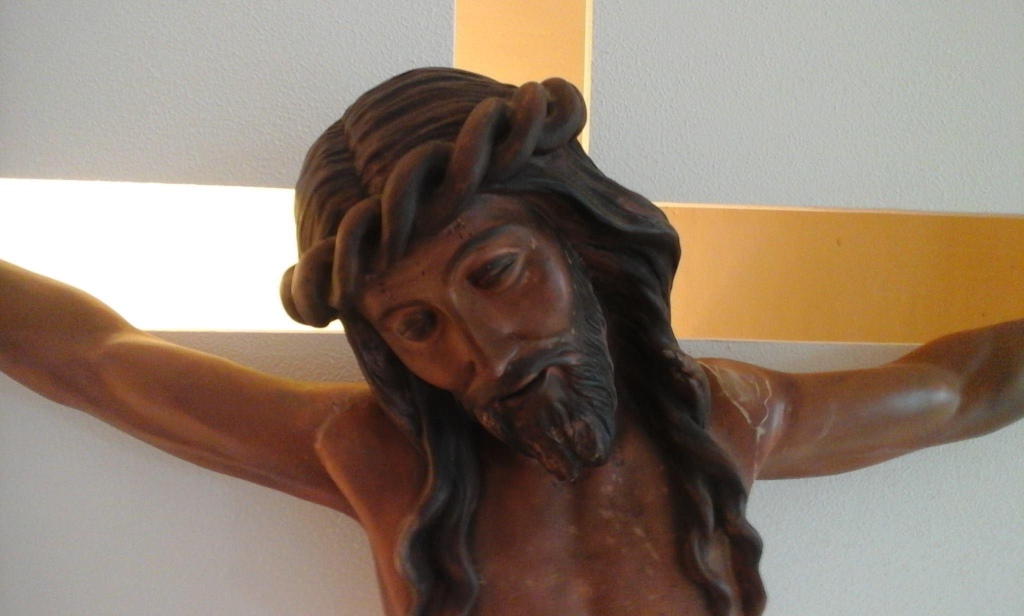
Photo by author, Chapel of the Holy Family, Sacred Heart Novitiate, Novaliches, June 2016.
The evangelists tell us that Jesus died on the Cross on a Friday at about 3PM. And they tell us too that our Lord died praying, exactly what most of the Seven Last Words expressed.
But from the gospel we have heard this afternoon written by the beloved disciple, we discover something very beautiful about the death of Jesus, that He was very calm and peaceful in His prayer unto death.
After this, aware that everything was now finished, in order that the Scripture might be fulfilled, Jesus said, “I thirst.” There was a vessel filled with common wine. So they put a sponge soaked in wine on a sprig of hyssop and put it up to his mouth. When Jesus had taken the wine, he said, “It is finished.” And bowing his head, he handed over the spirit.
John 19:28-30
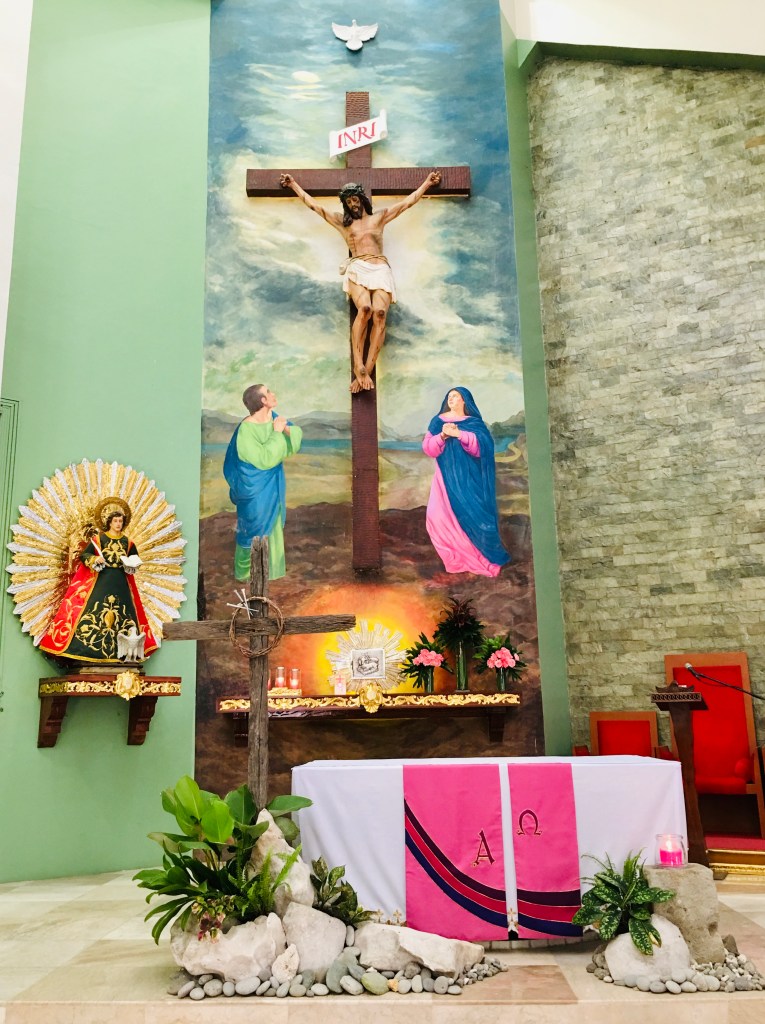
Photo by author, Chapel of the Holy Family, Sacred Heart Novitiate, Novaliches, June 2016.
When we are deep in suffering, in severe pain like Jesus on the cross, what do we usually pray? Most often, we pray that the terrible ordeal we are going through would finally end, would be finished.
And sometimes, due to desperation, we even pray for death, of how we wish God would finally end our life to be free from all the problems we are going to.
One of the things I keep telling to sick people I visit came from Meryl Streep who acted as mother of Winona Ryder in the 1990’s movie “House of Spirits” when she said, “Do not pray for death because death surely comes.” Sometimes in our desperation, we feel death is the solution to our problems and sufferings. But when Jesus died on the Cross, He made death an offering, a gift of self in love.
Photo by author, Chapel of the Holy Family, Sacred Heart Novitiate, Novaliches, June 2016.
In the original Greek text, the word used to express Jesus Christ’s final prayer “It is finished” is tetelestai from the root word telos meaning the final end and direction. It is not just an ending but a direction too.
From the very start, Jesus was clear with His mission and how it would be accomplished. He has always been sure of Himself, of who He is. Notice how the beloved disciple repeated many times in his account of the Last Supper how Jesus was “fully aware” of everything that was going to happen to Him that He was actually in control and never left to the whims and powers of His enemies when He went through His Passion and Death.
Last night we heard how Jesus knew everything was coming to end that He washed the feet of His disciples after their supper. Most of all, Jesus was so composed and serene that He even gave bread to His betrayer Judas Iscariot during their meal. In fact in the washing of the feet of His disciples to His agony in the garden, Jesus calmly and courageously faced death that in the end, on the Cross, He had the upper hand that He was able to pray “It is finished” because He was never made under the power of death completely as He would rise again on Easter.
In praying “It is finished,” Jesus consecrated not only Himself but also all humanity to the Father so that we are able to bear and face death squarely like Him. Very notable in this part is how we find only in the fourth gospel how Jesus died by “handing over his spirit to the Father.”
Remember the verb to hand over is the literal meaning of the Greek word used paradidomi or betrayal. But here at the death of Jesus, handing over has no negative connotation but purely positive; Jesus never betrayed or handed anyone over to sufferings. He bore all sufferings and handed these over to the Father. That is true passion in the active sense when we let things happen not because we are helpless and resigned to the situation but we passively take everything in the positive sense because we have that firm faith and deep conviction that being silent, being patient, being persevering will eventually bear fruit for us like the death of Jesus that led to Easter.
Suffering and death thus are not resignation nor mere surrender but submission to the higher power of God to convert darkness into light, sadness into joy, and death into life. There on the Cross Jesus showed that true power is in weakness.
Photo by author, Chapel of the Holy Family, Sacred Heart Novitiate, Novaliches, June 2016.
After the consecration of the bread and wine into Christ’s Body and Blood in the Mass, we proclaim “Christ has died; Christ is risen; Christ will come again.” We call it as “the mystery of our faith” because when we say “Christ has died,” we admit that truly, the Son of God went through all kinds of sufferings in life we all go through like betrayal, rejection, loneliness, sickness, hunger, thirst, and yes, even death. And His sufferings continue as we suffer more in this world marred by evil and sins, making us cry, asking when would these end and be finished.
There lies the mystery of our faith on the Cross that led to Easter: when we look at Jesus Christ on His Cross, we see our own pains and agony as God’s pains and agony too. Jesus joined us in our anguish and death so that we could experience all the more His immense love for us. Without Jesus and His Cross, we would never be able to bear or even face the many deaths we go through daily. May we recognize God’s immense love for us again this afternoon when we venerate the Cross and see it as the merging point of human and Divine suffering. Keep praying with Jesus who has the final say with death in Easter. Amen.
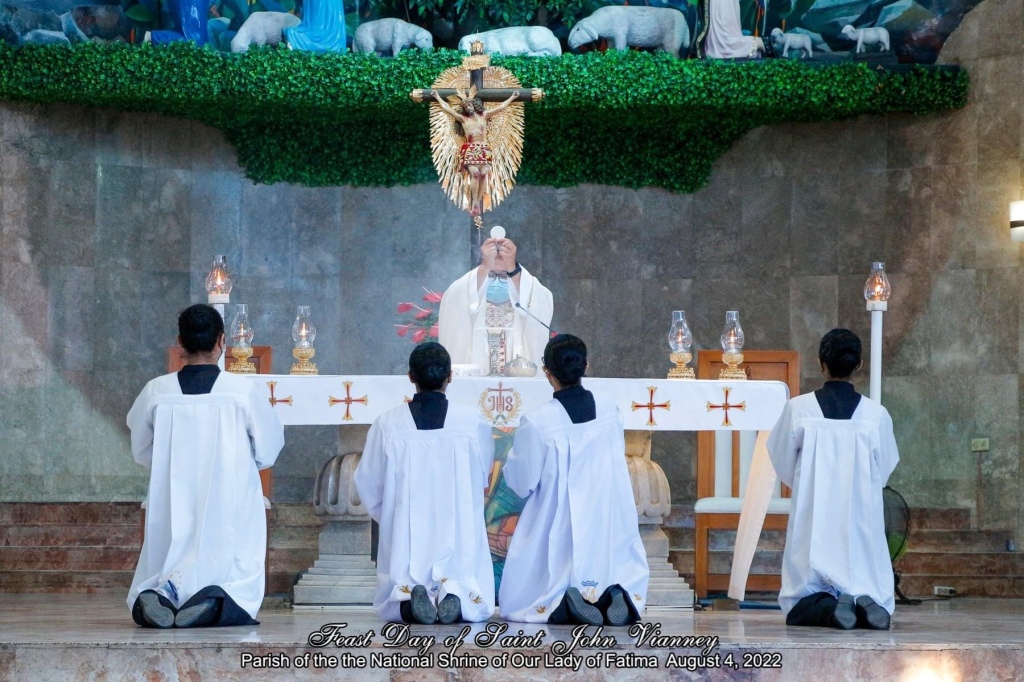
Photo by Ka Ruben, National Shrine of Our Lady of Fatima, Valezuela City, August 2022.
40 Shades of Lent by Fr. Nicanor F. Lalog II
Sunday Recipe for the Soul, Lent IV-B, 10 March 2024
2 Chronicles 36:14-16, 19-23 ><}}}}*> Ephesians 2:4-10 ><}}}}*> John 3:14-21
Photo of pink convolvulus from the Botanical Gardens of Jerusalem, flora.org.il.
Many times during prayer periods I banter with God especially when I feel overwhelmed by his kindness and love. Like last Thursday on my way to the adoration chapel when I passed by a row of banks.
As I knelt before the Blessed Sacrament to pray, I just felt like asking God: “BDO (Banco De Oro) ka ba, Lord? Kasi…you always find ways.”
That, for me, my dear friends is the meaning of this fourth Sunday in Lent – God never stops in finding ways to reach out to us, to be with us, to make us experience his love and mercy, kindness and forgiveness despite the hardness of our hearts.
Photo by author, 2019.
Our altars burst in shades of pink this Sunday called Laetare (Latin, rejoice) Sunday from the entrance antiphon that says, “Rejoice, Jerusalem, and all who love her. Be joyful, all who were in mourning; exult and be satisfied at her consoling breast.”
It is a misconception to see Lent as dull and drab due to its penitential nature; while there is the sober tone in our liturgy, let us keep in mind that it is also a season filled with joy and excitement for the coming Easter, the mother of all feasts in the Church.
And today we rightly rejoice because John reminds us in our gospel scene only him narrates – Nicodemus meeting with Jesus in the cover of the darkness of the night – of God’s immense love for us manifested in the dying of Jesus on the Cross.
Jesus said to Nicodemus: “Just as Moses lifted up the serpent in the desert, so must the Son of Man be lifted up, so that everyone who believes in him may have eternal life.” For God so loved the world that he gave his only Son, so that everyone who believes in him might not perish but might have eternal life.”
John 3:14-16
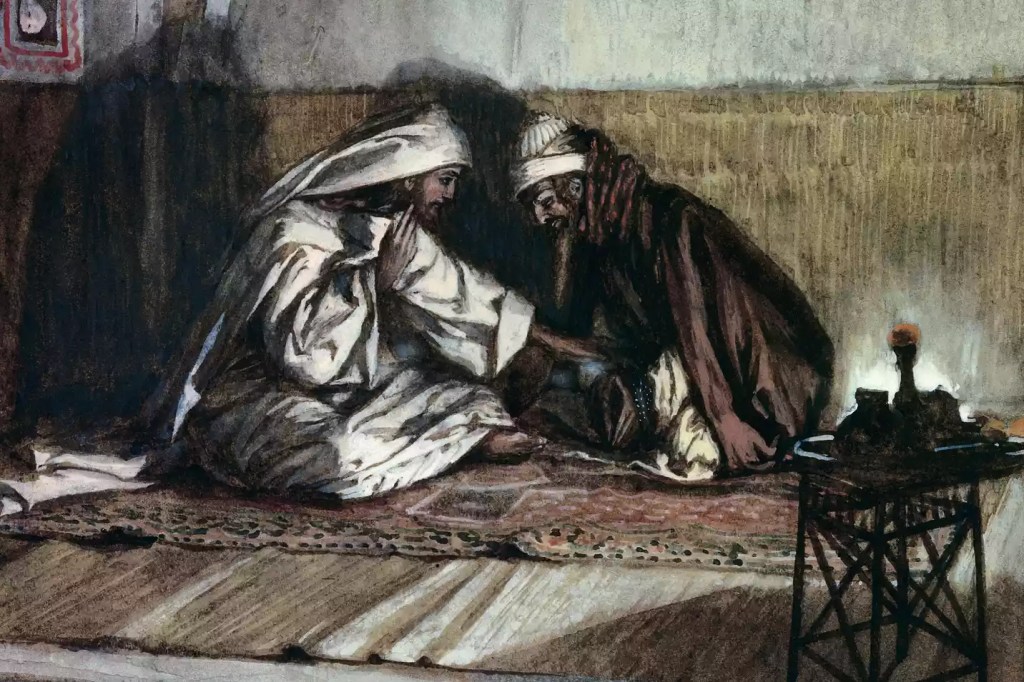
“Nicodemus and Jesus” painting by James Tissot (1836-1902) from SuperStock/GettyImages via learnreligions.com.
John saw a deeper meaning, of a sign pointing to Jesus as the Christ in this conversation with Nicodemus at night. Nicodemus was a Pharisee afraid to come out in the open to show his admiration and belief in Jesus. He eventually joined the disciples on Good Friday with another Pharisee, Joseph of Arimathea when they buried Jesus in a tomb.
See the deep perception of John in this recalling by Jesus to Nicodemus of the bronze serpent raised by Moses in the wilderness (see Num. 21:4-9) as a prefiguration of his own crucifixion.
In the gospel of John, the “lifting up” of the Son of Man refers to Jesus on the Cross. After that scene with the woman caught committing adultery, Jesus declared, “When you lift up the Son of Man, then you will realize that I AM…” (Jn.8:28). Then on Palm Sunday while in the temple area, Jesus told the crowd “‘And when I am lifted up from the earth, I will draw everyone to myself.’ He said this indicating the kind of death he would die” (Jn.12:32-33).
John’s gospel teems with other similar passages showing the inseparability of Christ’s Cross and glory. And so with our life, that is why in the middle of Lent, we rejoice this Sunday!
Photo by author in Petra, Jordan, May 2019.
Like last Sunday, here we find again early in the gospel of John how Jesus laid his vision-mission statement of coming to save us by dying on the Cross during his conversation with Nicodemus that night.
Jesus assured Nicodemus and us today that even while we are in the darkness of life’s many confusions and fears, problems and sufferings, we just have look up to him crucified lighting up our way to life and salvation. That night in their conversation, Jesus assured Nicodemus and us today that even in the worst situations in life when “darkness is our only light and hopelessness is our only hope” as T.S. Eliot wrote in his Four Quartets, God is in us, with us and for us in Christ. Just as when the world was covered in darkness on Good Friday when Jesus died on the Cross, it was the precise moment too of Christ’s glory when he conquered death and sin in obedience to the Father.
Yes, it is true these things are easier said than done but like Nicodemus, even in the darkness of the night we have to dare come close to Jesus, to speak to him and most of all, to hear and listen to him. As one poet had said, “only the brave who walk the darkness of the night shall see the brightness of the stars above.” Most of all, Jesus calls us today to be his love and mercy, his joy and light to the many other Nicodemus groping in the darkness of sin and evil.
In my three years as chaplain in a hospital, I have experienced personally and through others that truth so clear as crystal of God most closest with us in the worst days of our lives. Sometimes, we just sigh deeply as we feel him inside us, assuring us how everything is taken cared of, that everything would be fine.
Like the Israelites in the first reading, we too have to go through an “exile”, a kind of “punishment” not from God but as a result of own our sins and wrongdoing. Many times God let bad things happen to us because we insist on our ways; as God retreats to the back or sides of our lives, he never stops finding ways to save us, even “extricate” us from our imprisonment to sin and sufferings!
Indeed, as St. Paul had said in our second reading today, God is “rich in mercy, because of the great love he had for us” (Eph.2:4). Let us not waste that gift. Even though God forgives every sin no matter how bad it may be, do not forget some of our sins have irreversible consequences we shall face and suffer. Of course, God would still be there to help and guide us but, why wait for that to happen?
There lies the joy and grace – and challenge – of this fourth Sunday in Lent: even while we are in our worst situations in life, in our darkest nights, Jesus is always there for us, in fact, the first to have suffered and died for us so that with him on Easter, we may rise again to new life.
Be the sower of his love and mercy. Be his presence. Be another Nicodemus in the night leading others to the light of Jesus. Let us, therefore, rejoice in the Lord as we pray:
Praise and glory to you,
dearest Father
in giving us your Son
Jesus Christ our Lord,
our light,
our life,
our joy;
make us, O Lord,
your love and mercy
in this world
so everyone may experience
that indeed, God loves the world
that He gives us Jesus through me;
let your Holy Sprit enlighten
my mind and my heart
like Nicodemus
leading those in darkness
into the light of Christ.
Amen.
Quiet Storm by Fr. Nicanor F. Lalog II
The Seven Last Words, 01 April 2023
Photo by author, Chapel of the Holy Family, Sacred Heart Novitiate, Novaliches, Quezon City, 2014.
When they came to the place called the Skull, they crucified him and the criminals there, one on his right, the other on his left. Then Jesus said, “Father, forgive them, they know not what they do.”
Luke 23:33-34
Such is “the breadth, and length, and depth, and height of Christ’s love for us all” (Eph. 3:18-19) that right upon His crucifixion, Jesus begged God for our forgiveness. And that was not only for those who nailed Him on the cross on that Good Friday but also for us today who continue to crucify Him whenever we destroy our relationships.
In the Jewish thought, “to know” is not just of the mind but of the heart because to know is to have or enter into a relationship with others. Hence, Jesus begged first for our forgiveness when crucified because if there is something we must “know” above all is the fact that we are brothers and sisters in Him, one family in God our Father.
Every time there is a breakdown in our relationships, when we destroy our ties with one another, that is when we sin and know not what we do. And crucify Jesus anew.
We sin and know not what we do when we hurt those dearest to us – our mom and dad, sisters and brothers, relatives and friends – when we speak harsh words to them, calling them names, denigrating their persons as things.
We sin and know not what we do when we betray the trust of those with whom we promised to love forever, keep their secrets and protect them like your husband or wife, your children, your BFF, your student, your ward.
We sin and know not what we do when we lose hope in persons around us, choosing to do them evil because we thought they could no longer change for better, that they could never learn and overcome life’s pains and tragedies, that they could no longer get well from an illness or, sadly, because they are old and dying.
We sin and know not what we do when we cheat on those true to us, when we hide from those open to us, when we back stab those who believe and support us.
We sin and know not what we do when we abuse and use those people we are supposed to serve and protect, when we regard persons as objects to be possessed even if we do not know them personally.
Is there anyone whom you might have hurt in words or in deeds which you might not be aware of?
Who are the people who cause you pains and sufferings, who do not know what they are doing?
Let us pray:
Lord Jesus Christ,
I am sorry in crucifying You again,
when I know not what I am doing
like hurting the people You give and send me
to experience your love and mercy,
your trust and confidence
your kindness and fidelity;
I pray also for those who make me
suffer physically and emotionally,
those who do not know what they are doing;
help us build again
our many broken relationships;
make us humble and true;
let us believe in Your love
expressed by our family and friends
and by everyone who cares for us.
Amen.
Photo above is a sculpture called “Love” by Ukrainian artist Alexander Milov he created in 2015 showing two adults after a disagreement sitting with their back to each other while their inner child in both of them wanting to connect. A beautiful expression of how we are all interconnected and related as brothers and sisters. This Holy Week, let us mend and heal our broken relationships, let the inner child within us come out and simply say “I am sorry” or “I forgive you” and most especially, “I love you”. Photo from reddit.com. See also our blog, https://lordmychef.com/2023/01/14/the-human-child-mystery-of-gods-love/.








 lordmychef.com