The Lord Is My Chef Sunday Music by Fr. Nick F. Lalog II, 05 July 2020
At that time Jesus exclaimed: “Come to me, all you who labor and are burdened, and I will give you rest. Take my yoke upon you and learn from me, for I am meek and humble of heart; and you will find rest for your selves. For my yoke is easy, and my burden is light.”
Matthew 11:28-30
If there is anything we all wish this first Sunday of July 2020, it must be rest from all the worries and burdens in this time of the corona. We all want something that would be lighter in this second half of the heaviest year we have ever had in decades or even a generation.
Being light does not mean being worry-free, no problems nor sufferings. Dr. M. Scott Peck insists in his book Road Less Travelled that “life is difficult” – the sooner we realize and accept this, the better for us (see our homily, https://lordmychef.com/2020/07/04/we-are-disciples-of-a-meek-and-humble-lord/).
Being light is having a companion to share with our burdens and woes in life because having these all by ourselves is so difficult and impossible. Most of the time, our problems need not be solved at all but simply be accepted and shared with someone who loves us, cares for us, and believes in us.
Jesus Christ is that only companion par excellence we can have for he is meek and humble of heart.
Van Morrison’s lovely ballad Someone Like You released in 1987 captures this essential desire among us all to seek and forge many relationships.
I've been searching a long time
Someone exactly like you
I've been traveling all around the world
Waiting for you to come through

Someone like you makes it all worth while
Someone like you keeps me satisfied
Someone exactly like you
Though the song has become a staple in many weddings and in many romantic movies covered by various artists, Someone Like You sounds more like a spiritual song longing for God through our loved ones for he is always faithful and loving to us despite our many weaknesses and sins.
I've been doin' some soul searching
To find out where you're at
I've been up and down the highway
In all kinds of foreign lands

Someone like you makes it all worth while
Someone like you keeps me satisfied
Someone…
May Van Morrison’s song bring you closer to God through your loved ones as we continue to hurdle the many obstacles and trials ahead in this time of COVID-19.
One reason I have this blog on trying to link secular music with the Sunday gospel is the firm belief that God continues to speak to us through modern means of communications like music and films. Sometimes I feel that if Jesus were with us today, he might be instructing us priests to “feed my geeks” than “feed my sheep”.…..
For this Sunday we have the dynamic duo of Daryl Hall and John Oates — my most favorite group standing side by side with the late Walker Becker and Donald Fagen of Steely Dan.
Released in 1984 from their “Big Bam Boom” album, Possession Obsession is one of a kind in their long list of superb music with John Oates taking the front seat in this song unlike in their previous hits where it would always be Daryl taking the lead.
I have listened maybe a hundred times to Possession Obsession but it was only yesterday after preparing my Sunday homily that I have tried to internalize its lyrics, including the music video directed by Bob Giraldi who did Michael Jackson’s “Beat It”.
The song perfectly echoes the Sunday teaching today of Jesus Christ who said that
“Whoever finds his life will lose it, and whoever loses his life for my sake will find it.”
Matthew 10:39
Possession Obsession echoes Christ’s teaching this Sunday on life’s paradox wherein the more we give, the more we actually receive, that life is not about possession and having but about love, of giving and of sharing with others.
You know there's something you need
Right here and now
To fill the space inside of yourself
Money love or power
When you want to have the number one first run anyone
You're crazy 'til you own them

You ought to know better than that
The more that you buy the less you get back
It's a case of possession obsession
Gimme Gimme

The compulsion to count the percentage of time
Spent between two lovers
Can turn an hour into a crime
And all the good times suffer
Though you know it's only jealousy
You can't help but be
Haunted by your passion

Don't you know it's a matter of fact
The more that you take the less you give back
Just a taste of possession obsession
Brings a case of possession obsession
Gimme Gimme
Watch closely too this music video set inside a cab with John Oates as driver, taking different passengers in all the different forms of “love” understood these days, far from the truth witnessed to us by Jesus Christ.
In fact, it is one of the first music video to present two men holding hands as lovers at the back of John’s cab with one of the men looking like the late David Bowie (?).
At the last sequence of the music video is a beautiful presentation of giving and loving when Hall and Oates were in their usual attires in a cafe, competing in “possessing” the sugar dispenser. Hall prevailed and right before putting sugar into his coffee, he changed his mind and slid the sugar dispenser to Oates at the other end of the bar table.
The Lord Is My Chef Sunday Recipe for the Soul by Fr. Nicanor F. Lalog II
XIIIth Sunday in Ordinary Time, Year A, 28 June 2020
2 Kings 4:8-11, 14-16 >><)))*>Romans 6:3-4, 8-11 >><)))*> Matthew 10:37-42
Photo by author, Dome of the Chapel of Nativity at Shepherd’s Field, Bethlehem, the Holy Land, May 2019.
Jesus continues his lessons to us his disciples being sent to look for the “lost sheep of Israel”, to be not afraid for he is with us in this journey and mission. But, it is not enough that we have Jesus on our side and be present among us: we have to allow Jesus to take possession of us completely!
From having no fear because Jesus is here, Christ now deepens his presence by inviting us to be possessed by him, to be in communion with him.
Jesus said to his disciples: “Whoever loves father and mother more than me is not worthy of me, and whoever loves son or daughter more than me is not worthy of me; and whoever does not take up his cross and follow after me is not worthy of me. Whoever finds his life will lose it, and whoever loses his life for my sake will find it.”
Matthew 10:37-39
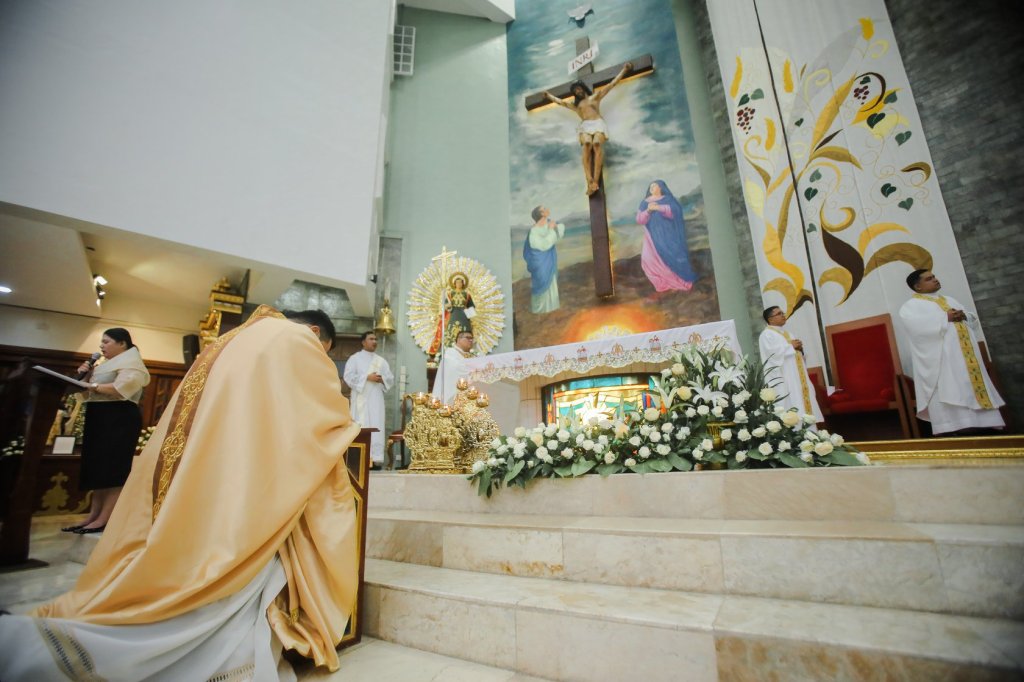
Photo by author, processional Cross at the altar, 2019.
The Mystery of the Cross
Discipleship in Jesus Christ is more than a total allegiance to him who is neither a demanding nor exacting Lord and Master for he does not arbitrarily impose himself upon us.
Nothing like that of subservience but something more lofty because it is wrapped in a mystery — a mystery of love freely given and shared to us by God even if we do not deserve it all. Remember the mystery of the Blessed Trinity four Sundays ago (June 07)?
Ever since, God has never imposed himself upon us, that we should love him back in return for he does not really need our love. He gave us the gift of freedom so that we may love him freely for he never imposes on us.
And here lies the beauty of discipleship, of this relationship we have with God that is based solely on love expressed to us in the most personal manner by giving us his Son Jesus Christ who suffered and died on the Cross but rose again on Easter. This we were reminded by the Solemnities of the Body and Blood of Jesus and of his Sacred Heart last June 14 and 19 respectively.
Now you see my dear readers the clearer picture of our liturgical celebrations expressing our concrete experiences of being loved by God in Jesus Christ most especially during times of trials and sufferings like in this COVID-19 pandemic.
It is Christ who made the initiative to be one with us in our pains and sufferings; God did not remove our crosses in life but made them holy in his Son Jesus Christ so that every time we go through life’s many difficulties, we share in the Lord’s Passion, Death, and Resurrection.
That is why, we are invited to take and carry our cross every day for it is through the Cross we are saved. It is not enough to simply believe in the person of Jesus but we need to accept and embrace his Cross because it is through which he had won our salvation by dying on it and rising again.
This is easier said than done. It is so difficult to love Jesus more than our loved ones like family and friends. And it is most difficult to love the Lord more than our selves, when we have to let go of our plans and agenda.
Letting go and letting God in itself is already crucifying — but that is when this mystery of Christ’s love and of his Cross deepens further when we lose ourselves in him!
Celebrating Mass without te congregation during the ECQ, March-April 2020.
Possessed by Christ
To be possessed by Jesus is to receive God and his gift of salvation through the mystery of Christ and his Cross. Like our Christian life, proclaiming the gospel carries with it the sign of the Cross of Christ.
We are not asked to reenact or reproduce his Crucifixion nor is Jesus asking us to be suicidal or go against our natural aspirations and dreams.
To be possessed by Jesus means we continue to take care of ourselves without neglecting the needs of others.
To be possessed by Jesus means being generous to others in the same manner Jesus has always been generous to us.
To be possessed by Jesus means to realize that every act of self-giving is really an act of receiving!
Photo by author, Malagos Park, Davao City, 2018.
That is the paradox of the Cross, of discipleship in Christ: “Whoever finds his life will lose it, and whoever loses his life for my sake will find it” (Mt.10:40).
And that is also where the mystery of Christ’s love deepens because whatever we give is not really ours but Christ’s.
Every time we give love, it is the love of Jesus.
When we are kind and generous with others, it is the kindness and generosity of Jesus we give and share.
When we are patient and understanding to others, it is still the patience and understanding of Jesus in us.
Even if we give and share material things like money, food, clothing… whatever good we share and give are all from Jesus not from us.
And the more we give, the more we receive!
Have you noticed especially during this pandemic how the generous among us are now more blessed?
Wonder no more because you have allowed yourself to be possessed by Jesus Christ!
This is what the woman at Shumen had realized after welcoming the Prophet Elisha into her home in our first reading. She even gave him a room to stay every time he comes for his mission while the Lord provided all her needs, even rewarded her with a son as promised by Elisha.
When we allow Jesus to take over us, when we enter into communion in him and with him in his very life, we become more free to love, we strengthen our relationships with others, we wander less and worry less in life; most of all, we feel lightened in our burdens with the presence of Jesus giving us fullness of life in him.
This is the grace I hope we have seen from this quarantine period, especially those two months of lockdown when were freed from our usual grind and busyness with more time to be silent and still, to pray and reflect on our relationships with God and with others. It was a difficult and very trying period that had given in return a lot of opportunities to others.
Photo by author, Marcos Highway, 2019.
Dead to sin, alive to God
Brothers and sisters: We know that Christ, raised from the dead, dies no more; death no longer has power over him. As to his death, he died to sin once and for all; as to his life, he lives for God. Consequently, you too must think of yourselves as dead to sin and living for God in Christ Jesus.
Romans 6:9-11
It has been four months since houses of worship were ordered closed to help stop the spread of the corona virus. Somehow, the lockdown had made us realize the importance of receiving the Sacraments especially the Holy Eucharist.
But, sacraments are not everything for we have the bigger roles of putting into practice its reality of being the saving presence of Jesus Christ.
Now that lowly life is beginning to go back to its usual grind especially the traffic, soon we might forget again the more important things in life like God and our relationships in our family and friends that it is hoped we have rediscovered during the quarantine period.
That is why I strongly feel the government must now allow Churches to open so the people may experience again God in the sacraments and in our rites and rituals lest they get busy again with so many things only to miss finding anew the meaning of our lives found in silence and stillness before the Cross of Christ.
It is my hope that in this quarantine period, may we find through the Cross of Jesus that when we learn to submit and surrender to him, that is when we truly become free; and, when we lose and give away our lives to him, that is when we gain fullness of life in him. Amen.
A blessed week and a more abundant July to everyone!
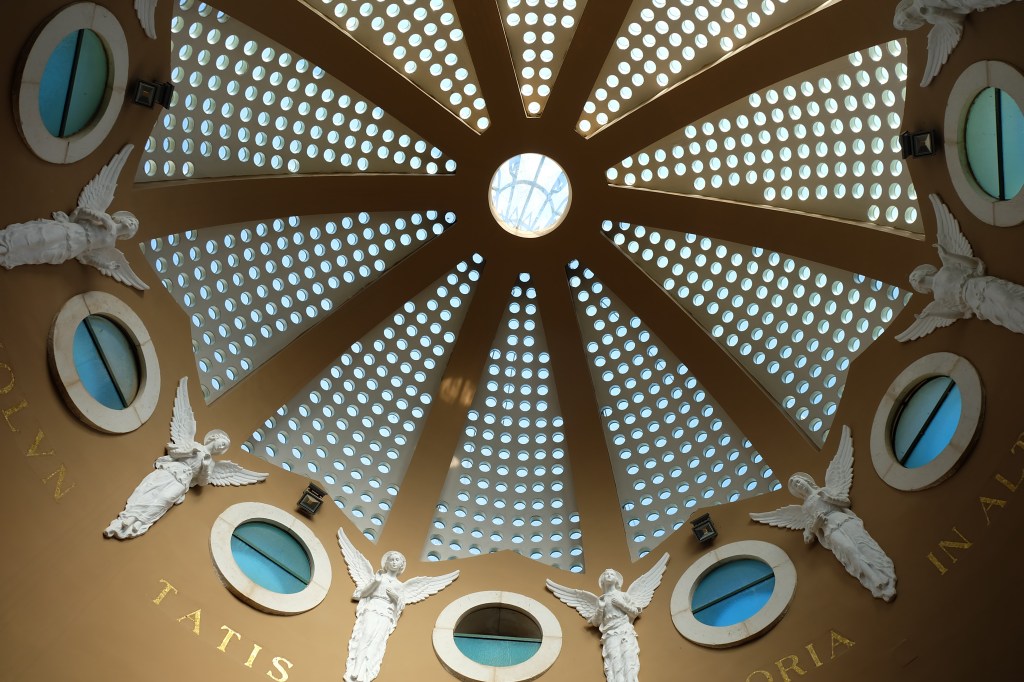
Dome and side altar of the Malolos Cathedral photo by author, 2019.
Glory and praise to you, our mighty God and Father! Truly there is no other Lord and Master of all but you alone from whom all good things come, even greater things than we can ever expect!
When they had crossed over, Elijah said to Elisha, “Ask for whatever I may do for you, before I am taken from you.” Elisha answered, “May I receive a double portion of your spirit.” “You have asked something that is not easy,” Elijah replied. “Still, if you see me taken up from you, your wish will be granted; otherwise not.”
2 Kings 2:9-10
How blessed was Elisha to dream big, asking for a double portion of the spirit you have granted his mentor Elijah!
Most often, we just have to trust you, we just have to believe in you as source of everything so we may be bold and daring enough to ask for greater things.
Help us believe in you, Lord.
Most of all, let us love you totally and unconditionally for you know everything what is deep in our hearts as Jesus your Son taught us in the gospel today. Amen.
Shore of Galilee at the back of ancient Capernaum where Jesus lived and preached. Photo by author, May 2019.
The Lord Is My Chef Breakfast Recipe for the Soul by Fr. Nicanor F. Lalog II
Tuesday, Week XI, Year II in Ordinary Time, 16 June 2020
1 Kings 21:17-29 <*(((>< <*(((>< ><)))*> ><)))*> Matthew 5:43-48
Photo from Google.
O God our heavenly Father, we come to you today begging for your mercy, for more enlightenment, for prudence and for self-control amid all the things going on in our land and elsewhere abroad while still under threats with this COVID-19 pandemic.
Every day we are beginning to see how ugly sin can be, often expressed in so many forms of injustice to one another; its ugliness can be seen in the “punishments” King Ahab shall suffer following the death of Naboth whose vineyard he had so desired to own.
Ahab said to Elijah, “Have you found me out, my enemy?” “Yes,” he answered. “Because you have given yourself up to doing evil in the Lord’s sight, I am bringing evil upon you: I will destroy you and will cut off every male in Ahab’s line, whether slave or freeman, in Israel. When one of Ahab’s line dies in the city, dogs will devour him; when one of them dies in the field, the birds of the sky will devour him.”
1 Kings 21:20-21, 24
Help us to turn away from sins, Lord, and cleanse our hearts and our hands of our many sins of dishonesty and insincerity, of lies and injustices, of pride and power tripping.
All these things happening to us today are largely due to our past sins that until now we refuse to admit and confess to you.
Give us the grace of honesty within, of confronting our true selves and admit our guilt, confess our sins to you to start anew like King Ahab towards the end that moved you, merciful God, to let go of your wrath in him.
May we find the wisdom and the immense beauty and power of your love as preached by Jesus to us in the gospel today.
Inspire us to be perfect, to be holy today just like you, our Father, is holy, perfect, and beautiful.
Holiness is not being sinless, Lord; fill us with your Self, O God so we may be strong enough to ward off sins and evil and be truly a reflection of your image and likeness in Christ Jesus. Amen.
The Lord Is My Chef Sunday Music by Fr. Nick F. Lalog II, 14 June 2020
Photo by author, sculpture of Jesus Christ as a homeless man sleeping on a bench at the entrance to the ancient town of Capernaum in Galilee where he grew up. May 2019.
Nice to be back, my dear readers and followers!
We have been unable to post our Sunday music since March due to demands of the ministry during this quarantine period of COVID-19 pandemic. Hoping you are all doing well, getting by each day with music.
Our featured music this Sunday should have been last week when we celebrated the Solemnity of the Holy Trinity as it talks about “l-o-v-e”, the love of God expressed in their community of Persons as the Father, the Son and the Holy Spirit.
But, any talk about love always presupposes “presence” because any one who truly loves is always present to the one he/she loves.
That is why we find Same in Any Language from the motion picture “Elizabethtown” (2005) still appropriate this Sunday of the Solemnity of the Most Holy Body and Blood of Jesus Christ which is an invitation to us all to be present with everyone like God who is always present among us especially in our life’s dark moments.
Written and directed by Cameron Crowe, “Elizabethtown” is a romance-comedy starring Orlando Bloom and Kirsten Dunst. Though it did not measure up to Crowe’s “Almost Famous” released in year 2000, “Elizabethtown” is still a good film despite the negative reviews by most critics.
It is a story about love found in the most strange yet ordinary situation when Orlando was at his lowest point in life after losing his job as a shoe designer that turned out to be a big market flop. As he contemplated suicide, his father died and had to fly to Elizabethtown for the cremation.
It was on that flight he met and befriended the stewardess Kristen whose presence – and love – helped him overcome his darkness in life.
And that is what the song tells us, that love is the same in any language.
Anywhere there is somebody willing to listen or lend a hand, be present to anyone in need, that is love.
Sometime ago I met a Navajo
In a parking lot in Tokyo
He said everything wordlessly
Wonderlust in my eyes, he did see
Oh yea
Oh oh yea
Those postcards I sent to Birmingham
All the way from those windows of Amsterdam
I copped a gram from Dappersan
Just to fall at her man in another jam
Oh yea
Oh oh yea
Its the same in any language
A brother is a brother if there's one thing I know
Its the same in any language
Wherever you go
Oooo yea
It is the same in every language when Jesus said, “I am the living bread that came down from heaven” (John 6:51) because he gives himself as food and drink to nourish us in this life full of pains and sufferings. Jesus came and gave himself to us because of love, to give life to us. And that is what he is also asking of us, especially in this time of corona virus pandemic to share his love with others.
It’s the same in any language, even when put into music….
The Lord Is My Chef Breakfast Recipe for the Soul by Fr. Nicanor F. Lalog II
First Friday, Week IX, Year II in Ordinary Time, 05 June 2020
2 Timothy 3:10-17 ><)))*> 000 + 000 <*(((>< Mark 12:35-37
Photo by author, Sleeping Sto. Niño, January 2020.
I wonder, dear Jesus, what delighted the people of your time when they heard you teach at the temple area, telling them:
“How do the scribes claim that the Christ is the son of David? David himself, inspired by the Holy Spirit, said: The Lord said to my lord, ‘Sit at my right hand until I place your enemies under your feet.’ David himself calls him ‘lord;’ so how is he his son?”
Mark 12:35-37
What delights me these past few days still in quarantine, still by myself, still uncertain when our churches would be opened?
As I prayed, O Lord, I realized YOU are the only one who delights me in these past days and weeks, even months since the pandemic and this quarantine.
Jesus, meek and humble of heart, make my heart like thine!
Despite the loneliness, the fears of getting sick, the insecurities of where to get so many things, the lack of concern and care from some people I care for, when I think of you, when I feel you inside my heart, that is when I am delighted like those people you taught at the temple.
I am delighted, Lord, because no matter what happens to me, you are always here with me, loving me, caring for me, forgiving me, accepting me most especially when persecution comes as St. Paul warned us in the first reading.
How is the Lord called by David as lord is his son?
That’s the wonder of you, sweet Jesus! You have allowed yourself to be small, to be weak, to be human like us so you can be in us and be with us.
Dwell in my heart, sweet Jesus, now and forever. Amen.
The Lord Is My Chef Breakfast Recipe for the Soul by Fr. Nicanor F. Lalog II
Thursday, Week XIX in Ordinary Time, Year II, 04 June 2020
2 Timothy 2:8-15 ><)))*> ><)))*> ><)))*> Mark 12:28-34
Photo by Mr. Raffy Tima of GMA-7 News, 02 June 2020
Remind people of these things and charge them before God to stop disputing about words. This serves no useful purpose since it harms those who listen.
2 Timothy 2:14
Dear God:
For today I just wanted to be silent before you in prayer.
But, you spoke a lot in that silence. Or, did I?
You know very well, Lord, how we have been silent since the start of this quarantine period due to COVID-19 pandemic. We bore everything in silence as much as possible, giving our government officials and lawmakers a chance to redeem themselves.
After all, we are in this mess because of their refusal to listen what others have been saying for the safety of the country, speaking of diplomacy and friendships among the originators of COVID-19, not knowing two of them have been infected with corona while here visiting. One eventually became the first fatality of COVID-19 outside China.
Photo by author, our altar decor with a snake on first week of Lent, 2020.
Those in government have always been doing all the talking that has always been non-sense and rubbish. They thought that the more words they used, the more things get clearer.
That is the problem, Lord: those in government like many of us your people are not aware that your silence always precedes your speaking; that your words are full of power, full of life, the fullness of meaning because every word comes from silence.
We humans, especially our elected officials, are all speaking out of noise and void, not from silence which is fullness.
We keep on talking in the hope and belief that the more we talk, the more our words become meaningful.
Lately, it is the opposite that is happening: the more our government officials speak, the more their words become empty while their tongues get sharper like swords, inflicting more pain and causing more shame.
They speak of lies after lies after lies hoping they become true if repeatedly said but the more they are lost.
They speak so tough, complete with warning against violators of quarantine rules but they are the ones who fall into their own pit, becoming like dogs eating what they have spit.
They speak of opening shops and offices, but they are closed to the plight of the commuters.
Worst and most unkind of all, they speak shamelessly of blaming the people for all their woes in this time of pandemic quarantine while they were busy silencing us the people, closing ABS-CBN and just this week, surreptitiously passing the anti-terror bill that silences all critics of this administration mired in profanities, lies, and insincerity.
They make so many laws, using so many words, and yet not a single word proved to be good like the scribe who asked Jesus:
“Which is the first of all the commandments?”
Mark 12:28
Photo by Mr. Raffy Tima of GMA-7 News, commuters at start of lockdown, March 2020.
Lord God of power and might, you are the only we have always count on for our protection and salvation.
You know what is in our hearts and you know very well what we are willing to do if you just say so.
For the sake of peace in our country, let our leaders eat their words or at least, keep their mouths shut to stop all their shows and start to listen, accept and love.
The Lord Is My Chef Breakfast Recipe for the Soul by Fr. Nicanor F. Lalog II
Wednesday, Memorial of St. Charles Lwanga and Companion Martyrs, 03 June 2020
2 Timothy 1:1-3, 6-12 ><)))*> + <*(((>< Mark 12:18-27
Photo by Mr. Raffy Tima of GMA-7 News, April 2020.
We thank you, most loving God our Father, for the grace of perseverance and patience in this time of the pandemic. We thank you for the gift of trusting in your love and mercy despite all the sufferings and hardships our people have been going through amid the callousness and insensitivity of our leaders in government who have allowed to open offices, factories, and malls without providing adequate transportation while keeping all houses of worship closed.
May they heed, O Lord, the reminders of St. Paul to Timothy:
“I remind you to stir into flame the gift of God that you have through the imposition of my hands. For God did not give us a spirit of cowardice but rather of power and love and self-control.”
2 Timothy 1:6-7
We pray for more courage for our leaders in government so they may not cower in fear to the threats of COVID-19 when there are so many measures to control its spread which they should have taken long time ago but have failed to do so for reasons only they know.
Give them courage to stand up to their superiors, to admit their faults and failures instead of being so concerned in building their image as strong and capable that deceive no one.
Remind us all, O Lord, that we own nothing in this life. Everything is yours even the power and authority we have that must be tempered with genuine love and concern for the people and most especially with self-control.
How sad, O Lord, that until now, there are people who insist on possessing persons like the Sadducees who cannot accept resurrection of the dead because they are stuck into the belief couples “own” each other:
“At the resurrection when they arise whose wife will she be? For all seven had been married to her.”
Matthew 12:23
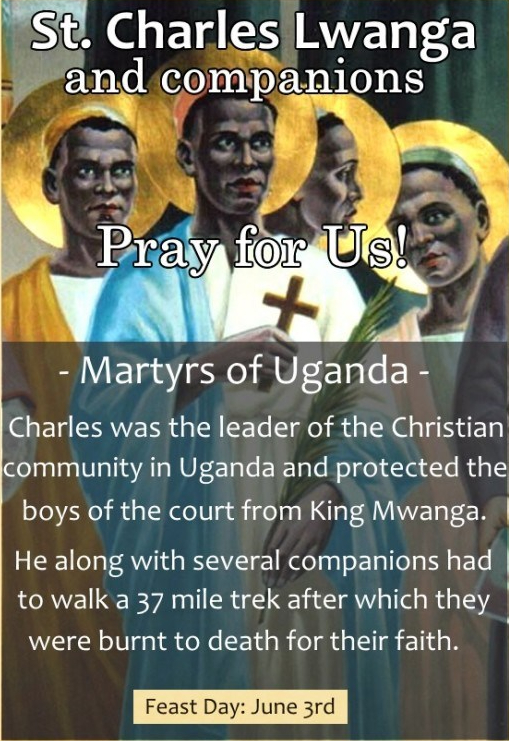
From ShareCatholic.com
One of those who thought of owning people was the pedophile King Mwanga of Uganda who persecuted the Christians in 1885-1887.
Inspire us, Lord, with the examples of St. Charles Lwanga and companion martyrs who remained pure and chaste, choosing tortures and death than to give in to the sexual perversions and immoralities of King Mwanga.
Their martyrdom became the seeds for the growth of Christianity in Uganda.
Help us to lead holy lives, Lord, amid the many sufferings we have to endure especially at this time of pandemic worsened by those who do not seem to care at all about you and spirituality, of the elderly and the sick, of the poor and needy among us.
Keep us all strong and let us not be perverted by the corrupt among us, always bearing our share of hardship for the Gospel with the strength that comes from you, O God. Amen.
The Lord Is My Chef Breakfast Recipe for the Soul, Memorial of St. Philip Neri, 26 May 2020
Acts of the Apostles 20:17-27 <*(((>< >+< ><)))*> John 17:1-11
Dome of the Malolos Cathedral. Photo by author, December 2019.
The beautiful readings of this week after the Ascension of the Lord complement the crucial week ahead for us all in this time of the corona virus.
Your words, O Lord, continue to amaze us with its many meanings to guide and soothe and assure us of your loving presence.
Jesus raised his eyes to heaven and said, “Father, the hour has come. Give glory to your son, so that your son may glorify you, just as you gave him authority over all people, so that your son may give eternal life to all you gave him.”
John 17:1-2
After praying for us your disciples, now you tell us of your “hour” when you shall fulfill your mission which is to suffer and die on the Cross for our salvation. It is your hour of glory, Lord Jesus, because it is the outpouring of your and the Father’s immeasurable love for us all.
Yesterday you have taught us that before everything else in our lives, there has always been your love.
Today, you assure us especially in this time of the corona virus that before all these sufferings and pains we endure, you were there first to suffer and die for us still because of your love for us.
Teach us to be like St. Paul to be firm and persevering in our mission to love against all odds, to never “shrink” in our love and patience to our detractors and those who mean to discredit us.
Like St. Paul, may we never “shrink“before all those who malign your holy name, those who find material things more essential than you our Lord and our God.
Let us never shrink in our love and understanding, patience and wisdom.
Likewise, fill our hearts with your joy and humor like St. Philip Neri who attracted many followers and believers to you with his infectious cheerfulness.
Despite our many limitations and sinfulness, may your Holy Spirit, dear Lord Jesus Christ help us to continue loving you among one another especially to those with special needs in this time of crisis.
And Lord, despite the continued abuse of those in power and authority in pushing and shoving us, shouting and cursing us for everyone to hear and see on national TV, let us never shrink in choosing to be peaceful and understanding. Amen.