The Lord Is My Chef Breakfast Recipe for the Soul by Fr. Nicanor F. Lalog II
Memorial of St. Joseph the Worker, 01 May 2021
Genesis 1:26-2:3   <*(((>< + ><)))*>   Matthew 13:54-58
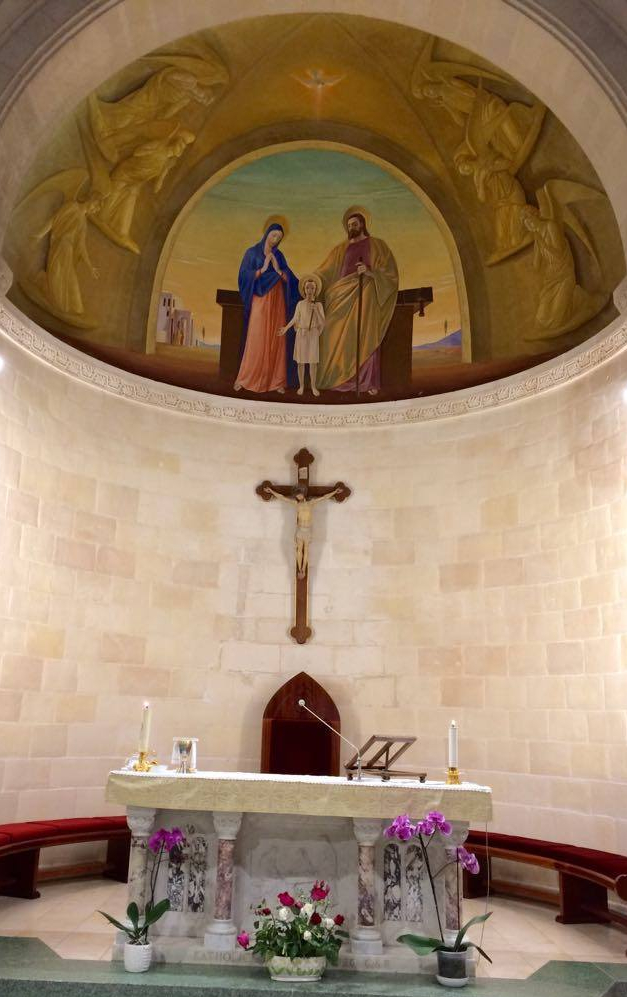
Photo by author, site of St. Joseph’s workshop in Nazareth beneath the chapel in his honor, May 2017.
God our loving Father, we praise and thank you for the gift of St. Joseph whom you have called to be the husband of Mary and the foster father of your Son Jesus Christ here on earth. In him, you have shown us the value of sharing in your work to nurture earth and its resources.
Most of all, in St. Joseph you have taught us to work centered on our Lord Jesus Christ by integrating work with family and with fatherhood to become truly a provider not only of food, clothing and other material needs but most of all in providing love and guidance to the family.
In St. Joseph, the motivation and the purpose of work is solely to serve Jesus Christ which is very evident in the gospel today.
Jesus came to his native place
and taught the people in their synagogue.
They were astonished and said,
"Where did this man get such wisdom and mighty deeds?
Is he not the carpenter's son?"
(Matthew 13:54-55)
How beautiful that in the “wisdom and mighty deeds” displayed by Jesus, the people remembered St. Joseph the carpenter – what a marvelous job he must have done in forming and providing for our Lord!
He must have worked diligently for you, dear God, never focusing attention to himself so unlike these days when we have categories of workers like those doing “white collar jobs” and “blue collar jobs”.
Dearest God our Father, in this time of the COVID-19 pandemic when so many people have lost work and are now suffering the adverse effects of quarantine, we pray in the most special way for our workers to please protect them from all harm and sickness especially those working in the hospital.
We pray for those trying to find work these days so they may continue to provide for their families.
Photo by author, Chapel of St. Joseph, Nazareth, Israel, May 2017.
Open our hearts on this year of St. Joseph as proclaimed by Pope Francis last December 8 on the occasion of the 150th anniversary of his proclamation as patron of the universal church:
The crisis of our time, which is economic, social, cultural and spiritual, can serve as a summons for all of us to rediscover the value, the importance and necessity of work for bringing about a new “normal” from which no one is excluded. Saint Joseph’s work reminds us that God himself, in becoming man, did not disdain work. The loss of employment that affects so many of our brothers and sisters, and has increased as a result of the Covid-19 pandemic, should serve as a summons to review our priorities. Let us implore Saint Joseph the Worker to help us find ways to express our firm conviction that no young person, no person at all, no family should be without work!
The Lord Is My Chef Breakfast Recipe for the Soul by Fr. Nicanor F. Lalog II
Friday in the Fourth Week of Easter, 30 April 2021 (St. Pius V, memorial)
Acts 13:26-33   ><)))'> + ><)))'> + ><)))'>   John 14:1-6
Photo by Ezra Acayan/Getty Images, Baclaran Church, 09 February 2020.
Jesus said to his disciples:
"Do not let your hearts be troubled.
You have faith in God; have faith also in me."
(John 14:1)
O dearest Lord Jesus Christ, how can we not let our hearts be troubled these days?
How can we not be troubled and worried with this prolonged pandemic and resulting quarantine made worst with our government’s inefficiency and incompetence, thriving in lies and malice against everybody who is not on their side and political color?
How can we not be troubled, Lord, when more and more people are sinking into depression, languishing, losing hope and meaning in this life?
Like your apostles at that time, we are trembling in fear as to what will happen to us, to our jobs, to the schooling of children, to our sick family members, to our very selves as well as to our country and its future.
We know that now is the time to be ever closer to you, Lord Jesus – to be one with you, to be one in you but, like Thomas, we do not know the way.
Help us in our unbelief and increase our faith, Lord!
Most of all, let us imitate Thomas your Apostle who dared ask you the simplest question we are afraid to ask because we also fear your answer might demand courage from us to totally identify ourselves to your values and attitudes being the Way, the Truth and the Life yourself.
Our hearts will always be troubled unless we have that deep relationship in you and with you, Jesus.
Like Paul in the first reading, give us that sense of firmness and certitude in your very person so that we may firmly and joyfully proclaim your Good News of salvation in these most troubling times of pandemic and divisions among us your people. Amen.
The Lord Is My Chef Breakfast Recipe for the Soul by Fr. Nicanor F. Lalog II
Thursday in the Third Week of Easter, 22 April 2021
Acts 8:26-40   ><)))'> + ><)))'> + ><)))'>   John 6:44-51
From Facebook, 04 April 2021: “There is an urgency to announce the Joy, the joy of the Risen Lord.”
Now there was an Ethiopian eunuch,
a court official of the Candace, that is, the queen of Ethiopians,
in charge of her entire treasury, who had come to Jerusalem to worship,
and was returning home.  Seated in his chariot,
he was reading the prophet Isaiah.
Philip ran up and heard him reading Isaiah the prophet and said,
"Do you understand what you are reading?"
He replied, "How can I, unless someone instructs me?"
So he invited Philip to get in and sit with him.
(Acts 8:27-28, 30-31)
Today, O Lord, I pray for teachers. For true and good, honest teachers who are also witnesses of your gospel. Give us more teachers like your deacon Philip who can teach to clear and clarify in the minds of the people the essential truth of this life which is about you, Jesus Christ, the Son of God.
And we pray for good teachers, for witnesses of your gospel, so unlike of the other teachers today especially our officials in government and the military who continuously peddle lies, maligning people without any qualms at all.
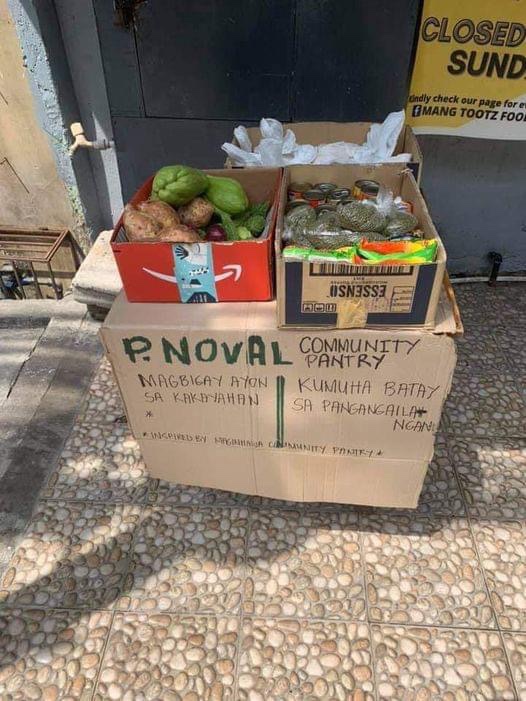
Send us teachers who will reawaken in us your presence among one another like Ms. Ana Patricia Non and all the others who have followed her witnessing in setting up community pantries that not only help those in need but also teach others to share.
In their witnessing as good teachers, they have brought out the innate goodness of so many people, rich and poor alike, men and women, young and old all over the country.
In their witnessing as good teachers, they have drawn so many people closer to you, dear Jesus Christ, our good Teacher!
At the same time, we pray for our professional teachers who continue to labor with love and dedication in forming young minds and hearts not only with modern knowledge but with wisdom based on fear of the Lord as they themselves struggle amid the many challenges of this COVID-19 pandemic.
Keep their minds and their hearts open in the promptings of the Holy Spirit so they may go wherever they are needed most for your greater glory. Amen.
Ms. Ana Patricia Non, the angel behind the community pantry movement now sweeping across the nation, giving us a fresh breath of hope after a year in the pandemic.
Modern man listens more willingly to witnesses than to teachers, and if he does listen to teachers, it is because they are witnesses.
The Lord Is My Chef Sunday Recipe for the Soul by Fr. Nicanor F. Lalog II
Third Sunday in Easter, 18 April 2021
Acts 3:13-15, 17-19  ><)))*>  1 John 2:1-5  ><)))*>  Luke 24:35-48
After listening to the accounts of the beloved disciple John, we now reflect on Luke’s story of the Resurrection which is a continuation of the gospel proclaimed in the afternoon of Easter, the Road to Emmaus.
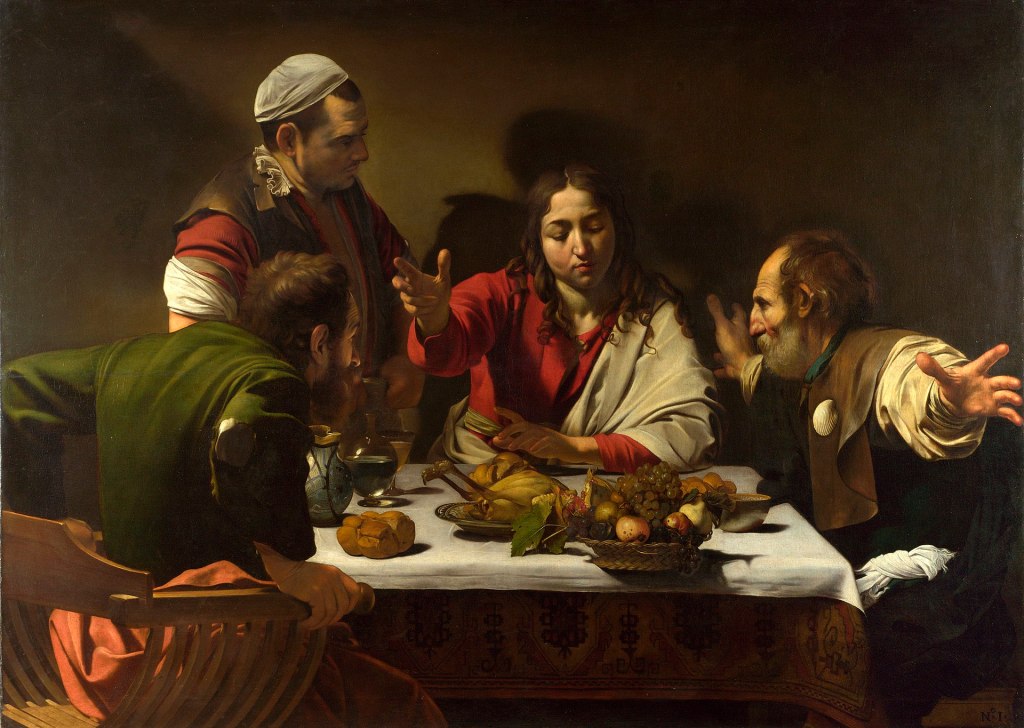
Recall how the two disciples did not recognize the Risen Lord when he joined them on their way back to Emmaus saddened with his death, doubtful of his resurrection. Upon reaching home, they invited the Lord for a meal when after breaking the bread, they recognized it was Jesus who had then vanished from their sights!
Both hurried back to Jerusalem to tell the rest of the disciples of their encounter with the Risen Lord.
While they were still speaking about this, he stood in their midst and said to them, “Peace be with you.” But they were startled and terrified and thought they were seeing a ghost. Then he said to them, “Why are you troubled? And why do questions arise in your hearts? Look at my hands and my feet, that it is I myself. Touch me and see, because a ghost does not have flesh and bones as you can see I have.” And as he said this, he showed them his hands and his feet. While they were still incredulous for joy and were amazed, he asked them, “Have you anything here to eat?” They gave him a piece of baked fish; he took it and ate it in front of them.
Luke 24:36-43
Painting by Caravaggio of the Emmaus Meal from commons.wikimedia.org.
Many times in life
 we feel it more "fearful" in the positive sense
to believe in God than in ghosts
because God is very real
when ghosts are not true at all.
Jesus appearing, speaking, and sharing meal
Both evangelists John and Luke consistently tell us in their Easter stories the three manifestations of the Risen Lord to the disciples: appearing, speaking, and sharing meal. All three acts belong together as one to remind the disciples of what transpired during their Last Supper, fulfilled on Good Friday.
But, there is something deeper in the dynamics of these three acts when seen from the perspective of Luke. And we have to look back to the beginning of this story on the road to Emmaus where we find Luke using a pattern of presenting an outward sign of Jesus appearing, speaking and sharing meal with the disciples who were then led to an inner recognition of the Risen Lord.
Notice that outwardly while walking, the disciples did not recognize Jesus as the man walking with them, speaking to them about the scriptures. Inwardly, something was happening with them: Then they said to each other, “Were not our hears burning within us while he spoke to us on the way and opened the scriptures to us?” (Luke 24:32)
This pattern of outward signs and inner recognition becomes strongest when Jesus shared meals with the disciples: And it happened that, while he was with them at table, he took bread, said the blessing, broke it, and gave it to them. With that their eyes were opened and they recognized him, but he vanished from their sight (Luke 24:30-31).
Exactly the same thing happened in this manifestation we now have in Jerusalem: the outward signs of the Risen Lord appearing to the disciples, showing them his hands and his feet. The disciples were amazed, could not speak at all upon seeing Jesus Christ alive, speaking to them, reminding them of his teachings before and most especially, shared meal with them by eating a baked fish to prove he is not a ghost.
Then, he spoke again to remind them of his earlier teachings of the scriptures being fulfilled in him through his Passion, Death and Resurrection, leading to the inner recognition by the disciples: Then he opened their minds to understand the Scriptures (Luke 24:45).
Painting by Frenchman James Tissot “Appearance of Christ at Cenacle Room” from commons.wikimedia.org.
Many times in life we feel it more fearful in the positive sense to believe in God than in ghosts because God is very real when ghosts are not true at all. “Mas nakakatakot maniwala sa Diyos kesa multo kasi ang Diyos ay totoong-totoo habang ang mga multo ay hindi.”
Amid the many outward signs we see unfolding right before our eyes, we could not help but believe as we are overwhelmed with God’s presence, with his love and mercy for us in the most personal way. The German Lutheran theologian Rudolf Otto called it as “mysterium tremendum” and “mysterium fascinans” when we feel so small like a tiny speck of dust in this vast universe yet so special, so loved by the almighty God.
There is that realization of our sinfulness, of our shortcomings before the Lord and yet still loved and forgiven like what Peter taught the people in his teaching after Pentecost at Jerusalem. Four times in four verses Peter spoke to the people with the second person pronoun YOU to stress their complicity in the crucifixion of Jesus, “you handed over and denied (v.13); you denied the Holy (v.14); you put to death (v.15)”; and finally, the saving declaration:
“Now I know, brothers, that you acted out of ignorance, just as your leaders did; but God has thus brought to fulfillment what he head announced beforehand through the mouth of all the prophets, that his Christ would suffer.”
Acts 3:17-18
Whenever we commit sins. when we refuse to love others, we become that “YOU” of Peter who hand over and deny Jesus, putting him to death whenever we reduce persons into things or take God’s blessings like food for granted.
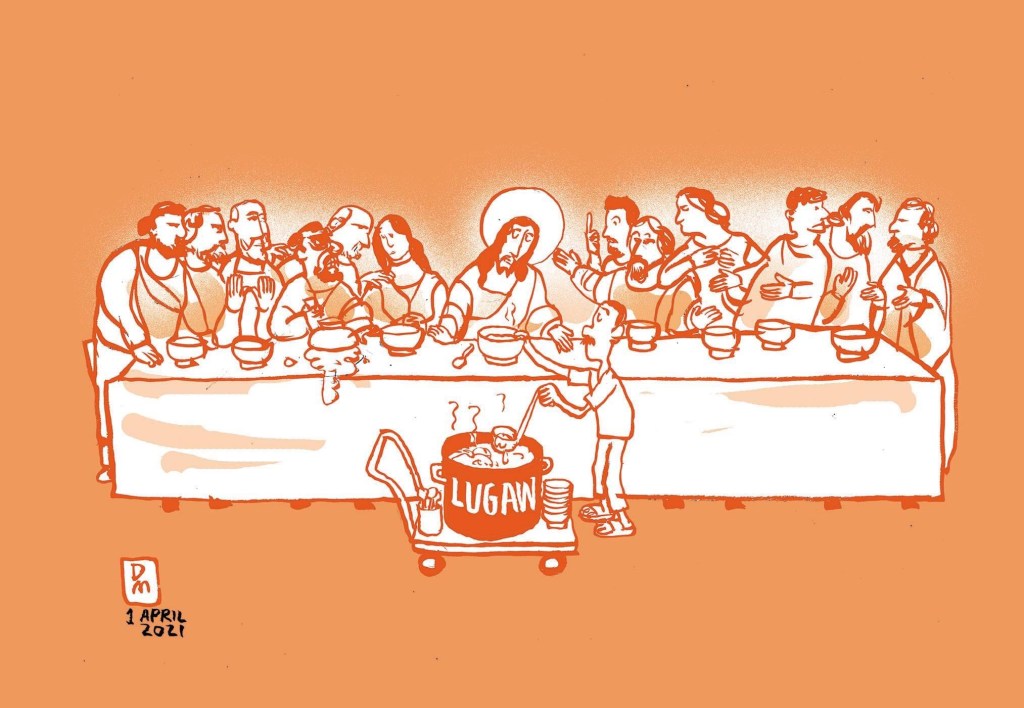
From the Facebook page of artist Mr. Dengcoy Miel, 01 April 2021.
The “essential” table fellowship
Aside from proving to his disciples that he is risen, Jesus Christ’s appearance, speaking, and sharing of meals with them continues to our time in the Holy Eucharist where he brings us to a new covenant in the table fellowship with him and the Father in heaven.
In the Holy Eucharist, Jesus gives us a share in his very life, allowing us to participate in his Resurrection through the purifying power of his Passion and Death.
From the days of the Apostles up to our own time, the celebration of the Mass had gone through many changes and reforms but its very essence has always remained as the Real Presence of Jesus Christ among us in outward signs perceptible to our senses like the proclamation of the Word, the sharing in the Lord’s Body and Blood, and the communion of members of the community gathered in every celebration.
Like the disciples of the Lord during that Easter evening, we continue to experience an inner awakening within us of his presence, of his very self.
That is why Vatican II as well as St. John Paul II had always insisted that the Eucharist is the summit of our Christian life, that everything in our lives and in our parish especially must flow from the Eucharist. This is the reason that even with the COVID-19 lockdowns, Masses continue to be celebrated by priests even in private without the congregation because it is our source of nourishment especially in these times of crisis.
These community pantries now sprouting
are in itself extensions of table fellowship with Jesus as the unseen guest -
appearing, speaking, sharing meals with us -
literally giving us food for the stomach, delighting our souls.

  It is another Easter and Pentecost happening in our midst,
of Jesus coming to us,
truly alive in the Holy Spirit among people
gathered in loving service for one another,
a perfection of the love of God in us!
Photo from Elijah San Fernando, Philippine Daily Inquirer, 16 April 2021.
See the recent “miracles” happening lately about this “community pantry” that started in Maguinhawa Street in Quezon City now fast spreading to other areas in Metro Manila with some farmers from the provinces giving their share of farm produce.
What a beautiful proof of the fulfillment of John’s words in our second reading today: “But whoever keeps his word, the love of God is perfected in him” (1Jn.2:1-5)!
These community pantries now sprouting are in itself extensions of table fellowship with Jesus the unseen guest – appearing, speaking, sharing meals with us – literally giving us food for the stomach, delighting our souls.
It is another Easter and Pentecost happening in our midst, of Jesus coming to us, truly alive in the Holy Spirit among people gathered in loving service for one another, a perfection of the love of God in us!
Photo by Toots Vergara, Philippine Daily Inquirer, 16 April 2021.
This Sunday, let us experience Jesus our guest right in our family, in our homes as we gather in our table without our gadgets and prejudices against each other, having only our very presence and fellowship in love and mercy, kindness and care as we feed our bodies as well as our souls. Amen.
*Please say a prayer for me and my six other classmates today as we celebrate our 23rd year of ordination to the priesthood (18 April 1998, Malolos Cathedral by Abp. Rolando J. Tria-Tirona). Salamuch and God bless you all! fr nick
The Lord Is My Chef Breakfast Recipe for the Soul by Fr. Nicanor F. Lalog II
Tuesday in the Second Week of Easter, 13 April 2021
Acts 4:32-37   ><)))*>  +  <*(((><   John 3:7-15
Photo by Cristian Pasion, Easter Vigil at the National Shrine of Our Lady of Fatima, 03 April 2021.
Jesus said to Nicodemus,
"If I tell you about earthly things
and you do not believe,
how will you believe
if I tell you about heavenly things?"
(John 3:12)
Lord Jesus, thank you for coming to us, in becoming human like us so that we may become divine like you. Unfortunately, so many times in life, we refuse to believe in your humanity, in your being human like us that we cannot understand earthly things.
Like Nicodemus in the gospel who had come to you hiding in the darkness of the night to enlighten his own spiritual darkness within, we come to you at this time of our history when everything seems to be crumbling, everything is getting out of control.
Teach us to believe in you again, Jesus, that you are the Son of God. Level up our sights and thoughts, let us be more concerned with things of the above than those of below that unfortunately distract us from real issues at hand when we get ourselves involved with mundane inanities like many of our benighted officials in government still detached with the people and with the realities happening.
How can we be of “one mind and one heart” with you, Lord, in this time of crisis? Sometimes it is so tempting to get down to the level of our officials who have always been caught lying, so detached from the people, lacking any clear plans for the pandemic since last year.
Send us someone like St. Barnabas who would encourage us to do something concrete in helping the suffering among us in this time of the pandemic.
Level up our sights and consciousness so we may think more of the things above than waste time and energies with petty discussions that lead nowhere.
It is only in being focused on you, dear Jesus, on your very person and your mission, can we truly address our many earthly needs that are always self-serving and selfish.
Direct all our actions, operations and intentions purely to the divine service of your name, Lord, so that everything we do may begin and happily end in you. Amen.
40 Shades of Lent by Fr. Nicanor F. Lalog II
Solemnity of the Annunciation of the Lord, 25 March 2021
Isaiah 7:10-14, 8:10  +  Hebrews 10:4-10  +  Luke 1:26-38
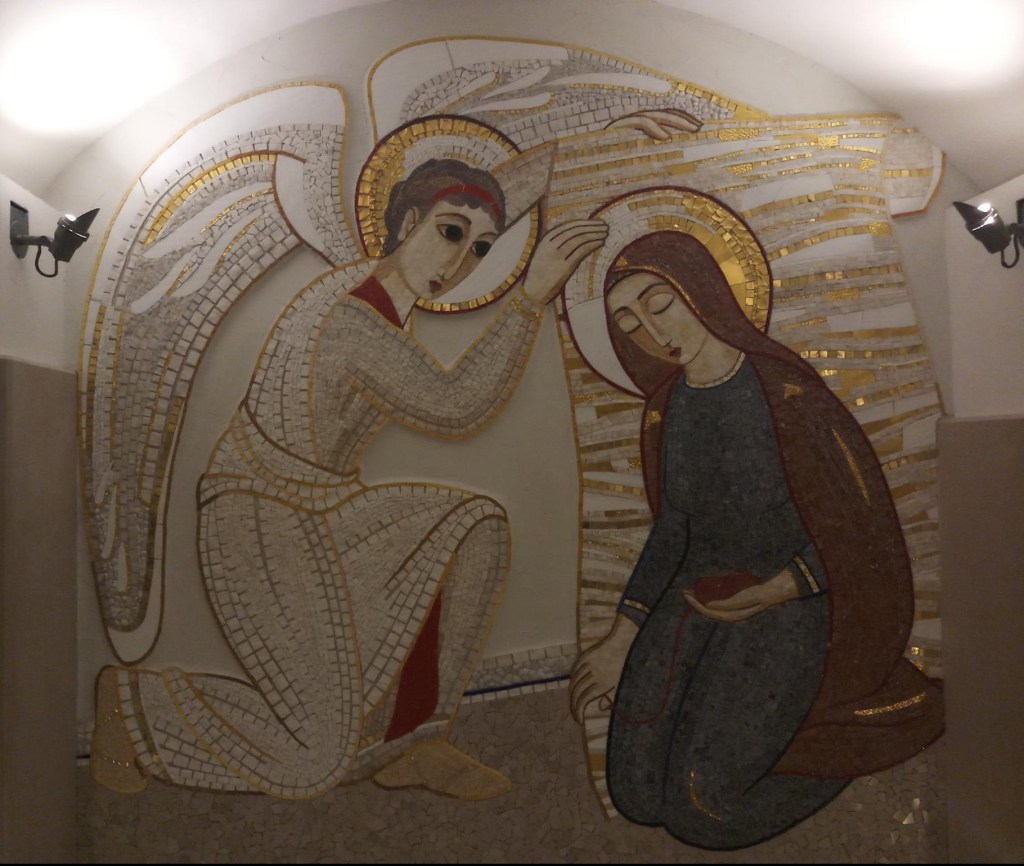
Photo by Arch. Philip Santiago of a mosaic of the Annunciation at the Shrine of St. Padre Pio at Rotondo, Italy, 2018.
Praise and glory to you, O God our Father on this Solemnity of the Annunciation of the birth of our Savior Jesus Christ! Thank you very much in fulfilling your promise, in sending us the perfect offering we can have to be one with you again.
Brothers and sisters: It is impossible that the blood of bulls and goats take away sins. For this reason, When Christ came into the world, he said, “Sacrifice and offering you did not desire, but a body you prepared for me; in holocausts and sin offerings you took no delight. Then I said, ‘As is written of me in the scroll, Behold, I come to do your will, O God.’” By this “will,” we have been consecrated through the offering of the body of Jesus Christ once for all.
Hebrews 10:4-7, 10
In his becoming human like us, your Son Jesus Christ taught us the value and beauty of obedience to you, O God, even unto death on the cross to restore our relationships with you and with one another destroyed by sin.
Teach us, O God, as we celebrate the Annunciation of the Lord, that more than the many things we expect in this life like our plans and dreams are the relationships and ties that bind us together as family and friends, as a nation and your people.
Give us the grace to offer our very selves, to let go of our many plans and agenda in life like the Blessed Virgin Mary as well as her most chaste husband St. Joseph to always say “yes” to your words, to your calls and invitations.
Mary said, “Behold, I am the handmaid of the Lord. May it be done to me according to your word.” Then the angel departed from her.
Luke 1:38
May we be like Mary giving flesh to your Word Jesus Christ, bringing his peace and mercy to this world so wounded by our many divisions and self-interests even in the midst of a pandemic. Amen.
Photo by author, site of the Annunciation, Basilica of the Annunciation at Nazareth, Israel, 2019.
40 Shades of Lent by Fr. Nicanor F. Lalog II
Solemnity of the Annunciation of the Lord, 25 March 2021
Isaiah 7:10-14, 8:10  +  Hebrews 10:4-10  +  Luke 1:26-38
Photo by author, Basilica of the Annunciation, Nazareth, Israel, 2017.
Last Monday I celebrated my 56th birthday in quarantine after having a close contact with a person with COVID-19. The health officers were both smiling in disbelief as they took my swab test that morning after finding out after my interview it was indeed my birthday.
Between that morning and its eve – in fact since Saturday when I went on quarantine – I felt like in another scene of the Annunciation as I awaited the “good news” with my whole world standing still in animated suspension.
Earlier that morning, I celebrated Mass in my room when I looked back to my birthday last year. It was a Sunday, the first week of the lockdown when public Masses were suspended. After celebrating the Mass alone in our Parish church, I borrowed a truck and mounted the Blessed Sacrament at the back and went around our parish that afternoon to bless the people who knelt on the road with some were crying.
This year, I felt the Lord wanted me to celebrate my birthday in quarantine to be alone with him again to realize the rich meaning of this Solemnity in relation with our lives, especially with me as his priest.
Photo by Ms. Ria de Vera, 2020.
Brothers and sisters: It is impossible that the blood of bulls and goats take away sins. For this reason, When Christ came into the world, he said, “Sacrifice and offering you did not desire, but a body you prepared for me; in holocausts and sin offerings you took no delight. Then I said, ‘As is written of me in the scroll, Behold, I come to do your will, O God.'” By this “will,” we have been consecrated through the offering of the body of Jesus Christ once for all.
Hebrews 10:4-7, 10
The mystery of Christ’s coming
Notice that in Mass today at the proclamation of the Creed, we are asked to genuflect at the words “conceived by the Holy Spirit, born of the Virgin Mary” to remind us that the Incarnation of the Son of God is the fundamental mystery of our faith which the Church has always proclaimed since the beginning.
This is the gist of our short but rich reflections by the author of the Letter to the Hebrews of how Jesus truly became human born by the Blessed Virgin Mary in the power of the Holy Spirit without losing any of his divinity in the process in order to save us and make us new again before God our Father.
In his reflection, the author of the Letter mentions how the Old Testament worship was more symbolic and a preparation to the perfect offering made by Jesus on the cross.
Photo by author, Basilica of the Annunciation, Nazareth, 2019.
In the Old Testament, priests offered animals for atonement of sins with the blood symbolizing life. They offered three animals: first for their sins so they may be cleaned before God in making the sacrifices for the people for whom the second animal stood for. The third animal was usually a goat to cover all the other sins of the world from which we got “scapegoat” as term for one who takes all the blame.
Jesus Christ came to perfect the temple worship in his very body when he told the Pharisees and scribes after cleansing the temple, “Destroy this temple and in a three days I will raise again” (Jn.2:19).
By dying on the cross, Jesus fulfilled his words to the Samaritan woman at Jacob’s well that someday, people would no longer worship in just one place because through his “hour” of glory – his crucifixion – people will be able to “truly worship the Father in Spirit and truth” (Jn.4:23).
On the cross, Jesus made himself the perfect sacrifice to God by atoning for our sins. The word atonement was coined by a Protestant translator of the bible to convey the idea of salvation as being one again with the Father, or “at-one-ment”.
Following the reflection by the author of the Letter to the Hebrews, we find that the very coming of Christ announced by the angel to Mary was in fact directed toward this paschal sacrifice of Jesus.
In the gospel today we have seen the angel telling Mary to name her child “Jesus” that means “God is my savior”. The angel was more explicit in the Annunciation to Joseph who was instructed, “you are to name him Jesus, because he will save his people from their sins” (Mt.1:21).
It was from this celebration of the Annunciation of Christ’s birth that we have the tradition of praying the Angelus every 6am, 12noon and 6pm to make our day holy, reminding us of this great mystery of the Incarnation of Jesus who became both “the gift and the giver” when he offered himself on the cross for us which we remember and make present in every celebration of the Mass.
Photo by author, chapel at the site of annunciation, Basilica of the Annunciation, Nazareth, 2019.
The life of obedience in Christ
From that beautiful story of the Annunciation of Lord we find how in the coming of Jesus Christ from the very start – from heaven to its coming on earth to Mary’s virginal conception at Nazareth – the mystery of his Incarnation has always been characterized by obedience.
In being obedient to the Father, Jesus consecrated us through him in offering his body once and for all that opened for us an avenue to a life of holiness through obedience to God. And the first to have this distinction is his Mother, the Blessed Virgin Mary.
Mary said, “Behold, I am the handmaid of the Lord. May it be done to me according to your word.” Then the angel departed from her.
Luke 1:38
Next to Mary is her husband, St. Joseph whose Solemnity we celebrated last week. His “yes” to following the angel’s instruction upon waking up from his dream echoed the Blessed Mother’s obedience to God’s plan and will for everyone through Jesus Christ.
Here we find Mary and Joseph, two righteous people who allowed themselves to be instruments in the fulfillment of the divine plan in Jesus Christ, relying more in the power of God, believing in his words spoken by the angel to them.
Photo by author, Basilica of the Annunciation, Nazareth, 2019.
On this Solemnity of the Annunciation of the Lord, we are challenged and invited to be open and obedient to God, to his words we hear proclaimed in the celebration of the Mass and in our personal prayers.
Jesus is the word who became flesh and dwelled among us, present among us because of the obedience and faith of Mary and Joseph.
It is always very tempting to be like King Ahaz in the first reading, when we rely more in ourselves, in our wisdom and intelligence, expertise and experience that we sometimes feel it no longer needed to bother God at all for directions especially with “earthly” things and concerns like the economy or defense of the country.
Or, pandemic.
This is the saddest part with COVID-19: a year after it started and wreaked havoc on this planet, we still continue to consider it as a medical and social issue, refusing to see its spiritual meaning.
This pandemic is an annunciation moment when God is telling us something very important for our salvation like with Mary over 2000 years ago.
God has been sending us messengers since the start of this crisis to welcome his Word, Jesus Christ so that he can work in us to bring us back to the Father and with one another through our loving service especially with the weak and most needy.
It is easy for God to send us solutions right away to end this pandemic. In fact, he had blessed us with at least six vaccines that took only a year to develop unlike the normal course of 3-5 years.
But vaccines will not entirely solve and end this pandemic. This we can see right in our country where spas and gyms and malls are seen as more essential than religious gatherings. Its worst part is how we have modern King Ahaz so confident with themselves in addressing the issues from the pandemic. Incidentally, the main sin and mistake by King Ahaz during the time of Isaiah was his aligning himself with the superpower Assyria that eventually conquered Israel – something so similar with our dealings and reliance with China, the origin of this virus and pandemic!
How sad at how this government pinned all its hopes last year in the discovery of vaccines without working hard in other aspects of mitigating the effects of the pandemic when now that there are vaccines available, it is still at a loss in making any progress in the vaccination program especially with those most vulnerable like the medical frontliners who are doing a life of offering like Jesus Christ.
Early this year, we had our major revamp in our parish assignments in almost nine years. It was an Annunciation event for us priests as it directed us to new challenges in the ministry to continue proclaiming the mystery of Incarnation.
I was assigned as chaplain of Our Lady of Fatima University (OLFU) and Fatima University and Medical Center (FUMC). At first, I was afraid like Mary in going to a new ministry at the forefront of facing the pandemic. But like Mary, I gave my fiat to God, joyfully coming to my assignment with so many plans and dreams.
And just when I was starting to heat up in my ministry, I was suddenly sent on a quarantine. That was when I realized the meaning of this Annunciation of the Lord to me: becoming like the Body of Christ to be offered too for many.
As I heard news of more people including friends and relatives getting COVID-19, I promised God in my prayers during my “quarantined” birthday that whatever may be the result of my swab test, I will still serve him with same enthusiasm in my previous assignments.
Like the Blessed Virgin Mary, may we say yes to God everyday, relying more than ever in our relationships with him and with others in Christ than in the hopes of things getting better; should things get worst like Jesus dying on the Cross, like Mary, may we hold only on God’s loving mercy and presence in this world marred by sin. And pandemic. Amen.
Photo by author, Basilica of the Annunciation, Nazareth, 2019.
*This is a prayer I have written in 22 February 2018, Year of Clergy and Consecrated Persons in our preparations for the 500th year of our Christianization in the Philippines happening next month. I find the prayer still relevant specially in the light of our recent reshuffle of assignments in the diocese.
This is my 22nd Lent as a priest, Lord; but, it is only now have I realized how lovely is this season with You offering us with the Feast of the Chair of St. Peter to deepen our priesthood following our recent new assignments.
Open us to pray and reflect St. Peter’s exhortation in the first reading to “tend the flock of God” by being examples.
Help us to take into our hearts the beautiful words by Pope Emeritus Benedict XVI that “the primacy of Peter symbolized by his chair atop the magnificent altar at the Vatican is the primacy of faith and the primacy of love” (Images of Hope, Ignatius Press, 2006).
Help us recall, too, the reminder of Pope Francis that “we priests have a mission, not an assignment… that we must smell like the sheep.”
Forgive us, dear Jesus in making priesthood another career as we talk more about programs and offices, positions and shamefully, about perks and money. We have forgotten priesthood is a mission when You called Simon as Peter, the rock on whom You established Your Church.
May we keep in mind without forgetting the value of education that St. Peter started Your Church without any degrees in philosophy and theology, management and psychology except a deep, personal faith in You.
Teach us Your priests to nurture Your gift of faith, reminding us that no organizational or management efficiency could ever keep our unity as a Church if we are separated from You.
That is the meaning of this feast of the Chair of St. Peter: the primacy of Simon’s faith in You Lord Jesus for without You, we cannot do anything. Remind us that whenever You choose us for a mission, it is a call for more faith in You than in us or our skills and talents.
And so, I pray, Lord Jesus, for more love for us priests in You. Faith leads to love that leads us to You in heaven and to others here on earth. Help us bring back love to Your Church so people may experience You again among us and others as the Body of Christ, a community of believers. How often do we forget it is Your Church and not ours for us to lord it over them – even for shameful profit as St. Peter had warned us in the first reading!
Let us stop hurting Your Church, Jesus, in our lack of love and charity so people would see You again in us as servant-leaders. Fill us Your priests with more faith and more love to keep Your Church alive to finally stop all “hearsays” about who You really are like at Caesarea Philippi. Amen.
Photo by author of the detail of the Seventh Station at the Parish of St. Ildephonse in Tanay, Rizal; woodcarving was done in 1785 depicting the Chief Priest Caiaphas according to some accounts as the man in sunglasses during the time of Jesus. May we priests remove also our shades to see Jesus more among the people we serve.
The Lord Is My Chef Sunday Music by Fr. Nick F. Lalog II, 21 February 2021
Rainbow appearing during our procession of the Blessed Sacrament last year during the first Sunday of lockdown, 22 March 2020. Photo by Ms. Anne Ramos, Parokya ni San Juan Apostol at Ebanghelista, Bagbaguin, Sta. Maria, Bulacan.
Rainbows are one of nature’s loveliest occurrence that remind us of God’s all-encompassing love for us despite our sinfulness. It is the most enduring and visible sign of God’s promise to love and keep us always despite our being-of-forgetfulness — forgetting God and others, forgetting our promises to be good, forgetting our loved ones.
On this First Sunday of Lent, we find how in the first reading God gave Noah the rainbow as a sign of his covenant to never destroy earth again after the great flood. Only Noah and his family along with the animals inside his ark survived the great flood that cleansed the world of sinfulness. It became the prefiguration of Jesus Christ coming to cleanse us of our sins to be able to lead holy lives anew amid the many temptations in life as seen in today’s gospel.
Jesus in the desert resisting temptations by Satan depicts how life really is, full of contrasts and struggles but always there is Christ helping us, comforting us, strengthening us like a rainbow after every storm.
Eventually on Good Friday when Jesus offered us himself on the cross, he became our rainbow in fact as seen in the shape of his outstretched arms.
And that is why we have chosen South Border’s 2003 hit Rainbow first heard for the movie Crying Ladies.
The song perfectly captures our reflection for this Sunday that life is a Lent, filled with so many contrasts like sufferings and joys, failures and victories, darkness and light.
Fallin’ out, fallin’ in Nothing’s sure in this world no, no Breakin’ out, breakin’ in Never knowin’ what lies ahead We can really never tell it all no, no, no
Say goodbye, say hello To a lover or friend Sometimes we Never could understand Why some things begin then just end We can really never tell it all no, no, no But oh, can’t you see That no matter what happens Life goes on and on So Oh baby, please smile Coz I’m always around you And i’ll make you see how beautiful Life is for you and me
Take a little time baby See the butterflies color’s Listen to the birds that were sent To sing for me and you Can you feel me This is such a wonderful place to be Even if there is pain now Everything would be all right For as long as the world still turns There will be night and day Can you hear me There’s a rainbow always after the rain
The lyrics of this OPM are so Lent, in fact, that you can replace the “rainbow” with Jesus who is our Eternal Rainbow amid all the storms of life. Amen.
The Lord Is My Chef Sunday Recipe for the Soul
Sixth Week in Ordinary Time, Year B, 14 February 2021
Leviticus 13:1-2, 44-46  >><)))*>  1 Corinthians 10:31-11:1  >><)))*>  Mark 1:40-45
The word “touch” is a very touchy one…
It can either be literal or figurative but can mean both at the same time like when we experience that proverbial “pat on the shoulder” – we feel it literally speaking but deeply within we feel so touched that we feel so good, we feel affirmed.
We say “we are touched” by words, by gestures and sights, by acts of kindness and love, by persons, by music, by poems, by so many things that touch both our senses and innermost being.
Touch can be fleeting, sometimes so brief but its impact can last a lifetime. Experts say that 30 seconds of touch is equivalent to more than 300 words of encouragement. That is why in our liturgy and sacraments, we employ the sense of touch extensively in imitation of Jesus in his many healings and interactions with everyone during his time.
And even up to our time, Jesus continues to touch us with his words, with his Body and Blood in the Holy Mass and through our family and friends, even strangers he sends us so we may experience his love through his healing touch, his merciful touch, his tender, loving touch.
Today we hear a very touching story on this Valentine’s day of how Jesus touched a leper and touched his life forever!
A leper came to Jesus and kneeling down begged him and said, “If you wish, you can make me clean.” Moved with pity, he stretched out his hand, touched him, and said to him, “I do will it. Be made clean.” The leprosy left him immediately, and he was made clean.
Mark 1:40-42
Photo by author, Lake of Galilee, May 2019.
Leprosy: a terrible disease, an image of sin
After healing Simon’s mother-in-law and those who were sick last Sunday, Mark told us how before dawn the following day Jesus went to a deserted place to pray then left Capernaum with his four disciples to preach and heal throughout the whole of Galilee.
As they were walking, a leper came to meet Jesus and begged him to be healed. This scene is very unusual for lepers were not supposed to get near anybody during that time. They have to warn people of their presence so they can be avoided lest others get infected.
But more than the fear of contagion, the first reading tells us why people were not supposed to interact with lepers because leprosy was seen so terrible as an image of sin that anyone afflicted must see the priest first, short of saying a leper was also a sinner. See how Moses described the wounds that evoked memories of those festering boils and lesions that afflicted the Egyptians and their cattle before the Exodus. Such was the gravity and seriousness of this sickness that those afflicted were totally separated from the rest of the populace, literally and figuratively speaking.
In this scene, we find not only a glimpse of another typical day in the life of Jesus but most of all, we see his very person filled with love and compassion for the least in the society like the leper. Here again is the Lord going to unknown territories to find and heal – to touch – the poorest of the poor.
And that is precisely the good news Mark is telling us this Sunday: Jesus wills our well-being, wants to touch us to be cleansed and healed from all our infirmities whether physical or spiritual or emotional.
Like the crowds following Jesus at that time, we also have to follow the Lord in his preaching to be healed from our sickness and be cleansed from sins. Anyone who believes in his power to heal like that leper must rely in his kindness and mercy because Jesus had removed all barriers that prevent us from meeting him, touching him.
See how Mark described Jesus being “moved with pity” which is more than an emotion or feeling but a stirring within called “miserecordia” in Latin and Spanish that means to move (miseor) the heart (cor) or do something with what he had seen and felt.
Do not be afraid or shy to come to Jesus; he is very approachable, no need for appointments like us humans as he welcomes us all, very open to us all, so willing to meet and be with us in our joys and sorrows, victories and defeats, triumphs and miseries.
Then, warning him sternly, he dismissed him at once. He said to him, “See that you tell no one anything, but go, show yourself to the priest and offer for your cleansing what Moses prescribed; that will be proof for them.”
More than a healer, an exorcist, and a doer of miracles, Mark presents to us for the third consecutive Sunday the very person of Jesus Christ as our Savior. One thing we shall notice in Mark’s gospel is his extensive use of the so-called “Messianic secret” wherein he reports Jesus warning those he had healed and exorcised not to tell it to anyone, to keep it a secret lest people regard him as a miracle worker or provider of every human needs.
And that is because who Jesus Christ is really is — our Savior who gave himself up for us all to be healed by sin symbolized by leprosy. His touching and healing of that leper vividly shows us that this Jesus is the Christ who came to renew and bring us back to God as his beloved children. It is the most touching image of God becoming human like us, getting so close to us to touch us and be one with us so we can be cleansed from all dirt of sin and evil because that is how much he loves us.
To be touched by Jesus is to be loved by God. And anyone touched and loved by God becomes a brand new person who finds himself whole and one anew with others around him, sharing with them his newfound love and joy and meaning in life. That is the surest sign of being touched and being loved; hence, the command by Jesus to the leper to present himself to the priests to be reintegrated to the community and eventually commune again with others.
But the leper could not contain his joy that according to Mark, “The man went away and began to publicize the whole matter, spread the report abroad so that it was impossible for Jesus to enter a town openly, remaining outside in deserted places as people kept coming to him from everywhere” (Mk.1:45).
By his very life, the healed leper gave glory to God as admonished by Paul in our second reading today. For Paul, to glorify God in whatever we do is to imitate Jesus Christ (1Cor. 10:31) by dealing with or resolving conflicts and issues among us in the most personal manner instead of theoretical principles.
During that time, the early Christians in Corinth and elsewhere for that matter were confused if the consumption of animals offered by pagans to their idols and later sold in the market constituted their participation to idolatry.
Paul explained that idols are nothing and therefore, the sacrifice of animals in the sanctuaries does not give the meat sold in the markets any particular qualification. Those who can understand this can it eat without scruple but— if it can cause scandal among those weak in faith and understanding, they must renounce this freedom.
For Paul, morality and propriety must have their origin and motivation in God, not just any precepts or standards that sometimes difficult to accept. Again, here we have to consider sensitivity – the touchiness of certain acts and things so that when we give glory to God, even the weakest among us may be encouraged to do the same.
There is no “middle ground” as the wokes are implying these days in the US especially in that recent Super Bowl Jeep commercial with Bruce Springsteen, implying America can only be a ReUnited States through “compromises”.
Love is not like politics or diplomacy that seek detente among different parties of people as Jesus warned us to “Let your ‘yes’ be ‘yes’ and your ‘no’ be ‘no’. Anything apart from this is from the evil one” (Mt.5:37).
To love is to be touched by someone, especially by God. When we love, when we touch, there are no ifs nor buts, no middle grounds nor compromises because it is either you love or do not love. That is what Jesus showed us when he touched and healed the leper who came to him along the road.
That is also what Jesus showed us later by dying on the Cross for us so we may be cleansed from our sins and be new again so we can reach out to touch others with his immense love that is full of joy.
On this most joyous day of hearts we call Valentine’s, get real with our love by touching someone with the love of Jesus in the most concrete way of kindness and care, mercy and forgiveness. Not with flowers and chocolates that are very temporary. A blessed week to you!