The Lord Is My Chef Sunday Music by Fr. Nick F. Lalog II, 07 February 2021
Photo by author, Pililla Wind Farm in Rizal, 07 January 2021.
If I were to make a video on today’s gospel presenting to us a typical sabbath day with Jesus Christ, I would surely use this 1998 hit by The Corrs What Can I Do. So Irish and yes, for me, so Catholic, so Christian.
The music is cool and refreshingly crisp especially with its slow doo-wop style at the start, increasing in tempo interspersed with orchestral strings that soothe your mind and soul with repetitive chorus that seem like a prayer mantra inducing you into deeper reflections and meditation.
What can I do to make you love me
What can I do to make you care
What can I say to make you feel this
What can I do to get you there
In our gospel today, Mark shows us a glimpse into the life and person of Jesus who is first of all centered in God his Father, devoutly going to the synagogue every sabbath day to worship and rising early before dawn to go to a deserted place to pray by himself.
But it was not all prayer and worship for Jesus; coming from the synagogue, he came home with Simon to heal his mother-in-law then with fever by grasping her hand and raising her up from bed. That is what Jesus does to us every time we come to join him in the Sunday Masses we celebrate, touching us, holding our hands and lifting up our sagging spirits, enabling and empowering us to fulfill our mission in this life.
After sabbath that evening, crowds of sick people and those possessed by evil spirits also came to see Jesus for their healing; the Lord did not mind their number and the darkness because that is how he really is, always coming to us to heal us, to comfort us, to simply be with us to experience his love and mercy from the Father.
But, are we there to meet Jesus passing by? Do we have the discipline also of prayer life, not just uttering prayers but truly entering into union with him in silent prayers?
Imagine it is Jesus singing this song, asking us what else must he do to make us love him, love others? What else must Jesus do so we might come to him, be one with him when it is only him who can quench our innermost thirsts in life, the only one who can fulfill us?
Have a blessed Sunday and remember, you are loved.
The Lord Is My Chef Sunday Recipe for the Soul
Fifth Week in Ordinary Time, Cycle B, 07 February 2021
Job 7:1-4, 6-7  >><}}}*>  1 Corinthians 9:16-19, 22-23  >><}}}*>  Mark 1:29-39
Photo by author, January 2021.
Mark continues to show us a slice in the daily life and ministry of Jesus Christ. We have seen last week how everything began at the synagogue where Jesus preached and healed on a day of sabbath.
The Lord is clearly telling us that everything must begin and end in God. Always.
This Sunday we see a complete 24-hour look not only into the life and ministry of Jesus but most specially to his very person as the Christ, the Son of God as he continued his preaching while proclaiming his good news of salvation to everyone.
And to truly experience him and his gospel, we have to make that effort of meeting him.
On leaving the synagogue Jesus entered the house of Simon and Andrew with James and John. Simon’s mother-in-law lay sick with a fever. They immediately told him about her. He approached, grasped her hand, and helped her up. Then the fever left her and she waiting on them.
Mark 1:29-31
Day time with the Lord…
Photo by author, morning inside our parish church during last summer’s lockdown.
We all know by heart God’s third commandment to keep holy the sabbath day. This commandment was perfected in Jesus Christ when he rose again on Easter, the day after sabbath which is our Sunday celebration.
It is true that sabbath day is Saturday but when Jesus rose from the dead on the first day of the week, the early Christians who were all Jews shifted their day of worship to Sunday. Such shift was very remarkable, proving beyond doubt the truth of the Resurrection of Jesus for the Jewish followers of Christ to abandon their Saturday worship.
In Jesus Christ, we find sabbath not just a stop in work and everything but a return to God who is our life. Such is the centrality of God in our lives that sabbath is the day of the Lord because it is the only day without any other day at par with – walang katapat kasi walang katapat ang Diyos! See there are seven days in a week, an odd number because there is one day without any “partner day” like for example Monday-Tuesday, Wednesday-Thursday, Friday-Saturday.
Photo by author, parish altar one morning in November 2019.
Sabbath which is Sunday for us Christians is solely for the Lord!
The four disciples of Jesus must have known earlier of the fever of Simon’s mother-in-law; they must have been worried but they went along with Jesus to the synagogue to pray and worship God first, casting aside all their worries for they were with the Lord.
It was after coming from the synagogue, when Mark tells us how “they immediately told him about her” that they witnessed and experienced an outpouring of grace in their home and family.
That imagery of Jesus grasping the hand and raising her up is so rich in meaning that tells us how God helps those who help themselves.
Imagine how even if we do not pray daily nor celebrate Mass weekly yet God never fails to bless us every day. How much more if we come and meet him every Sunday!
Here we find how every true worship of God with the community extends to our families when we bring home Jesus if we are with him so we can immediately tell him our concerns in life. Jesus comes daily to us, always wanting to hold our hands and raise us up to be well and better than before like Simon’s mother-in-law but, are we willing to meet him especially in the Holy Eucharist?
In the first reading, we find Job crying to God, lamenting his many sufferings and the sad condition of life in general, something like what Qoheleth had written. It is not a cry of revolt by Job but more of a complaint coming from the heart of a faithful servant caught between despair and hope who finds life’s nothingness without God. Despite his losing all his children and workers in a day along with his properties not to mention his getting sick, Job never turned away from God and kept on calling to him in the silence of his heart from daytime to evening until the Lord heard him and blessed him fourfold.
When it was evening, after sunset, they brought to him all who were ill or possessed by demons. The whole town was gathered at the door… Rising very early before dawn, he left and went off to a deserted place, where he prayed. Simon those who were with him pursued him… He told them, “Let us go on to the nearby villages that I may preach there also. For this purpose have I come.” So he went into their synagogues, preaching and driving out demons throughout the whole of Galilee.
Mark 1:32-33, 35-36, 38-39
Remaining in the Lord even in darkness…
Photo by author of seminarians meditating in silence after their evening prayers, November 2020.
It was still Saturday but sabbath day had already ended at 5PM (having started at 5PM of Friday) that people have started to come to Jesus to seek his healing from their sickness and possessions by evil spirits.
Darkness did not stop Jesus from serving the people despite the difficulties of seeing them, of being so tired and hungry at night, even sleepy. Likewise, darkness did not prevent Jesus communing with the Father by rising before dawn to go to a deserted place to pray alone. What a very beautiful image of Jesus as our Good Shepherd lovingly serving the sick and the poor and as our Eternal Priest making time to pray, ensuring prayer as center not only of his ministry but of his life.
That is 28 hours a week, meaning we lose one whole day or 24 hours weekly just for Facebook, Instagram and other social media platforms! Not included are the hours spent watching television. How about time with God and with our loved ones?
Photo by Ms. Ria De Vera during our Christ the King procession, November 2020.
Please allow me now to be a little personal as this is also my last full week in this first parish I have served for nine years and seven months.
If there is one thing I have learned so well from here is the value and importance ofless.
Since my ordination in 1998 until 2010, I have always been celebrating Masses in major parishes like the Malolos Cathedral, the Santissima Trinidad in Malolos (a pilgrimage parish), and the Parish and National Shrine of Our Lady of Fatima in Valenzuela. Every Mass, every sacrament there was really big time with large congregations coming.
Totally the opposite here in my first parish assignment under the beloved disciple of Jesus, St. John Evangelist. Small church building without a garage nor a patio in one small baranggay with about 12000 souls to care for.
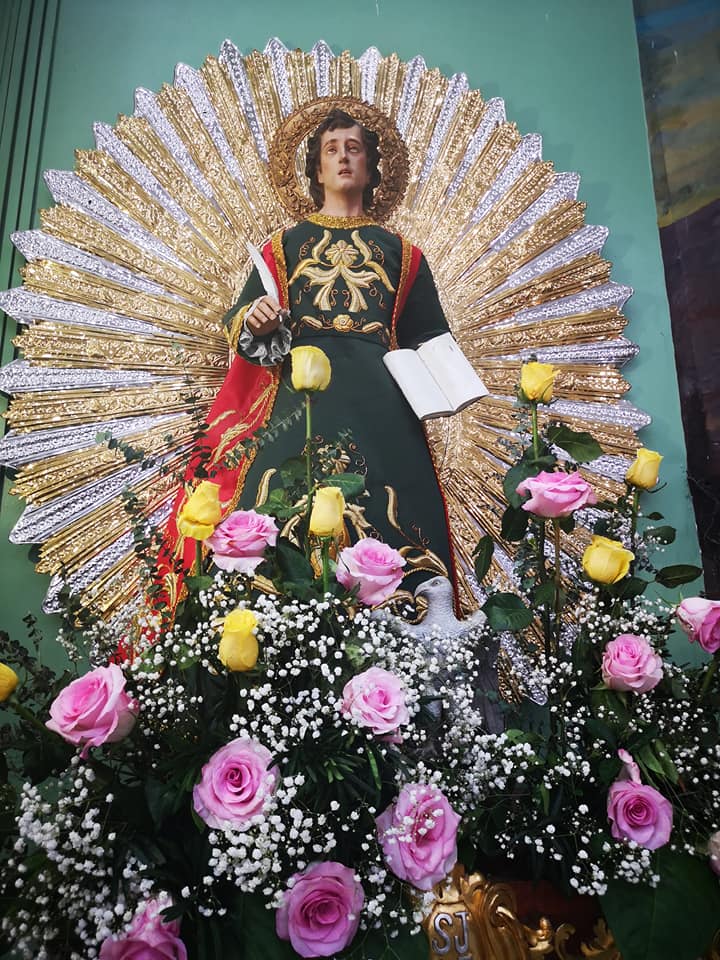
Our Patron Saint, San Juan Apostol at Ebanghelista of Bagbaguin, Santa Maria, Bulacan.
My predecessors saw this as too small that they did not have daily Masses. But I felt in my prayers that is the only thing Jesus wanted me to do here: make him present in the daily Masses and other sacraments.
We started with just five people attending our daily Masses while Sundays were half-filled. Before COVID-19, we have increased attendees to our daily Masses to about 20 people and our Sunday celebrations have become almost seating capacity.
At first I felt sad and disappointed but the people here kept on telling me it is a miracle already that “so many people” were coming for the Masses. Slowly, I have come to accept our situation that that’s the way it is. And that is where I felt God blessing us so abundantly with our less!
Modesty aside, in the past nine years we have sent more children to receiving the Sacraments of Holy Communion and Confirmation (without any fees but with free snacks) since 1998 when this started as a quasi parish. We have almost baptized every adult person who have not yet received the sacrament too.
COVID-19 stopped everything, affecting our collections so bad but we just kept on serving and proclaiming Jesus with our daily Masses seen online, motorcade of the Blessed Sacrament every week, distribution of the Holy Communion every Sunday to those who attended our online Mass including through our innovative “drive-thru” Communion.
01 November 2020.
We never beg the people for donations but they all poured in, enabling us to continue helping the poor like helping them bury their dead, even renovate our church with the finest liturgical vessels and things!
One thing has become clear with me: always begin in God, keep him as our center in everything and all else follows.
Remember those days when you were centered in Christ; despite the problems and trials, we were never forsaken by the Lord. Even if we have lost some of our life’s battles, we have still emerged victorious because we have become stronger and fulfilled inside.
We all come and go, especially us priests but, our mission as disciples of Christ remains the same everywhere which is to make Jesus present, make God known to everyone like in the gospel today. This we can only accomplish when we remain one in him, totally free for him and free from other attachments to be free for all.
Like St. Paul, may we all strive especially us your priests to be “all things to all men” -omnia omnibus (1Cor.9:22) by being free to lovingly serve others especially the weak and the poor in Christ Jesus. Amen.
Photo by Mr. Red Santiago of his son praying in our parish, November 2019.
The Lord Is My Chef Breakfast Recipe for the Soul
Tuesday, Feast of the Presentation of the Lord, 02 February 2021
Malachi 3:1-4  >><)))*>  Hebrews 2:14-18  >><)))*>  Luke 2:22-40
“Presentation at the Temple” painting by Italian Renaissance artist Andrea Mantegna done around 1455; Mary holding Baby Jesus while St. Joseph at the middle looks on the bearded Simeon. The man at the right is said to be a self-portrait of the artist while the woman at the back of Mary could be his wife. Photo from wikipedia.org.
Dearest God our Father:
It has been 40 days since Christmas when you sent us your Son our Lord Jesus Christ! Thank you very much for this wonderful gift but, have we had him? Have we truly met him?
Fill us with your Holy Spirit like Simeon, dear God: make us devout like him who finally “met” Jesus Christ on his presentation at the temple by Joseph and Mary.
Now there was a man in Jerusalem whose name was Simeon. This man was righteous and devout, awaiting the consolation of Israel, and the Holy Spirit was upon him. It had been revealed to him by the Holy Spirit that he should not see death before he had seen the Christ of the Lord. He came in the Spirit into the temple; and when the parents brought in the child Jesus to perform the custom of the law in regard to him, he took him into his arms and blessed God…
Only St. Luke used the word “devout” in the scriptures. First in describing Simeon, and thrice at the Book of the Acts of the Apostles to describe the Jews who attended the pentecost at Jerusalem (2:5); “the devout men who buried” our first martyr Stephen (8:2), and called Ananias a “devout observer of the law” when you told him to pray over and heal Saul who got blinded on the way to Damascus (22:12).
Teach us to be devout like Simeon, give us a “good heart, ready to believe, and then to act openly and with courage” (Timothy Clayton, Exploring Advent with Luke; page 125).
More than being faithful to you, a devout person O Lord is one who does not only wait patiently for your coming but most of all, looks forward to its fulfillment by making it happen. Exactly what Simeon and Anna did on that day when Mary and Joseph presented Jesus at the temple.
So many times in our lives, Jesus comes, enlightening our minds and our hearts but we are so busy with so many other things that do not truly fulfill us, that in the end, would be more of an excess baggage on our way to you and others. And eventually, making death difficult and devastating instead of becoming a blessing like with Simeon and Anna.
Let us spend more time meeting Jesus in prayers to be more attuned with his coming so that we may be ready to follow his promptings and leads.
May we also learn to respect and care for others in order to meet Jesus like Simeon who recognized his parents for their roles in bringing the child into this world; likewise, the attitudes of Mary and Joseph in giving Simeon and Anna the child Jesus. What a beautiful scene of loving and caring for one another, especially of respect for the elderly! So many times we forget that truth, that we meet Jesus coming in others.
Lastly, fill us with joy no matter how difficult life may be has for us; we can never meet your Son Jesus if all we have are bitterness and resentments. Like Simeon and Anna, they were overflowing with joy, so excited to meet Christ and upon encountering him that day, they embraced him in their arms, expressing their readiness to die and rest in peace.
“Now, Master, you may let your servant go in peace, according to your word, for my eyes have seen your salvation, which you prepared in sight of all the people, a light for revelation to the Gentiles, an d glory for your people Israel.”
Luke 2:29-32
Dearest Father in heaven, make us devout like Simeon and Anna with hearts overflowing with joy, striving to realize its fullness only in Jesus Christ, in this life and hereafter. Amen.
The Lord Is My Chef Sunday Recipe for the Soul
Third Sunday in Ordinary Time, Cycle-B, 24 January 2021
Jonah 3:1-5, 10  >><)))*>  1 Corinthians 7:29-31  >><)))*>  Mark 1:14-20
Photo by Mr. Jim Marpa, 2018.
The sea evokes mixed feelings of both joy and fear at the same time. It symbolizes life itself that may be nice and lovely but difficult and dangerous too. For many people, the sea is the sign of abundant life, a source of livelihood while for some, a reminder of death and misery.
Such is the mystery of life too that at the start of the ministry of Jesus Christ, we find Mark locating its setting by the sea as we embark fully into the Ordinary Time of the liturgy.
After John had been arrested, Jesus came to Galilee proclaiming the gospel of God: “This is the time of fulfillment. The kingdom of God is at hand. Repent, and believe in the gospel.” As he passed by the Sea of Galilee, he saw Simon and his brother Andrew casting their nets into the sea; they were fishermen.
Mark 1:14-16
Mark wrote the first gospel account that became the framework for Matthew and Luke in writing their own versions. He was in a hurry in writing his gospel because he felt the urgency in making known the good news of Jesus Christ; thus, his gospel is also the shortest, doing away with so many other details without losing the essentials.
This we find in his brief presentation today of the beginning of Christ’s ministry set by the Sea of Galilee.
Our sea of discontent.
First thing we notice is the very nature of the coming of Jesus Christ that happens when we are in rough waters, perhaps even with a violent storm at the middle of the sea called life: After John had been arrested, Jesus came to Galilee proclaiming the gospel of God: “This is the time of fulfillment. The kingdom of God is at hand. Repent, and believe in the gospel.”
Photo by author, sunrise at the Sea (Lake) of Galilee, 2017.
The setting was not totally good. John had been arrested. People must have been disappointed. But, that is always the cue in God’s coming called “kairos” or fullness of time, the day of judgment.
It is when we are going through difficult situations in life when we must examine ourselves too, of the need to set aside our own plans and agenda to let go and let God.
Every here and now is the time of fulfillment, a time of God’s coming to us.
Do we have the room, the space in us to welcome him to bring us into fulfillment? Hence, the need to empty ourselves, to repent and believe in Jesus Christ, the gospel himself.
Secondly, it is when we are sailing through rough seas when we also experience within that feeling of discontentment, of emptiness when there seems to be something missing in our lives even if everything is going fine like with our career or business, relationships, or family where nobody is sick or maybe the kids have all grown up and now on their own.
There comes a time in our lives when our problem is not having any problems at all — when we are no longer contented with being happy and satisfied but longing for fulfillment.
Rejoice and be glad when feeling this way! Emptiness leads to fullness as discontentment in life is always a sign of spiritual growth if we heed the calls of Jesus when desolation is a prelude to consolation.
Like in the story of creation, out of chaos comes order, exactly the experience of the first four disciples of Jesus.
As he passed by the Sea of Galilee, he saw Simon and his brother Andrew casting their nets into the sea; they were fishermen. Jesus said to them, “Come after me, and I will make you fishers of men.” Then they abandoned their nets and followed him. He walked along a little farther and saw James, the son of Zebedee, and his brother John. They too were in a boat mending their nets. Then he called them. So they left their father Zebedee in the boat along with the hired men and followed him.
Mark 1:16-20
Photo by Mr. Jim Marpa, Carigara, 2019.
When we are sailing through rough seas in life, that is when we have to trust God more so he can do and move in our lives to achieve the great plans he had created us for. “Be still and confess that I am God!” (Ps. 46:10), so the psalmist tells us.
Money and material things were not a problem for Simon and company. They must be well to-do as they have their own fishing boats at the time, even with men hired to work for them. Opening their hearts to listen to Jesus, they must have felt deep inside them that finally, they have found direction in life, something they have been searching for a long time.
Did they understand the meaning of “fishers of men”? We have no way of knowing it but Mark tells us how upon listening to Jesus, Simon and Andrew left everything behind and followed the Lord! Imagine the great fortune they have left behind.
Even Zebedee, the father of James and John, did not complain nor run after them to at least ask them to stay behind so they would help him run their family business because he too must have been praying for his sons to grow up and mature! Recall how the mother of James and John requested Jesus the favor to have them seated beside him when reigning in his kingdom they thought to be like the kings of their time living in a palace. Or, their attitude in asking Jesus to burn down a Samaritan village that refused them passage. These instances indicate how the brothers James and John may have been like today’s typical happy-go-lucky rich kids of their time but searching for meaning in life amid the many troubles and misadventures in life.
Jesus comes to us in a similar manner, in the ordinariness and problems and struggles of our lives like when Simon and Andrew, James, and John were busy working near the Sea of Galilee. The Lord speaks to them about what they were doing as fishermen to express to them his plans to make them fishers of men.
We do not find God;
it is God who finds us.
Every day, Jesus Christ is passing by, calling us, inviting us to repent and believe in his gospel, challenging us to face our responsibilities and most of all, asking us for our commitment. He never imposes but would always patiently wait for us.
We all search for meaning in life; for some, it may come early in life while for others, it might come later. But surely, our search for meaning, for God always come for sure because we were created that way by God.
In my personal experience, I have realized that we do not really find God; it is God who actually finds us! Moreover, nobody escapes God as attested by so many saints and even ordinary people we have known who have experienced conversion.
Photo by Dr. Mylene A. Santos, MD, December 2020.
One beautiful story of God coming to us, searching for us, and saving us from storms at the middle of the sea of life is that of Jonah and the city of Nineveh in the first reading. Jonah himself tried to escape God when his ship encountered a severe storm in the middle of the sea that he was thrown out to be swallowed by a whale. Of course, it is symbolic but it tells us in a nutshell the urgency of proclaiming God’s message of conversion, of not escaping God. This we find when Jonah was surprised at how a pagan nation like Niniveh listened to his preaching that they were spared of God’s wrath and punishment.
Jonah and Niniveh both give us beautiful lessons in resolutely turning back to God and his ways without wasting any instant as well as God’s immense love and concern for everyone, offering his mercy and forgiveness no matter how serious our sins are.
The characters of Jonah and of the inhabitants of Niniveh may be exaggerated but they are very true even among us in our own days! Recently we have seen how things have gone worst in this life in almost every aspect especially since last year with the coming of COVID-19 pandemic.
That is why St. Paul’s call in the second reading is so timely: “I tell you, brothers and sisters, the time is running out. For the world in its present form is passing away” (1Cor.7:29,31).
When St. Paul wrote the Corinthians telling them to act as not having wives or weep as not weeping means we have to detach ourselves from all that perish like material things as well as jobs and careers, and even this life we have. We have to focus more on things that last who is ultimately God in Jesus Christ.
Last week, I was so saddened with the news of the closing of the Makati Shangri-la Hotel next month. One of our parishioners is a young man working there as a chef since 2004. He is a very good man, always dropping by the parish after work, never missing a Sunday with his father who died last summer. When COVID-19 started, he would always attend our online Mass wherever he may be.
I texted him the night the news came out of the closure of their hotel next month. Beside is a screenshot of our chat that turned my sorrow into joy upon realizing Carlo’s deep faith in God.
That night, I thanked God in my final prayer, for letting Jesus passed by my room while chatting with Carlo, in taking care of Carlo.
Yesterday after Mass I talked to him again and he was already very upbeat, looking forward to celebrating the Mass with us more often while looking for a new job.
Let us pray this Sunday for everyone going through many hardships these days so they may remain open in their hearts, listening to Jesus who is passing by, calling them to be his fishers of men in this troubled seas. Amen.
The Lord Is My Chef Breakfast Recipe for the Soul
Friday, Memorial of St. Vincent, Deacon and Martyr, 22 January 2021
Hebrews 8:6-13     >><)))*>  = + =  <*(((><<     Mark 3:13-19
Photo by author, Dominus Flevit Church, the Holy Land, 2017.
Jesus went up the mountain and summoned those whom he wanted and they came to him. He appointed Twelve, whom he also named Apostles that they might be with him and he might send them forth to preach and have authority to drive out demons. He appointed the Twelve: Simon, whom he named Peter; and Judas Iscariot who betrayed him.
Mark 3:13-16, 19
How great indeed is your love for us, O Lord Jesus Christ! I just wonder how or what are your criteria in calling those you wanted to follow you? You do not seem to reject anyone at all! You want all because you love us all!
Thank you very much, dear Jesus! Despite our many flaws and weaknesses, you still want us, you still call us, and most of all, even send us despite our imperfections.
And amid your great love for us is your “poor memory”, of always forgetting or disregarding our sins against you. Like when you called Simon and named him Peter to lead the Twelve as attested in all accounts as being the first among the list of the Apostles; but, at the same time, always mentioned last in every list of your inner circle is Judas Iscariot who betrayed you. Why called him at all?
So often, I find that so strange with you who knows everything and reads our hearts; but, the more I pray over your calls and our response, the more I find it more strange on our part when despite your mediating a new and perfect covenant in God (first reading from Hebrews), we still choose to turn away from you in sin.
Forgive me, Lord Jesus, when I cannot resist the temptation to slide back to the past, to seek something already obsolete and imperfect simply because they are easier.
Teach me to have the inner strength like of St. Peter, your prince of the Apostles and of St. Vincent, your Martyr and Deacon whose feast we celebrate today. May we remain faithful and vigilant in our commitment in responding to your call, Lord Jesus so we may always be one in the Father. Amen.
Photo by author, St. Joseph Parish in Baras, Rizal (07 January 2021).
The Lord Is My Chef Breakfast Recipe for the Soul
Tuesday, Week-I, Year-I in Ordinary Time, 12 January 2021
Hebrews 2:5-12   +   >><)))*>  +  <*(((><<   +   Mark 1:21-28
Praise and glory to you, O God our Father in giving us your Son Jesus Christ. Not just as Savior but as a brother by suffering and dying for us.
What a great mystery You have revealed to us when Jesus could have just come and simply be our brother through a declaration from You when He was baptized at Jordan; but, He chose to obediently go through Passion and Death.
So often, we take this so ordinarily without realizing its deeper meaning that Your glory and our salvation should be brought about by Jesus becoming one of us but that He should go through so much pain and suffering on the cross, not to mention the indescribable humiliation He went through.
You know so well, O God, how we see sufferings as punishment but in Jesus Christ you have shown and taught us that in fact it is a source of Your abounding grace.
In “subjecting” all things to him, he left nothing not “subject to him.” Yet at present we do not see “all things subject to him,” but we do see Jesus “crowned with glory and honor” because he suffered death, he who “for a little while” was made “lower than the angels,” that by the grace of God he might taste death for everyone. For it was fitting that he, for whom and through whom all things exist, in bringing many children to glory, should make the leader to their salvation perfect through suffering.
Hebrews 2:8-10
How sad that like in Capernaum during His time, we are amazed, wondering, asking: “What is this? A new teaching with authority. He commands even the unclean spirits and they obey him” (Mk.1:27).
Help us, O God, to embrace this beautiful mystery and reality of Jesus Christ’s coming that through His obedience to You even in suffering and death, He is able to help us, consecrating us to You because we are His brothers and sisters in suffering and death. Amen.
The Lord Is My Chef Sunday Recipe for the Soul
Baptism of the Lord, 10 January 2021
Isaiah 55:1-11   +   1 John 5:1-9   +   Mark 1:7-11
On this second week of January we celebrate the final epiphany of Jesus Christ as an adult in His baptism by John the Baptist at Jordan River which is also called a “theophany” when God the Father made known to everyone Jesus is His beloved Son with whom He is well-pleased.
The other two epiphanies were last Sunday when Jesus manifested to the nations of the world symbolized by the Magi while the other was during His Nativity when He appeared to the poor and lowly symbolized by the shepherds for whom He first came for.
His baptism at Jordan closes the Christmas season that coincides with our secular calendar’s entry to the second week of January which is named after the Roman god Janus who has two faces with one looking forward to the future and the other looking backwards to the past.
It is exactly what our liturgical and secular calendars in this month of January are both telling us – that we are at the threshold of new beginnings, new start as we slowly leave the past behind. And what a blessed start we have on this Solemnity of the Lord’s Baptism when Jesus reminds us of His presence this 2021 which experts predict would just be an extension of 2020. We are looking to the future in Jesus and with Jesus while we look back to the past seeing the great things the Lord had done for us!
This is what John the Baptist proclaimed: “One mightier than I is coming after me. I am not worthy to stoop and loosen the thongs of his sandals. I have baptized you with water; he will baptize you with the Holy Spirit.” It happened in those days that Jesus came from Nazareth of Galilee and was baptized in the Jordan by John. On coming up out of the water he saw the heavens being torn open and the Spirit, like a dove, descending upon him. And a voice came from the heavens, “You are my beloved Son; with you I am well pleased.”
Mark 1:7-11
Jesus Christ our Good News
For this year 2021 properly referred to in liturgy as “Cycle B”, we shall have Mark as our guide and companion in our Sunday Mass journey in the Lord (Cycle A is with Matthew, Cycle C is Luke; we hear John on special occasions like Christmas and Easter).
As I have told you during Advent, Mark wrote the first gospel account, it is the shortest because he was in a hurry in making known the good news right away. But, as Shakespeare had said, brevity is the soul of wit; Mark’s brief and direct reporting of the events and teachings of Jesus open for us so many reflections that make us experience the Lord.
Right away at the start of his gospel account, Mark tells us the baptism of Jesus as the inaugural event of the Gospel in fulfillment of the Old Testament prophecies announcing the coming of John the Baptist as Precursor to the coming of the Christ.
See his manner of narrating, stating matter-of-factly without any further ado that Jesus came from Nazareth of Galilee and was baptized in the Jordan by John; he seems to be in a hurry to tell us something great, something important and so beautiful: On coming up out of the water he saw the heavens being torn open and the Spirit, like a dove, descending upon him.
I like that part when he said “the heavens being torn open” or in some translations which I prefer, “the sky rent in two”. What a beautiful imagery, so evocative of God intervening into our lives, descending into our world to bring order, to bring peace!
In the Book of Isaiah which is read during Lent, we find that beautiful expression, “Oh, that you would rend the heavens and come down” (Is.63:19-64:3).
I love that so much! Imagine God rending, tearing apart the heavens like an action hero coming from behind to save us, to protect us, to get us.
Also in Mark’s gospel, he tells us how Jesus at his last breath “rending” while the curtain at the sanctuary of the temple was torn in two from top to bottom (Mk.15:38).
For the heavens to be rent apart shows us God finally intervening into our lives and affairs to set things right, to have some order.
And that is the beginning of the Good News of Jesus Christ that happens daily in our lives. God has rent the heavens and descended upon us in His Son Jesus Christ who clothed Himself in our humanity so we can be like Him, divine and holy.
It is an invitation He extends to us every day, beautifully expressed by Prophet Isaiah in the first reading:
Thus says the Lord: All you who are thirsty, come to the water! You who have no money, come, receive grain and eat; come, without paying and without cost, drink wine and milk! Heed me, and you shall eat well, you shall delight in rich fare. Come to me heedfully, listen, that you may have life. I will renew with you the everlasting covenant, the benefits assured to David. For my thoughts are not your thoughts, nor are your ways my ways, says the Lord… so shall my word be that goes forth from my mouth; my word shall not return to me void, but shall do my will, achieving the end for which I sent it.
Isaiah 55:1-3, 8, 11
What a beautiful assurance to us this day with the threats of new strains of COVID-19 and problems in having the vaccine, here is God assuring us all the good things we need in this life. Of course, it is not merely the material things we need but surely all good things like milk and honey we need not only to survive but to live fully.
This Feast of the Baptism of the Lord assures us all the blessings and fulfillment we need and long for this 2021 if we accept His invitation to be one with Him.
How sad that too often, we reject Christ’s invitation, thinking how difficult it is to keep the commandments of God without realizing that they are indeed “not burdensome” (1 Jn.5:3) because the more we sin, the more life gets harder and heavier for us.
Today God assures us of His love, of how his favor rests upon us in Jesus Christ.
May we heed His calls so we may see Him rending the heavens apart, coming to our rescue, coming to our aid and presence. Amen.
The Lord Is My Chef Breakfast Recipe for the Soul
Friday after the Epiphany, 08 January 2021
1 John 5:5-13     <*(((><<   +   >><)))*>     Luke 5:12-16
Photo by author, December 2020.
Beloved: Who indeed is the victor over the world but the one who believes that Jesus is the Son of God? This is the one who came through water and blood, Jesus Christ, not by water alone, but by water and blood. The Spirit is the one who testifies, and the Spirit is truth.
1 John 5:5-6
If we could all be aware of this wonderful declaration by your Son’s beloved disciple, O God our Father, surely there would be fewer disappointments and frustrations among us in this life, especially from that “rat race” where there are no victors but only losers.
As we advance in science and technology supposedly making life better and easier for us, making us more affluent to some degree, what a tragedy that we still do not feel contented as life has become more competitive in quantitative terms than qualitative aspects like love and understanding, closer ties and cooperation.
Life may be easier but, unfortunately we cannot see its great value that even on the personal level, there is still so much self-hate and self-rejection going on among us.
Help us, dear Jesus, to keep in our minds and our hearts how you wish only the best for us, our healing and our fulfillment in life like that leper you have healed in the gospel today.
It happened that there was a man full of leprosy in one of the towns where Jesus was; and when he saw Jesus, he fell prostrate, pleaded with him, and said, “Lord, if you wish, you can make me clean.” Jesus stretched out his hand, touched him, and said, “I do will it. Be made clean.” And the leprosy left him immediately.
Luke 5:12-13
Lord Jesus, let us believe in you wholeheartedly by embracing your Cross where you won the world for us with “the Spirit, the water, and the blood” that all testify to you as the Christ, the Anointed One of God who saved and redeemed us. Amen.
Photo by author, Chapel of Theology Dept., ICMAS, 12 November 2020.
Quiet Storm by Fr. Nicanor F. Lalog II, 28 December 2020
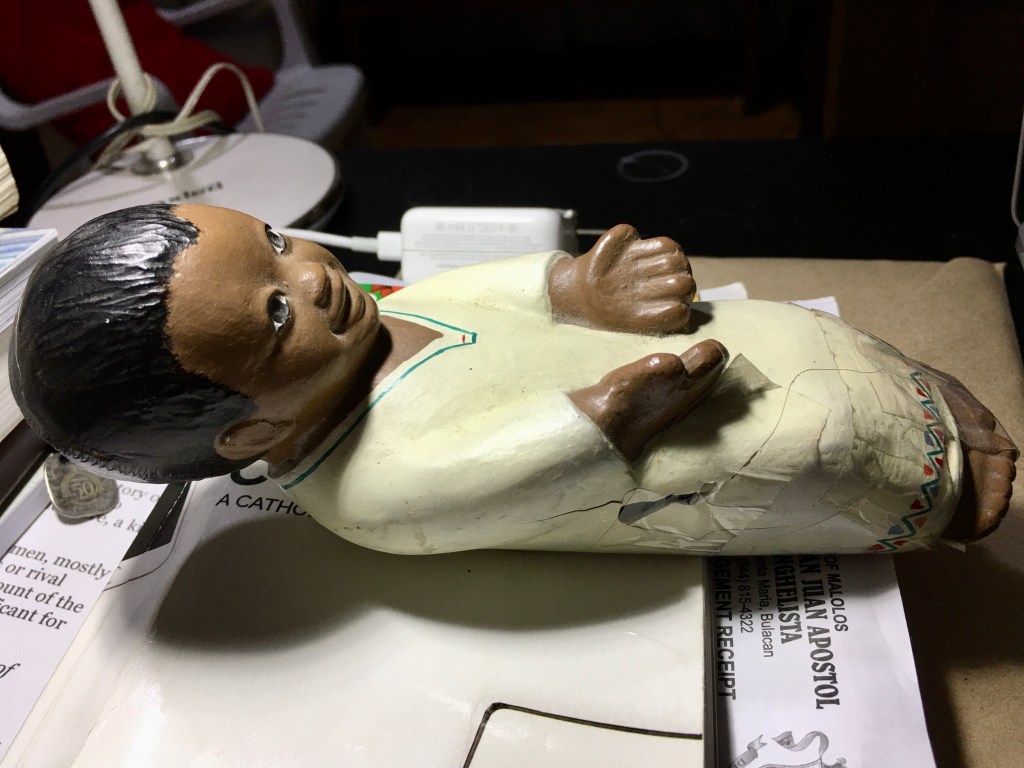
Photo by author, 28 December 2020.
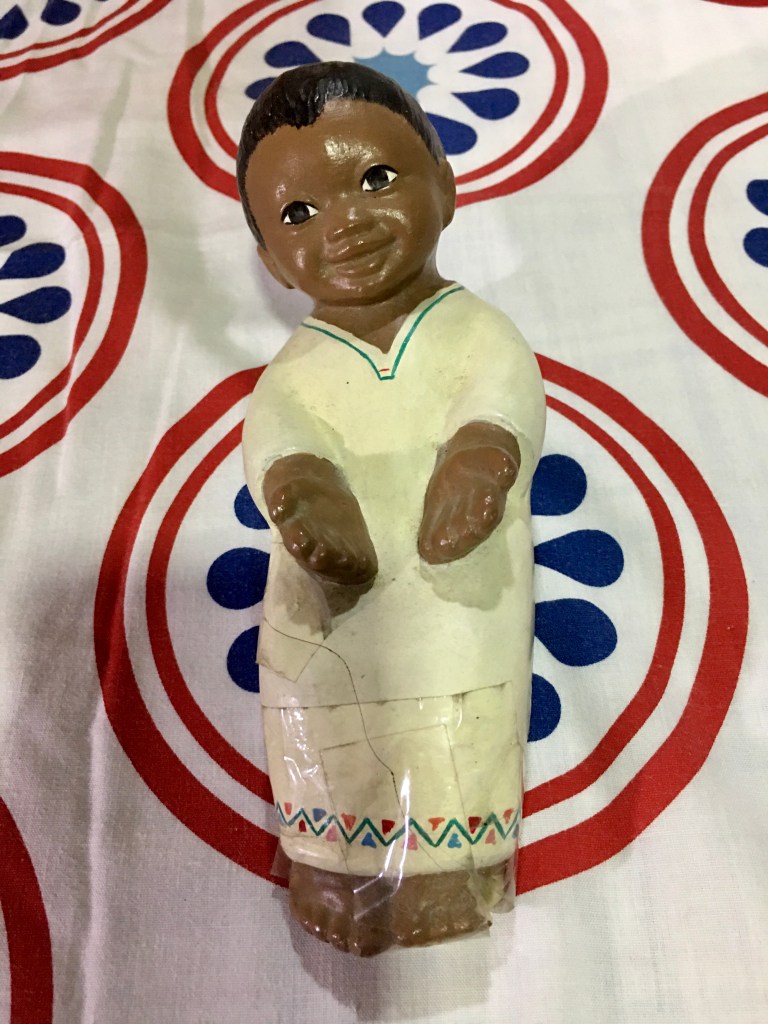
“Welcoming Jesus”.
It is not really the title of this piece but the name of this image of the baby Jesus above.
See His smiles and open hands with eyes exuding with warmth and joy to anyone who sees Him. Even with the dusts and cracks held intact by scotch tapes, it is one of my most loved and cherished possessions I would never trade for anything.
Given to me by a brother priest in Christmas 2017, Welcoming Jesus measures about eight inches and seems to be Mexican or African inspired with his dark skin and lively colorful design of baby dress. I have always loved this Baby Jesus who seems so alive that I have kept Him on my desk, giving me so many inspirations and “kicks” in my studies in the past three years.
Small and handy, and so fragile, I have always imagined Him to be just like the infant Jesus when He was born in Bethlehem more than 2000 years ago.
As I turned off my lamp last night before retiring, I saw Him, smiling and yes, “welcoming” to remind me of a story I have read ten years ago about St. Mother Teresa of Calcutta, India when one of their patients threw to her a crucifix in a fit of tantrum. After pacifying the patient, St. Mother Teresa picked the crucifix and pieced together with a scotch tape an arm of Jesus that was broken. She then gave it to one of her nuns with instructions to hang it again on their wall with a note that says, “Let me heal your broken arm”.
In the same manner, as I looked onto my little image of “Welcoming Jesus”, I felt it my Christmas message for 2020 as we celebrate Holy Innocents’ Day: “Let me show you tenderness, Baby Jesus.”
If there is one thing we all need at this time of the pandemic, this Christmas 2020, it must be tenderness. Like the tender compassion of God, His mercy.
Tenderness is being merciful, being soft in the heart in a very positive sense. Some people think that being tender, being merciful and forgiving is a sign of weakness; on the contrary, it is pure power and strength.
The former US President Theodore Roosevelt who was a military officer before getting into politics used to tell that in any argument or discussion, the first to use one’s fist is always the one with less intelligence, less power who resort to force because they have ran out of reasons to argue.
Very true! Exactly with that off-duty cop who brutally shot and killed mother and son in Paniqui, Tarlac whose tiny brain could not control his humongous body much less understand everything that was going then.
Mercy and tenderness, like courage, are movements within the heart. The Latin word for mercy perfectly captures its meaning: misericordia or a stirring of the heart, a moving of the heart. More than a feeling, it is taking concrete actions to bow down and be one with those suffering.
That is why the Son of God became human, chose to be born as an infant like everybody else, to be one with us, to suffer with us, that is, compassion from cum and passio, to suffer with.
The eminent theologian Fr. Hans urs Von Balthasar, a good friend of Pope Emeritus Benedict XVI, wrote before he died that “the central mystery of Christianity is our transformation from a world-wise, self-sufficient ‘adults’ into abiding children of the Father of Jesus by the grace of the Holy Spirit. All else in the Gospel – the Lord’s Incarnation, his hidden and public lives, his miracles and preaching, his Passion, Cross, and resurrection – has been for this” (Unless You Become Like This Child).
A baby is always welcoming to almost everyone, and vice versa, anyone even the most hardened criminal would always welcome and be moved by the sight of a baby or a child.
How sad that until now, there are still King Herods among us who are insecured with children and infants. Worst are those who abuse and molest children, the single most damning crime by some in the clergy this century because it is directly opposite the central theme of Christ’s teachings and warning – “See that you do not despise one of these little ones, for I say to you that their angels in heaven always look upon the face of my heavenly Father” (Matt.18:10).
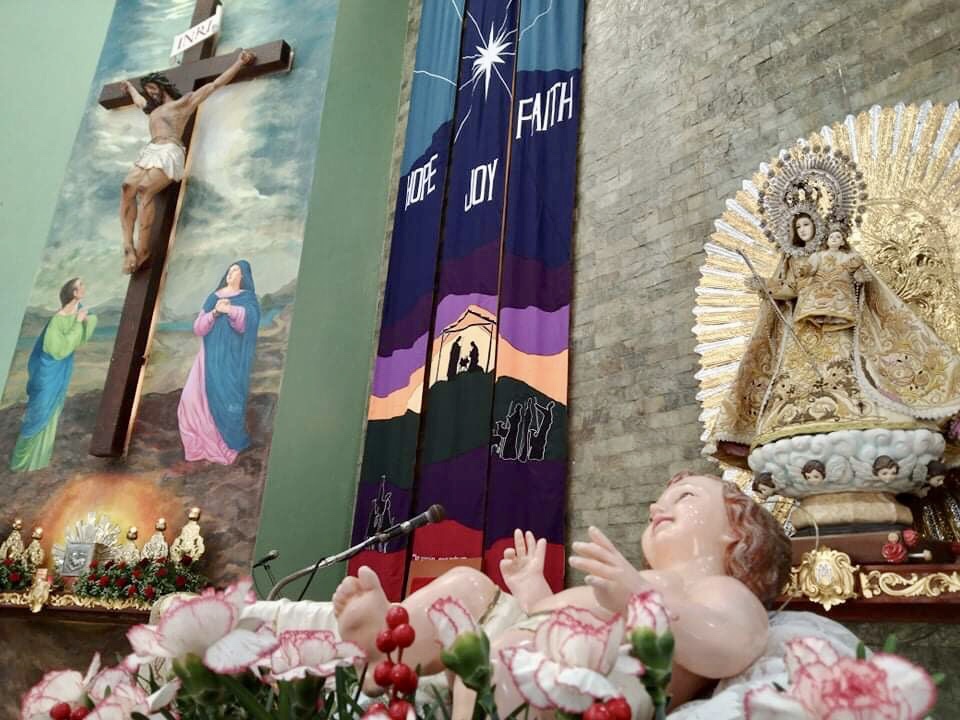
Photo by Mr. Marc Angelo Nicolas Carpio, Baby Jesus in our Parish, Christmas 2020.
Due to COVID-19 pandemic, for the first time in our churches, the traditional kissing (pahalik) of the image of the Baby Jesus is scrapped. Perhaps it is a good reminder to us all to meditate more in our hearts the meaning of Jesus being born an infant – so weak, so dependent to adults like us.
It is a call for us too to do something concrete about the many sufferings children have to go through in this time, on one end those denied of basic goods and services while on the other extreme are the children with all the material needs except the warmth and love of their parents.
One saint I have discovered before our ordination more than 20 years ago is St. Charles de Foucauld, a French priest who lived among the Tuaregs of the Sahara desert in the early 20th century. In his room, he always had a baby Jesus and an altar for the Blessed Sacrament to adore daily.
His core value is founded on “littleness” – of finding Jesus among the little ones, of being little before the Lord.
Have that tender care that expresses itself in the little things that are like a balm for the heart… With our neighbours go into the smallest details, whether it is a question of health, of consolation, of prayerfulness, or of need. Console and ease the pain of others through the tiniest of attentions. Be as tender and attentive towards those whom God puts on our path, as a brother towards brother or as a mother for her child. As much as possible be an element of consolation for those around us, as soothing balm, as our Lord was towards all those who drew near to him.
St. Chrales de Foucauld
What a beautiful reminder of the Child Jesus this Christmas and hereafter. If we can be tender with one another in the most minute detail like Jesus, then we can truly experience His coming to us, fulfilling us with His presence and love which is the spirit of Christmas. Amen.
The Lord Is My Chef Recipe for the Soul by Fr. Nicanor F. Lalog II
27 December 2020, Feast of St. John the Apostle and Evangelist, Patron of our Parish
1 John 1:1-14  >><)))*> John 20:2-8
Our Parish Patron, the beloved disciple of the Lord, St. John the Apostle and Evangelist (Photo by Ms. Jo Villafuerte, Sept. 2018).
Today we celebrate in our Parish the feast of our Patron Saint, John the Apostle and Evangelist also known as “the beloved disciple of the Lord”. Although it is a Sunday in the Christmas octave when the Feast of the Holy Family is celebrated by the universal Church, parishes and dioceses with the beloved disciple as patron as exempted. Perhaps, it is St. John’s gift to me before I move to my new assignment in February next year that I celebrate his feast for the last time this Sunday.
I tell my parishioners to love St. John; that is their first task as parishioners, to love and support their Patron Saint. Moreover, I have always stressed to them how St. John the Apostle is so special, and not an ordinary saint or Apostle. Next to his being the beloved disciple of Jesus, he is the only Apostle to have not died a martyr but grew old to witness the growth of the Church; he was the one who took care of the Blessed Virgin Mary as per instruction by the Lord Himself before He died on the Cross on Good Friday; and though there are only a few parishes dedicated to him, mostly are Cathedrals like the one at Dagupan-Lingayen in Pangasinan, at Naga City in Camarines Sur, and of course, the Cathedral of Rome, the St. John Lateran, the Mother of all churches in the world.
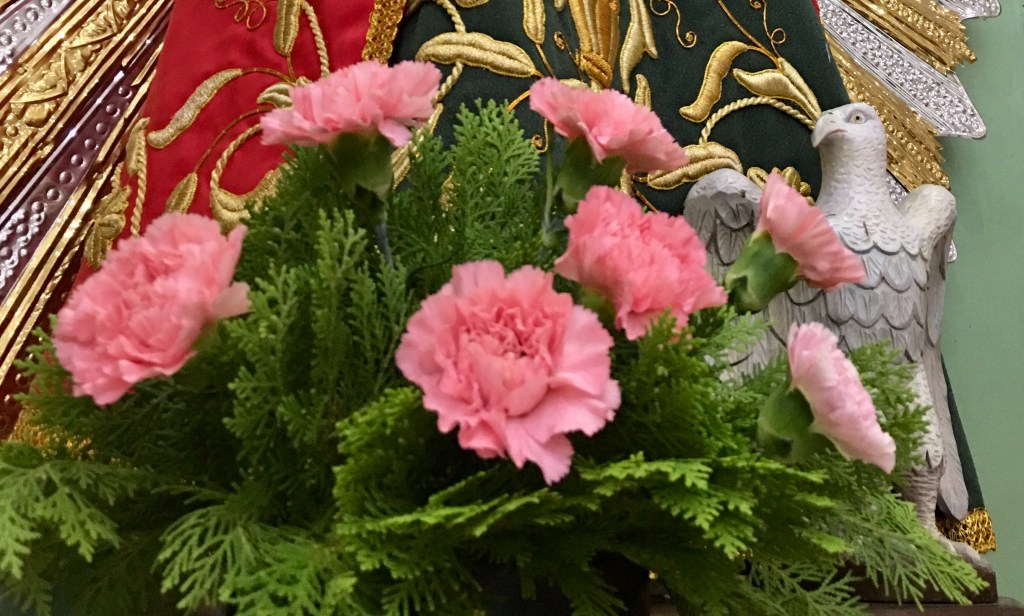
He is often symbolized by the eagle for his sharp and incisive way of looking at things and events in the life of teachings of Jesus that he is the only one able to tell us about the wedding feast at Cana, the man born blind, the raising of Lazarus as well as the more detailed account of the teachings after the feeding of five thousand people.
The great American writer Helen Keller, a blind woman, said it so well, “The only thing worse than being blind is having sight but no vision.”
I wish to reflect on that vision of St. John, on what had he seen in our Lord Jesus that hopefully we may always try to look into in our own lives.
Photo by author, Gaudete Sunday 2020.
Seeing Jesus, a real man among us
I used to say in my wedding homilies that women should always look for men who not only has sights but also vision. We all have sights but not everyone has a vision, the ability to see and look beyond what is on the surface, on what can only be seen but also perceived further.
St. John the Evangelist had a great vision of who Jesus Christ is. No wonder towards the end of his life while a prisoner at the island of Patmos off Greece, the Lord offered him a vision of heaven which he had recorded to us in the most difficult book of the Bible, the Revelation; his other four writings, the Gospel and three letters are also difficult to understand due to the different layers of meaning that only the beloved disciple was able to perceive.
Such is the kind of the vision of St. John said to be like the eagle, believed to be the only creature that can stare directly into light without getting blinded — very sharp and keen, as we say in Filipino, “matang-lawin” or eagle sight.
Being the only Apostle of the Lord to have grown old and spared from dying a martyr like the rest, St. John witnessed the first errors or heresies of early Christians concerning the humanity of Jesus Christ. They could not accept the Son of God took on a genuinely human body so that in a mistaken zeal for spirituality, they condemned everything material as evil, claiming the humanity of Jesus was just an appearance. As a result, these heretics like the gnostics taught that to be fully united with God meant to withdraw as much as possible from everything material.
St. John wrote his letters primarily to address this wrongful and erroneous views (which would persist for 400 years, still echoing in our present time), insisting that Jesus Christ is true God, and true man. We have heard him declare that on Christmas day when his prologue was proclaimed when he claimed “the Word became flesh and dwelled among us” – that Jesus Christ fully entered into our humanity and material condition by blessing and making it holy!
Today St. John insists on this contact with the real, bodily Jesus, repeating the words “seen” and “visible” about five times in four verses, emphasizing contact with a real, bodily Christ.
What was from the beginning, what we have heard, what we have seen with our eyes, what we looked upon and touched with our hands concerns the Word of life — for the life was made visible…
1 John 1:1-2
Here we find what St. John tells us also after the Resurrection in his gospel account how Jesus invited the doubting Thomas to touch and feel him, “Put your finger here and see my hands, and bring your your hand and put it into my side, and do be unbelieving, but believe” (Jn.20:27).
It is this physical, truly human, touchable Jesus that the Church proclaims every Christmas. Yet, how tragic that through the ages, we in the Church had always had that tendency to withdraw from the material that perhaps had led to so many problems with the human body and sexuality so that we have all these sex scams happening even long before.
Part of the mystery of the Incarnation is for us to be at home with our humanity like Jesus our Lord because everything God had made is good. Mention SEX, even in seminaries or Catholic schools, you hear for sure that rising crescendo of whispers and impish laughters.
Everything that God made is good. That is why Jesus became human to show us it is good to be a human being, it is the path back to God, into heaven. If we cannot accept Jesus as truly human, how can we truly love God whom we do not see? Hence, we find this beautiful flow of reason and reflection of St. John in his first letter:
No one has ever seen God. Yet if we love one another, God remains in us and his love is brought o perfection in us. God is love, and whoever remains in love remains in God and God in him. We love because he first loved us. If anyone says, “I love God,” but hates his brother, he is a liar; for whoever does not love a brother whom he has seen cannot love God whom he has not seen.
1 John 4:12, 16, 19-20
Photo by Mr. Marc Angelo Nicolas Carpio, Christmas 2020.
In short, to love God and to love others, we must first love our very selves, accept our “human-ness” like Jesus, a real man in everything except sin. The more we accept each other, the more we “see” God among us as a community, as a Church, the Body of Christ.
The Church, the Body of Christ
This vision of the Church as the body of Christ by St. John came from the empty tomb of Jesus at Easter, when the Lord was paradoxically not in sight!
When Simon Peter arrived after him, he went into the tomb and saw the burial cloths there, and the cloth that had covered his head, not with the burial cloths but rolled up in a separate place. Then the other disciple also went in, the one who had arrived at the tomb first, and he saw and believed.
John 20:6-8
What did our Patron Saint “see” that he believed, not like Simon Peter who was the leader of the Apostles?
Photo by author, August 2020.
This is the best example of St. John’s vision, of seeing beyond the physical, of seeing the significance of the folded cloth that covered the Lord’s face that has its basis in the story of Moses who had to put on a veil whenever he would converse with God face to face (cf. Exodus 34) due to the immense brightness of God, of His overwhelming presence. This the Israelites have seen every time after Moses had spoken with God, his face shone so brightly.
With the cloth that covered the head of Jesus folded and separated from the burial cloths, it meant that Jesus had met the Father, the veil to cover His face was no longer needed.
At that instance, everything became clearer for St. John – from the cleansing of the temple to His conversations with that Samaritan woman at Jacob’s well – convincing him that Jesus had risen to new life, to new level of existence. Years later, we find Jesus appearing to Saul on his way to Damascus, asking him, “Saul, Saul, why are you persecuting me?(Acts 9:1-5)” to indicate that whatsoever you do anyone, you do unto Jesus (Matt. 25:40).
In His glorified body, we are now able to look at God also in the new body of Jesus, the Church. It is in this aspect that we have to learn so much from the beloved disciple, St. John. Our lack of any sense of community like the collective effort in stopping the spread of COVID-19 shows of the great need for us to have wider and sharper vision of Jesus among us especially in the Church. May we strive to love more Jesus to find Him in our humanity. Amen.
Photo by author, Malolos Cathedral, September 2020.