Learning, following, sending… again. And again.

Homily, Baccalaureate Mass, College Students
Our Lady of Fatima University-Antipolo City, 10 July 2024

Photo by Pixabay on Pexels.com

Our gospel today speaks so well of your graduation when “Jesus summoned his Twelve disciples and gave them authority over unclean spirits to drive them out and to cure every disease and even illness. The names of the Twelve Apostles are these…” (Matthew 10:1).

See how Matthew distinguished the Twelve: first, as disciples then as Apostles, a beautiful reminder to us all that first we learn and then we are sent out like you upon graduation.
Photo by shy sol on Pexels.com

“Disciple” is from the Latin word discipulos or follower which came from the verb discere, to learn. A follower or tagasunod in Filipino is a learner, someone who learns from a teacher. From it came also the word discipline; that is why, a disciplined person – one who is masunurin – is one who follows and obeys always not only persons but also the truths and new learnings he/she may have learned.

On the other hand, the word “apostle” is from the Greek apostolos which is to be sent forth. In the gospel, the Apostles are the Twelve members of Christ’s inner circle, those closest with Jesus. Though the gospel would always have that distinction between a disciple and an apostle, they are essentially inseparable because before one is sent forth, he/she has to be learned first. Therefore, every baptized person is both a disciple and an apostle, a learner of the Lord’s ways and teachings who is sent out to proclaim the Gospel to others in words and in deeds.

Every Christian is a disciple and an apostle with a special relationship with Jesus Christ.

That is most specially true with you, my dear Fatimanians, students and graduates of Our Lady of Fatima University here in Antipolo City.

“The Exhortation to the Apostles” painting by James Tissot (ca.1886-1894) from commons.wikimedia.org.

Being a disciple and an apostle is a continuous process of learning, following and sending.

Don’t ever think that graduation is the end of your studies. The more you get into your professional life, the more you must pursue learning to follow new trends in your fields of specialization as you are sent not only across the Philippines but even abroad, across the globe like most of our alumni.

Being a disciple and an apostle, learning and following and being sent, are more of the inside than of the outside. Remember that first lesson of the pencil: what is inside is most important, not the outside which today is given more importance and prominence especially in social media.

Puro palabas. All about the outside and externalities that are superficial like having the most likes, becoming viral and trending. It is all show which is what the word palabas means. Showbiz na show biz tayo pero walang laman.

When you look at the mirror like what the BINI would sing, “salamin, salamin…”, what do you see? Are you a reflection of a man or a woman of depth and meaning or one who is empty?

Learning is not about stacking information and data inside the brain like a computer; learning involves the education of the heart, of becoming “man as man himself” as we say here at OLFU. “To rise to the top” is not to rule over others but becoming “the glory of God in man fully alive”, reflecting our mottos Veritas et Misericordia.

As you leave the portals of our beloved alma mater, ask yourself: am I more loving and understanding with all the knowledge and learning I have gained after years of studies here at OLFU?

Education literally means “to lead out”… from darkness into light, from slavery into freedom, from ignorance into wisdom. St. Thomas Aquinas wrote that the more we gain knowledge, the more we become intelligent, the more we must become holy. A truly intelligent person is one who does what is good and avoids evil and sinful. But, why are we as a nation of so many graduates still kulelat in many aspects in life?

From The Valenzuela Times, 02 July 2024.

You must have seen that photo of our nursing student carrying on his back his girlfriend while crossing the flooded McArthur Highway in Valenzuela City last week.

At first I was so happy seeing that chivalry is still alive in this modern age; later that night, I felt disappointed and so sad when I saw the negative reactions. Most netizens clicked the LOL emoticons with others commenting the girl was OA, saying, sana nagholding hands na lang sila. At least some were honest enough to admit their jealousy, commenting sanaol!

Why the negative reaction these days when somebody does something good like sacrificing? Why do people seem to approve when we see videos and reels of wrongdoings and stupidities? Have we become a nation of delulu?

Even the words we use are being altered. I cannot understand why a girl is now spelled as gurl? Somebody asked me who is my bias among the lovely members of BINI; why say bias when you mean favorite?

Call me old and conservative but the trend these days seem to be rejoicing in what is negative and wrong and frowning at whatever is good and beautiful. Clearly it is not generation gap but more of a symptom of a sick society and generation, exactly like what Hosea mentioned in the first reading, of how people have turned away from God worshipping idols. Who and what are these modern idols we worship and follow these days? Do we still call on God our Father and to His Son Jesus Christ our Savior?

Photo by author, Our Lady of Fatima University, Valenzuela City, 2023.

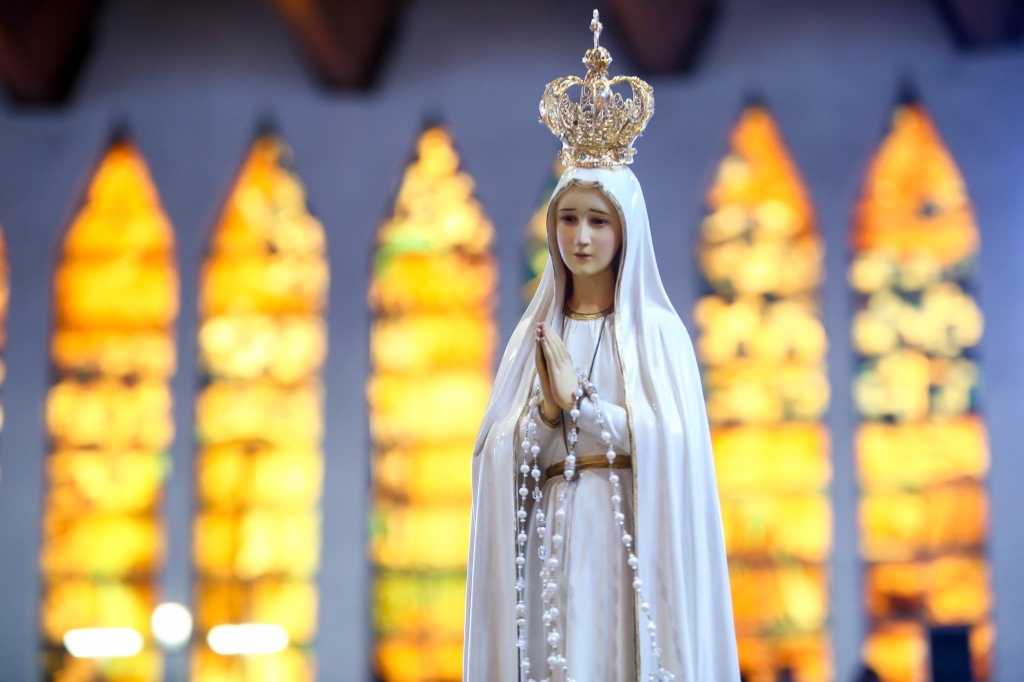
If there is anything most important we must have learned in our university, it is the value of prayer, of opening to God like those three children at Fatima in 1917. See how the Blessed Mother, our Patroness, came to see and teach St. Francisco and his sister St. Jacinta Marto with their elder cousin Sr. Lucia for six consecutive months every 13th day to pray, do penance and celebrate the Mass.

It is my hope that you continue to pray the Rosary, you continue to celebrate Masses on Sundays after your graduation to always learn and follow Jesus who actually sends you to serve those most in need as nurses, medical technologists, pharmacists, accountants, and criminologists. Be the loving hands, the healing hands of Jesus Christ!

Remember what I have been telling you since I came here in Our Lady of Fatima University: even now that you are professionals, continue to study hard, work harder, and pray hardest. God bless you, dear graduates of 2024!
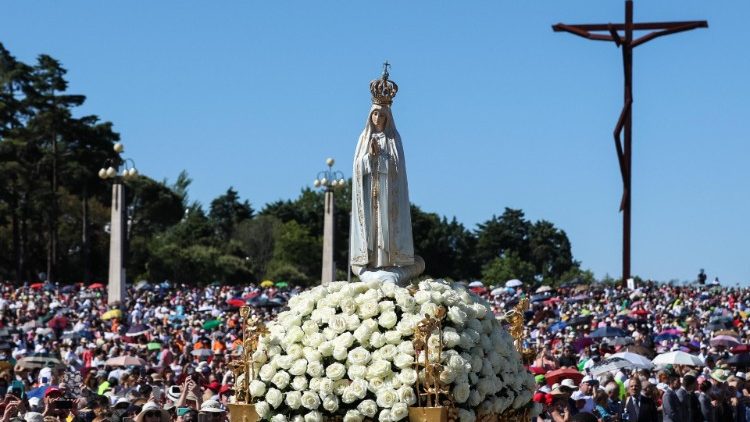
From the cbcpnews.net, 13 May 2022, at the Parish of the National Shrine of Our Lady of Fatima, Valenzuela City.

A lesson about prayer and storms

Quiet Storm by Fr. Nicanor F. Lalog II, 05 September 2023
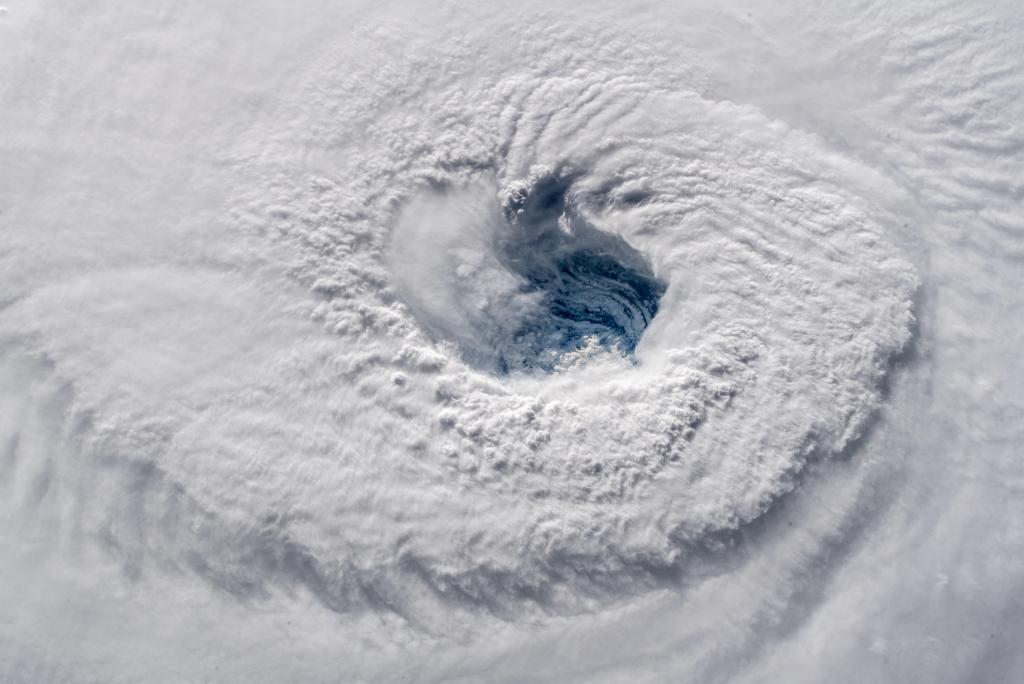
The well-defined eye at the center of the storm Hurricane Florence seen from the International Space Station taken by astronaut Alexander Gerst in 12 September 2018, https://www.nasa.gov/image-feature/staring-down-hurricane-florence.

Much of my 25 years in the priesthood were spent in the school ministry. My first assignment after ordination in 1998 was as a school administrator and teacher at our diocesan school in Malolos City until 2010. After a decade of parish ministry with a parish of my own, I was again sent to the school setting as chaplain of the Our Lady of Fatima University in Valenzuela City in 2021 to present.

As I celebrated Masses of the Holy Spirit in our six campuses amid the rains of the past two weeks, I told our students of the one important lesson they must first learn every school opening: there will always be storms in life. Literally and figuratively speaking. There are no ways of preventing storms and typhoons. Just like other calamities. Hence, the need for our students at a very young age to learn too the very important lesson of prayer.

Photo by author.

My dear students, prayers do not necessarily change situations like typhoons and calamities but prayers transform the person.

A man of prayer or a woman of prayer is like a gold bar or a diamond that even if it is thrown into the mud or sewage, it remains a gold or diamond. A person of prayer becomes strong and pure like gold and diamond or any precious stone.

So, have a prayer life.

Handle life with prayer so you will be able to weather every storm that comes to your life. Have that sacred space within you where you meet and commune with God, with Jesus Christ. Remember, God’s presence is never determined by outside forces like storms. God is always with us, even within us. Problem is we rarely notice nor recognize him because we are not attuned with him.

Experts tell us that every storm has an eye as its central part; however, the eye is the calmest part of every storm, always bright and sunny. It is its walls that are most dangerous where winds are most strongest and unpredictable. Having a prayer life, having a sacred space within us is like having that eye of the storm, our center of being that is always calm and peaceful because that is being rooted and grounded in God.

More than reciting prayers, having a prayer life is entering into a relationship with God in Jesus Christ, creating that sacred space within us where we experience his Divine presence whatever the season or weather is. It is being one with God. This relationship with God is reflected in our relationships with others, enabling you to make many friends and create wonderful relationships that enrich you as a person and eventually, after graduation, as a professional.

Photo by author.

The post-COVID period offers us with so many new ways of learning even amid class suspensions during storms. New methods, new technologies will emerge in the future making learning more enriching, more sustainable amid many outside factors like storms. But one thing remains very true in all our learning endeavors: we can only know so much, and there is only one who truly knows everything in this life – God. Know him first. And well.

This school year and every school opening until your graduation, remember these three things always, my dear students: study hard, work harder, and pray hardest. God bless!

Graduation lessons from St. Thomas the Apostle

Quiet Storm by Fr. Nicanor F. Lalog II, 03 July 2023
Photo by olia danilevich on Pexels.com

In this season of graduations when we also celebrate today the feast of St. Thomas the Apostle, we are reminded that growth and maturity in Christian faith goes through a process too of “graduation”.

St. Thomas went through different stages in life as a disciple of Christ before finally graduating with honors as a martyr. Most of all, he is a good model for every graduating student to emulate because he is the one so famous for having “doubts” and being known as the “doubting Thomas”.

To doubt is not necessarily bad. In fact, it is a grace from God because every doubt is a step closer to wisdom and knowledge. Without doubts, we can never learn because we will never be able to verify and validate what we know if we do not doubt at all. We shall discuss this further as we reflect on the three graduation events in the life of St. Thomas the Apostle.

His first graduation happened when the Lord’s best friend, Lazarus, died.

“The Raising of Lazarus”, 1311 painting by Duccio de Buoninsegna. Photo by commons.wikimedia.org

Recall how Jesus and his Apostles were prevented from visiting Lazarus when he was seriously ill because he lived with his sisters Marth and Mary in the town of Bethany that was near Jerusalem where the Lord’s enemies were plotting to arrest and put him to death. It was too risky for Jesus to go to Bethany but, because of his love for Lazarus and his sisters, Jesus decided to take the risk to visit him.

It was St. Thomas who rallied his fellow apostles to come with the Lord to share in his death.

So then Jesus said to them clearly, “Lazarus has died. And I am glad for you that I was not there, that you may believe. Let us go to him.” So Thomas, called Didymus, said to his fellow disciples, “Let us also go to die with him.”

John 11:14-16

A good student is always a risk-taker. All graduating students since 2021 to present deserve a great commendation, a great congratulations for taking all the risks and difficulties in pursuing your studies in these four years of the pandemic. Despite the poor internet connections, the threats of viral infections and many other risks, you forged on and now you are a step closer in fulfilling your dreams.

The key here is to never be away from Jesus like St. Thomas who at that early stage had identified himself with the destiny of Christ in offering himself on the Cross. St. Thomas knew it then that nothing is easy in this life but if we are with the Lord, there is nothing we cannot overcome.

Graduation as a process or a passing through stages is also a passover, a pasch like the Passion, Death, and Resurrection of Jesus Christ. Recall the gospel the other Sunday when Jesus told his Apostles to fear no one, to be not afraid. The same thing is what St. Thomas is reminding us today: do not be afraid to learn, to commit mistakes, to doubt, to fail, to get hurt. These little deaths are all part of our process of growing and maturing, of getting better, of being achievers.

The second graduation moment of St. Thomas happened during their Last Supper when the Lord was telling them of his coming death that would lead to his Resurrection and return to the Father’s house where he would prepare a room for them.

“Where I am going you know the way.” Thomas said to him, “Master, we do not know where you are going; how can we know the way?” Jesus said to him, “I am the way and the truth and the life. No one comes to the Father except through me.”

John 14:4-6

Imagine the somber and serious mood of the Last Supper, of Jesus telling everyone of his coming pasch. Then suddenly, there was St. Thomas interjecting with a statement “we do not know where you are going” with a question, “how can we know the way?”

Notice the comedy twist? Funny indeed and truly, we could see St. Thomas in a low level of understanding but if he never dared to ask that question, we would never have that most quotable quote of the Lord of him being “the way and the truth and the life.”

Here, St. Thomas is teaching us to always ask for explanations, even from the Lord himself! As RiteMed would say in its commercials, “Huwag mahihiyang magtanong”!

Photo by Mr. Paulo Sillonar, 07 June 2023.

In telling St. Thomas – and us – that Jesus is the way and the truth and the life, the Lord is reminding us how it is forever valid that true learning is gained from our dealing and relating with persons, with people, not with things like gadgets. Or even pet animals nor plants.

As you go on your school break after your graduation, spend more time with people, with your parents, with your brothers and sisters and cousins. Or playmates. Leave your gadgets and pets behind. Go out and play, bond with people. Get real and stop those virtual realities.

Very often, the teachers we truly love or like and appreciate impact are those who have gone out of their ways to reach out to us, to relate with us. They were the teachers really deserving to be called mentors who not only taught us with so many knowledge and information and techniques but most of all, the ones who have made us experience life, the ones who have opened our minds and hearts to realities of life, showing us the relationships between the classroom and actual life.

Jesus is more than a teaching or a doctrine or a lesson. Jesus is a person we relate with, we experience life with, we live with through people he sends us in the family and in the school. And we learn most in life with them.

Do not be afraid to approach and ask them for explanations, directions, and clarifications. Google nor ChatGPT can never teach you life. St. Thomas must have learned so much from that simple table incident in their Last Supper that even if at first he doubted Christ had risen, he eventually made the boldest expression of faith in Jesus when they finally met on the eighth day of Easter, his final graduation.

Then he said to Thomas, “Put your finger here and see my hands, and bring your hand and put it into my side, and do not be unbelieving, but believe.” Thomas answered and said to him, “My Lord and my God!” Jesus said to him, “Have you come to believe because you have seen me? Blessed are those who have not seen and have believed.”

John 20:27-29
Caravaggio’s painting “The Incredulity of St. Thomas” (1602) from en.wikipedia.org.

Many times, our doubts lead us to more brighter outcome than any uncertainty we may have before like St. Thomas. If St. Thomas did not believe at all that Jesus had risen, he would have not come to the Upper Room to be with the other Apostles to meet Jesus the following Sunday. He believed, though, there were some doubts that were natural. After all, the Resurrection of Jesus was beyond normal, beyond logic. It was truly astounding.

After a long series of stages, here we find St. Thomas making the boldest and strongest expression of faith ever which we silently pray every consecration period in the Mass, “my Lord and my God.”

Dear students, be a man of prayer, be a woman of prayer.

Persevere in deepening your faith despite the many difficulties and challenges being posed today by modern culture characterized by relativism and individualism, materialism and consumerism. St. Mother Teresa said it well, “We are called to be faithful, not successful”. The recent dark days of the pandemic have shown that science will never be enough in this world, in this life. There is God. And the good news is he is not that far from us. He is the one calling us to believe even if we have not seen him. If the world says to see is to believe, that if there are no pictures it did not happen at all, Jesus is telling us today in the experience of St. Thomas that when you believe, then you shall see!

Let us imitate St. Thomas, a student who studied hard, worked harder, and prayed hardest to Jesus who never abandoned him especially in his doubts and weaknesses. May the example of St. Thomas strengthen our faith in Jesus who is our Lord and God. Amen.

God, our true treasure in life

Homily by Fr. Nicanor F. Lalog II for the Baccalaureate Mass
Our Lady of Fatima University, Valenzuela City, 17 June 2022
2 Kings 11:1-4, 9-18, 20     <*{{{{>< + ><}}}}*>   Matthew 6:19-23
Photo by Ms. Jing Rey Henderson in Taroytoy, Aklan, 30 April 2022.

Congratulations, dear graduates of Academic Year 2022! The term “earning your degree” is most appropriate for your batch because it was no easy task and feat to go through college these last two years on line and limited face-to-face classes.

Most difficult for you, Batch 2022 who are all so young and should have been out there exploring the world, learning life beyond the classrooms but due to the COVID-19 pandemic have to be kept inside your homes, denied even of lakwatsa? (I doubt…)

You have not only earned a degree nor would receive a diploma next week; remember, Batch 2022 of Our Lady of Fatima University, you have made it in one of the most difficult moments in modern world history!

The past two years were truly difficult as we navigated through uncharted journeys, making the best of whatever we can and we have to finish our studies and yes, keep our sanity. Let us be grateful to our Administrators and professors, and everyone in Our Lady of Fatima University who ensured our online classes continued so you may graduate this June.

These past two years are so precious that surely in the years to come, we would all look back for the many lessons we have learned about life.


God must be preparing you for something big, something so special like the young King Joash of Judah in our first reading.

Photo by Fr. Pop dela Cruz, San Miguel, Bulacan, 15 June 2022.

Our first reading today is very interesting, a bit like Stranger Things for its bizarre plot and most of all, it tells us something good and beautiful about isolation like what we have experienced in COVID-19 pandemic.

Around the year 387 BC, the King of Judah by the name of Ahaziah died at a very young age of 22. His mother Athalia seized power after his death and to ensure she would keep the throne as queen, she ordered the king’s children – her own grandchildren – killed!

Here now are the stranger things: Athalia’s husband, King Jehoram who was the father of Ahaziah, also killed all his brothers and their sons upon succeeding their father to the throne so that no one among them would seize power from him. To top it all, the brothers of Ahaziah were killed by raiding Arabs that have left their royal lineage from King David almost deleted, except for one infant who survived Athalia’s carnage – his youngest son named Joash. He was saved by his auntie, Ahaziah’s sister Jehosheba by hiding him for a year in the maids’ quarter with his yaya or baby sitter. After a year, Joash was brought to the temple to hide him there for six years under the care and protection of the high priest Jehoida who happened to be the husband of Jehosheba.

When Joash turned seven years old, his uncle, the high priest Jehoida staged a coup d’etat against his grandmother Queen Athalia by revealing to the people gathered at the temple the evil deeds of Queen Athalia. Furthermore, he revealed to the people how one of the princes had survived, Joash, who was immediately installed as the new and legitimate king of Judah.

Athalia was arrested and killed outside Jerusalem along with the priests of the pagan idol Baal. King Joash lived long to rule over Judah to eventually continue the Davidic lineage of kings to fulfill God’s promise of sending the coming Messiah from the family of King David.


We are not told what was taught or the kind of formation the little prince Joash had while in isolation and hiding in the temple but that surely prepared him for the great task and mission he would have later in life.

From Facebook, April 2020.

Imagine King Joash had to hide for seven years from his own, wicked Lola and, we are just in our second year of the COVID-19 pandemic with many semblances of normalcy beginning to return; I won’t be surprised at all that many of you have already gone to Baguio City or Boracay or any vacation spot these past months.

My message for you, dear Batch 2022 is simple: following the COVID-19 lockdowns and isolation, never forget its beautiful lesson that God is our only surety in life, that God alone is our true treasure who could never be stolen or destroyed.

Jesus said to his disciples: “Do not store up for yourselves treasures on earth, where moth and decay destroy, and thieves break in and steal. But store up treasures in heaven where neither moth nor decay destroys, nor thieves break in and steal. For where your treasure is, there also will your heart be.”

Matthew 6:19-21

God alone is our true treasure whom we must keep and nurture in life, both in good times and in bad.


We have all experienced these past two years that nothing is permanent in life except God alone. Some of us have lost friends and relatives, even family members not only to COVID but to other sickness.

Many of us got sick with COVID and other diseases and ailments.

We experienced tightening our belts, trying to cut down on many expenses as finances went down while others lost their jobs and livelihood. We cannot even rely on our savings and investments as the pandemic brought them down.

Despite the many viral trends that came out these past two years, we have learned too that popularity does not last. In fact, it wanes too fast until the next trending topics or videos.

There is nobody else we can truly rely on except God and his everlasting love. Remain in him in your prayers and communal celebrations like going to Mass on Sundays. Since last year when I came here at the Our Lady of Fatima University, I have been telling you in our Masses and conferences, most especially during Baccalaureate Mass like this, study hard, work harder, and pray hardest.

Bad times like sickness and death, problems and difficulties are like storms that keep us inside our homes so we can reflect more about ourselves, our lives and our goals. Though the clouds may be dark, it is during the storms in life when we are truly enlightened to see the more important things in life, our true treasures.

Remember, it is always after the rains and the storms when the leaves are greenest.

Photo by Peter Fazekas on Pexels.com

Just like you, Batch 2022, who went through severe tests and storms these past two years. Now, you rejoice for the well-deserved recognition of completing your courses, of graduating.

There will be more storms coming your way, even darker and stronger than what you went through while at Our Lady of Fatima University. We are still in a pandemic and nobody knows until when we shall have all these set-ups in life, in work and in school. However, if we have made it this far especially you, Batch 2022, better days are coming ahead for you.

God has special plans for you like King Joash that is why he kept you at home for two years, why he pushed you to be patient and persevering in your online classes despite the many problems you have had like the perennial slow internet.

As you go out to the world with your diploma, with your knowledge and wisdom as you rise to the top, do not forget God. Handle life with prayer, practice well our two mottos, Veritas et Misericordia, Truth and Mercy. Sometimes, go into isolation or retreat with God to find the truth, to examine how merciful you have been and to listen to God’s voice, to discover his plans for you. And to be focused more in him through Jesus Christ, the light of the world.

Keep Jesus your light. Even if you are not able to see the entire path, one step is enough because Jesus will never leave you, would always guide you to our true treasure in life, God. Amen.

Congratulations again and God bless you more, OLFU’s Batch 2022!

From Facebook, Our Lady of Fatima University, 15 June 2022.

Schooling in time of COVID-19

Homily by Fr. Nicanor F. Lalog II 
Mass of the Holy Spirit for the College Department
Our Lady of Fatima University, Valenzuela City
06 September 2021
Photo by Dr. Mylene A. Santos, MD, April 2021.
"Those who seek truth seek God,
whether they realize it or not."
- St. Teresa Benedicta of the Cross

Last August 9 we celebrated the memorial of a modern saint who died at the gas chambers of Auschwitz during the Second World War. She was a German Jew named Edith Stein who became an atheist but later regained her faith as she pursued higher learning in the field of philosophy that was so rare for women at that time.

As she progressed into her philosophical studies working as an assistant to Prof. Edmund Husserl known as the “father of phenomenology”, she converted into Catholicism, eventually leaving her teaching post at a university to become a Carmelite contemplative nun, adopting the name Teresa Benedicta dela Cruz.


Congratulations, our dear students in college who dare to learn and seek the truth by enrolling in this Academic Year 2021-2022.

Students and teachers are both seekers of truth. As St. Teresa Benedicta had experienced, every search for truth leads us to God, the ultimate Truth.

This is a very difficult and trying year for us all but like St. Teresa Benedicta and all the other saints as well as great men and women of history, they all sought for the truth in the most troubled time in history. Trials and hardships in life make learning more “fun” – and an imperative at the same time. In fact, the more we must study and search the truth during critical moments in history and in our lives in order to learn more lessons that are valuable not only to us in dealing with our problems but also with the succeeding generations.

Two important virtues we need to cultivate in seeking the truth, in learning our lessons in this time of the pandemic that I hope you, teachers and students will rediscover this Academic Year: patience and humility.


This pandemic may be considered as another Pentecost, 
teaching us the value of patience, 
of patient waiting for everything, 
reminding us that the beauty of life is best experienced 
by allowing nature to take its course, 
without shortcuts nor rush, to enjoy its beauty as it unfolds before us.

Photo by author, 2019.

Patience is from the Latin “patior” that means “to suffer, to bear with.”

Learning is a process. We cannot know everything right away. It requires a lot of patience on every student and teacher.

This is the reason why Jesus assured his disciples at the Last Supper that he would send them the Holy Spirit he referred to as the Advocate.

“When the Advocate comes whom I will send you from the Father, the Spirit of truth that proceeds from the Father, he will testify to me. And you also testify, because you have been with me from the beginning… I have much more to tell you, but you cannot bear it now. But when he comes, the Spirit of truth, he will guide you to all truth.

John 15:26-27, 16:12

In the last 20 years, so much have changed in our lives brought about by modern means of communication.

Great volumes of information have become so readily accessible at great speed, that many in the younger generation have seemed to have lost the virtue of patience. At the snap of your fingers, you can easily have almost everything you need aside from information and music – including food and groceries, clothes and appliances, plants and pets, even medicines and dates!

But life, most especially learning, takes time, requiring a lot of patience in waiting and searching.

Like the Apostles of Jesus who had to wait for the descent of the Holy Spirit at the Upper Room in Jerusalem.

This pandemic may be considered as another Pentecost, teaching us the value of patience, of patient waiting for everything, reminding us that the beauty of life is best experienced by allowing nature to take its course, without shortcuts, to enjoy its beauty as it unfolds before us.

Let our Lord Jesus Christ be our example in following in the path of patience, of suffering; every trial becomes a blessing, a moment of transformation when seen in the light of Jesus Christ who suffered and died for us on the Cross. His very life tells us that there can be no Easter Sunday without a Good Friday.

This pandemic period is an extended Good Friday but in between those moments of sufferings, we experience little Easter if we try to be patient like what some of you have experienced when you graduated in this time of the pandemic.


Photo by author, January 2020.

The second virtue I wish to invite you to rediscover, teachers and students alike, is humility which is again from the Latin word humus that literally means “soil”.

From humus came the words human and humor.

Man was created from clay, a kind of soil. A person with a sense of humor is one who can laugh at things because he or she is rooted on the ground. We call a person with sense of humor in Filipino as “mababaw” or shallow – not empty but close to the ground or deeply rooted.

It is very difficult to learn anything nor discover the truth unless we first become humble. Pride and ego are the greatest stumbling blocks to any kind of learning. You will find in history, even in our personal lives how many opportunities in the past were lost simply because of our pride or “ego trip”.

Pride was the very sin of Adam and Eve that led to their fall. That is why when Jesus came to save us from effects of that Fall, humility became his central teaching when he demanded us to forget ourselves and, most of all, to become like that of a child so we shall enter the kingdom of heaven.

This humility Jesus himself showed us the path by being born like us – small and helpless.

And that has always been the way of God ever since: the small and little ones, those taken for granted, the unknown and rejected are always the ones used as God’s instruments, the ones always effecting the most far-reaching changes in history and our personal lives.

Even in the story of the Pentecost, the coming of the Holy Spirit, we find the centrality of becoming small to become a part of the whole.

It is the exact opposite of the story at Babel when people in the Old Testament dared to build a tower reaching to the skies; because of their pride, God confused them by making them speak different languages that led to the collapse of their tower and ambitions. During the Pentecost, the people were all united as one despite the different languages they speak because everybody was willing to listen, to become small in themselves to give way to others.

Like during the Pentecost, let us allow the “tongues of fire” and the “strong, driving wind” of the Holy Spirit part us of our fears and indifference, pride and ego during this Academic year 2021-2022 to fully realize and learn the important lessons and truth this pandemic is teaching us.

Photo from vaticannews,va, 13 May 2017.

Whenever, and wherever there is a search for truth that leads to the discovery of God through our patience and humility, there springs simultaneously the growth of a community. It is no wonder that wherever there is prayer and worship, there is always learning leading to bonding, or communing.

The first universities – from the Latin term universitas or “community of teachers and scholars” – where all offshoots of the efforts of the monks in their monastery as they evangelized peoples, teaching them not only prayers but also the basics of learning like reading and writing. Eventually monasteries had annex buildings as schools and universities that led to the establishment of towns and cities in Europe that spawned the growth of commerce and trade following the great many interactions among peoples.

Here we find the beautiful interplay of the search for truth that leads to discovery of God that bears fruit into mercy and love among people.

Another learned Saint who sought the Truth, Thomas Aquinas said that the more we learn the truth, the more we become intelligent, the more we must become holy.

How lovely it is, my dear students and teachers of Our Lady of Fatima University that wherever there is Truth which is Veritas, there is also Misericordia, the two mottos of our beloved University.

Amid the threats of COVID-19, amid the difficulties of online learning, let us continue to seek the truth, be patient and humble with one another as we try to build a community of “achievers” by “improving man as man”, “rising to the top” not to be conceited and proud but to be able to offer ourselves in the service of the country and of the world, for the praise and glory of God.

May our Patroness, the Our Lady of Fatima, lead us closer to Jesus Christ who is “the Way, the Truth and the Life.” Amen.

From Facebook.com/fatima.university.