Daniel 2:31-45 ><)))*> ><)))*> ><)))*> Luke 21:5-11
It is again the approaching end of the month, end of the year, Lord. Everybody is talking about the coming ultimate end of the world, the apocalypse, with or without you, O God our mighty Father.
How funny that we spend so much time thinking about the end of the world, so fascinated with predictions and doomsday scenarios forgetting the present moment and most especially you, O God.
Pagans and Christians alike entertain it because deep within ourselves is the reality that everything comes to an end for that is our orientation and direction. if we have you in our sights.
Open our eyes, O Lord, like Daniel in the first reading to see that only you shall remain in the end: everything and everyone, no matter how powerful and greatly endowed with power will ever remain in control of everything. Worst, even those we tend to ignore as so little and so small in stature could one day topple us!
Likewise, widen our horizons, Lord, and let us not be so fixed with certainties like dates and signs on the coming end. May we always see everything in your light, Jesus Christ, so that we may always see every here and now as your coming.
Most of all, let us keep in mind that your coming is always the end of our old selves and the beginning of a new person in you. Amen.
Daniel 1:1-6, 8-20 ><)))*> ><)))*> ><)))*> Luke 21:1-4
Davao City, August 2018.
Lord Jesus Christ,
November is about to end and on this first day of work and school, we are saddled with so many burdens and worries we need to hurdle this week.
We worry so much, thinking a lot of bigger things that could happen: bigger problems, bigger tasks, bigger responsibilities that compel us to think so big in our own terms, forgetting we have a greater God in you than all our problems in life.
Give us the courage to think more of you, of relying in your powers through simple things like Daniel and his company who chose to just have vegetables and water than partake in the banquet of Nebuchadnezzar and defile your holy name, O Lord, with unclean food.
Let us be more generous inside, to offer you our broken and weak selves like that poor widow at the temple who put two coins in the collection box.
Remind us Lord to have more of you always, and less of ourselves, less of the world in this life for it is in little things or even nothing can we gain everything. Amen.
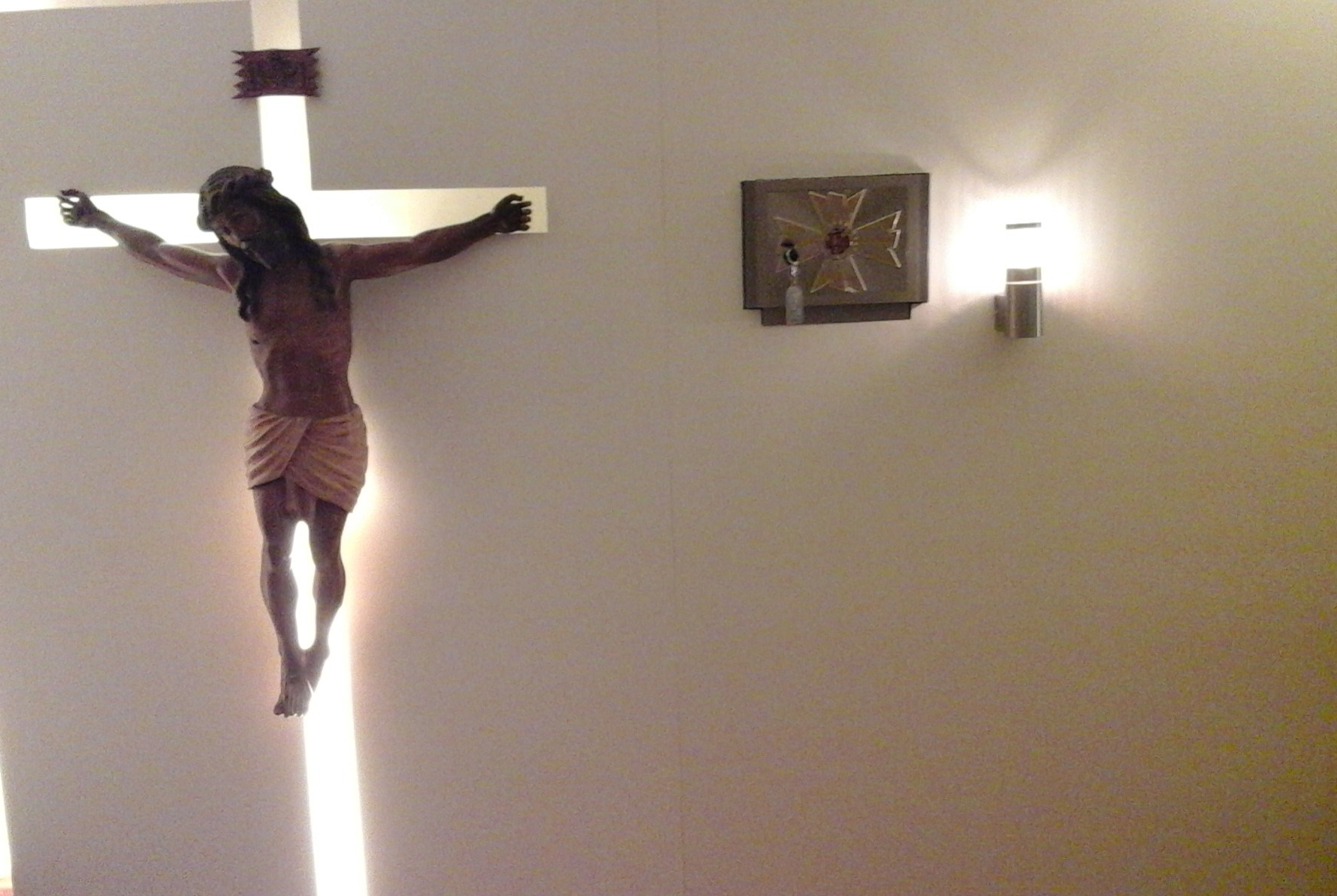
The Cross is the throne of our Lord Jesus Christ, King of the Universe. It is also a lesson in itself, the most profound Jesus has given us that continues to unfold and unravel the “depth and breath” of God’s love for each of us.
Through his Cross, Jesus did not only enter humanity but also allowed humanity to enter him by putting into his heart its very symbolism which is death we all deny and are afraid of. By dying on the Cross, Jesus turned it into a blessing to now become the symbol of life.
Let’s make an illustration.
Yes, it is Bruce Willis from a scene in one of his popular series, “Die Hard” which I continue to watch whenever possible.
What I like most with Bruce Willis in all of his movies is his being so “human” – very vulnerable physically, emotionally and even psychologically. His roles never hide his being a frail human being despite his muscular strength and tactical acumen. Bruce never hides his weaknesses that he can get shot and wounded, dumped and divorced or cheated by his wife like in “The Last Boy Scout”, making him more believable than the other action stars.
And that’s our point here: Jesus never hid his humanity from us. The all-powerful God on whose everything was created according to St. Paul in the second reading became human like us in every aspect except sin.
He is the image of the invisible God, the firstborn of all creation. For in him were created all things in heaven and on earth… He is before all things, and in him all things hold together. He is the head of the body, the church. He is the beginning, the firstborn from the dead, that in all things he himself might be preeminent. For in him all the fullness was pleased to dwell, and through him to reconcile all things for him, making peace by the blood of his cross through him, whether those on earth or those in heaven.
Colossians 1:15-19
Carmelite Monastery, Guiguinto, Bulacan, 12 November 2019.
In becoming human like us, Jesus entered our humanity. He who is the Son of God became an infant and child so weak, entrusting himself to us humans.
And when he had grown into a man, he experienced leaving home and family to fulfill his mission like almost everybody. He had friends, some eventually became faithful while another had betrayed him.
Jesus went to almost every gathering like weddings and banquets, met everybody from the “who’s who” to the nobody like sinners and marginalized. He was manly enough to relate with every kind of people, be they children or women, rich and poor alike.
He had wept at the death of a good friend and the impending destruction of his beloved city of Jerusalem, felt hunger and thirst, got angry and was surprised in some occasions.
Jesus is truly human that we can also identify with him but in his dying on the cross, we were able to enter him to become like him when on his Resurrection, he took away the curse of death and turned it into pure grace in him.
Cross at the Dominican Hill in Baguio City, January 2019.
A very unique characteristic of Jesus as a human is his being a radical in its truest essence and meaning. From the Latin word “radix” that means roots, Jesus brought us back to our very roots, to our grounding of being who is God himself.
Too often, we think of radical people as rebels and revolutionaries leading movements and many changes in the society. They are the “game changers” because they radically change things to show us the more essential.
But in reality, radicals do not change things: they restore things to its original state and being. They get into the roots or “radix” of things to bring out its true meanings by doing away with the unimportant accidentals that have taken over the realities.
That is why Jesus is a radical: by dying on the Cross, he firmly reestablished his throne as King of the Universe because that is where evil ended and death is conquered.
It is on the Cross his throne where every new life begins because it is our very rootedness and “grounding of being” as beloved children of God in him.
Most of all, it is on the Cross his throne, our root and grounding from which comes our sole focus and attention in life – God in Christ Jesus.
The rulers sneered at Jesus… even the soldiers jeered at him. Now one of the criminals hanging there reviled Jesus, saying, “Are you not the Christ? Save yourself and us.” The other, however, rebuking him, said in reply, “Have you no fear of God, for you are subject to the same condemnation? And indeed, we have been condemned justly, for the sentence we received corresponds to our crimes, but this man has done nothing criminal.” Then he said, “Jesus, remember me when you come into your kingdom.” He replied to him, “Amen, I say to you, today you will be with me in Paradise.”
Luke 23:35, 36, 39-43
We have a beautiful expression in Filipino about a person described as “malalim” or deep. A radical is the truly deep person because he is rooted and grounded in his being who is God!
Anyone who truly recognizes Jesus Christ becomes a radical person too, a person of depth because he is rooted in God like the other thief hanging on the cross with Jesus.
See how the rulers or the elite like the priests and elders of Israel who sneered at Jesus: the more they poked fun on him as “the Christ of God”, the more they indict themselves of the grave crime of putting Jesus to death. Eventually at the death of Jesus, the Temple curtain would be torn from top to bottom to signal the end of temple worship and the start of worshipping God in “truth and spirit” in Christ.
The soldiers jeered Jesus too because they “know not what they were doing” because they were all pagans. But again, upon Christ’s death, we find one soldier there at the scene declaring “truly this is the Son of God.”
In any case, some members of Israel’s rulers and Roman soldiers eventually followed Jesus after the Resurrection to show us how the Cross is indeed the throne of Christ the King: it is also a door that opens anyone to conversion, to accept his reign and kingdom!
Most of all, the “good thief”, usually referred to as Dimas, shows us how at the cross any one can become radical like the Lord. While agonizing with Jesus on the cross, Dimas must have examined his life and got into his very core, his roots and realized that basic truth inside him was right there suffering also with him — Jesus whose name means “Yahweh saves”.
What is so surprising with his request from Jesus “to remember him he gets into his kingdom” is the fact that in the Old Testament, it is God who always remembers his people, remembers his promise, remembers his covenant.
Man always forgets God and his covenant that we always turn away from him to live in sin. But at the cross, the throne of Jesus our King, he enables us to remember our roots, our being children of God, our being loved and forgiven that we finally find our way back home.
And that home is God in eternity: “Today you shall be with me in Paradise.”
Every time we are at the cross, when we are getting through so many pains and sufferings, failures and disappointments, even darkness and sin, get into your roots – Jesus Christ – and you will never get lost.
Long before we got into all these crosses in life, remember Jesus was there first for us to suffer and die on his Cross. And that is why he is our King for he rose again so we can become like him in eternity. Amen.
Friday, Memorial of St. Cecilia, Virgin and Martyr, 22 November 2019
1 Maccabees 4:36-37, 52-59 ><)))*> <*(((>< Luke 19:45-48
Candles seen from our altar onto our church rear, 18 November 2019.
Lord Jesus Christ, Light of the World, please keep your fire burning within us, always aglow with your firm faith, fervent hope and unceasing charity and love.
On this memorial of your virgin and martyr, St. Cecilia who is also the patroness of sacred music, may we imitate her to keep on “singing the song of God in our hearts”, whether in good times or in bad.
Let us praise you both in words and in deeds without ceasing.
How sad that we are like the Jews after their victory over the Gentiles in the Maccabean revolt: very enthusiastic at first that eventually waned, becoming complacent that after a hundred years, the Romans easily conquered and subdued Jerusalem.
On the anniversary of the day on which the Gentiles had defiled the temple, on that very day it was reconsecrated with songs, harps, flutes, and cymbals. All the people prostrated themselves and adored and praised heaven, who had given them success.
1 Maccabees 4:55-56
Forgive us, Lord, on the many occasions when we are so eager and full of zeal in praising you and doing your will after we have gained particular blessings and intentions from you that later on, we become complacent like your contemporaries.
Jesus entered the temple area and proceeded to drive out those who were selling things, saying to them, “It is written, my house shall be a house of prayer, but you have made it a den of thieves.”
Luke 19:45-46
Candle in our sacristy, 19 November 2019.
Let us not be complacent, Lord.
Remind us that our work and mission from you will continue until we rest in you, O Lord.
Thursday, Memorial of the Presentation of Mary to the Temple, 21 November 2019
Zechariah 2:14-17 ><)))*> <*(((>< Matthew 12:46-50
Feast of the Presentation of Mary at the Temple originated from the Eastern Church where it is known as “The Introduction of the Theotokos (Mother of God) to the Temple”. Photo from Google.
Dearest Lord Jesus Christ:
As we celebrate the memorial of your Mother Mary’s presentation at the Temple, I am deeply struck by the gospel scene for this feast.
Someone told Jesus, “Your mother and your brothers are standing outside, asking to speak with you.” But he said in reply to the one who told him, “Who is my mother? Who are my brothers?” And stretching out his hand toward his disciples, he said, “Here are my mother and my brothers. For whoever does the will of my heavenly Father is my brother, and sister, and mother.”
Matthew 12:47-50
This is so striking to me, Lord because here you are asserting your authority outside your family circle. Here you are telling us of the need to eventually leave our family and friends in order to join you in your mission and journey.
It is very true that we find our first sense of belonging in our family and circle of friends but as we get older like you in Nazareth, our larger sense of belonging to God our Father can only happen when we break free from our family and friends.
Not because we do not love them but primarily because each of us has a calling and mission from you that must be followed and fulfilled. And to do so, we have to leave our family and friends in order to heed and follow your call, O Lord.
In this age of social media, there are some family and friends who get the wrong notion that belonging and possessing or ownership go together, that parents own their children, and friends own each other.
I pray for all parents to imitate St. Joachim and St. Anne who clearly knew they did not own Mary their daughter, that she is God’s that they have to offer her to him at the temple.
May we all grow into maturity that there comes a time when we have to leave our family and friends, even say “no” to them to be like you to freely say “yes” to the Father. Amen.
Quiet Storm by Fr. Nick F. Lalog II, 20 November 2019
A chef is basically a person who loves people. And that is why for any chef, cooking is both a passion and an art. His menu are not only meant to feed the body but most especially enrich the heart and soul of every diner.
Welcome to Netflix original series “Midnight Diner: Tokyo Stories”!
Each episode is exactly like every recipe the main character called “Master” dishes out to his patrons and customers who come from all walks of life with their unique burdens and story to share and eventually, resolve after tasting his fresh and easy to cook meals.
Midnight Diner is as Japanese as the ramen and sake the Master serves his guests. Everything is in Nihongo with English subtitles that demand one’s total attention to understand the conversations briefly interspersed with first person accounts by the Master.
At the opening, the Master gives us the warm and nice ambience of the series set at midnight until seven in the morning for people who do not wish to go home straight after their office hours.
It turns out that they are not only looking for good food but for warm company as well which the Master ably provides with his total attention and communion.
Very interesting to note that the Master is a celibate, reason why he can devote himself wholly to his diners, listening to their joys and sorrows, victories and defeats. So far, from what I have seen in its two seasons, he has no love interests although it won’t be surprising if in the third season he turns out to be a character from one of Murakami’s novels or short stories.
Though he is a fictional character, he is rightly called “Master” for his commanding presence that is not intimidating but so warm and gentle, so unlike the celebrity chefs we see on TV.
The Master can cook anything, including fancy corndogs and pancakes that are very American. He always has a “menu of the day” as title of each episode.
Should anyone ask for any kind of dish, he willingly prepares it subject to availability of ingredients that turns out he always has or sometimes, like a true chef, finds other alternatives just to fulfill a customer’s cravings. In one episode, a patron comes nightly with his own three pieces of bread so the Master can make him “yakisoba sandwiches” — exactly how we Filipinos eat pancit with another carbohydrate!
What makes the series so good is that the Master is more than a chef — he is the Tokyo counterpart of Paris’ Cafe Anglais famed lady chef “Babette” of the 1987 Danish film “Babette’s Feast” and James Taylor’s 1977 hit single “Handy Man” rolled into one.
More than the food he passionately serves, the Master delights and comforts every troubled heart and lonely soul longing for love and relationships, forgiveness and kindness they finally find in his Midnight Diner.
Most of all, neither the Master nor his food is the main focus of each episode but the story of every customer who comes to his diner at the most unholiest hours – between 12 midnight and seven in the morning – searching for food for their souls!
Mainstays of the Midnight Diner.
Helping the Master in processing every customer are his interesting mix of characters of regular patrons: LGBTQ members, career ladies mostly single, retirees, professional gamblers and of course, Yakuza gang members.
They are the Master’s “secret spices” who bring out all the flavors and aroma of every customer’s life story like a widowed lawyer searching for his lost step brother to a nightclub stripper sought and saved from miserable life by her high school teacher suffering the early stage of Alzheimer’s disease. Sometimes they act like the Master’s garnishings, adding taste and beauty with some sprinklings of life lessons to lost customers.
Though most stories are understandably peculiar to Japanese culture, they all touch a common chord within us for our basic need of acceptance which the Master warmly provides like his steaming hot dishes.
Unlike most TV series, Midnight Diner’s pacing is so fast and without any pretensions that prevent it from becoming dragging and boring. In less than 30 minutes, each episode is deftly resolved just as magically how the Master came out with a superb meal from his limited resources and tiny kitchen.
But the best attraction of the show is how the viewer eventually finds one’s self warmly welcomed into the diner, laughing or crying, sympathizing or objecting to whatever situation is presented by every guest.
It is a very lovely series that transcends language barriers and cultures because it nourishes and warms our soul that never rest nowadays due to the demands of modern living. Somehow, inside the little Midnight Diner, there is always a space welcoming everyone including us viewers to unwind and be fulfilled with good food, nice people, and meaningful conversations.
2 Maccabees 7:1, 20-31 ><)))*> <*(((>< Luke 19:11-28
Candle and ordo in our sacristy, 17 November 2019.
Today’s first reading is very interesting, Lord, especially that part describing the disposition of the mother of the seven Maccabean brothers facing execution:
Filled with a noble spirit that stirred her womanly heart with manly courage, she exhorted each of them in the language of their forefathers…
2 Maccabees 7:21
I really wonder the meaning of “womanly heart with manly courage” but something tells me it is exactly what we need these days.
A womanly heart is a faithful heart, like a mother who would never forsake her child (Is. 49:15). It is a heart willing to bear all pains in life, suffering in silence, totally empty for the beloved and filled with God.
In this age of “instants” where lines are always moved to accommodate our whims and selfish desires, we need a womanly heart that is rooted and inclined to you O God.
Like the mother of the Maccabean brothers, she freely gave up her sons and exhorted them to look more intently to you, God, than to her herself, insisting that in the end, we are all answerable to you alone, O Lord.
Our sacristy table, 17 November 2019.
Manly courage, on the other hand, Lord is perhaps our ability to muster our strength to be truthful about our very selves.
It is something that still pertains to the heart because the word “courage” is from “cor” or heart.
A manly heart is a sincere heart that gallantly accepts one’s limitations than pretend to be somebody else.
In our suffocating world of social media where everybody is blowing out of proportion everything including one’s self, it is very ironic that while everybody claims to be the best, the more our lives are in a mess.
Like those servants in your parable, O Lord, grant us a manly heart so we may graciously accept our role and mission in this life to please you than pretend to be somebody else who really has nothing at all. Amen.
2 Maccabees 6:18-31 ><)))*> ><)))*> ><)))*> Luke 19:1-10
Sunrise at Camp John Hay, Baguio City, November 2018.
While praying over today’s first reading, Lord, I wondered what if you were just pretending to be good? What if everything going on in our lives is a big act of pretending so as not to destroy the flow of life or throw everything off balance?
No, it cannot be, dear loving Father!
We are so sure you are real! And this life, our very selves are real.
The problem is with us when we always pretend, when we are afraid to show what is true, what is real, what we believe and what we feel.
So often we pretend you are not real, that you do not exist even if we are convinced of your love and presence.
The problem with pretending is that it is not true, it is a lie.
The problem with pretending is we never realize our true value.
Unfortunately, we still keep on pretending that pretending can work, that pretending is good.
Let us stop pretending, Lord, because we can never escape you, the Ultimate Truth.
Eleazar said: “Should I thus pretend for the sake of a brief moment of life, they would be led astray by me, while I would bring shame and dishonor on my old age. Even if, for the time being, I avoid the punishment of men, I shall never, whether alive or dead, escape the hands of the Almighty.”
2 Maccabees 6:25-26
Give us the courage to be truthful like the 90 year-old Eleazar and chief tax collector Zacchaeus of Jericho who never pretended about who they really were, of the truth about you, O God, that eventually they experienced your saving power in Christ. Amen.
Monday, Dedication of the Basilicas of Sts. Peter and Paul, 18 November 2019
Acts of the Apostles 28:11-16, 30-31 ><)))*> Matthew 14:22-33
High Altar of St. Peter’s Basilica
My dearest Lord Jesus:
It is again the start of work and studies.
How I pity Monday!
It is perhaps the most hated day of the week primarily because of the many fears it brings upon us.
Inner and outer fears that lead us to doubt our selves, our talents and abilities, even people around us.
And worst, of doubting YOU.
There are times we are like the Apostles who could hardly see you coming to us in times of darkness and storms in life.
Though you keep on calling us, assuring us of your presence, to be not afraid, we still choose to be afraid that we sink deeper into sin and evil.
Immediately Jesus stretched out his hand and caught Peter, and said to him, “O you of little faith, why did you doubt?”
Matthew 14:31
Hardly a day passes in our lives, Lord, without our experience of so many fears, doubts, apprehensions, and anxieties that drain us of so much energies to do more good things for you through others.
Some of us have long been held captive by this dark power of fear within and without that we hardly experience true freedom!
As we celebrate the dedication of the two Major Basilicas in honor of your two great Saints and Apostles, Peter and Paul, teach us to come home to your dwelling place of love and freedom, not of fear and doubts.
Teach us to be at home with you, to always find you even in the midst of darkness and giant waves of uncertainties. Amen.
St. Paul with a sword in front of the Basilica in his honor in Rome. From Google.