40 Shades of Lent by Fr. Nicanor F. Lalog II
Solemnity of the Annunciation of the Lord, 25 March 2021
Isaiah 7:10-14, 8:10  +  Hebrews 10:4-10  +  Luke 1:26-38
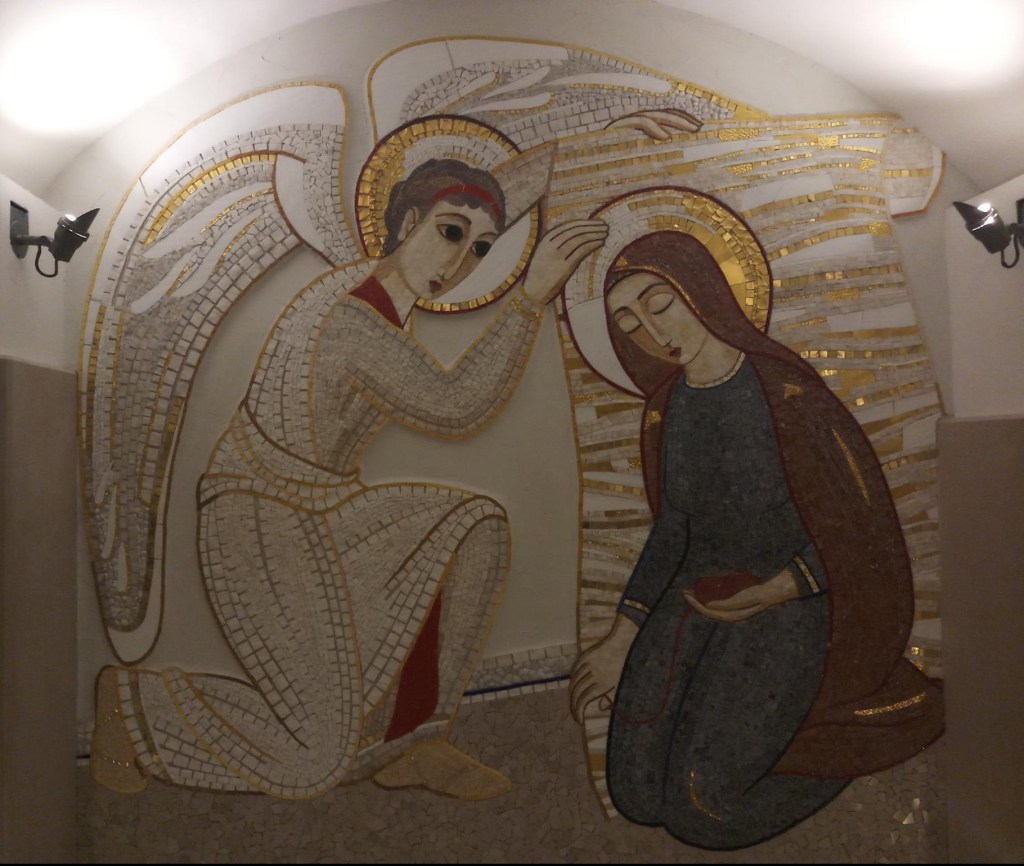
Photo by Arch. Philip Santiago of a mosaic of the Annunciation at the Shrine of St. Padre Pio at Rotondo, Italy, 2018.
Praise and glory to you, O God our Father on this Solemnity of the Annunciation of the birth of our Savior Jesus Christ! Thank you very much in fulfilling your promise, in sending us the perfect offering we can have to be one with you again.
Brothers and sisters: It is impossible that the blood of bulls and goats take away sins. For this reason, When Christ came into the world, he said, “Sacrifice and offering you did not desire, but a body you prepared for me; in holocausts and sin offerings you took no delight. Then I said, ‘As is written of me in the scroll, Behold, I come to do your will, O God.’” By this “will,” we have been consecrated through the offering of the body of Jesus Christ once for all.
Hebrews 10:4-7, 10
In his becoming human like us, your Son Jesus Christ taught us the value and beauty of obedience to you, O God, even unto death on the cross to restore our relationships with you and with one another destroyed by sin.
Teach us, O God, as we celebrate the Annunciation of the Lord, that more than the many things we expect in this life like our plans and dreams are the relationships and ties that bind us together as family and friends, as a nation and your people.
Give us the grace to offer our very selves, to let go of our many plans and agenda in life like the Blessed Virgin Mary as well as her most chaste husband St. Joseph to always say “yes” to your words, to your calls and invitations.
Mary said, “Behold, I am the handmaid of the Lord. May it be done to me according to your word.” Then the angel departed from her.
Luke 1:38
May we be like Mary giving flesh to your Word Jesus Christ, bringing his peace and mercy to this world so wounded by our many divisions and self-interests even in the midst of a pandemic. Amen.
Photo by author, site of the Annunciation, Basilica of the Annunciation at Nazareth, Israel, 2019.
40 Shades of Lent by Fr. Nicanor F. Lalog II
Monday, Fifth Week in Lent, 22 March 2021
Daniel 13:41-62   ><}}}*> + <*{{{><   John 8:1-11
Praise and glory to you, O God our loving Father for the gift of life, for this final week of Lent you are giving us to continue uncovering the sins we hide from you, from others and even from ourselves. And worst, the sins of others we bare to cover our own sins.
How wonderful are your words today, Lord, of two women accused of adultery – one falsely, the other guilty – but, the same story of your justice and mercy.
Susana in the first reading was spared from death when her two accusers who were both elders and judges of the people were convicted of perjury following the courage and wisdom of your prophet Daniel.
As she was being led to execution, God stirred up the holy spirit of a young boy named Daniel, and he cried aloud, “I will have no part in the death of this woman.” All the people turned and asked him, “What is this you are saying?” He stood in their midst and continued, “Are you such fools, O children of Israel! To condemn a woman of Israel without examination and without clear evidence? Return to court, for they have testified falsely against her.”
Daniel 13:45-48
Stir in us, O God the same Holy Spirit that like Daniel we may have the courage to defend and stand for those wrongly accused of any wrongdoing whether in our homes or community or in the courts.
I pray most especially for women who are often at the receiving end of false accusations, of gossips and of hurtful lies. The victims of rape and molestation and sexual harassment cry in the silence of their deep pains and sufferings just because they are women and sadly, because their accusers are men of stature and position. Send us more Daniels, dear God to defend them.
Let us take into our hearts the challenge of your Son Jesus Christ to let the one who is without sin be the first to throw a stone at anyone guilty of sins (Jn.8:7). It is not that we must be silent with the evil persisting around us but so we may be cautious against hasty pronouncements and judgement against those guilty of any sin.
Worst of all is when we accuse sinners of evil they are guilty of doing only to cover our own sins we have been hiding from you and others, even foolishly from ourselves. Give us some decency, at least like those people, “beginning with the elders (Jn.8:9)” who left guilty of sins without casting any stone to the woman caught in adultery.
Have mercy on us, Jesus, when we act like those Pharisees and scribes who look for sinners, accuse them in public in order to look good and find something against you. Amen.
40 Shades of Lent by Fr. Nicanor F. Lalog II
Friday, Solemnity of St. Joseph, Spouse of the Blessed Virgin Mary
2 Samuel 7:4-5, 12-14, 16  +  Romans 4:13, 16-18, 22  +  Matthew 1:16, 18-21, 24
Photo by author of the site believed to be the workshop of St. Joseph in Nazareth, 2017.
Today’s celebration of the Solemnity of St. Joseph as most chaste spouse of the Blessed Virgin Mary is a very special one being in the “Year of Saint Joseph” that began last December 8, 2020 until December 8, 2021 in commemoration of the 150th year anniversary of Pope Pius IX’s declaration of the beloved saint as Patron of the Universal Church.
In launching this Year of Saint Jospeh last year, Pope Francis wrote in his Apostolic Letter “Patris Corde” (With a Father’s Heart) how the COVID-19 pandemic has helped us see more clearly the importance of “ordinary” people who, though far from the limelight, exercise patience and offer hope every day.
The Holy Father explained that the “ordinary” people like those who kept our lives going especially during the lockdowns resemble Saint Joseph, “the man who goes unnoticed, a daily, discreet and hidden presence,” who nonetheless played “an incomparable role in the history of salvation” (Vatican News, 12 December 2020).
I really hope you can have time to read today this very short letter by Pope Francis who is a known devotee of Saint Joseph having popularized among us during his 2015 Papal Visit the image of “Sleeping Saint Joseph”.
In Patris Corde, Pope Francis gives us some helpful points on how we can love with the heart of God our Father like Saint Joseph during this time of the COVID-19 pandemic. One of these traits the Pope invites us to imitate from Saint Joseph is his “creative courage” in loving God and loving others.
If the first stage of all interior healing is to accept our personal history and embrace even the things in life we did not choose, we must now add another important element: creative courage. This emerges especially in the way we deal with difficulties. In the face of difficulty, we can either give up and walk away, or somehow engage with it. At times, difficulties bring out resources we did not even think we had.
Pope Francis, Patris Corde #5
A creative person is always someone who is deeply in love with another person or with one’s craft, art, career or whatever passion.
The most loving person is always the most creative like Saint Joseph who sought ways expressing his love for Mary and her child by deciding to silently divorce her as the gospel tells us.
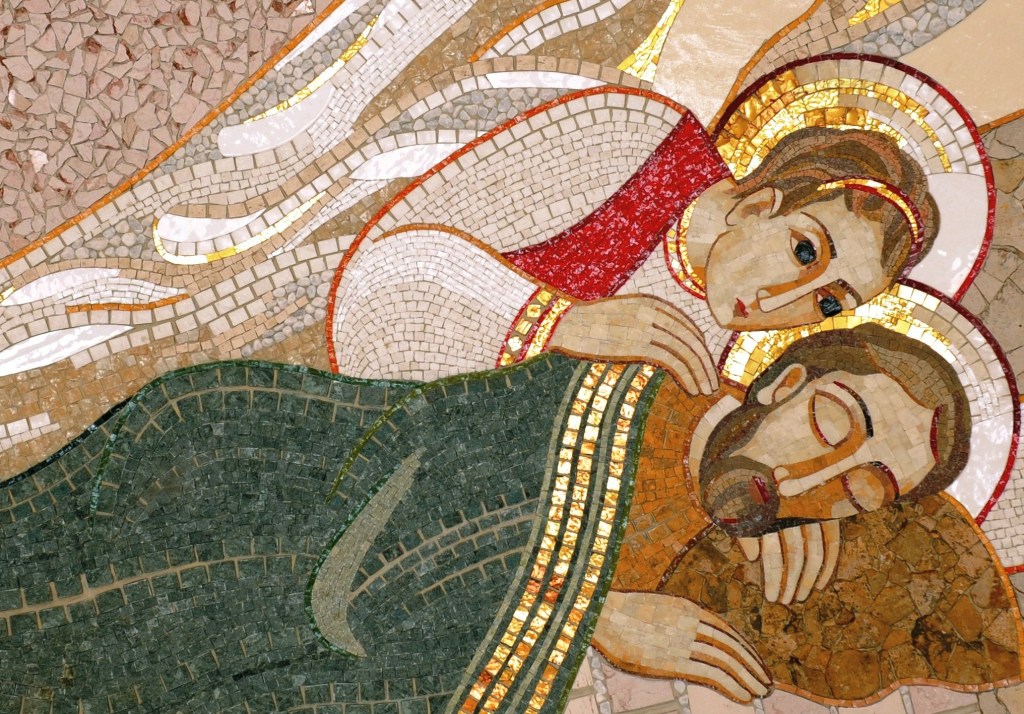
This is how the birth of Jesus Christ came about. When his mother Mary was betrothed to Jospeh, but before they lived together, she was found with child through the Holy Spirit. Joseph her husband, since he was a righteous man, yet unwilling to expose her to shame, decided to divorce her quietly.
Matthew 1:18-19
Photo by Arch. Philip Santiago of a mosaic at the San Padre Pio Shrine at Rotondo, Italy of the angel appearing to Saint Joseph in his dream.
Holiness is having creative courage like Saint Joseph.
Notice how the Pope’s description of Saint Joseph is not far from St. Matthew’s calling him a “righteous man” – a holy man – who obeys the Laws of God handed down to them by Moses, including their other traditions meant to keep them clean and pure before God.
Problem during that time is how people have lost sight of God and of others that they were so focused on the letters of the law than its spirit, becoming impersonal in the process as we have seen in instances when they would ask Jesus why he healed the sick even on sabbath day. Worst is when people brought to Jesus a woman caught committing adultery, reminding him of Moses’ instruction to stone her in public.
Such was the dilemma faced by Saint Joseph with Mary being pregnant with a child definitely not his!
In deciding to silently leave Mary, Saint Joseph expressed his righteousness or holiness wherein he showed the true interpretation of their Laws by upholding the dignity of every person, respecting life above all. Like Jesus Christ, Saint Joseph showed that real holiness is authentic love that is willing to sacrifice for the beloved by having the courage to be in pain in giving up or losing a beloved.
Here we find Saint Joseph was not only courageous in facing the painful truth about Mary having a baby not his but also very creative in the sense that because of his great love for the Blessed Virgin, he did not want her exposed to shame and public humiliation in allegedly breaking the seal of their betrothal.
Having courage is more than being able to do death-defying acts that is more on physical strength; courage is a spiritual virtue, a spiritual strength when we do extraordinary things because of higher ideals and values like the love of Jesus who offered us his life on the Cross.
Courage is from the Latin word “cor” for heart which is the seat of our being. And to have courage is to be true and loving that we have such expressions to speak from the heart, to listen to our heart, and to act from our heart when we dare to lose ourselves because of love.
Photo from Aleteia.org of “Let Mum Rest” image St. Joseph nursing the Infant Jesus while Mary sleeps, 2019.
A person who truly loves is always creative,
finding ways in expressing one's love even sometimes
it may be painful and difficult.
A “creatively courageous” person like Saint Joseph is someone so deeply in love with Mary and with God: after learning the circumstances surrounding Mary’s pregnancy, St. Matthew tells us “When Joseph awoke, he did as the angel of the Lord had commanded him and took his wife into his home” (Mt.1:24).
Saint Joseph’s love for Mary found ways to spare her all the pains and hurts that may result if found with a baby not his; but after learning the truth, the more we find him creatively courageous when he sought many ways to save Mother and Child from all harm and even death like bringing them to Egypt in the time of Herod.
See that when Saint Joseph accepted Mary, Jesus came forth to us while at the same time, when Saint Joseph accepted God through the angel as expression of his deep faith and love, he took Mary as wife.
And this is what Pope Francis further explains in Patris Corde that at the end of every account in which Saint Joseph plays a role, the Gospel tells us that he gets up and takes Jesus and Mary who are the most precious treasure of our faith.
Taking Jesus and Mary like Saint Joseph as creative courage calls us Christians to always love the Church and in loving the Church, we love the poor for whom Jesus came and Mary identified herself with in her Magnificat which she sang after accepting the Annunciation by the Angel of Christ’s birth which we celebrate next week on March 25.
In this time of the pandemic, we are called to be creatively courageous in finding Jesus among those people too familiar with us as well as with those so different from us. Don’t you find it so funny that the people we always take for granted are those either so close to us like family or completely strangers?
Being creatively courageous in this time of the pandemic means being more sensitive with others especially in our words and actions like Saint Joseph.
I was wondering during prayers why did he not ask Mary about the truth of her pregnancy so that he would have been spared with all the thinking and praying? That is when I realized the value of Saint Joseph’s silence: he did not speak at all to Mary as a sign of his love and oneness with her who must have been into some difficulties too with the situation of being the Mother of Christ. sympathy.
In his silence, Saint Joseph expressed his complete trust in Mary and in God. And in his being silent, Saint Joseph was creatively courageous expressing aloud his tenderness and care for Mary and her Child, something we need so much in this time of the pandemic.
Let us pray to Saint Joseph in this time of social distancing that like him, we may have the creative courage in touching others with the love of God, especially those who are sick and suffering, those in difficult situations, and those forgotten by their families and friends and even by the society. Have a blessed Friday, everyone!
Saint Joseph, Patron of the Universal Church, pray for us!
Photo from Vatican News, St. Joseph and the Child Jesus, 14 December 2020.
40 Shades of Lent by Fr. Nicanor F. Lalog II
Wednesday, Third Week in Lent, 10 March 2021
Deuteronomy 4:1, 5-9   <*{{{><  +  ><}}}*>   Matthew 5:17-19
Photo by Dr. Mai B. Dela Peña, MD, at Tokyo, 2018.
God our loving Father in heaven, you have designed us to always remember people and events, their meanings and significance, and most especially, to always remember you and your love and kindness for us. But, alas, due to our fallenness, we have become “beings-of-forgetfulness” too.
In this season of Lent as we pray more and slow down in life, give us the grace to refresh our memories, to remember the many good people and good things they have brought us. Most especially, help us keep our memories not only of your laws but of their meanings, of the relationships they lead us to keep you through others.
Moses spoke to the people and said: “However, take care and be earnestly on your guard not to forget the things which your own eyes have seen, nor let them slip from your memory as long as you live, but teach them to your children and to your children’s children.”
Deuteronomy 4:9
How sad we are always afflicted with selective memory when we choose which and whom to remember and to forget. More sad is the fact that we forget you more, disregarding all the good gifts you have given us.
Help us make every effort to remember you, dear God, by cultivating and nurturing within us the relationship you have established with each of us with others through Jesus Christ.
Give us the grace to fulfill your laws by loving and respecting one another for that is the essence of to RE + MEMBER, which is to make somebody a member again of every present, of every here and now. Amen.
40 Shades of Lent by Fr. Nicanor F. Lalog II
Tuesday, Third Week in Lent, 09 March 2021
Daniel 3:25, 34-43   ><}}}*> + <*{{{><   Matthew 18:21-35
Photo by Mr. Chester Ocampo, UST High School, 2019.
Thank you, God our Father in heaven, for the gift of Lent. Now we are into its third week, I could strongly feel its character, its impact, making me realize of the need to pray for more patience. From you. And for me.
Patience from You.
Like Azariah in the first reading, we pray for your patience to bear with us for our many sins that have brought us to our lowest point in life. Teach us to pray for mercy and forgiveness like Azariah, to plea for your patience to our hardness of hearts.
For we are reduced, O Lord, beyond any other nation, brought low everywhere in the world this day because of our sins. We have in our day no prince, prophet, or leader, no burnt offering, sacrifice, oblation, or incense, no place to offer first fruits, to find favor with you. But with a contrite heart and a humble spirit let us be received; as though it were burnt offerings of rams and bullocks, or thousands of fat lambs, so let our sacrifice be in your presence today as we follow you unreservedly; for those who trust in you cannot be put to shame.
Daniel 3:37-40
How wonderful it is, O Lord our God, of your patience — that virtue of enduring suffering and pain — when we are the ones who have turned away from you, we were the ones who have hurt you with our sins and here you are, bearing all the pains for us?
Thank you for bearing with us always.
And forgive us when we lack patience.
Please, grant us patience…now!
But kidding aside, how ironic that we keep on asking for patience from you and from others too when we cannot be patient at all in dealing with our fellow debtors and sinners like that unforgiving servant in the parable today. You have been so patient in forgiving all our debts yet we cannot forgive those who owe us with less.
Methinks maybe we have not suffered that much, we have never been patient at all that we have not truly felt and realized your patience for us.
Like Peter, we would rather be thinking of quantity, of how many times must we forgive those who wrong us that eventually we run out of patience because of the great number of sins against us.
We have never been patient at all if what we do is keep tabs of the wrongs and sins against us. We do not bear any suffering at all but merely count them like Peter.
Teach us to stop counting the sins of others and be like you in being patient with us sinners: you forgive because we are your children, because you love us.
That is perhaps the key to being patient: instead of counting how many times should we forgive, let us see more why we must forgive because we are all forgiven sinners in your Son Jesus Christ. Perhaps if we can keep that in mind, then we can always patient with our fellow sinners. Amen.
The Lord Is My Chef Sunday Music by Fr. Nick F. Lalog II, 07 March 2021
Photo from turbosquid.com.
The Season of Lent is like a refresh or reset button of the computer: it is a time when we “reboot” ourselves with prayers, fasting and abstinence, and alms giving to be connected anew with God and with one another. It gives us another chance to make things better in our lives marred by sins and many pains and hurts in the past.
And that is why for this Sunday we have chosen American R&B group Champaign’s 1983 single “Try Again” from their album Modern Heart. It peaked at number 23 on the Billboard Hot100 of that year.
I find the song very lenten in character. The music is sober but not bland. In fact, the cool instrumentation especially at the start kept ringing in my ears as I prayed over the readings this whole week, kind of convinced me of how truly sorry was Pauli Carman to his beloved in failing to be more loving, more intimate, and more personal to her.
I been starin’ at your photograph Wondering where you’re at today And I’ve been hanging by the telephone Hopin’ that you’d call home and stay
You told me you needed More walks, more talks More feelin’ close to me I want to be close to you
I didn’t know you needed Some roses, some romance A little candlelight and slow dance That’s not how it’s been But maybe we can try again Try, try, maybe we can try again
Sometimes in life, we take people around us for granted, we always presume everything is given, everything is well and good, that our loved ones know or assured that we love them so much. Worst is how we sometimes forget that in our love for our family and friends, we have been so focused in our other pursuits purportedly for them that in the process we actually forget them. Things can never replace persons who need to be loved and cherished.
I always tell couples that after years of living together with the coming of kids and career and problems, always remember, first there was your wife or husband for you. No matter what happens, God first called you to each other. Continue the courtship, keep surprising each other with expressions of your love for each other. Watch movies, have romantic dinners together.
The same with us priests: before all the demands of the ministry and apostolate came, there was first Jesus Christ who had come to call us, loving us that every day we have to pray, make time for him.
Try Again exactly tells us what the readings this Sunday teach us: of how we must cleanse ourselves to find our first love again, the person dearest to us. And the good news from God is that we can always try again and make up for our past sins and shortcomings to him and to one another.
Refresh, reset or reboot your self this Lent by making time for your loved ones for intimate and personal moments.
Have a blessed and refreshing week ahead!
Music video by Champaign performing Try Again. (C) 1981 Sony Music Entertainment
40 Shades of Lent by Fr. Nicanor F. Lalog II
Third Sunday of Lent in Cycle B, 07 March 2021
Exodus 20:1-17  ><}}}*>  1Corinthians 1:22-25  ><}}}*>  John 2:13-25
Parish Church of St. Joseph in Baras, Rizal.
One thing we notice in Lent is the “noble simplicity” of celebrations: no flowers at the altar, simple music without percussions, without Gloria no Alleluia meant to refocus our attention back to God in a more personal level.
That is why during Lent, our faith is refreshed or rebooted in order to “reset” it back to God himself than with rites and rituals and other formalisms that have made our relationships with him and with one another stagnant.
When faith and religion get fixated on formal codes of worship and belief, detached not only from God but even with people like those in the margins, then it had become an idolatry.
Since the Passover of the Jews was near, Jesus went up to Jerusalem. He found in the temple area those who sold oxen, sheep, and doves, as well as the money-changers seated there. He made a whip out of cords and drove them all out of the temple area, with the sheep and oxen, and spilled the coins of the money changers and overturned their tables, and to those who sold doves he said, “Take these out of here, and stop making my Father’s house a marketplace.” His disciples recalled the words of Scripture, “Zeal for your house will consume me.”
John 2:13-17
Photo from turbosquid.com.
Our personal, relating God
On this Third Sunday of Lent until its final Fifth week, we turn to the fourth Gospel of John to deepen our personal relationship with the Father in Christ when each gospel is compacted with signs and language rich in meanings to reignite our faith with “zeal” that “consume” us like Jesus.
Observe John’s formal introduction of this episode of cleansing of the temple by presenting to us its chronemics, the non-verbal communication of time and space to indicate the presence of God in Passover (time), Jerusalem, and temple (space/place). Keep in mind that the fourth gospel is called “the book of signs” because John would always use events, buildings and places, and people as signs pointing to Jesus as the Christ, the Son of God.
In this episode that immediately happens at the start of the Lord’s ministry as seen by John, something very wrong have happened with the very signs of God’s presence so revered by the people during their important feast of Passover right in their temple in Jerusalem: God had been eased out from the lives of the people and from their worship itself!
The gospels teem with many references at how the people at that time led by the temple officials and religious leaders have turned into worshipping rites and rituals than God himself, forgetting to serve the people by sticking to the letters than to the spirit of the Laws that Jesus always attacked.
It is similar to our own time where our faith and church worship have become empty of God and spirituality filled with human inanities led by some priests who tinker with liturgy, forgetting its noble simplicity, that less is always more. In our efforts to make God “present” with so many “shows” and gimmicks in the liturgy and church buildings, the more we have removed the Divine, unconsciously creating a cult around ourselves.
Notice some churches devoid of the holy with all the flat screens and tarpaulins all over. Worst is how priests have promoted this culture of shouting and clapping of hands during and after Mass as if God were deaf!
So many other things are sadly going in our celebrations where emotions are heightened without really stirring the hearts nor souls with God’s presence. Good liturgy flows from our personal and faithful relationship with God anchored in prayer life, not with shows and activities.
In the first reading, God reminds us in his Commandments that more than laws, these are meant to bring us into a relationship with him our God. See God speaking in the first person, addressing everyone with conversational personal pronouns, “I am the Lord your God” or “I am the Lord thy God”.
More than a mere body of commandments, the Decalogue are a covenant by God with people he had freed from slavery, pledging his unfailing fidelity to them who are expected to be wholeheartedly attached with him as their Lord and God. The Decalogue is first of all a call to intimacy with God expressed with our respect for one another.
This Lent, God invites us to renew our personal relationship with him in Jesus who had come to bring equilibrium in our lives through his Cross where our vertical relationship with the Father is intersected by our relationships with one another in Christ, through Christ, and with Christ. Without this, our faith or any religion will drift to extremes, either to joyless conformism as seen in fundamentalism and traditionalism or exaggerated expressionisms happening nowadays, disregarding the norms of liturgy and of sanity as well. In both instances, there is human manipulation strongly present that pretend to serve God but actually massage somebody’s ego, totally forgetting the people who suffer most.
Photo by author, 2019.
Jesus himself as the new temple
When Pope Emeritus Benedict XVI was newly elected in office, he wrote a bishop in Europe suffering with cancer. According to reports, the former Pope tried to uplift the spirits of the sick bishop by telling him that “Jesus saved the world not with activities but by suffering and dying on the cross.”
Beautiful words from one of the most spiritual and theological man of our time! Here lies too the fullness of our relationship with God expressed in our worship when our “zeal” for him is consumed in our oneness in Jesus Christ, our new temple.
At this the Jews answered and said to him, “What sign can you show us for doing this?” Jesus answered and said to them, “Destroy this temple and in three days I will raise it up.” The Jews said, “This temple has been under construction for forty-six years, and you will raise it up in three days?” But he was speaking about the temple of his body. Therefore when he was raised from the dead, his disciples remembered that he had said this, and they came to believe the Scripture and the word Jesus had spoken.
John 2:18-22
John now presents to us Jesus more than a prophet cleansing the temple with full authority, being the perfection of every worship that is “in Spirit and truth” (Jn.4:23) because as the Messiah of God offered on Good Friday which is also the feast of the Jewish Passover, his Body becomes the new temple.
Of course, sacred buildings are still important as well as rites and rituals but they are signs pointing to the realities of Jesus Christ, the Emmanuel or God-is-with-us truly felt in ourselves, in our lives when we have that oneness, that intimacy in him in our personal and communal prayers that flow down to our interpersonal relationships with others especially the poor and the suffering.
Last October, I had the most severe test in life when my only brother was diagnosed with an ailment affecting his spine, becoming immobilized for three months. I took him to my parish so I can look after him. What was most difficult for me was seeing him suffer, writhing in pain even in the middle of the night, sometimes begging me to ask God to take him so his sufferings may finally end.
I thought already knew how to pray, that I was tough and strong especially in my faith but, like a child, I would always hide and cry to God for my only brother who in his entire life has always been sickly and afflicted with many illnesses.
One morning in our daily Mass, tears swelled in my eyes during consecration as I held the Body of Christ in my hands with my voice breaking as I said, THIS IS MY BODY WHICH WILL BE GIVEN UP FOR YOU.
How I wanted to stop the Mass at that moment to cry in joy as I felt Jesus so true, in his flesh and blood, truly alive and personal!
Until now I could not explain what or how I felt that I cried at that time except that the night before, I assisted my brother in bed and cleaned him up. It was very difficult and even messy but a great moment of God’s grace and mercy for me expressing my love for him through my brother. That is when I realized that to truly touch Jesus is first of all to touch him among our sick brothers and sisters; that there is an intimate connection between the real presence of Jesus in the Eucharist and everyone especially the sick and suffering. And, for us to truly receive the Body of Christ, to experience the Holy Communion in him, we must first have his eyes and heart and hands among those deprived around us (https://lordmychef.com/2020/10/28/the-body-of-christ/).
Photo by Ms. Ria De Vera, Good Friday 2020.
Brothers and sisters: Jews demand signs and Greeks look for wisdom, but we proclaim Christ crucified, a stumbling block to Jews and foolishness to Gentiles, but to those who are called, Jews and Greeks alike, Christ the power of God and the wisdom of God. For the foolishness of God is wiser than human wisdom, and the weakness of God is stronger than human strength.
1 Corinthians 1:22-25
Faith in God is not meant to be explained nor analyzed. Though we do not stop studying and learning our faith doctrines and teachings, we are reminded this third Sunday of Lent to keep our zeal for God burning. Let us pray to Jesus that like him, may our zeal for the Father consume us by seeing him in persons not on things that are often self-serving. Amen.
Have a blessed and refreshing Sunday in the Lord with your family and loved ones!
The Lord Is My Chef Sunday Music by Fr. Nick F. Lalog II, 21 February 2021
Rainbow appearing during our procession of the Blessed Sacrament last year during the first Sunday of lockdown, 22 March 2020. Photo by Ms. Anne Ramos, Parokya ni San Juan Apostol at Ebanghelista, Bagbaguin, Sta. Maria, Bulacan.
Rainbows are one of nature’s loveliest occurrence that remind us of God’s all-encompassing love for us despite our sinfulness. It is the most enduring and visible sign of God’s promise to love and keep us always despite our being-of-forgetfulness — forgetting God and others, forgetting our promises to be good, forgetting our loved ones.
On this First Sunday of Lent, we find how in the first reading God gave Noah the rainbow as a sign of his covenant to never destroy earth again after the great flood. Only Noah and his family along with the animals inside his ark survived the great flood that cleansed the world of sinfulness. It became the prefiguration of Jesus Christ coming to cleanse us of our sins to be able to lead holy lives anew amid the many temptations in life as seen in today’s gospel.
Jesus in the desert resisting temptations by Satan depicts how life really is, full of contrasts and struggles but always there is Christ helping us, comforting us, strengthening us like a rainbow after every storm.
Eventually on Good Friday when Jesus offered us himself on the cross, he became our rainbow in fact as seen in the shape of his outstretched arms.
And that is why we have chosen South Border’s 2003 hit Rainbow first heard for the movie Crying Ladies.
The song perfectly captures our reflection for this Sunday that life is a Lent, filled with so many contrasts like sufferings and joys, failures and victories, darkness and light.
Fallin’ out, fallin’ in Nothing’s sure in this world no, no Breakin’ out, breakin’ in Never knowin’ what lies ahead We can really never tell it all no, no, no
Say goodbye, say hello To a lover or friend Sometimes we Never could understand Why some things begin then just end We can really never tell it all no, no, no But oh, can’t you see That no matter what happens Life goes on and on So Oh baby, please smile Coz I’m always around you And i’ll make you see how beautiful Life is for you and me
Take a little time baby See the butterflies color’s Listen to the birds that were sent To sing for me and you Can you feel me This is such a wonderful place to be Even if there is pain now Everything would be all right For as long as the world still turns There will be night and day Can you hear me There’s a rainbow always after the rain
The lyrics of this OPM are so Lent, in fact, that you can replace the “rainbow” with Jesus who is our Eternal Rainbow amid all the storms of life. Amen.
The Lord Is My Chef Sunday Recipe for the Soul by Fr. Nicanor F. Lalog II
40 Shades of Lent, First Sunday, Year B, 21 February 2021
Genesis 9:8-15   +   1Peter 3:18-22   +   Mark 1:12-15
Photo by author, ancient fortress of Masada in Israel, 2017.
Lent may be the most sparse in outward signs and decorations like flowers in all liturgical seasons but it is the most dense in meaning and imageries. Although it is often seen as a drab with its motif of penitential violet and subdued music when both Gloria and Alleluia are omitted, Lent sparkles with profundity and depth leading to joy deep within if we truly dwell into its main message of God’s encompassing love for us.
Take our gospel this First Sunday of Lent this year taken from Mark. It is the shortest compared with Matthew and Luke who both give us details, but, Mark’s brevity is so precise and thought-provoking, too!
The Spirit drove Jesus out into the desert, and he remained in the desert for forty days, tempted by Satan. He was among wild beasts, and the angels ministered to him. After John had been arrested, Jesus came to Galilee proclaiming the gospel of God: “This is the time of fulfillment. The kingdom of God is at hand. Repent, and believe in the gospel.”
Mark 1:12-15
Photo by Dr. Mylene A. Santos, MD, 2020, Infanta, Quezon.
Life is a daily Lent.
Of all the seasons in our liturgical calendar, Lent is my favorite because for me, it captures best the reality of life that is at the same time so beautiful but in some aspects ugly, nice but painful. There is always that contrasts of light and darkness that indeed, life is Lent, a daily Exodus filled with trials and difficulties that lead to joy and fulfillment in God.
See how Mark shows this so well in his brief narration that begins after the scene of the baptism of Jesus by John at Jordan. Immediately after that, Mark tells us without fanfare, “The Spirit drove Jesus out into the desert, and he remained in the desert for forty days, tempted by Satan.”
Is it not this is how life really is?!
At once after praying, after celebrating the Mass that is when you get into a debate with your wife or husband, son or daughter or siblings. Sometimes it happens while you are still in the church you get into arguments about parking. Right after you have resolved to be a better person and turn away from sins and its occasions, that is when your friends would come and ask you to join their “gimmicks” or that is when your “ex” would come or text you, entice you to go out again.
Photo by author, Egypt, 2020.
The desert is the image of that place of so many battles in life, where we cried in pain, where we were rejected, where we were hurt. Our life is like the desert, so hot and humid at day, so cold and freezing at night. Worse of all, the desert is our life because that is where we fight Satan who always deceives us with his many temptations that eventually lead us to wrong decisions, hurting not only us but those dearest to us, dividing our families, separating us from one another that in the end, we feel trapped in a terrible mess.
But, it is not that all bad because Jesus joins us in our battles and struggles in this life, in this desert that we find ourselves in a similar situation, “He was among wild beasts, and the angels ministered to him.”
Yes, life is difficult but it is in those situations we find its meaning and beauty. Though there are so many trials and sufferings, God never leaves our side, sending us angels like family and friends, even strangers who come and stay with us in life, believing in us, helping us, and most of all, loving us — right in the desert.
Photo by author, an oasis in the Dead Sea area of Israel, 2017.
Like an oasis where life springs abundantly, Jesus joins us in our many struggles against Satan by giving us the strength and courage to remain faithful to God, to experience fulfillment and salvation by giving us little pockets of Easter in the midst of our daily lent.
See that “After John had been arrested, Jesus came to Galilee proclaiming the gospel of God. Amid the bad news of John’s arrest, Jesus began his ministry and mission of love and mercy for us all, It was in the middle of such disturbing situation that Jesus came boldly proclaiming, “This is the time of fulfillment. The kingdom of God is at hand. Repent, and believe in the gospel.”
The same is true with us today as we enter the first full year of the pandemic that had altered our way of life so drastically, causing us so much pains in the many losses we have suffered in life and properties, God comes closest to us in Jesus especially in the Mass (https://lordmychef.com/2021/01/23/from-fishermen-to-fishers-of-men/)!
Most of all, as we shall see in this Season of Lent, even in the midst of sins and evil, that is when God comes closest to us to experience him and his saving grace.
Beloved: Christ suffered for sins once, the righteous for the sake of the unrighteous, that he might lead you to God. Put to death in the flesh, he was brought to life in the Spirit. In it he also went to preach to the spirits in prison who had been disobedient while God patiently waited in the days of Noah… This prefigured baptism, which saves you now.
1Peter 3:18-21
From Google.
Baptism as the key to Lent.
The key to understanding the Season of Lent is to see it in the light of the Sacrament of Baptism. Originally as a preparation to the mother of all feasts in the Church we call Easter, Lent was the period when candidates (catechumens) for baptism were prepared. That explains why the Easter Vigil we celebrate is too long because it was only during that time when people were baptized especially when the Church came under persecution.
In Jesus Christ, we are washed clean of our sins, we are cleansed and purified to get by in this life in the desert as beloved children of God.
He knows so well our human situation, our living in the wilderness that Jesus had to leave Paradise for a while to be with us here on earth, going through all our human experiences except sin so we may return to the Father’s home in heaven. Remember how we mentioned Lent as a journey back into the Father’s home: Ash Wednesday is the porch and every Sunday is a room we enter until we reach the Father’s inner room on Easter to be one with him in Jesus.
Photo by author, Chapel of Holy Family, Sacred Heart Spirituality Center in Novaliches, QC, 2015.
In the first reading we have heard the story when God made a covenant with Noah and his children after the great flood which prefigured Baptism that cleansed the world of all the sins and evil. God had felt sad in creating the world when people turned away from him living in sins that he decided to destroy everything by sending a great flood. However, he found Noah as the only one along with his family still living uprightly. So, God asked Noah to build an ark where they stayed during the flood along with the different animals representative of every species. In effect, Noah prefigured the new Adam in Christ who came to be the new beginning of the human race, clean and without sin. After the flood, God sealed a covenant with Noah with the rainbow as its sign.
God added: “This is the sign that I am giving for all ages to come, of the covenant between me and you and every living creature with you: I set my bow in the clouds to serve as a sign of the covenant between me and the earth. When I bring clouds over the earth, and the bow appears in the clouds, I will recall the covenant I have made between me and you and all living beings, so that the waters shall never again become a flood to destroy all mortal beings.”
Genesis 9:12-15
As I was telling you at the start, Lent is so rich in meanings. When you look on the Crucifix and find those arms of Jesus outstretched when he died on Good Friday, that is the new rainbow of his covenant with us we celebrate daily in the Holy Eucharist.
Remember when you look at Jesus Christ crucified, he is the rainbow promised to Noah by God that he would never destroy all mortal beings again.
Photo by author, Chapel of Holy Family, Sacred Heart Spirituality Center in Novaliches, QC, 2015.
During the first Sunday of the COVID-19 lockdown that fell on the Fourth Sunday of Lent that was also my 55th birthday last year, we decided to carry around my previous parish the Blessed Sacrament so that the people may at least adore God after churches were ordered closed and public Masses suspended.
On the last leg of our route, it began to rain but I told our driver to go ahead with our “libot” until suddenly, as we turned to a long stretch of road in the middle of rice fields, there appeared over the horizon a rainbow! The sight made me cry as I felt God assuring me on my birthday that we can pull through this pandemic, that he is with us and would protect us, keep us safe.
And he kept his promise. Our parish had the lowest incidence of COVID-19 in the town of Santa Maria. From then on every Sunday afternoon, we would borrow the F-150 truck of our neighbor and I would carry the Blessed Sacrament around our parish, blessing the people who knelt at the side of the road. Eventually, it led us to innovations like “walk-thru” and “drive-thru” Holy Communion when I would announce the distribution of Holy Communion after our online Masses in front of our Parish Church and in some designated areas along the highway.
It was the most memorable Lent I ever had in my life when everything felt so real like Jesus in the desert being tempted. Yes, life is like in the desert where the devil and wild beasts attack us.
Have faith, be firm, and take courage in Jesus Christ for we are all covered and protected in his power and might, love and mercy. He is the Father’s best sign of his all-encompassing love for us sinners. Amen.
The Lord Is My Chef Breakfast Recipe for the Soul
Monday, Sixth Week in Ordinary Time, Year I, 15 February 2021
Genesis 4:1-15, 25     >><)))*>  >><)))*>  >><)))*>     Mark 8:11-13
Photo by Ms. Jo Villafuerte at Atok, Benguet, 01 September 2019.
Last Saturday, Lord, you surprised us as we prayed over the deeper meaning of the question “where” like “where are you?” and “where are we going to get?” The question where always implies something that is lost or about to lose, missing or denied.
Today, we pause for the more usual question of “what” like your question to Cain in the first reading:
The Lord then said: “What have you done? Listen: your brother’s blood cries out to me from the soil!”
Genesis 4:10
In the gospel, the enemies of your Son Jesus were also asking, in effect, about “what” signs he can show them from heavens to prove he is the Christ you have sent.
How funny it is, dear God our Father that in your asking Cain as in most cases, you ask us with WHAT because you knew what had happened, you know everything and merely want us to admit the truth and be sorry— but we would not!
For you, the what is already known for you know everything! Nothing can be hidden from you.
On the other hand, for many of us like the Pharisees, we keep on asking you with WHAT because we refuse to recognize or acknowledge what is present, what is existent, what is there because we prefer to accept what is in our minds than what is revealed and true.
What a silly world at how we have made the objective question of what very subjective, depending on what we wish to know and accept or believe. May the question what lead us closer to recognizing every person as a subject to be loved and cherished because we are indeed, our brothers’ keepers. Amen.
Photo from Facebook posted by Ms. Marivic Tribiana, 17 April 2020 during fire in Tondo area.
















 lordmychef.com