Saturday, Feast of the Exaltation of the Cross, 14 September 2019
Numbers 21:4-9 ><)))*> Philippians 2:6-11 ><)))*> John 3:13-17
The Brazen Serpent Monument on Mt. Nebo inside the Franciscan Monastery in Jordan, May 2019.
“We adore you, O Christ, and we praise you. Because by your holy cross you have redeemed the world.”
As we celebrate today the Feast of the Exaltation of the Cross, we widen our gaze on your holy cross, Lord Jesus, that remains standing to remind us of your love and mercy, of your abiding presence and light amidst the many darkness enveloping us today.
When we look around us, when we read the newspapers, watch the TV and listen to the radio, we cannot help but cry, even complain deep within like the Israelites in the wilderness why all the miseries still happening around us with all the killings and injustices going on.
Sometimes, Lord, the powers of evil and sin seem to prevail over the world cast in widespread darkness with all the chaos and confusions going on.
But here lies the beauty of your Cross, Jesus Christ: it does not deny the sufferings and pains caused by our sins that led to your death that still continue to this day and cause our grave sufferings; however, despite this gravity of our sins, your Cross reminds us too of your unending love and mercy.
More powerful than evil and darkness are your love and light, O sweet Jesus made manifest on your Cross.
Grant us that gaze of faith, the look of faith needed by so many of us travelling in this wilderness to always see you Lord who was sent by the Father because he so loved the world that whoever believes in you might not perish but gain eternal life. Amen.
1 Timothy 1: 1-2, 12-14 ><}}}*> ><}}}*> ><}}}*> Luke 6:39-42
From Google.
Thanks be to you, O God our loving Father for this merciful day of Friday. Today, the whole Church praises you with that beautiful Psalm 51, “The Miserere Nobis”.
Have mercy on me, God, in your kindness. In your compassion blot out my offense. O wash me more and more from my guilt and cleanse me from my sin.
My offenses truly I know them; my sin in always before me. Against you, you alone, have I sinned; what is evil in your sight I have done… O see, in guilt I was born, a sinner was I conceived.
From the Breviary
Like St. Paul in today’s first reading, give us the grace of having that “sense of sinfulness” within us, Lord.
So many times, we deny the presence of sin in our lives as we keep on justifying our actions, always having that feeling of uprightness, of never erring. Worst, we have become blind guides you have mentioned, O Lord, in the gospel today.
Give us the grace of a deep sense of sinfulness within us, Jesus, so that like St. Paul and all the other saints who were all sinners before, including Dimas the thief who died with you on the Cross on that Good Friday, we may also have that sense of the Father’s rich mercy.
Garden of Gethsemane, May 2019.
Let us not be blinded by our self-righteousness that make us deny the presence of sin in us that ultimately deny ourselves of your mercy. May we realise that only those who have been forgiven can understand what it means to receive the Father’s mercy. Amen.
The Lord Is My Chef Sunday Recipe, Week XXIII-C, 08 September 2019
Wisdom 9:13-18 ><)))*> Philemon 9-10, 12-17 ><)))*> Luke 14:25-33
Photo by Ms. Jo Villafuerte at Atok, Benguet, 01 September 2019
“A loveless world is a dead world, and always there comes an hour when one is weary of prisons, of one’s work, and of devotion to duty, and all one craves for is a loved face, the warmth and wonder of a loving heart.”
Albert Camus, “The Plague”
I always tell people not all days are bright and sunny but, there comes a time when we are so down, when all is so dark and even hopeless that the only thing left for us is to believe, to hope, and to love.
There is really nothing we can do except to patiently wait for the storm to pass while we suffer alone and cry alone. That is when we are surprised and even shocked at how the gospel of Jesus and the commandments of God can sometimes be so rigid that we want it modified even a little because we want to get even, we want to fight back. If we are not busy thinking of revenge, we complain, asking God why me who should suffer?
But, the more we pray and submit ourselves to God, the more we realise that God’s ways are not our ways. That despite the difficulties, we feel deep inside God is with us, guiding us, leading us to something better!
“Who can know God’s counsel, or who can conceive what our Lord intends? Or who ever knew your counsel, except you had given wisdom and sent your holy spirit from on high? And thus were the paths of those on earth made straight.”
Wisdom 9:13, 17-18
Photo by Ms. Jo Villafuerte at Atok, Benguet, 01 September 2019
Here we find the importance of Christ’s teaching last Sunday, of the need to be humble, to be our true selves by being where we should be for “those who humble themselves will be exalted and those who exalt themselves shall be humbled.”
It is in our poverty, in our weakness, even in our incomprehension when the Holy Spirit works well to reveal to us the higher realities of life often wrapped in every pain and suffering we go through. And that is why sometimes in life, it is best to be unreasonable when the only explanation and justification we can have in still being loving and forgiving, merciful and understanding, kind and patient is the person of Jesus Christ.
“If any one comes to me without hating his father and mother, wife and children, brothers and sister, and even his own life, he cannot be my disciple.”
Luke 14:26
Photo by the author, Holy Family Chapel, Sacred Heart Novitiate (Novaliches), July 2016.
Our gospel today is a continuation of last Sunday when Jesus was invited to a Sabbath dinner by a Pharisee. After giving them some “table talks”, Jesus told them another parable about the great feast to stress that God’s mercy is so vast that there is room for everyone in heaven.
People started to follow him after that meal and lesson on heaven, wanting to become his followers and disciples. To further motivate them in following him, Jesus challenged them with these powerful words using a figure of speech. The word “hate” may be too strong and harsh but such is the gravity of discipleship: we have to lose our very selves even those dearest to us when we have to see everything and everyone in the person of Jesus. To “resolutely follow Jesus in his journey to Jerusalem”, we must be ready to be totally his with him alone as the basis in every decision that can be sometimes foolish like St. Paul who claimed in one of his writings he was a fool for Christ!
See the “foolishness in Christ” of this great apostle: St. Paul was in prison at Rome awaiting trial and judgement. A slave named Onesimus escaped his Christian master named Philemon. It was definitely against the law to harbor escaped slaves yet St. Paul welcomed Onesimus in his prison as his companion and servant! More than that, without really knowing him well, St. Paul baptised Onesimus to become a Christian!
Imagine St. Paul’s adherence to the gospel of Christ even to the point of being unreasonable when he could have just told Onesimus to go back or go somewhere else and spare him all the troubles! But no. It was very clear with St. Paul in asking Philemon to receive Onesimus back that he was not sticking to any moral standards or laws but solely on the person of Jesus Christ, in our communion in him as brothers and sisters.
“Perhaps this is why he was away from you for a while, that you might have him back forever, no longer as a slave but more than a slave, a brother, beloved especially to me, but even more so to you, as a man and in the Lord. So if you regard me as a partner, welcome him as you would me.”
Philemon 15-17
Photo by Ms. Jo Villafuerte at Atok, Benguet, 01 September 2019.
Next Sunday we shall hear the very long but beautiful parable of the merciful father also known as parable of the prodigal son. Like God our Father, the merciful father would reassure his two sons of his immense love for them despite their sins because of their very persons as his sons.
Today in our Sunday Eucharist, Jesus welcomes us all as persons, his brothers and sisters despite our sins and weaknesses. Like Mary whose birth we also celebrate today inspire us to receive Jesus our Savior in his total person in ourselves by receiving the persons around us in him. Amen.
Today, O Lord, I pray for my hardening heart. I have a festering anger deep in my heart against some people who have hurt me. And I am harboring a grudge against them like Herodias, the mistress of Herod.
Herodias harbored a grudge against John the Baptist and wanted to kill him but was unable to do so. She had an opportunity one day when Herod, on his birthday, gave a banquet for is courtiers, his military officers, and the leading men of Galilee. Herodias’s own daughter came in and performed a dance that delighted Herod and his guests. The king said to the girl, “Ask of me whatever you wish and I will grant it to you.” So she went out and said to her mother, “What shall I ask for?” She replied, “The head of John the Baptist.”
Mark 6:19, 21-22, 24
What is so shameful, O Lord, like Herodias, I want to have the heads of those people. I want to get even with the pains they have inflicted against me. I want revenge.
But more shameful, Lord Jesus, is, unlike Herodias, I have not done anything wrong against these people. And no amount of pain can justify my grudge, my anger, my hatred against them.
This is what makes it more painful with me: the festering anger in my heart is slowly poisoning my soul, my very being.
Teach me, Jesus, to bear all pains like John the Baptist, suffering for you, suffering with you.
Give me the courage and strength to “gird my loin” as you told the Prophet Jeremiah so I may be able to control myself and be on guard against becoming like Herodias or, worst, Herod, who beheaded John in prison.
Let me rise above my instincts and feelings to be not like the evil doers and fake people who fight and malign me because you have assured me that they will never prevail over me, that you will deliver me for you are always with me. Amen.
“The Severed Head of John the Baptist”, a sculpture by the French artist Auguste Rodin in 1875. This is probably a representation of a guillotined criminal’s head during that time. From Google.
Quiet Storm by Fr. Nicanor F. Lalog II, 07 May 2019
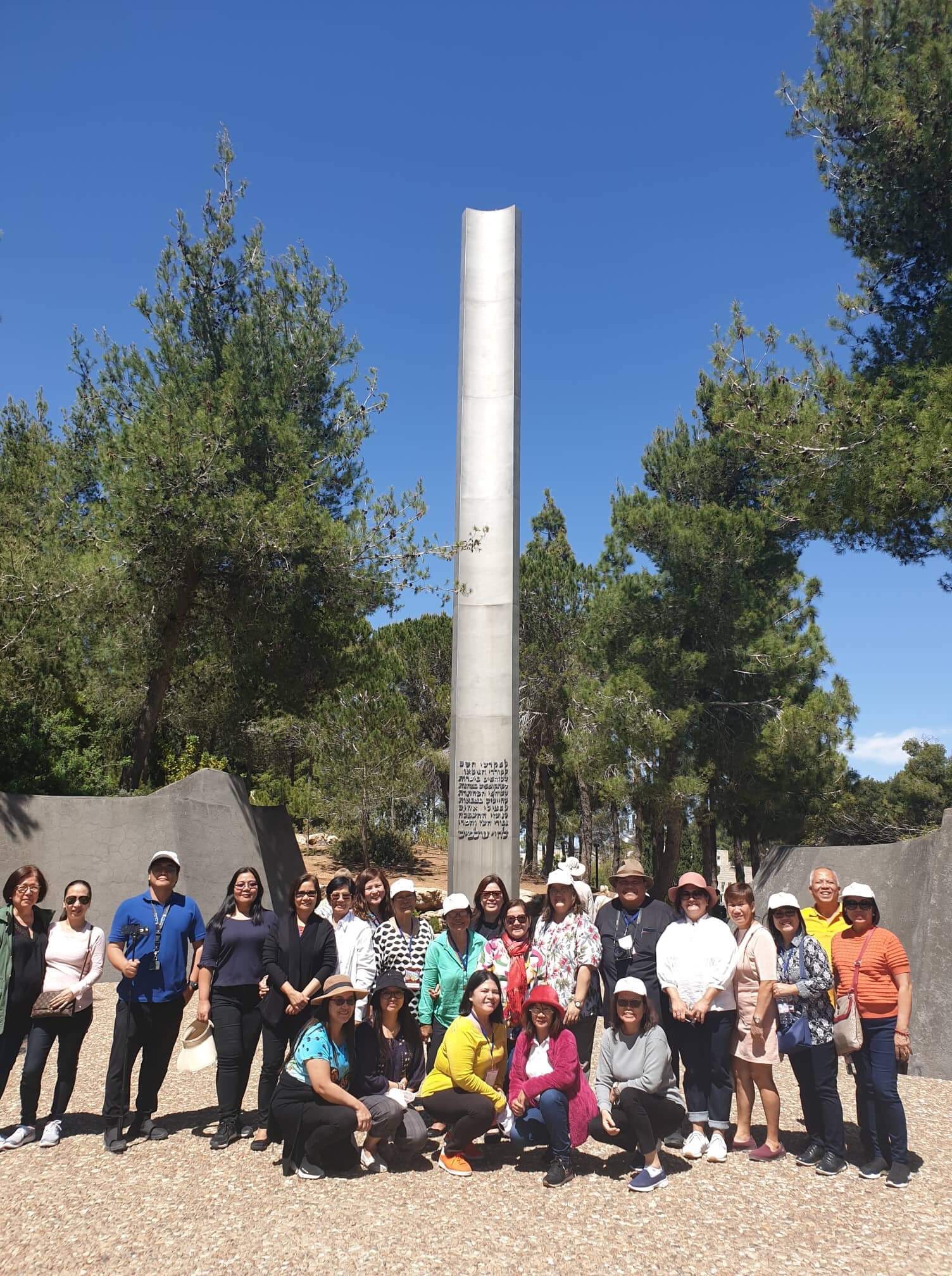
We are now traveling to the Mt. Sinai area to cross into Egypt. As I have been telling you, this is my third time in the Holy Land and Yad Vashem, the Holocaust Memorial of Israel. I shall write later of my reflections but below is my email written the first time I came here:
23 June 2005
Shalom everyone!
Until now, I could still feel the impact Yad Vashem had on me.
I would just like to add here a story shared with us by Ronnie before our tour….
Accdg to Ronnie, he acted as a guide to a group of young Americans at the Yad Vashem last summer. They met a Jewish woman who survived the holocaust after their tour and told them firsthand her own experience from the Auschwitz camp.
The young tourists were so touched with her story, of how she had lost her parents, siblings and friends. As she wiped her tears, a young man asked the survivor: have you forgiven the people who killed your family?
And Ronnie said, the woman replied this way:I could only forgive if you would always remember.
We were also so touched with the story and the woman’s declaration: I could only forgive if you would always remember.
One of my favorite philosopher is Martin Heidegger, a German existentialist who, unfortunately, was blinded by Hitler’s rhetorics in the beginning but later denounced Nazism.
According to Heidegger, we are all “beings of forgetfullness”; he explained that this is the main reason why we always lead “inauthentic living.”
And that is true. We always have to remember the past not to take tally of how we were hurt or maltreated by others; we remember the painful past so that we would not repeat it and do them again onto others.
It is so sad that in our lives, we keep on remembering how we got inflicted with wounds so that we could wound others; hence, what we have is a vicious circle of violence and retributions.
That I think is the essence of “learning from history”—-of not repeating the same mistakes over and over again.
This is often at the root of many of our problems in our dealings with other people: parents, priests, teachers, supervisors or almost anyone who always remember the difficulties they have gone through when they were younger; we are sometimes guilty of harking at our painful past and get even with those presently under us. And the pains and the hurts increase, forgetting the lessons that could have been learned.
Our country is in deep, deep, deep crises because we are mostly “beings of forgetfullness”—we have a poor sense of history, we can’t remember the lessons of the past because we did not learn at all or just maybe, preoccupied with getting even or vengeance.
Forgiving does not mean forgetting because that is impossible; God programmed us to always remember so that we could become more loving, more forgiving, more understanding, and more like Him in seeing what’s good in everyone.
At the back of Yad Vashem is a breathtaking view of Jerusalem below. After seeing and somehow experiencing the horrors of the Holocaust, I can’t help thinking how come God could accept and allow the Jews, Moslems, and Christians live together in His old city when we can’t even stand the sight or the smell of the person next to us because he is not of same color or creed with us?
God bless!
With my parishioners the other day at Yad Vashem. Many cried at the sights in the museum but we were all touched with the personal story and reflections of our guide, a 70 year old man we fondly call Lolo Mendy. Will write his stories later.
40 Shades of Lent, Tuesday, Week III, 26 March 2019
Daniel 3:25, 34-43///Matthew 18:21-35
Praise and glory to you, O Lord Jesus Christ!
Here we are now O Lord being confronted by this topic of sin and forgiveness. Every day we pray the “Our Father” and you know very well how mechanical it had become for us asking God “to forgive us our sins as we forgive those who sinned against us.”
Like Peter, we often feel at a loss at how to forgive those who have hurt us. No… not just hurt or wronged us but, hurt or wronged us so deeply.
The pain is so deep in our hearts, Jesus. And that is why you want us all to forgive from our hearts, not from our lips or from our minds but from our hearts where the pains hurt us most.
We really do not know how. Your parable seems inadequate though you make an absolutely valid point of forgiving others because we have been forgiven too.
Like Daniel your prophet in the Old Testament, we beg you to “Deliver us by your wonders” – surprise us O Lord with your gentle mercy, with your kindness that like you we may be moved to forgiving those who have terribly wronged us. Amen.









 lordmychef.com