Advent is “putting on Christ”

The Lord Is My Chef Sunday Recipe for the Soul

First Sunday of Advent-A, 01 December 2019

Isaiah 2:1-5 ><}}}*> Romans 13:11-14 ><}}}*> Matthew 24:37-44

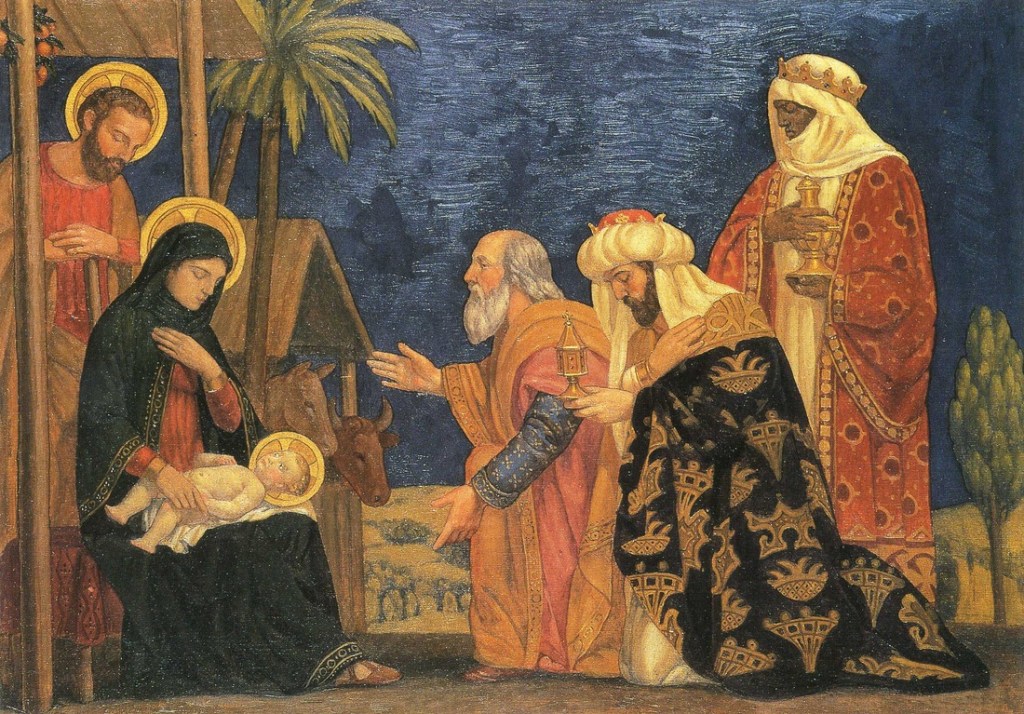
From Google.

A blessed first Sunday of Advent to you my dear reader and follower! Today we begin another new year in our Church calendar with this season of Advent. Both the word “Advent” and its concept were borrowed from ancient Rome when provinces prepared for the coming, or “adventus” of the emperor to visit the occupied territories of his empire.

But, Jesus is more than any emperor of the world for he is true God and King of kings, the one who had come, always comes, and will be coming again at the end of time to judge us, both the living and the dead. This Season of Advent gives us the opportunities to intensely prepare for the Lord’s adventus that always begins in our hearts.

Advent has a two-fold character: beginning today until December 16, the readings and prayers set our sights to the Second Coming of Christ at the end of time or the parousia. From December 17-24, focus shifts to the first Christmas when Jesus was born in Bethlehem more than 2000 years ago.

According to St. Bernard of Clairvaux, between these two comings of Christ is his third coming that happens daily in our lives, so ordinary but very sudden like in the time of Noah.

Photo by author, sacristy of our Parish, Advent 2018.

Jesus said to his disciples: “As it was in the days of Noah, so it will be at the coming of the Son of Man. In those days before the flood, they were eating and drinking, marrying and giving in marriage, up to the day that Noah entered the ark. They did not know until the flood came and carried them all away. So will it be also at the coming of the Son of Man.

Matthew 24:37-39

Staying awake, actively waiting for the Lord.

Jesus is definitely coming at the end of time. It is useless to be concerned when that would be because it will be sudden and unexpected. What matters most is our attitude of “staying awake, actively waiting” for the Lord’s coming again.

The Lord cites to us the example of Noah whom God had instructed to build an ark in the Old Testament for the coming great flood meant to cleanse the earth of sins and evil.

To actively wait for the Lord’s parousia means to be a sign of contradiction like Noah who faithfully obeyed God’s will in building an ark and later gathering into it all the animal species of earth.

Imagine the insults Noah had to endure from people laughing at him while building the ark. Yet, he never wavered and faithfully fulfilled his task before the Lord.

From Google.

Jesus cites three other instances of displaying the right attitude in actively waiting for his Second Coming: the two men out in the field, the two women grinding, and the master of the house.

One of the two men in the field was taken while one of the two women grinding was also taken because they were responsibly fulfilling their tasks when the parousia comes; their respective counterparts were most likely doing nothing or very lazy that they were left behind.

The mini parable Jesus inserted at the end shows us the imagery of the master of the house staying awake to keep the thief from breaking into the house in the middle of the night.

These are all about having the right attitude as disciples of Jesus actively awaiting his return. From Noah to the other man in the field, the other woman grinding, and the master of the house, we find from their attitudes of active waiting budding forth their hope in God.

Generally speaking, the way we live our lives determines also how we hope in the Lord.

And this we find in St.Paul’s exhortation to the Christians of Rome:

Brothers and sisters: you know the time; it is the hour now for you to awake from sleep. For our salvation is nearer now than when we first believed; the night is advanced, the day is at hand. Let us then throw off the works of darkness and put on the armor of light; let us conduct ourselves properly as in the day, not in orgies and drunkenness, not in promiscuity and lust, not in rivalry and jealous. But put on the Lord Jesus Christ, and make no provisions for the desires of the flesh.

Romans 13:11-14
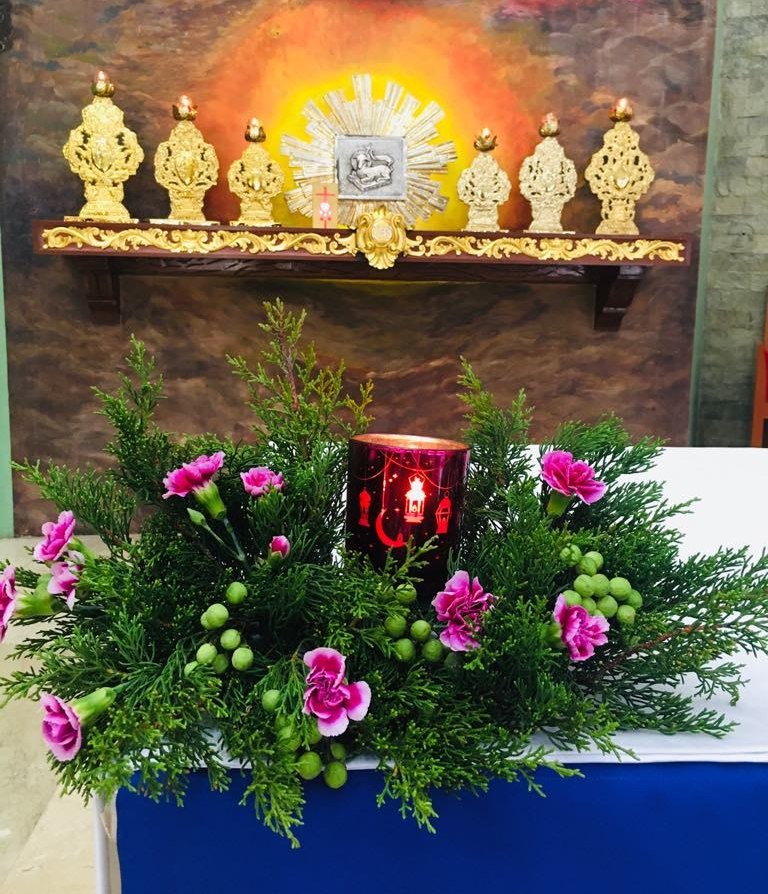
Altar table at the Parokya ng San Juan Apostol at Ebanghelista, Bagbaguin, Santa Maria, Bulacan, Advent 2018.

Putting on Christ to show his light to dispel darkness.

St. Paul wrote the Christians in Rome more than 2000 years ago to remind them of the fierce spiritual warfare between good and evil, light and darkness while they were living in the midst of a pagan world and culture.

It was a very difficult time to be truly Christians but St. Paul felt the need to remind everyone of the ever-present reality of the parousia. Like in most of his letters, he captured by the grace of the Holy Spirit the beautiful imagery of disciples with the right attitude awaiting the Second Coming as “putting on the Lord Jesus Christ”.

Putting on our Lord Jesus Christ is not just a mere call to be morally perfect persons but for us to strive in making the light of Christ shine on us so that we may manifest Jesus more in us and in our lives.

Simply put, it is becoming “Christ-like”, a true Christian who is “dead to sin but alive for God in Christ Jesus” (Rom. 6:11), one who lives differently by making Jesus more present especially in these difficult and troublesome times.

The time of St. Paul was no different with our present age with growing materialism and consumerism among peoples, including Christians afflicted with Pope Emeritus Benedict XVI’s “dictatorship of relativism” that have removed God from every aspect of human life, including Christmas itself!

See how we are so focused on Christmas countdowns than with the very reason of the Season, Jesus Christ. See how the media equate Christmas with material things, sugarcoating it with sentimental feelings as most Christmas songs nowadays indicate.

Advent is seeing more of Jesus, than of time.

On this first Sunday of Advent, our sights are redirected anew into Christ’s Second Coming with our important task of making him present in our very selves.

As children of the light, we slowly discover and realize how our definitive salvation is slowly moving towards its fullness in Christ’s parousia when everything is totally changed by God with peace finally reigning supreme over all.

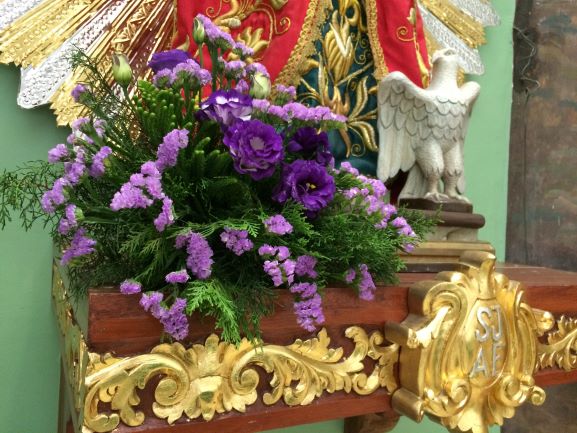
Violets on the pedestal of our Patron Saint, John the Evangelist.

This was the vision of Isaiah a long, long time ago.

It had been fulfilled in Christ’s first coming in Bethlehem over 2000 years ago and it is being fulfilled daily through people filled with hope in God’s justice and love.

In the days to come, the mountain of the Lord’s house shall be established as the highest mountain and raised above the hills. All nations shall stream toward it; many people shall come and say: “Come, let us climb the Lord’s mountain…” They shall beat their swords into plowshares and their spears into pruning hooks; one nation shall not raise the sword against another, nor shall they train for war again. O God of Jacob, come, let us walk in the light of the Lord!

Isaiah 2:2-3, 4-5

People who keep on wondering and asking when will Jesus come again are not really interested with the Lord’s Second Coming but only with themselves like the people during the time of Noah – oblivious to anything else and busy with their own pursuits.

The more we think of the WHEN, the less we think of the WHO of Advent. Let us put on the Lord Jesus Christ to be filled with his light until all darkness in life is dispelled. Amen.

We Remember

The Lord Is My Chef Breakfast Recipe for the Soul

Red Wednesday in Memory of Persecuted Christians, 27 November 2019

Revelation 15:1-4 ><)))*> ><)))*> ><)))*> Luke 21:12-19

From Google.

Today, O dear Jesus, we gather as one nation to remember the 300 million Christians worldwide who are persecuted in various forms because of their faith in you: those who were denied of work, housing, liberty, and most especially, life.

We remember and pray for our Christian brothers and sisters who were unjustly tortured and murdered because of carrying a cross and confessing their love for you, Jesus Christ.

Jesus said to the crowd: “You will be hated by all because of my name, but not a hair of your head will be destroyed. By your perseverance you will secure your lives.”

Luke 21:17-19

May those who have suffered and those still suffering be consoled with your love and peace, Lord.

Have mercy on their persecutors, let them realize that religion should bring us together and not apart.

Most especially, Lord Jesus, teach us to remember in carrying and embracing our crosses in the midst of these persecutions. Wash away our sins of indifference. Give us courage to follow promptings of your Holy Spirit in working for genuine peace and justice.

Empty ourselves of hatred and mistrust of one another to always remember we are all brothers and sisters in the Father. Amen.

Red Wednesday poster of Bacolod Diocese last year.

Living in the present

The Lord Is My Chef Breakfast Recipe for the Soul

Tuesday, Week XXXIV, Year I, 26 November 2019

Daniel 2:31-45 ><)))*> ><)))*> ><)))*> Luke 21:5-11

It is again the approaching end of the month, end of the year, Lord. Everybody is talking about the coming ultimate end of the world, the apocalypse, with or without you, O God our mighty Father.

How funny that we spend so much time thinking about the end of the world, so fascinated with predictions and doomsday scenarios forgetting the present moment and most especially you, O God.

Pagans and Christians alike entertain it because deep within ourselves is the reality that everything comes to an end for that is our orientation and direction. if we have you in our sights.

Open our eyes, O Lord, like Daniel in the first reading to see that only you shall remain in the end: everything and everyone, no matter how powerful and greatly endowed with power will ever remain in control of everything. Worst, even those we tend to ignore as so little and so small in stature could one day topple us!

Likewise, widen our horizons, Lord, and let us not be so fixed with certainties like dates and signs on the coming end. May we always see everything in your light, Jesus Christ, so that we may always see every here and now as your coming.

Most of all, let us keep in mind that your coming is always the end of our old selves and the beginning of a new person in you. Amen.

The throne of Christ the King

The Lord Is My Chef Sunday Recipe, Solemnity of Christ the King-C, 24 November 2019

2 Samuel 5:1-3 ><}}}*> Colossians 1:12-20 ><}}}*> Luke 23:35-43

Photo by Pixabay on Pexels.com

The Cross is the throne of our Lord Jesus Christ, King of the Universe. It is also a lesson in itself, the most profound Jesus has given us that continues to unfold and unravel the “depth and breath” of God’s love for each of us.

Through his Cross, Jesus did not only enter humanity but also allowed humanity to enter him by putting into his heart its very symbolism which is death we all deny and are afraid of. By dying on the Cross, Jesus turned it into a blessing to now become the symbol of life.

Let’s make an illustration.

Yes, it is Bruce Willis from a scene in one of his popular series, “Die Hard” which I continue to watch whenever possible.

What I like most with Bruce Willis in all of his movies is his being so “human” – very vulnerable physically, emotionally and even psychologically. His roles never hide his being a frail human being despite his muscular strength and tactical acumen. Bruce never hides his weaknesses that he can get shot and wounded, dumped and divorced or cheated by his wife like in “The Last Boy Scout”, making him more believable than the other action stars.

And that’s our point here: Jesus never hid his humanity from us. The all-powerful God on whose everything was created according to St. Paul in the second reading became human like us in every aspect except sin.

He is the image of the invisible God, the firstborn of all creation. For in him were created all things in heaven and on earth… He is before all things, and in him all things hold together. He is the head of the body, the church. He is the beginning, the firstborn from the dead, that in all things he himself might be preeminent. For in him all the fullness was pleased to dwell, and through him to reconcile all things for him, making peace by the blood of his cross through him, whether those on earth or those in heaven.

Colossians 1:15-19
Carmelite Monastery, Guiguinto, Bulacan, 12 November 2019.

In becoming human like us, Jesus entered our humanity. He who is the Son of God became an infant and child so weak, entrusting himself to us humans.

And when he had grown into a man, he experienced leaving home and family to fulfill his mission like almost everybody. He had friends, some eventually became faithful while another had betrayed him.

Jesus went to almost every gathering like weddings and banquets, met everybody from the “who’s who” to the nobody like sinners and marginalized. He was manly enough to relate with every kind of people, be they children or women, rich and poor alike.

He had wept at the death of a good friend and the impending destruction of his beloved city of Jerusalem, felt hunger and thirst, got angry and was surprised in some occasions.

Jesus is truly human that we can also identify with him but in his dying on the cross, we were able to enter him to become like him when on his Resurrection, he took away the curse of death and turned it into pure grace in him.

Cross at the Dominican Hill in Baguio City, January 2019.

A very unique characteristic of Jesus as a human is his being a radical in its truest essence and meaning. From the Latin word “radix” that means roots, Jesus brought us back to our very roots, to our grounding of being who is God himself.

Too often, we think of radical people as rebels and revolutionaries leading movements and many changes in the society. They are the “game changers” because they radically change things to show us the more essential.

But in reality, radicals do not change things: they restore things to its original state and being. They get into the roots or “radix” of things to bring out its true meanings by doing away with the unimportant accidentals that have taken over the realities.

That is why Jesus is a radical: by dying on the Cross, he firmly reestablished his throne as King of the Universe because that is where evil ended and death is conquered.

It is on the Cross his throne where every new life begins because it is our very rootedness and “grounding of being” as beloved children of God in him.

Most of all, it is on the Cross his throne, our root and grounding from which comes our sole focus and attention in life – God in Christ Jesus.

The rulers sneered at Jesus… even the soldiers jeered at him. Now one of the criminals hanging there reviled Jesus, saying, “Are you not the Christ? Save yourself and us.” The other, however, rebuking him, said in reply, “Have you no fear of God, for you are subject to the same condemnation? And indeed, we have been condemned justly, for the sentence we received corresponds to our crimes, but this man has done nothing criminal.” Then he said, “Jesus, remember me when you come into your kingdom.” He replied to him, “Amen, I say to you, today you will be with me in Paradise.”

Luke 23:35, 36, 39-43

We have a beautiful expression in Filipino about a person described as “malalim” or deep. A radical is the truly deep person because he is rooted and grounded in his being who is God!

Anyone who truly recognizes Jesus Christ becomes a radical person too, a person of depth because he is rooted in God like the other thief hanging on the cross with Jesus.

See how the rulers or the elite like the priests and elders of Israel who sneered at Jesus: the more they poked fun on him as “the Christ of God”, the more they indict themselves of the grave crime of putting Jesus to death. Eventually at the death of Jesus, the Temple curtain would be torn from top to bottom to signal the end of temple worship and the start of worshipping God in “truth and spirit” in Christ.

The soldiers jeered Jesus too because they “know not what they were doing” because they were all pagans. But again, upon Christ’s death, we find one soldier there at the scene declaring “truly this is the Son of God.”

In any case, some members of Israel’s rulers and Roman soldiers eventually followed Jesus after the Resurrection to show us how the Cross is indeed the throne of Christ the King: it is also a door that opens anyone to conversion, to accept his reign and kingdom!

Most of all, the “good thief”, usually referred to as Dimas, shows us how at the cross any one can become radical like the Lord. While agonizing with Jesus on the cross, Dimas must have examined his life and got into his very core, his roots and realized that basic truth inside him was right there suffering also with him — Jesus whose name means “Yahweh saves”.

What is so surprising with his request from Jesus “to remember him he gets into his kingdom” is the fact that in the Old Testament, it is God who always remembers his people, remembers his promise, remembers his covenant.

Man always forgets God and his covenant that we always turn away from him to live in sin. But at the cross, the throne of Jesus our King, he enables us to remember our roots, our being children of God, our being loved and forgiven that we finally find our way back home.

And that home is God in eternity: “Today you shall be with me in Paradise.”

Every time we are at the cross, when we are getting through so many pains and sufferings, failures and disappointments, even darkness and sin, get into your roots – Jesus Christ – and you will never get lost.

Long before we got into all these crosses in life, remember Jesus was there first for us to suffer and die on his Cross. And that is why he is our King for he rose again so we can become like him in eternity. Amen.

How much do you love?

The Lord Is My Chef Sunday Recipe for the Soul

Week XXXIII-C, 17 November 2019

Malaci 3:19-20 ><}}}*> 2 Thessalonians 3:7-12 ><}}}*> Luke 21:5-19

The Wailing Wall of Jerusalem Temple, May 2019.

We are now at the penultimate Sunday of the year as Jesus continues to summarize his teachings today at the Temple area in Jerusalem about his final coming at the end of time.

While some people were speaking about how the temple was adorned with costly stones and votive offerings, Jesus said, “All that you see here — the days will come when there will not be left a stone upon another stone that will not be thrown down.” Then they asked him, “Teacher, when will this happen? And what sign will there be when all these things are about to happen?” He answered, “See that you not be deceived… “

Luke 21:5-8

On the surface, Jesus seemed like to be a “kill joy” in making those bold assertions about the coming destruction of the Temple while everybody was admiring it. But notice how the people reacted: instead of being worried, they asked when it would happen and what would be the warning signs before it takes place as if it is just an ordinary thing!

“Wala lang…” as the young would say these days. Nothing, duh…?

View of Jerusalem from the Church of Dominus Flevit where Jesus wept upon seeing the city from the Mount of Olives.

St. Luke tells us that before Jesus entered Jerusalem, “he wept over it” at the thought that it would be destroyed and that its enemies would not “leave one stone upon another” (Lk.19: 41-44).

If there is anyone deeply hurt and saddened with the Temple’s destruction, it is not other than Jesus Christ our Lord. He certainly shared the people’s admiration for the Temple which he had also claimed as “my Father’s house” (Lk.2:49) when he was accidentally left behind there by Mary and Joseph when he was 12 years old.

Imagine what Jesus must have felt when he spoke of the destruction of the Temple which is the heart of Jerusalem, the jewel of the city, and most of all, the sign of God’s presence among his chosen people!

There must be something deeper with his warning words of the Temple’s destruction that pertains not only to his people at that time but also to us today.

Wailing Wall of Jerusalem, may 2019.

For the Jews at that time, the destruction of the Temple is the end of the world, the signal of the apocalypse. More than a catastrophe involving the destruction of buildings and almost everything including life, it is judgment day that must not be taken lightly.

It is a day calling for conversion as the prophet Malachi in the first reading reminds us that every coming of God is a day of judgment and salvation.

Lo, the day is coming, blazing like an oven, when all the proud and all evildoers will be stubble, and the day that is coming will set them on fire… But for you who fear my name, there will arise the sun of justice with its healing rays.

Malachi 3:19-20

Christ had already come and will come again.

This was his promise and this is what he meant at the cleansing of the temple, “Destroy this temple and in three days I will raise it up” (Jn.2:19). At his Passion, Death, and Resurrection, Jesus Christ had replaced the old Temple worship with himself!

This is what we celebrate in every Holy Mass, God’s coming to us in Jesus Christ his Son.

Jesus comes in every here and now, and his every coming is a process of destroying our old temple of self to give rise to a new temple in Christ. Our concern need not be about a future date of his Second Coming or specific signs of its fulfillment.

Every day Jesus comes again and the challenge is for us to live authentically as Christians daily and not be bothered about the future. He warns us not to be deceived by all of these apocalyptic predictions and statements.

The key word is conversion, of living in the present. Jesus tells us so many things that can be very frightening and scary because what he wants us to do in preparation for his Second Coming is to love, love, and love.

And to love is to always suffer in Christ, with Christ.

He answered, “See that you not be deceived, for many will come in in my name… Do not follow them! When you hear of wars and insurrections, do not be terrified; for such things must happen first, but it will not immediately be the end.” Then he said to them, “Nation will rise against nation, and kingdom against kingdom. There will be powerful earthquakes, famines, and plagues from place to place; and awesome sights and mighty signs will come from the sky. Before all this happens, however, they will seize and persecute you… You will even be handed over by parents, brothers, relatives, and friends, and they will put some of you to death. You will be hated by all because of my name, but not a hair of on your head will be destroyed. By your perseverance you will secure your lives.”

Luke 21:8-19
From I.REDD.IT.

Yes, Jesus will definitely come again at the end of time. Like last Sunday, definitely, there is a resurrection of the dead and life everlasting. But both must be seen in the context of the present time, of the here and now.

When Jesus comes again to judge us at the end of time, he won’t be asking us about the things we have been so preoccupied with in this life like how much money we earn, what car do you drive, or how big is your house?

When Jesus comes again, he will be asking us questions we have always refused to answer in our daily lives like how much have you loved, how much have you sacrificed and suffered for a loved one, or how much have you shared to a stranger?

These are the questions we must be asking ourselves as we near towards the end of the year: how close have I followed Jesus Christ in his Passion and Death so I may be with him in his Resurrection?

May we imitate St. Paul in his second letter to the Thessalonians today to faithfully and calmly fulfill our daily tasks in this life, avoiding being idle for each day is the day of the Lord. Amen.

“Never Existed Before” by Minnie Riperton (1979)

The Lord Is My Chef Sunday Music, 03 November 2019

My cousin Joyce Pollard-Lopez with Tony during their honeymoon 40 years ago in Greece, still together and very much in love with each other!

It’s the end of a long weekend of bonding and prayers for the All Saints’ Day and All Souls’ Day that ushered in the penultimate month of every year that is November.

Let us not forget that on these days dedicated for our departed loved ones, we are also reminded to remember more of God and those people he sends us to experience his immense love for us.

They are the people who have profoundly changed us into who we are today, that made us live like we never existed before…

So you ask me what do I see
When I look in your eyes
I see things that have never existed before
Shall I tell you all that I find
In those beautiful eyes I can try
But it never existed before
The silvery moon… a walk in the park
The tunnel of love… a kiss in the dark
The light of the stars… the clouds in the sky
The fireworks on the fourth of july
And you ask me what do I hear
When you whisper my name
Music plays that has never existed before
Oh, and I don’t know why
But it’s there just the same
And it’s plain that it never existed before
The song of the rain the flowers in spring
The wind in the willow trees murmuring
The laughter that falls the children at play
Like church bells that call all the people to pray
So you ask me why do I glow
Well, I think you should know
I’m in love and I never existed before

Minnie Riperton co-wrote this song released in May 9, 1979 as part of her fifth and final album called Minnie.

Two months later, Minnie died of cancer at the age of 31.

Never Existed Before speaks so well of how Minnie had experienced the great love of her husband Richard Rudolph especially in her long struggle against cancer.

The song leaves no trace of her great sufferings as Minnie herself was filled with joy by actively working for her advocacies in cancer prevention and research.

Beautiful voice, beautiful woman, and beautiful song.

Just like Zacchaeus.

He only had one desire – to see Jesus who surprised him by coming into his house as a guest!

It is a story of faith, no matter how little it may be for as long as there is that desire for God.

Jesus comes first in our hearts, to those who truly seek him in their hearts.

And the mark of being saved and loved by Jesus is to be filled with joy like Zacchaeus who promised to change his life and even repay those he had cheated.

Truly, any encounter with the Lord Jesus Christ can change us deeply to live differently, like we never existed before.

Meeting Jesus our Saviour

The Lord Is My Chef Sunday Recipe, Week XXXI-C, 03 November 2019

Wisdom 11:22-12:2 ><}}}*> 2 Thessalonians 1:11-2:2 ><}}}*> Luke 19:1-10

A giant sycamore tree at the center of Jericho, the world’s oldest city. Photo by author, May 2019.

Jesus is now on the final leg of his “resolute journey to Jerusalem” as he passed by the world’s oldest city of Jericho. Next week, he would be teaching at the Temple area in Jerusalem where his enemies would gang up against him, eventually sending him to death as we shall hear on the 24th of this month, the Solemnity of Christ the King.

Today we find a very interesting story that is in stark contrast with last Sunday’s parable of the Pharisee and tax collector praying at the Temple.

And this time, our story is not a fiction but an event found only in St. Luke’s gospel about a real tax collector named Zacchaeus, a very wealthy man indeed.

The fictional Pharisee Jesus narrated in his parable last week was a very proud one, of high stature literally and figuratively speaking that he would always stand and pray inside the Temple to be seen by everyone.

He was a self-righteous man who despised everyone else, especially tax collectors.

But, according to Jesus, the Pharisee’s prayer was not heard by God because he was not really seeking God but seeking adulation for himself!

Treetop of a sycamore tree in Jericho today.

Contrast that Pharisee with the chief tax collector in Jericho named Zacchaeus: he was of small stature, literally and figuratively speaking, that he had to climb a sycamore tree in order to see “who Jesus was” (Lk.19:3).

We can safely surmise that from St. Luke’s narration, nobody loved Zacchaeus in Jericho: he must be really so small in their eyes that he is hardly noticed maybe except when people paid taxes.

And that is why when he learned Jesus of Nazareth was passing by their city, he went to climb a sycamore tree to have a glimpse of the man he must have heard so often performing miracles and doing all good things for sinners like him.

Then, a strange thing happened…

When he reached the place, Jesus looked up and said, “Zacchaeus, come down quickly, for today I must stay at your house.” And he came down quickly and received him with joy. When they all saw this, they began to grumble, saying, “He has gone to stay at the house of a sinner.” But Zacchaeus stood there and said to the Lord, “Behold, half of my possessions, Lord, I shall give to the poor, and if I have extorted anything from anyone I shall repay it four times over.” And Jesus said to him, “Today salvation has come to this house because this man too is a descendant of Abraham. For the Son of Man has come to seek and to save what was lost.”

Luke 19:5-10

Was it serendipity or divine destiny?

Jesus was just passing through Jericho while Zacchaeus was merely interested in seeing the Lord. Never in his wildest dream, so to speak, did he intend to meet him personally.

From Google.

But, as we all believe and have realised, there are no coincidences or accidents in life.

Everything that happens in our lives has a purpose, a meaning that may either make us or unmake us.

It all depends on us whether we make the right decision in making the most out of whatever life offers us, of what comes to us. Either we become better or bitter – so choose wisely.

More so with salvation from God who never stops coming to us everywhere, anytime like with Zacchaeus when Jesus suddenly came to meet him.

The Catholic Parish Church in Jericho run by the Franciscans, May 2019.

Here we find again a story about faith that leads to conversion and salvation or justification.

It does not really matter how little faith we have like when the Apostles asked Jesus on the first Sunday of October, “Lord, increase our faith in God” (Lk. 17:5,Wk. 27). What matters is that we always have that option for God, a desire for God.

This is specially true as St. Paul assures us in the second reading that Christ will come again at the end of time. Nobody knows when or how he will come again but like Zacchaeus, we must have that desire for Jesus who first comes into our hearts before entering into our homes or churches, no matter how grandiose they may be.

Every desire for God in itself is an expression of faith in him. And God comes to those who truly seek him because that is how great God is: not in his power to do everything but to be small and forgiving!

Before the Lord, the whole universe is as a grain from a balance, or a drop of morning dew come down upon the earth. But you have mercy on all, because you can do all things; and you overlook people’s sins that they may repent. But you spare all things, because they are yours, O Lord and lover of souls.

Wisdom 11:22-23, 26
Inside the Catholic Parish of the Good Shepherd in Jericho, May 2019.

Like in the parable of the persevering widow and judge as well as that of the Pharisee and tax collector praying at the temple last Sunday, today’s story of Zacchaeus meeting Jesus shows us how God never abandons us his children, always ready to grant our desires and wishes even beyond what we are asking for — if we have faith in him.

Our salvation depends solely in our faith to God in Christ Jesus, like Abraham in the Old Testament that we can now rightly be called as his children like Zacchaeus.

No one is excluded from this tremendous grace of God brought to us through Jesus Christ who had come to seek those who are lost.

Like Zacchaeus upon receiving salvation from the Lord on that simple day, may we joyfully turn away from sins and most of all, cheerfully rid ourselves of so many other things that hamper us from following Jesus resolutely to Jerusalem. Amen.

What Jesus looks for and how we see

The Lord Is My Chef Breakfast Recipe for the Soul

Friday, Week XXIX, Year I, 25 October 2019

Romans 7:18-25 ><)))*> ><)))*> ><)))*> Luke 12:54-59

Photo by Noelle Otto on Pexels.com

What a beautiful way to end the week of work and studies, O Lord, when you asked us to read the signs of the times.

Jesus said to the crowds, “When you see a cloud rising in the west you say immediately tat it is going to rain — and so it does; and when you notice that the wind is blowing from the south you say that it is going to be hot — and so it is. You hypocrites! You know how to interpret the appearance of the earth and the sky; why do you not know how to interpret the present time? Why do you not judge for yourselves what is right?”

Luke 12:54-57

In this age of social media where everything is being shown and seen by everyone, it is very unfortunate that we still fail to see beyond the physical realities.

In an age when everything and everyone is seen, we have become more superficial than ever and have refused to see more deeper than what appears to the eyes.

We look outside of us to explain everything like in the news and in the internet, at YouTube and Facebook, Google and Wikipedia.

Rarely do we look deep inside ourselves like St. Paul to realize the greater battle going on deep within each one of us between good and evil.

Teach us Lord to see more the spiritual meanings of the things happening in us and around us, to always look deep into our hearts to see and realize the need to be good and just, kind and loving.

Maybe if we can look more often into our hearts and look piercingly into the heavens to find you, perhaps we can have a better world with lesser crimes and hatred among peoples. Amen.

Going beyond the skin

The Lord Is My Chef Sunday Recipe Week XXVIII-C, 13 October 2019

2 Kings 5:14-17 ><}}}*> 2 Timothy 2:8-13 ><}}}*> Luke 17:11-19

Photo by Mr. Jim Marpa, September 2019.

This Sunday readings tell us about the skin, the healing of people afflicted with the dreaded “Hansen’s disease” or leprosy. Since ancient time, it has always been seen with deeper implications than mere wounds on the skin that scars not only the leper but also the community. At its worst, it is regarded as a divine punishment that lepers have to be separated from others to live in designated areas for their treatment.

Skin plays a major role in our social status and mobility. Being the largest organ of the human body, the skin is always the first to be seen and noticed that whatever its condition would always have a big impact on the person, for better or for worst.

This is specially true for us Filipinos who are so concerned with our skin color that we still regard being white or maputi is maganda (beautiful) and having dark skin or maitim is pangit (ugly). No wonder everybody is going crazy to get whiter skin with all those soaps and creams and medicines advertised on billboards everywhere!

In a very funny twist unknown to most Filipinos who idolise white skin, many of our popular devotions in the Catholic faith actually have dark skin like Quiapo’s Black Nazarene and Our Lady of Antipolo?!

But, that’s another story of how skin-deep we can be…..

Going back to our reflection of today’s readings, Jesus is inviting us to go deeper than the skin to realize the richer meaning of having faith in him.

As Jesus continued his journey to Jerusalem, he traveled through Samaria and Galilee. As he was entering a village, ten lepers met him. They stood at a distance from him and raised their voice, saying, “Jesus, Master! Have pity on us!” And when he saw them, he said, “Go show yourselves to the priests.” As they were going they were cleansed. And one of them, realizing he had been healed, returned, glorifying God in a loud voice; and he fell at the feet of Jesus and thanked him. He was a Samaritan.

Luke 17:11-16
View from the walled city of ancient Jerusalem, May 2019.

Since June 30 of this year, the 13th Sunday of Ordinary Time, we have been following Jesus when “he resolutely determined to journey to Jerusalem” (Lk.9:51). More than a destination to reach, Christ’s journey to Jerusalem is about directions in life because it is spiritual and theological in nature than spatial or geographical.

It is the same truth every pilgrim to the Holy Land realizes too!

And now that Jesus is nearing Jerusalem to fulfill his mission, his teachings are getting clearer and closer to home, indicating also our own “passing over” or pasch with him with the many verbs and movements found in our gospel scene today.

Let’s try reflecting on them one by one. Please bear with me…

“As Jesus continued his journey to Jerusalem” …. Jesus never stops in his journey to Jerusalem to suffer with us, to cry with us, to die with us. He is committed in being one with us in our many struggles and battles in this life until we make it with him to heaven.

“he travelled through Samaria and Galilee.” This is beautiful. Samaria and Galilee are the regions where the poor and marginalized lived, where sinners abound. But, that is where Jesus would always come. When we are in our darkest moments in life due to sickness, failures and disappointments, especially sin – that is when Jesus comes closest to us! In the first reading, we have heard how God’s Prophet Elisha told the Syrian Army General Naaman to bath in the Jordan River to be healed of his leprosy even if he were a pagan and an enemy of Israel! God loves us all.

“As he was entering a village, ten lepers met him.” Keep in mind that Jesus came for the lost like us. Be open and ready for him for he is always passing by. Jesus surely comes to those who patiently wait for him.

“They stood at a distance from him, and raised their voice, saying, ‘Jesus, Master! Have pity on us!’ and when he saw them, he said, ‘Go show yourselves to the priests.’ As they were going they were cleansed. This episode of the healing of ten lepers can only be found in St. Luke’s gospel filled with many meaningful expressions. First is how “the lepers stood at a distance from Jesus.” This is our usual stance with the Lord when we are full of sin, so ashamed to look at him. But, it does not really matter with the Lord who looks more into is our hearts full of contrition than into our ego full of pride as we shall hear three weeks from now in the parable of the Pharisee and tax collector (Lk. 18:9-14).

The lepers cried to him, “Jesus, Master! Have pity on us!” and when Jesus saw them, he told them to see the priests and they were cleansed. This is an extraordinary profession of faith in Christ by the ten lepers who were crying out not only for pity but also mercy. There are only three instances in the gospels when Jesus is addressed in his name, once in Matthew and twice in Luke. This is the first and the second is when Dimas the thief called on him saying, “Jesus, remember me when you come into your kingdom.” To say his name “Jesus” in itself is a prayer, an admission of guilt and sin. That is why, as the ten lepers went their way to the priests, they were “cleansed” like Dimas on the cross was instantly promised with paradise.

“And one of them, realizing he had been healed, returned, glorifying God in a loud voice; and he fell at the feet of Jesus and thanked him. He was a Samaritan.”

Here we find every encounter with Jesus in prayer and the sacraments as well as in various events in our life is a passage to salvation and new life. See the transition from being cleansed into being healed: that is something deeper than the skin, so to speak. The Samaritan was not merely cleansed of his skin blemishes but most of all, his soul and inner being that Jesus later told him to “Stand up and go; your faith has saved you.”

Sometimes in life, we stop at being cleansed by the Lord; after obtaining our prayers and wishes, we never go back to him until we face another problem again. Are we willing to keep on going back to Jesus to kneel before him and to thank him?

Last Sunday we prayed to Jesus to increase our faith and today like the ten lepers from a distance, we cry out to him as our Master to have pity on us. We always have that gift of faith in us but we have to deepen and cultivate it daily in our prayer life and most especially in the Sunday Eucharist, the highest expression of giving thanks to God.

Let us live in our faith and trust in God’s gift freely given to everyone regardless of who we are. Let us rely in the words of St. Paul that

“if we have died with him we shall also live with him; if we persevere we shall also reign with him. But if we deny him he will deny us. If we are unfaithful he remains faithful, for he cannot deny himself.”

2 Timothy 2:11-13

A blessed Sunday to everyone!

Hope for our difficult personality

The Lord Is My Chef Breakfast Recipe for the Soul

Monday, Memorial of St. Jerome, 30 September 2019

Zechariah 8:1-8 ><)))*> ><)))*> ><)))*> Luke 9:46-50

St. Jerome painting by El Greco portrayed as wearing the Cardinal’s robe to represent his highly esteemed works and contributions to the Church as one of the Four Western Fathers along with St. Augustine, St. Ambrose of Milan, and St. Gregory the Great. Photo from Google.

Praise and glory to you, God our loving Father! Thank you very much for giving us saints, men and women like us who were sinners with so many weaknesses but through your grace were able to lead holy lives.

Through your saints, you give us so much hope to be become better persons despite our many imperfections like our great Doctor of the Church, St. Jerome, the Father of Catholic biblical studies who immersed himself in the study and prayer of the Sacred Writings right in the Holy Land.

Considered as one of the great theologians of the Church, St. Jerome is said to be approachable but notorious for being a difficult person too due to his temper as well as sarcasm and being argumentative at times.

I confess, O God, that I am exactly the opposite of the kind of person Jesus Christ is telling us to be like – a child. Instead of being childlike, many times I have become childish, difficult to handle with my burst of temper and sometimes annoying sarcasm.

Like St. Jerome, fill me with your grace, with courage and willpower to conquer my irascibility and direct all my negative energies in pursuing you in prayers and good works.

Help me to follow St. Jerome in his call to “let us translate the words of the Scriptures into deeds.”

Fill me with your words, O Lord, cleanse me of my sins and iniquities so that your Holy Spirit may dwell in me, suffuse me with your holiness. Amen.

My favorite depiction of St. Jerome by Italian painter Antonello da Messina (c.1430-79), “St. Jerome in his Study.” Again, we see St. Jerome in red robe and hat like a Cardinal at his study desk with his faithful lion in the background which tradition says he had helped in the forest by removing a thorn in its paw. At the foreground are two birds: a peacock which is an ancient Christian symbol of eternal life that our saint meditated often (reason why he always has a skull in other paintings), and a partridge, a reference to St. Jerome’s notorious temper as the bird often represents jealous rage. Photo from Google.