The Lord Is My Chef Breakfast Recipe for the Soul by Fr. Nicanor F. Lalog II
Thursday, Memorial of St. John Paul II, Pope, 22 October 2020
Ephesians 3:14-21     >><)))*>  +  <*(((><<     Luke 12:49-53
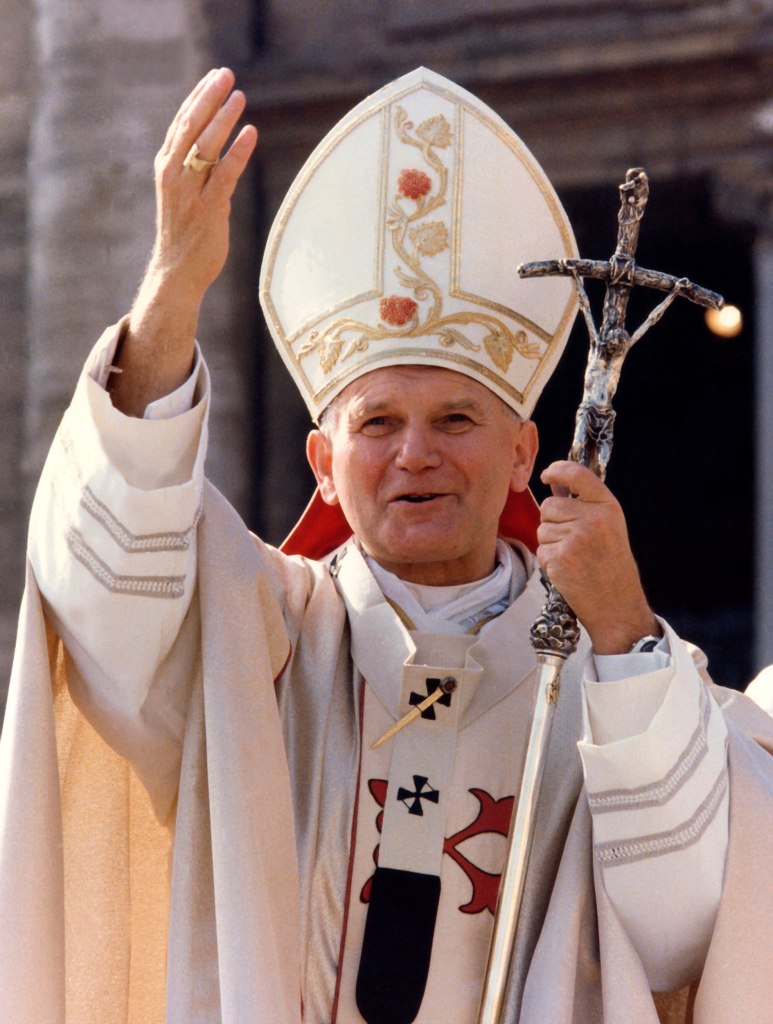
Pope John Paul II waves to well-wishers in St. Peter’s Square at the Vatican in 1978 when he was elected as the 263rd successor to St. Peter (CNS photo/Arturo Mari, L’Osservatore Romano).
One of the things I am so thankful to you, O God our Father in making me live in this generation is your gift to us of a great shepherd in St. John Paul II whose memorial we celebrate today. It is a tremendous blessing from you to grace our years of existence along with a great man like him who had overcome so many difficulties and struggles in life, being orphaned at a very young age from his mother, then from his father and later from his only beloved brother, not to mention his coming from Poland, a country exploited by foreign powers and subjected to communism for the longest time.
In his entire life, Lord, you have always manifested your loving presence in him and destined him to be your sign in this most difficult period in history when men and women have gravely challenged you with so many evil and sins, including some priests you have called to serve.
Praise and glory to you, O God, for the great St. John Paul II, a man rooted and grounded in love!
and that Christ may dwell in your hearts through faith; that you, rooted and grounded in love, may have strength to comprehend with all the holy ones what is the breadth and length and height and depth, and to know the love of Christ that surpasses knowledge, so that you may be filled with all the fullness of God.
Ephesians 3:17-19
What a beautiful prayer by St. Paul after extolling your love to call us all to be your children by having faith in your Son Jesus Christ!
What a beautiful prayer by St. Paul so perfect for today the memorial of St. John Paul II, a man rooted and grounded in love!
But, beyond the beautiful language, teach us, Father, what is to be rooted and grounded in love to know the love of Christ that surpasses knowledge, to be filled with all of your fullness?
Roots refer to something inside, deep within and hidden, not seen; on the other hand, grounded is something outside, above and seen.
What do you mean, Father?
It is so demanding but that is what to follow you, to be set on a blazing fire of purification in Jesus Christ (Lk. 12:49), to be one with him on the Cross so that inside and outside, we are totally yours with Mary like St. John Paul II’s Totus Tuus!
St. John Paul II, pray for us to be not afraid to follow Jesus and be one with the Father in the power of the Holy Spirit. Amen.
Quiet Storm by Fr. Nicanor F. Lalog II, 10 December 2019
Homily for the First Mass of Rev. Fr. Roel Aldwin C. Valmadrid, First Priest from our Parish of St. John Evangelist, Bagbaguin, Santa Maria, Bulacan
In my 21 years of priesthood, I have found so many descriptions and interpretations of being a priest. But there is only one priesthood we all share — the Priesthood of Jesus Christ.
And that is why, every priest has to be a radical like Jesus.
From the Latin word radix which means “roots”, a radical is someone who is always rooted, grounded in being as we say in philosophy.
A priest is a radical because he always has to be rooted in Jesus Christ, our Eternal Priest. He alone is our model and everything in our lives and ministry. Everything and everyone must be seen in relation with Jesus Christ.
I am the true vine… I am the vine, you are the branches.
John 15:1, 5
It is the Caller, Not the Call
Since last year when I was invited to be a guest spiritual director of our School of Theology, I have realized how seminarians and eventually priests give more importance to the vocation or call to the priesthood than to Jesus Christ himself, the Caller.
When we priests and seminarians are focused on the call, we get so many excuses in life: we have every justification for everything like in acquiring material goods and gadgets, indulging in so many luxuries and lifestyles for the rich and famous simply because we are priests.
See how some seminarians and priests alike, despite the many immoralities in life, they cling to the vocation but never to Jesus.
Worst, when we are more focused with our call than with Jesus the Caller, that is when we see more of ourselves that soon enough we play gods and we start making our vocation an excuse for everything, even flaunting them in social media.
Call it triumphalism, exaggeration of devotions when in fact it is the start of a cult around the person of the priest. That is when we start having our own interpretations of everything, starting from Jesus Christ, on the liturgy, morality, scriptures and everything!
Sad and tragic. Most of all, a grave scandal of our time.
When we focus more on our Caller Jesus Christ, then we start praying and discerning.
That’s when everything gets clearer because when we examine things in the light of Christ, we become sensitive of others and sensible as well.
When we see Jesus more than our priesthood, that is when we see more of Christ among others, especially the poor and marginalized.
Yes, when we priests look at Jesus more, the better we see him in others that we get inspired to do more, to serve more with love and kindness.
“I Am”
We have learned in our studies of the scriptures that Jesus Christ’s declarations of “I AM” in all gospel accounts mean a lot, especially in the fourth gospel by our beloved Patron, Saint John the Evangelist. It is indicative in itself of Jesus being the Christ, the awaited Messiah.
Keep that in mind, keep that in your heart, Fr. RA: that “I AM” is Jesus Christ, not you.
A priest is always a radical because every day we have to go back to this very root of our being, Jesus. Without him our Caller, there is no call. No Jesus Christ, no priesthood.
Twice did Jesus declare this I AM: at the opening verse where he used the adjective I AM the true vine then at the fifth verse when he said I am the vine, you are the branches.
Most important part here is the I AM to show how Jesus has let himself planted on earth, never to be uprooted like that story of the vine producing sour grapes in the Book of Isaiah.
His I AM here is the very mystery of his incarnation mentioned by our Patron Saint, John the Evangelist at his prologue to his gospel account. Like what St. Paul had written to the Romans we always read in the Evening Prayer I of each week, “God’s gift and call are permanent and irrevocable.”
Jesus called us to the priesthood, he will never recall that. That is why we are celebrating tonight despite your many sins and heavy warnings in the seminary. He called you Fr. RA and he kept that.
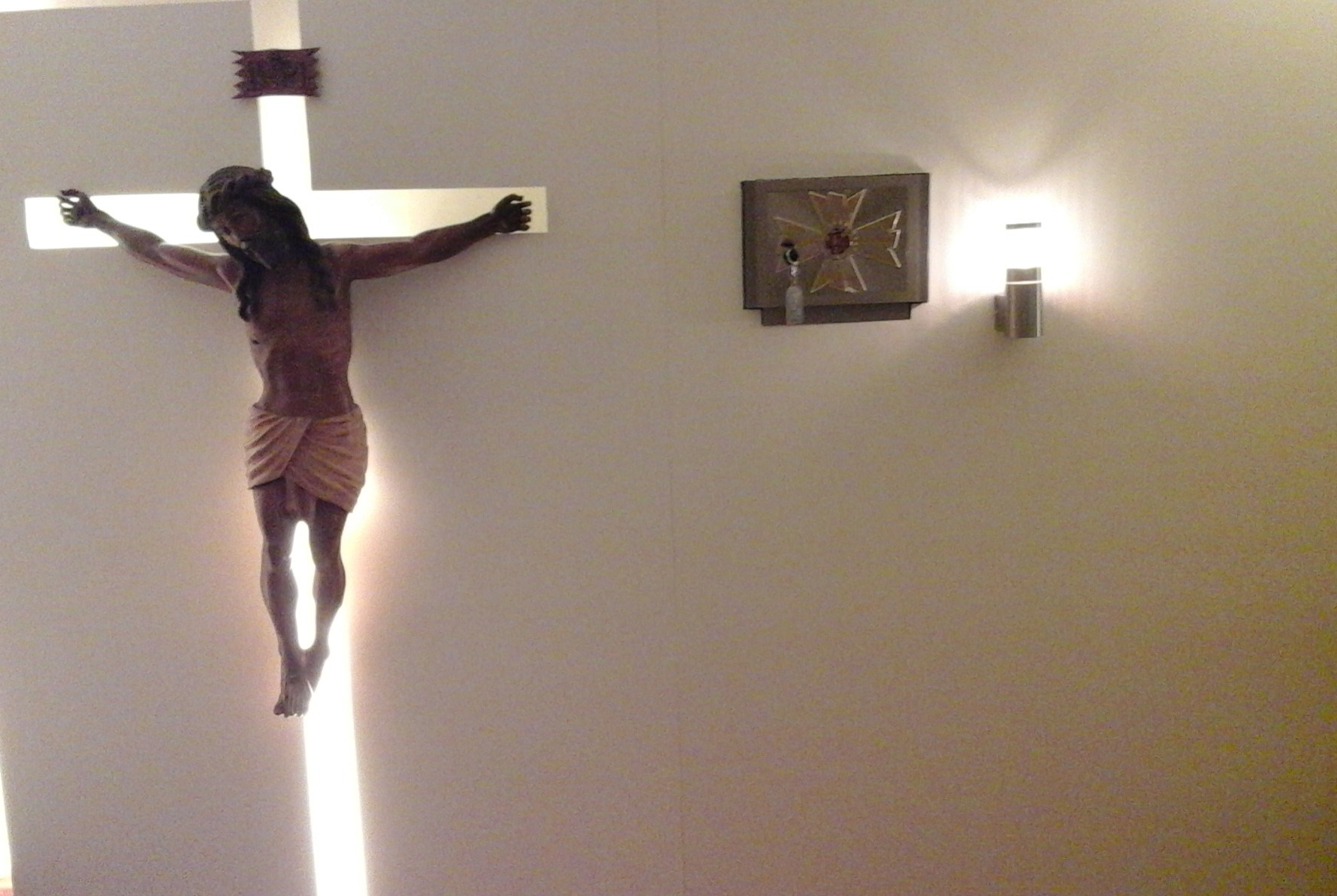
Chapel of the Holy Family, Jesuit Novitiate and Retreat House, Novaliches, 2017.
Now you are priest, Fr. RA, let Jesus dwell in you as you keep grounded in him too.
Have an altar in your room, Father. Keep the TV set outside your bedroom. Upon waking up even if your bladder is full, kneel before your altar, say the Morning Offering, be with Jesus, hear him tell you every morning “I AM the true vine, you are the branches.”
People always ask me what is the most difficult in being a priest?
It is not really being celibate. In fact later in life, ask your married friends, it is a great blessing to be celibate!
Since my first year in the priesthood, I have always been telling people since then until now that the most difficult in being a priest is we have to pray every day. I mean, real prayer where we strip ourselves naked before Jesus. No ifs, no buts. Just our plain, ugly self before him.
It is difficult to pray every day because it means being true to one’s self that requires a lot of discipline and courage.
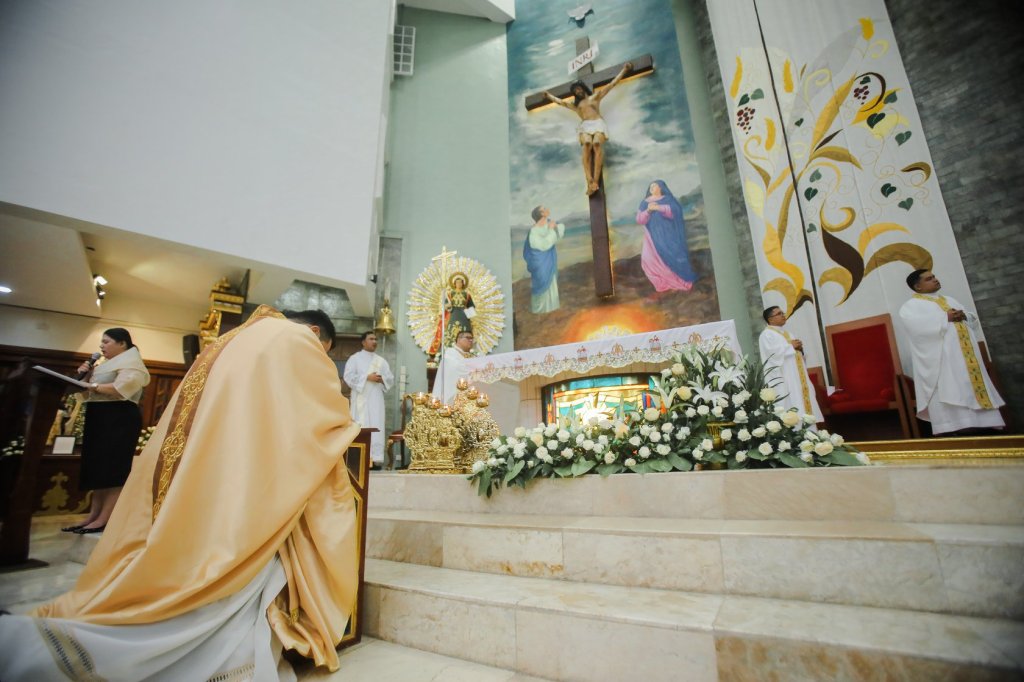
Bp. Dennis Villarojo ordaining Fr. RA, 10 December 2019, Malolos Cathedral.
Most of all, it is difficult to pray because that is surrendering one’s self to God. It is like being ordained every day when we keep on saying, “yes, Lord…yes Lord.”
Whatever is the fruit of our prayer, that is what we share in our homilies and talks to people.
That is when we come into the most difficult part of our prayer life as priests: when we preach, then people measure us, even judge us. They ask if we “walk our talk”.
When a priest does not preach anymore, when a priest avoids celebrating Mass, pray for that priest. Most likely he is no longer praying. He is already separating himself from the vine, forgetting the Caller.
Remember St. Augustine who told his deacon in De Catechizandis de Rudibus, “the catechist is the lesson himself”. In the same manner, the priest is the homily himself.
It is prayer where we grow deeper in our faith as priests. And people would right away notice this if we believe in God, if we believe in the Mother Church, if we believe in the sacraments we celebrate.
When we experience Jesus our true vine, it is always Jesus whom people would see and feel in us his priests.
“Remain in Me so you will bear fruit”
Our prayer life as priests keeps us one with Jesus our Caller and our true vine. In our gospel today, Jesus repeated the word “remain” about nine times, the most of any word in our gospel this evening.
Remaining in Jesus as a priest is imitating our Patron Saint John the Beloved, the only one who remained and stayed by our Lord’s side at his crucifixion.
To remain in Jesus is stay with him at the Cross.
Notice how Jesus reminded us that as branches, the Father has to prune us always. Pruning means sufferings. Pruning means carrying the cross daily.
Ten years ago I was invited to give a recollection to our students at the Theology Deaprtment with the topic, “The Cross as the Cost of Discipleship”.
People praying for Fr. RA after Holy Communion, 10 December 2019. Chinggoy Futol Photography.
I accepted the invitation to correct their topic because it is absolutely wrong: the Cross is not and should never be considered as a cost of discipleship. When you talk about costs, then you think of rewards and profits. Then it becomes a business. No longer a vocation.
The Cross is the life of a priest because that is the life of our Caller, Jesus Christ!
Remain in Jesus, bear all pains and hurts. Kneel always before his Cross and look at him to realize that before our sufferings came, Jesus was there first to suffer and die for you, Father!
Part of that Cross comes from those nearest to us priests, our family and brother priests!
Every day, especially Sunday, you celebrate life and death, health and sickness with people you hardly know, some of them even hurt you and malign you when you can not even be with your parents, sisters and nieces and nephews.
Worst, there are times it is your brother priests are the ones who would hurt you too!
Rejoice when you are being pruned, when you suffer, Father. Remember the beatitudes, “Blessed are you when people persecute you and malign you.”
Photo by Chinggoy Futol.
Be good and kind to your brother priests, Father RA.
Do not fight back if they hurt you.
Love your parish priest. Help him always in his Masses. Volunteer to him especially when you see the slightest of him catching colds!
When a priest is kind to his brother priest, that priest is surely a good priest, a kind priest.
By being good to fellow priests, you keep them remain in Jesus our true vine too.
And you become fruitful.
Being fruitful is different from being successful.
Sometimes, our failures are the very joys of our Lord Jesus Christ because that is when we are nearest to him.
To be fruitful is to rely more in the powers of God. Relying more on our powers is success.
And there is only one fruit Jesus wants from us: love.
Photo by Neil Jumaquio Adriano.
See how after Jesus declared himself as the vine and we are his branches, that is when he would speak eloquently about love, his commandment.
“I have told you this so that my joy might be in you and your joy might be complete. ?This is my commandment: love one another as I love you. No one has greater love than this, to lay one’s life for one’s friends.”
John 15:11-13
The new priest with his family. Chinggoy Futol Photography.
Love like Jesus Christ, Father RA.
Be a radical priest, not as a subversive but always go back to our very root, Jesus Christ.
Better, restore Jesus Christ.
Next year, I will be moving to another parish, Father RA.
When you are broken, when somebody maligns you again, you are most welcomed wherever I may be transferred and together, with our aching gouts, we shall kneel to before Jesus our vine, our root, our Caller. Amen.
The Cross is the throne of our Lord Jesus Christ, King of the Universe. It is also a lesson in itself, the most profound Jesus has given us that continues to unfold and unravel the “depth and breath” of God’s love for each of us.
Through his Cross, Jesus did not only enter humanity but also allowed humanity to enter him by putting into his heart its very symbolism which is death we all deny and are afraid of. By dying on the Cross, Jesus turned it into a blessing to now become the symbol of life.
Let’s make an illustration.
Yes, it is Bruce Willis from a scene in one of his popular series, “Die Hard” which I continue to watch whenever possible.
What I like most with Bruce Willis in all of his movies is his being so “human” – very vulnerable physically, emotionally and even psychologically. His roles never hide his being a frail human being despite his muscular strength and tactical acumen. Bruce never hides his weaknesses that he can get shot and wounded, dumped and divorced or cheated by his wife like in “The Last Boy Scout”, making him more believable than the other action stars.
And that’s our point here: Jesus never hid his humanity from us. The all-powerful God on whose everything was created according to St. Paul in the second reading became human like us in every aspect except sin.
He is the image of the invisible God, the firstborn of all creation. For in him were created all things in heaven and on earth… He is before all things, and in him all things hold together. He is the head of the body, the church. He is the beginning, the firstborn from the dead, that in all things he himself might be preeminent. For in him all the fullness was pleased to dwell, and through him to reconcile all things for him, making peace by the blood of his cross through him, whether those on earth or those in heaven.
Colossians 1:15-19
Carmelite Monastery, Guiguinto, Bulacan, 12 November 2019.
In becoming human like us, Jesus entered our humanity. He who is the Son of God became an infant and child so weak, entrusting himself to us humans.
And when he had grown into a man, he experienced leaving home and family to fulfill his mission like almost everybody. He had friends, some eventually became faithful while another had betrayed him.
Jesus went to almost every gathering like weddings and banquets, met everybody from the “who’s who” to the nobody like sinners and marginalized. He was manly enough to relate with every kind of people, be they children or women, rich and poor alike.
He had wept at the death of a good friend and the impending destruction of his beloved city of Jerusalem, felt hunger and thirst, got angry and was surprised in some occasions.
Jesus is truly human that we can also identify with him but in his dying on the cross, we were able to enter him to become like him when on his Resurrection, he took away the curse of death and turned it into pure grace in him.
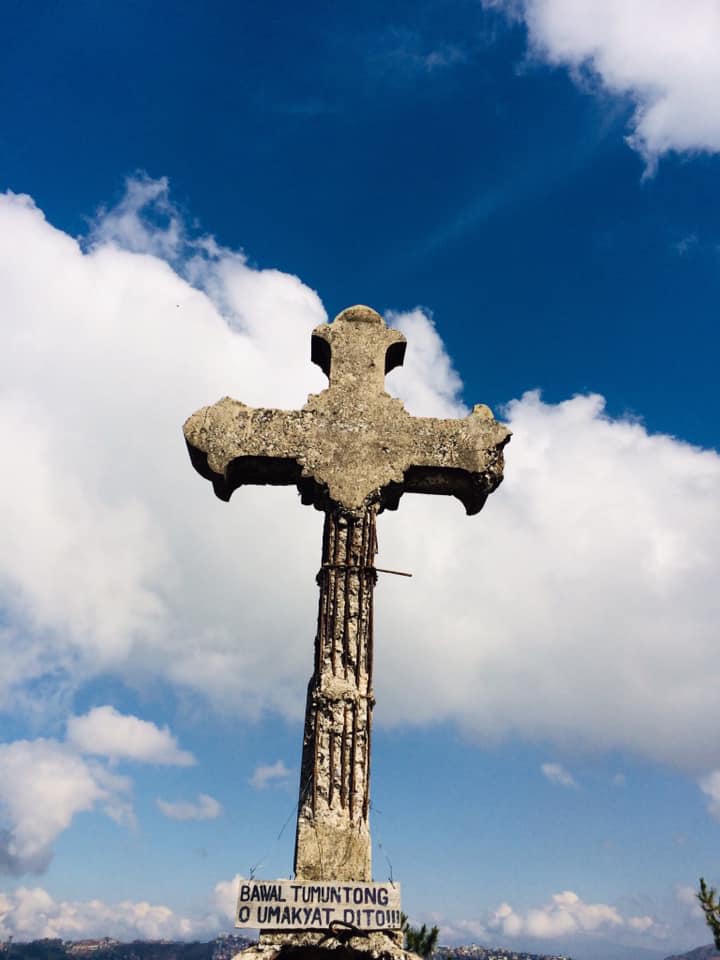
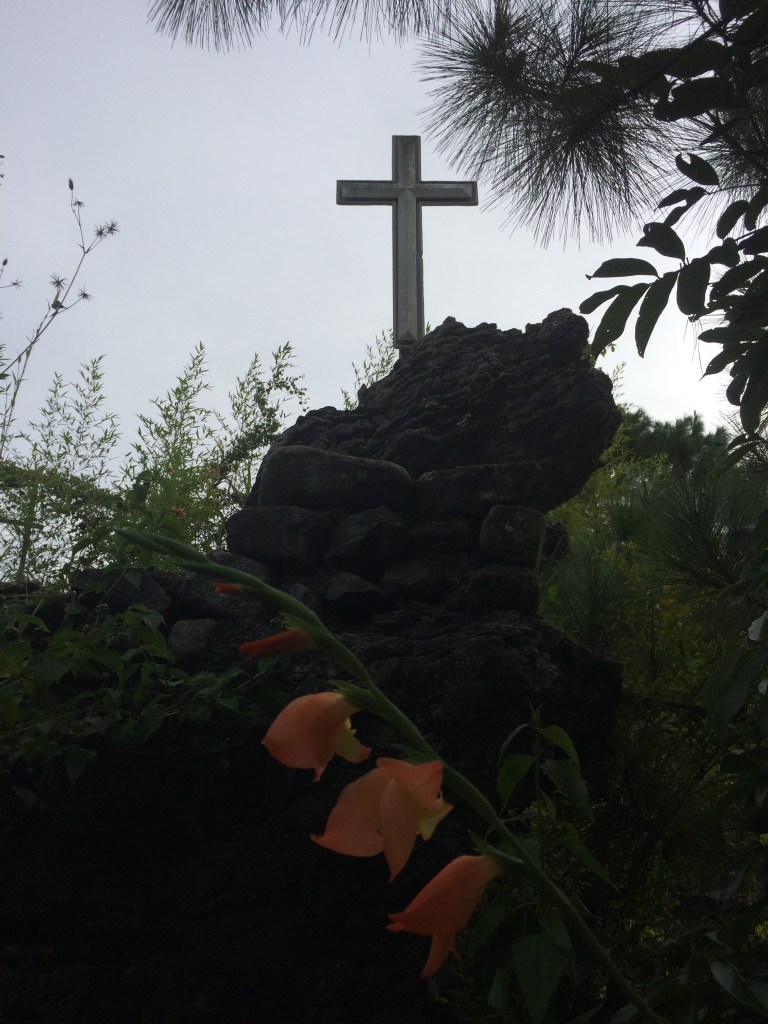
Cross at the Dominican Hill in Baguio City, January 2019.
A very unique characteristic of Jesus as a human is his being a radical in its truest essence and meaning. From the Latin word “radix” that means roots, Jesus brought us back to our very roots, to our grounding of being who is God himself.
Too often, we think of radical people as rebels and revolutionaries leading movements and many changes in the society. They are the “game changers” because they radically change things to show us the more essential.
But in reality, radicals do not change things: they restore things to its original state and being. They get into the roots or “radix” of things to bring out its true meanings by doing away with the unimportant accidentals that have taken over the realities.
That is why Jesus is a radical: by dying on the Cross, he firmly reestablished his throne as King of the Universe because that is where evil ended and death is conquered.
It is on the Cross his throne where every new life begins because it is our very rootedness and “grounding of being” as beloved children of God in him.
Most of all, it is on the Cross his throne, our root and grounding from which comes our sole focus and attention in life – God in Christ Jesus.
The rulers sneered at Jesus… even the soldiers jeered at him. Now one of the criminals hanging there reviled Jesus, saying, “Are you not the Christ? Save yourself and us.” The other, however, rebuking him, said in reply, “Have you no fear of God, for you are subject to the same condemnation? And indeed, we have been condemned justly, for the sentence we received corresponds to our crimes, but this man has done nothing criminal.” Then he said, “Jesus, remember me when you come into your kingdom.” He replied to him, “Amen, I say to you, today you will be with me in Paradise.”
Luke 23:35, 36, 39-43
We have a beautiful expression in Filipino about a person described as “malalim” or deep. A radical is the truly deep person because he is rooted and grounded in his being who is God!
Anyone who truly recognizes Jesus Christ becomes a radical person too, a person of depth because he is rooted in God like the other thief hanging on the cross with Jesus.
See how the rulers or the elite like the priests and elders of Israel who sneered at Jesus: the more they poked fun on him as “the Christ of God”, the more they indict themselves of the grave crime of putting Jesus to death. Eventually at the death of Jesus, the Temple curtain would be torn from top to bottom to signal the end of temple worship and the start of worshipping God in “truth and spirit” in Christ.
The soldiers jeered Jesus too because they “know not what they were doing” because they were all pagans. But again, upon Christ’s death, we find one soldier there at the scene declaring “truly this is the Son of God.”
In any case, some members of Israel’s rulers and Roman soldiers eventually followed Jesus after the Resurrection to show us how the Cross is indeed the throne of Christ the King: it is also a door that opens anyone to conversion, to accept his reign and kingdom!
Most of all, the “good thief”, usually referred to as Dimas, shows us how at the cross any one can become radical like the Lord. While agonizing with Jesus on the cross, Dimas must have examined his life and got into his very core, his roots and realized that basic truth inside him was right there suffering also with him — Jesus whose name means “Yahweh saves”.
What is so surprising with his request from Jesus “to remember him he gets into his kingdom” is the fact that in the Old Testament, it is God who always remembers his people, remembers his promise, remembers his covenant.
Man always forgets God and his covenant that we always turn away from him to live in sin. But at the cross, the throne of Jesus our King, he enables us to remember our roots, our being children of God, our being loved and forgiven that we finally find our way back home.
And that home is God in eternity: “Today you shall be with me in Paradise.”
Every time we are at the cross, when we are getting through so many pains and sufferings, failures and disappointments, even darkness and sin, get into your roots – Jesus Christ – and you will never get lost.
Long before we got into all these crosses in life, remember Jesus was there first for us to suffer and die on his Cross. And that is why he is our King for he rose again so we can become like him in eternity. Amen.
Wednesday, Easter Week IV, 15 May 2019 (Feast of St. Isidore Labrador)
Acts 1224-13:5///John 13:16-20
Plants growing on walls along the Palm Sunday Path of Jesus in Jerusalem. Photo by author, 03 May 2019.
You know O Lord Jesus Christ how grateful I am and my fellow pilgrims for the gift of coming to your Holy Land last week. And you know how we felt later when we were so eager to come home, to get back to the Philippines.
Partly it was homesickness but largely I think due to our “rootedness”, to our desire to get back to our roots in our home, with our family, with my parishioners.
Yes, we have felt and experienced you Lord in the Holy Land but you are felt most when we all go back to our roots, when we touch base to our home, family and friends.
After Barnabas and Saul completed their relief mission, they returned to Jerusalem… While they were worshipping the Lord and fasting, the Holy Spirit said, “Set apart for me Barnabas and Saul for the work to which I have called them.”
Acts 12:25, 13:2
This touched me so much,Lord: Barnabas and Saul began to venture far and wide in their mission to the Gentiles while they were praying with the others in Jerusalem. It happened when they returned to Jerusalem, their home, their base where you first gathered them together after Easter!
Yes… you are most present whenever we come home and touch base with our roots like family and relatives, friends and neighbors, even schools or places where we first met you!
You can boldly claim that whoever believes in you believes also in the Father who sent you because you remained rooted in the Father, Lord Jesus.
Help us, Lord, to find our way back home to you in the Father. Give us the courage to touch base with our roots, to find you in our selves, in others around us including our places of work and study.
Like St. Isidore Labrador who always prayed and visited you, touching base with you as his roots always before farming, may we come to realize that ultimately, our rootedness is in God alone. Amen.
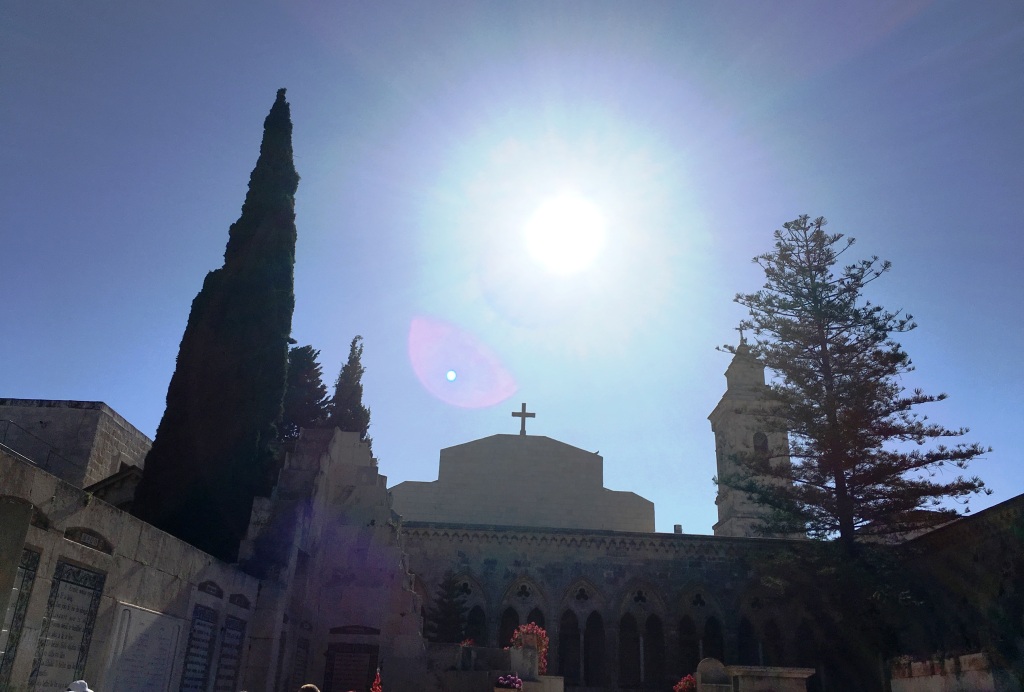
The Our Father Church in Jerusalem. Photo by the author, 03 May 2019.








 lordmychef.com