It’s a very beautiful Sunday, the first in this month of March.
I have been thinking of so many other songs that best capture our reflection for the Sunday gospel which is about education of the heart when Jesus said, “A good person out of the store of goodness in his heart produces good, but an evil person out of a store of evil produces evil; for from the fullness of the heart the mouth speaks” (Lk.6:45).
Our heart is the core of our person and that is why it is called “corazon” in Spanish from the Latin “cor”. And the best way to understand it is to simply feel what is inside.
Can we really look inside one’s heart as David Benoit said?
The French mathematician and philosopher Blaise Pascal wrote that “the heart has its own reasons that the mind can never understand.”
Another Frenchman, the aviator and writer Antoine de St. Exupery expressed in his book “The Little Prince” that “what is essential is invisible to the eye; it is only with the heart one can truly see.”
And so, I have decided this Sunday to share with you the music of the Swedish pop singer Orup (Thomas Eriksson) called “The Keys to Your Heart” released in 1991. I can’t find its lyrics but that’s the key to our heart – just feel the music and enjoy!
Life, sometimes, is a series of “good news-bad news” situation like the Beatitudes preached by Jesus during His sermon on the plain last week: the blessings are the good news while the woes are the bad news.
But, wait…! Such a view is the way of the world, not of Christ’s disciples!
As we have reflected last Sunday, the Beatitudes are the paradoxical happiness of the disciples of Christ because they all run directly against the ways of the world. Today we hear more paradoxical teachings from Jesus that are actually His “win-win” solution for our many problems like wars and other forms of enmities. Unfortunately, we have never given them a try because we always complain the ways of the Lord as being far from realities of life, impossible to imitate because He is God and we are not.
Today let us set aside all these reservations and arguments to reflect on this new set of paradoxical teachings by the Lord: Jesus said to his disciples: “To you who hear I say, love your enemies.od to those who hate you, bless those who curse, pray for those who mistreat you… But rather, love your enemies and do good to them. Be merciful, just as your Father is merciful. For the measure with which you measure will in turn be measured out to you” (Lk.6:27-28, 35, 36, 38).
It is very striking that Jesus repeated twice His call to “love your enemies”.
Does He not care about us who have to bear with the sins of evil people? What a good news to those who hate us, curse us, and mistreat us! Suwerte sila! We would surely say they must be so lucky, even blessed with us who strive to heed the calls of Jesus to love them our enemies.
But, on deeper reflections, we are actually more blessed when we try to love our enemies because that is when we elevate – or “level up” as kids would say – our hearts to be merciful like God. Experts claim that the best way to exact revenge against people who have hurt us is to shower them with good deeds and kindness from us they have offended. According to these experts in counselling and psychology, evil people get disappointed and angrier with themselves when their evil plots fail especially when their targets do not react negatively. They sound understandable because evil people derive joy in making people miserable. So, why be miserable?
Far from being their “punching bag”, the Lord simply wants us to teach our enemies to respect us, to be kind to us by not being like themselves. In loving our enemies, we teach evil people that more powerful than sin is the power of love. Sin and evil consume a person while love and kindness make a person grow and mature and bloom to fullness.
Far from being passive, to love our enemies by returning evil with good is always the most active method in fighting sins. When Jesus asked us to offer the other side of our cheeks to those who slap our face or when we give them our tunic when they demand our cloak, we are showing these evil people that love is never exhausted unlike evil. Love is boundless and the more we love, the more we have it, the more we keep on doing it. Evil, on the other hand, reaches a saturation point that we get fed up with it, then we we stop doing it because it is exhausting and worst, consumes us within that in the
process destroys us. Think of the most evil person you have known and surely, you find that person so ugly, so zapped of life and energy, eaten up from within by a festering wound. Evil people will never have peace and joy within, glow on their face and skin because they are rotting inside like zombies.
In the first reading we heard how David as a type of Christ foregoing vengeance by holding on to God, trusting Him completely that he chose not to strike King Saul who was then trying to kill him out of jealousy. As disciples of the Lord, we have to trust in the Word of God that can transform our hearts of stone into natural hearts filled with love and mercy like Him. This is the point being explained by St. Paul in the second reading wherein Christ as the “second Adam from heaven” had made us bear the “heavenly image”despite our “earthly image” that is weak and sinful having come from the “first Adam from earth”. Through Baptism, we have been endowed with all the necessary grace from God, transforming us into better persons of heaven.
One of my favorite sayings came from the desk of a friend of mine I used to visit in their office that says “If you have love in your heart, you have been blessed by God; if you have been loved, you have been touched by God.”
See how God has loved us so immensely without measure! Remember that scene two Sundays ago when Jesus borrowed the boat of Simon as He would do with our voice, with our hands, with our total selves? Who are we or what do we really have and own that the almighty God would borrow from us? Nothing! Yet, Jesus comes to us daily with all His love without measure to bless us with everything we need. So, who are we now to love by measuring everything, loving only those who love us, lending only to those who could repay us?
Imagine how astonishingly disproportionate is the love of God with our kind of love. It is in this light must we see the meaning of Christ’s final lesson this Sunday: “For the measure with which you measure will in turn be measured out to you.” So paradoxical and provocative yet so true! This Sunday, may we share God’s love in our hearts with others, especially with our enemies so they may also experience the loving and merciful touch of God. Then we begin to realize too the “win-win” solution of Christ to humanity. Amen.Have a blessed week!Fr. Nicanor F. Lalog II, Parokya ng San Juan Apostol at Ebanghelista, Gov. F. Halili Ave., Bagbaguin, Sta. Maria, Bulacan.
Side garden of the Church of the Beatitudes with the Lake of Galilee at the background. Photo by the author, April 2017.
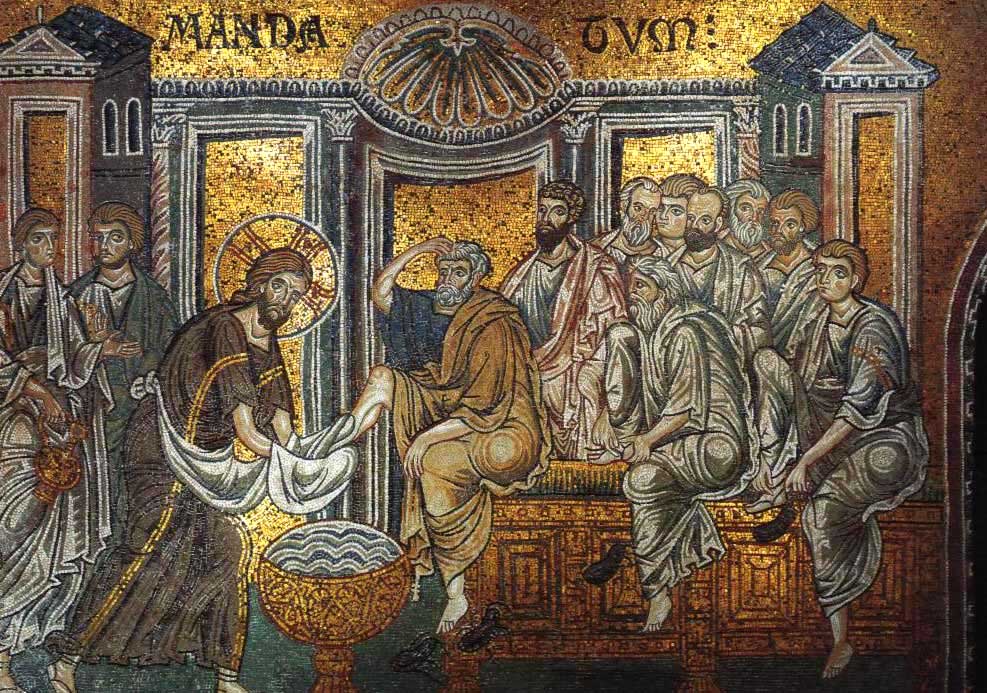
During His Last Supper, Jesus rose from His seat to wash the feet of His apostles to show them what position is all about: loving service to one another. See in this icon from Google there are only 11 apostles present; Judas left the Last Supper to “unseat” the Lord. Above is the word “mandatum”, Latin for “command”, Christ’s command for us to love by leaving our seats of power and comfort to stand with Him at His Cross.
Quiet Storm by Fr. Nicanor F. Lalog II, 22 February 2019
If you are a Catholic and a regular Mass-goer, most likely you always follow the “Roman seating position” – that is, you always sit at the back, avoiding the front seats even in other gatherings outside the church.
According to Msgr. Gerry Santos who used to give us retreats and recollections while we were seminarians, the “Roman seating position” is a carry-over from the martyrdom of the early Christians who were always seated at the front rows of the Colosseum in Rome who were forcibly pushed to be devoured by hungry lions and beasts below.
Of course it is a joke but it holds so much grain of truth because we often refuse to take the front row seats for fears of being put on the spot, of making a stand. How ironic that in this age when seating positions matter so much for us, we have forgotten that more important than the position and prestige that come with the seats we occupy – literally and figuratively speaking – is the stand we take in every issue we face. Protocols dictate in so many occasions how seats indicate power and authority; the throne is always reserved to the highest in rank like kings and presidents. And the closer one is seated to the one in command, the wider is one’s sphere of power and influence too. Unfortunately, this is not everything because every seat of power and authority is always a call to serve, to make a stand for what is true and what is good.
Jesus Christ showed us the true meaning of our seating positions during the Last Supper on Holy Thursday evening when He rose to remove His outer garments to wash the feet of His apostles (Jn.13:1-15). It was a task left for slaves only but Jesus used it as a gospel parable in action to show us that what matters most in life is not where we are seated with Him but where we stand with Him. It was exactly what He meant when He said that anyone who wishes to be the greatest must be the least and the servant of all.
Recall my dear readers how during that evening of the Holy Thursday when John the beloved disciple sat not only beside Jesus but even rested his head on His chest to signify their intimacy as friends (Jn. 13:23). That touching gesture of friendship and love took its summit the following Good Friday when John the beloved was the only one of the Twelve who remained standing with the Lord at the foot of His Cross with the Blessed Mother Mary. In that scene we see how John literally stood his ground as the beloved disciple by remaining faithful and loving with the Lord from His Last Supper to His Crucifixion. Peter, the prince of the Apostles, was nowhere to be found on Good Friday after denying Jesus thrice during His trial before the Sanhedrin the night of His arrest. Very interesting was Judas Iscariot who committed suicide after realizing his grave sin in betraying the Lord. See how he had left the Lord’s Supper to deal with His enemies for His arrest. What an image of the traitor who could not stay on his seat during the Lord’s Supper was the same one who could not stand to face Him again at the foot of the Cross. See how those people who refuse to sit with us are also the ones who never stand with us, stand for us like Judas, a traitor!
I tell you these things even if Holy Week is still more than six weeks from now but in the light of the Feast of the Chair of St. Peter which is about the Primacy of Rome or the Pope as Vicar of Christ and successor of St. Peter. We celebrate this Feast to remember St. Peter and his successors love and service to the Church as examples we must all emulate. In 110 AD, St. Ignatius of Antioch wrote the Christians in Rome to describe to them the Church of Rome as the “primacy of love” and the “primacy of faith”. Every power and every authority signified by the chair or cathedra in the Church as well as in the world when we speak of “seat of power” must always be seen in the light of Jesus Christ’s example of loving service at His Last Supper. This is especially true for us priests who are united in Christ and with Christ in the Eucharist.
This festering problem of sexual abuse in the Church is largely due to our deviation from this primacy in love for Jesus as priests. We have been so focused with our seats – positions and titles – that we have forgotten to stand with Christ at the foot of His cross, standing for what is good and true, just and right. We have been so focused with the “party” of the Supper of the Lord and have forgotten Jesus Himself. Seminarians have been so focused with the vocation and the call, with ordination, forgetting the more essential, the Caller Jesus Himself! And that explains why some in the clergy and those in the hierarchy come up with so many excuses and alibis for the many things we do in our ministry, in our churches, in our parishes, and in our lives because we are only concerned with our office and position but never the Master.
When we love Jesus or any other person, we do not have to justify our actions. Love that is true and pure does not need justifications. But the moment we start making justifications, something is wrong like when we justify our special relationships, no matter how deep or shallow it may be for clearly, there is no primacy in love for Jesus and the Church.
When we justify our vices, our lifestyles, our business endeavors that Canon Law prohibits, clearly there is no primacy in love for we cannot be poor for Christ.
There is no problem with having advocacies as priests but when we are aligned with ideologies contrary to Christ, or when we play in partisan politics, there is neither primacy of faith nor primacy of love. It is the Lord who changes the world, not us, not our programs, not our ideas.
It is our duty as priests to love like Christ but to adopt children and raise them as our own children using our names, there is no celibacy, only stupidity.
Like Jesus, we need money to get our programs going but when we lack transparency and accountability, that is stealing and banditry.
When all we have is the ministry, the priesthood without prayer periods, without the Eucharist, we only have the call but not the Caller Jesus Christ Himself.
More than ever, today Jesus Christ is asking us all His priests to make a stand for Him, to stand with Him, to suffer with Him and to die with Him by leaving our seats of comfort and seats of power.
Yehliu Geopark in Taiwan with “mushroom” rock formations at the background. Photo by the author, 30 January 2019.
The Lord Is My Chef Sunday Music, 17 February 2019
Every year when Valentine’s comes, I only think of one song: Dennis Lambert’s “Of All the Things”. It is probably the ultimate love song of all time especially for us die-hard romantic Filipinos that even Sr. Bubbles Bandojo, rc covered it for a Jesuit CD of popular songs often sung in weddings in the country. No wonder, Dennis Lambert gained a cult following in the country for that song he released in 1972 from the album “Bags and Things”.
Another cut from that great album is “Ashes to Ashes” which I find as a perfect match for our gospel this Sunday about the Beatitudes preached by Jesus Christ during His sermon on the plain based on St. Luke’s gospel. In the Beatitudes, Jesus tells us true blessedness and happiness in following Him is being poor, hungry, weeping, and hated by others. They are paradoxical because they run directly against the values of the world and yet, we know deep in our hearts how they are very true! Life is not about having and amassing but giving and sharing. Dennis Lambert reminds us that in the end, we are all “ashes to ashes, dust to dust.” And there lies the great paradox in this life that Jesus has always reminded us, “Whoever seeks to preserve his life will lose it, but whoever loses it will save it” (Lk.17:33). The saints who have followed the Lord knew it so well and lived it through as well as poets, writers and musicians like Lambert wrote about it too. A blessed Sunday to you!
Lover’s Bridge in Tamsui Fisherman’s Wharf, New Taipei City, Taiwan opened on Feb. 14, 2003. Photo by author, 29 January 2019.
Quiet Storm by Fr. Nicanor F. Lalog II, 15 February 2019
I thought last year’s Valentine’s Day was the most interesting in recent years because February 14 fell on an Ash Wednesday, a beautiful juxtaposition of the secular and the sacred that both remind us of love and death. It happened again to me yesterday very early morning when I drove with my brother down south to visit a beloved aunt who is our late father’s favorite sister sick with Parkinson’s for the last seven years. It was the closest experience I ever had with the realities of love and death intimately related.
Unlike my previous visits to her in the last two years, the latest last January 03, Tita Neneng has always looked so sad and depressed with her situation, choosing to be left alone than be seen in her plight. She used to be bursting with life, so busy with her career and family that upon retirement, she spent it going almost everywhere especially to visit her children in the US. Yesterday, Tita Neneng was so different, almost like back to her old self as she smiled and talked a lot. Her face was radiant, exuding with her beauty that had captivated so many men until her 50’s! She was bubbling with joy as we reminisced the good old days when my father was still alive along with her older siblings, our many family reunions, and of course, our Lola Queta. After anointing her with Holy Oil for the Sick and giving her the Viaticum, she told me something that made me cry so hard after: “Father, I am ready.”
Of course, I knew what she meant but I had to lean close to her to ask her again what she just said. “Father, handa na ako mamatay,” she told me with a smile on her lips while her eyes lovingly looked at me. I asked her if she had told it to her husband, Tito Terry and she replied, “hindi pa.” I told her she must tell it to Tito Terry so he would also be ready. She then looked down, then faced me again and told me, “yung mga anak ko umaasa pa sa milagro. Ayaw pa nila ako payagan.” I looked at her and asked permission to inform her children in the States of her feeling ready.
She just smiled. And I cried. Very hard.
I had to excuse myself to run for some tissue in her bathroom as I could not contain myself crying and sobbing beside her. Once in a while, a lesson from our pastoral psychology crossed my mind that as a pastor or minister, I should not cry in front of a patient, but, what can I do? She’s my dearest aunt who had made me feel so loved and special even before I ever thought of becoming a priest in high school?!
Deep inside me, I also felt some joy amidst the sadness because I felt my Tita Neneng is indeed ready to go anytime soon because she was so composed without any tear in her eyes and always with that sweet smile on her lips. Before, Tita Neneng would always cry to me, begging me to pray that God would take her as she could not endure her sufferings anymore. That was before when she begged for death out of desperation as a way out of her pains and sickness. But yesterday, she simply told me she was ready to die maybe because she must have found her direction in life already.
Yesterday was actually a déjà vu for me, having experienced it before with my bestest friend from high school seminary, Gil who was diagnosed with colorectal cancer in January 2013. He would always cry to me whenever I would visit him, asking “why me” with the Big C? Seven months after undergoing surgery and some chemo treatment, his doctors gave up. It was time to face the inevitable as his cancer cells were so strongly active; but, surprisingly, my friend Gil accepted it gallantly, even with joy on his face! I visited him thrice on his final week before he died. And there I was, breaking into tears before him, crying like a child. A reversal of roles had suddenly happened with Gil assuring me with everything, explaining things I should know more as a priest. The most remarkable thing I have discovered with Gil as he approached death was the inner peace he head when he told me how he had forgiven his wife who had abandoned them, telling me how much he still loved her, vowing to keep his marital vows until his end!
The beloved disciple of Christ wrote, “No one has ever seen God. Yet, if we love one another, God remains in us, and his love is brought to perfection in us” (1Jn.4:12).
Have you ever noticed how when our loved ones were diagnosed with serious illness, they always cried to us while we tried to assure them that everything would be fine? Then, as our loved ones slowly embraced their mortality and faced death, we in turn cried before them who also assured us that everything would be fine? There seems to be a reversal of roles when our loved ones embrace death because their love has been perfected that they no longer fear anything at all. They must be so assured of where they are going to in life, unlike us who are still uncertain of what awaits us and that is why we cry when they go. We not only cry for them but we cry more for ourselves because we have not seen the bigger picture yet that we still love imperfectly. The great love stories of literature like Shakespeare’s “Romeo and Juliet” and Charles Dickens’ “A Tale of Two Cities” show us that death and love always go together not only for a beautiful story but precisely because death shows the depth of one’s love. It is in suffering and death love is perfected. A heart willing to suffer and die for another is the heart that truly loves. Though love is symbolized by the heart as we have it on Valentine’s day, love is best expressed by the Cross of Jesus Christ who showed us the way of true love. Coming to terms with life is coming to terms with death and vice versa. So, let us have Valentine’s day every day!
The Lord Is My Chef Sunday Music, 10 February 2019
It is a very lovely Sunday despite the very warm weather. Perfect for listening to the music of Seawind with vocals by Fil-Am Ms. Pauline Wilson who would surely touch your heart and delight your soul with “Still in Love” from their self-titled album “Seawind” released in 1980.
How lovely to realize that after all these years, you are still loved by someone you have loved. Exactly the kind of love of Jesus Christ to us all. In the gospel today, we find Jesus calling His first apostles while preaching by the shores of Lake Gennesaret after being rejected at their synagogue in Nazareth. That is how true and faithful Jesus is with His mission to reach out to everyone proclaiming His good news of salvation. Jesus is the only one who would always still be in love with us no matter how often we turn away from Him or reject Him.
Are you still in love with someone special? Or with Jesus?
Rejoice because most likely, you are still loved by that someone.
Photo by Mr. Raffy Tima of GMA-7 News, Sampaloc Cove in Subic, Zambales, 20 January 2019. Used with permission.
The Lord Is My Chef Sunday Music, 03 February 2019
As I was telling you in my last blog, we had a unique weekend yesterday when we celebrated the Feast of the Presentation of the Child Jesus in the Temple because its gospel reading complements our gospel this Sunday. Recall how yesterday we have heard Simeon telling Mary the Mother of Jesus, “Behold, this child is destined for the fall and rise of many in Israel, and to be a sign that will be contradicted – and you yourself a sword will pierce you – so that the thoughts of many hearts may be revealed” (Lk.2:34-35). Today in our gospel we have seen the fulfillment of Simeon’s prophecy of Jesus being a sign of contradiction when people at their synagogue were amazed at His “gracious words” in proclaiming the word of God on a Sabbath. Then suddenly, the same people became skeptical of Him, wondering where or how He got such wisdom, asking “is he not the son of Joseph the carpenter?” This deteriorated more when the people became furious of Jesus, trying to hurl Him down headlong a ravine after He had explained to them the meaning of the word of God that revealed their hypocrisies.
So many times we go through the same experiences like Jesus in His own hometown when family and relatives and friends would speak highly of us but later put us down with their gossips and nasty words. Like Jesus when we try to be true and just with everyone, there are those would feel insecure that they would backstab us and even worse, betray us like Judas to Jesus. These are all a part of our being a prophet like Jesus Christ. A prophet is more than being a spokesman of God but someone who makes the word of God happen and fulfilled in every here and now like Jesus declaring in the synagogue on that Sabbath day, “Today this Scripture passage is fulfilled in your hearing” (Lk.4:21). Sometimes, the more we try to truly love, the more we try to truly care and be kind with others, the more we are maligned and disliked by others. Indeed, no prophet is accepted in his own native place.
And that is why I remembered this beautiful song originally sang and recorded in 1970 by the Chicago soul family group called the Five Stairsteps. This song was originally meant to be the B-side of the Five Stairsteps’ version of another song but due to its meaningful and soothing message of hope and love, it became an instant hit at that time. There have been so many versions of this song that has become timeless as it assures everyone in every generation of how things would get better despite the many obstacles and setback in life. It is the very same assurance of God to us all who try to follow His Son Jesus Christ in being a sign of contradiction in this world where the norm nowadays is selfishness and self-centeredness masquerading as love and service. A blessed Sunday to you!
The Cross of Christ atop the church of our Lady of Lourdes in France. Photo by my former student Philip Santiago during his pilgrimage, September 2018.
We had a rare weekend yesterday in the Feast of the Presentation of the Lord that wonderfully complemented our gospel on this Fourth Sunday in Ordinary Time. Recall that last Sunday we were told how Jesus went home to Nazareth, entering the synagogue on a day of rest. Everybody was amazed with His “gracious words” in proclaiming the word of God that we ended the gospel with a very positive note when Jesus declared “Today this Scripture passage is fulfilled in your hearing” (Lk.4:22). Our gospel today repeated this line as its take off point to continue the story of Jesus at the synagogue but, this time Luke tells us of a twist from the very positive “all spoke highly of him” to their skeptical “Isn’t this the son of Joseph?” (Lk.4:22). The mood deteriorated further after Jesus had spoken so that “the people at the synagogue were filled with fury. They rose up, drove him out of the town, and led him to the brow of the hill on which their town had been built, to hurl him down headlong” (Lk.4:28-29)!
What and how did this sudden turn of events happen? Here we find the complementing Feast of the Presentation yesterday based on the infancy narratives of Christmas by St. Luke when Simeon told Mary the mother of Jesus, “Behold, this child is destined for the fall and rise of many in Israel, and to be a sign that will be contradicted – and you yourself a sword will pierce you – so that the thoughts of many hearts may be revealed” (Lk.2:34-35). See how Jesus at the inauguration of His ministry at their Nazareth synagogue last week proclaiming the word of God would now start to be seen as a sign of contradiction among His people as prophesied by Simeon to His mother yesterday. That would reach its highest point 33 years later in Jerusalem where He was presented to the Temple 40 days after Epiphany after resolutely going there to offer or present Himself to the Father on the Cross. This explains why Jesus merely “passed through the midst of them and went away” when the people at the synagogue tried to hurl Him down headlong because His time of final offering had not yet come. But very clearly here at the synagogue of Nazareth, Christ is indeed the sign of contradiction not only to His people but also to us in this generation when we would also speak highly of Jesus, shouting Amen with clapping of hands and suddenly hit people near us with harsh and nasty words or even brutal force. Most of all, like the Lord, we too have experienced being a sign of contradiction when people would speak highly of us then suddenly or over time, turn against us and speak ill of us, betraying us like what Judas did to Jesus on Holy Thursday.
My dear friends in Christ, it is our calling and our life too in living out the word of God through our life of witnessing His immense love in service and mercy for those in the margins. Every time we gather for the Sunday Mass like when Jesus entered the synagogue of Nazareth on a day of rest, He invites us to follow Him to be a prophet by entering Him more than merely the church building. Being a sign of contradiction like Jesus is our prophetic mission in Him. So unlike what most people think, a prophet is not a fortune teller or a seer of the future. As the spokesperson of God, a prophet is one who makes God’s word happen or fulfilled in every here and now. Keep in mind that one feature of Luke’s gospel is the pre-eminence of “listening and doing” the word of God like when he reported how Jesus declared Isaiah’s prophecy fulfilled in their hearing that led into the sharp and sudden shifting in the reaction of people against the Lord, from approval to rejection.
First of all, those reactions were most evidently from His claiming to be the Messiah referred to in Isaiah’s prophecy on whom the “Spirit of the Lord rests upon.” He was the one who proclaimed the word and if we have truly immersed ourselves into this beautiful scene in the synagogue on that Sabbath day, we would really feel Jesus is in fact the one Isaiah is speaking of as being “anointed to bring glad tidings to the poor, liberty to captives, sight to the blind, freedom to those oppressed, and to usher in a year acceptable to the Lord” (Lk.4: 18-19). Salvation decisively begins in Christ and through Christ whenever we enter Him in His words. That “today” in Nazareth synagogue is also the today of our own time that continues to provoke astonishment among others when we try to be Christ’s witnesses of authentic love for others. That is perhaps the sad reality of these days when it becomes big news when people do something genuinely good and beautiful like the woman who impulsively rented 20 hotel rooms in Chicago so the homeless could escape the deep freeze this week in the US Midwest; her deed snowballed into other strangers doing the same! That is essentially the meaning of Paul’s lofty words on love being the greatest of all gifts because it makes God most present in our midst. To truly love like Christ is essentially being a sign of contradiction in this world where the norm is selfishness and self-centeredness often masked in different in lofty terms and ideals bereft of any love at all.
Along this line of self-centeredness we find Luke reminding us in this scene at the Nazareth synagogue of the persisting problem self-entitlement among people then and now when we prophetically live out our mission of making Christ present. People always look down and frown upon those who try to be good and holy by striving to do what is right and just while the holier-than-thou sanctimoniously feel they are the only ones anointed to do such things because they are entitled. They are the modern Gnostics according to Pope Francis in his latest encyclical about holiness in our modern time (Gaudete et Exsulatate)” who feel as the only ones gifted in knowing what is right or wrong, true and good as if they are God. Like those people at the synagogue in Nazareth, they refused to accept Jesus of being more knowledgeable because He is the son of Joseph who was a carpenter. Jesus would strike at the very core of their self- entitlement when He told them “Amen, I say to you, no prophet is accepted in his native place” (Lk.4:24), citing how Elijah and Elisha of the Old Testament days were both sent by God to help pagan peoples and not the Jews who have turned away from Him exactly like them. That filled them with fury against Jesus, wanting to hurl Him down the hill headlong. It is the same feeling those people around us experience like our relatives and friends who could not accept we are better than them that they start spreading all kinds of lies and nasty talks against us as they see their self-entitlement slowly eroding. Such is our life as a prophet like Jeremiah, always going against the flow of the people, choosing Christ to be a sign of contradiction and give way to the fulfilment of God’s word among us. Amen.Fr. Nicanor F. Lalog II, Parokya ng San Juan Apostol at Ebanghelista, Gov. F. Halili Ave., Bagbaguin, Sta. Maria, Bulacan.
You are the truest lover of all… so “nakaka-in-love” and so “kilig” as we say. You are so undeniably real, so personal, always my loving Dad, the only one who truly knows me and would always do things just to let me rest and have a break from all my worries and burdens in life.
As I prayed today’s readings, I could feel your strong presence that made me wonder what the author of the Letter to the Hebrews must have experienced when he wrote “God is not unjust so as to overlook your work and the love you have demonstrated for his name by having served and continuing to serve the holy ones” (6:10).
What he had written has always been true. So many among us at this very moment or past days are feeling so low, crying in silence, grappling with anger within while bearing all the pains of the continuing lack of love and respect, kindness and concern, even civility by some of those around us who feel so entitled in this world. Then out of nowhere, you are suddenly here beside me, coming like a lover, embracing me, hugging me, or simply touching me softly or just tenderly glancing at me full of love and affirmations.
Sometimes like the Twelve we get so tired and hungry following Jesus that we would pick the heads of the grain while passing through a field on the Sabbath when the holier-than-thou people around us would object like the Pharisees saying that is unlawful to do on a Sabbath (Mk.2:23-24). But Jesus would readily defend us because you are “not unjust so as to overlook our work and the love we have demonstrated for your name by having served and continuing to serve the holy ones” (6:10).
Thank you, dear God. Thank you. Help us to persevere in doing what is good in your sight, in fulfilling your will no matter how difficult it may be. Let us never doubt that you can never be outdone in kindness and generosity. Amen.Fr. Nicanor F. Lalog II, Parokya ng San Juan Apostol at Ebanghelista, Gov. F. Halili Ave., Bagbaguin, Sta. Maria, Bulacan.
Photo from Google. During my prayer period, I remembered the song “Like a Lover” that partly inspired me in writing this prayer. Good morning vibes and hope you love it!
It is still Christmas this Sunday here in the Philippines as we celebrate today the Feast of the Child Jesus known as Señor Sto. Niño. The feast reminds us of the most central teaching of Jesus Christ which is to be like a child for He said that “unless you become like children, you shall never inherit the kingdom of heaven.”
One distinct quality of being a child like Jesus Christ is to be always filled with love for everyone. In this age of modern technologies, how sad that we have become more technical than personal that slowly, real love has become so rare among us. Too often love is not only abused and misused but also misunderstood as mere feelings alone. No! Love is always a decision, a choice we make after the interplay of our mind and heart that leads to growth and maturity. And the more we stand on that decision and choice to love, the more it is deepened and perfected in God. So often, love is symbolized by the heart but its truest meaning can only be found in the great sign of the Cross of Jesus where we can find the perfect expression of Christian “childlikeness” and Christian maturity when we choose whatever is more painful and more difficult because we have found someone to love more than our self.
This is the child-like love that Dianne Reeves tells us in her 1987 crossover hit “Better Days” also known as the “Grandma Song” where she spoke of her grandmother not only teaching her but making her experience love that leads to better days. We find in the song her grandmother somehow portraying to us what we have said as Christian “childlikeness” and Christian maturity so that in the end, she peacefully joined God because she had always been faithful and loving as a child of the Father like Christ. That is also the challenge to us of this Feast of the Sto. Niño: to remain children of God even as adults like Jesus Christ. Or Dianne’s grandmother. If only we can be child-like like Jesus or Dianne’s Grandma, we can be assured of better days too not only here but in eternity.
Photo by the author, Dominican Hill, Baguio City, 18 January 2019.










 lordmychef.com