Postscript to Jesus calling us, “come to me”

Quiet Storm by Fr. Nicanor F. Lalog II, 08 July 2026
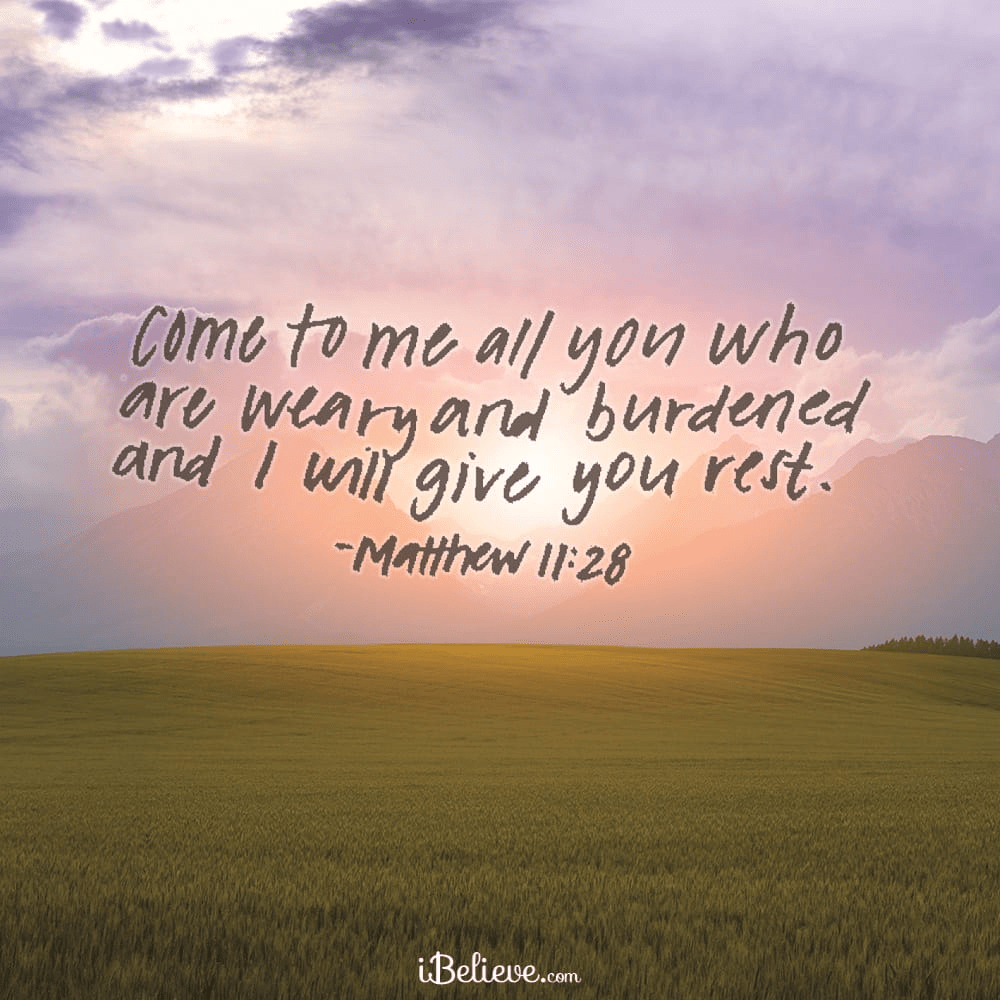
It has been three days since Sunday when we heard Jesus calling us to “Come to me, all you who labor and are burdened, and I will give you rest. Take my yoke upon you and learn from me, for I am meek and humble of heart; and you will find rest for your selves. For my yoke is easy, and my burden is light” (Mt.11:28-30).

It is one of the shortest and most memorable passage in the gospel but, how do we really come to Jesus in order to rest and feel light?

The good news is, it is Jesus who actually comes to us first, inviting us to come to him to find rest and feel light. Exactly like at the meeting of the Risen Lord and Thomas the Apostle eight days after Easter as narrated to us by John. You will recall that last Friday was the Feast of St. Thomas the Apostle (June 3) when I presented in my homily Caravaggio’s painting called The Incredulity of Thomas done in 1602. This is the second time I have used a painting by this renowned Italian painter said to be the favorite of the late Pope Francis too.

Photo of painting by Caravaggio, “The Incredulity of Thomas” via wikipedia.commons.org.

Thomas “refused” to believe the Apostles’ news to him that Jesus had risen, saying that “Unless I see the mark of the nails in his hands and put my finger into the nail marks and put my hand into his side, I will not believe” (Jn.10:25).

Many times we are like Thomas, a Didymus, with a twin in life like doubt and certainty, belief and unbelief, darkness and light.

Like Thomas, we say unconsciously that “Unless I see the mark of the nails in his hands and put my finger into the nail marks and put my hand into his side, I will not believe” (Jn.10:25) because it is when we are suffering, when we are in darkness, when we are in doubt when we truly search and long for God and Jesus.

It is not that Thomas nor we could not believe that Jesus had risen or doubted Christ at all; actually, Thomas believed in Jesus that is why he came on the eighth day to await the Lord’s coming in the same manner that we still pray despite our “doubts”.

 Now a week later, his disciples were again inside and Thomas was with them. Jesus came, although the doors were locked, and stood in their midst and said, “Peace be with you.” Then he said to Thomas, “Put your finger here and see my hands, and bring your hand and put it into my side, and do not be unbelieving, but believe.” Thomas answered and said to him, “My Lord and my God!” (John 20:26-28)
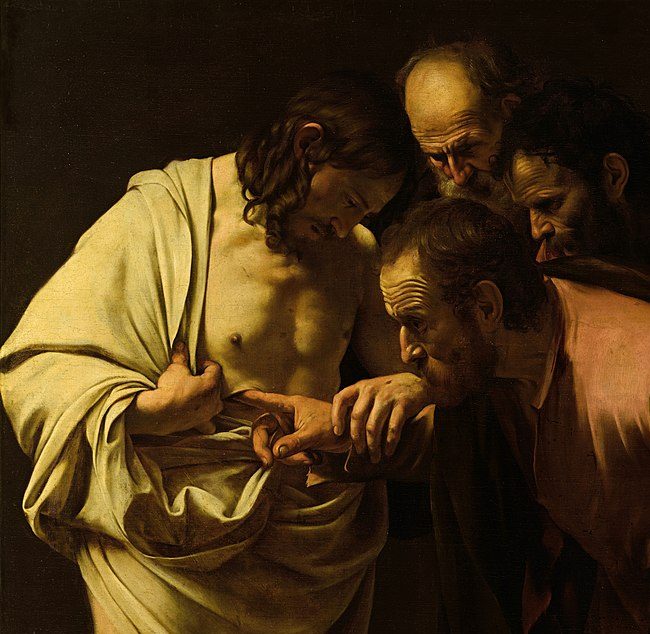
Photo of painting by Caravaggio, “The Incredulity of Thomas” via wikipedia.commons.org.

See the artistry of Caravaggio in this painting, that characteristic play of light and darkness emanating from Jesus, illuminating Thomas and his elder Apostles Peter and John.

All darkness in life are diminished, even vanished completely when we bring everything and everyone in the light of Jesus Christ who comes to us to enlighten us, to illumine us from many darkness we go through in life like Thomas on that night of the eighth day of Easter.

But, there is more to the light of Christ that we can see in this Caravaggio painting.

Amid its stillness and silence, one could feel deeply Jesus Christ’s words last Sunday – come to me – echoed softly, personally, lovingly to Thomas. And to each one of us today.
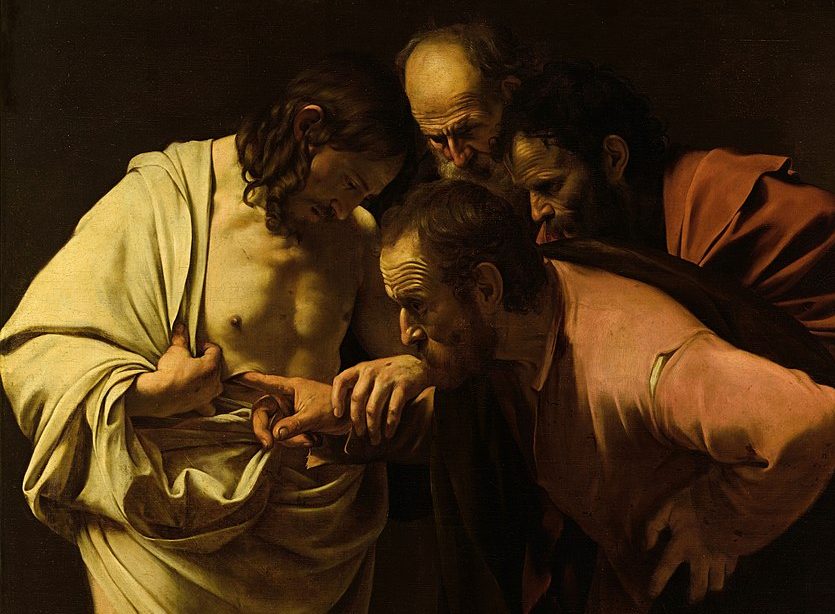
Photo of painting by Caravaggio, “The Incredulity of Thomas” via wikipedia.commons.org.

John tells us that Jesus simply said to Thomas to “Put your finger here and see my hands, bring your hand and put it into my side, and do not be unbelieving, but believe.” Thomas answered and said to him, “My Lord and my God” (Jn.20:27-28).

Okay, fine… it is just my imagination or my contemplation that I heard Christ’s words last Sunday echoed in this scene, “come to me and I will give you rest” but, there is something so beautiful and deeply personal with Jesus in saying or implying those same words here. You can hear it so close, so near you, not from afar especially when you consider its Filipino translation of “Lumapit kayo sa akin” or the informal “Halikayo at lumapit sa akin” that both indicate a separation of even a few feet away from Jesus who is calling us.

See the proximity of the four people in this painting. That is how close Jesus gets to us whenever he comes to us, inviting us to come to him in order to find rest especially in those dark moments in our lives, when we feel hurt and abandoned. When we are so stressed out as seen in those wrinkles on the foreheads of the three apostles!

Contrast their images to the serenity of Jesus. Most of all, see also the hands of Jesus, of how his left hand with the nail wound visible moving aside his garment so that Thomas and his companions may see further his pierced side.

Whenever Jesus comes to us, calling us to come to him to show us his wounds from the cross to remind us that before all our pains and hurts came, he was there first to suffer and be wounded and died for us.

And he has come to us again, calling us to come to him because he had risen, assuring us that all our wounds like his will heal eventually! That is when we experience rest. And being light in life.

But, what I love most in this painting is the way Caravaggio depicted the Risen Lord holding the hand of Thomas while probing into his side wound:
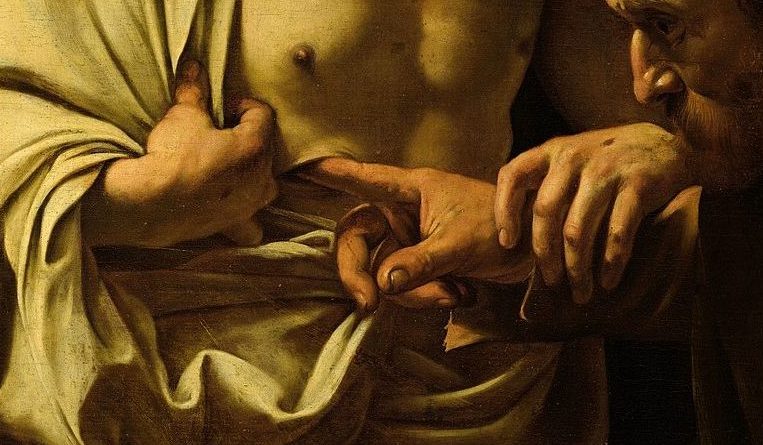
Photo of painting by Caravaggio, “The Incredulity of Thomas” via wikipedia.commons.org.

How lovely! Caravaggio must be in the highest heaven when he painted this part.

Remember when Thomas dared to say unless he sees the nail marks in the Lord’s hands and put his hand at his side, he would not believe?

Jesus knew it so well not only with Thomas but with each one of us, of our being a Didymus, always with a twin of doubt so that he does not merely appear but touches us to experience deeply, personally his loving presence through his wounds.

See how Caravaggio depicted the left hand of Jesus again with the mark of nail holding the very hand of Thomas, directing his finger into his pierced side. You could feel the sure grip as well as gentleness of the Lord’s hand in leading the finger of Thomas into his pierced side wound. So dramatic as if it is not enough for Jesus to being present but most of all, experienced as closest at possible.

Jesus touches us always, literally and figuratively by holding our wounded selves to experience his wounded self too. He does not only call us in words but leads us with his total self.

Christ’s invitation for us to “come to him” remains personal and personalized. Not mass produced like what is happening these days where speed and reach are the main considerations, not the person.

While writing this piece yesterday, one of the blogs I follow came out with a new article exactly about last Sunday’s gospel scene, claiming that if God texts us today, these very words to “come to me” by Jesus would be his “text message” to us (https://thedevotionalguy.blog/2026/07/07/if-god-sent-you-a-text/).

I believe so. Because text messages have become the closest things we can have of anyone in these days of social media. However, if ever you receive that text message from Jesus, run outside to meet him personally for surely, he had come. Amen. God bless you.
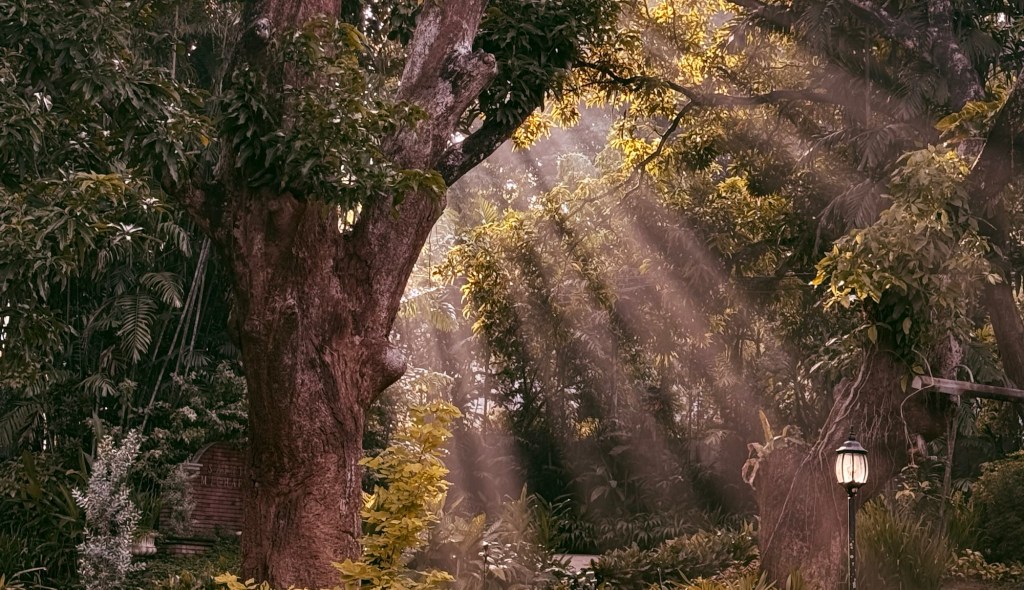
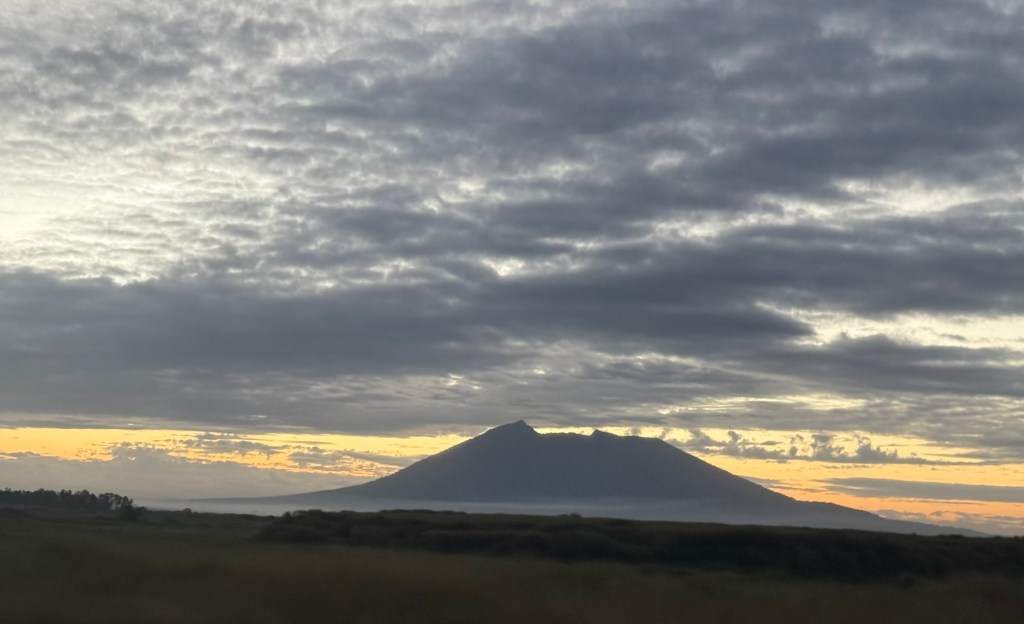
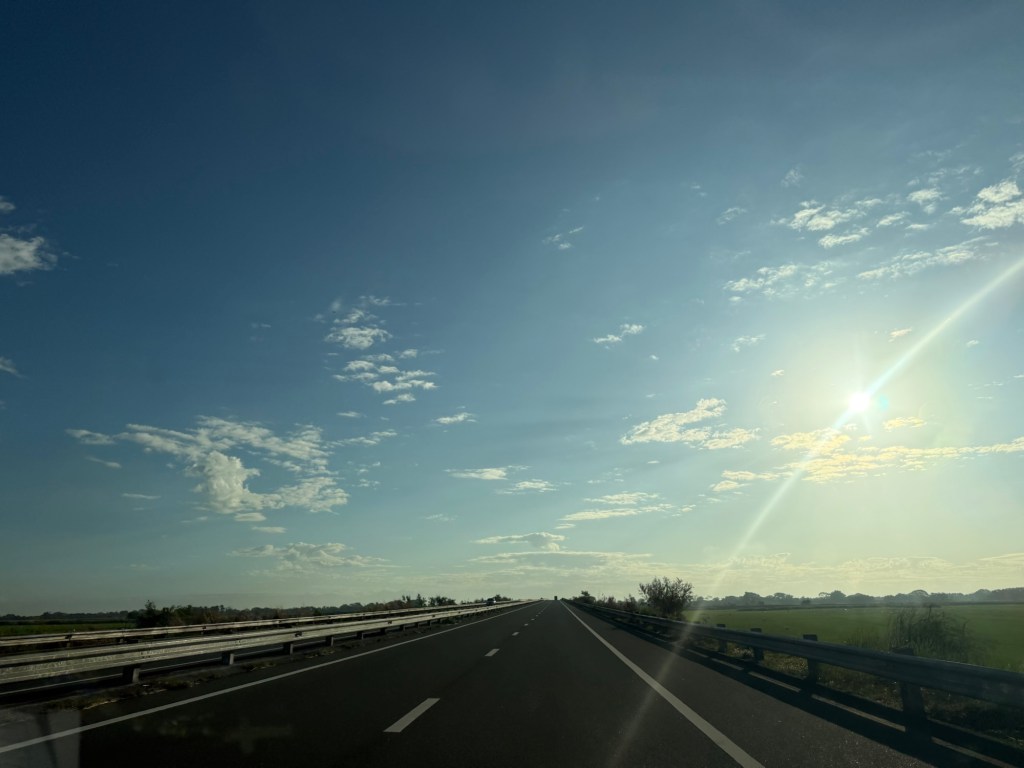
Photo by author, St. Michael Retreat House, Antipolo City, 16 June 2026.

Bringing out the light of Christ

Lord My Chef Daily Recipe for the Soul by Fr. Nicanor F. Lalog II
Thursday, Third Week in Ordinary Time, Year II, 29 January 2026
2 Samuel 7:18-19, 24-29 <'[[[[>< + ><]]]]'> Mark 4:21-25
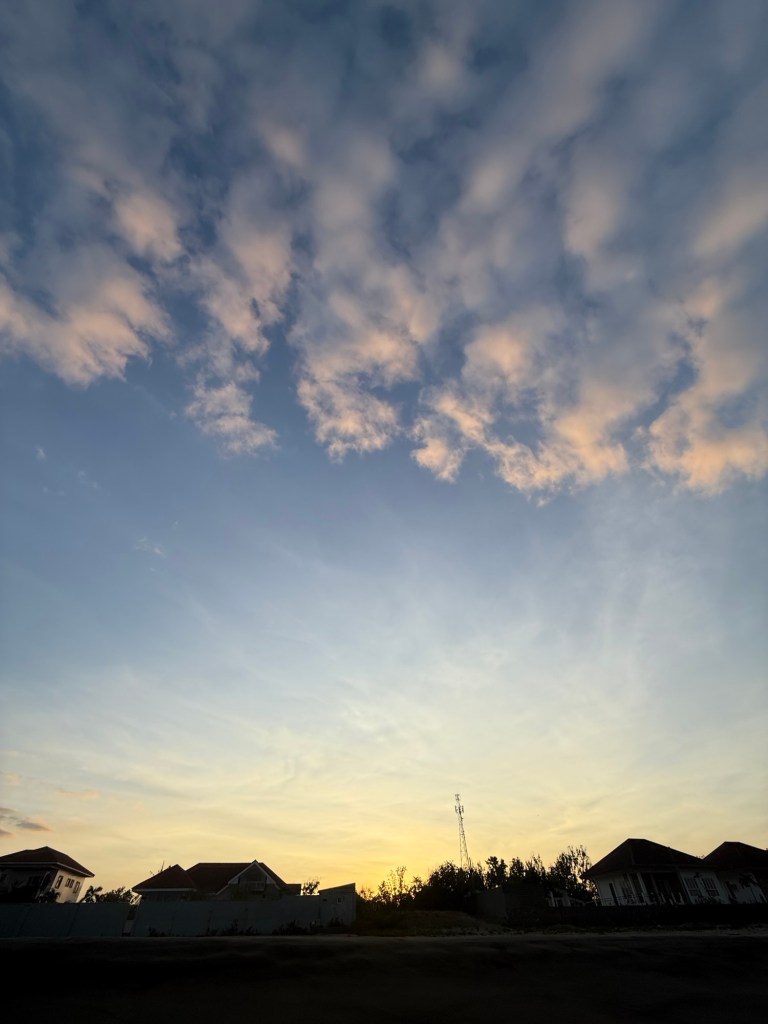
Photo by author, Mt. Arayat, Pampanga, 28 January 2026.
How lovely it must be,
dear Jesus,
if there were few sunrise
each year like in other
places of the world;
maybe everybody would be up
very early for those few mornings
we can witness a sunrise
to see and behold;
as I have told you Lord
last Sunday,
I have always loved sunrise
with its subtle yet intense
appeal of light slowly bursting forth,
light breaking out to brighten
the earth and life in it.

Jesus said to his disciples, “Is a lamp brought in to be placed under a bushel basket or under a bed, and not be placed on a lampstand? For there is nothing hidden except to be made visible; nothing is secret except to come to light… To the one who has, more will be given; from the ones who has not, even what he has will be taken away” (Mark 4:21-22, 25).

Thank you,
dear Jesus for that
reassurance today of God
continually pouring out his grace
on us today as he reveals further to us
his glory and majesty in you,
our light,
the true light of the world
never hidden and finally
brought out to the world;
grant me the grace of courage
to bring out your light in me,
Jesus; enough with too much
hiding of you,
now is the time to reveal you
Jesus in me,
through me;
take away my being too shy
even ashamed and afraid
of letting your light shine in me,
Jesus in this time everybody is
so fascinated with the artificial lights
of the world that dazzle us at first
and slowly blinds us until
we could not see the realities
anymore; like King David
in the first reading,
make us realize that it is in
our weaknesses when you,
O Lord, can shine most
and work most.
Amen.
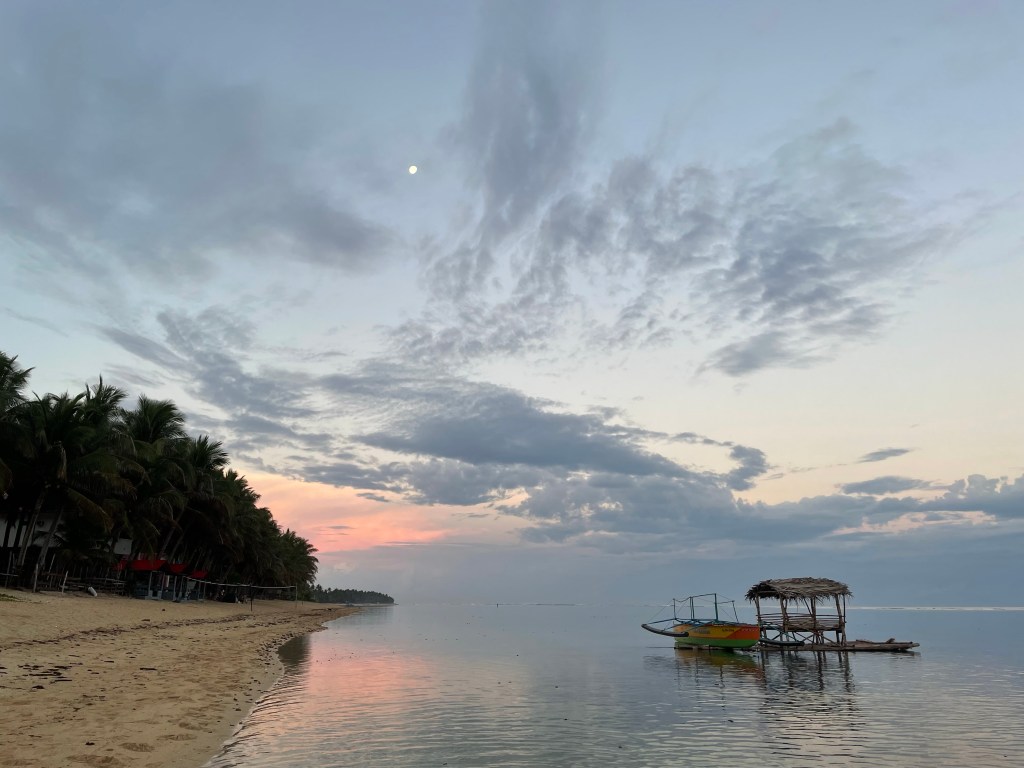
Photo by author, La Paz, Tarlac CLLEX, 28 January 2026.

Jesus our Light

Lord My Chef Sunday Recipe by Fr. Nicanor F. Lalog II
Third Sunday in Ordinary Time, Cycle A, 25 January 2026
Isaiah 8:23-9:3 ><}}}}*> 1 Corinthians 1:10-13.17 ><}}}}*> Matthew 4:12-23
Photo by author, sunrise at the Lake of Galilee, the Holy Land, May 2019.

More than a month ago at the Midnight Mass of Christmas we have heard this Sunday’s first reading, that beautiful prophecy by Isaiah fulfilled in Jesus Christ’s coming.

First the Lord degraded the land of Zebulun and the land of Naphtali; but in the end he has glorified the seaward road, the land west of Jordan, the district of the Gentiles. Anguish has taken wing, dispelled is darkness: for there is no gloom where but now there was distress. The people who walked in darkness have seen a great light; upon those who dwelt in the land of gloom a light has shone (Isaiah 8:23-9:1).

When Jesus heard that John had been arrested, he withdrew to Galilee. He left Nazareth and went to live in Capernaum by the sea, in the region of Zebulun and Naphtali, that what had been said through Isaiah the prophet might be fulfilled… (Matthew 4:12-14).

As we move forward into Ordinary Time, we hear anew one of the most beautiful promises in the Old Testament of how the coming of the Christ is the “breaking of dawn of salvation” as Zechariah sang in his Benedictus after naming his son “John” when light bursts forth to dispel the darkness that had enveloped us for a long time.

Photo by author, sunrise at the Lake of Galilee, the Holy Land, May 2017.

Notice that it is those who live and walk in darkness literally and figuratively speaking are always the first to come forward into the light like the people in Galilee at that time, especially the towns of Zebulun and Naphtali who were actually names of Jacob’s two other sons. Their tribes settled in that area of Galilee that was at the border with other pagan countries always subjected to wars and conflicts with foreigners. Their lands were literally in the dark, never at peace as if forsaken.

Here lies the good news of this Sunday: after hearing the news of John’s arrest, Jesus launched his public ministry. Notice how plain and simple was Matthew’s narration, “When Jesus heard that John had been arrested” – it was another period of darkness for the people with rampant violence and injustice. However, it was not totally dark at all: see how Jesus withdrew to Galilee; Christ’s “withdrawing” to Galilee was not something negative but actually more of a positive development. Jesus chose to begin his ministry in that forsaken province of Galilee to show his love and concern for the people long forgotten. Remember how at that time that Jerusalem was the center of everything, something like an “imperial Manila” we call these days.

Here we find again that imagery of Jesus like in his birth that happened during the darkest night of the year that 30 years later, he chose to go to the darkest region of Israel to bring light of salvation to everyone. Jesus comes to us most in moment of darkness in our lives! When we are troubled by sins and problems, never lose that spark within for Christ had come, is coming and continues to come to us! Matthew mentioned this prophecy of Isaiah of the great light shining in the land of gloom not really for his readers then and now to remember what God had done in the past but to make us all aware always that God continues to send us his Son Jesus in these dark moments of our lives. In telling us how Jesus began his ministry by withdrawing to Galilee in the land of Zebulun and Naphtali, Matthew wants us to be aware of what God has done for us, of giving us Jesus, the true Light of the world right into the many darkness we are going through in life today.

More than the news overseas that we have heard like wars and the breaking apart of world peace and order with America suddenly flexing its muscles to remind everyone they are still great and powerful or the very frustrating corrupt lawmakers of the country, we are all in some form of being in the midst of darkness in our personal lives too like a sick loved one or a problematic brother or sister.

Photo by author, San Juan, La Union, 08 January 2026.

God has delivered us from slaveries of sin and selfishness in Christ’s coming and presence among us. Surely there would always be darkness and shadows in our lives this 2026 but Jesus is telling us today in his withdrawing to Galilee after hearing John’s arrest that we need to get out of our own darkness! There is no more darkness in Christ’s coming; it is us who have darkened our lives with our selfish interests like the quarrels and animosities against one another that St. Paul warned against in the second reading.

Every time we destroy our unity, our oneness, we plunge ourselves into darkness. Whenever we refuse to bow down, when we refuse to give way, when we refuse to forgive even forgo or let go of others inanities, we go back to darkness. Inasmuch as Jesus Christ is the great light who shone on the many darkness of our lives, he is calling us like the first four disciples to bring his light to others.

Was it really that easy for the brothers Simon and Andrew, especially brothers James and John to immediately leave behind their livelihood and father so easily for Jesus? Not really. Matthew need not go into details about their call and conversion because most likely, they went through the same stages we have gone through or going through right now as we pray and reflect about our life direction. Like us today, Simon and Andrew, James and John experienced burn out, searching for meaning in life that after listening to the words of Jesus, they felt and saw him as the light enlightening everything for them. They saw in Jesus their lives and very person getting clearer that they decided to follow him and become fishers of men.

How far are we willing to repent and be converted in the light of Christ to start anew living in the land of loving God, self, and others?

Photo by author, Bolinao, Pangasinan, 19 April 2022.

I have always loved sunrise. Though sunsets are more colorful and dramatic like a spectacular show called palabas in Filipino, sunrise is different: it is more of paloob, an inside movement that is subtle yet intense when light steals into shadows as the sun is gradually breaking open the darkness to reveal what is unseen.

That is why our Filipino term for sunrise is more evocative of its deeper meaning as pagbubukang liwayway which literally means breaking of dawn. Every morning person (madrugeño in Spanish) knows so well those feelings of being up before sunrise, of exactly catching the breaking of dawn that is always joyful and liberating with a certain kind of lightness and relief from deep within because another day is given us.

Maybe it is a carry over with my having worked for three years in the graveyard shift covering the police beat while still working at GMA News in the late 1980’s. But more recently, I feel that imagery of coming forward into the light resonates most after a good confession when we deeply realize God’s immense love, that God is not that really angry at all with us because of our sins, that there is a bright light to always look forward in this life amid all the darkness and shadows enveloping us.

Today is the National Bible Sunday. It is when we prayerfully read the Sacred Scriptures everyday that we see the light of Christ in our selves, in our lives. The more we pray the Scriptures, the more we are enlightened, the more we are filled with the light of Christ that enables us to see too his light on the face of those we meet daily. Let us step out of our darkness in life this Sunday and everyday to henceforth experience and share Christ. Amen. Have a blessed, enlightening week ahead!

Advent is the light of Christ coming

Lord My Chef Simbang Gabi Recipe for the Soul by Fr. Nicanor F. Lalog II
Wednesday, Simbang Gabi-XIX, 24 December 2025
2 Samuel 7:1-5, 8-12, 14, 16 <*((((>< + ><))))*> Luke 1:67-79
Photo by author, sunrise at Lake of Galilee, the Holy Land, May 2019.

Being an early riser or “madrugeño” in Spanish, I have always loved and preferred early morning Masses because churchgoers at that time are mostly silent, either still sleepy or simply truly reverent.

Though sunsets are more colorful and dramatic like a spectacular show – a palabas in Filipino -sunrise is different because it is more of paloob, of inside movement that is subtle yet intense when light steals into shadows as the sun isgradually breaking open the darkness to reveal what is unseen. Our local term for sunrise or breaking of dawn says it all, pagbubukang liwayway.

There lies the beauty of our Simbang Gabi especially on this final day of our novena when we are slowly seeing the light of Christ’s coming. It is hoped that in these nine days of prayers and reflections on the Sacred Scriptures, we have been enlightened about the the true meaning of Christmas, of how it continues to come and happen in our modern time so darkened by sin and evil.

On this final day of our Simbang Gabi, we reflect on the wonderful aftermath of the assertions by Elizabeth and later by her husband Zechariah on the name “John” meaning “God is gracious” being given to their child as instructed by God. Suddenly, Zechariah who was rendered deaf and mute following his unbelief in having a child, sang praises to God!

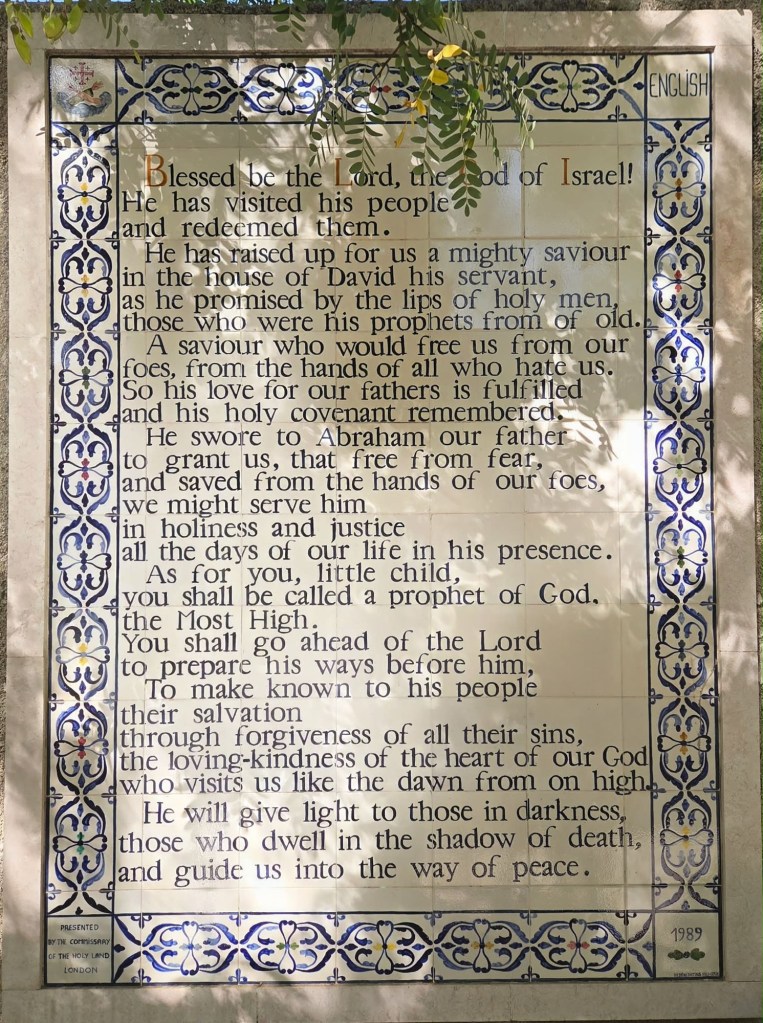
Zechariah his father, filled with the Holy Spirit, prophesied, saying: “Blessed be the Lord, the God of Israel; for he has come to his people and set them free. He has raised for us a mighty Savior, born of the house of his servant David… In the tender compassion of our God the dawn from on high shall break upon us, to shine on those who dwell in darkness and the shadow of death, and to guide our feet into the way of peace” (Luke 1:67-68, 78-79).

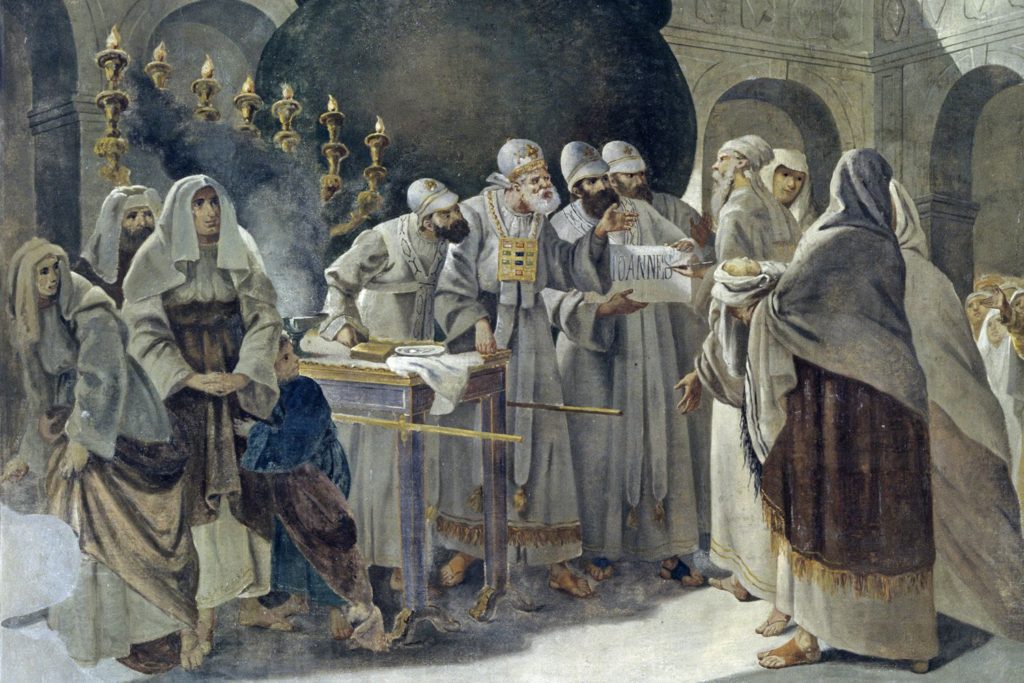
Painting by Italian Riccardo Cessi in 1892 of Zechariah giving name to his son John;from commons.wikimedia.org.

In singing the Benedictus, Zechariah affirmed and confirmed in himself the reality and truth of God being present in our lives.

Many times we are like Zechariah that even if we pray, celebrate the Masses, do all the devotions but still deep inside, doubt God’s reality that we simply do all this sacred rites and traditions just for the sake of doing them.  Last week at the start of our Misa de Gallo, we have invited you to reassess and examine the reason why we are keeping this sacred tradition.  Is it because of special favors we are asking from God or is it because we want to see God?

The late American Trappist monk Thomas Merton said in one of his writings that seeking God is not like searching for a “thing” or a lost object because God is more than an intellectual pursuit or a contemplative illumination of the mind. Merton explained that God reveals Himself to us in our hearts through our communion and fellowships in the Church. 

Photo by Ar. Philip Santiago, Benedictus on the wall of the patio of Church of St. John the Baptist in Ein-Karem where he was born.

In singing the Benedictus, Zechariah realized God’s presence and His coming communion throughout Israel’s history, from the Patriarchs down to the birth of his son John who would prepare the way of Jesus Christ.  The Benedictus describes to us the coming of the Christ as expected by the people of Israel in the Old Testament and that is why, unlike Mary’s Magnificat, it is in the future tense. While Zechariah mentions the mission of his son John, the main focus of the Benedictus is Jesus Christ who was about to be born six months later at that time. 

Therefore, when we who believe in Jesus as the Christ or Messiah expected by the people of Israel in the Old Testament, the Benedictus becomes an affirmation of God’s presence in us and among us today and forever.

It is in this most sublime expression by Luke we find Christ’s coming like the breaking of dawn like shafts of light bursting forth, “In the tender compassion of our God the dawn from on high shall break upon us, to shine on those who dwell in darkness and the shadow of death, and to guide our feet into the way of peace.” It is in this breaking of dawn we find and experience the poetry of sunrise that is more of the heart than of the eyes we mentioned earlier.

After seeing the coming of the Christ in the birth of his son John, Zechariah now summarizes to us the very essence of Jesus our Savior, of God Himself: tender compassion or in the original Greek, splaghna or “tender mercy” of God.

It is not just compassion which is to suffer with us but at the same time be filled with tenderness that one is so moved to reach out, to do something by going down with the one suffering.

Like courage, mercy is a movement in the heart called misericordia in Spanish from the Latin mittere, meaning to be moved, to be stirred. It is something dynamic, not static. It is a deep feeling that moves toward someone in pain and suffering. An identification of Jesus with every person going through so much hardships and sufferings in life.

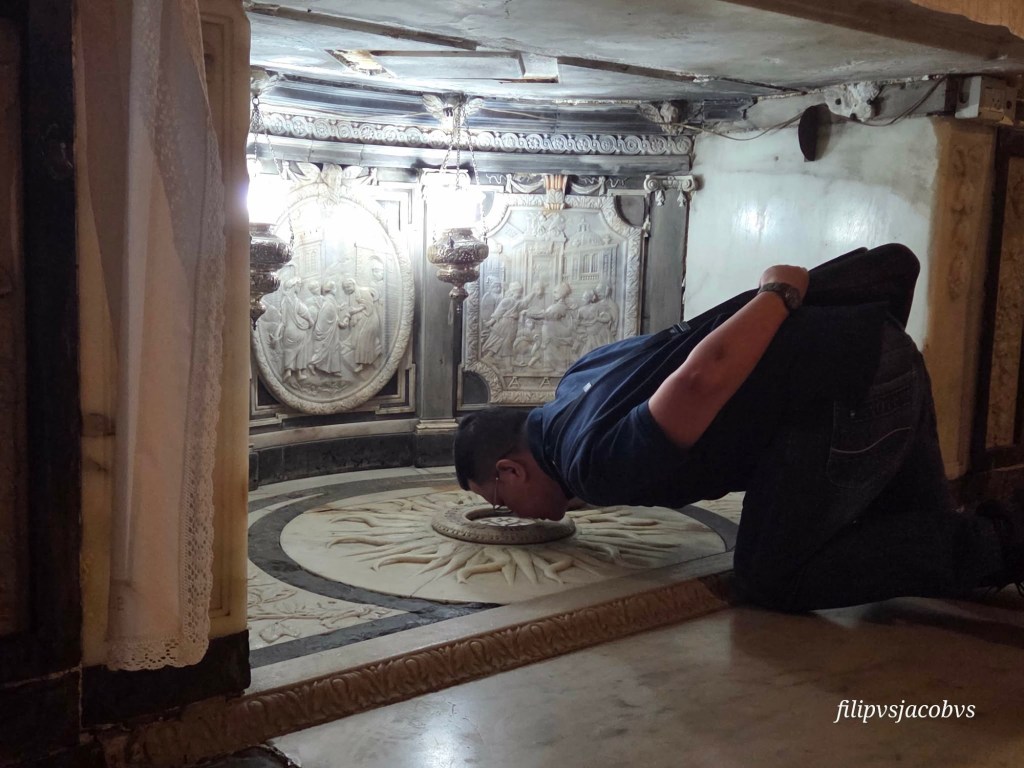
Ar. Philip Santiago reverently kissing the very site of John’s birthplace in Ein-Karem, October 2025.

See now the culmination of movements we have mentioned in Luke’s Christmas story: last Saturday at the Annunciation to Mary, the Angel mentioned the “overshadowing of Holy Spirit” on her in bearing our Savior; today in the Benedictus, there is the moving or stirring of the heart in Zechariah. Whenever we allow God to overshadow with His powers, our hearts are moved to love more, to be tender like God.

Zechariah’s heart is no longer hardened with negativity and cynicism – it was so stirred by God that he mentioned His tender mercy or compassion because he had personally felt it as he recovered his voice and speech. With the birth of John, he now believes that God’s love for his suffering people is deep and personal.

And that is perhaps one of the things we sorely lack in our history as a nation especially during the decadent years of the last Administration – the utter lack of tenderness by our officials and their kawatan in corruption. Wala silang awa at habag sa taong-bayan.

Recall the tender compassion, tender mercy of Jesus, how during His ministry all four evangelists would narrate Jesus was moved with pity and compassion to the people who were lost, tired and sick “like sheep without a shepherd” that no matter how tired He may be, He would always find time to teach them, heal their sick, and even feed them. That is the mercy of God that Jesus had brought forth to us in His coming, experienced by Zechariah himself that he could foresee its coming at the birth of John.

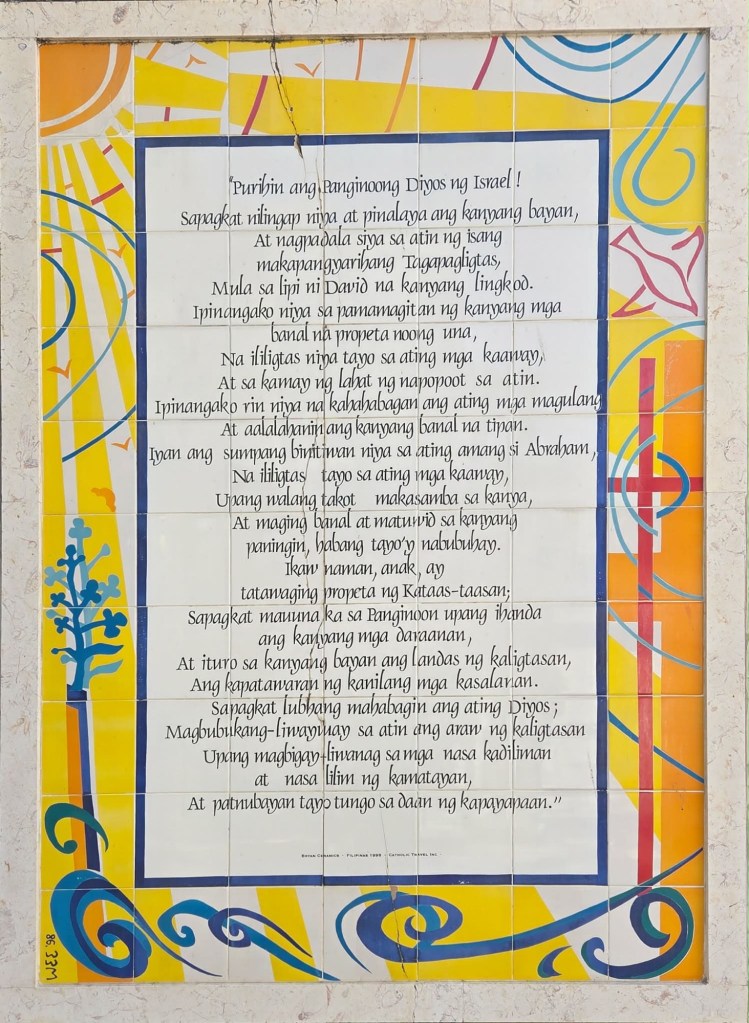
Photo by Ar. Philip Santiago, Filipino translation of the Benedictus on the wall of the patio of Church of St. John the Baptist in Ein-Karem where he was born.

That is the Benedictus, the song of every faithful disciple of Jesus introducing His coming, His birth. So many people have forgotten God, do not know God, refused to believe in God because many among us He had lavishly loved have refused to share His love with others, choosing to remain in the darkness of the night, thinking more of themselves and of their hurts and pains that they revenge with by stealing billions of money.

How lovely to think that God’s tenderness moves in us like the breaking of dawn, of shafts or streaks of lights slowly penetrating, bursting forth through cracks in the skies, in our homes and even right in our very selves. Bask in that light saw by Zechariah, shared by John the Baptist his son. Amen. Have a blessed and meaningful Christmas! Thank you for following our reflections. Share it and let it be shafts of light to somehow illumine the darkness in others.

God in light & shadows

Lord My Chef Daily Recipe for the Soul, 18 July 2025
Friday in the Fifteenth Week of Ordinary Time, Year I
Exodus 11:10-12:14 <'[[[[>< + ><]]]]'> Matthew 12:1-8
Photo by author, Sacred Heart Novitiate, Novaliches, QC, 20 March 2025.
How lovely are your words
today, O God,
on this dark, rainy Friday
with many light and shadows
that show life's many contrasts
with you still remaining
with us,
in us,
and among us.

Although Moses and Aaron performed these various wonders in Pharaoh’s presence, the Lord made Pharaoh obstinate, and he would not let the children of Israel leave his land (Exodus 11:10).

You know everything,
dear God that is why you
set the stage for the first passover
at "evening twilight" just in time
for the people to see the light
of freedom in you;
you sometimes allow storms
to happen but
you already have
provisions for us
beforehand:

Jesus was going through a field of grain on the sabbath. His disciples were hungry and began ton pick the heads of grain and eat them (Matthew 12:1).

What a beautiful contrast
is today's gospel!

How did it happen
the Twelve were hungry
while with Jesus
who had fed more than
5000 people with just five
loaves of bread and two pieces
of fish?

Right there under
the glaring light
and heat of the sun
on a Sabbath
when you "fed" on the Twelve
with grains in the field;
moreover,
when criticized by your
enemies,
you defended the Twelve!
You are a God of
mystery, Jesus!
Truly "greater than
the temple" for you are
the Christ,
the Son of God
who became human like us
to show us you are with us,
in us,
and among us
when everything seems
so dark or so bright
that may blind our sights;
incline our hearts to you, Jesus
who "desires mercy,
not sacrifices"
 so that when we grapple
in light and shadows,
it is solely you whom we hold on.
Amen.

Fr. Nicanor F. Lalog II
Our Lady of Fatima University
Valenzuela City
Photo by author, Sacred Heart Novitiate, Novaliches 20 March 2025.