Lord My Chef Daily Recipe for the Soul by Fr. Nicanor F. Lalog II
Wednesday in the Seventh Week of Easter, 04 June 2025
Acts 20:28-38     <*{{{{><  +  ><}}}}*>     John 17:11-19
What a moving first reading
today as we come to close the
Easter Season when Paul bid goodbye
to the presbyters of the Church of
Ephesus.

They were all in tears because
most likely they would never see
Paul again; but most of all, of the
sincerity of Paul in his words spoken
to them.
“Keep watch over yourselves and over the whole flock of which the Holy Spirit has appointed you as overseers, in which you tend the Church of God that he acquired with his own Blood…I have never wanted anyone’s silver or gold or clothing. You know very well that these very hands have served my needs and my companions. In every way I have shown you that by hard work of that sort we must help the weak, and keep in mind the words of the Lord Jesus who himself said, ‘It is more blessed to give than to receive'” (Acts 20:28, 33-35).
Indeed,
it is more blessed to give
than to receive because in giving
that is when we have to use more of our hands
in toiling and working;
in the work of our hands,
we not only share Christ in the good
deeds we do but most of all,
open the eyes and hearts of others
to welcome Jesus into them to work
also through their very own hands.
It is the same imagery
we have of Jesus praying for us
his disciples,
laying over his hands over us
as he "consecrate" us in truth.

Oh dear Jesus,
make our hands strong
to keep working, doing
the difficult things many avoid
so we can bless more people;
keep our hands open too
to share our work and blessings
with others;
most of all,
keep our hands clasp together in prayer
to you to surrender ourselves
to your will always so that
our hands may be cleansed
of dirt and stains of sin
worthy in giving praise
to you and touching
those in need.
Amen.
Paul saying goodbye at Ephesus on the way to Rome for his trial and eventual martyrdom.
The Lord Is My Chef Daily Recipe for the Soul by Fr. Nicanor F. Lalog II
Thursday, Memorial of St. Alphonsus Liguori, Bishop & Doctor of Church, 01 August 2024
Jeremiah 18:1-6     ><))))*>  +  <*((((><     Matthew 13:47-53
God our Father,
I love your words today,
of You being like a potter that
"Whenever the object of clay
which he was making turned out
badly in his hand,
he tried again,
making of the clay
another object of whatever sort
he pleased.
Then the word of the Lord came to me:
Can I not do to you,
house of Israel,
as this potter has done?
says the Lord.
Indeed, like clay in the hand
of the potter,
so are you in my hands,
house of Israel"
(Jeremiah 18:4-6).
Teach me, Lord
to be docile
and to have faith in You
when things turn out badly
in my life;
let me be like the clay,
pliant and flexible,
permeable and absorbent
easy to be formed;
like St. Alphonsus Liguori
who was at first a very able lawyer
but after losing a case due to a
simple neglect,
he was depressed
that he left his legal profession
to become a priest
who later became a bishop.
How lovely to remember
accomplished people
like St. Alphonsus
committing costly mistakes in life
still given a chance
to become even greater
in your new calling;
remind us, dear Lord,
especially in moments of failures,
in times things turn out so badly
in our lives
how all the beautiful potteries we see
came from the same process of
failures and destruction
in order to be formed into
something even more beautiful
than before.
Amen.
40 Shades of Lent by Fr. Nicanor F. Lalog II
Solemnity of the Palm Sunday of the Lord's Passion-B, 24 March 2024
Isaiah 50:4-7  ]]+[[  Philippians 2:6-11  ]]+[[  Mark 15:1-39
From influencemagazine.com
As you all know by now, I turned 59 years old last Friday, March 22. For the second consecutive year, I have moved my personal annual retreat to my birthday so I can pray more, thank God more for his gift of life to me. This is one of my realizations in turning 59 years old:
"The more we enter the heart of Jesus
 where we find peace and fulfillment,
joy and security,
the more we also discover
the dark and ugly sides of life.
Darkness, pains, sickness, failures,
and other forms of sufferings
come to the fore when we are
in God’s loving presence,
and vice versa."
The more we see and experience God’s beauty, we also see and experience Christ’s agony and passion within our very selves and among our brothers and sisters. These two faces of life ever present in our earthly journey are perfectly shown to us by today’s celebration called “the Solemnity of the Palm Sunday of the Lord’s Passion.”
What we have this Sunday is actually a twin-celebration.
Palm Sunday came from the liturgy of the early Christians living in Jerusalem in the fourth century who started the Holy Week tradition with a procession of palm branches that later spread to France and Germany where the blessing of palms was introduced. Later in Rome in the 12th century, the Pope began the tradition of commemorating the Lord’s Passion on this Sunday with a proclamation of that long gospel narrating Christ’s entry into Jerusalem leading to His Last Supper until His Crucifixion and Death. It was only in 1965 during Vatican II when these two celebrations were combined into what we now have as the Solemnity of the Palm Sunday of the Lord’s Passion.
The merging of these two celebrations sums up the mystery we celebrate during Holy Week as well as the mystery of our everyday life wherein we have the glory of Palm Sunday in one hand and at the other hand, the darkness of our own passion as a sharing in the Pasch of the Lord.
Photo by author, Chapel of St. Francis Xavier, Sacred Heart Novitiate, Novaliches, 20 March 2024.
I have intended a play in the word “hand” there as I prayed over our gospel this Sunday during my recent retreat. As directed by my Jesuit guide, I reflected on the four gospel accounts of the Lord’s Passion where I found the word “hand over” used so many times.
“To hand over” is the more literal translation of the Greek word paradidomi used by the evangelists in the “betrayal”of Jesus by Judas Iscariot. In Filipino, it is ipasa and ibigay that are more picturesque than ipagkanulo which is our equivalent of “to betray”.
Now, look at how our Filipino word ipasa takes on a deeper meaning when we reflect on how Jesus was “handed over” first by Judas Iscariot to the chief priests who then “handed him over” to Pilate who eventually “handed him over” into death by crucifixion. Pinagpasa-pasahan nila si Jesus! And that is how evil we are humans with God and with one another, using our very own hands, handing them over by manipulating them for our own selfish ends.
Then Judas Iscariot, one of the Twelve, went off to the chief priests to hand him over to them. When they heard him they were pleased and promised to pay him money. Then he looked for an opportunity to hand him over… He (Judas Iscariot) came and immediately went over to him and said, “Rabbi.” And he kissed him. At this they laid hands on him and arrested him.
Mark 14:10-11, 45-46
As soon as morning came, the chief priests with the elders and the scribes, that is, the whole Sanhedrin, held a council. They bound Jesus, led him away, and handed him over to Pilate… So Pilate, wishing to satisfy the crowd, released Barabbas to them, and after he had Jesus scourged, handed him over to be crucified.
Mark 15:1, 15
Photo by author, Chapel of St. Francis Xavier, Sacred Heart Novitiate, Novaliches, 20 March 2024.
This handing over of Jesus – pinagpasa-pasahan si Jesus in Filipino took its lowest point in Matthew’s account when Pilate “took water and washed his hands in the sight of the crowd” (Mt. 27:24) to claim innocence in the Lord’s death. That’s how dirty our hands as humans have become! How ironic and tragic that the more we wash our hands in repeatedly handing over our family and friends, colleagues and even country, the more our hands have become dirty.
This Sunday, Jesus is inviting us to examine our hands, to clean our hands so that they become His hands of loving service, mercy and forgiveness, kindness and understanding and care for each other and nature. Let us remember the lessons of COVID-19 four years ago today when we constantly washed and disinfected our hands to be more responsible with each other, with nature and with life. Our problems are often the results of things getting off hand, out of control or too much control as we manipulate everything even God, persons and nations through elections as well as habits and patterns for economic and social reasons
“Ecce Homo” painting by Vicente Juan Masip (1507-1579) from masterapollon.com
It is so different with the hands of God expressed so beautifully in our first reading from the Prophet Isaiah’s Song of the Suffering Servant who was fulfilled in Jesus Christ our Lord and Savior.
The Lord God has given me a well trained-tongue, that I might know how to speak to the weary a word that will rouse them… and I have not rebelled, have not turned back.
Isaiah 50:4, 5
Here is a beautiful picture of God in Jesus Christ whose hands we have tied so many times as we insisted on our own ways, in seeking instant gratifications, in manifesting power through sheer strength. Here lies the beauty of God’s hands in Jesus Christ so opposite with our manipulating and controlling hands because His is of submission. Or passion.
The word “passion” is from the Latin patior that means to suffer or to undergo. It is related with the words passivity and patience – exactly like patients who just lie and wait on their beds, waiting for the doctors and nurses, for them to be healed and get better.
Passion here connotes passivity in the positive sense when we strip ourselves naked before God in order to be open to new possibilities like Jesus Christ eloquently expressed by St. Paul in the second reading when He “emptied and humbled himself, becoming obedient to the point of death, even death on a cross” (Phil.2:7, 8).
Photo by author, Chapel of the Holy Family, Sacred Heart Novitiate, Novaliches, June 2016.
In his Passion, Jesus taught us that true power is in weakness like him dying on the Cross. Now here we find something so interesting with the synoptics account of Christ’s death when “he breathed his last” (Mk. 15:37) leading to the faith of a Roman soldier, a pagan.
When the centurion who stood facing him saw how he breathed his last he said, “Truly this man was the Son of God!”
Mark 15:39
What was in Christ’s final breath that convinced the Roman centurion that Jesus was indeed the Son of God? The fourth gospel gives us the answer: When Jesus has taken the wine, he said, “It is finished.” And bowing his head, he handed over the spirit (Jn. 19:30).
Here again we find the words “handing over” but this time in the positive sense. Jesus never betrayed the Father nor anyone; he instead handed over Himself to God and to us. That is passion when we suffer passively in the positive sense because we love, we care, we understand.
For us to enter into the heart of Jesus this Holy Week, we have to enter into His passion too. That is to submit, to surrender all our powers to God through our parents and superiors by emptying ourselves of our pride to be filled with Christ’s humility, justice and love. Amen. A blessed Holy Week to everyone!
Photo by author, Chapel of the Holy Family, Sacred Heart Novitiate, Novaliches, June 2016.
The Lord Is My Chef Daily Recipe for the Soul by Fr. Nicanor F. Lalog II
Thursday, Solemnity of the Nativity of John the Baptist, 23 June 2022
Isaiah 49:1-6 ><]]]]'> Acts 13:22-26 ><]]]]'> Luke 1:57-66, 80
Photo by author, the Church of St. John the Baptist at Ein Karem, Israel, 2019.
All who heard these things took them to heart, saying, “What, then, will this child be?” For surely the hand of the Lord was with him.
Luke 1:66-67
The term “hand of the Lord” is a description of God’s presence and power in the Old Testament, a vivid way of presenting God “intervening” in the daily lives of his people, saving them from all kinds of dangers like the prophets.
There was Elijah who was hunted by the soldiers of Jezebel and the “hand of the Lord was on Elijah” (1 Kgs. 18:46) that he was spared from their murderous plots. Then there was also Ezekiel who saw “the hand of the Lord” (Ez. 37:1) upon him at the vision of a valley of dry bones coming back to life.
Sometimes, the “hand the Lord” referred to God’s judgment like when King David had sinned against God in not trusting him when he ordered a census of soldiers before a battle. It angered God who asked David to choose which punishment he preferred: natural disaster or victory by his enemies or God’s judgment. David chose the third option, saying, “Let me fall into the hand of the Lord for his mercy is great…” (1 Chr. 21:13).
In narrating to us the events that transpired at the birth and circumcision of John, Luke merged the two meanings of the expression “hand of the Lord” to show that every moment of judgment is also a moment of grace as seen in the life of John the Baptist who “grew and became strong in spirit, and he was in the desert until the day of his manifestation to Israel” (Lk.1:80).
If we go back to Luke’s account of the annunciation of John’s birth, we also find the hand of God clearly at him with Elizabeth feeling vindicated with her pregnancy specially when visited by Mary. Most of all, the hand of the Lord was strongly felt at the birth, circumcision and naming of John in the most unique manner not only because no one among their relatives have such name (Lk.1:61) but most of all when Zechariah his father wrote “John is his name” and “Immediately his mouth was opened, his tongue freed, and he spoke blessing God” (Lk.1:63).
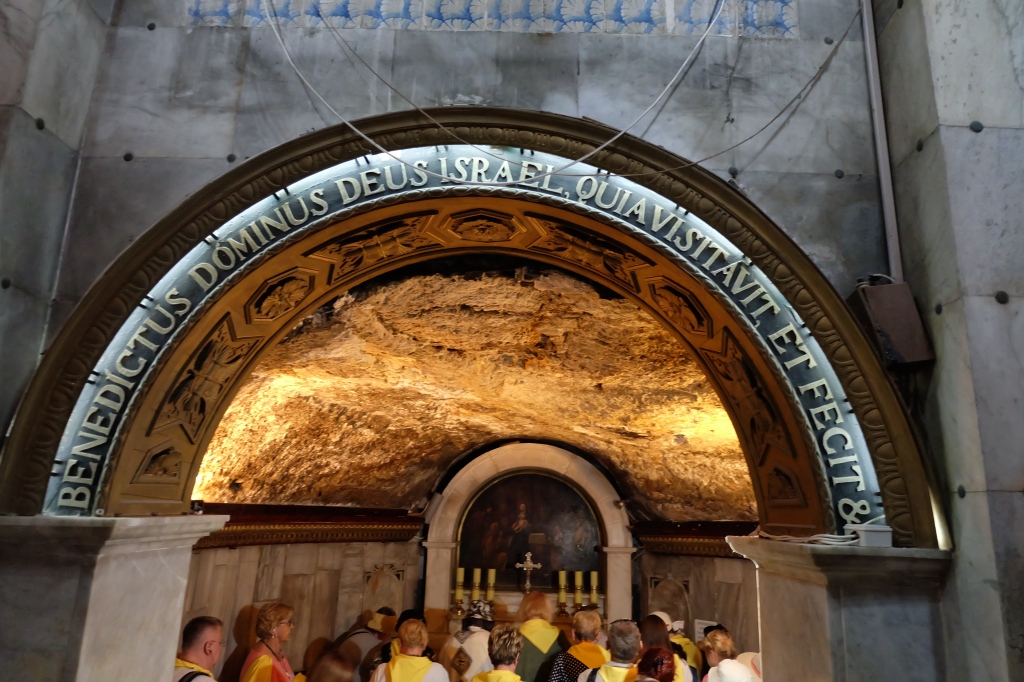
Photo by author, site of John’s birthplace underneath the Church of St. John the Baptist at Ein Karem, Israel, 2019.
What a beautiful scene of Zechariah and Elizabeth wrapped in the arms of God, basking in his tremendous blessings with the people so amazed for evidently God was present among them, working in the most special ways albeit in silence that after looking back to the past and the present moment, they wondered what more good things God has in store for the three.
The same scene happens daily in our lives as individuals, as families and communities and as a nation – of how the hand of God saving us in so many occasions like during this pandemic and recent disasters through generous people coming to our side. There lies the greatness of Zechariah and Elizabeth – through them despite their weaknesses, the hand of the Lord worked wonders not only for them but for everyone including us in this time.
We are invited today to be like John’s parents who, despite their weaknesses and shortcomings, they allowed the hand of God to work in them and manifest in them. The name Zechariah means “God remembers” while Elizabeth means “God promised”, a beautiful combination of names of a couple who tell us how God remembered his promise to them and gave them John which means “graciousness of God.”
Photo by author, 2019.
In this age when we act as though God does not exist with our emphases on the wrong notions of freedom and the “dictatorship of relativism” along with materialism and consumerism, we celebrate this Solemnity of John’s nativity to remember our calling to be prophets and precursors of Jesus like Isaiah in the Old Testament who voiced dissensions to the wrong ways of the people like “a sharp-edged sword” and “polished arrow” (Is. 49:2) even to the point of offering one’s life, truly a precursor of the coming Christ.
John’s testimony still resounds today as proclaimed by Paul in our second reading, urging everyone to repent ones sins to go back to God, always ensuring we are not the Christ but merely his messengers not worthy to unfasten his sandals.
Today is also the eve of another Solemnity, that of the Sacred Heart of Jesus as we come to close the first half of 2022. Let us not forget the COVID-19 pandemic is still with us, that we must not let our guards down lest all our gains this year go to waste. Are we willing to be used as expressions of the “hand of the Lord”?
May we keep “the hand of the Lord” with us, allowing ourselves to be used by God like Zechariah, Elizabeth, and John the Baptist in meditating where Jesus is leading us in the second half of 2022. It is enough that we lead others to Jesus. In fact, that is the only joy we have in this mission and once others have met Christ, then, like John the Baptist, we begin to disappear, leaving only the hand of the Lord. Amen.
Photo by Fr. Pop dela Cruz, San Miguel, Bulacan, 15 June 2022.
The Lord Is My Chef Simbang Gabi Recipe-8 for the Soul
by Fr. Nicanor F. Lalog II
Wednesday, Advent Week IV, 23 December 2020
Malachi 3:1-4, 23-24     >><)))*>   +   <*(((><<     Luke 1:57-66
Photo by author of the entrance to the site believed to be where the Lord’s Precursor was born below the side altar of the Church of St. John the Baptist in Ein Karen, Israel (2019).
We are almost into the completion of our nine-day novena for Christmas as we heard today the story of the birth of the Lord’s Precursor, John the Baptist. It is a story narrated so simple by Luke but filled with beautiful meanings specially for us today in this time of the pandemic.
First thing we see is how Zechariah’s speech was restored upon declaring the name of his son is “John”:
He asked for a tablet and wrote, “John is his name,” and all were amazed. Immediately his mouth was opened, his tongue freed, and he spoke blessing God.
Luke 1:63-64
Luke did not tell us what kind of praise did Zechariah speak about God when his speech was restored but here we find that basic truth in our lives that for every blessing we receive from the Lord, right away – immediately! – we must praise and thank God first.
Moreover, this scene shows us the good effect of the “imposed quarantine” on Zechariah when he was made deaf and speechless after doubting God’s gift of a child to him and his wife Elizabeth during the annunciation by the angel while incensing the Holy of holies in Jerusalem.
God restored the power of Zechariah to speak again and greatly renewed him that this time, he had become obedient to the Father to his plan. In a sense, Zechariah was not merely freed to speak again but most of all, he was freed to believe and trust in God again!
As we have reflected last Saturday morning, Advent is quarantine. So many times in life, we have to step backwards, be silent to listen to God and just let Him do His work in us! Sometimes we think of so many things that are not really necessary and has nothing to do with God’s plans or work. With Zechariah able to speak now, he shows us that in the exercise of our powers we must first get in touch with God how to use His gifts to us.
This we shall see in our second point: allowing God to use us as His hand.
Photo by author, dome of the Church of St. John the Baptist at Ein-Karen, 2019.
Then fear came upon all their neighbors, and all these matters were discussed throughout the hill country of Judea. All who heard these things took them to heart, saying, “What, then, will this child be?” For surely the hand of the Lord was with him.
Luke 1:65-66
From rejoicing at the birth of Zechariah and Elizabeth’s son, their neighbors now moved to being amazed when the child is named “John” that coincided with the restoration of his father’s ability to speak.
Luke tells us how it was such a big thing, maybe so “viral” and “trending” like today that everybody was discussing it. They must have felt God so near, almost there that Luke used an Old Testament expression, “For surely the hand of the Lord was with him”.
It is a beautiful expression indicating power too, just like the ability to speak.
Our hands are so powerful that we are able to move and do so many things because of these.
To say “the hand of the Lord was with him” is to portray the image of God’s immense power, His omnipotence, of being able to do whatever He deems needed to life on earth.
In the Old Testament when Elijah was being pursued by the soldiers of Queen Jezebel after he had shamed the priests of baal for failing to light a pile of firewood for worship, the prophet escaped by running beyond human ability considering his old age because “the hand of the Lord was on Elijah” (1 Kgs. 18:46).
Sometimes, the “hand of the Lord” can be scary as it means judgment or punishment from God like when King David disobeyed God when he ordered a census of Israel to find out how many men can fight in their wars, doubting the power of the Lord. David was given with three options for his punishment by the seer Gad: a natural disaster or a victory by his enemies, or a time of God’s judgment. David chose the third option, saying “I am i dire straits. But I prefer to fall into the hand of the Lord, whose mercy is very great, than into the hands of men” (1Chronicles 13:21).
Photo by author, Chapel of the Holy Family, Sacred Heart Spirituality Center in Novaliches, QC (2014).
The late Jaime Cardinal Sin of Manila used to tell of the story about the hand of God: he said sometimes, the hand of God would “spank” or hit us with pains and trials in life to discipline us and make us strong; sometimes, the same hand of God would caress and soothe our tired bodies or give us that proverbial pat on the shoulder to affirm us. But what is most important to remember according to Cardinal Sin is the fact that whether we are being disciplined or touched by the hand of God, it is always loving and merciful, most of all grace filled.
The recent news of that trigger happy cop who brutally shot and killed Sonia and her son Antonio in Tarlac recently is a reminder to us all most especially this Christmas in the time of pandemic, of the need for us to let the hand of God take control of our lives, guide us to life through more patience, love, kindness, and understanding.
It seems that so often, whenever we let our hands do everything, they always go out of control like our mouth and lips that lead us to more disasters and even deaths.
Beginning this Christmas, may the hand of God lead us back to Him and with each other.
Let us imitate the praying hands, of two hands touching each other but always creating a space between. That space is for Jesus born in Bethlehem 2000 years ago, asking us everyday to take Him into our hands to care for Him, to protect Him through one another.





 lordmychef.com