Lord My Chef Daily Recipe for Soul by Fr. Nicanor F. Lalog II
Tuesday, Memorial of St. Scholastica, Virgin, 10 February 2026
1 Kings 8:22-23, 27-30     ><]]]]’> + ><]]]]’> + ><]]]]’>     Mark 7:1-13
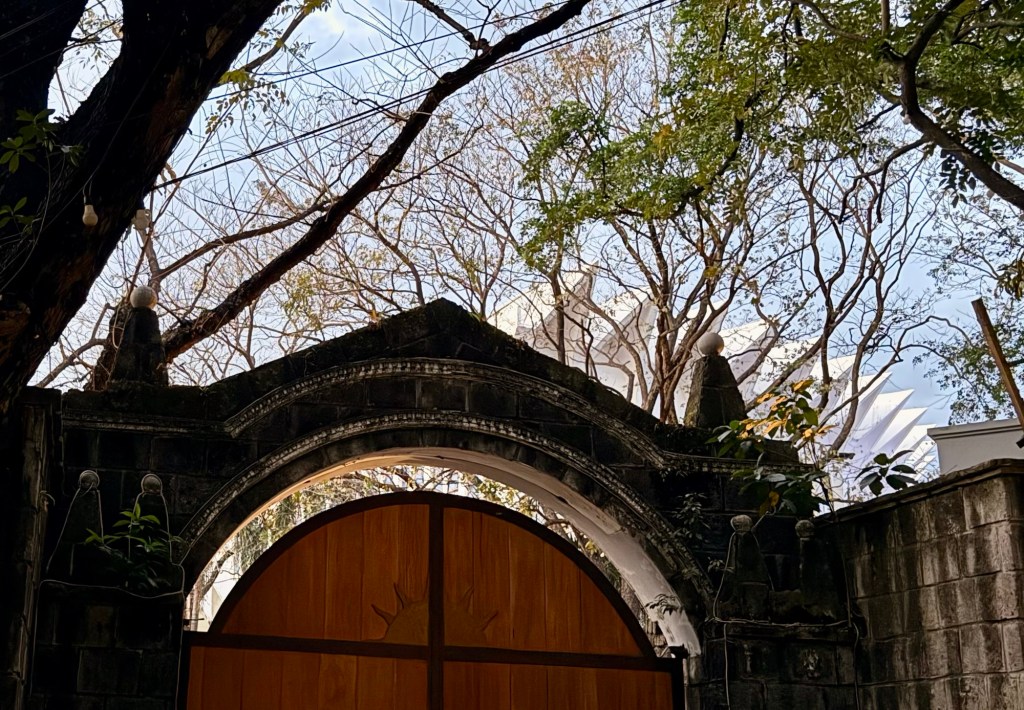
Photo by author, Museo de Valenzuela’s replica of “Arkong Bato” with the pointed facade of the National Shrine of Our Lady of Fatima as background, 21 January 2026.
How true were the words
of your great King and Servant
Solomon, O God our mighty Father,
that nothing like "the heavens
and the highest heavens"
can contain you
much less the temple he had built
or anything that we have
in this time;
yet, you have promised us
to hear our prayers when we come
to pray to you,
to call on you
in temples and churches
human hands have made
that are not enough to have you.
Forgive us, Lord,
when we try to "contain" you,
"keep" you in specific places
not just churches and temples
and oratories;
most of all,
forgive us, Lord,
when we lack
the reverence and intimacy
we must have with you
when inside the church
and other sacred places;
Jesus' words in today's gospel
cuts us to the heart of our hypocrisies,
"This people honors me with their lips,
but their hearts are far from me;
in vain do they worship me,
teachings as doctrines human precepts"
(Mark 7:6).
O dear Jesus
present in the Blessed Tabernacle,
empty me of my pride
so that You may reign
in my heart
always.
Amen.
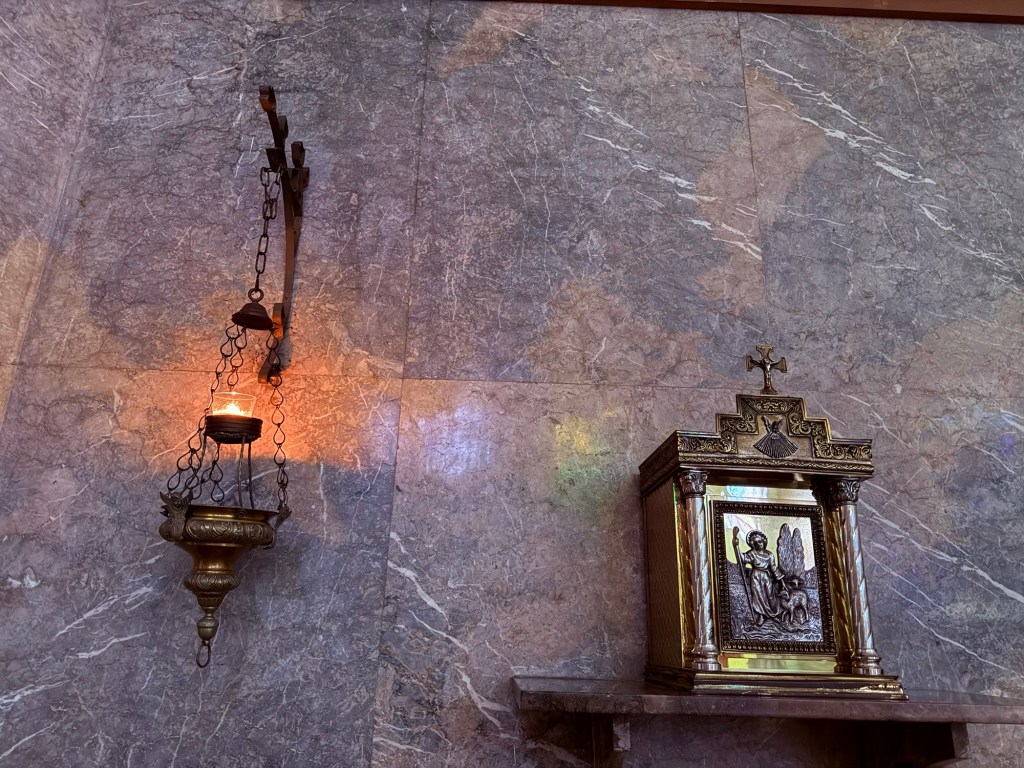
Photo by author, Chapel of the Carmel of the Holy Family Monastery, Guiguinto, Bulacan, 23 January 2026.
Lord My Chef Daily Recipe by Fr. Nicanor F. Lalog II
Monday, First Week of Advent, 01 December 2025
Isaiah 4:2-6     ><]]]]'> + ><]]]]'> + ><]]]]'>     Matthew 8:5-11
Photo by author, Malolos Cathedral, December 2018.
Blessed are you,
O God our Father
for this first day of December,
the first working day in this
blessed Season of Advent
as we prepare for your Son
Jesus Christ's Second Coming;
cleanse our hearts, O Lord
so that you may dwell in us,
come to us as as we
dwell in you,
come to you,
"our shelter and protection;
shade from parching heat of day,
refuge and cover from storm
and rain" (Isaiah 4:6).
How lovely are your words today,
O Lord, as you fulfill in Jesus Christ
our gathering in you as your people,
this time not just in a building
like the old temple of Jerusalem
nor our modern churches;
teach us to be more humble
like that centurion in recognizing
your supreme authority for
you are Authority yourself;
despite his not being a Jew,
the centurion had the faith
and humility in Jesus Christ's
healing of his servant without
touching nor seeing him.
O dear Jesus,
you are the New Temple,
you are our Temple,
our dwelling no longer made
by hands: grant us the grace
of genuine faith and humility
in you especially during the Mass
right before we receive you in
the Holy Eucharist saying the
very same words of that centurion
you praised, "Lord, I am not worthy
that You should come under my roof,
but only say the word and my soul
shall be healed" (Matthew 8:8).
Amen.
Lord My Chef Sunday Recipe for the Soul by Fr. Nicanor F. Lalog II
Sixth Sunday in Easter, Cycle C, 25 May 2025
Acts 15:1-2, 22-29 ><}}}}*> Revelation 21:10-14, 22-23 ><}}}}*> John 14:23-29
Photo by author, Chapel of the Angel of Peace, Our Lady of Fatima University, Valenzuela City, 28 March 2025.
Let us start again our Sunday reflection from the Book of Revelation where we heard last week John mentioning the word “new” four times when he saw “new heaven, new earth, new Jerusalem” coming with a voice of the Lord declaring “I make all things new” (Revelation 21:1, 2, 5).
In continuing his narration this Sunday of his visions while imprisoned in Patmos, John tells us how he not merely “saw” but also “experienced” heaven when he wrote:
The Angel took me in spirit to a great, high mountain and showed me the holy city Jerusalem coming down out of heaven from God. It gleamed with the splendor of God. Its radiance was like that of a precious stone, like jasper, clear as crystal… I saw no temple in the city, for its temple is the Lord God almighty and the Lamb (Revelation 21:10-11, 22).
I saw no temple in the city,
for its temple is the Lord God almighty
and the Lamb.
Try imagining John’s experience of heaven, almost indescribable for its beauty and majesty as the very presence of God when he specified “there is no temple in the city for its temple is the Lord God almighty and the Lamb.”
John reminds us again this Sunday that though these new heaven, new earth, new Jerusalem are the things to come at the end of time, these are already happening right now in our midst. His description of heaven like jasper and other precious stones indicate not only the incomparable beauty of heaven but the very truth that our home is in God. Thus, an invitation too for us today to live in the light of God for he dwells among us in Christ.
This “divine indwelling” has always been a part of our Catholic doctrine.
Photo by author, Cabo da Roca, Pundaquit, San Antonio, Zambales, 14 May 2025.
Recall how in the Old Testament during the chosen people’s wandering in the desert when God dwelled among them in a tent or booth called sukkoth where the Ark of the Covenant was kept. God’s presence was marked by a pillar of smoke over the tent at daytime and a pillar of fire at night. From this came their Feast of the Booths being the dwelling of God; hence, at the Transfiguration of Jesus on Mount Tabor, Peter told the Lord how they would build booths for him, Moses and Elijah as he felt they were already in heaven!
Booth or tent or temple. Or church.
These indicate the presence of God now manifest in Jesus Christ, “the word who became flesh and dwelled among us.” That is why these past three Sundays of Easter we returned to his words spoken at the Last Supper to deepen our understanding and appreciation of Easter that teaches us about our relationship in God expressed with one another.
Two Sundays ago Jesus identified himself as the Good Shepherd who knows his sheep, us; then, last Sunday he gave us his “new commandment” of love that is rooted in God, a love that leads to our communion or oneness with God like Jesus and the Father. This Sunday, Jesus deepens that relationship we all have in him in the Father which perfectly matches the vision and experience of John found in the Book of Revelation.
Jesus said to his disciples: “Whoever loves me will keep my word, and my Father will love him, and we will come to him and make our dwelling with him” (John 14:23).
Photo by author, Cabo da Roca, Pundaquit, San Antonio, Zambales, 15 May 2025.
This “dwelling” of Jesus and the Father among those who love him and keep his word is the Church, his Body which we his disciples make up.
In instructing his disciples at the Last Supper that included us today to keep his word and commandment to love, Jesus taught how this love is manifested in the Church, his Body, the indwelling of God in Jesus Christ with us his people.
Recall when the curtain in the temple was torn apart from top to bottom at his death on Good Friday that signaled the end of temple worship when people will worship in truth and in spirit as Jesus had spoken to the Samaritan woman at Jacob’s well.
When Pope Leo XIV was elected two weeks ago, one of the news that have struck me was about the presence of non-Catholics at St. Peter’s Square celebrating on that day. According to the news, the non-Catholics joined the crowds because they never felt such kind of unity where people were one in praising God, celebrating his loving presence in gifting the world – not just Catholics – with a Pope as the Vicar of Christ.
What a beautiful reality we now have of God’s dwelling among us as the Church!
Photo by author, Sacred Heart Novitiate, Novaliches, QC, 20 March 2025.
From the Hebrew concept of qahal or congregation, Jesus linked love and his dwelling with his disciples in forming a community as his Body, the new Temple he had told he would raise in three days we now call the church which in Greek is called ekklesia that literally means to lead out “ek” the people, “kaleo”. Loving and dwelling of God among us is the reality of the Church as a community of believers called to lead others out of darkness into light, out of emptiness into fullness, out of death into life in Jesus Christ – exactly what the early Church did in our first reading today when they agreed not to impose burdens on gentile converts like circumcision and other Jewish traditions.
The Church herself is a Sacrament, a visible sign of Jesus Christ’s saving presence along with the other seven sacraments we have. The challenge is how these sacraments become dynamic ways of living for us, truly a Divine indwelling and not just signs we go through.
Every Sunday in the Mass, we renew our baptismal vows as children of God, expressing our love for each other as a community, visibly the dwelling of God, making the new heaven, the new earth and the new Jerusalem not just a vision but a reality happening now. Let us pray:
Lord Jesus Christ,
dwell in us,
dwell among us
by making us follow your light
not the artificial lights of the world;
let us keep your word
by loving more like you
for where there is love,
there is God dwelling in us
because he is love himself.
Amen.
The Lord Is My Chef Daily Recipe for the Soul by Fr. Nicanor F. Lalog II
Monday, Solemnity of the Immaculate Conception of Mary, 09 December 2024
Genesis 3:9-15, 20 ><}}}}*> Ephesians 1:3-6, 11-12 ><}}}}*> Luke 1:26-38
Photo by Rev. Fr. Gerry Pascual at Palazzo Borromeo, Isola Bella, Stresa, Italia 2019.
The Solemnity of the Immaculate Conception of the Blessed Virgin Mary is one of the most awaited feasts in our predominantly Catholic Christian country due to its timing that is so close to Christmas as well as our deep devotion to the Blessed Mother.
Yet, it is also the most problematic because every year, the biblical passage we hear in its celebration is the Annunciation of the Birth of Jesus Christ that is held on March 25 so that people often confuse the December 8 Solemnity as Mary’s Immaculate Conception of Jesus. Of course, there is no direct quotation in the bible of Mary’s Immaculate Conception for it is a fruit of long process of deliberations and reflections in the Church that was finally made official in 1854 as a Dogma.
For those still confused, today’s celebration is when Mary was immaculately conceived in St. Anne’s womb through the merits of Jesus in all eternity, being freed from any stain of original sin so that she may bear our Savior, the Son of God, all-perfect, into the world who is the Christ.
Photo by Rev. Fr. Gerry Pascual of Iba, Zambales at Santuario di Greccio, Rieti, Italy in 2019.
Mary was chosen by God to be His Son’s Mother not because of her having any special traits but purely out of God’s goodness. It is a beautiful story that continues to happen daily we hardly notice nor recognize when God intervenes into our time to bless us not because we deserve to be blessed but simply out of His immense love for us.
This is what we celebrate in the Immaculate Conception of the Blessed Virgin Mary: we have a very loving God making a room among us so we may dwell and live in His grace since the very beginning of time.
In the bible and in spirituality, the words room and dwelling actually refer to communion of man and God. In fact, the first letter of God’s name “Yahweh” is shaped like a door of a house in Hebrew writing. At the last supper, Jesus told the Twelve that in His Father’s house are many rooms where He shall go first to prepare one for us all. It is not a literal room but a relationship with God that begins here.
In Genesis, paradise as dwelling place of Adam and Eve was more of their oneness with God they have destroyed with sin.
God truly loves us, never gave up on us when He sent Jesus Christ to redeem us to take us back to Him by renewing that relationship with Him. It had always been part of the divine plan even before the fall of man as reflected by St. Paul in the second reading, “as he chose us in him, before the foundation of the world, to be holy and without blemish before him” (Eph. 1:4).
Every December 8 (or 9, like today when the solemnity falls on a Sunday), we hear Luke’s beautiful account of the annunciation of Christ’s birth because it also conveys to us the same message of the Immaculate Conception of Mary who made a room too for God in her self.
The angel Gabriel was sent from God to a town of Galilee called Nazareth, to a virgin betrothed to a man named Joseph, of the house of David, and the virgin’s name was Mary (Luke 1:26-27).
“Cestello Annunciation” by Botticelli painted in 1490; from en.wikipedia.org.
The scene preceding this is the annunciation of John’s birth to Zechariah during the Jewish major feast of Yom Kippur or Day of Atonement at the temple in Jerusalem. Observe Luke’s account and we see how God entered through human activities in that scene. Nakisabay, naki-ride on ang Diyos sa takbo ng panahon noon nang ibalita ang pagsilang ni Juan Bautista.
In the Annunciation of the birth of Jesus, it was different: it was God setting everything on His own as we feel from Luke’s solemn reportage. The five major “W’s” of news were there present, namely, who (Mary), what (birth of Jesus), where (Nazareth), when (sixth month of Elizabeth’s pregnancy) and why (Jesus to save the world).
With Mary in Nazareth, the major event was the Annunciation itself of Christ’s birth. It is the entrance of the eternal God into the temporal and finite time of man. That is why we pray the Angelus thrice a day, to sanctify our day as we remember that great event of God becoming human like us in Jesus. (Sadly, so few people pray the Angelus these days, giving more importance to social media, video games and noon time shows or news programs.)
Mary’s Immaculate Conception actually had its fullness in the Annunciation when Mary said yes to God by making a room for Jesus in herself and in her life that led to Christ’s birth and fulfillment of His mission of salvation for us. We see this also in Joseph as narrated by Matthew.
God made everything possible to restore this relationship through Mary who had to be immaculately conceived in order to be the room who would receive His Son Jesus Christ.
Photo by author, left side of the facade of the Basilica of the Annunciation in Nazareth, Holy Land, May 2019.
Nazareth is the only major place in the New Testament never mentioned in the Old Testament unlike Bethlehem, the birthplace of Jesus and actually His very root being from the lineage of King David was mentioned many times in the Old Testament.
Nazareth was Mary’s hometown, obscured and unknown like her. After returning from Egypt, the angel told Joseph to bring the Holy Family there to avoid Herod, son and namesake of his father who ordered the massacre of children in Bethlehem upon learning from the Magi the birth of the new king of Israel, Jesus Christ. Though officially from Bethlehem, Jesus grew up in Nazareth that is why the people refused to acknowledge Him as the Messiah who would come from Bethlehem.
Nazareth was so insignificant at that time that it was the butt of jokes in Israel. When one of the Lord’s early disciples Philip told Nathanael (Bartholomew) that they have found “the one about whom Moses wrote in the law” as the Messiah, Jesus of Nazareth, Nathanael replied, “Can anything good come from Nazareth?” (Jn.1:45-46). Jesus did not reprimand Nathanael for his comment because it was true, even praising him as a true Israelite without guile!
Photo by author, Nazareth Square, Holy Land, may 2019.
In the first reading, it was God who chose paradise as dwelling of Adam and Eve; in the New Testament, it was God anew who chose the obscured town of Nazareth as the room and dwelling of His Son Jesus Christ, so perfectly jibed with Mary also obscured, so young and perhaps no voice nor say in the Jewish society at that time.
That is how God works, always in silence, often choosing people and places so insignificant in human standards to eventually display His glory like in Mary.
Inasmuch as the Immaculate Conception is God making a room for us to dwell in Him in Mary, God needs also our cooperation and participation in the process. It is not a one-shot deal but an ongoing process, something that continues and most of all, we cultivate and nurture. It is a gift freely given by God, reminding us of our original state and being as clean and pure.
Like Mary, do we have a room for Jesus within us to come especially in this world so preoccupied with man’s pride and achievements? Let us reclaim our original status and pure and clean children of God in making a room for Him in our lives today. Amen.
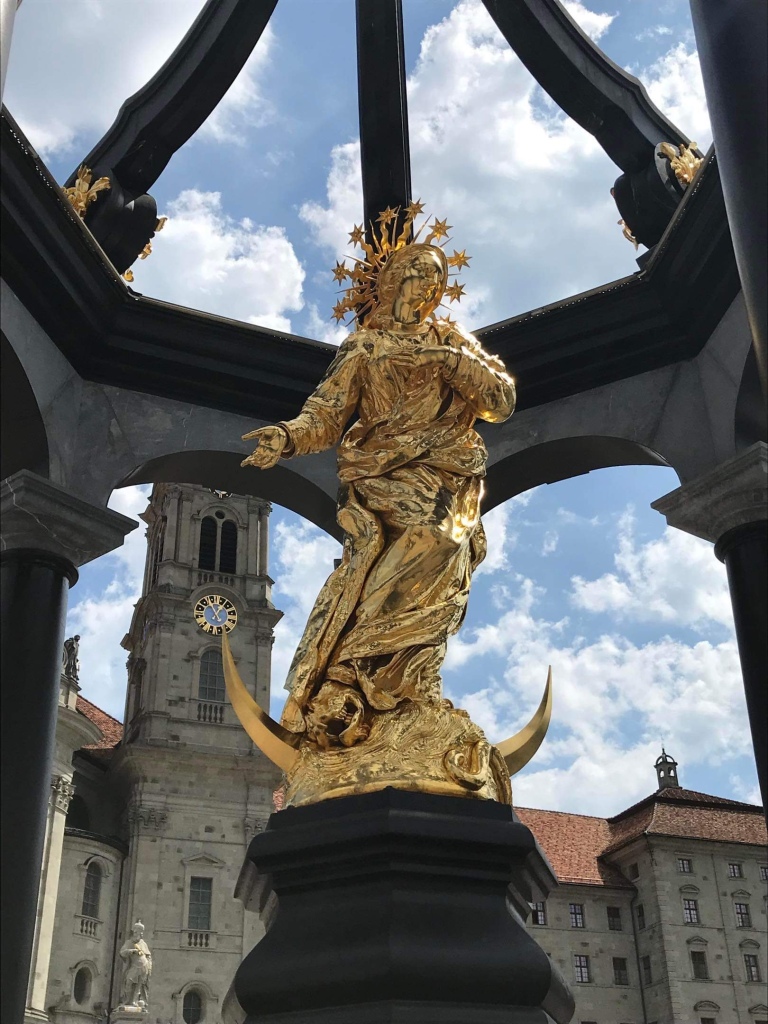
Photo by Fr. Gerry Pascual of Iba, Zambales at Einsiedeln Abbey, Einsiedeln, Switzerland, 2019.
The Lord Is My Chef Daily Recipe for the Soul by Fr. Nicanor F. Lalog II
Monday, Memorial of St. Agatha, Virgin & Martyr, 05 February 2024
1 Kings 8:1-7, 9-13  <*((((>< + ><))))*>  Mark 6:53-56
Photo by Mr. Boy Cabrido, kids playing “piko” outside patio of the National Shrine of St. Michael & the Archangels in San Miguel, Manila, 04 February 2024.
On this first working day of the week,
we pray to you dear Father,
may we share your loving presence
we experienced at the Sunday Mass
to everyone we shall meet today;
like Jesus your Son,
may we "approach, touch and raise"
especially those who are down in
trials and tribulations in life;
dwell in our hearts, Lord, like when
your clouds envelop the temple built
by Solomon when they placed your
Ark of the Covenant at the Holy of Holies.
When the priests left the holy place, the cloud filled the temple of the Lord so that priests could no longer minister because of the cloud, since the Lord’s glory had filled the temple of the Lord.
1 Kings 8:10-11
Dwell on us your people, Lord;
fill us with your grace of courage to
witness your love and truth among peoples
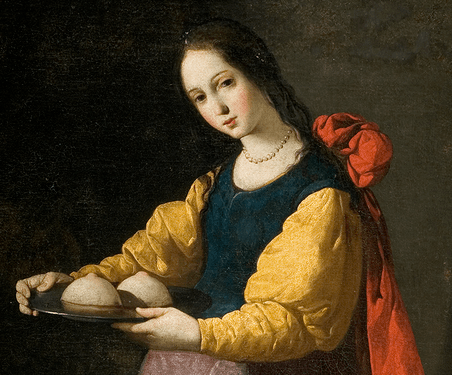
like St. Agatha who died remaining a virgin
for your holy name after enduring so much
pains from her torturers who cut off her breasts
but with the intercession of St. Peter the Apostle,
her wounds were healed, making her the
patron saint of those with breast cancer;
you know O Lord the pains and difficulties
those with cancer go through;
give them the strength to withstand the
long process of treatments along with their
loved ones;
never let them lose hope in you through
Jesus Christ who never gets tired "crossing
the lake" to reach the sick;
have mercy on those with all kinds of cancer,
bless those who were healed and in remission,
and please accept the souls of those
who have died.
Amen.
From en.wikipedia.org, painting of St. Agatha with her severed breasts that many thought to be loaves of bread that is why in some churches in Europe, breads are distributed during her memorial.






 lordmychef.com