Lent is asking God “how”?

40 Shades of Lent by Fr. Nicanor F. Lalog II
Solemnity of the Annunciation of the Lord, 25 March 2025
Isaiah 7:10-14;8:10 + Hebrews 10:4-10 + Luke 1:26-38
“Cestello Annunciation” by Botticelli painted in 1490; from en.wikipedia.org.
As we journey towards Easter,
we thank you dear God our Father
for the gift of this Solemnity of the
Annunciation of the birth of Jesus
to the Blessed Virgin Mary,
teaching us how the Christ
came into this world with the
Blessed Virgin Mary's attitude
and example worth emulating
as our companion in this Lenten journey
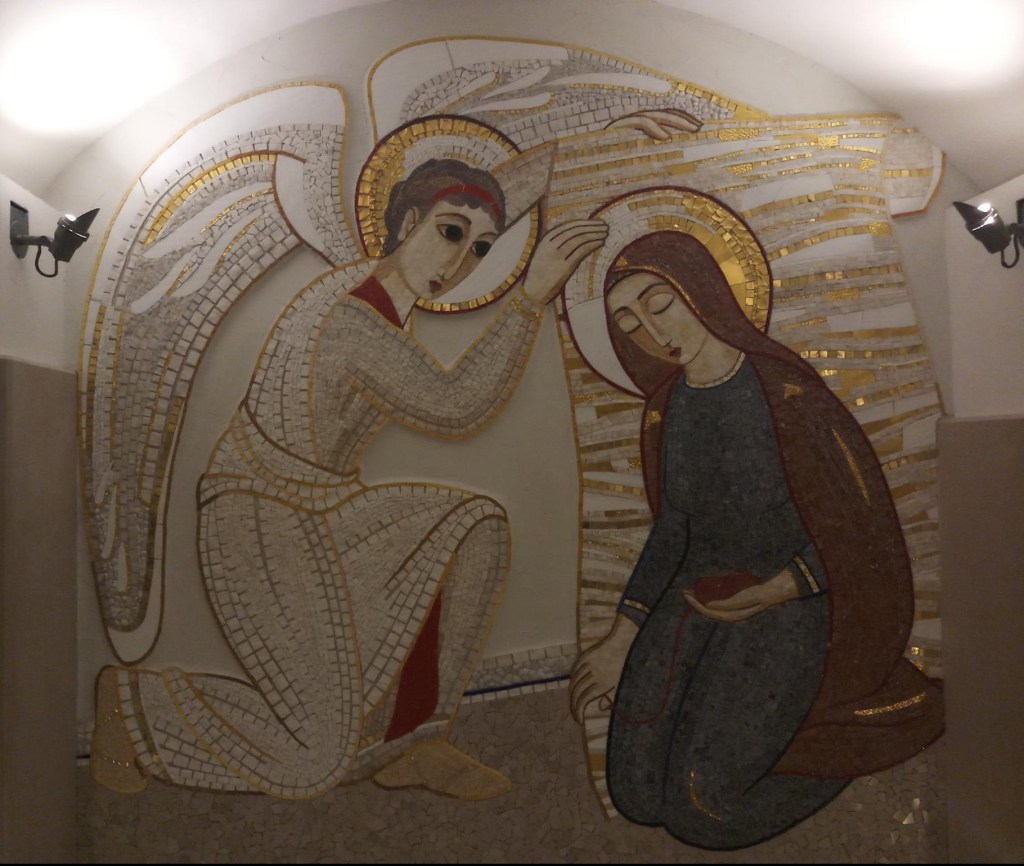
when she asked Archangel Gabriel,
"How can this be,
since I have no relations
with a man?"
(Luke 1:34).
Photo by author, Our Lady of the Poor, Sacred Heart Novitiate, Novaliches, QC, 17 March 2025.
Many times in life,
we live as if there is no God,
with us not only playing like you,
O God but actually acting truly
as God.
We live our lives according to
our own ways, to our own standards,
to our own thinking that most often
lead to more disasters,
more problems and worst,
broken self and broken relationships;
we feel we know better than you
than anyone.
Teach us, Jesus,
to be humble like your Mother,
the Blessed Virgin Mary:
in her asking
Archangel Gabriel
"How can this be",
she had already expressed her
acceptance of the Father's invitation
to be your Mother;
many times,
we refuse to even listen
to God’s plan for us as we
we rarely or have stopped
praying at all
so unlike Mary who must
have been at prayer
when Gabriel came.
In her asking "How
can this be?",
Mary was already setting aside
her own plans in life
to give way to God's plan;
in asking "How
can this be?", Mary showed us
the beauty of prayer
as a relationship where there
is true freedom and openness
to God in you, Jesus.
Forgive us Jesus
when we act like King Acaz
so hypocrite,
pretending not to test you
when in fact we have already
decided on our own
without considering you
at all.
.
How, O Lord,
can we truly change our ways
to follow God’s plans
and most unique ways
for nothing is impossible
in him?
Amen.
Photo by author, Our Lady of the Poor, Sacred Heart Novitiate, Novaliches, QC, 17 March 2025.

Advent as a dialogue leading to Christmas, the presence of God

The Lord Is My Chef Daily Recipe for the Soul by Fr. Nicanor F. Lalog II
Simbang Gabi-5 Homily, 20 December 2024
Isaiah 7:10-14 <*((((>< + ><))))*> Luke 1:26-38
Photo by Mr. Boy Cabrido, National Shrine of Our Lady of Mt. Carmel, QC, 16 December 2024.

Last Monday at the start of Simbang Gabi, one of our priests became viral when at the recessional of their Mass while the choir was joyfully singing “Pasko na! Pasko na!”, he sarcastically sang “Hindi pa! Hindi pa!”

Many people laughed at the viral video with some commenting that Father was right because it wasn’t Christmas yet while a liturgist advised choirs to check the many choices of Advent songs now available online. But, sad to say, the people missed the whole point of the incident.

What our brother-priest did was not funny at all in putting to shame his own choir members and most of all, in destroying the solemnity of the Mass.

And the problem was not really the choir at all but the priest himself. What the priest did at the end of the Mass was a self-indictment of his lack of formation for his choir members and of any dialogue at all.

Photo by author, Advent in previous parish, 2018.

Advent is a dialogue between God and humans that led to the presence of God among us in Jesus Christ on Christmas. It is a process that continues in our own time as we are all called to be open to God and with others for dialogue like Mary in the annunciation of Christ’s birth by Archangel Gabriel.

Dialogue is more than conversing to improve relationships among people in a community or organization but a way of being with others as opposed to a way of thinking through issues and problems only. Dialogue is being present with others, of giving one’s self to feel and listen and experience the other person.

Luke shows us in his second Christmas story today how this true meaning of dialogue between God and Mary happened.

In the sixth month, the angel Gabriel was sent from God to a town of Galilee called Nazareth, to a virgin betrothed to a man named Joseph, of the house of David, and the virgin’s name was Mary. And coming of her, he said, “Hail, full of grace! Then Lord is with you.” But she was greatloy troubled at what was said and pondered what sort of greeting this might be. Then the angel said to her, “Do not be afraid, Mary, for you have found favor with God… But Mary said to the angel, “How can this be, since I have no relations with a man?” And the angel said to her in reply, “The Holy spirit will come upon you, and the power of the Most High will overshadow you. Therefore the child to be born will be called holy, the Son of God. And behold, Elizabeth, your relative, has also conceived a son in her old age, and this is the sixth month for her who was called barren; for nothing will be impossible for God” (Luke 1:26-30, 34-37).

“Cestello Annunciation” by Botticelli painted in 1490; from en.wikipedia.org.

See the artistry and genius of Luke as a storyteller. Yesterday he presented to us the annunciation of the birth of John the Baptist to his father Zechariah while incensing the Holy of Holies in the temple of Jerusalem.

Notice the great differences in the flow of conversations and dialogue in the two annunciations narrated by Luke. Both Zechariah and Mary were troubled at the coming of the angel. And who would not be in a such unprecedented event? However, there is one minute detail we find in Luke’s narration of the two annunciations that reveal something so big and deep in meaning.

According to Luke, “Zechariah was troubled by what he saw, and fear came upon him” (Lk. 1:12) while Mary “was greatly troubled at what was said and pondered what sort of greeting this might be” (Lk. 1:29). Both were troubled which is normal but their reactions differed so great with Zechariah becoming proud while Mary was humbled.

I believe that it was more than their age and differences in social status that Zechariah was simply “troubled” while Mary was “greatly troubled” but it was largely due to their dispositions and openness to God.

Zechariah was proud of his stature and of his intelligence, trying to take hold and control of everything that is why he was seized with fear. When he told the angel, “How shall I know this? For I am an old man, and my wife is advanced in years” (Lk.1:18), Zechariah was troubled and fearful because he felt challenged as a priest much respected in the community, choosing to stand proud of his position and intelligence as if having a child is all an effort of man and woman alone! There was no dialogue as Zechariah was proud that is why he was made mute by the angel. He had forgotten all about God!

Photo by author, Basilica of the Annunciation, Nazareth, Israel, May 2019.

Compare Mary’s reaction to the annunciation, “But she was greatly troubled at what was said and pondered what sort of greeting this might be.”

Luke always portrayed Mary as the listener and doer of the word, the one who ponders at the words spoken to her not only by the angel here but later at the birth of Jesus those spoken by the shepherds, then by Simeon at the Presentation and by Jesus Himself at the wedding in Cana. Mary has always been open to dialogue, to feeling the other person conversing with her. She was not concerned only with the news and information but with the persons involved.

In that sense, there is her remarkable humility and great courage at the same time. True humility is not really about being submissive but most of all being filled with courage, not with fear. Mary as the very young virgin from a poor family in a town nobody gave importance stood fearless before the angel as she took hold of herself to ponder on the words spoken to her. Despite the very unprecedented moment with an angel, Mary had that inner engagement with the words she had just heard without any violent reactions.

Photo by author, December 2018.

Unlike Zechariah, Mary was the one actually in control of herself and of her emotions. The Jedi Master Yoda of Star Wars said it so well, “fear leads to anger, anger leads to destruction”. Zechariah was afraid of losing power and control but Mary was not bothered at all. In fact, she faced the challenge head on, reflecting deep in her what is this going on? Am I awake, is this a dream would most likely be the words playing in her mind and heart. Mary had presence as she tried to feel the angel and later God that no wonder, Jesus came to her womb and we have Christmas!

The humility and courage of Mary became more evident when she said to the angel, “How can this be, since I have no relations with a man?”

She was not afraid at all to be become the Mother of God! There was already her willingness to submit, as if telling the angel, “OK let’s do it but tell me how?” whereas Zechariah was argumentative, trying to escape responsibilities? Such was the attitude too of Ahaz in the first reading, denying he won’t test God when in fact he had already aligned with other kings in the region as he feared the invading enemies near his borders.

It was at this moment when the good news became most closest to us through Mary when the angel explained of the coming of the Holy Spirit, of how the power of God would overshadow her, assuring her that nothing is impossible with God.

How wonderful is this scene for us to emulate Mary so that we experience Christmas daily in our lives, not only of God coming but being present in us and among us. Can we dare to be open before God like Mary? Have a blessed Friday!

Photo by author, Fatima Avenue, Valenzuela City, December 2024.

God’s will be done.

The Lord Is My Chef Easter Recipe by Fr. NIcanor F. Lalog II
Monday, Solemnity of the Annunciation of the Lord, 08 April 2024
Isaiah 7:10-14, 8:10 ><}}}}*> Hebrews 10:4-10 ><}}}}*> Luke 1:26-38
Photo by author, Our Lady of the Poor, Sacred Heart Novitiate, Novaliches, QC, 20 March 2024.
You ended it, 
O blessed Mother with
"Behold, I am the handmaid
of the Lord.
May it be done to me
according to your word"
and it all set us to an
ever new beginning
happening daily
with your Son Jesus Christ's
coming!
God and man 
too far apart from each other
before because of the Fall
are now so close
and near with each other
when you,
O blessed Virgin,
said yes
to His Holy Will
so that the promise of old
is fulfilled.

Brothers and sisters: It is impossible that the blood of bulls and goats take away sins. For this reason, when Christ came into the world, he said… “behold, I come to do your will, O God.” By this “will,” we have been consecrated through the offering of the Body of Jesus Christ once for all.

Hebrews 10:4, 7, 10
Chapel of Della Strada, Sacred heart Novitiate.
Pray for us,
our Mother Mary
that like you
we may be open
always to God's will,
intently listening to His voice
and most of all
obeying His word
so that like you,
we may bring Jesus Christ
to this world,
be enfleshed
in us to become His presence.
Amen.

God comes any where, any time

The Lord Is My Chef Daily Recipe for the Soul by Fr. Nicanor F. Lalog II
Misa De Gallo V, Wednesday, 20 December 2023
Isaiah 7:10-14 <*((((>< + ><))))*> Luke 1:26-38
Photo by author, flower garden outside the Basilica of the Annunciation, Nazareth, Israel, May 2019.

Experts tell us that much of human communications are non-verbal in nature. And most often, people rely more to our non-verbal than verbal communication because it is more truthful by nature as actions speak louder than words. 

For our reflection this fifth day of our Christmas novena, let us examine the two kinds of non-verbal communications employed by St. Luke to portray God’s immense love for us as well as his sublime uniqueness as perfect communicator. These are proxemics or the communication of spaces, of how places are designed or designated to convey something special and profound. The second i which is the use of time in non-verbal communication like time perceptions of punctuality, willingness to wait, and, “timing”.

Photo by author, Basilica of the Annunciation, Nazareth, Israel, May 2019.

See how St. Luke extensively employed these modes of non-verbal communications in his infancy narrative to show us that God is everywhere, any time.

In the sixth month, the angel Gabriel was sent from God to a town of Galilee called Nazareth, to a virgin betrothed to a man named Joseph, of the house of David, and the virgin’s name was Mary.

Luke 1:26-27

Right away St. Luke established here the direct correlation between John the Baptist and Jesus Christ, of how their respective mission are directly linked with each other that our Lord was conceived six months after his Precursor’s conception.

More than the time frame conveyed by the six month difference in their births, we find behind it a deeper meaning about their differences as well in stature and nature wherein John was completely human flowing with time while Jesus is both human and divine with God directly intervening in our time. John was born June 24, the summer solstice when days are longer and brightest while Jesus was born December 25 when nights are longest and darkest!

The chronemics and proxemics are undeniably hinting on something deep, of how our eternal God entered through our temporal time so that within we can have that cosmic experience of “the here and not yet” when time seems to stand still because we are being wrapped in God’s eternal embrace of love made possible by Christ’s birth, passion, death and resurrection. This we can see at the contrasting circumstances between the advent of John the Baptist and Jesus Christ where we find God most unique, immensely loving us.

Photo by author of the site of the Annunciation at the basement of the Basilica of the Annunciation in Nazareth, Israel, May 2019.

First, Zechariah was a priest while Mary was a commoner. It was natural for God to work through his ministers but in choosing Mary an ordinary woman was something else not because of any special quality she had but simply because God is good. The angel clearly told this to Mary, “you have found favor with God”.  God does not call the qualified but he qualifies the call! Today, God is telling us Jesus is coming through us, no matter who we are or what we have gone through and did in life.

Second, God used the setting of the Temple of Jerusalem in yesterday’s account because that is where he is supposed to dwell but today, everything happened in a very simple house in Nazareth, the only place of significance and importance in the New Testament never mentioned in the Old Testament. It was a place looked down upon by many like St. Bartholomew asking Philip, “can anyone good come from Nazareth?”

The word “Nazoraios” or Nazarene mentioned by Matthew refers to the overall designation of Jesus by the prophets as the hope and fulfillment of God’s promise that there shall come forth a “shoot from the stump of Jesse” (Is. 11:1)Shoot in Hebrew is from the word nezer which is also the context used by Isaiah in chapters 7 and 9 found in Isaiah 11:1 cited by Matthew. Therefore, Jesus being called a Nazarene or Nazorean is more than a reference to his place of origin but most of all his very essence – a shoot from God, someone totally consecrated to God.

And that is also who we are! St. Paul’s letters teem with this beautiful theme of us being called and justified in Christ by God.

Today, God is telling us to never lose hope in life, to never give up because he will never give up on us because we are from him, we are his. For as long as we are alive, God will make a way to make a shoot or nezer bud forth from a stump to bring us back to life. 

Yesterday, it was the imagery of barrenness of Elizabeth, of her being fruitless and therefore empty. Many times, that is just what God needs from us, an entry point, an opportunity when we are so weak so he can mightily work with his powers.

One of my hopes after Christmas is to celebrate Mass at the Quiapo Church, to cultivate a devotion to Jesus Nuestro Padre Nazareno. I just feel drawn to him as I have personally met so many people including non-Catholics with devotion to the Nazareno of Quiapo after granting them their almost impossible petitions and prayers.

Photo by Mr. Boy Cabrido, Quiapo Church, Misa de Gallo, 17 December 2023.

Third, there was a major feast going on, the Yom Kippur, with a lot of people present when Zechariah was informed of the birth of John; Mary was alone in her house when the angel came to announce to her the birth of Jesus on the sixth month after going to Zechariah. Again, here we find both the place and time conveying something deeper than mere locations and settings. This is what the Church has always been insisting, most especially lately after the lockdown during pandemic when people got the wrong impression that online Masses are enough or can replace actual participation in our Eucharistic celebrations especially on Sundays.

Yes, God comes to us personally as individuals but with Jesus Christ, we have been more interconnected than ever as we have seen how his birth was linked with John’s birth too. Faith and worship, life itself can never be relegated to just a personal matter. There is always the communal aspect of our faith and of life itself because man is a social being, created by God to relate which is what communication is all about.

Photo by author of a Filipino painting of the Annunciation scene on the facade of the Basilica of the Annunciation in Nazareth, Israel, May 2017.

In the first reading we found Ahaz refusing to ask for a sign on the pretext he did not want to offend God but actually because he did not want to show his faith like some people these days who try to see everything on the practical side, on the material side and most of all, the personal side.  This is the tragedy of our time even in our Church that has become secularized in certain aspects.  See those different guidelines of every diocese and archdiocese about the Simbang Gabi, with others allowing anticipated Masses we have long tried educating people that it is an oxymoron. Many times, we in the Church have overextended or over-interpreted many of our rubrics and traditions just to accommodate others in the name of inclusiveness and other woke ideas.

On this fifth day of our Simbang Gabi, the Annunciation of the birth of Christ invites us to ask ourselves how do we show others that the Lord is with us like Mary? If God is every where, all the time, how come so many have lost him or could not find him? Maybe we no longer have him. Let’s ger him back again today! Amen. Have a blessed Wednesday!

Photo by author, Basilica of the Annunciation, Nazareth, Israel, May 2019.

The Annunciation: the reality of God, the reality of our humanity

40 Shades of Lent by Fr. Nicanor F. Lalog II
Friday in the Solemnity of the Annunciation of the Lord, 25 March 2022
Isaiah 7:10-14, 8:10 ><}}}*> Hebrews 10:4-10 ><}}}*> Luke 1:26-38
Photo by author, chapel beneath the Basilica of the Annunciation, Nazareth, Israel, May 2019.

Beneath the huge and magnificent Basilica of the Annunciation in Nazareth is a beautiful chapel where one may find a small cave converted into another little chapel with iron grills to keep off people from approaching the brightly lit altar believed to be the site where the Archangel Gabriel announced the good news of Christ’s birth to Mary.

At the base of the altar are the words, Verbum caro hic factum est, “The Word was made flesh here.”

Borrowed from John’s gospel who declared Verbum caro factum est – The Word was made flesh – the one who have thought of adding the demonstrative pronoun here to declare it as the site of the Annunciation – Verbum caro hic factum est – was definitely divinely inspired to remind us that the reality of God is something deeply ingrained in our own realities of here and now, in our very selves.

Photo by author, site of the Annunciation, May 2019.

The angel Gabriel was sent from God to a town of Galilee called Nazareth, to a virgin betrothed to a man named Joseph, of the house of David, and the virgin’s name was Mary. And coming to her, he said, “Hail, full of grace! The Lord is with you.”

Luke 1:26-28

Only Luke has this account of the Annunciation of the birth of Jesus to Mary. And true to his prologue to his gospel of “investigating everything accurately anew” about the life and teachings of Jesus, Luke tells us how the Annunciation happened with all the details like the five w’s in a news report, the who-what-where-when-why as we have heard proclaimed today.

This is very important because it tells us the factuality of the great spiritual reality that changed world history and the whole humanity when God became human, when eternity entered the temporal.

It is a beautiful presentation of this great event so profound and so touching that continues to happen within each one of us every day of our lives, of God coming to us, filling us with his grace because each of us is a beloved, a highly favored one chosen to be the indwelling of his Son, Jesus Christ like Mary.

This is the grace of this solemnity we celebrate nine months before Christmas, that God comes to us in our very humanity, always inviting us like Mary to receive Jesus, to be the vessel and instrument in fulfilling God’s great plans. We are like Mary in everything except in her being immaculately conceived – we are all poor and lowly, mostly a nobody in the society, but so loved by God!

Photo by author, flowers outside the Basilica of the Annunciation, Nazareth 2019.

God comes to us precisely where we are, in our every here and now even when we are most lowly and down, when we are deep in sin and despair, in trials and sufferings, in pains and in hurts because like Mary, even before the angel came, God had already silently started working on many things to save us.

There is always God’s perfect timing when we would meet the right people who would guide and help us.

There is always an Elizabeth that God would point us to as a signpost and proof of his reality, of his wonderful plan starting to uncover right in our very lives if we would stop like Mary to listen further to his words.

Speaking of Elizabeth, recall in Luke’s account that the angel mentioned her to Mary to allay her of her fears upon receiving the good news of Christ’s coming.

So often when God comes to us, fear naturally follows. In the Bible, it is described as “reverential fear” which comes upon an experience of the Holy; it is a feeling of being so small before the almighty God (mysterium fascinans) yet deep in this fear is a joy within about to burst because of the great honor and privilege of being loved and recognized by God. There is that normal feeling of doubts of whether we can do God’s mission or not as well as the feeling of checking the reality if it is really happening at all! Once we have verified we are not dreaming, that indeed we are called by God despite our smallness, that is when we suddenly remember our fellow mortals doing the work of God.

Then the angel said to her, “Do not be afraid, Mary, for you have found favor with God… And behold, Elizabeth, your relative, has also conceived a son in her old age and this is the sixth month for her who was called barren; for nothing will be impossible for God.” Mary said, “Behold I am the handmaid of the Lord. May it be done to me according to your word.” Then the angel departed from her.

Luke 1:36-38
Photo by author, Basilica of the Annunciation, Nazareth, 2019.

By this “will,” we have been consecrated through the offering of the body of Jesus Christ once for all.

Hebrews 10:10

Last week I underwent a surgery. It was my first time to be hospitalized and to go under the knife. Though it was a very simple procedure, I was nervous. Very nervous in fact although I tried to keep my sense of humor especially with my doctors and nurses.

The experience had taught me so many valuable lessons that I am still “masticating” them, trying to find words on how to express those learnings and realizations.

One of those is the discovery of my humanity, of my mortality. I feel I have become more human with that experience when I finally accepted my body, when slowly I have learned to look closely at my body parts I took for granted even so ashamed to look at, with all the blood and abscess and wounds.

Hindi pala puwede na hindi tayo magkakasakit, na mahina tayo, at walang perpekto sa atin na hindi kakailanganin ang tulong ng iba.

As I learned to accept my mortal body, slowly it dawned upon me how it is the true path to letting go and let God with my spiritual and emotional woundedness for it is in our humanity when God’s reality is most felt, most true. It is only when we are faced with the real threat of “harm” or being hurt, of possibly being extinct and gone from this earth when we realize what is to be afraid and finally entrust our total self to God for whatever will happen next.

That is the gift of the Incarnation of Jesus Christ that formally began in the annunciation of his birth to Mary. It is in accepting our very humanity and mortality when God truly comes, when we become one in him through Jesus Christ on the Cross. Amen.

Advent is God’s transforming presence

The Lord Is My Chef Simbang Gabi Recipe for the Soul by Fr. Nicanor F. Lalog II
Monday, Simbang Gabi 5, 20 December 2021
Isaiah 7:10-14   ><)))*> + ><)))*> + ><)))*>   Luke 1:26-38
Photo by author, an altar near the Chapel at the site of the Annunciation below the Basilica of the Annunciation, Nazareth, Israel, 2019.

We are now at the final stretch of the week leading to Christmas as cash registers ring following the renewed economic activities with the lowering of COVID cases this month after a long lull since this pandemic began early last year.

Though the commercial hubbub is all around us, let us not forget that unlike the commercial green and red shades of Christmas, our Advent color is violet like Lent to signify the spirit of penance though in a more subdued manner. Amid our busy schedules, let us not forget that Advent is a preparation of our inner selves, of our interior disposition for a deeper meaning and nature of Christmas. With still a week to go, we are invited to empty our selves of sins, of pride and of other excess baggages so we can create a space for Christ’s coming right in our hearts, like our Blessed Virgin Mary.

In the sixth month, the angel Gabriel was sent from God to a town of Galilee called Nazareth, to a virgin betrothed to a man named Joseph, of the house of David, and the virgin’s name was Mary. And coming to her, he said, “Hail, full of grace! The Lord is with you.” She was greatly troubled at what was said and pondered what sort of greeting this might be.

Luke 1:26-29
Photo by author, site of the Annunciation beneath the Basilica of the Annunciation at Nazareth, Israel, 2019.

One of the most beautiful characteristic of Mary as a disciple is her openness to God. She always had that empty space in her solely for God, an inner disposition nurtured by her deep prayer life.

See the very solemn narration by Luke of the Annunciation, specifically mentioning to us the time, place, persons and circumstance involved in this “sacred moment” we have reflected yesterday. Mary must have been deeply in prayer when the angel came, a sign she was always attuned with God.

Notice that next to her surprise with the coming of the angel with the good news was her “pondering” what sort of greeting that might be. What an image of the Blessed Mother disposed to God’s calling and plans that immediately during her conversations with the angel, she was already reflecting on the meaning of the message. No hesitations or whatsoever. Just clarifications but willing to obey.

Luke tells us in other instances how Mary would “ponder” on words and events in her life like when the shepherds came to visit her newly-born child Jesus and after finding Jesus at the temple. Mary would always ponder the words and events that came her way, an indication of open acceptance, of a welcoming attitude to God’s works and wonder.

Photo by author outside Basilica of the Annunciation, Nazareth, 2019.

Her pondering on the words of the angel Gabriel was very significant; we can’t help compare her attitude to Zechariah who was made mute after questioning the angel’s announcement his wife Elizabeth would bear a child six months earlier.

There’s nothing wrong asking God and seeking clarifications with his plans for us but, never challenge and dare him like Zechariah who doubted the good news brought to him by the same angel Gabriel whose name means “the presence of God.”

But Mary said to the angel, “How can this be, since I have no relations with a man?” And the angel said said to her in reply, “The Holy Spirit will come upon you, and the power of the Most High will overshadow you. Therefore the child to be born will be called holy, the Son of God… for nothing will be impossible for God.”

Luke 1:34-35, 37

In asking the angel “How can this be”, we find in Mary an honest and sincere, an innocent question already inclined to accept and cooperate with the plan. In fact, Mary indicated no resistance at all to the plan to be the Mother of Jesus – she just wanted to know the “script” or her role in the Divine plan of the Incarnation.

It is here where we find the transforming presence of God coming upon her at that moment when the angel told her “The Holy Spirit will come upon you, and the power of the Most High will overshadow you”.

What a picturesque description that only an artist like Luke could express so vividly well.

The Holy Spirit will come upon you – God coming down to her, becoming present in her. And the power of the Most High will overshadow you – that is the clincher!

Look at the wonderful flow and unfolding of the Incarnation: a coming down, a descent of the Holy Spirit and an overshadowing of the power as some sort of being “possessed” by the Divine! Observe how Luke would repeat in his second book, the Acts of the Apostles the same sequence of coming down of the Holy Spirit and overshadowing of the Apostles with Mary!- at the Pentecost in Jerusalem. Their striking similarities remind us of the tremendous grace and power coming upon us when like Mary and later the Apostles we entrust our total self, including our future to God. It is only then when God’s transforming presence begins to work wondrously among us.

Photo by Ezra Acayan of Getty Images, February 2020 in Baclaran Church.

Too often, we feel uncomfortable and even not amenable to being overwhelmed by another. Our sense of independence is so strong, deeply ingrained in us even in childhood when we would always assert our very selves, insist on what we want that along the way, we also feel very suspicious of anyone trying to get too close, too soon with us.

It is funny that even with too much presence in social media like Facebook, we get that feeling of being violated or at least slighted by someone too close for comfort in posting and commenting on our walls.

At the Annunciation, we find Mary personally giving her yes to God, calling herself the handmaid of the Lord to let his will be done upon her. And the rest is history. That is why we have this joyous season of Christmas today when Mary allowed herself to be overwhelmed, transformed by Christ’s presence in her womb.

While we were so busy with our Simbang Gabi and Christmas preparations last week, another powerful typhoon battered the southern part of our country resulting in many losses of lives and properties. So typical of the stronger than usual typhoons hitting our country this past decade in this part of the year, it makes us wonder where is God amid all these things happening while we are in a pandemic.

Where is the transforming presence of God in this time of pandemic and calamities and inanities of so many gunning for the top positions of the land?

Photo by author, 2019.

We need not look far and beyond us. Like Mary, let us look into our hearts to see if there is room in my life for God. Recall in the Book of Genesis how out of chaos God’s transforming presence created everything good and, how in the darkness of Israel’s and mankind’s history came the Christ.

In this time of darkness and calamities, God is very much present among us, so raring to transform the world and our lives to something better. But, is there anyone among us willing to be like Mary telling God, “I am the servant of the Lord; may it be done to me according to your word”?

To transform this world into a better one, let us first be transformed in Jesus Christ. With Mary. Amen.

Have a blessed Monday!

Praying for our relationships and the ties that bind us

40 Shades of Lent by Fr. Nicanor F. Lalog II
Solemnity of the Annunciation of the Lord, 25 March 2021
Isaiah 7:10-14, 8:10  +  Hebrews 10:4-10  +  Luke 1:26-38
Photo by Arch. Philip Santiago of a mosaic of the Annunciation at the Shrine of St. Padre Pio at Rotondo, Italy, 2018.

Praise and glory to you, O God our Father on this Solemnity of the Annunciation of the birth of our Savior Jesus Christ! Thank you very much in fulfilling your promise, in sending us the perfect offering we can have to be one with you again.

Brothers and sisters: It is impossible that the blood of bulls and goats take away sins. For this reason, When Christ came into the world, he said, “Sacrifice and offering you did not desire, but a body you prepared for me; in holocausts and sin offerings you took no delight. Then I said, ‘As is written of me in the scroll, Behold, I come to do your will, O God.’” By this “will,” we have been consecrated through the offering of the body of Jesus Christ once for all.

Hebrews 10:4-7, 10

In his becoming human like us, your Son Jesus Christ taught us the value and beauty of obedience to you, O God, even unto death on the cross to restore our relationships with you and with one another destroyed by sin.

Teach us, O God, as we celebrate the Annunciation of the Lord, that more than the many things we expect in this life like our plans and dreams are the relationships and ties that bind us together as family and friends, as a nation and your people.

Give us the grace to offer our very selves, to let go of our many plans and agenda in life like the Blessed Virgin Mary as well as her most chaste husband St. Joseph to always say “yes” to your words, to your calls and invitations.

Mary said, “Behold, I am the handmaid of the Lord. May it be done to me according to your word.” Then the angel departed from her.

Luke 1:38

May we be like Mary giving flesh to your Word Jesus Christ, bringing his peace and mercy to this world so wounded by our many divisions and self-interests even in the midst of a pandemic. Amen.

Photo by author, site of the Annunciation, Basilica of the Annunciation at Nazareth, Israel, 2019.