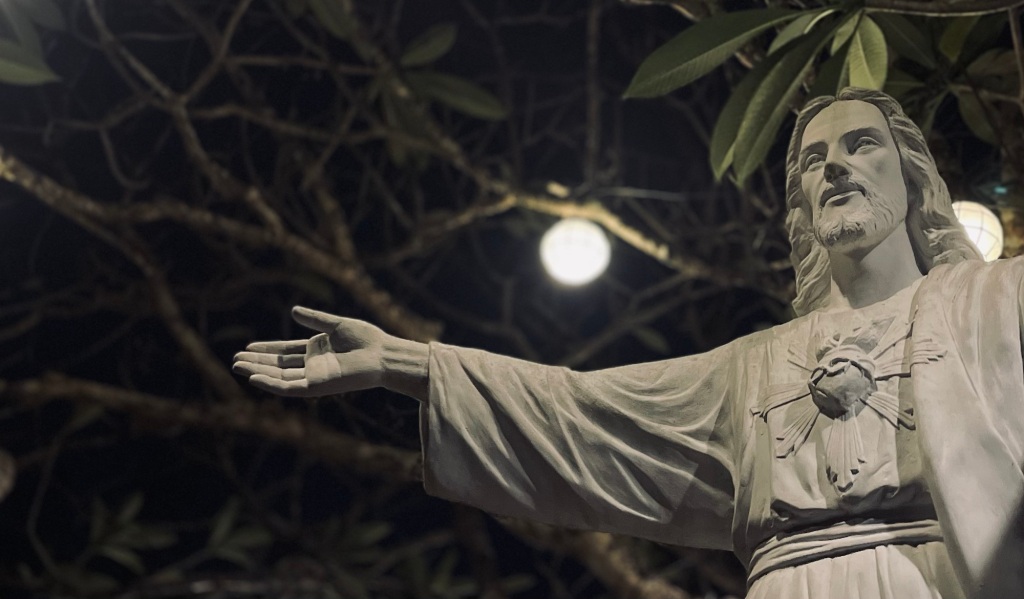
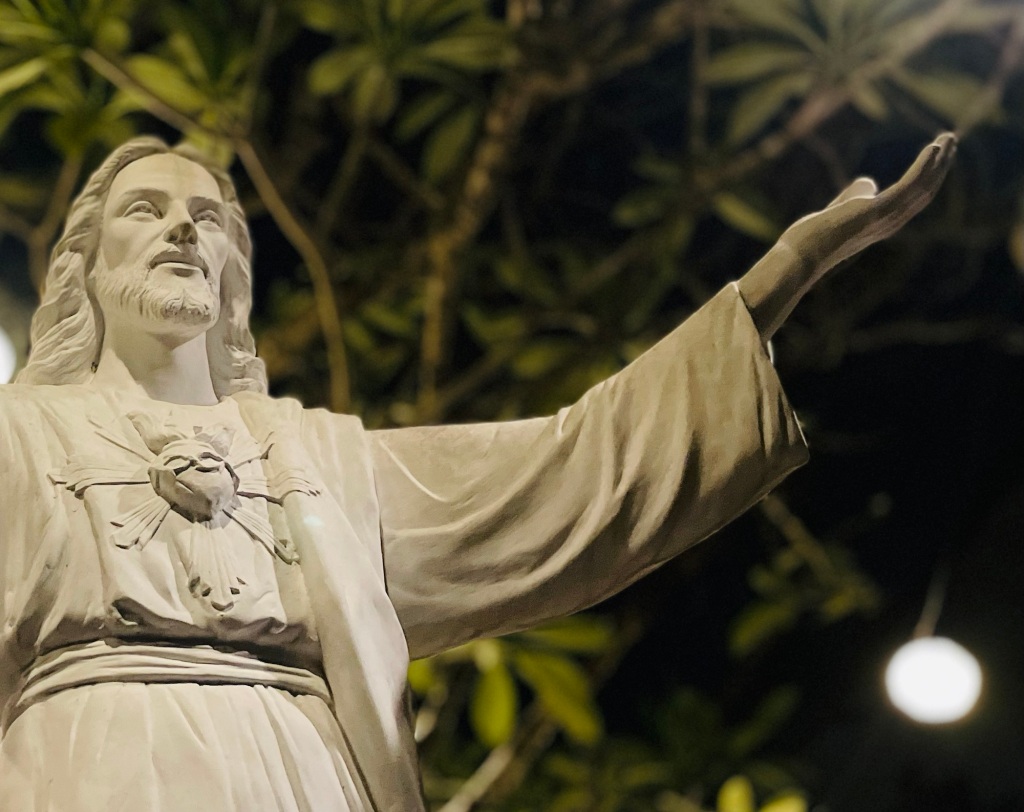
The heart of the priest

Lord My Chef Daily Recipe for the Soul, 04 August 2025
Monday, Memorial of St. John Baptiste Marie Vianney, Priest
Numbers 11:4-15 <*{{{{>< + ><}}}}*> Matthew 14:13-21
St. John Baptiste Marie Vianney from https://liturgiadashoras.online/.

People complain and ask me why our patron saint, St. John Baptiste Marie Vianney is always portrayed “unattractive” as old, balding and so thin who seemed to be so tired, even sad. Para daw hirap na hirap.

Usually I smile at them because when I entered the seminary, I felt the same way too upon seeing his images. But as I learned about his life and teachings, the more I realized St. John Baptiste Marie Vianney is actually one of the original “rock star” saints of the Church with his white, balding hair so much like Jimmy Page of Led Zeppelin!

There is something so deeply within him when we try to feel and observe his portrayals in the arts as more than images but a reality and experience of a man deemed weak yet so strong with an intensity of a Michael Jordan in his life and ministry. He was another St. Paul who had truly let “Christ lived in him” (Gal. 2:20), “strongest when weakest” (2Cor.12:10) who declared with conviction that “the priesthood is the love of the heart of Jesus.” Hence in my prayers last night and today, I asked Jesus to give me a heart “so big, so wide to welcome everyone and life’s many challenges” (https://lordmychef.com/2025/08/03/praying-with-our-patron-saint-john-baptiste-marie-vianney/).

Detail of a painting of the Sacred Heart of Jesus at Visitation Monastery, Marclaz, France from godongphoto / Shutterstock.

The readings this Monday of the eighteenth week in Ordinary Time perfectly jibed the celebration of the Memorial of St. John Baptiste Marie Vianney as they spoke of the heart of the priest.

In the first reading we heard of Moses lamenting to God of the difficulty in dealing with his people who were so stubborn and refused to recognize God’s immense love for them, so similar with us priests in many occasions when we feel so frustrated and sad when parishioners fail to see the good things we are doing for them.

When Moses heard the people, family after family, crying at the entrance of their tents, so that the Lord became very angry, he was grieved. “Why do you treat your servant so badly?” Moses asked the Lord. “Why are you so displeased with me that you burden me with all this people?”… I cannot carry all this people by myself, for they are too heavy for me. If this is the way you will deal with me, then please do me the favor of killing me at once, so that I need no longer face this distress” (Numbers 11:10-11, 14-15).

Many times, we priests feel like Moses who cannot voice out problems with the people who would never understand it at all. Worst, people would even blame us priests why we work so hard or why do we bother at all with their lives. “Pabayaan na lang ninyo kami…sanay na kami” are what they often say. It can be frustrating when people refuse to match the fire and ardor of their priests.

In this scene, we find one of the many instances in the life of Moses that was centered on God in prayers. The heart of the priest is a heart in prayer. The attitude of Moses in the first reading conversing with God in prayer shows us that in our life and ministry, there is no one to turn to except God alone with whom we can be our most personal self, even dare God to “take us” or “kill us” when we are so fed up. The good news is, God never took those words seriously as he knew Moses and the prophets including us who spoke to him that way never knew what we were saying at all.

There is a saying that goes, “if you can’t bear the heat, leave the kitchen”; but, it cannot be applied with the priesthood that is neither a profession nor a job one can easily walk out from and start into another venture or career. Priesthood is a call or a “vocation” from God; however, priesthood is more of the Caller than the call. It is a life centered on prayer to become like Jesus Christ who alone feels and understands and appreciates all our ups and downs in the ministry. The more we get closer to Jesus in the Cross, the more we experience fulfillment that we would never dare to trade it for anything or anyone else, not even the prettiest woman on earth.

Photo by author, Chapel of St. Francis Xavier, Sacred Novitiate, Novaliches, QC, March 2024.

Priesthood is the love of the heart of Jesus that continues to be wounded and hurt by sins of men and women in this modern age so selfish and materialistic. Thus, every priest is called to be a “wounded healer” too like Christ who in his woundedness healed the wounds of others. We remind people of the paradox and scandal of the Cross of Jesus, of life itself by taking into heart Christ’s teaching, “For whoever wishes to save his life will lose it, but whoever loses his life for my sake will find it” (Mt. 16:25).

Let us now reflect on our gospel.

When Jesus heard of death of John the Baptist, he withdrew in a boat to a deserted place by himself. the crowds heard of this and followed him on for from their towns. When he disembarked and saw the vast crowd, his heart was moved with pity for them, and he cured their sick (Matthew 14:13-14).

Observe the brevity of Matthew in narrating the situation at the scene without losing its very soul and meaning especially for us priests: Jesus did not have any intentions to go after Herod nor to challenge him for his execution of John the Baptist who spoke the truth.

Instead, Jesus sought solitude. Like Moses in the first reading, Jesus turned to God in his grief and anguish of the death of John the Baptist. He crossed the lake to pray and be one with the Father to pour out his sadness and most of all, to reflect on what to do next after John’s death.

Jesus shows us in this scene of his going into solitude that our low points in life as priests are also our high points like Christ’s Transfiguration. Every prayer moment is a transfiguration moment because that is when we get closest with Jesus. It has been consistently proven in our collective and personal experiences as priests verified by studies that crises in the priesthood happen when we stop praying because that is detaching from Jesus Christ, our Caller.

Priesthood is not only difficult but very difficult starting with the vestments we have to wear. What a shame when priests prefer to do away with the proper vestments as well as wearing of shoes during celebrations of the Mass and other sacraments because the weather is so hot. What then are we going to bear if the weather is already a big issue for us? One of the teachings of St. John Vianney that I have always followed is the value of putting on good vestments in the celebration of Sacraments because they are a homily in themselves, proclaiming the glory and love of God for us all.

Photo by FlickrBrett Streutker from catholic365.com.

Many times, people forget priests have personal concerns and problems too, that we get hurt, get lonely, get sick and grieve at the death of family and friends. Despite all these lows in our life as priests, we go and follow the Caller Jesus Christ when people come and ask for our help and service. Woe to our brother priests who forget this and think more of themselves especially of their comfort!

See how when Jesus was praying in solitude and the crowd followed him, it was not difficult for him to forget his own worries that his heart was moved with pity upon seeing them disembarked from their boats. Despite his sadness at the death of John, Jesus taught the crowd who have followed him and healed the sick among them. And when the Twelve told him to drive away the crowd to search for their own food and lodging, Jesus told them to give them food themselves. What followed was the great miracle of the feeding of over five thousand people from five loaves of bread and two pieces of fish. It was the event that prepared the Twelve and the people to the Last Supper of the Lord and the road to Emmaus where Jesus was recognized at his “breaking of bread”.

The whole life of St. John Baptiste Marie Vianney was a prayer of praise and thanksgiving to God in Christ’s priesthood. He had a heart so big and wide, hearing confessions daily up to 16 hours! Pray for us your priests to have big hearts too to bear all the wounds and hurts because only the heart that suffers, that is “broken” can truly sing of the joys and pains of living, of the sense and meaning of serving to the point of being emptied, and of the healing and transforming power of Christ’s love and mercy. Amen. Pray for us your priests. Salamuch. Fr. Nicanor F. Lalog II, Our Lady of Fatima University, Valenzuela City (lordmychef@gmail.com).

 have not been to France nor do I know French but while searching for images of St. John Marie Vianney, I found this from the French website, https://www.notrehistoireavecmarie.com/; it is perhaps the depiction of the new pastor speaking to the young Antoine whom he asked for directions to Ars.

Thomas, our twin?

Lord My Chef Daily Recipe for the Soul, 03 July 2025
Thursday, Feast of St. Thomas the Apostles
Ephesians 2:19-22 <*{{{{>< + ><}}}}*> John 20:24-29
Caravaggio’s painting “The Incredulity of St. Thomas” (1602) from en.wikipedia.org.
Lord Jesus,
teach me to be like you -
so understanding,
so caring,
so loving
to those who are doubting
you like Thomas your Apostle;
poor Thomas -
he has been called "Doubting"
when the evangelists simply
referred to him as "Didymus"
or twin; however, it is so lovely
too to know that doubt and
certainty are like twins because
when we doubt,
the more we seek and find
the truth which Thomas did.
When I think of my own faith
journey in you, Lord,
many times I was worst
than St. Thomas for I was not only
doubting you
but also hesitant in following you
because of fears and mistrust,
lack of confidence in my self,
and simply self-centered.
Could it be, Lord,
that in each one of us is
Thomas our twin -
doubting,
hesitating,
indecisive,
in following you?

Now a week later his disciples were again inside and Thomas was with them. Jesus came, although the doors were locked, and stood in their midst and said, “Peace be with you.” Then he said to Thomas, “Put your finger here and see my hands, and bring your hand and put it into my side, and do not be unbelieving, but believe.” Thomas answered and said to him, “My Lord and my God!” (John 20:26-28).

How nice of you, 
Lord Jesus
to be so warm with Thomas
on that night
when you appeared again;
instead of engaging Thomas
into a debate or discussion,
you called him,
invited him to touch your wounds,
to feel your scars;
what an incredible courage,
Lord Jesus
to let us see and feel
closely your wounds,
to stare and look at your
sufferings, to remember and
imagine your lowest point in life
if only to show us that it is
the only way to glory;
many times, we are afraid
to admit even to ourselves
and to others our wounds and hurts,
preferring to keep them
even hide them
to keep our illusions
of greatness.
May we find 
the graces of
joy and warmth,
love and kindness
that fill our many wounds
in life as a result of our
following you, Lord Jesus
for it is in our woundedness
and hurts that we become
"members of the household of God
who are built together to be
the dwelling place of God
in the Spirit" (Ephesians 2:19, 22).
Amen.

Fr. Nicanor F. Lalog II
Our Lady of Fatima University
Valenzuela City

Easter is getting real, not “ghosting”

The Lord Is My Chef Easter Recipe for the Soul by Fr. Nicanor F. Lalog II
Third Sunday in Easter-B, 14 April 2024
Acts 3:13-15, 17-19 ><}}}}*> 1 John 2:1-5 ><}}}}*> Luke 24:35-48
Photo by Dra. Mylene A. Santos, MD, 27 March 2024 at Katmon Nature Sanctuary & Beach Resort, Infanta, Quezon.

More than ten years ago, there used to be a billboard at the C3-Banaue area in Quezon City that said, “True love is like ghosts, which everybody talks about and only a few have seen.”

I googled the saying and found it was from French moralist Francoise de la Rochefoucauld (1613-1680). Nonetheless, we remembered that billboard because in our gospel today, we have heard how the Apostles thought upon seeing the Risen Lord that He was a ghost!

While they were still speaking about this, he stood in their midst and said to them, “Peace be with you.” But they were startled and terrified and thought that they were seeing a ghost. Then he said to them, “Why are you troubled? And why do questions arise in your hearts? Look at my hands and my feet, that it is I myself. Touch me and see, because a ghost does not have flesh and bones and you can see I have.”

Luke 24:36-39
“The Road to Emmaus” painting by American Daniel Bonnell from fineartamerica.com.

This is the last Sunday we shall hear a story of the Risen Lord’s appearance to His disciples; beginning next Sunday, our gospels will be the accounts of Jesus Christ’s discourses at their Last Supper.

It is not really important to count how many times the Risen Lord had appeared to His disciples who in the first place never bothered themselves with it. John explained it last Sunday why only a few of these were written so that we may believe and have life in Him (Jn.20:31). There are two things we find always in these few Resurrection stories that convince us the Lord is risen.

First, there is always the intensity we feel in the Resurrection stories we have. Even though there is no account of how it happened, we could feel in the whole New Testament that it actually happened. It is historical but beyond the physical and ordinary. So real yet surreal. That is why initially, there is the incredulity not only among the disciples but even among us at this time. As we say in Filipino, “hindi makapaniwala” as opposed to “hindi maniwala” because Jesus Christ’s Resurrection opened new possibilities in our human existence that only faith in Him can explain though not fully. It is when all we can say in Filipino is “a…basta!”

From this intensity of His Resurrection, there is always that movement to gather together as a community of the risen Lord’s disciples. Easter is always in the context and setting of a community. See how Jesus would always tell or lead His disciples to gather together as a community, always appearing to them when there are at least two of them gathered like Clopas and companion on the way to Emmaus on the evening of Easter. And we see its effect – once they recognized Jesus at His breaking of bread, they both hurried back to Jerusalem to join the other disciples to share the good news!

That’s the beauty and mystery of Easter. It is so intense, so true we can feel and experience, always leading us to gather together as a community, as a family. It is never selfish nor personal. Do we have the same intensity today as individuals and as a community especially in our Sunday Masses?

From Facebook, 04 April 2021: “There is an urgency to announce the Joy, the joy of the Risen Lord.”

Today’s gospel scene is the continuation of that Emmaus story. While Clopas and companion were telling the disciples their experience, Jesus suddenly came into their room and again, they were startled and terrified.

But Luke added that one word “ghost” that was used twice in this scene: first in v.37, “But they were starteld and terrified and thought that they were seeing a ghost” and in v. 39 when Jesus read His disciples’ minds, telling them to “Look at my hands and my feet, that it is I myself. Touch me and see, because a ghost does not have flesh and bones as you can see I have.”

Sorry for the long introduction as I wish to direct our attention to that word ghost.

When we were growing up, there was a cartoon show on TV called “Casper the friendly ghost.” In Filipino, we always refer to ghost as multo, something scary because like the aswang, they look terrible and would always harm people. That is why the Church later on changed the name Holy Ghost to Holy Spirit because of the very negative connotation of the word ghost.

These days, the young people are using again the word ghost, turning it into a verb form that means so negative: ghosting as in “iniwan sa ere”. At first, I thought to be ghosted is the equivalent of what we used to say “na-Indian” when a date or someone stood you up in a meeting or coming together.

But ghosting is more than just not appearing nor coming to a meeting or get together. It is almost like betrayal or infidelity. Precisely what the youth say, to be left hanging on air not knowing at all what is next. Very disappointing. Most of all, painful as it hurts us deeply when ghosted. The Filipino expression says it all completely, iniwan sa ere which is worst than the English expression “dropped like a hot potato”. To be ghosted is to be betrayed, to be taken for granted, to be discarded like a thing. It is utter lack of respect to another person. Worst, it is lack of life fulln of pessimism and indifference to life itself.

Photo by author, Sacred Heart Novitiate, 18 March 2024.

Jesus Christ is not a ghost. Had never and would never ever ghost us because He is faithful, truly alive and truly present with us especially in our darkest and emptiest moments in life. Many times, we do not see nor recognize Him because we are so focused at how we were ghosted especially by loved ones.

In the first reading, we heard Peter’s second discourse on Pentecost Sunday about the Resurrection of Jesus as the summit of everything that was written in the Old Testament, the fulfillment of salvation history. But at the same time, he was telling the people of how they have ghosted the Lord “whom you handed over and denied in Pilate’s presence, when he decided to release him” (Acts 3:13).

Peter was not accusing the people then or anyone today for being accomplices in Jesus Christ’s death because he himself denied the Lord thrice, remember? Peter ghosted Jesus too but repented. And that was his point to everyone including us today of how may times we too have ghosted Jesus when we sin against each other, when we betray our loved ones, when we are remiss in our duties and responsibilities, when we are unfaithful that people fail to experience the Risen Lord coming to them.

Peter is asking us this Sunday to look into ourselves at how we continue to ghost each other that we contribute to the vicious circle of violence happening in the world that often starts right in our family and community, even in the Church.

That is why the beloved disciple asks us in the second reading “to keep his commandments so that we may not commit sin” by rejecting the lusts of the flesh not only in the sexual sense but in all of our selfish interests. Most of all, to imitate Jesus Christ by living like Him full of love and kindness, always understanding and forgiving and caring especially of the weak and marginalized.

Photo by author, 09 April 2024.

The Resurrection remains a mystery. It is a call for us to be real with flesh and bones not like a ghost. Easter is an invitation to live our lives as Easter people, full of joy and hope in Christ even when the chips are down.

Being real as opposed to ghosting means proclaiming Jesus Christ with our very own witnessing of His loving presence and service to others with our very lives.

Being real as opposed to ghosting is avoiding “back burning” those dearest to us.

Being real as opposed to ghosting is not “bread crumbing”, of being mediocre that we do only the bare minimum.

Easter is Jesus faithfully present with us especially in the most trying and difficult moments of our lives because He assures us nothing can keep us nor hostage us in whatever darkness or emptiness we are in.

Not being able to see someone does not mean that someone does not exist. Many times in life, it is after our loved ones are gone – permanently or temporarily – when we actually experience them closest. That’s because of the Resurrection of Jesus!

Let’s get real by praying:

Lord Jesus Christ,
open my mind and my heart
to Your words;
let me develop that prayer life
You have always been inviting me
to get into a relationship with You;
let me find You in my wounds
so I may find Your glory too;
let me find You in my many hurts
and scars in my heart so I may
find and share Your healing and
comfort with those still in the
darkness of Good Friday
or silence of Holy Saturday;
dearest Jesus,
fill me with life and joy
so that people may see You
in me alive
and not like a ghost.
Amen.

Easter is touching Jesus

The Lord Is My Chef Easter Recipe by Fr. Nicanor F. Lalog II
Thursday in the Octave of Easter, 04 April 2024
Acts 3:11-26 <*((((>< + ><))))*> Luke 24:35-48
Photo by author, Sacred Heart Novitiate, Novaliches, QC, 18 March 2024.
Thank you,
Lord Jesus,
for always touching me,
making me experience
You truly alive in prayers
and Sacraments
but most especially
in the people You send
to touch me
and be touched by me
for You.

Then he said to them, “Why are you troubled? And why do questions arise in your hearts? Look at my hands and my feet, that it is I myself. Touch me and see, because a ghost does not have flesh and bones as you can see I have.”

Luke 24:38-39
Photo by author, Sacred Heart Novitiate, Novaliches, QC, 18 March 2024.
How amazing,
O Lord,
in Your rising from
the dead,
You still have those
wounds You bore for us
there on the Cross
but all healed
to remind us that
all wounds we have
can be healed in You!

Most of all,
though our hands
and words wound
so many others,
it is also our same
wounded hands
and hearts You use
to heal others
wounded.
Most loving Jesus,
"open our minds to understand
the Scriptures" (Lk.24:45),
help us to touch base
with our very selves,
with our past,
with our sins
and mistakes we refuse
to admit
or did not know at all
like when Simon Peter
reminded the people
of Jerusalem
so that
we remain in touch
with You,
with others,
and with our
true selves.
Amen.

*Sharing with you one of my favorite prayer-music by Fr. Manoling Francisco, SJ; speaks so well of Fr. Henri Nouwen’s reflection on our being a “wounded healer” as well as the amazing power of human touch.

From Youtube.com