Thank you very much, O God, in giving us this weekend to examine and test our hearts about our relationships and friendships.
How nice of you to speak about “tests” in our Mass readings today:
In the first reading, you ask us to “first test a friend and be not too ready to trust him” (Sir. 6:7).
It is sad, O Lord, that in this age of Facebook and social media, friends have become numbers and status symbol for our popularity than persons to be loved and cherished as gifts from you. To test a friend means to see to it that in our relationships, we do not regard each other as objects to be possessed like things.
Too often, this happens when we disguise as testing you like the Pharisees in the gospel who asked you, “Is it lawful for a husband to divorce his wife?” (Mk.10:2)
How funny, O Lord, that in testing you, we end up being tested about the friendships and relationships we keep!
And so many times, we fail because we have removed you from the many ties that bind us.
Teach us, O Lord, today to always see you in every person we meet, in every relationship we keep. Guide us in the way of your commands that we live together in love and unity as brothers and sisters, never allowing our selfish interests to separate us from one another. Amen.
Fr. Nicanor F. Lalog II, Parokya ng San Juan Apostol at Ebanghelista, Gov. F. Halili Ave., Bagbaguin, Sta. Maria, Bulacan.
“Wisdom breathes life into her children and admonishes those who seek her. He who loves her loves life; those who seek her will be embraced by the Lord” (Sir.4:11-12).
Forgive us, Lord Jesus, when there are times we think more about our various affiliations like religion that we forget the need for communion of minds and hearts in you.
Like John in the gospel, there are times we feel so entitled in life simply because we are with you, believing that we have the monopoly of doing what is right and what is good.
Instead of building bridges so we could be linked together as one, we put up walls that confine us with our own group but apart from others.
Enlighten us O Lord with your wisdom, finding the great truth that God dwells within each one of us despite our many differences in color and creed.
Give us your grace of wisdom and truth, fill us with your life so we may share your life freely with one another.
May God our Father embrace us with His great love and wisdom to drive away the demons and evil within us that keep us apart. Amen.Fr. Nicanor F. Lalog II, Parokya ng San Juan Apostol at Ebanghelista, Gov. F. Halili Ave., Bagbaguin, Sta. Maria, Bulacan.
Last Wednesday evening I visited to anoint with oil one of your beloved poor patients in the government hospital. She died eventually two days after.
But what remained etched in my memory was the sight of some children crying in pain at the emergency room.
I have always wondered how difficult it must be for children to be sick when they cannot speak of what they feel that they simply cry and hold on to their mother and maybe trust her and the doctors attending.
“Whoever receives one child such as this in my name, receives me; and whoever receives me, receives not me but the One who sent me” (Mk.9:37).
Give me O Lord that same grace of children to suffer and bear all pains.
Teach me O Lord “to trust God and wait for His mercy, hope in Him and love in Him so my heart may be enlightened” (Sir.2:6-9).Amen.
Fr. Nicanor F. Lalog II, Parokya ng San Juan Apostol at Ebanghelista, Gov. F. Halili Ave., Bagbaguin, Sta. Maria, Bulacan.
Life, sometimes, is a series of “good news-bad news” situation like the Beatitudes preached by Jesus during His sermon on the plain last week: the blessings are the good news while the woes are the bad news.
But, wait…! Such a view is the way of the world, not of Christ’s disciples!
As we have reflected last Sunday, the Beatitudes are the paradoxical happiness of the disciples of Christ because they all run directly against the ways of the world. Today we hear more paradoxical teachings from Jesus that are actually His “win-win” solution for our many problems like wars and other forms of enmities. Unfortunately, we have never given them a try because we always complain the ways of the Lord as being far from realities of life, impossible to imitate because He is God and we are not.
Today let us set aside all these reservations and arguments to reflect on this new set of paradoxical teachings by the Lord: Jesus said to his disciples: “To you who hear I say, love your enemies.od to those who hate you, bless those who curse, pray for those who mistreat you… But rather, love your enemies and do good to them. Be merciful, just as your Father is merciful. For the measure with which you measure will in turn be measured out to you” (Lk.6:27-28, 35, 36, 38).
It is very striking that Jesus repeated twice His call to “love your enemies”.
Does He not care about us who have to bear with the sins of evil people? What a good news to those who hate us, curse us, and mistreat us! Suwerte sila! We would surely say they must be so lucky, even blessed with us who strive to heed the calls of Jesus to love them our enemies.
But, on deeper reflections, we are actually more blessed when we try to love our enemies because that is when we elevate – or “level up” as kids would say – our hearts to be merciful like God. Experts claim that the best way to exact revenge against people who have hurt us is to shower them with good deeds and kindness from us they have offended. According to these experts in counselling and psychology, evil people get disappointed and angrier with themselves when their evil plots fail especially when their targets do not react negatively. They sound understandable because evil people derive joy in making people miserable. So, why be miserable?
Far from being their “punching bag”, the Lord simply wants us to teach our enemies to respect us, to be kind to us by not being like themselves. In loving our enemies, we teach evil people that more powerful than sin is the power of love. Sin and evil consume a person while love and kindness make a person grow and mature and bloom to fullness.
Far from being passive, to love our enemies by returning evil with good is always the most active method in fighting sins. When Jesus asked us to offer the other side of our cheeks to those who slap our face or when we give them our tunic when they demand our cloak, we are showing these evil people that love is never exhausted unlike evil. Love is boundless and the more we love, the more we have it, the more we keep on doing it. Evil, on the other hand, reaches a saturation point that we get fed up with it, then we we stop doing it because it is exhausting and worst, consumes us within that in the
process destroys us. Think of the most evil person you have known and surely, you find that person so ugly, so zapped of life and energy, eaten up from within by a festering wound. Evil people will never have peace and joy within, glow on their face and skin because they are rotting inside like zombies.
In the first reading we heard how David as a type of Christ foregoing vengeance by holding on to God, trusting Him completely that he chose not to strike King Saul who was then trying to kill him out of jealousy. As disciples of the Lord, we have to trust in the Word of God that can transform our hearts of stone into natural hearts filled with love and mercy like Him. This is the point being explained by St. Paul in the second reading wherein Christ as the “second Adam from heaven” had made us bear the “heavenly image”despite our “earthly image” that is weak and sinful having come from the “first Adam from earth”. Through Baptism, we have been endowed with all the necessary grace from God, transforming us into better persons of heaven.
One of my favorite sayings came from the desk of a friend of mine I used to visit in their office that says “If you have love in your heart, you have been blessed by God; if you have been loved, you have been touched by God.”
See how God has loved us so immensely without measure! Remember that scene two Sundays ago when Jesus borrowed the boat of Simon as He would do with our voice, with our hands, with our total selves? Who are we or what do we really have and own that the almighty God would borrow from us? Nothing! Yet, Jesus comes to us daily with all His love without measure to bless us with everything we need. So, who are we now to love by measuring everything, loving only those who love us, lending only to those who could repay us?
Imagine how astonishingly disproportionate is the love of God with our kind of love. It is in this light must we see the meaning of Christ’s final lesson this Sunday: “For the measure with which you measure will in turn be measured out to you.” So paradoxical and provocative yet so true! This Sunday, may we share God’s love in our hearts with others, especially with our enemies so they may also experience the loving and merciful touch of God. Then we begin to realize too the “win-win” solution of Christ to humanity. Amen.Have a blessed week!Fr. Nicanor F. Lalog II, Parokya ng San Juan Apostol at Ebanghelista, Gov. F. Halili Ave., Bagbaguin, Sta. Maria, Bulacan.
Side garden of the Church of the Beatitudes with the Lake of Galilee at the background. Photo by the author, April 2017.
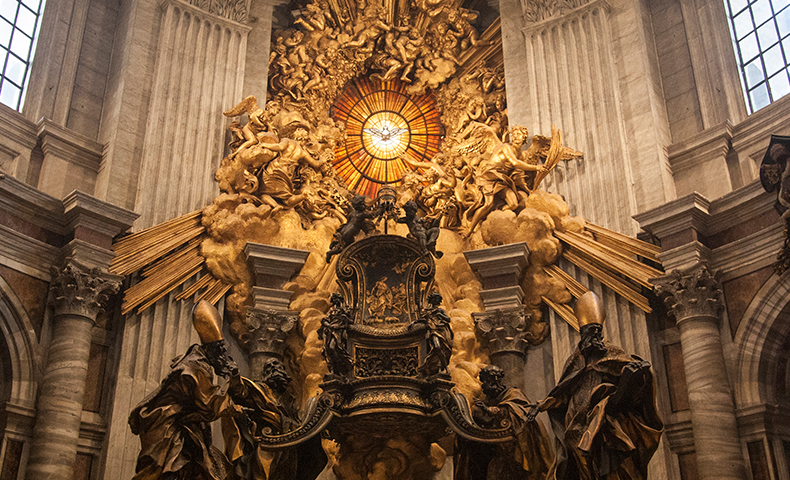
The Chair of St. Peter at the high altar of the Basilica of St. Peter at the Vatican flanked below by the two teachers of the East, St. John Chrysostom and St. Athanasius with the two Latin Fathers of the Church St. Ambrose and St. Augustine. All four saints showed us how love stands on faith; that, without both love and faith, everything falls apart in the Church. Photo from Bing.
The Lord Is My Chef Breakfast Recipe for the Soul
Friday, Feast of the Chair of St. Peter, 22 February 2019
1Peter 5:1-4///Matthew 16:13-19
Glory and praise to you, O Lord Jesus Christ as we celebrate today a most unique feast, the Chair of St. Peter!
It is so unique O Lord especially in this age when the world is so concerned with seating arrangement whether at home, in school, in offices, in buses… everywhere seats matter these days because every seat is about position, rank, power and convenience.
And we have forgotten that more important than our seating position is where we stand.
On this Feast of the Chair of St. Peter, remind us Lord especially your priests of that beautiful example you have shown at the Last Supper when you left your seat to wash the feet of the Apostles.
How sad and shameful, O Lord, when we your priests fail to realize that the throne of the Eucharist is not a seat of power or prestige but a seat of loving service to everyone.
So true were the words of St. Ignatius of Antioch in his Letter to the Romans in the year 110 that the Primacy of Rome is the Primacy of Love because primacy in faith is always primacy in love, two things we can never separate.
May we your priests heed the call of St. Peter, the designated “owner” of that Chair, that we “Tend the flock of God in your midst, overseeing not by constraint but willingly, as God would have it, not for shameful profit but eagerly. Do not lord it over those assigned to you, but be examples to the flock” (1Pt.5:2-3). Amen. Fr. Nicanor F. Lalog II, Parokya ng San Juan Apostol at Ebanghelista, Gov. F. Halili Ave., Bagbaguin, Sta. Maria, Bulacan.
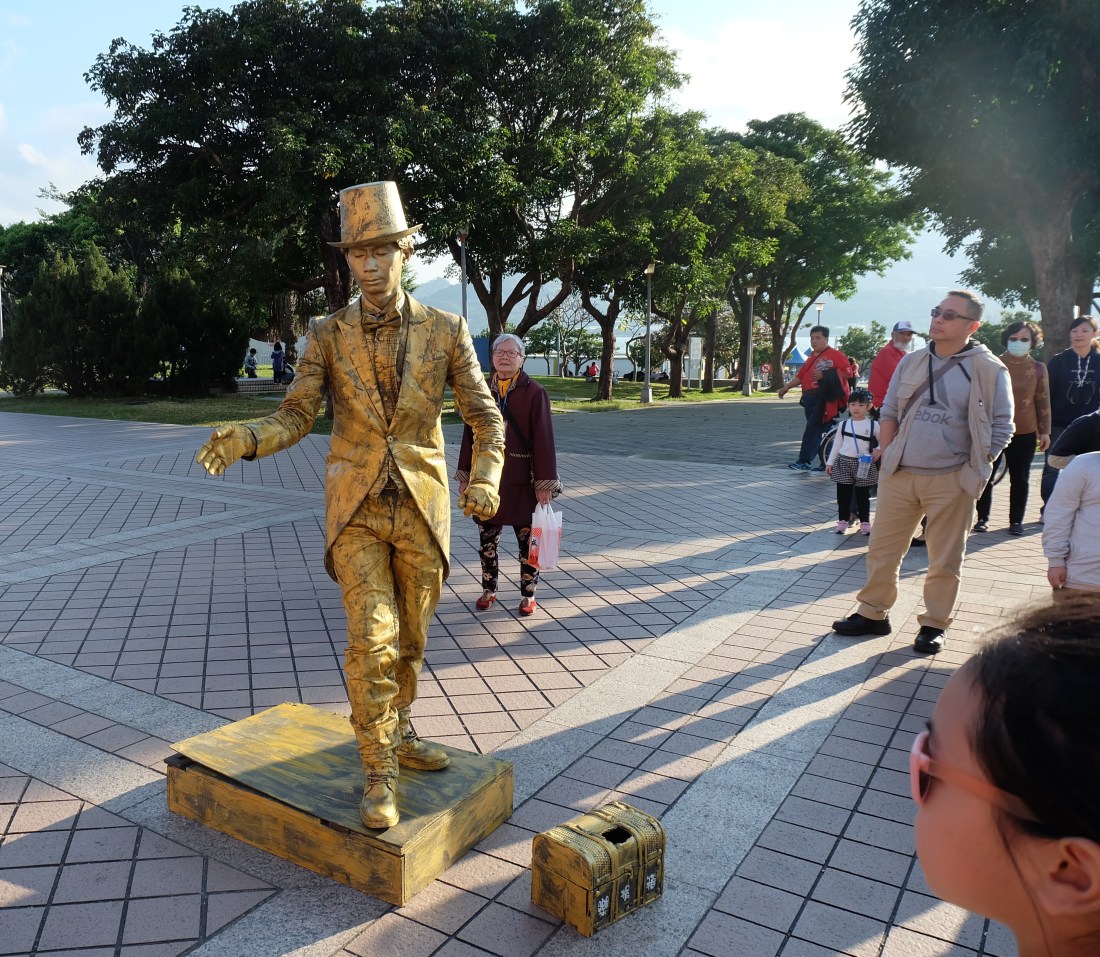
A street performer at the Tamsui Fisherman’s Wharf in Taiwan must have tried and failed so many times before getting his permit from Taipei officials to perform in public. Photo by the author taken last January 29, 2019
The Lord Is My Chef Breakfast Recipe for the Soul
Wednesday, 20 February 2019, Week VI, Year I
Genesis 8:6-13, 20-22///Mark 8:22-26
Lord Jesus Christ, yesterday you taught me of your great love and mercy through your fidelity and patience in my being too slow in understanding your signs of presence.
Thank you very much, Lord, for bearing with my mindlessness.
But today, I praise and thank you twice, even thrice, in giving me the grace of being patient like you in my persevering to keep on trying and hoping for your love and mercy, healing and grace.
Like that blind man in Bethsaida you have healed gradually, you have taught me how things are not that clear right away at your coming. Sometimes, everything seems to be so blurred when “I see people looking like trees and walking” (Mk.8:24).
Like Noah in the first reading after the rains and the floods, it takes time before plants sprout and bloom again. So many times, I just have to be like Noah, always waiting, always trying until the floods have subsided.
Let me offer you a sacrifice of praise today O Lord through my kindness and patience with others just like you. Amen.Fr. Nicanor F. Lalog II, Parokya ng San Juan Apostol at Ebanghelista, Gov. F. Halili Ave., Bagbaguin, Sta. Maria, Bulacan.
Buds starting to grow on one of the many Cherry blossoms of Taiwan’s Yangming National Park near Taipei. Photo by the author, 28 January 2019.
The Lord Is My Chef Breakfast Recipe for the Soul
Tuesday, 19 February 2019, Week VI, Year I
Genesis 6:5-8;7:1-5, 10///Mark 8:14-21
Thank you very much Lord Jesus Christ for your patience and fidelity in bearing with my mindlessness and lack of understanding in reading your signs in my life.
So many times, despite your many blessings and very presence in my life, I still don’t get it like your disciples that I can feel as so real, O Lord, your seeming desperation, asking me, “Do you still not understand?” (Mk.8:21)
There are times Lord that my mind wanders far into other concerns like the material “bread” being offered by the world that I easily forget the wondrous signs of far more important things you have been showing me like love and mercy, kindness and compassion.
Cleanse my heart, dear Jesus, especially when all I desire are evil like the people during the time of Noah. Let me be on guard against the leaven and understanding of the world that is fleeting and temporary. Amen.Fr. Nicanor F. Lalog II, Parokya ng San Juan Apostol at Ebanghelista, Gov. F. Halili Ave., Bagbaguin, Sta. Maria, Bulacan.
Good morning Lord Jesus Christ! I hope you don’t mind my asking you on this first day of work and studies: why did you sigh in the gospel today?
The Pharisees came forward and began to argue with Jesus, seeking from him a sign from heaven to test him. He sighed from the depth of his spirit and said, “Why does this generation seek a sign? Amen, I say to you, no sign will be given to this generation.” Then he left them, got into the boat again, and went off to the other shore (Mk.8:11-13).
Some people tell me it is not good to sigh; but, they have never explained to me why, and so, I sigh even more! Most often, I sigh when I feel helpless and even hopeless with people and situations; but, surely O Lord, you neither get helpless nor hopeless with us as we keep on asking you for more signs.
Did you sigh, O Lord, because you were so tempted to get down to their level?
Did you sigh, O Lord, so that you would not give in to sin and be like Cain who lost sight of himself and of his brother Abel and eventually of God?
What a beautiful sign of your humanity and divinity as well is your sighing, O Lord, reminding us of our need to always reconnect with the Holy Spirit in the depths of our being especially when temptations for us to sin are so strong that we forget we are our brother’s keeper.
Remind us always O Lord when we sigh that we may think of your many signs of wonder before us, of the many signs of your mercy and love so that we remain rooted in you.Amen.Fr. Nicanor F. Lalog II, Parokya ng San Juan Apostol at Ebanghelista, Gov. F. Halili Ave., Bagbaguin, Sta. Maria, Bulacan.
A paradox is a statement that seems contradictory but may be true in fact. From the Greek words para for beyond and doxa for opinion, a paradox promotes critical thinking and deep introspection or reflections. Christian living is a life of paradoxes as we often hear Jesus our Lord telling us to lose our lives in order to gain it. St. Francis of Assisi knew it so well that in his prayer to be an instrument of peace, he rightly claimed that “it is in giving that we receive, it is in pardoning that we are pardoned and it is in dying that we are born into eternal life.” We shall have a taste of some paradoxical teachings by Jesus Christ beginning today until the next two Sundays before we get into the Season of Lent as we listen from the account by St. Luke of the Lord’s “Sermon on the Plain”. For this Sunday, we hear the centerpiece of His sermon on that day, the Beatitudes.
And raising his eyes toward his disciples, he said: “Blessed are you who are poor, for the kingdom of God is yours. Blessed are you who are now hungry, for you will be satisfied. Blessed are you who are now weeping, for you will laugh. Blessed are you when people hate you, and when they exclude and insult you, and denounce your name as evil on account of the Son of Man. Rejoice and leap for joy on that day! Behold, your reward will be great in heaven” (Lk.6:20-23).
Beatitudes are words of promise that have a strong link from the long line of tradition of Old Testament teachings like the one we heard from the first reading today from Jeremiah: “Blessed is the one who trusts in the Lord, whose hope is the Lord” (Jer.17:7). Recall how last Sunday Jesus called His first four disciples led by Simon whom He had asked to be “fishers of men” (Luke chapter 5). As Jesus went around Galilee preaching and healing the sick, He gained some disciples or followers. In chapter six, St. Luke tells us Jesus departed to a mountain to pray for the night and upon coming down the following morning, He chose 12 men among His disciples whom He called apostles. This is now the setting of our gospel today when a vast crowd have followed Jesus, many of whom are poor people with some pagans from Tyre and Sidon who all wish to listen to Him about the word of God and to be healed from their sickness.
Speaking to His community of disciples that include us now, the Beatitudes by Jesus express the meaning of discipleship which is paradoxical because they run directly against the values of the world. For Jesus Christ, true blessedness and the way of happiness for us His disciples is being poor, hungry, weeping, and hated. What a paradox indeed! Yet, we know deep in our hearts, in our love for Christ and for others especially to those dear to us, we are willing to live with these promise of trials and sufferings because it is the only way to follow Jesus who said “anyone who wishes to follow Him must deny himself, take up his cross daily and follow Him” (Lk.9:23). The paradox becomes deeper and more paradoxical that we are willing to go through all pains and trials for our love for Jesus and others because we trust in the Lord’s promise that “He will provide us with wisdom in arguing with our enemies… and most of all, not a hair on our head will be destroyed. By our perseverance we shall secure our lives” (Lk.21:14-19). We forge on with the Beatitudes because we are convinced in the words of Jesus about the complete reversal of fortunes when that “day” comes for our “rewards in heaven shall be great!” (Lk.6:23) And that “day” is the “now” when the scriptures are fulfilled in our hearing, when despite the many hardships we go through, we have that firm assurance within of meaning and joy in life because like St. Paul, we firmly believe in our resurrection in Jesus Christ. Every day we die in our sins, in our sufferings, we share in the passion and death of Jesus; but every day too, we experience rising to new life in Christ in this little deaths we go through in daily living.
It is along this line that we discover how the Beatitudes reveal to us the mystery of Jesus Christ Himself who calls us into communion with Him and in Him. When we examine the Beatitudes, we find Christ being referred to as the one who is poor, hungry, weeping, and hated for He is the first to be so blessed and filled with God when we recall His baptism at Jordan. In His life, Jesus showed us true blessedness as prophesied by Jeremiah, the one “who trusts and hopes in the Lord… like a tree planted beside waters that despite drought, it shows no stress and still bears fruit” (Jer.18:8). Without doubt, Jesus was the first to go through all the sufferings and pains of the Beatitudes and the first to resurrect from the dead as St. Paul insisted to the Corinthians. In following the Beatitudes, we become true fishers of men who catch nothing all night without Christ; but, with Jesus, despite our many losses in life, we continue to cast our nets into the deep so our lives may be fulfilled in Him always. Life is a mystery, filled with paradoxes that make it so wonderful and beautiful in God. A blessed week ahead to you! Amen. Fr. Nicanor F. Lalog II, Parokya ng San Juan Apostol at Ebanghelista, Gov. F. Halili Ave., Bagbaguin, Sta. Maria, Bulacan.
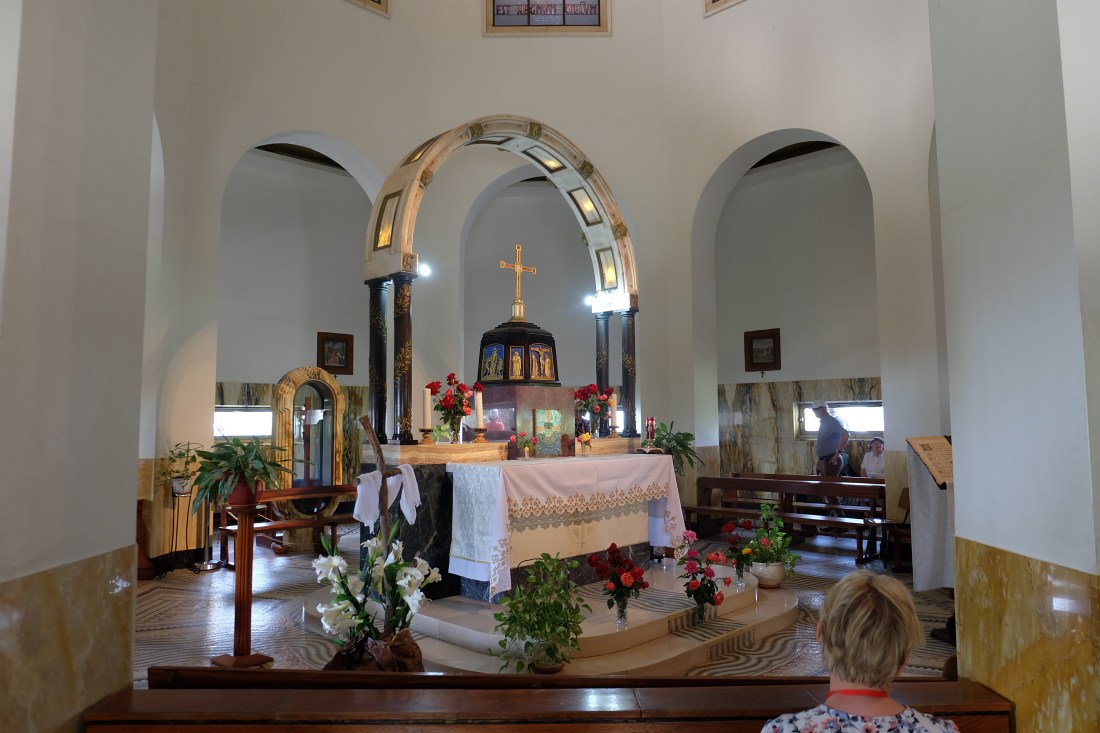
Sanctuary and altar of the Church of the Beatitudes in Israel. Photo by the author, April 2017.
Lover’s Bridge in Tamsui Fisherman’s Wharf, New Taipei City, Taiwan opened on Feb. 14, 2003. Photo by author, 29 January 2019.
Quiet Storm by Fr. Nicanor F. Lalog II, 15 February 2019
I thought last year’s Valentine’s Day was the most interesting in recent years because February 14 fell on an Ash Wednesday, a beautiful juxtaposition of the secular and the sacred that both remind us of love and death. It happened again to me yesterday very early morning when I drove with my brother down south to visit a beloved aunt who is our late father’s favorite sister sick with Parkinson’s for the last seven years. It was the closest experience I ever had with the realities of love and death intimately related.
Unlike my previous visits to her in the last two years, the latest last January 03, Tita Neneng has always looked so sad and depressed with her situation, choosing to be left alone than be seen in her plight. She used to be bursting with life, so busy with her career and family that upon retirement, she spent it going almost everywhere especially to visit her children in the US. Yesterday, Tita Neneng was so different, almost like back to her old self as she smiled and talked a lot. Her face was radiant, exuding with her beauty that had captivated so many men until her 50’s! She was bubbling with joy as we reminisced the good old days when my father was still alive along with her older siblings, our many family reunions, and of course, our Lola Queta. After anointing her with Holy Oil for the Sick and giving her the Viaticum, she told me something that made me cry so hard after: “Father, I am ready.”
Of course, I knew what she meant but I had to lean close to her to ask her again what she just said. “Father, handa na ako mamatay,” she told me with a smile on her lips while her eyes lovingly looked at me. I asked her if she had told it to her husband, Tito Terry and she replied, “hindi pa.” I told her she must tell it to Tito Terry so he would also be ready. She then looked down, then faced me again and told me, “yung mga anak ko umaasa pa sa milagro. Ayaw pa nila ako payagan.” I looked at her and asked permission to inform her children in the States of her feeling ready.
She just smiled. And I cried. Very hard.
I had to excuse myself to run for some tissue in her bathroom as I could not contain myself crying and sobbing beside her. Once in a while, a lesson from our pastoral psychology crossed my mind that as a pastor or minister, I should not cry in front of a patient, but, what can I do? She’s my dearest aunt who had made me feel so loved and special even before I ever thought of becoming a priest in high school?!
Deep inside me, I also felt some joy amidst the sadness because I felt my Tita Neneng is indeed ready to go anytime soon because she was so composed without any tear in her eyes and always with that sweet smile on her lips. Before, Tita Neneng would always cry to me, begging me to pray that God would take her as she could not endure her sufferings anymore. That was before when she begged for death out of desperation as a way out of her pains and sickness. But yesterday, she simply told me she was ready to die maybe because she must have found her direction in life already.
Yesterday was actually a déjà vu for me, having experienced it before with my bestest friend from high school seminary, Gil who was diagnosed with colorectal cancer in January 2013. He would always cry to me whenever I would visit him, asking “why me” with the Big C? Seven months after undergoing surgery and some chemo treatment, his doctors gave up. It was time to face the inevitable as his cancer cells were so strongly active; but, surprisingly, my friend Gil accepted it gallantly, even with joy on his face! I visited him thrice on his final week before he died. And there I was, breaking into tears before him, crying like a child. A reversal of roles had suddenly happened with Gil assuring me with everything, explaining things I should know more as a priest. The most remarkable thing I have discovered with Gil as he approached death was the inner peace he head when he told me how he had forgiven his wife who had abandoned them, telling me how much he still loved her, vowing to keep his marital vows until his end!
The beloved disciple of Christ wrote, “No one has ever seen God. Yet, if we love one another, God remains in us, and his love is brought to perfection in us” (1Jn.4:12).
Have you ever noticed how when our loved ones were diagnosed with serious illness, they always cried to us while we tried to assure them that everything would be fine? Then, as our loved ones slowly embraced their mortality and faced death, we in turn cried before them who also assured us that everything would be fine? There seems to be a reversal of roles when our loved ones embrace death because their love has been perfected that they no longer fear anything at all. They must be so assured of where they are going to in life, unlike us who are still uncertain of what awaits us and that is why we cry when they go. We not only cry for them but we cry more for ourselves because we have not seen the bigger picture yet that we still love imperfectly. The great love stories of literature like Shakespeare’s “Romeo and Juliet” and Charles Dickens’ “A Tale of Two Cities” show us that death and love always go together not only for a beautiful story but precisely because death shows the depth of one’s love. It is in suffering and death love is perfected. A heart willing to suffer and die for another is the heart that truly loves. Though love is symbolized by the heart as we have it on Valentine’s day, love is best expressed by the Cross of Jesus Christ who showed us the way of true love. Coming to terms with life is coming to terms with death and vice versa. So, let us have Valentine’s day every day!






 lordmychef.com