Seeing and Hearing Jesus

40 Shades of Lent, Sunday Week-2, Year C, 17 March 2019
Genesis 15:5-12, 17-18//Philippians 3:17-4:1//Luke 9:28-36

From the mountain of temptation, we now join Jesus in His mountain of Transfiguration this Second Sunday of Lent. It does not matter on which mountain Jesus transfigured because Lent as a journey is not about destination but direction that begins right in our hearts when we examine and purify, renew and vivify our faith in the resurrection of Christ. At the very core of this Lenten journey is the glory of Jesus seen in the light of His Cross.

Jesus took Peter, John, and James and went up the mountain to pray. While he was praying his face changed in appearance and his clothing became dazzling white. And behold, two men were conversing with him, Moses and Elijah, who appeared in glory and spoke of his exodus that he was going to accomplish in Jerusalem… Then from the cloud came a voice that said, “This is my chosen Son; listen to him.” After the voice had spoken, Jesus was found alone. They fell silent and did not at that time tell anyone what they had seen.

Luke 9:28-31,35-36

Of the three evangelists who reported the Transfiguration, only Luke tells us its context, prayer: “Jesus took Peter, John, and James and went up the mountain to pray” (Lk. 9:28). It is very clear with Luke that the Transfiguration is a “prayer event” to show us what happens when Jesus talks with His Father. It is reminiscent of the experience of Moses when his face became radiant after talking with God at Sinai but far more deeper in meaning and reality. According to Pope Emeritus Benedict XVI, the Transfiguration is the “interpenetration” of Christ with His Father, becoming “light from light” for He Himself is the light. The face of Moses shone by receiving light from God after meeting Him on Mt. Sinai while the Transfiguration affirmed the divinity of Jesus as the Son of God whose light came from within Him.

What a wondrous sight to behold seeing Jesus in all His glory that prompted Peter to ask Jesus that they remain there as he offered to build them with a tent each! Luke tells us a similar story on the evening of Easter when two disciples going home to Emmaus met Jesus along the way, asking Him to stay with them for the night. In both stories, the sight of Jesus in His glory vanished immediately after He was recognized by the disciples. The same thing happens with us when we go through the same experiences of seeing the glory of Jesus in our lives, of how we wanted to preserve it, wishing Christ would remain to stay with us so we can keep those feelings of joy and peace within. Like Peter, the experience is too deep for words that we find ourselves not knowing what to say; and, like the two disciples at Emmaus we feel our hearts burning within because we have seen and heard the Lord!

Seeing and hearing are God’s greatest gifts. We find in the gospels how people were amazed whenever Jesus would restore sight of the blind and enable the mute to speak by opening their ears. Jesus Himself tells the disciples that include us today of how “Blessed are your eyes because they see, your ears because they hear! Amen, I say to you, many prophets and righteous people longed to see what you see but did not see it, and to hear what you hear but did not hear it”(Mt. 13:16-17).

Seeing and hearing Jesus happen whenever we pray, the starting point of every Transfiguration. This is the reason why we have to pray always, not only during Lent. Prayer is communion with God, being one with God. The beloved disciple tells us that “No one has ever seen God. Yet, if we love one another, God remains in us, and his love is brought to perfection in us” (1Jn.4:12). God’s love is perfected in us whenever we join Jesus in His exodus or pasch, His passing over Passion, Death, and Resurrection. This is why the voice heard during His Transfiguration said “This is my chosen Son; listen to him.” After His Transfiguration, Jesus would always speak about His coming Passion, Death and Resurrection, calling us all to follow Him always.

And that is Transfiguration: the light of Christ’s Passion and Death burn us within to be transformed into His glorious Resurrection.  Any experience of God is always a transfiguration and transformation into His image and likeness which sin had destroyed and disfigured in us. The surest sign that we have seen and heard God is when we die in our sins, being transformed into new persons in Christ when we forget one’s self, carry our cross daily and follow Jesus. See again the centrality of the Cross in the Lord’s teachings and events. We can never have a complete and correct picture of Jesus Christ without the Cross. And there can be no real change in us without sufferings and pains with Christ leading the way.

In the first reading, Abraham saw and heard God at night in the desert like in the Transfiguration. God sealed His promise to him to be the father of all nations by taking the initiative to burn by “passing over” the animals he had sacrificed. Abraham held on to that promise through many tests and trials from God, thus becoming the father of all nations recognized by Jews, Christians and Moslems alike.

Yes, our life and times could even get worse with all the killings and problems going on in many parts of the world, even in our own lives, family and friends. Things may even get worst than better but the story of the Transfiguration this Sunday assures us of our future glory in Christ amidst all the crosses in our lives. Let us “stand firm in the Lord” as Paul tells us in the second reading by reviewing the many decisions and choices we have made in the past to go back to Christ’s direction to His Cross. Like Abraham and the apostles, let us be faithful to Jesus our Savior “who will change our lowly body to conform with his glorified body by the power that enables him also to bring all things into subjection to himself” (Phil. 3:21-4:1). A blessed week to you in Christ Jesus!
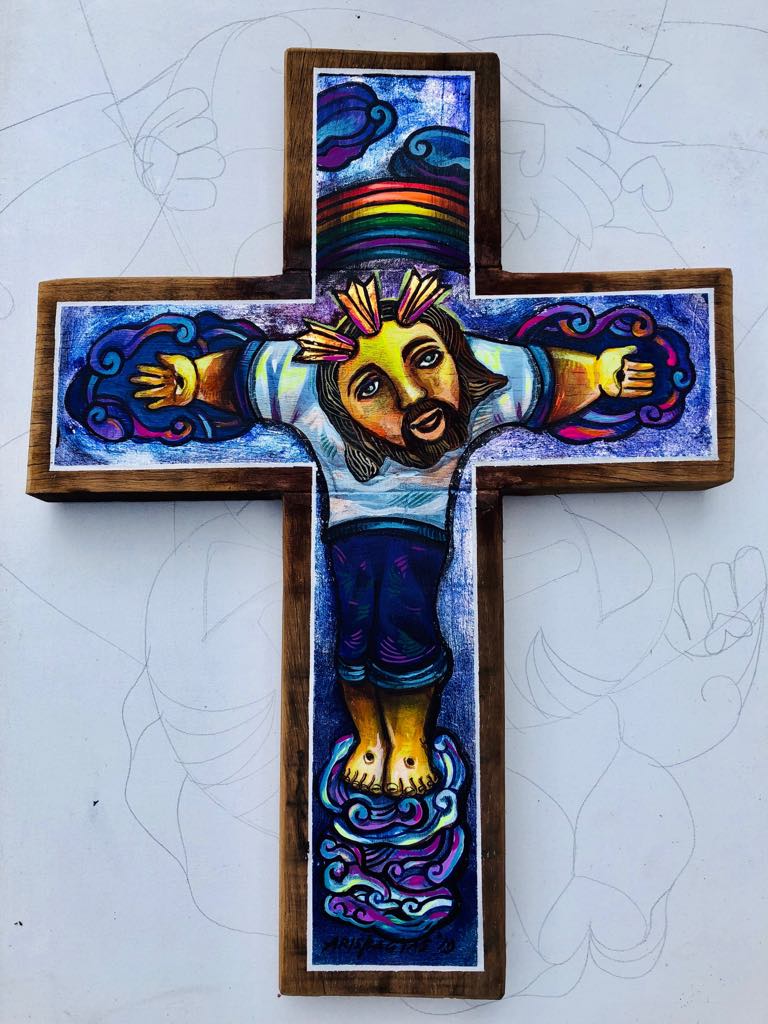
Painting of the glorious crucified Christ called “Luwalhati” by Bulakenyo artist Aris Bagtas, acrylic on old wood 18×24, 2019. Used with permission.

The Ides of March

40 Shades of Lent, Friday, Week-1, 15 March 2019
Ezekiel 18:21-28///Matthew 5:20-26

Lord Jesus Christ, it is “the Ides of March” and like “Friday the 13th” some of us are thinking of so many misfortunes and bad things that could befall us on this date made notorious by the assassination of the Roman emperor Julius Ceasar. Forgive us in professing our faith in you yet continue to subscribe to so many superstitious beliefs.

Remind us O Lord of the ironic twist that the Ides of March is not gone if we continue to live in sin, or, if after leading a virtuous life we turn into evil deeds because in both instances we shall die. It is true that you “never derive joy in the death of the wicked” (Ez. 18:23) because you have come to forgive us from our sins so we can lead holy lives as children of the Father.

Indeed, Shakespeare was absolutely right when Cassius voiced out in his play Julius Caesar that “the fault my dear Brutus is not in the stars but in ourselves.”

Give us the courage to look into our hearts to examine our lives and see if our worship of You and our dealing with others are in congruent with each other. Let us stop our attitudes of blaming and complaining to start changing our ways according to your will O Lord. Amen.

Images from Google.

Objective of Prayer

40 Shades of Lent, Thursday in Week-1, 14 March 2019
Esther C:12, 14-16, 23-25///Matthew 7:7-12

God our loving Father, if there is one thing we wish to tell you today, it is the Psalmist’s song for today, “Lord, on the day I called for help, you answered me.”

So many times, we felt like “Queen Esther, seized with mortal anguish” with no other recourse but to you O God. We know our limits and our weaknesses as well as sinfulness, yet, you keep on trusting us, giving us so many responsibilities and missions in life. Not because we are great or so good but simply because we trust in you.

Teach us to discover anew that in prayer, our lone objective is You alone, O God: not things like money and wealth, power and honor. It is you alone whom we seek, whom we ask for, whom we knock doors for.

Give us the grace to strive to for your Person for you are more than a concept.

Give us the grace to experience your Person as you are not according to our belief or imaginations.

Just to feel your presence O God is more than enough for especially when we are in great need. Stay with us, remain in us always. Amen.

Images from Google.

God’s Word, God’s Sign

40 Shades of Lent, Wednesday of Week 1, 13 March 2019
Jonah 3:1-10///Luke 11:29-32

Open “the ears of our hearts”, O Lord, to always heed your words especially in this holy season of Lent when your readings are so rich and meaningful. So many times we are like your contemporaries, “an evil generation always seeking signs.” (Lk. 11:29)

Or, like your reluctant prophet Jonah: we cannot believe your words, always trying to escape responsibilities and mission from you to proclaim your word.

The word of the Lord came to Jonah a second time: “Set out for the great city of Nineveh, and announce to it the message that I will tell you.” So Jonah made ready and went to Nineveh, according to the Lord’s bidding.

Jonah 3:1-3

How funny and even insane, Lord, for us to run away from you, hide from you like Jonah because we find your words so simple, doubting its powers to move and change people.

But when like Jonah we proclaim your words, we are amazed and surprised at its efficacy not only with the people they are directed to but most of all with us. Your words indeed are alive and so powerful especially if our whole heart is humbled and contrite from our sins.

Help us to always recognize your presence in your words for you are the Word who became flesh. Take away our stony hearts and give us a natural heart that beats with firm faith, fervent hope and unceasing charity and love. Amen.

Images from Google.

When prayer becomes like rain and snow

40 Shades of Lent, Tuesday of Week-1, 12 March 2019
Isaiah 55:10-11///Matthew 6:7-15

May our prayers, O God, be like rain and snow that soak and soften earth to allow seeds and plants to grow, bloom and bear fruit.

Soak and soften our hearts hardened with pride and sin with your love and divine mercy that we may eventually go back to you. Soak and soften our hearts, O God, with our prayers that we may recognize others as brothers and sisters in you our Father. Soak and soften our hearts with our prayers, O God, that we may learn to forgive others as you forgive our sins.

We have so many things to learn about prayer, O God. And perhaps, the most important of these is to keep in mind that every prayer is a God-centered activity, not man-centered. Indeed, even before we pray to you, you already know what we need; we pray so that we may know what we need most, and that is you as a Person, not as a concept but as our Father.

Like Jesus your Son and our Savior, may we always be attentive – docile – to your words O God our Father for man does not live by bread alone. Amen.

Images from Google.

“Walang Laman”

Lawiswis ng Salita ni P. Nicanor F. Lalog II, Ika-11 ng Marso 2019

 
Apatnapung araw nag-ayuno si Kristo
Nang siya ay tinukso ng diyablo:
“Kung ikaw ang Anak ng Diyos,
Gawin mong tinapay itong bato.”


Gutom at walang laman tiyan ni Kristo
Ngunit hindi napatangay sa tukso ng diyablo
Hindi siya nalito, naging matibay tulad ng bato
Na buhay ng tao higit nakasalalay di lamang sa tinapay
Kungdi sa Salita ng Diyos na bumubuhay, gumagabay na tunay.


Ito ang pangunahing katotohanang
Dapat nating pakatandaan
Na hindi sapat, at lalong di dapat
Tayo ay mapuno at mabusog
Ng mga bagay ng mundo upang hindi matukso at malito.


Maraming pagkakataon
Lalo tayong nababaon
Sa balon ng pagkagumon
Kapag lahat tayo ay mayroon
Na malayo naman sa naaayon.


Sa pag-aayuno tayo napapanuto
Tumitibay ating pagkatao
Nawawala pagkalito sa higit na totoo
Na si Hesu-Kristo naparito upang samahan tayo
Maiwaksi at malampasan maraming tukso.


Mangyayari lamang ito kung tulad ni Kristo
Masasaid natin ating sariling kalooban
Di lamang bawasan kungdi mawalan ng laman
Magkaroon ng puwang sa ating kalooban
Diyos na ating tanging yaman.
Larawan ng ilang sa Israel tulad marahil ng pinuntahan ni Hesus nang Siya ay tuksuhin ng Diyablo.  Kuha ng may-akda noong Abril 2017.  Ang unang larawan sa itaas ay mula sa Google.

Sin is having more “I”, less God and others

40 Shades of Lent, Monday, Week 1, 11 March 2019
Leviticus 19:1-2, 11-18///Matthew 25:31-46

Your readings today, O Lord, invite us to examine the choices we have made recently in our lives. It is always easy to say “I love you, Lord” but when we examine the decisions we have made, it seem to show we really do not love you at all because we have been selfish. Most of the time in making choices, we think first of our self. And that is when we sin.

Every time we have more of our selves – that big, personal, pronoun “I” – in every choice and decision we make, we s-I-n.

When we refuse to be like you who is holy, when we disregard you as our Lord and God whom we must see in everyone, we s-I-n because we see only our self.

When we disregard the hungry and the thirsty, the stranger and the naked, when we do not care at all to those ill or in prison, we s-I-n because we refuse to love.

Help us, Lord Jesus, to have less of our self and more of your Holy Spirit so that we may be attentive and docile to the Father speaking to us in our hearts and crying out to us among the suffering people around us. Amen.

Images from Google.

“Stuck In A Moment You Can’t Get Out” by U2 (2000)

The Lord Is My Chef Sunday Music, Lent Week 1-C, 10 March 2019

Every year on this first Sunday of Lent, we always hear the story of the tempting of Jesus by the devil in the wilderness. According to St. Luke, Jesus was “filled with the Holy Spirit” when He went to the desert to pray and fast for 40 days. He was able to resist the temptations of the devil because Jesus was filled with the Holy Spirit.

To be filled with the Holy Spirit means to be docile to the Holy Spirit. Being docile is not merely being obedient; from the Latin word docilitas, being docile literally means being “attentive”. Lent is the season that invites us to bring back the spirit of docility in our lives, that is, to be attentive to one’s self, to God and to others. How sad that in this world of advanced technologies, we have become more attentive with things and gadgets than with persons. Maybe if we are more attentive to our inner selves, to God and to others, we could have prevented the many disasters and problems we now have.

If we have been attentive to our self, to God and to others, we would not be “stuck in a moment we can’t get out” – the very same title of a cut from the U2’s 2000 album All That You Can’t Leave Behind. I have always loved that song – and that album which I feel is their second best after Joshua Tree – that I used it so many times in my talks and recollections with young people. According to Bono, it was written after his friend from another band committed suicide, of how he wished he had exerted more effort to prevent his friend from killing self, of being stuck in a moment you can’t get out.

The song perfectly suits our gospel today. Every time the devil tempts us, its aim is not merely for us to commit a sin. The devil’s ultimate goal in tempting us to sin is to destroy our lives, to get us stuck in a moment we can’t get out. The good news is that Jesus had shown us how we can get over every temptation by the devil. Moreover, He has filled us with the Holy Spirit so that like Him, we can be docile – attentive – to God, to others and to our self so that we avoid sins and avert destroying our lives.

 
You've got to get yourself together
You've got stuck in a moment
And now you can't get out of it
Don't say that later will be better
Now you're stuck in a moment
And you can't get out of it
Photo above from Bing.com; music video from Youtube.

Lent is docility to the Holy Spirit

40 Shades of Lent
Week I, Year C, 10 March 2019
Deuteronomy 26:4-10//Romans 10:8-13//Luke 4:1-11

Our gospel story on this first Sunday of Lent about the tempting of Jesus at the desert sets the prevailing mood and disposition we must have on this holy season: docility to the Holy Spirit.

Docility is obedience. A docile person is an obedient one who is also attentive which is the literal translation of the Latin root docilitas. On the other hand, “obedience” is also from two Latin words “ob audire” that literally mean to listen intently. Here we find that Lent is a season that invites us to be attentive God and with others. Most of all, Lent is the season that calls us to recover this beautiful trait of docility and obedience by submitting and surrendering our selves to God and those above us like our parents.

How ironic and unfortunate that in our highly advanced world, we have become inattentive with persons and more attentive with things and gadgets. We have not only become less obedient but even less caring and kind with others because we no longer care at all with persons next to us. We cannot listen intently to parents and teachers, friends and almost everybody because our ears are always plugged with earphones while our eyes are fixed on screens! And maybe that explains why we always find ourselves into so many disastrous situations in our lives that could have been prevented had we been more attentive with our selves, with others and with God. According to a study in 2015, the average attention span of audience is 8.25 seconds while a goldfish has 9 seconds. This maybe the reason why looking at fish in an aquarium can be therapeutic… at least a goldfish can spare you with more attention than anyone!

Going back to our gospel this Sunday, we sense this spirit of docility of Jesus in the introduction and conclusion of Luke’s version of the temptation in the desert that follows right after His baptism at Jordan.

Filled with the Holy Spirit, Jesus returned from the Jordan and was led by the Spirit into the desert for forty days, to be tempted by the devil. He ate nothing during those days, and when they were over he was hungry.

Luke 4:1-2

“Filled with the Holy Spirit.” What a beautiful expression to describe Jesus after His baptism at Jordan and in going to the wilderness to pray and fast, later to be tempted by the devil!

Docility in the Spirit is being filled with the Holy Spirit we first received in our Baptism, in Confirmation, in the Holy Communion and the sacraments. Every day like Jesus during His baptism at Jordan, we are filled with the Holy Spirit upon waking up because we are all beloved children of the Father. We have to claim the Holy Spirit who fills us, comes to us day in and day out. Docility in the Spirit is being attuned with God like a radio or any communication device that must be “connected” to a power or signal source. This is the reason we have to fast and do some sacrifices as well as pray during Lent so that we may be empty of our selves to be filled with the Holy Spirit and be docile to God. Without the Holy Spirit, there can be no docility.

Docility in the Spirit is entrance into the very person of Jesus Christ who is the beloved Son of God. The five Sundays of Lent are like doors that lead us closer into the innermost room of God. It is a journey that begins in our hearts. It is a journey we said last Ash Wednesday that is more about direction than destination. We enter the person of Jesus Christ, just like when He entered the synagogue at Nazareth to proclaim the reading from Isaiah that said “The Spirit of the Lord is upon me…” (Lk.4:14-21). The people were amazed at Jesus because He was so filled with the Holy Spirit that they really felt the part of the scripture fulfilled in His proclamation. Recall also the gospel last Sunday when Jesus said “from the fullness of the heart the mouth speaks” (Lk.6:45) to remind us that whatever good or evil comes from us comes from what is in our hearts, from the kind of spirit that fills us.

Jesus was consistently filled with the Holy Spirit up to the end, was consistently docile to the Father that reached its summit at the Cross because he was also continuously tempted on many occasions by the devil up to His crucifixion. That final temptation at His crucifixion was first heard in the wilderness when the devil said “if you are the Son of God” very similar with the words of the bystanders at the foot of the Cross. Most of all, that final temptation at the crucifixion was foreshadowed in the desert when the devil led Jesus to parapet of the temple in Jerusalem, teasing Him to throw Himself down for the angels would surely support Him.

Every time the devil tempts us to sin, his intention is not only for us to sin but for our lives to be destroyed by making us turn away from God signified by jumping from the top of the temple in Jerusalem. Jesus knew this so well that is why from the desert to the Cross, Jesus remained docile to the Father, remained filled with the Holy Spirit by relying on the powers of God than of Himself or of anyone else. And that is always the temptation we also encounter daily: to abandon God, to rely on ourselves and various forms of human powers. Every temptation faced by Jesus was always a temptation to abandon God’s plans, to be ordinary, to remain stuck in the level of the of the world.

The good news is not only that Jesus had overcome every temptation from the devil but most of all, enables us to do so by filling us with the Holy Spirit. Like Moses in the first reading, remember how God saved us in the past. He will never forsake us for as St. Paul reminds us today, “everyone who calls on the name of the Lord will be saved” (Rom.10:13). May we be attentive to the Holy Spirit always. Amen.

The imagery of the wilderness every Lent invites us to be docile, i.e., literally attentive in Latin, to the Holy Spirit, to the things of God and of the more sublime than merely human and material. Photo by author, Holy Land, April 2017.

The Joy of Lent

40 Shades of Lent
Saturday after Ash Wednesday, 08 March 2019
Isaiah 58:9-14///Luke 5:27-32

Our loving Father, we are now about to enter the first Sunday of Lent. We have been trying to be serious with this season with our prayers and fasting. But, let us not lose sight of the fact that Lent is a joyous season too as we wait for Easter!

There are times O Lord some of us feel like Levi, sitting alone at the customs post, surrounded with all the wealth and trappings of the world, longing for some meaning in life. Maybe like Levi in that little customs post, some of us feel trapped in our sinfulness with no help in sight.

But, then you came, O Lord Jesus, like a shaft of light amid the darkness, just passing by, saying “follow me” (Lk. 5:27) without even asking our sins or work or world. You asked us nothing but you know everything about us. And that is the mystery that caught us!

What a joy being called to follow you, despite our sinfulness. Remind us always of that joy of Lent that in the midst of our sinfulness and darkness, you still come to call us to follow you.

Help us, O Lord to “remove oppression from our midst, false accusation, and malicious speech… bestow bread to the hungry and satisfy the afflicted” (Is.58:9-10). Help us to sustain our efforts in following you in every direction by being good and just with one another. Amen.

The Calling of St. Matthew (Levi), a painting by Caravaggio which is one of the favorite masterpieces frequently visited by Pope Francis in Rome while still a student and Archbishop of Buenos Aires. Let us keep in mind that Lent, despite it penitential character, is a joyful season of Christ’s coming. Images from Google.