Understanding the parables is giving up everything for Jesus

The Lord Is My Chef Sunday Recipe for the Soul by Fr. Nicanor F. Lalog II
Week XVII, Cycle A in Ordinary Time, 26 July 2020
1 Kings 3:5,7-12 >><}}}*> Romans 8:28-30 >><}}}*> Matthew 13:44-52
Photo by author, 2020.

The other Sunday during our Mass, I saw a man wearing a black t-shirt with these signs:

– = +

Of course, it means “Less is more” because a minus (-) is equal (=) to an addition or a plus (+)!

That is also the meaning of the Cross of Jesus Christ wherein it is in giving that we receive, in dying that we live, in losing that we gain more of everything because the cross is a plus sign.

This Sunday, that is essentially the lesson Jesus is telling us on this final installment of his parables wherein we have to lose everything in order to have him, the kingdom of God.

See how the three parables present us with one situation: to get the treasure in a field, its finder has to bury it again, sell all he has to buy the field where he had found the treasure; a trader searching for fine pearls sells everything he has to acquire a pearl of great price he had found; and lastly, not all fish caught in a net thrown in the sea are good to be sold with bad ones that must be thrown.

These parables are reminding us today of the need to exercise our freedom properly by making wise choices in life. Freedom is not the ability to do whatever we want but the ability to choose always what is good.

In every situation in life, we always have to make a choice; it is never true that we have no choice left to make. Choosing not to make a choice is actually choosing what is wrong, what is bad, and what is not good for us and for others.

We are always made by the choices we make in life. And that is why the parables are teaching us to choose wisely like King Solomon in the first reading.
Photo by author, February 2020.

Choosing wisely

The Lord appeared to Solomon in a dream at night. God said, “Ask something of me and I will give it to you.” Solomon answered: “O Lord, my God, you have made me, your servant, king to succeed my father David; but I am a mere youth, not knowing at all how to act. Give your servant, therefore, an understanding heart to judge your people and to distinguish right from wrong.” The Lord was pleased that Solomon made this request. So God said to him: “Because you have asked for this — not for a long life for yourself, nor for riches, nor for the life of your enemies, but for understanding so that you may know what is right — I do as you requested. I give you a heart so wise and understanding that there has never been anyone like you up to now, and after you there will come no one to equal you.”

1 Kings 3:5,7,9, 11-12

Here we go back again to that basic reality of a parable which is a simple story of every day life filled with profound meanings. It is something we take for granted because it is so ordinary like the seed forgetting its great potentials in the future.

Many times in life we get distracted like today when we have a plethora of products and services available that we cannot focus on what is really essential and important. Our decisions are clouded even erratic because we are so distracted with the wide array of choices to make, from food to eat to clothes to wear, movies or series to watch on Netflix or cable TV as well as music to listen from thousands of titles in our playlists.

And in our distraction, many times we miss our priorities in life, especially God and our loved ones.

Then, we end up sad and miserable, way too far from what God had envisioned for us since the beginning which is to live in joy in him.

For those he foreknew he also predestined to be conformed to the image of his Son, so that he might be the firstborn among many brothers and sisters. And those he predestined he also called; and those he called he also justified; and those he justified he also glorified.

Romans 8:29-30

St. Paul is reminding and assuring us in these short passages we heard from his letter today that God called us to be saved and glorified in Jesus Christ not by chance but by purpose. He willed it, he wanted it so because he loves us so much, assuring us all of future glory in him in eternity.

The key to experiencing that joy from God is to always abide in him like King Solomon of choosing what is good, letting go of everything that will separate us from him like sin and evil. For God’s plan and grace to operate and materialize, we need to cooperate with him like being a good soil that produces fruitful wheat.

Photo by Mr. Jim Marpa, 2018.

Our Christian life of joy

Like the Twelve inside the house listening to Jesus explained and narrated more parables, the Lord is also asking us today the same question:

“Do you understand all these things?”

Matthew 13:51

To “understand all these things” is not about human intelligence like being smart or brilliant but of holy wisdom or spiritual intelligence characterized by humility and simplicity before God and others.

To “understand all these things” and be like “every scribe… or the head of a household who brings from his storeroom both the new and the old” (Mt.13:52) is to be one in Jesus Christ, a person learned in the ways of God, who knows how to prioritize things, always making things relevant in the present even if it is an old lesson.

To be truly joyful in life is to just have Jesus, only Jesus and always Jesus.

It is easier said than done but we must try even little by little, slowly by learning more to give of our very selves to others.

It is difficult to imitate the main characters in the parables today – the finder of treasure, the pearl merchant, and the fisherman – when we always think of having more than having what is most valuable and important.

Have we noticed during this pandemic that whenever we would count or take tabs of everything we share, we feel sad and even grouchy because we feel we have lost a lot? And if we get too much in return, we cannot rejoice because we somehow feel guilty?

True joy comes when we are able to be generous, of giving without counting the costs, without thinking of what would be left for me because my only concern is what else can I give the other persons so that my joy can be complete when I see them like me – happy, contented, and peaceful with a simple smile or delighted by a hot bowl of soup or a hearty breakfast.

And that’s that greatest parable of Jesus of all that we need to understand and embrace: the less we have of created things, the more we have of the Creator, of himself who is the kingdom of God.

Then, that is heaven.

A blessed Sunday to everyone!

Photo by Dr. Mylene A. Santos at Infanta, Quezon, July 2020.

Kindness of Jesus Christ

The Lord Is My Chef Breakfast Recipe for the Soul by Fr. Nicanor F. Lalog II
Saturday, Feast of St. James the Greater, Apostle, 25 July 2020
2 Corinthians 4:7-15 ><}}}*> >><}}}*> >>><}}}*> Matthew 20:20-28
Facade of “Santiago de Compostela” in Spain in honor of St. James the Greater. Photo courtesy of Fr. Gener Garcia during their “El Camino de Santiago de Compostela”, May 09 to June 05, 2019.

Glory and praise to you, Lord Jesus Christ who had called and given us the Apostles as foundations of your Holy Church as we celebrate today the feast of St. James the Greater, the first bishop of Jerusalem and the first among the Twelve to die a martyr.

In him, O Lord, you gave us an image of hope in you, of how we can grow in holiness in you.

Through St. James the Greater, you have shown us your kindness in joining us in our earthly pilgrimage, slowly making us realize how we must adhere to you more closely to finally make it to our final destination in your kingdom in heaven.

Jesus said in reply, “You do not know what you are asking. Can you drink the chalice that I am going to drink?” They said to him, “We can.” He replied, “My chalice you will indeed drink, but to sit at my right and at my left, this is not mine to give but is for those for whom it has been prepared by my Father.”

Matthew 20:22-23

Your kindness is very evident, sweet Jesus.

I really wonder how you felt when the mother of James and John asked you that her sons be seated “one at your right and the other at your left in your kingdom” (Mt.20:21).

You were so kind to simply tell her and her sons, “You do not know what you are asking.”

Photo by Fr. Gener Garcia, image of Santiago de Compostela in Spain, 2019.

So many times, Lord, like St. James, we ask so many things from you, even demanding from you in exchange of what we believe as too great we have given you. You perfectly know so well that we do not know what we are asking at all. You know how we are blinded by fame and honor, power and wealth – things that do not matter at all in your kingdom.

You are so gentle in reminding us about the deeper realities of life, of discipleship by simplifying your demands, “Can you drink the chalice that I am going to drink?” to which we are often so naive, even oblivious for good reasons. Primarily because, we really do not know what we are asking.

And that’s when you are kindest of all, sweet Jesus: like with St. James and his brother St. John, you invite us “to drink the chalice you are drinking” by assuring us it can be done, that it is very possible, that in fact, that is the greatest honor of being with you, to drink from your chalice – without letting us know right away what it meant! St. John eventually realized and wholly accepted what you meant of drinking in your chalice when he became the first to share in your passion and death during the persecution by King Herod Agrippa (Acts 12:1-1).

Slowly, you make us realize too what is to drink in your chalice as we continue life’s journey with you, most especially into our inner self where we eventually find and rest in you when the goings get tough and rough.

It is total kindness on your part Lord to show us the beauty of sharing a meal with you, of sharing in your mission, of sharing in your life and most especially of sharing in your death that we make it with you to your kingdom.

Like St. James the Greater, continue to be kind with us, Lord, accompanying us in this journey.

In the same manner, make us kind to one another too like St. James the Greater who offered his life for the early church, for being the first to drink from your chalice. Amen.

Photo by Fr. Gener Garcia, marker along the “El Camino de Santiago de Compostela”, 2019.

“You Gotta Be” by Des’ree (1994)

The Lord Is My Chef Sunday Music by Fr. Nick F. Lalog II, 12 July 2020
Van Gogh’s “The Sower” from Wikimedia Commons.

It is a very lovely Sunday with Jesus Christ continuing to shower us with his good seeds to make us fruitful despite the many setbacks we may have had lately due to the COVID-19 pandemic and sad turn of events.

His parable of the sower proclaimed today in all churches throughout the world reminds us that inasmuch as we have to be a good kind of soil, we need to examine the kind of seeds we have become.

Seeds are so small that we often take for granted, like our very lives and most especially God.

But, Jesus reminds us too of how every seed is the presence of what is to come in the future, of something so big and huge that we can never imagine (https://lordmychef.com/2020/07/11/jesus-is-both-the-sower-and-the-seed-and-so-must-we/).

In a sense, Jesus is telling us today what Des’ree sang in 1994, “You Gotta Be”…..

Listen as your day unfolds
Challenge what the future holds
Try and keep your head up to the sky
Lovers, they may cause you tears
Go ahead release your fears
Stand up and be counted
Don’t be ashamed to cry
You gotta be
You gotta be bad, you gotta be bold
You gotta be wiser, you gotta be hard
You gotta be tough, you gotta be stronger
You gotta be cool, you gotta be calm
You gotta stay together
All I know, all I know, love will save the day

You Gotta Be was first released as a single in 1994 and instantly became a hit worldwide staying on top of almost every chart in the US, Europe and Australia. Music is warmly smooth, at the same time infectious with a sort of hypnotic effect from its sophisticated upbeat set in the cool and soothing voice of Des’ree who also wrote its lyrics.

I have used the song in my classes in our school for girls a decade ago and in many recollections and retreats to young people as it presents to us this great mystery of life packed in a seed that must fall and die to give way to new life and eventually bear fruit.

You gotta hear and feel it to appreciate this wonderful music that sounds like Jesus Christ’s parable of the sower.

I have uploaded the video with lyrics so you can follow and sing. And dance if you wish. Have a blessed day!

Video uploaded by
MyFavMusic123

Jesus is both the Sower and the seed – and so must we!


The Lord Is My Chef Sunday Recipe for the Soul by Fr. Nicanor F. Lalog II
Week XV, Cycle A in Ordinary Time, 12 July 2020
Isaiah 55:10-11 >><}}}*> Romans 8:18-23 >><}}}*> Matthew 13:1-23
“The Sower” painting by Van Gogh, photo from Wikimedia Commons.

Parables constitute the heart of Jesus Christ’s preaching. From the French para bolein which means “along the path”, parables are simple stories with deep realities that must be cracked open through prayers and reflections to uncover its meaning.

In fact, every parable by Jesus is a word of God that is like a seed that must be received, planted, and nurtured so we may eventually see and experience what is within it who is God himself!

On that day, Jesus went out of the house and sat down by the sea. Such large crowds gathered around him that he got into a boat and sat down, and the whole crowd stood along the shore. And he spoke to them at length in parables, saying: “A sower went out to sow. As he sowed, some seed fell on the path, and birds came and ate it up. Some fell on rocky ground, where it had little soil. It sprang up at once because the soil was not deep, and when the sun rose it was scorched, and it withered for lack of roots. Some seed fell among thorns, and the thorns grew up and choked it. But some seed fell on rich soil, and produced fruit, a hundred or sixty or thirtyfold. Whoever has ears ought to hear.”

Matthew 13:1-9
Photo by Onnye on Pexels.com

Jesus, the mysterious seed

Beginning today until the last Sunday of this month of July we shall hear different parables by Jesus taken from this 13th chapter of the gospel according to St. Matthew.

It is very interesting that as Jesus now begins to preach in parables, we also notice his usual usage of this image of the seed, especially of the mustard seed to stress to us what we have mentioned earlier about the significance of parables as simple things with deeper realities. Every seed is so small, easy to overlook and taken for granted. Yet, we all know how every seed is also the presence of what is to come in the future, of something so big and huge that we can never imagine.

That is how Jesus would always portray the Kingdom of God, which is himself, his very person who is always taken for granted but full of mysteries that later in the fourth gospel he would reveal a deeper reality of this seed akin his Cross:

“Truly, truly, I say to you, unless a grain of wheat falls into the earth and dies, it remains alone; but if it dies, it bears much fruit.”

John 12:24

That is the mystery of the seed, the mystery of Christ: something so ordinary we take for granted with immense possibilities when given up, when it dies. In this parable of the sower, Jesus shows us a hint of this profound truth about himself as a mysterious seed, someone who must be broken to die in order to grow and bear fruit.

If we read the full text of today’s gospel, we find Jesus explaining the meaning of this parable and we discover that he himself is both the sower and the seed: he goes out everyday to bring us the good news of salvation, providing us with seeds we must plant so we can have food in the future.

Every seed Jesus sows in us is always good as the first reading assures us.

Thus says the Lord: Just as from the heavens the rain and snow come down and do not return there till they have watered the earth, making it fertile and fruitful… so shall my word; my word shall not return to me void.”

Isaiah 55:10-11

Most of the time, we reflect on this parable on the importance of the soil on which the seed is sown.

This Sunday, let us reflect on what kind of a seed are we, of how we waste or put into good the enormous potentials packed in each of us by God.

Photo by Dids on Pexels.com

“A sower went out to sow. As he sowed, some seed fell on the path, and birds came and ate it up.“

Jesus the sower does not make distinctions on different kinds of soil; he just scatters the seeds freely. His words concern everyone.

Unfortunately, there are some of us who do not care at all, as hardened as the path or pavement.

These are the people who has no plans in life, no directions, spending their lives watching days pass without knowing that they are really the ones passing by.

Sometimes, they just go wherever the winds would lead them while once in a while, they step out of themselves a little to join friends or peers wherever they may be going. Eventually they leave when the journey gets farther.

They are literally wasting their lives.

“Some fell on rocky ground, where it had little soil. It sprang up at once because the soil was not deep, and when the sun rose it was scorched, and it withered for lack of roots.“

They are the “spur of the moment” type who eventually end up as what we call ningas-cogon (a kind of local grass when dried is highly combustible; quick to start fire but quick to extinguish too).

Beware of them who are at the beginning very enthusiastic in every project and endeavor but when the goings get tough and difficult, they are the first to leave.

No roots, no foundations in life. Easy to give up. Just as hard as those seeds on the pavement.

Photo by author at Petra, Jordan, May 2019.

“Some seed fell among thorns, and the thorns grew up and choked it.”

These are the people who thrived a little but eventually the “thorns of the world” choked them that they eventually dried and died.

They are the kind of people we lament and sometimes grieve, wondering what have happened within them that their hearts have suddenly turned away from God and others with their noble causes we used to share with them at the beginning.

Oh, they are well represented in Congress, especially the party-list representatives of various advocacies for the marginalized and less privileged who eventually come out with their true colors and ugly features. Some of them simply stopped thinking and feeling the other persons, blinded with power and wealth selling off their souls completely to any golden calf willing to pay them.

The modern Judas Iscariots.

“But some seed fell on rich soil, and produced fruit, a hundred or sixty or thirtyfold.“

Photo by Ms. Jo Villafuerte, flower farm at Atok, Benguet, 2019.

We now come to the better seeds (because all are good seeds, remember?).

They are the ones who fell on rich soil and produced fruit because they were the ones who willingly gave themselves up to the Sower. They are the ones who let go and let God, those who let themselves “die” and fell on the ground to give way to new life.

They are fruitful, not successful; the former relied on the powers of God, patiently bearing all pains and sufferings while the latter relied on their own powers, own intelligence and even connections that on the surface may seem to have the upper hand but totally empty inside.

The fruitful seeds are those willing to fall and be broken by God according to his divine plan. Many times, what is fruitful to God may be failures to us humans. Being fruitful is not about results and accumulations we have made but what have we become.

Fruitful people are focused on with the future glory to revealed by God through our pains and sufferings as St. Paul reminds us in the second reading today.

Let us not put into waste this good seed sown in us by Jesus Christ, allow it to be cracked open and broken to let the new life within us spring forth and lead us to becoming fruitful. Amen.

A blessed week ahead to everyone!

When evil becomes life

The Lord Is My Chef Breakfast Recipe for the Soul by Fr. Nicanor F. Lalog II
Wednesday, Week XIII, Year II in Ordinary Time, 01 July 2020
Amos 5:14-15, 21-24 <*(((><< <*(((><< >><)))*> >><)))*> Matthew 8:28-34
Photo by Mr. Raffy Tima of GMA7 News, Taal eruption, January 2020.

Praise and glory to you O God our loving Father for this brand new month of July! It is our hope this month will be kinder and more gentle with us than June. It is our hope that this July, we can all come closer to you doing what is good, what is right.

Seek good and not evil, that you may live. Then truly will the Lord, the God of hosts, be with you as you claim! I hate, I spurn your feasts, says the Lord, I take no pleasure in your solemnities… Away with your noisy songs! I will not listen to the melodies of your harps. But if you would offer me burnt offerings, then let justice surge like water, and goodness like an unfailing stream.

Amos 5:14, 21, 23-24

Most of all, through your Son Jesus Christ our Lord, it is our hope O merciful Father that beginning today we start to reject and shake off evil from our lives, from our very selves.

We have not only sinned, O sweet Jesus; worst part of our sinfulness is how we have accepted sin and evil as a way of life, as a part of life itself with our usual excuses and arguments “wala nang magagawa, nariyan na yan, hayaan na lang” (there’s nothing that can be done, just accept it).

We have got so used to immoralities and lies that we simply accept them as facts of life.

Like those people at Gadarenes where two demoniacs have terrorized them for some time that “no one could travel by that road” (Mt.8:28).

But when you came, Lord Jesus and drove the demons into entering the herd of swine that jumped and drowned into the sea, the whole town came out to meet you and begged you to leave their district!

Instead of being thankful, they begged you to leave, Lord, because you have disturbed their lives so used to the demons. They have failed to see how two people were finally healed and exorcised. Most of all, they have refused to accept the new order in their place.

What a silly turn of events that continues to happen day when people have grown so used to evil and sin, refusing changes and conversion.

How sad that whenever we make a stand for what is right and good, what is true and just, we are the ones made to suffer, even persecuted for bringing order because we have disturbed the evil that people have been used to.

We pray for those who continue to fight injustice and immoralities in our communities, in our church that they may always be guided and strengthened by the Holy Spirit.

And we pray for those among us who have lost the sense of sinfulness, of living with sin and evil and yet continue to worship and praise you O God. Amen.

Photo by Gelo Nicolas Carpio, June 2020.

Let Christ possess us

The Lord Is My Chef Sunday Recipe for the Soul by Fr. Nicanor F. Lalog II
XIIIth Sunday in Ordinary Time, Year A, 28 June 2020
2 Kings 4:8-11, 14-16 >><)))*> Romans 6:3-4, 8-11 >><)))*> Matthew 10:37-42
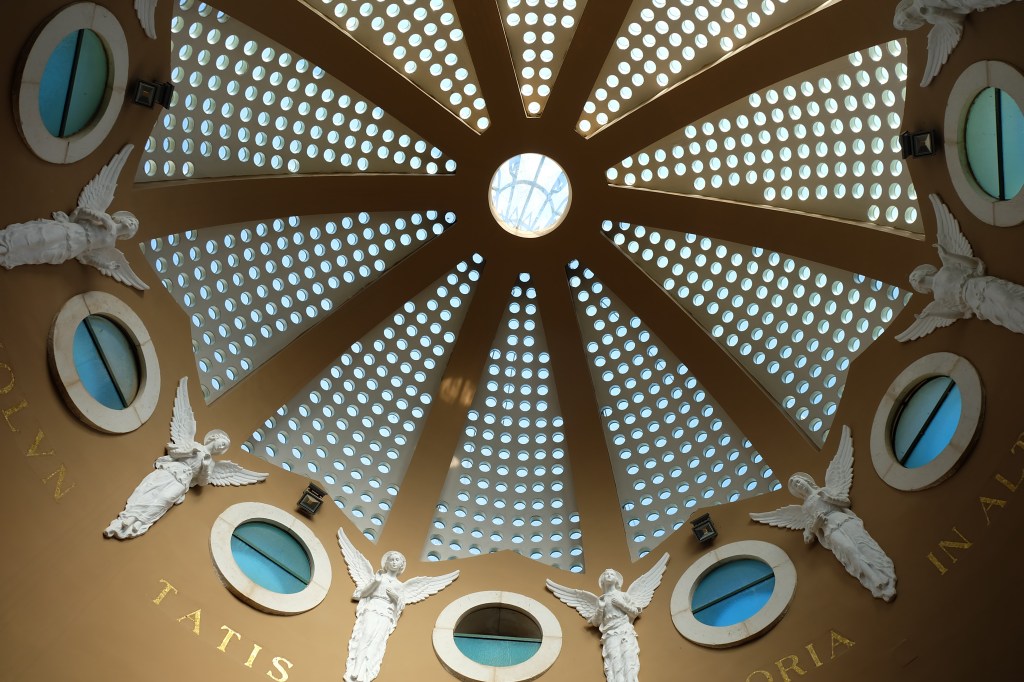
Photo by author, Dome of the Chapel of Nativity at Shepherd’s Field, Bethlehem, the Holy Land, May 2019.

Jesus continues his lessons to us his disciples being sent to look for the “lost sheep of Israel”, to be not afraid for he is with us in this journey and mission. But, it is not enough that we have Jesus on our side and be present among us: we have to allow Jesus to take possession of us completely!

From having no fear because Jesus is here, Christ now deepens his presence by inviting us to be possessed by him, to be in communion with him.

Jesus said to his disciples: “Whoever loves father and mother more than me is not worthy of me, and whoever loves son or daughter more than me is not worthy of me; and whoever does not take up his cross and follow after me is not worthy of me. Whoever finds his life will lose it, and whoever loses his life for my sake will find it.”

Matthew 10:37-39
Photo by author, processional Cross at the altar, 2019.

The Mystery of the Cross

Discipleship in Jesus Christ is more than a total allegiance to him who is neither a demanding nor exacting Lord and Master for he does not arbitrarily impose himself upon us.

Nothing like that of subservience but something more lofty because it is wrapped in a mystery — a mystery of love freely given and shared to us by God even if we do not deserve it all. Remember the mystery of the Blessed Trinity four Sundays ago (June 07)?

Ever since, God has never imposed himself upon us, that we should love him back in return for he does not really need our love. He gave us the gift of freedom so that we may love him freely for he never imposes on us.

And here lies the beauty of discipleship, of this relationship we have with God that is based solely on love expressed to us in the most personal manner by giving us his Son Jesus Christ who suffered and died on the Cross but rose again on Easter. This we were reminded by the Solemnities of the Body and Blood of Jesus and of his Sacred Heart last June 14 and 19 respectively.

Now you see my dear readers the clearer picture of our liturgical celebrations expressing our concrete experiences of being loved by God in Jesus Christ most especially during times of trials and sufferings like in this COVID-19 pandemic.

It is Christ who made the initiative to be one with us in our pains and sufferings; God did not remove our crosses in life but made them holy in his Son Jesus Christ so that every time we go through life’s many difficulties, we share in the Lord’s Passion, Death, and Resurrection.

That is why, we are invited to take and carry our cross every day for it is through the Cross we are saved. It is not enough to simply believe in the person of Jesus but we need to accept and embrace his Cross because it is through which he had won our salvation by dying on it and rising again.

This is easier said than done. It is so difficult to love Jesus more than our loved ones like family and friends. And it is most difficult to love the Lord more than our selves, when we have to let go of our plans and agenda.

Letting go and letting God in itself is already crucifying — but that is when this mystery of Christ’s love and of his Cross deepens further when we lose ourselves in him!

Celebrating Mass without te congregation during the ECQ, March-April 2020.

Possessed by Christ

To be possessed by Jesus is to receive God and his gift of salvation through the mystery of Christ and his Cross. Like our Christian life, proclaiming the gospel carries with it the sign of the Cross of Christ.

We are not asked to reenact or reproduce his Crucifixion nor is Jesus asking us to be suicidal or go against our natural aspirations and dreams.

To be possessed by Jesus means we continue to take care of ourselves without neglecting the needs of others.

To be possessed by Jesus means being generous to others in the same manner Jesus has always been generous to us.

To be possessed by Jesus means to realize that every act of self-giving is really an act of receiving!

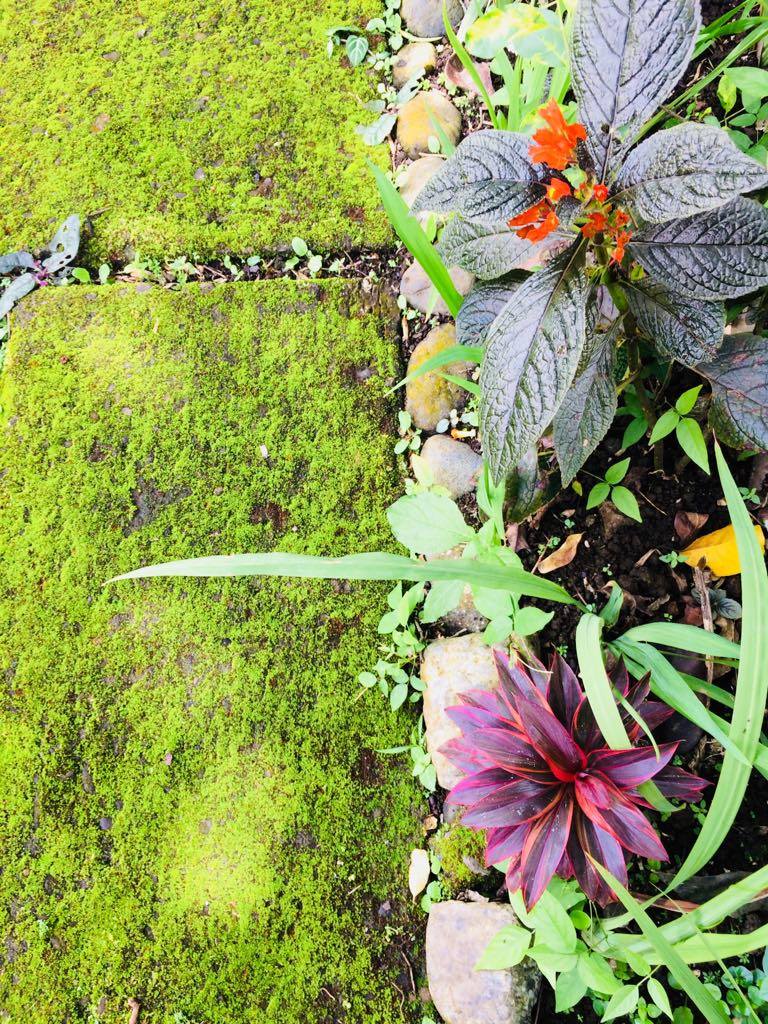
Photo by author, Malagos Park, Davao City, 2018.

That is the paradox of the Cross, of discipleship in Christ: “Whoever finds his life will lose it, and whoever loses his life for my sake will find it” (Mt.10:40).

And that is also where the mystery of Christ’s love deepens because whatever we give is not really ours but Christ’s.

Every time we give love, it is the love of Jesus.

When we are kind and generous with others, it is the kindness and generosity of Jesus we give and share.

When we are patient and understanding to others, it is still the patience and understanding of Jesus in us.

Even if we give and share material things like money, food, clothing… whatever good we share and give are all from Jesus not from us.

And the more we give, the more we receive!

Have you noticed especially during this pandemic how the generous among us are now more blessed?

Wonder no more because you have allowed yourself to be possessed by Jesus Christ!

This is what the woman at Shumen had realized after welcoming the Prophet Elisha into her home in our first reading. She even gave him a room to stay every time he comes for his mission while the Lord provided all her needs, even rewarded her with a son as promised by Elisha.

When we allow Jesus to take over us, when we enter into communion in him and with him in his very life, we become more free to love, we strengthen our relationships with others, we wander less and worry less in life; most of all, we feel lightened in our burdens with the presence of Jesus giving us fullness of life in him.

This is the grace I hope we have seen from this quarantine period, especially those two months of lockdown when were freed from our usual grind and busyness with more time to be silent and still, to pray and reflect on our relationships with God and with others. It was a difficult and very trying period that had given in return a lot of opportunities to others.

Photo by author, Marcos Highway, 2019.

Dead to sin, alive to God

Brothers and sisters: We know that Christ, raised from the dead, dies no more; death no longer has power over him. As to his death, he died to sin once and for all; as to his life, he lives for God. Consequently, you too must think of yourselves as dead to sin and living for God in Christ Jesus.

Romans 6:9-11

It has been four months since houses of worship were ordered closed to help stop the spread of the corona virus. Somehow, the lockdown had made us realize the importance of receiving the Sacraments especially the Holy Eucharist.

But, sacraments are not everything for we have the bigger roles of putting into practice its reality of being the saving presence of Jesus Christ.

Now that lowly life is beginning to go back to its usual grind especially the traffic, soon we might forget again the more important things in life like God and our relationships in our family and friends that it is hoped we have rediscovered during the quarantine period.

That is why I strongly feel the government must now allow Churches to open so the people may experience again God in the sacraments and in our rites and rituals lest they get busy again with so many things only to miss finding anew the meaning of our lives found in silence and stillness before the Cross of Christ.

It is my hope that in this quarantine period, may we find through the Cross of Jesus that when we learn to submit and surrender to him, that is when we truly become free; and, when we lose and give away our lives to him, that is when we gain fullness of life in him. Amen.

A blessed week and a more abundant July to everyone!

Every birthday is a small Christmas

The Lord Is My Chef Breakfast Recipe for the Soul by Fr. Nicanor F. Lalog II
Wednesday, Solemnity of the Birth of John the Baptist, 24 June 2020
Isaiah 49:1-6 ><)))*> Acts of the Apostle 13:22-26 ><)))*> Luke 1:57-66, 80
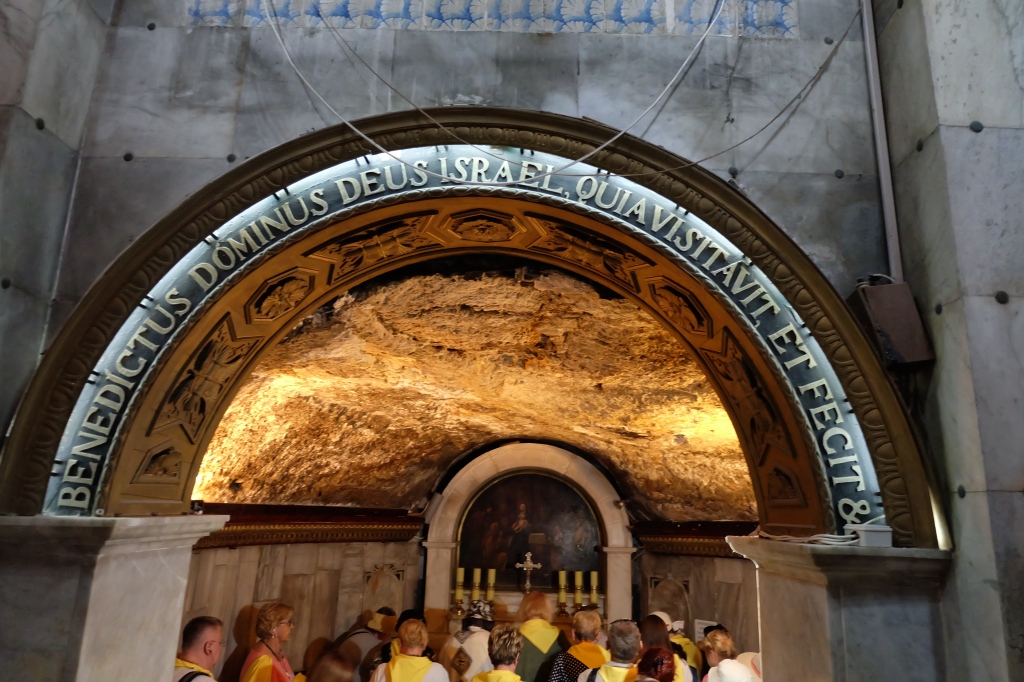
Photo by author, chapel beneath the Church of St. John the Baptist in Eim Karen, birthplace of our saint.

Every birthday is a small Christmas because with the birth of every person comes Jesus Christ.

St. John Paul II, “Evangelium Vitae” (1995)

Thank you very much, O God our loving Father for the gift of sharing in your life, for the grace of being alive. As we celebrate today the birth of the your Son’s precursor, St. John the Baptist, we remember with joy our own birthdays, our giftedness, your graciousness.

Birthday is always special because of the gift of life, and the gift of direction and purpose that everybody looks forward into the future, of what is in store for us here on earth like in the birth of St. John the Baptist.

All who heard these things took them to heart, saying, “What, then, will this child be?” For surely the hand of the Lord was with him.

Luke 1:66

With the coming of St. John the Baptist, you have taught us Lord that in life, what we must look forward to is to be one with your Son Jesus Christ.

May our lives be like of John, a precursor of Jesus, always pointing people to Jesus, leading people to him who is the Christ who takes away the sins of the world.

Photo by author, marker at Eim Karen, 2019.

Teach us to be strong in spirit, always creating a space for silence and hiddenness where we can meet you often, Lord, so that at the end of our life journey, you remain our reward like the prophets of old.

Though I thought I had toiled in vain, and for nothing, uselessly, spent my strength, yet my reward is with the Lord, my recompense is with my God.

Isaiah 49:4

That is the meaning of John – grace of God and graciousness of God.

It is a grace for us all to be alive, to share Jesus with others, to be a glimpse of himself and of his truth and kindness.

But, ultimately, your greatest grace for us all is to share in the Cross of Christ like John the Baptist for that is only when people realize you have come indeed in us. Amen.

Life after life after life

Quiet Storm by Fr. Nicanor F. Lalog II, 17 June 2020

Today is my mother’s 81st birthday and my father’s 20th year of death.

Since June 17, 2000, we have “stopped” celebrating my mother’s birthday as she ordered that date to be remembered more as my father’s birth into heaven.

So many things have happened in our lives as a family, most especially with me as a man and a priest being the eldest.

Yes, I always dread this date, feeling at a loss until now at how to behave or what to say when I come home. There is always a “drama” we have to go through when we get together, with a lot of “dead air” moments during Mass and later at the dinner table.

Though somehow they have lessened in these past 20 years, the sadness is still there.

I thought time heals.

True.

But the pain remains. And the more it gets painful.

Lalong bumabaon, as we say.

With her apos when still able to move freely; Sunday after Mass was always at my father’s gravesite.

Since her 61st birthday, Mamu as she preferred to be called when the apos came, she had “stopped” living because my dad was really her life. We believe her sorrow contributed to her stroke in December 2004.

Growing up until I have become a priest, I have always seen my father preparing coffee and breakfast daily for her. She had in fact forgotten how to cook or learn new dishes because my father was a superb cook — that is why we all have gout in the family.

Most of all, as I would always tell my students before, since childhood until I have become a priest, dad never ate his meals without Mamu at his side or at least to personally tell him to eat because she had gone to a party or some prayer meeting.

Every Sunday after my Masses in a nearby town, I would visit my father’s grave and surely find fresh flowers and candles earlier placed by my mom and sister’s family.

After praying and blessing his gravesite, I would talk to him, telling him, “Dad, there are 365 days in a year. Why did you die on June 17, 2000?”

It took my father more than a year before answering my question.

Yes, he spoke to me in his usual deep, whispering voice I heard from within as I looked down on his grave, “Nick, I died on your mother’s birthday so you would love her more like I have loved her.”

Tears swelled in my eyes and eventually rolled down my cheeks that I almost watered the grass on his gravesite!

It was a very tall order that until now, I really do not know if I have fulfilled.

Mothers are like God

God cannot be everywhere that is why He created mothers.

Jewish saying

Every Thursday I come home to visit Mamu on my day off, as well as during special occasions and gatherings like birthdays of my siblings and pamangkins.

Sometimes I ask myself if I have loved my mom that much as my dad had wanted me to.

This comes strongest to me when going to a sick mother in my parish to anoint with Holy Oil or when presiding at a funeral Mass of a deceased mother; I would listen intently to the “thank you speech” of a son or a daughter and marvel at how great his/her love for the deceased parent.

As a priest, I have always been with so many mothers but not so much with my own mom. But one thing I have experienced since my father died on my mother’s birthday 20 years ago is the life that continues to flow from her very self and presence which flows unto me and spills even up to my parish and community.

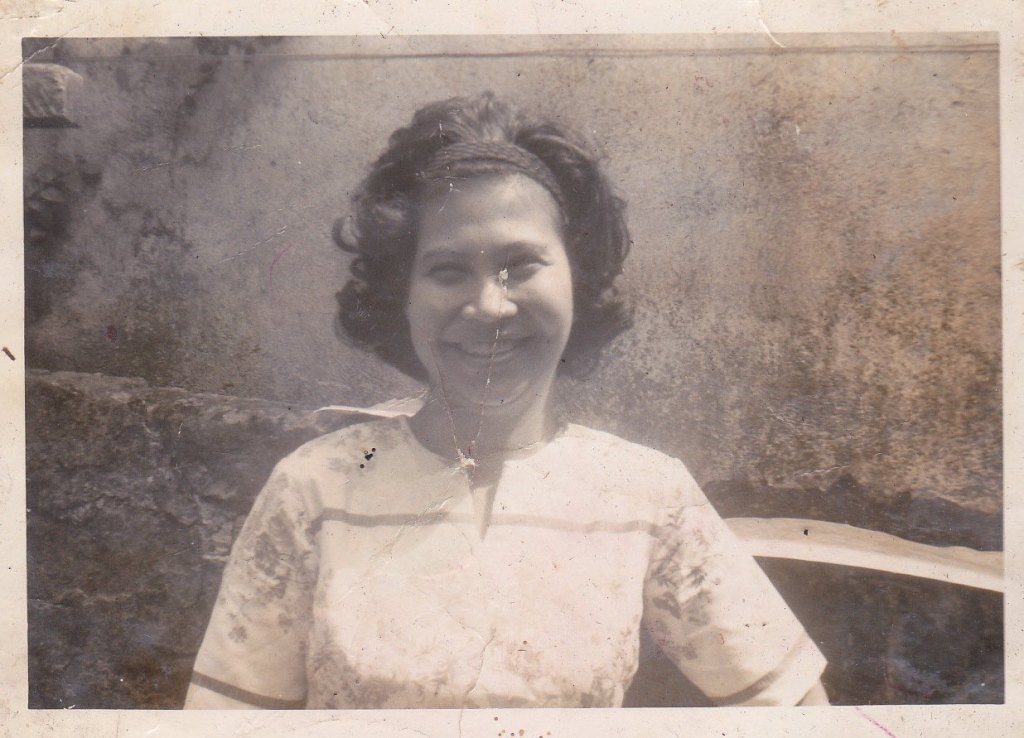
My mom as a teenager.

She’s from the “old school” who had taught me a lot about sacrifices, of keeping things in order like telling me after lunch that while resting, I should mop the floor and dust off the jalousies of our windows downstairs. Resting meant doing something worthwhile like removing cobwebs at ceilings; so, you can just imagine what is housecleaning for her!

Another thing I have learned from her is harimunan wherein you try to save little amounts of money with things you may forego like instead of taking tricycle, I walked for three kilometers or instead of buying soda, drink from the water fountain at school.

The only lesson that I have refused to learn from her which I now admit I should have taken into heart is the art of bargaining or asking “tawad” in the “palengke” (market). It is a gift from God I think reserved for mothers.

One important lesson I have learned from Mamu came via a picture I have found in a copy of a Reader’s Digest. I was five years old then while scanning the new copy of my dad’s magazine, I saw the picture of a baby crying so hard after being delivered.

I asked her why the baby was crying and her explanation had stuck into my mind since then that later as a priest I realized it so existentially true! According to her, when a baby is born crying, that means she/he is alive; if the baby does not cry, that means she/he is dead.

So simple yet so deep.

When we cry, we are alive.

And sometimes, to be alive, we have to cry. A lot.

And I believe that is why mothers continue to give life to us despite the passing away of their husband because they are the ones who cry a lot.

Mothers cry in silence, alone because they are the ones who can truly feel the flowing of life, the slipping away of life.

In a few hours I will be coming home and I could already visualize and feel my mother’s crying on her birthday.

As much as possible I hold my tears, praying that in God’s time, we would just be the ones crying so that finally, Mamu would no longer be crying.

But, that’s another thing I dread so very much…I hope not yet that soon because I really do not know how life will be for me and my siblings.

Thank God for all the Mothers who have given and nurtured our lives even in old age.

Thank God for their tears of love and joy for us.

Why are you here?

The Lord Is My Chef Breakfast Recipe for the Soul by Fr. Nicanor F. Lalog II
Friday, Week X in Ordinary Time, Year II, 12 June 2020
1 Kings 19:9, 11-16 ><)))*> ><)))*> ><)))*> ><)))*> Matthew 5:27-32
Photo by author, sunrise at Camp John Hay, Baguio City, November 2018.

At the mountain of the God, Horeb, Elijah came to a cave, where he took shelter… After the fire, there was a tiny whispering sound. When he heard this, Elijah hid his face in his cloak and went and stood at the entrance of the cave. A voice said to him, “Elijah, why are you here?” He replied, “I have been most zealous for the Lord , the God of hosts. But the children of Israel have forsaken your covenant, torn down your altars, and put your prophets to the sword. I alone am left, and they seek to take my life.”

1 Kings 19:9, 12b-14

The rainy season has started, Lord, and we have covered almost half of the year, making it through more than two months of quarantine period and here we are, before you… tired and exhausted, a bit lost, and frankly, your question to Elijah echoes within, stirring our inmost being.

Why are you here?

It is both a mystery and a gift why we are here.

Some of us have lost family and friends these past six months, some to the dreaded disease of COVID-19. Many of us have lost money and time due to the pandemic. This early, 2020 is practically gone for many of us.

Many of us are just awaiting for you, to your tiny voice to tell us what is next.

That is why we are here, Lord.

Like Elijah, we await your coming.

Unlike before when we await dates and occasions, now, we await you, O God for you alone are sure and guaranteed in coming.

Photo from NCCA.

On this day, Lord, we also celebrate our Independence Day that has become more of a festivity than a reality. Forgive us for wasting, for throwing away our country to undeserving people who have all been puppets of foreign powers with same personal interests.

Yet, one reason why we are here is also because we believe we can change our country for the best.

Help us, O God, by cleansing our hearts, purifying our desires and motivations so that we may be more faithful to you.

And that is why we are here, like Elijah.

Awaiting for you.

Please do come quickly!

Marana tha!

Amen.

Tensions lead to life and joy

The Lord Is My Chef Breakfast Recipe for the Soul, Friday, Easter Week-VI, 22 May 2020

Acts of the Apostles 18:9-18 <*(((>< + 0 + ><)))*> John 16:20-23

Photo by Ms. Ria De Vera, Sunrise along Halili Ave. in front of our Parish, 21 May 2020.

Your words today, dear Jesus, are very mysterious, so difficult to understand but so delightful to dwell on, or chew — as St. Ignatius of Loyola reminded us in his “Spiritual Exercises”.

There are many tensions present in your words today, Lord.

And that is where I have found you — in the many tensions that come into our lives!

So often, we find the word “tensions” so negative as they lead to wars and troubles of all sorts. But in deeper reflection, tensions are like frictions that without them, we can never experience life at its fullest.

The beauty of every sunrise and sunset is due to the tensions between light and darkness.

Tensions often occur between good things, never between good and evil. Tensions help us purify our intentions, clarify our priorities because tensions lead us to deeper discernment of your plans and will for us.

In the first reading, there was the tension among St. Paul and the Jews about your good news of salvation. The division resulted into more conversions and baptisms that made Corinth so dear to St. Paul.

Photo by author, altar of our Parish at sunrise, 2019.

But what is most beautiful about tensions is found in the gospel, of how joy is borne out of pain and sufferings like a woman in the pangs of childbirth:

Jesus said to his disciples: “Amen, amen, I say to you, you will weep and mourn, while the world rejoices; you will grieve, but your grief will become joy. When a woman is in labor, she is in anguish because her hour has arrived; but when she had given birth to a child, she no longer remembers the pain because of her joy that a child has been born into the world. so you also are now in anguish. But I will see you again, and your hearts will rejoice, and no one will take your joy away from you.”

John 16:20-22

Lord Jesus Christ, there are so many tensions in our lives these days since the start of quarantine period due to the pandemic.

Help us first identify the tensions in our lives these days.

Some of these tensions are between the need for us to pray more and immerse ourselves with those in need; the tension of going out to help and staying indoor to plan for our actions.

Send us your Holy Spirit, Jesus, to enlighten our minds and our hearts so we may identify the tensions we encounter that lead to life and joy in you. Amen.