The Lord Is My Chef Breakfast Recipe for the Soul by Fr. Nicanor F. Lalog II
Monday, Week XXIX, Year II in Ordinary Time, 19 October 2020
Ephesians 2:1-10     >><)))*>   +   <*(((><<     Luke 12:13-21
Photo by Mr. Jim Marpa, 2018.
As we begin our work this Monday, guide us O God our Father to discover anew this great gift of life in you. May we see ourselves the way you see us – beloved and forgiven children made in your own image and likeness — your handiwork as St. Paul beautifully expressed!
For by grace you have been saved through faith, and this is not from you; it is the gift of God; it is not from works, so no one may boast. For we are his handiwork, created in Christ Jesus for good works that God has prepared in advance, that we should live in them.
Ephesians 2:8-10
Let us value this unique blessing from you, dear Lord; in your power and supremacy, you could have just let us vanished and be forgotten. Yet, you chose to redeem us in your Son Jesus Christ, giving us countless opportunities to rise again, to bloom, and to be healed.
Make our hearts whole in you, undivided in pride, complacency and selfishness unlike that man in the parable whom we imitate most often, busy storing treasures for ourselves that we forget real wealth is found in what matters to you our God (Lk. 12:21).
Wake us up from this insanity of amassing too much of everything, not realizing that in the process, the more we have, the more we are actually empty and lost because all these things perish.
Only you, O God, suffices. Make us aspire and desire more of you so your glory and majesty may be seen in us. Amen.
The Lord Is My Chef Breakfast Recipe for the Soul by Fr. Nicanor F. Lalog II
Tuesday, Feast of Archangels St. Michael, St. Gabriel, and St. Raphael, 29 September 2020
Daniel 7:9-10, 13-14     >><)))*>   +   >><)))*>   +   >><)))*>     John 1:47-51
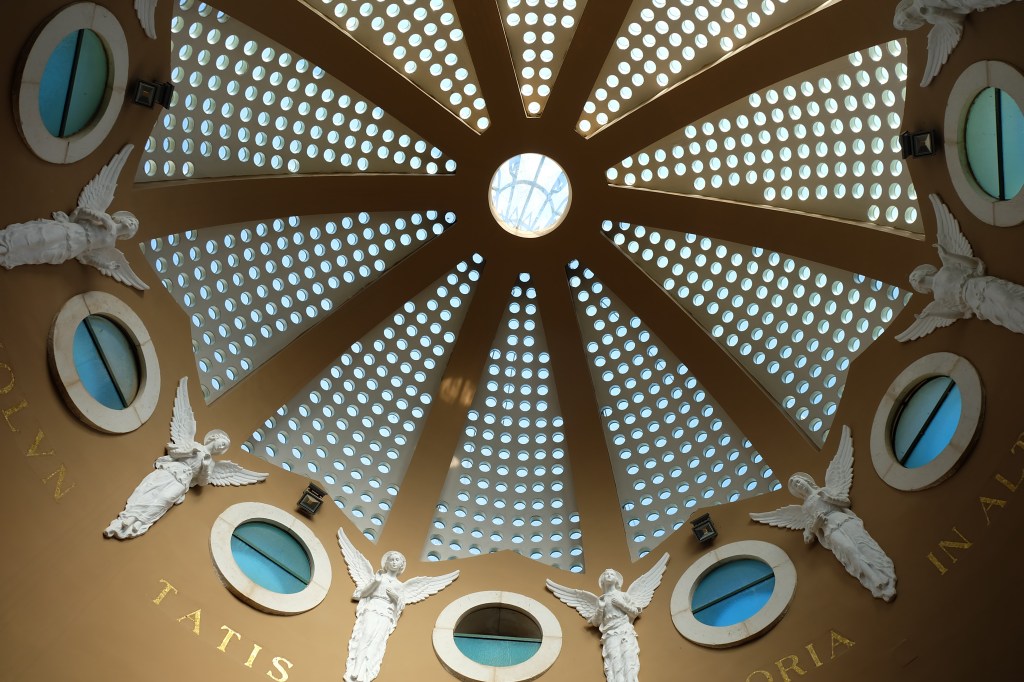
Photo by author, dome of the chapel at Shepherds’ Field in Bethlehem, the Holy Land, May 2019.
Thank you Lord Jesus Christ for opening the heaven for us to be in the presence of God the Father anew and most especially, to become like him again in his image and likeness.
As we celebrate today the Feast of your Archangels Michael, Gabriel and Raphael, we remember God’s original plan for us to be with him like his angels and Archangels, of being like him not to compete but to reflect his image and likeness.
And so today, we pray that we may have the grace to be like St. Michael whose name means “who is like unto God?” that we may be like God not to compete with him but to be holy and merciful like him, fighting evil and sins with justice and truth.
Make us strong, Lord Jesus, like St. Gabriel whose name means “God is my strength” so we may deliver always your good news of salvation to the world now numb to bad news of wars and murders, injustice and inhumanity, poverty and starvation as well as the excesses of the first world with more than half the world starving and barely surviving with bare essentials.
Lastly, we beg you Lord in this time of the pandemic to grant us the gift of healing for those sick not only with COVID-19 but with other sickness. May St. Raphael who name means “God has healed” come and guide us in this journey like he did to Tobias, providing him the medications to heal not only bodily sickness but also emotional and spiritual maladies.
These we present to God our Father through you our Lord Jesus Christ. Amen.
The Lord Is My Chef Sunday Recipe for the Soul, Week VII-A, 23 February 2020
Leviticus 19:1-2, 17-18 ><)))*> 1 Corinthians 3:16-23 ><)))*> Matthew 5:38-48
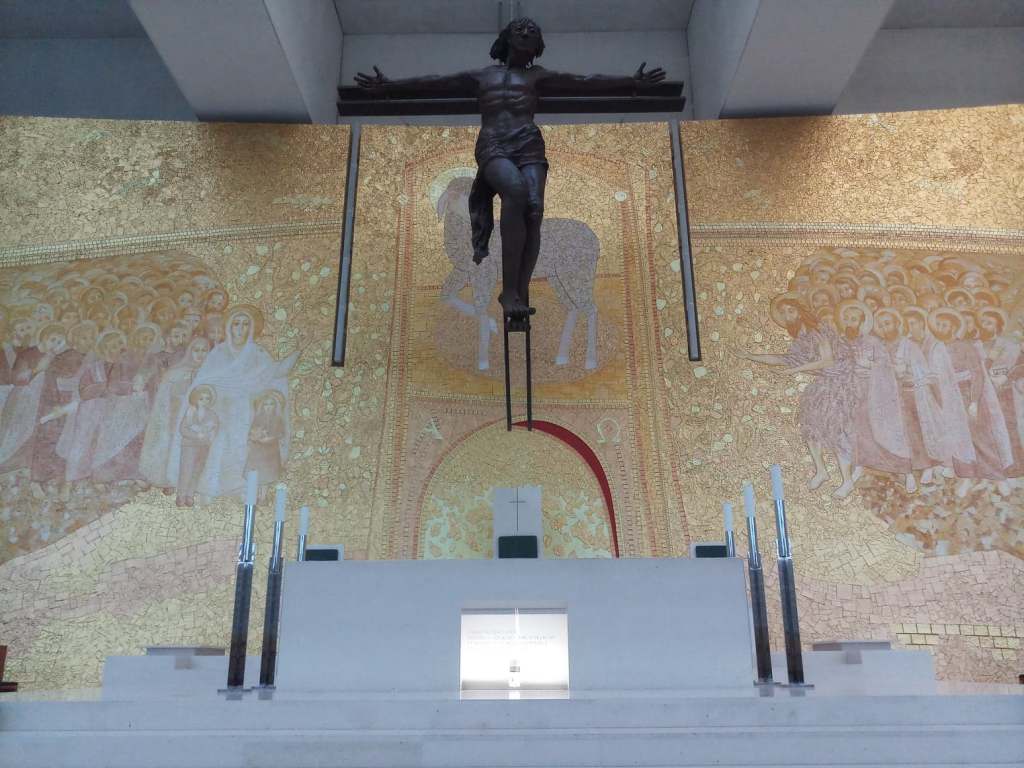
Altar of the modern Minor Basilica of the Holy Trinity at Fatima, Portugal. Photo by Arch. Philip Santiago, 2017.
Jesus concludes his Sermon on the Mount this Sunday just in time for the start of Lent this coming Ash Wednesday. He taught us last Sunday that righteousness is not only measured by acts but most of all by the purity of the heart’s intentions that we call “education of the heart”.
Today Christ comes to the demands of charity and love, the fullness of the Laws in himself.
Jesus said to his disciples: “You have heard that it was said, An eye for an eye and a tooth for a tooth. But I say to you, offer no resistance to one who is evil. When someone strikes you on your right cheek, turn the other one as well… You have heard that it was said, You shall love your neighbor and hate your enemy. But I say to you, love your enemies, and pray for those who persecute you, that you may be children of your heavenly Father..”
Matthew 5:38-39, 43-45
See again the Lord’s pattern in his preaching like last Sunday: a recall of the laws to show his adherence to them contrary to claims of his enemies, and then his infusion of his teaching that perfects the laws: “You have heard… But I say to you…”
Jesus focuses only on two laws today, that of revenge or “lex talionis” (from Latin talio for the word such) and that of hate for enemy which needs some clarifications.
Nowhere do we find in the Laws of Israel “to love your neighbor and hate your enemy”. Experts say Jesus must be citing a popular saying of his time in this part of his teaching. Besides, the Aramiac spoken by the Lord does not connote the harsh meaning we have today for the word “hate”. In short, Jesus is correcting here the norm among Jews of his time to “just love those who love us”.
This is why he adds this beautiful explanation with the most unique conclusion of all.
“For if you love those who love you, what recompense will you have? Do not the tax collectors do the same? And if you greet your brothers only, what is unusual about that? Do not the pagans do the same? So be perfect, just as your heavenly Father is perfect.”
Matthew 5:46-48
Photo by Lorenzo Atienza, 12 June 2019, Malolos Cathedral.
A fraternity of humanity in the Father
Here we find a beautiful dimension of Jesus Christ’s assertion last week that he had come to fulfill the Laws: more than having a broader approach to the spirit of the laws, education of the heart leads us to see everyone as a brother and a sister.
No one is different. Every one is a family – a kin! which is the root of the word “kind”.
Being kind is more than being good as we say in Filipino, mabait or mabuti.
Being kind is treating the other person as a kin, a relative or family; someone who is not different from us. When we say “he is kind to me”, it means more than being good to me but treating me as a family, a brother or a sister – not as “another” or “iba sa akin” as we say in Filipino.
Photo by author, Mt. St. Paul, Baguio City, 03 February 2020.
This is the essence of our “Year of Inter-religious Dialogue, Ecumenism, and Indigenous Peoples” in preparation next year of our 500 years of Christianity in the country.
Everybody is included in that celebration as we reach out to peoples of other faith and beliefs as well as to the indigenous peoples whose forefathers were actually the first settlers of the country.
This is very important in any dialogue and relationship and partnerships including marriage: there must always be the acceptance of everyone in equal footing with same dignity as a person. It is from here we start that fullness of the Laws in Christ in love.
Human holiness as a reflection of God’s holiness in love
Love can only happen where there is equality and fairness. Love demands we are first of all at equal footing with each other. This is why Jesus became human like us: the Son of God became human to stand on equal footing with us that we cannot argue that he is greater because he is truly human, too, going through everything we have gone through except sin.
When he said that we offer our other cheek, to give our cloak, and go for another mile, he is not referring to criminal or penal codes but more into our humanity, that spirit of universal brotherhood so that even our oppressors and enemies come to realize within them that we are one, that we should be caring for one another, not hating and hurting each other.
Loving our enemies does not mean we let evil continue; loving our enemies means continuing to “love” perpetrators of evils until they realize we are brothers and sisters, keeping each other, caring for each other.
Loving our enemies is making them realize that there are nobody else here on earth for them except us – why fight and perish?
Yes, these are easier said than done. And admittedly, I must confess it is the most difficult part of the gospel, of being a Christ-ian. But it is something Jesus is asking us in the most personal manner.
From Google.
Let it be clear that Jesus is not asking us to behave with naiveté that we give in to injustice, evil, and violence but that we always be peacemakers, the blessed ones he said in his Beatitudes. In our fight for justice and peace, we fight with the moral persuasions of love which is the morality of Christ.
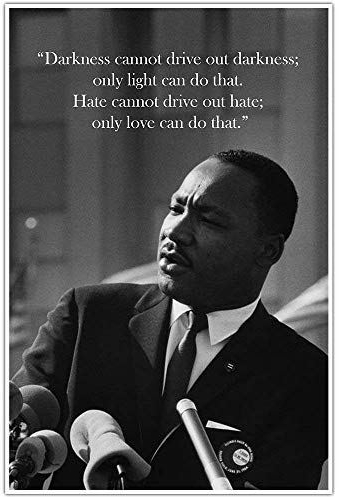
The American civil rights leader Rev. Martin Luther King, Jr. had shown in our modern time that the Lord’s teachings are doable: we just have to be convinced and must truly believe in Jesus.
“Love is the most durable power in the world. This creative force is the most potent instrument available in mankind’s quest for peace and security.”
Rev. Martin Luther King, Jr.
When we love truly in Jesus Christ, asserting what is true, what good, what is just, we make God truly present in the world. When that happens, the more we allow him to do his works of changing us within, of transforming us within. It is in our imperfect love that we make God present, the perfect I Am.
The Lord said to Moses, “Speak to the whole Israelite community and tell them: Be holy, for I, the Lord your God, am holy. Take no revenge and cherish no grudge against your people. You shall love your neighbor as yourself. I am the Lord.”
Leviticus 19:1-2, 18
Photo by Dra. Mai B. Dela Peña, Santorini in Greece, 2016.
Hubris, our greatest temptation and sin
The Season of Lent is fast approaching us, set to start with Ash Wednesday this week. It is a season characterized by barrenness: no Gloria and Alleluias, no flowers, no decorations, no images to make us turn back to God again, our Lord and Master alone.
St. Paul reminds us today in our second reading that we are “God’s temple… that there is no need to boast of anyone including one’s self” (1Cor. 3:16, 21). Instead of embracing or holding on to anyone including one’s self, we have to embrace the scandal of the cross of Christ, that is, power in weakness, wisdom in what the world considers folly.
For the ancient Greeks as depicted in their epics, the greatest temptation and sin of man is hubris – the arrogant presumption that he is god, that he can do everything, he can have everything that he defies the gods.
Hubris is the sin of pride that has led everyone from Adam and Eve to all the powerful men and women of history into their downfall. It is absolute power crumbling absolutely, always tragically.
In his Sermon on the Mount where we heard many of the Lord’s teachings this whole month of February, Jesus shows us the path away from hubris, his path of love and holiness in the Father. Let us heed his calls, give his teachings a try and a chance to be fulfilled in us.
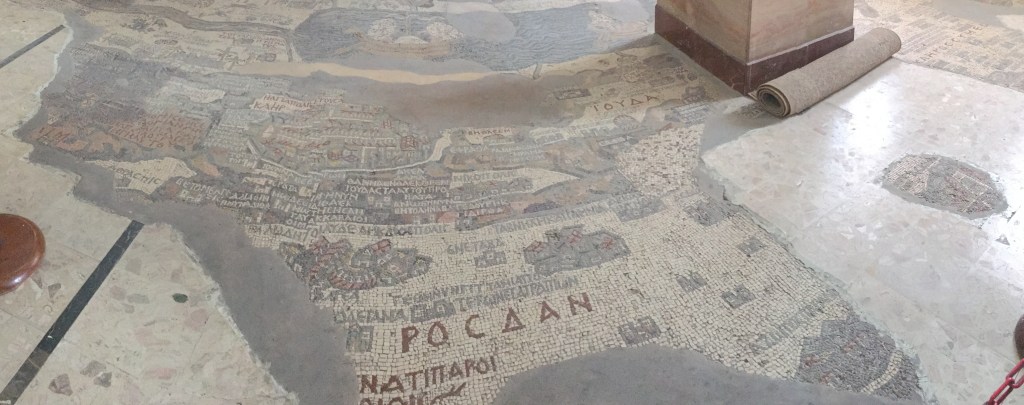
Madaba Mosaic Map on the floor of the Byzantine church of St. George in Madaba, Jordan dating back to 560 AD, one of the oldest maps of the Holy Land discovered in late 19th century. Photo by author, 02 May 2019.
Your readings for today, Lord Jesus, remind me of that wonderful experience you gave us to see so many beautiful mosaics in your Holy Land. Some are very old, some are new. But they are all so lovely not only for our sight to behold but also for our hearts to reflect and cherish.
It was only then when I realized in the production of a mosaic that each stone represents every one of us who has rough edges cut into a tiny piece then glued together to form one big picture by highlighting each one’s smooth and shiny surface.
Just one shiny, smooth surface needed to complete a beautiful picture.
Just one good character or trait of us, never mind our rough and uneven edges and sides, to portray your beauty, your majesty, your glory.
Thank you, Lord, for looking more on our beautiful side like in a mosaic.
Thank you for washing us of our sins so we may be smoother and shinier.
Thank you for that long story of salvation Paul summarized in the first reading at how you patiently waited in time to fix everything until you came to save us. It is the same kind of patience and love you must have put on each of us to be a part of your big picture, Lord.
May we always see the bigger picture of you among us who are tiny pieces of little stones with many rough sides with just one good side needed to portray you. May we keep in our minds and our hearts that “no slave is greater than his master nor any messenger greater than the one who sent him” (Jn.13:16) so we may always focus on the brighter and smoother side of us and of life to reflect you more. Amen.
The Madaba Mosaic Factory in Jordan employs disabled persons with a large part of its earnings supporting other disadvantaged people in the area. Photo by the author, 02 May 2019.







 lordmychef.com