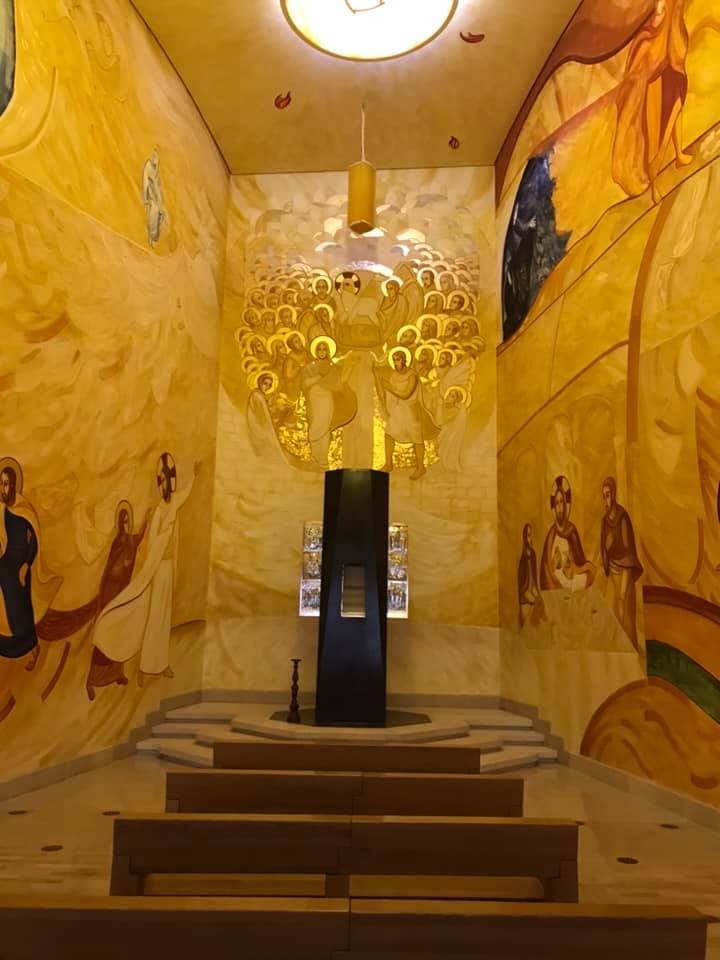
Blessed Sacrament Chapel of the Sanctuary of San Pietro Pietrelcina-Nuovo Chiesa in Italy. Photo by Rev. Fr. Gerry Pascual, February 2019.
“Brothers and sisters: As you received Christ Jesus the Lord, walk in him, rooted in him and built upon him and established in the faith as you were taught, abounding in thanksgiving. You were buried with him in baptism, in which you were also raised with him through faith in the power of God, who raised him from the dead… he brought you to life along with him.”
Colossians 2:6, 12, 13b
Praise and glory to you, our Lord Jesus Christ! Thank you for dying with us in our sins, forgiving us and raising us to new life in you in the sacrament of baptism!
Let us be immersed in you, Lord Jesus.
Let us claim our new life in you by walking with you who is our Way and Truth and Life.
To be immersed in you, O Christ, is to be free and faithful to lovingly serve you with all our mind, heart and soul. Being immersed in you is letting go of our pains and hurts in the past to start anew in you. To be immersed in you, O Christ, is to see more the goodness within each one of us because of you, the most holy one.
May we heed the call of St. Paul today not to be swayed by false beliefs and other philosophies not rooted in you, claiming elemental and dark powers here on earth.
You alone are the sovereign power here on earth and the entire universe, Lord Jesus.
And the good news is that through baptism, you have made us share in your “cosmic victory” of the Resurrection. More than a rite of initiation, our baptism is a sharing in your great power here on earth to conquer evil with good.
Let us be your modern “apostles” — an apostolein, someone sent ahead of you, someone with special relationship with you, someone truly immersed in you, very personal with you, Lord Jesus, who reign forever and ever. Amen.
The Lord Is My Chef Sunday Recipe, Wk. XVII-C, 28 July 2019
Genesis 18:20-32 >< }}}*> Colossians 2:12-14 >< }}}*> Luke 11:1-13
I have always loved this photo by Ms. Jaileen Jimeno or “JJ”, a former colleague at GMA-7 News. JJ told me how on the evening of May 28 she dropped by the Adoration Chapel of the UP Parish of the Holy Sacrifice for a very special intention when she was stunned by this sight of the “headless man” praying in one of the pews. Always a journalist, JJ took this shot with her camera phone and after praying, posted it on her FB with the caption, “losing one’s head in prayer.” I have not talked with her since then but perhaps, her special intention that evening must have been heard by God because her photo itself is essentially a prayer too!
This is what prayer is all about – losing one’s self in God.
Jesus was praying in a certain place, and when he had finished, one of his disciples said to him, “Lord, teach us to pray just as John taught his disciples.”
Luke 11:1
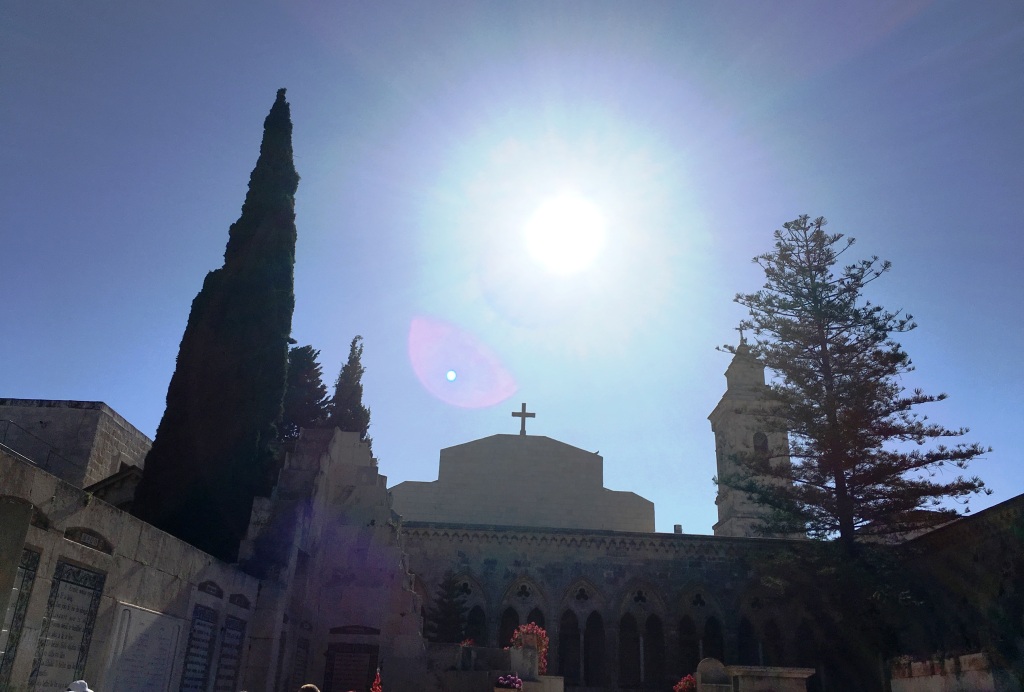
The Our Father Church outside Jerusalem where Jesus taught his disciples to pray the Our Father, 04 May 2019.
This is the third Sunday in a series of “things to do to gain eternal life” following that conversation by Jesus with a scholar of the law on his way to Jerusalem when he taught us to “love God and love others” by showing compassion to the suffering like the Good Samaritan. Last Sunday during his stopover at the home of Martha and Mary, he taught us that the more we are busy, the more we must pray; and the more we pray, the more we realize of the need to be active. This Sunday, Jesus deepens this lesson about prayer which is also the more essential – “the better part” – as he told Martha that we must do to gain eternal life.
For St. Luke, this episode of Jesus teaching his disciples the Our Father is more than the teaching of a prayer to recite but the attitude itself they must possess in praying.
Of the four evangelists, St. Luke is the one who always present to us Jesus at prayer like at this scene today. Unlike with St. Matthew’s version when Jesus taught the Our Father during his sermon on the mount so that his disciples would know what to pray for instead of multiplying words like the Pharisees and scribes at that time, St. Luke set this teaching in the context of the Lord at prayer to teach us how to pray.
He said to them, “When you pray, say: Father, hallowed be your name, your kingdom come. Give us each day our daily bread and forgive us our sins for we ourselves forgive everyone in debt to us, and do not subject us to the final test.”
Luke 11:2-4
Jesus came to make known to everyone God is our Father whose name we must always revere and never take in vain. By dying on the Cross, he revealed the glory of the Father who loves us so much that “he gave us his only Son so that we may not perish but gain eternal life”.
This is the first lesson of the Our Father. By teaching us the Lord’s Prayer, Jesus involves us in his own prayer to form our inner being to be like him in total obedience to the Father so that his kingdom may come. Remember the acronym ACTS in praying: “A” for adoration, “C” for confession of sins, “T” for thanksgiving, and “S” for supplications. So often, we only pray the “S” that we no longer merely ask but even demand from God so many things without even praising and thanking him for all his kindness, without realizing how we have turned out to be gods and the Lord our servant!
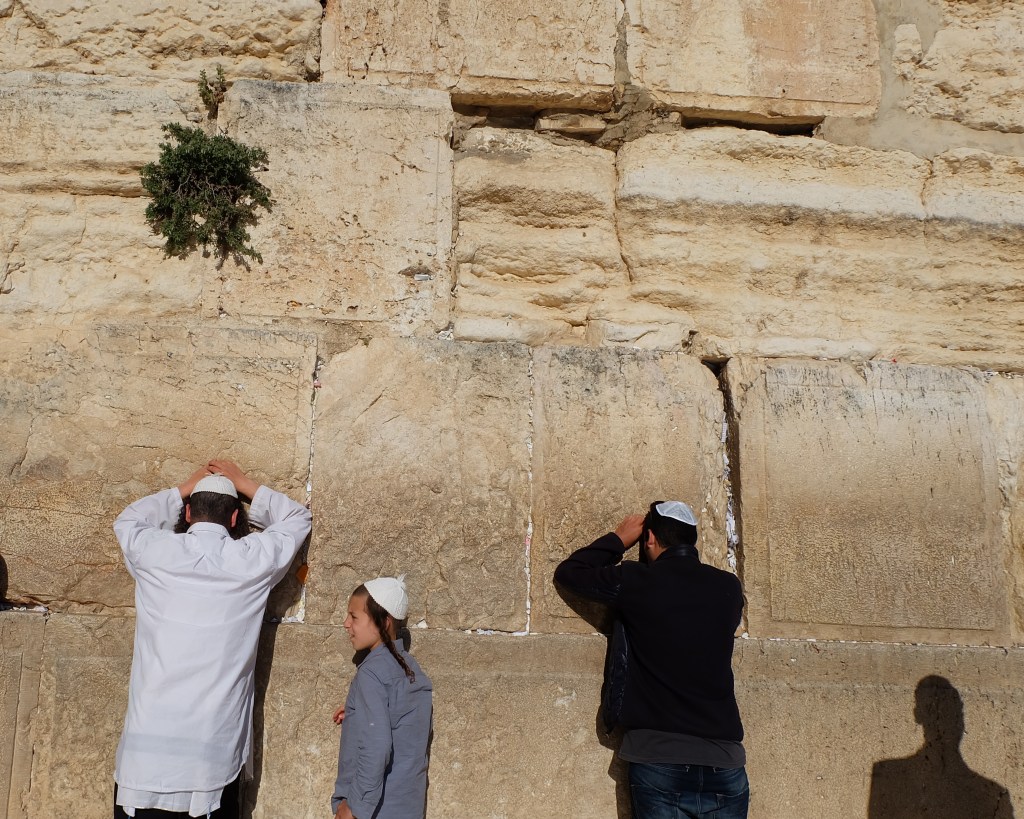
Wailing Wall of Jerusalem, May 2019.
“And I tell you, ask and you will receive; seek and you will find; knock and the door will be opened to you. For everyone who asks, receives; and the one who seeks, finds; and to the one who knocks, the door will be opened. What father among you would hand his son a snake when he asks for a fish? Or hand him a scorpion when he asks for an egg? If you then, are wicked, know how to give good gifts to your children, how much more will the Father in heaven give the Holy Spirit to those who ask him?”
Luke 11:9-13
Another unique feature of St. Luke’s version of the teaching of the Lord’s prayer is the parable that follows about an insistent neighbor asking for bread followed by a series of valuable sayings about prayer. Contrary to common interpretations, Jesus is not telling us to ask God for anything we want like money and gadgets. Prayer is essentially asking for God. It is God whom we must desire in prayer because when we have God, we have everything!
In St. Luke’s second book, the Acts of the Apostles, we find the Holy Spirit animating the early Church as a community as well as every individual. Every decision, every plan, and every prayer is always powered and guided by the Holy Spirit. When Jesus told his disciples to ask, to seek, and to knock, he was referring to always pray for the Holy Spirit for we really do not know how to pray. It is the Holy Spirit who enables us to speak rightly to God for things we need to tell him.
See how the two basic prayers we have, the Our Father and the Hail Mary are actually the words of God, not by men. The Our Father is by Jesus Christ himself that is why we call it the Lord’s prayer. The Hail Mary are the words of God through Archangel Gabriel when he greeted Mary to deliver the good news she would be the Mother of Christ. Even its second part are also the words of God when the Holy Spirit filled Elizabeth to praise Mary and the fruit of her womb, Jesus!
We need to ask for the Holy Spirit so that we can truly pray and enter that wonderful dialogue with God. When we pray like Jesus Christ in the Holy Spirit, we realize what God wants from us and we are able to respond properly as he gives us the necessary grace to accomplish them. Praying like Jesus is entering a dialogue with God, searching him and acting on his words.
Deacons prostrating before God in earnest prayer before their ordination.
That dialogue between God and Abraham at Mamre before the destruction of Sodom and Gomorrah in our first reading shows us that prayer helps us discern good and evil. Abraham did not bargain with God to save Sodom and Gomorrah for the sake of up to at least ten good people. In fact, only two good people remained there, Abraham’s nephew Lot and his wife who eventually perished after disobeying the angels’ instructions. What really matters in that episode is how Abraham recognized not only the good people but most of all, the prevailing evil at Sodom and Gomorrah.
Chapel of the Assumption Sabbath in Baguio, January 2019.
When we pray like Jesus, we also realize our giftedness of being saved from sin, of being “buried with him in baptism and brought to life along with him” (Col. 2:12,13) and thus becoming children of God. As children of the Father and brothers and sisters of Christ, prayer is where we enter into that deep relationship with God, learning his plans for us and how we can accomplish them by staying out of sin.
The example of Abraham and the teaching of Jesus show us that prayer is not a flight from the realities of this life and of this world. Far from being an escape, real prayer brings us closer to life, to following Christ our Savior for the glory of the Father by bringing his kingdom in this imperfect world marred by sins.
When we pray like Jesus, we get in touch with our true selves as well as with the many pains and hurts we share with others in this life journey, making us realize that we cannot do it alone. And more than the love and support we can get from our family and friends, there is God who loves us so much, giving himself to us to make it through eternal life. Have a blessed Sunday! Amen.
Photo by Lorenzo Atienza, Malolos Cathedral, 12 June 2019.
Please forgive me for my curiosity: lately I have noticed the sudden sprouting of many “breastfeeding stations” and “lactation sections” in many public places that I feel so tempted getting inside them just to see how the mothers would react.
One of the joys of prayer is how God would communicate with us even with the most crazy ideas we have like that thought of entering a breastfeeding station. I recalled this thought as I dwelt deeply into Isaiah’s prophecy in our first reading today presenting God like a mother comforting her children the Israelites who were exiled to Babylon.
It was one of the lowest points in the history of the Jewish people when they lost everything – family and friends, country and nation, and most of all, their Temple in Jerusalem that they felt they were forsaken by God. As exiles, they were slaves without any freedom at all.
Thus says the Lord: “Rejoice with Jerusalem and be glad because of her, all you who love her, exult, exult with her, all you who were mourning over her! Oh, that you may suck fully of the milk of her comfort, that you may nurse with delight at her abundant breasts! As nurslings, you shall be carried in her arms, and fondled in her lap; as a mother comforts her child, so will I comfort you; in Jerusalem you shall find your comfort.”
Isaiah 66:10-11, 12b-13
Sometimes, God allows us to experience several blows and beatings in life not because he punishes us or he takes delight in seeing us suffer; sometimes, we need to be like infants and children again to trust God more, to rely to his goodness. It is the surest way to remind us who we really are. That we are not god.
In our second reading, St. Paul bolstered this imagery of our being children of God by reminding us that the only bragging rights we have as disciples of Jesus is to be one with him in his Cross.
Brothers and sisters: May I never boast except in the cross of our Lord Jesus christ, through which the world has been crucified to me, and I to the world.
As children of the Father and disciples of Jesus, our mark of distinction is not found in our greatness, achievements and success but in our being weak, in our being wounded and bruised, always needing the comfort by God like a mother to her children. This is very clear with St. Paul not only in our second reading today but most especially in his second letter to the Corinthians:
“I will rather boast most gladly of my weaknesses, in order that the power of Christ may dwell in me. Therefore, I am content with weaknesses, insults, hardships, persecutions, and constraints, for the sake of Christ; for when I am weak, then I am strong.”
2 Corinthians 12:9-10
It is in our weakness when God is most manifested.
Try listening to anyone bragging about his or her achievements and talents: for a time, we get impressed, we admire them but in the long run, it becomes both convulsing and convoluting. But when we come to learn or hear the sacrifices and sufferings of people even those we do not personally know, we feel uplifted. We remember God and his goodness, his mercy and love.
Crucifix at the side wall of the chapel of St. John Evangelist at Cana, Galilee. Photo by author, 06 May 2019.
Only the disciples of Christ who join him in his Cross can be filled with the gift of peace, the only possession of every disciple. See how how when Jesus sent out the 72 other disciples, he asked them not to bring anything at all. The only thing they must have is the peace of Jesus Christ that they have to share with everyone they visit.
“Go on your way; behold, I am sending you like lambs among wolves. Carry no money bag, no sack, no sandals; and greet no one along the way. Into whatever house you enter, first say, ‘Peace to this household.'”
Luke 10:3-5
Remember that when Jesus visited his Apostles in the locked upper room on the evening of Easter Sunday, he also greeted them with “peace” or “shalom” which is God’s greatest gift to anyone. Shalom in Hebrew means having a good relationship with one’s self, with others, and with God. Peace is always borne out of love and only those willing to sacrifice, suffer and even die for someone are the ones who truly love.
Mt. St. Paul Retreat House, June 2017.
There can be no peace in our hearts when we are filled with pride and ego. We need to be like children again, relying solely in the powers of our parents.
Last Thursday we brought our niece to her doctor at UST Hospital. While waiting for my sister when she left to get the lab results, I saw my niece feeling sleepy. I asked her to sleep on my lap as I gently rubbed her shoulder until she fell asleep soundly and peacefully.
What an attitude of not being bothered by her sickness because she must have great trust in me her uncle, my sister her mom, and also her doctor!
When we embrace our crosses in life and rely solely in Christ, we can also experience peace within. That is when we can rejoice as Jesus assured us, “your names are written in heaven” (Lk. 10:20).
A blessed week ahead to everyone! Jesus loves you, entrust to him all your worries and woes. Amen.
The picturesque Siq leading to Petra in Jordan. Photo by author 30 April 2019.
Every day, Lord God, you give us the wonderful gift of making choices, of deciding for ourselves to choose what is best for us. Unfortunately, we always forget the very essence of making every choice which is to always choose what is good, what is the best.
Very often, we make the wrong choices in life because we fail to consider in choosing you first, the highest good, the summum bonum.
Like Lot in the first reading, we are easily misled by beautiful sights, of abundance, of having everything as bases in choosing what is best for us.
We always forget that saying “not all that glitters is gold” as Lot would eventually found out later how sinful were the people living in those areas he had chosen where the cities of Sodom and Gomorrah thrived.
Teach us to be like Abraham, to always trust in your wisdom, in your plans, and in your providence.
Teach us to choose you first of all above all.
And choosing you, Lord, means choosing the path of sacrifice and of giving of self.
Jesus said to his disciples: “Enter through the narrow gate; for the gate is wide and the road broad that leads to destruction, and those who enter through it are many. How narrow the gate and constricted the road that leads to life. And those who find it are few.”
Matthew 7:13-14
Bless, O Lord, those who have to make important decisions today, those discerning your will. Enlighten their minds and their hearts to choose you only and to stand firm on that choice. Amen.
The narrow door leading to the Nativity Church in Bethlehem that reminds us of the need to be small, to be humble to truly meet Jesus Christ. Photo by author, 04 May 2019.
The Lord Is My Chef Breakfast Recipe, Holy Tuesday, 16 April 2019
Isaiah 49:1-6///John 13:21-33, 36-38
At the Wailing Wall of Jerusalem, April 2017. Photo by author.
As we come closer to your Paschal Triduum O Lord Jesus Christ, I try to probe deeper into myself to examine where are in you in my life? There were so many times I have not been faithful to you. There were so many times I wavered, almost gave up following you because nothing seemed to happen.
Who really fills me, you O Lord or the enemy?
So many times I have wallowed into so many complaints and excuses, always doubting if you are really with me, if you have truly called me. Like Peter, I just say so many things, asking you many questions without really understanding and knowing anything at all especially your very words. Worst, there are times I feel like Judas sharing in your sacred meal and yet betraying you when I sin because I have allowed evil to take over me.
Give me the grace to be like you as the faithful, suffering Servant of God so certain and so trusting of the Divine call and mission:
The Lord called me from birth, from my mother’s womb he gave me my name. He made me a sharp-edged sword and concealed me in the shadow of his arm. He made me a polished arrow, in his quiver he hid me. Though I thought I had toiled in vain, and for nothing, uselessly, spent my strength, yet my reward is with the Lord, my recompense is with my God.
Isaiah 49:1-2, 4
Lord Jesus Christ, reign in my heart, fill me with your humility, justice, and love. Amen.
The Lord Is My Chef Sunday Recipe, Palm Sunday of the Lord’s Passion, Year C, 14 April 2019
Isaiah 50:4-7///Philippians 2:6-11///Luke 22:1-49
Photo from Bing.com.
Today we begin the Holy Week with two celebrations merged into one, Palm Sunday of the Lord’s Passion. The Palm Sunday is a tradition started by the early Christians in Jerusalem in the fourth century while in Rome during the 12th century, the Pope proclaimed the long gospel account of the Lord’s Passion on this Sunday to signal the start of Holy Week. Almost 2000 years later in reforming the liturgy, Vatican II merged these two traditions into one to usher in our holiest days of the year.
Like in the four Sundays of Lent except last week, St. Luke guides us today in reflecting the Lord’s Passion with emphasis on the Cross with its call to conversion. For St. Luke, the cross is the object of discipleship in Christ. Join me in reflecting on the last three words our evangelist had recorded when Jesus was crucified.
First word:
When they came to the place called the Skull, they crucified him and the criminals there, one on his right, the other to his left. Then Jesus said, “Father, forgive them, they know not what they do.”
Luke 23:33-34
Mosaic of the Crucifixion at the crypt of the Manila Cathedral. Photo by Arch. Philip Santiago, October of the Jubilee of Mercy 2016.
This is very striking. Immediately upon his crucifixion, Jesus prayed for the forgiveness of his enemies! It is a total adherence to his preaching during his sermon on the plain, “love your enemies, do good to those who hate you, bless those who curse you, pray for those who mistreat you” (Lk. 6:27-28, Seventh Week Ordinary Time, 24 February 2019). Here we find the immense love and mercy of Jesus — no hatred, no calls for revenge or threats like “karma” against those who crucified him. He simply begged for their forgiveness because “they know not what they do.”
In Jewish thought, to know means more than an intellectual knowledge for it implies relationship. Knowing somebody for them is more than knowing one’s name but having ties with the person. And to know something is always to see things in this perspective, always in relation with a person. Had they known Jesus is the Christ, they would have not crucified him! Exactly the preaching of St. Peter at the healing of a lame man after Pentecost at the temple when he told them they have “acted in ignorance” in “killing the Author of life whom God raised from the dead” (Acts 3:15). St. Luke also notes in his Acts of the Apostles how the crowd upon hearing St. Peter’s preaching were moved or “cut to the heart” (2:37) that many were baptized on that day. Recall also how at the arrival of the wise men from the East searching for the child Jesus: the scholars of Jerusalem “knew” from the books how the Christ would be born in Behtlehem yet he was found by the pagan magis! Even the most learned man in the New Testament, St. Paul admits how ignorant he had been in persecuting and blaspheming Jesus before (1Tim.1:13) experiencing God’s loving mercy.
In the bible we always see this combination of knowing and ignorance at the same time to indicate that more than factual and cerebral knowledge, there is that deeper knowing of relating and of loving. If we really know somebody, the more we love, the lesser we sin. St. Thomas Aquinas used to say that the more we know and become intelligent, the more we realize the truth, the more we must become good and holy. That is why saints are the most intelligent people that they were able to do what is good and what is right.
In this age of Google and Wikipedia , Jesus is challenging us that if we truly know so much that we have become smart and more intelligent, then, how much do we really love and care for others?
Photo from Google.
Second word:
Then he said, “Jesus, remember me when you come into your kingdom.” He replied to him, “Amen, I say to you, today you shall be with me in Paradise.”
Luke 23:42-43
The Venerable Archbishop Fulton Sheen used to claim that Dimas was indeed a great thief who was able to steal or snatch Paradise from Jesus just before dying on the Cross. It may be funny but very true. But more than “stealing” his salvation from the Lord, Dimas had displayed on the cross what we have discussed earlier about the combination of knowing and ignorance. I would say Dimas is perhaps the “most learned thief” of all time who truly knew what is most essential in life which is to know Jesus. The moment he called out to him “Jesus”, Dimas expressed his knowing Jesus, of belonging to Jesus. As we have reflected earlier, to know is to relate. Anyone who truly relates must first believe in order to love dearly. Dimas believed in Jesus that he called out to him while hanging on the Cross.
Today, Jesus is reminding us that the door to Paradise is him alone. And we begin to enter Paradise the moment we entrust our total self to Jesus like Dimas who came to know Christ at the Cross, and then believed him and loved him. If we really know, do we believe?
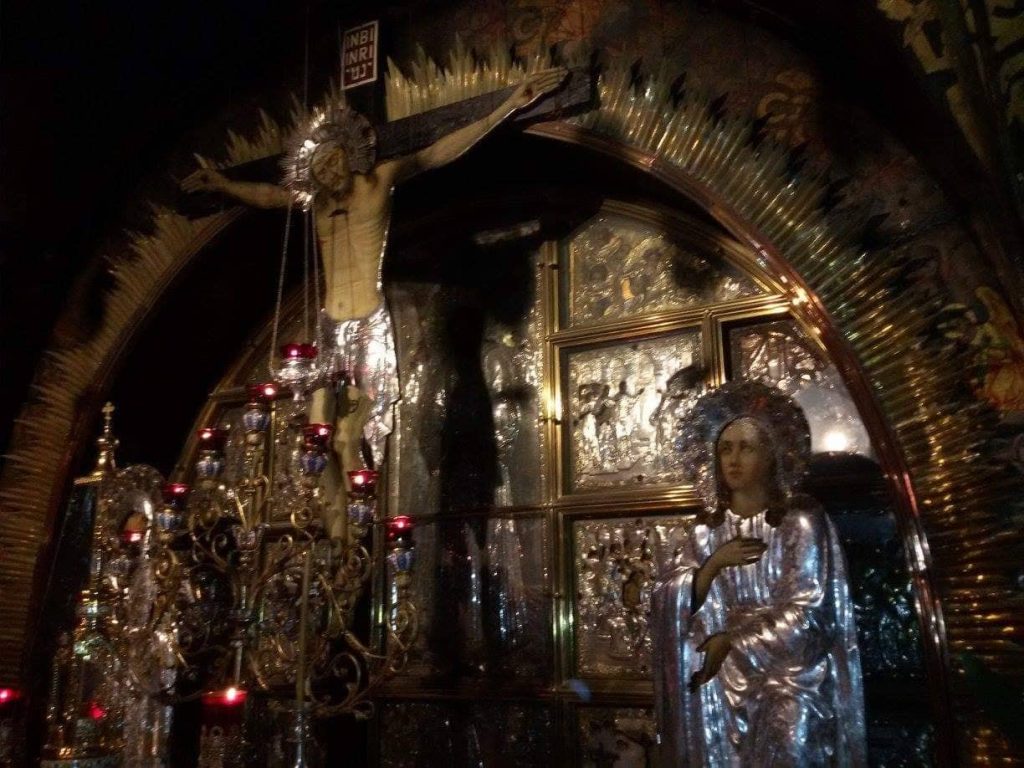
Altar of the Church of the Holy Sepulchre over the exact site where Jesus was crucified outside Jerusalem. Photo by Arch. Philip Santiago, October 2017.
Third word:
Jesus cried out in a loud voice, “Father, into your hands I commend my spirit,” and when he had said this he breathed his last.
Luke 23:46
One of St. Luke’s unique feature is always presenting to us Jesus at prayer. Especially here at his crucifixion. See how his first words were prayer of forgiveness for his persecutors. Now at his death, St. Luke presents Jesus again at prayer, reciting Psalm 31:5, “Father, into your hands I commend my spirit.”
Here we find the whole picture of Jesus Christ’s life which is a prayer and his prayer is his very life. From the very start, Jesus has always been one with the Father which is the essence of every prayer called communion. And that is the important aspect of his being our Savior: everything he said and did was everything the Father had told and asked him. There is that perfect communion of the Father and the Son in the Holy Spirit so that in his death, Jesus offered his total self with us to God. Everyone and everything is thus sanctified anew in Christ. This became possible only with his kenosis, his self-emptying eloquently expressed to the Philippians by St. Paul in our second reading.
On the Cross, everything in the life of Jesus Christ came to a full circle, God’s whole picture emerged. Now more than ever, we have become closest to God in love. In his dying on the Cross, Jesus made known to us God, brought him closest to us so we can relate and be intimate with him more than ever. In his becoming human like us by bearing all the pains and sufferings expressed in the first reading from Isaiah, God proved to us his love in Jesus. Most of all, he enabled us too to be capable of knowing and loving like Jesus Christ by being intimate with him always. This is why these days are called Holy Week when we are filled with God so we experience him anew and have him more than ever in our hearts, in our very selves. Amen.
A view from the inside of the Church of the Beatitudes overlooking the Lake of Galilee in the Holy Land. Photo by the author, April 2017.
The Lord Is My Chef Sunday Recipe, 03 March 2019, Week VIII, Year-C 1Samuel 26:2, 7-9, 12-13, 22-23///1Corinthians 15:45-49///Luke 6:27-38
For the past two Sundays we have been listening to some of Christ’s most sublime teachings filled with paradoxes that may sound like a folly for us humans because they all run contrary to the ways of the world. Beginning with His Beatitudes, Jesus taught that true blessedness comes from being poor and hungry, when we are weeping and being maligned. More difficult yet most sublime of all were His teachings last Sunday when He told us to love our enemies and do good to those who hate us, bless those who curse us, and pray for those who mistreat us.
They are very, very difficult but doable in Christ Jesus who have taken all these lessons directly from life. He knows very well how capable is our hearts in truly loving like Him.
And so today, Jesus turns His attention to us His disciples who shall act as guides in putting into practice all His teachings through the education of our hearts. It is in our hearts where all the good and evils around us originate from. All the problems and sufferings we have in the world today like wars and various forms of violence, hunger and sexual exploitation, human trafficking and all kinds of injustice first happen right in our hearts. Not in Syria or Jolo or the slums of Tondo or any other city in the world. Jesus perfectly hit it right when He said, “A good person out of the store of goodness in his heart produces good, but an evil person out of a store of evil produces evil; for from the fullness of the heart the mouth speaks” (Lk.6:45).
In the first reading we find the same line of thinking during the Old Testament when Ben Sirach wrote, “When a sieve is shaken, the husks appear; so do one’s faults when he speaks. As the test of what the potter molds is in the furnace, so in tribulation is the test of the just. The fruit of a tree shows the care it has had; so too does one’s speech disclose the bent of one’s mind. Praise no one before he speaks, for it is then that people are tested” (Sir.27:4-7). Remember that in the Bible, speech and being always go together like when God created everything by simply speaking.
And that is the whole point of Ben Sirach: people reveal who they really are in the manner they speak as well as in the words they use to express their thoughts and feelings that all come from the heart. Of all the creation by God, it is only the human person whom He had gifted with the ability to communicate intelligibly with speech. Our ability to speak is in fact a sharing in the power of God who created everything by simply speaking. But how do we use this great power of speech and communication? Are we like the Spiderman convinced in our hearts that with great power comes great responsibility?
It is elections again in the country and sadly, it is more like a circus than a democratic process. And the great tragedy we keep on repeating again and again is how most people put into office candidates without any qualifications at all and worst, deeply mired in every form of immorality and scandals. Where is our heart that we allow blind people to lead us? Or, have we become heartless that we have no regard anymore for our country, for our future and the next generation?
Jesus is challenging us today to educate our hearts, to learn from Him, to come to Him and be like Him to have our hearts transformed like unto Him. Though we are all weak and have all the defects as a person, our readings today lead us to the Christ who revealed to us that ultimately, “communication is more than the expression of one’s thoughts and feelings but at its most profound level is the giving of self in love” (Communio et Progression, 11). It is the Lord Jesus Christ who had revealed in His very person and life of self-giving the paradoxical joy of discipleship, the transforming power of love gained in His own pasch that removed the sting of sin and of death in our weak humanity. May we persevere in our education of our hearts in Jesus, “firm, steadfast, always fully devoted to the work of the Lord, knowing that in Him our labor is not in vain” (1Cor.15:58). Amen. Have a blessed week!
Fr. Nicanor F. Lalog II, Parokya ng San Juan Apostol at Ebanghelista, Gov. F. Halili Ave., Bagbaguin, Sta. Maria, Bulacan.
Here is the link to one of my favorite songs, “One More Gift” by Jesuit Fr. Manoling Francisco that speaks eloquently of the need to educate our hearts. Sing it prayerfully.
Life, sometimes, is a series of “good news-bad news” situation like the Beatitudes preached by Jesus during His sermon on the plain last week: the blessings are the good news while the woes are the bad news.
But, wait…! Such a view is the way of the world, not of Christ’s disciples!
As we have reflected last Sunday, the Beatitudes are the paradoxical happiness of the disciples of Christ because they all run directly against the ways of the world. Today we hear more paradoxical teachings from Jesus that are actually His “win-win” solution for our many problems like wars and other forms of enmities. Unfortunately, we have never given them a try because we always complain the ways of the Lord as being far from realities of life, impossible to imitate because He is God and we are not.
Today let us set aside all these reservations and arguments to reflect on this new set of paradoxical teachings by the Lord: Jesus said to his disciples: “To you who hear I say, love your enemies.od to those who hate you, bless those who curse, pray for those who mistreat you… But rather, love your enemies and do good to them. Be merciful, just as your Father is merciful. For the measure with which you measure will in turn be measured out to you” (Lk.6:27-28, 35, 36, 38).
It is very striking that Jesus repeated twice His call to “love your enemies”.
Does He not care about us who have to bear with the sins of evil people? What a good news to those who hate us, curse us, and mistreat us! Suwerte sila! We would surely say they must be so lucky, even blessed with us who strive to heed the calls of Jesus to love them our enemies.
But, on deeper reflections, we are actually more blessed when we try to love our enemies because that is when we elevate – or “level up” as kids would say – our hearts to be merciful like God. Experts claim that the best way to exact revenge against people who have hurt us is to shower them with good deeds and kindness from us they have offended. According to these experts in counselling and psychology, evil people get disappointed and angrier with themselves when their evil plots fail especially when their targets do not react negatively. They sound understandable because evil people derive joy in making people miserable. So, why be miserable?
Far from being their “punching bag”, the Lord simply wants us to teach our enemies to respect us, to be kind to us by not being like themselves. In loving our enemies, we teach evil people that more powerful than sin is the power of love. Sin and evil consume a person while love and kindness make a person grow and mature and bloom to fullness.
Far from being passive, to love our enemies by returning evil with good is always the most active method in fighting sins. When Jesus asked us to offer the other side of our cheeks to those who slap our face or when we give them our tunic when they demand our cloak, we are showing these evil people that love is never exhausted unlike evil. Love is boundless and the more we love, the more we have it, the more we keep on doing it. Evil, on the other hand, reaches a saturation point that we get fed up with it, then we we stop doing it because it is exhausting and worst, consumes us within that in the
process destroys us. Think of the most evil person you have known and surely, you find that person so ugly, so zapped of life and energy, eaten up from within by a festering wound. Evil people will never have peace and joy within, glow on their face and skin because they are rotting inside like zombies.
In the first reading we heard how David as a type of Christ foregoing vengeance by holding on to God, trusting Him completely that he chose not to strike King Saul who was then trying to kill him out of jealousy. As disciples of the Lord, we have to trust in the Word of God that can transform our hearts of stone into natural hearts filled with love and mercy like Him. This is the point being explained by St. Paul in the second reading wherein Christ as the “second Adam from heaven” had made us bear the “heavenly image”despite our “earthly image” that is weak and sinful having come from the “first Adam from earth”. Through Baptism, we have been endowed with all the necessary grace from God, transforming us into better persons of heaven.
One of my favorite sayings came from the desk of a friend of mine I used to visit in their office that says “If you have love in your heart, you have been blessed by God; if you have been loved, you have been touched by God.”
See how God has loved us so immensely without measure! Remember that scene two Sundays ago when Jesus borrowed the boat of Simon as He would do with our voice, with our hands, with our total selves? Who are we or what do we really have and own that the almighty God would borrow from us? Nothing! Yet, Jesus comes to us daily with all His love without measure to bless us with everything we need. So, who are we now to love by measuring everything, loving only those who love us, lending only to those who could repay us?
Imagine how astonishingly disproportionate is the love of God with our kind of love. It is in this light must we see the meaning of Christ’s final lesson this Sunday: “For the measure with which you measure will in turn be measured out to you.” So paradoxical and provocative yet so true! This Sunday, may we share God’s love in our hearts with others, especially with our enemies so they may also experience the loving and merciful touch of God. Then we begin to realize too the “win-win” solution of Christ to humanity. Amen.Have a blessed week!Fr. Nicanor F. Lalog II, Parokya ng San Juan Apostol at Ebanghelista, Gov. F. Halili Ave., Bagbaguin, Sta. Maria, Bulacan.
Side garden of the Church of the Beatitudes with the Lake of Galilee at the background. Photo by the author, April 2017.
Buds starting to grow on one of the many Cherry blossoms of Taiwan’s Yangming National Park near Taipei. Photo by the author, 28 January 2019.
The Lord Is My Chef Breakfast Recipe for the Soul
Tuesday, 19 February 2019, Week VI, Year I
Genesis 6:5-8;7:1-5, 10///Mark 8:14-21
Thank you very much Lord Jesus Christ for your patience and fidelity in bearing with my mindlessness and lack of understanding in reading your signs in my life.
So many times, despite your many blessings and very presence in my life, I still don’t get it like your disciples that I can feel as so real, O Lord, your seeming desperation, asking me, “Do you still not understand?” (Mk.8:21)
There are times Lord that my mind wanders far into other concerns like the material “bread” being offered by the world that I easily forget the wondrous signs of far more important things you have been showing me like love and mercy, kindness and compassion.
Cleanse my heart, dear Jesus, especially when all I desire are evil like the people during the time of Noah. Let me be on guard against the leaven and understanding of the world that is fleeting and temporary. Amen.Fr. Nicanor F. Lalog II, Parokya ng San Juan Apostol at Ebanghelista, Gov. F. Halili Ave., Bagbaguin, Sta. Maria, Bulacan.
For the past three weeks we have seen how Luke had been true to his intent of writing in an “orderly sequence” the events in the life of Jesus Christ so we may realize the “certainty of the teachings” handed down to us by the apostles (Lk.1:3-4, Jan. 28). Taking off from the scene at the Nazareth synagogue, Luke showed us how Jesus is the “word who became flesh” when He told the people, “Today this Scripture passage is fulfilled in your hearing” (Lk.4:21). And like those people in the synagogue, we too are so amazed with the words of Jesus but likewise disturbed, even mad when He hits a soft spot within us. That is how Jesus does His mission, always inviting us to listen and act on His word that is fulfilled in the “today” like in the calling of the first four apostles, the brothers Simon and Andrew, James and John. After driving Him out of their synagogue, Jesus went to preach to the crowd who followed Him along the shores of Gennesaret.
While the crowd was pressing in on Jesus and listening to the word of God, he was standing by the Lake of Gennesaret. He saw two boats there alongside the lake; the fishermen had disembarked and were washing their nets. Getting into one of the boats, the one belonging to Simon, he asked him to put out a short distance from the shore. Then he sat down and taught the crowds from the boat (Lk.5:1-3).
What a lovely sight to behold, my dear readers, of Jesus Christ borrowing the boat of Simon to preach to the people. Imagine the Son of God, through whom everything was created, borrowing the boat of Peter? Imagine how that boat of Simon must have looked like. It must be so ordinary and most likely, even with some holes with nothing so outstanding – just like us! Yet, here is the King of kings borrowing that boat from Simon. Luke is showing us here a “parable in action” of how the Gospel is to be preached to all people with no exception. It is a beautiful imagery of the Church gathered around our Lord and Master with Simon – like us – in supporting role. Today, it is the boat of Simon being borrowed but later on, it would be his voice, his total self that Jesus would borrow, very similar with us too.
After he had finished speaking, he said to Simon, “Put out into deep water and lower your nets for a catch.” Simon said in reply, “Master, we have worked hard all night and have caught nothing, but at your command I will lower the nets.” When they had done this, they caught a great number of fish and their nets were tearing. When Simon Peter saw this, he fell at the knees of Jesus and said, “Depart from me, Lord, for I am a sinful man.” Jesus said to Simon, “Do not be afraid; from now on you will be catching men.” When they brought their boats to the shore, they left everything and followed him (Lk.5:4-6,8,10-11).
This is the climax not only of our gospel scene today but also of the whole series these three Sundays that started on a day of rest inside the synagogue of Nazareth when Jesus came to proclaim the word of God. The actualizing power of the word of Jesus Christ fulfilled in every “today” when proclaimed and heard and accepted. See how Simon was filled with fear that he fell into his knees after seeing the bountiful catch after obeying the words of Jesus, “Master, we have worked hard all night and have caught nothing, but at your command I will lower the nets.” Of course, the fish is always in the sea; the key to their great catch was the presence of Jesus Christ. It is the same with our own lives when we work so hard in our jobs or career and in our studies and other pursuits but we are still left empty. But after finding Jesus, we are so overwhelmed with so much blessings not really in material form but something more deeper and lasting. The word of God is His very presence and its effect is always in the here and now, not later. Like the other Sunday, we said it is not enough to enter the church but we enter the person of Jesus Christ. And the moment we enter Jesus, we then become like Simon, filled with His presence that we no longer address Christ as Master or Teacher but also Lord. Like Simon, we also experience a deepening in our recognition and relationship with Jesus: at first, we relate to Him more as a Master and Teacher but later, we realize that He alone is our Lord.
See how by placing the miraculous catch, the call of Simon and his companions, and their response at the beginning, Luke is teaching us the spirit that must guide us in proclaiming and listening to the Gospel Jesus Christ. In these three Sundays, we have seen Jesus Christ as the central figure for He alone is our Master and Lord. He alone is the one calling us all to be fishers of men and to follow Him means to leave everything behind like Simon and company.
Here lies our problem today when we forget Jesus our Master and Lord. So many times we in the Church, especially us priests and those in the hierarchy as well as some laypeople forget Jesus, usurping His Lordship that we speak and act like God. Luke reminds us in this scene at the Gennesaret that we do not replace Christ! In the first place, remember that people come for Jesus in the first place and only Him, always Him whom we must share to everyone. How sad that so often, consciously or unconsciously, some priests create cults around their very selves, we become the standard of everything, we claim everything that people look up to us more than to Christ. Like Simon who would be called as Peter later, our job is to lend our boat and our voice to Jesus and not to replace Him. Like the prophet Isaiah, we are being sent forth by the Lord to bring Him among people, to make Him present among them. As Paul explained also these past three weeks in his first letter to the Corinthians, the Church is the living body of Christ that we all build together. There is the diversity of graces, gifts, and ministries that come from the Holy Spirit to complement each other. Most of all, in proclaiming and listening to the word of God, there must always be love for without it, nothing would have value at all. And that alone proves to us the centrality of Jesus Christ who alone is our Master and Lord, who calls us despite our many defects like Simon. Jesus alone is the one we must love and serve, His very person and not only His call and teachings. A blessed week to you! Amen. Fr. Nicanor F. Lalog II, Parokya ng San Juan Apostol at Ebanghelista, Gov. F. Halili Ave., Bagbaguin, Sta. Maria, Bulacan.








 lordmychef.com