A more decisive 2026 in Christ

Lord My Chef Sunday Recipe for the Soul by Fr. Nicanor F. Lalog II
Feast of the Baptism of the Lord, Cycle A, 11 January 2026
Isaiah 42:1-4, 6-7 ><}}}}*> Acts 10:34-38 ><}}}}*> Matthew 3:13-17
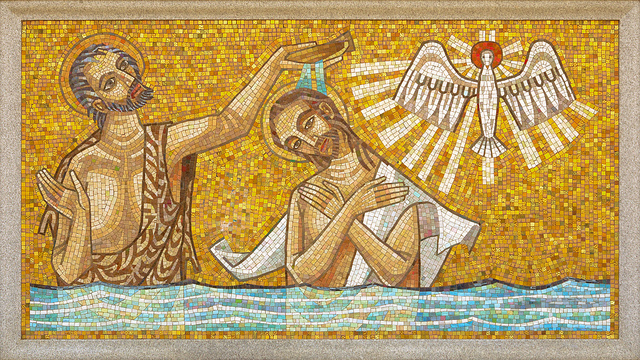
Mosaic of the Lord’s Baptism by John at the Neonian Baptistery, Ravenna, Italy; from wikimedia commons.

Still, our greeting today is a blessed Merry Christmas until the last Mass tonight when we close the Christmas Season with this Feast of the Lord’s Baptism. Tomorrow we shift into the Ordinary Time with the green motif back in our liturgy.

Most often during this time of the year, many of us make “new year’s resolutions” that always end up unfulfilled, discarded, and forgotten because these are merely based on whims or fads or anything less than a matured decision. A decision is the making up of the mind and heart to act firmly on something; hence, it connotes a sense of determination in fulfilling that decision made.

In this Feast of the Lord’s Baptism, Jesus invites us to reflect our decision-making process as we embark on another journey of twelve months in him with Matthew as our guide so we can be more matured in our faith and as a person.

Jesus came from Galilee to John at the Jordan to be baptized by him. John tried to prevent him, saying, “I need to be baptized by you, and yet you are coming to me?” Jesus said to him in reply, “Allow it now, for thus, it is fitting for us to fulfill all righteousness.” Then he allowed him (Matthew 3:13-15).
From wikimedia.org.

See the brief and direct reportage by Matthew of the event that immediately followed his story last Sunday of the Lord’s Epiphany to the world represented by the wise men from the East as we meet Jesus today all grown up, so matured as a man in his decisions.

And what do we find so remarkable in his decision-making process we can all emulate? His obedience to the Father!

All throughout his ministry, Jesus always made known to everyone that whatever he said and did were not his but the Father’s will. From his coming here at the first Christmas until his death on the Cross, it was all about Christ’s obedience to the Father. In fact, there was no need for him to be baptized by John for it was a baptism of repentance because Jesus is sinless, being the Son of God. Yet, he decided to be baptized “to fulfill all righteousness” as planned by the Father. In a similar manner, see John’s obedience too to Jesus and the Father when he could had insisted not to do it because Jesus is the Christ.

Photo by author, 2025.

Fulfillment of every aspiration and mission in this life becomes difficult when we insist on what we know or what we prefer rather than what God wills for us.

Obedience is one virtue that is vanishing in this modern age so characterized by everyone wanting to be in control of everything, of one’s life and even of others expressed in those handheld gadgets as well as cars and other vehicles. See how everyone would want to “drive” one’s own life, totally disregarding those in authority especially God.

The word obedience is from two Latin words “ob audire” that literally means “to listen attentively”.

One cannot be obedient without first learning to listen that begins with our willingness to to be silent. Jesus is obedient because he always listens to the Father through frequent and long periods of prayers. Even the Blessed Mother as we reflected last January first exemplified the virtue of obedience when she listened intently and treasured in her heart the words spoken by the shepherds who came to adore the new-born Jesus in Bethlehem.

It would be nice this 2026 that we start cultivating a prayer life by embracing silence to listen attentively to God’s plans for us so that we could make the right decisions in life.

The opposite of “ob audire” in Latin is “absurdus” – exactly what we are when we make the wrong decisions and become absurd.

And sorry, that’s how we can describe this year’s Traslacion – absurd. In fact, every year, it becomes more absurd than ever and something drastic even radical has to be done in the real sense of the word, that is, by going back to its very roots.

When the devotees refused to obey the priests to stop at the San Sebastian Church and insisted on bringing the Poon Nazareno to Quiapo regardless of its many safety and practical implications, it was a clear case of misplaced devotion. It is fanaticism. Selfish and un-Christian. Despite the many defenses and theologizing by many, it is about time Nazareno devotees examine themselves about this devotion, of their panata that admittedly have been so baffling that if our faith in God is such intense, why are we still electing corrupt and evil officials?

Obedience is always a virtue because everything that is good follows when we are obedient, like being more loving at its truest sense. Whenever we decide out of obedience to God and parents and superiors, it is most often because of love.

Photo by Ryan Jacob, Paco, Obando, Bulacan, 2023.

This is the second characteristic of Jesus Christ’s decision-making process that is based on his love for the Father expressed in his love for us.

Again, there was no need for Jesus Christ to be baptized by John in the river Jordan because he is sinless but, he chose to be baptized there as a sign of his solidarity, of his oneness with us sinners and weak people. It was all because of love. 

Jesus chose to be baptized even there was no need because he loves us and wants to be one with us. Jesus chose to die on the Cross, as depicted in the Black Nazarene of Quiapo, because he loves us and wants to carry our burdens.  Jesus chose to be eaten as bread in the Holy Mass all because he loves us too so that we may have eternal life.

When Jesus went down to Jordan river, out of obedience and most of all out of love for all of us, he became one with us in our pains and hurts and sickness and failures and even sins which St. Peter realized personally that he declared after Pentecost that “God shows no partiality” (Acts 10:34) that we are all loved by God and are called to be obedient to him always by loving one another as he loves us. That is our mission, to love and be like Jesus Christ, the “Suffering Servant” who was “sent to bring forth justice… to open the eyes of the blind, to bring out prisoners from confinement, and from the dungeon, those who live in darkness” (Is.42:1,6-7).

Photo by Mr. Boy Cabrido, January 2024.

In going down into the dirty waters of Jordan River that signifies this earth, this life, Jesus showed us his mission of redeeming us so that we can become like him, God’s beloved child with whom he is well pleased. Every morning when we wake up, this scene at Jordan happens anew. The choice is ours to make by being like Jesus Christ who throughout his earthly life was a total obedience and yes to God because of love.

Last week I went to Baguio to facilitate a retreat with some of my kababata or teenage friends from my hometown of Bocaue. Being the youngest among them at 60 years old, I reflected about our senior years. Two things I shared with them:

First, as senior citizens, let us stop thinking of getting old because we are already old. Stop saying pagtanda ko… matanda na nga tayo. Let us face the reality we are old and find most especially the grace of God of reaching this stage. Being senior is to look with gratitude to our youth and to our past as we look forward to finding and meeting God who continues to call us to him.

Second, I told them to stop saying or thinking about our coming death because we are already dying. Huwag na nating isipin yung “kapag namatay tayo” kasi namamatay na nga tayo. Being senior is doing away with all those bucket lists, of things to do or places to visit before we die. We are already dying; hence, do whatever you can do now!

Perhaps the same propositions are applicable to anyone of any age. What matters is how much we love God and others expressed in our obedience to them like Jesus Christ. Let us keep following Jesus in the next twelve months of this 2026 to be filled with himself. Amen. Have a blessed week ahead.

Photo from forbes.com, 2019.

Gaano kadalas ang minsan?

Lawiswis ng Salita ni P. Nicanor F. Lalog II, Ika-18 ng Nobyembre 2025
Larawan mula sa starforallseasons.com

Hindi ko po napanood ang pelikulang iyan noong 1982 pero usap-usapan dahil daw sa sobrang ganda lalo ng aming mga mommy at tita na libang na libang sa Betamax. First year college ako noon at sa sobrang sikat ng pelikulang iyan, isang drayber ang nagpinta sa jeepney niyang nasasakyan ko patungong Recto ng signage na “gaano kadulas ang minsan?”

Pero iba po ang kuwento ko sa inyo. Hindi pelikula o pakuwela kungdi sa Bibliya.

Naalala ko ang pelikulang iyan dahil sa Unang Pagbasa sa Misa ngayong araw ng Martes mula sa ikalawang aklat ng Macabeo kung saan ang isang nobenta anyos na Hudyo, si Eleazar ay hinimok ng kanyang mga kaibigan na kunwari ay kumain ng baboy upang hindi siya patayin ng mga paganong mananakop.

Mas gusto ko ang salin sa Ingles nang sabihin ni Eleazar sa kanyang mga kababayan na patayin na lang siya ngayon din kesa magkunwari pa. Aniya ano ang mabuting halimbawa ang maiiwan niya sa mga kabataan kung sa kanyang katandaan ay magtataksil siya sa Diyos sa pagkain ng ipinagbabawal.

“At our age it would be unbecoming to make such a pretense… should I thus pretend for the sake of a brief moment of life, they would be led astray by me, while I would bring shame and dishonor on my old age” (2 Maccabees 6:24, 25).

Ito yung nagustuhan kong sinabi ni Eleazar, should I thus pretend for the sake of a brief moment of life?”

Iyon yung matindi sa sinabi niya, pretend for the sake of a brief moment of life.

Magkukunwari o magsisinungaling ba ako maski minsan sandali sa buhay ko?

Hindi ba kadalasan iyan ang palusot natin mula pa noong panahon nina Eba at Adan marahil? Minsan lang naman titikim… minsan lang naman gagawin… minsan lang naman nagkamali o nagkasala.

Totoo naman minsan-minsan ay sablay ating mga desisyon at nasasabi. Hindi rin maiwasan minsan minsan ang pagkakasala at pagkakamali. Pero, iyon nga ang punto ni Eleazar marahil upang ating pagnilayan, gaano kadalas ang minsan?

Yung minsan-minsan na iyan ang nakakatakot dahil madalas ang minsan katumbas ay wala ng wakas. Minsan ka lang magkamali o magkasala o magkunwari, maaring ikawasak o gumuho at maglaho lahat ng ating mga plano at pangarap na ilang taong pinagpagalan at pinagpagurang mabuti. Kadalasan, marami sa ating mga sablay sa buhay ay dahil lang sa binale-walang minsan.

Mapapatawad tayo ng Diyos sa ating mga kasalanan pati ng ating mga kapwa tao subalit, yung minsang pagkakamali o pagkakasala ay hindi na maibabalik ang dating kaayusan. Madalas yang minsang pagkakamali o pagkakasala ay mayroong tinatawag kong “irreversible consequences”.

Larawan ni Vincenzo Malagoli sa Pexels.com

Kapag ikaw ay nakapatay o maski nga lang masangkot sa krimen ng murder, siguradong maiiba ang takbo ng iyong buhay. Tiyak iyon, kahit na ika’y matapagtago at hindi makulong dahil habang buhay kang uusigin ng iyong konsiyensiya. Iyang minsan lang na pagkakamali dala ng init ng ulo o kalasingan ay hindi na mababago ng gaano mang kataimtim na pagsisisi dahil hindi na maibabalik ang buhay na nawala.

Ikalawang halimbawa na palagi kong sinasabi sa mga kabataan noon pa man na mayroong irreversible consequences ay ang mabuntis ng wala sa panahon. Patatawarin kayo ng Diyos maging ng inyong mga magulang ngunit kapwa ang babae at lalake maiiba na takbo ng buhay pagkatapos ng minsang pangyayari. Mapanagutan man o hindi.

LAOAG CITY, PHILIPPINES – MAY 08: A dog walks past campaign posters supporting presidential candidate Ferdinand “Bongbong” Marcos Jr. in a residential neighborhood on May 08, 2022 in Laoag City, Philippines. The son and namesake of ousted dictator Ferdinand Marcos Sr., who was accused and charged of amassing billions of dollars of ill-gotten wealth as well as committing tens of thousands of human rights abuses during his autocratic rule, has mounted a hugely popular campaign to return his family name to power. Ferdinand “Bongbong” Marcos Jr. enjoys a wide lead in opinion polls against his main rival, Vice President Leni Robredo, owing to a massive disinformation campaign that has effectively rebranded the Marcos dictatorship as a “golden age.” Marcos is running alongside Davao city Mayor Sara Duterte, the daughter of outgoing President Rodrigo Duterte who is the subject of an international investigation for alleged human rights violations during his bloody war on drugs. (Photo by Lauren DeCicca/Getty Images)

Ikatlong halimbawa naisip ko ngayon lang ay ang maling pagboto sa bawat halalan.

Isang lingkod ng simbahan ang nagtanong sa akin na pagtitiisan na lang daw ba natin ang kasalukuyang pangulo gayong sinabi na ng kapatid nitong siya ay adik?

Bagamat batid kong siya ay DDS, pinagsikapan ko pa ring pagpaliwanagan. Sabi ko sa kanya, sila lang ang magtitiis, hindi kami kasi sila lang ang bumoto sa tambalang BBM at Sara noon.

Hindi sila nakinig sa sinasabi at paliwanag nating iba ang kandidato sa pagkapangulo at bise nito.

Ganyan kako ang demokrasya, parang pag-aasawa: hindi ka nakinig sa paliwanag ng iba, tapos nagkamali ka sa iyong pinili – aba, pagtiiisan mo. Minsan ka lang nga gumawa ng desisyon ngunit hindi mo sinuring mabuti ni pinagdasalan, pagdusahan mo. Ganun talaga. Kaya hindi uubra ang pagpapababa sa kasalukuyang pangulo na katulad ng sinasabi ng ilan na magdiborsiyo ang mag-asawa dahil minsan lang nagkamali.

Huwag tayong palilinlang sa minsan. May kasabihan sa Ingles na the devil is in the details: nasa mumunting bagay o detalye ang demonyo na mismong uri ng ating minsan na madalas ituring lang naman.

Pag-aralang mabuti mga bagay-bagay lahat na may kinalaman sa pagpapasya na makaka-apekto sa takbo ng buhay natin. Hindi maaring sabihin minsan lang dahil kung madalas ang minsan-minsan, bisyo na iyan!

Pagnilayan po natin yung minsan… gaano kadalas yung ating minsan na sa atin ay nagpahamak? Salamuch kaibigan. God bless!

larawan mula sa inquirer.net.

Magnanimous Jesus

The Lord Is My Chef Sunday Recipe for the Soul by Fr. Nicanor F. Lalog II
Sixth Sunday in Ordinary Time, Cycle C, 16 February 2025
Jeremiah 17:5-8 ><}}}}*> 1 Corinthians 15:12, 16-20 ><}}}}* Luke 6:17, 20-26
Photo by Haley Black on Pexels.com

After the call of his first disciples last Sunday, Jesus went on to preach in Galilee as great crowds followed him with some of them becoming his disciples too. From among these many disciples, Jesus chose twelve to be his Apostles after praying one night on a mountain (Lk. 6:12-16).

As they went down from the mountain, Jesus taught the Twelve along with his other disciples and crowd of people who have gathered to listen to him in what came to be known as his Sermon on the Plain.

Luke patterned his Sermon on the Plain on earlier account of Matthew’s Sermon on the Mount that portrayed Jesus like the new Moses and moreover, the new Law himself. Matthew’s Sermon on the Mount has a smaller audience that was limited to just the Twelve while Luke’s Sermon on the Plain had a wider audience of not just the Apostles but also the other disciples and the crowd of people who have been following him.

But, more than their differences in their setting and audience, the two sermons differ greatly in the message itself. Both Luke and Matthew begin with four beatitudes, but Matthew concludes with additional beatitudes while Luke matched the four beatitudes with four woes that frankly speaking, are very disturbing.

“But woe to you who are rich, for you have received your consolation. Woe to you who are filled now, for you will be hungry. Woe to you who laugh now, for you will grieve and weep. Woe to you when all speak well of you, for their ancestors treated the false prophets in this way” (Luke 6:24-26).

Again, Luke is telling us something deeper about Jesus in his version of the Sermon on the Plain that actually echoes the Blessed Virgin Mary’s Magnificat found only in his gospel too.

Recall in the Magnificat how Mary spoke of God sending the rich “away empty” (Lk.1:53) as he blessed the poor and the hungry. And here now is Jesus Christ fulfilling those words of his Mother.

The gospels and the whole Bible itself teem with many pronouncements against the rich and those in similar good fortune in life. Is God against the rich, those happy and those of good reputation? What’s wrong with being rich or well-off, of having our fill of food and laughter, and being spoken well of by others?

Photo by author, November 2024.

Nothing really.

Jesus is not against anyone for he loves everyone as he preached extensively on the need to love one another as we love God. If Jesus preached only love, he would have not been crucified, and most definitely would have not made so much enemies. But, the kind of love Jesus preached was so radical that shook not only the ways of the old but also of modern time because it is a kind of love that pulls down the mighty and favors the poor and those suffering. His Sermon on the Plain rings louder than ever today as we have not seemed learned from the lessons of the past. And believe it or not, the four woes declared by Jesus in his Sermon on the Plain are actually expressions of his magnanimous love, contrary to what others claim.

The four woes that are antitheses of the four blessings are not actually maledictions as most interpretations have expressed. A malediction is like a curse, an expression of one’s desire for someone’s harm like in calling down God’s wrath. The four woes of Jesus in his Sermon on the Plain is far from that reality nor a condemnation against anyone.

Photo by author, Church of the Beatitudes, the Holy Land, May 2017.

In calling the rich “woeful” along with those who are filled and those who laugh “now” as well as those of whom “all speak well”, Jesus is neither condemning them nor declaring them as evil-doers; in calling them “woeful”, Jesus reminds them and us today of being on the wrong and bad path in life that can lead to a fatal outcome or end.

Like in the parable of the rich man and Lazarus that only Luke has an account in his gospel, Jesus Christ’s “woes” are warnings – “red flags” – everyone must consider who might be in the wrong direction and wrong choices in “enjoying” life “now” without any concern for those who are suffering like the poor and the hungry, those who grieve and those maligned and hated.

Photo by Mr. Jay Javier, Quiapo, 09 January 2020.

The poor, the hungry, the weeping and the hated are blessed not simply because of their state in life but more of their willingness to forego so many worldly things “now” for they trust in God who shall deliver them to salvation and justice.

They are blessed because they have realized that things of the world are passing, something that the worldly could not accept. How sad that many today have lost sight of eternity and even of God, living only for the “now”.

Jesus is not asking us to be “masochists” or at the other end of the extreme, to be complacent in the face of widespread suffering and pains. Remember how in the synagogue at Nazareth one sabbath when Jesus launched his ministry by proclaiming from the Prophet Isaiah how the Spirit of God rested on him to bring glad tidings to the poor, liberty to captives, healing to the sick (3rd Sunday, Jan. 26).

By calling the poor and the suffering as “blessed”, Jesus assures them that God is with them and that justice shall be reestablished on “that day” when they enter the kingdom that has been prepared for them in eternal life. He called us “woe” to warn us while there is still enough time to change our course in life to be blessed not only now but in all eternity too!

Photo from forbes.com.

See how our readings this Sunday are actually about our making of wise choices in life: in the first reading, Jeremiah warns us of the consequences of trusting God or trusting humans while the psalms show us the ways of the just and the ways of the wicked; Paul in the second reading presents to us the grace of believing in Christ’s Resurrection and the folly of denying it while in the gospel, Jesus offers us blessing or woe in living.

These readings show us there is no middle ground in following Jesus nor grey areas in God. Our decisions in life define the course of our lives like what the Pepsi Cola ad used to say in the 1990’s, “we are made (or unmade) by the decision we make.”

Moreover, in giving us those four woes, Luke reminds us that in making our decisions, we must consider more than the moral but the Christological perspective of life to be like Jesus Christ – who is himself the “blessed” because he is the poor one, the hungry, the weeping and the hated.

Should we make the wrong decisions in life, Jesus remains magnanimous, remaining in us, telling us those woes over and over so we would still make the right choices in life. Don’t take it personally; Jesus cares for you.

In three weeks we shall be entering the Season of Lent. Incidentally, the last time we celebrated Sixth Sunday of Ordinary Time in Cycle C was in 2010, the Seventh Sunday in 2007, and the Eighth Sunday in 2001!

Our gospel readings in the coming two more Sundays before Ash Wednesday would still be taken from Jesus Christ’s Sermon on the Plain to emphasize the closeness of God with those who are poor and suffering.

As we approach the holy Season of Lent that calls us to more prayers, fasting and almsgiving, we can already start this Sixth Sunday examining our lives to see if we are aligned with the blessed ones of God or are we the woeful ones. The choice is ours. Let us pray for the grace to choose Jesus, only Jesus, always Jesus. Amen. A blessed week ahead to everyone!

To love is to be small to be a part of the other person

A wedding homily for Sir Vicente R. Santos III & Ms. Jillian Bianca Carpio
St. Michael the Archangel Parish, Bonifacio Global City, Taguig, 12 July 2024
Tobit 8:4b-8 >><}}}}*> + <*{{{{><< John 15:9-12
Photo by author in La Trinidad, Benguet, 12 July 2023.

Congratulations, Sir Teng and Mam Jill on your wedding day. Your decision to get married in the Church is an expression of love itself because love is a decision, not just a feeling. Making a decision to get married is a choice to be small, to be broken into pieces to be united, to be one with the other person, your beloved.

Every time we make that decision to love, we renounce our very selves, our selfishness. The truest sign that we love is when we are able to love somebody more than our self; and to grow in love is to always choose the other person by a daily renunciation of one’s self which Ben&Ben sang so well, “Mahiwaga… pipiliin ka sa araw-araw…”

Photo by author, Camp John Hay, 12 July 2023.

This we saw in our first reading in the beautiful prayer by Tobiah with Sarah on their honeymoon when he mentioned God’s original plan in Genesis in creating woman as a suitable partner of man.

The root word of “partner” is part. A part is always small that makes up the whole. Every whole is made up of small parts.

A part-ner means you are both a part of each other and you both have to be small in order to be whole as married couple.

In that beautiful story of Tobiah and Sarah, we find them choosing to become small in order to become part of the bigger whole, of each other, and of God.

Tobiah is the son of Tobit who lived in exile in Nineveh, the capital of Assyria that had conquered Israel in the Old Testament. Tobit used to be wealthy but had a reversal of fortunes later in life made worse with his going blind. He sent his son Tobiah to Media to collect a debt from a fellow Jew with hopes he could also find there a bride for himself among their kindred.

God then sent Archangel Raphael who disguised as a traveler to Tobiah who was so kind to welcome him as companion. On their way to Media, Tobiah was attacked by a large, strange fish while taking a bath at the Tigris River. Tobiah was able to subdue the creature while Raphael instructed him to take out its heart, liver and gall due to its medicinal properties. Tobiah obeyed Raphael and they proceeded to Media to collect the debt owed to his father. There he met and fell for a Jewish woman named Sarah.

But, there was a major problem with Sarah: she had been widowed seven times because the devil Asmodeus would always come and kill her husband just before their honeymoon!

Engraving of Raphael instructing Tobiah to gut the fish by Georg Pencz (1543) from en.wikipedia.org.

Raphael pushed Tobiah to still marry Sarah, teaching how to drive away the devil Asmodeus on their honeymoon by burning the heart and liver of the strange fish he had killed. Tobiah followed Raphael’s instructions and Asmodeus was finally driven away that is why we have this scene of them praying in thanksgiving for their marriage. (This is the reason St. Raphael is portrayed with a fish and why arbularyos burn fish intestines to drive away evil spirits.)

Tobiah returned home to present his wife Sarah to his parents in Nineveh; Raphael again instructed Tobiah to apply the dried gall of the fish onto the eyes of his father Tobit to regain his sight. Amid their celebrations for Tobit’s healing and Tobiah’s marriage, Raphael revealed himself as God’s archangel sent to them to bring their healing which is the meaning of the name Raphael, “God has healed”.

See how Tobiah and Sarah, as well as Tobit even Archangel Raphael chose to be small and humble before God and everyone, to play mere parts in the grand plan of God in their lives. They were all willing to be humble and small.

Photo by author, St. Michael Archangel Parish, BGC, Taguig City, 12 July 2024.

Sir Teng and Mam Jill, you were sent for each other by God like St. Raphael to Tobiah and Sarah and Tobit. Handle your life with prayer. Always invite Jesus into your life as a married couple just like today you when you invited Him to bless your wedding. Do not forget to celebrate Mass every Sunday, to pray daily, as much as possible together as husband and wife.

True greatness is in becoming small like a little child as Jesus Christ repeatedly told His disciples. In this world where we compete on being the biggest and most powerful, God tells us the key to fulfillment is in being small, being humble, to become a part of the whole. The greatness of every person depends on the measure of his or her ability to share because it is only in participating in the whole does one becomes truly great.

Marriage is becoming small to become one. Husband and wife cannot be one unless they let go of themselves first. Marriage is not a competition of who has more love to give and share but simply of loving and loving, giving and giving.

When you reflected Sir Teng on what to do with your life and realized you will never be complete without Mam Jill, that is being small, that is truly loving because you are willing to let go of yourself to be a part of Jill.

Remember, there’s no perfect husband nor perfect wife but you can be the ideal husband, the ideal wife by forgetting yourself through daily conversion in Jesus Christ who gave His total self out of love for us. And you do not have to die on the cross literally, Sir Teng and Mam Jill.

Photo by Irina Iriser on Pexels.com

Sir Teng, the ideal husband is someone who is deaf. Bingi. You know how women are. They talk a lot as they remember everything in detail even from long, long time ago. The moment Mam Jill starts talking, play deaf. So you don’t quarrel or debate.

Mam Jill, the idal wife is someone who is blind. Bulag. Problem with women is you see everything, kahit wala naman, may nakikita pa rin mga babae. When you see something with Sir Teng, play blind. Wala yun. Mabait siya talaga.

You two were brought together by your love for the French language. Every language is made up of small parts called letters used to form words put together in a sentence to express a thought or a feeling so we can communicate.

But, “communication is more than the expression of one’s thoughts and feelings; at its most profound level, it is the giving of self in love like Jesus Christ on the Cross” (Communio et Progressio #11)… just like every husband and wife too.

So, be small, Sir Teng and Mam Jill for you to remain in love, to grow in love, and be great in love. Amen.

Photo by author, 2018.