The Lord Is My Chef Daily Recipe for the Soul by Fr. Nicanor F. Lalog II
Feast of the Baptism of the Lord, 08 January 2024
Isaiah 55:1-11  <*{{{{>< + ><}}}}*>  Mark 1:7-11
How lovely, dear God our Father,
that at the start of work and classes
this 2024, we heard from Mark
the start of his gospel where he told us
the baptism of your Son Jesus,
the fulfillment of your promises of old
announced by his precursor, John the Baptist.
On coming out of the water he saw the heavens being torn open and the Spirit, like a dove descending upon him. And a voice came from the heavens, “You are my beloved Son; with you I am well pleased.”
Mark 1:10-11
Oh how I love that part of Mark's narration
of "the heavens being torn open",
so evocative of your power, almighty Father
of intervening into our lives,
of rending the sky to come down
upon us to bring order,
to bring peace,
to bring salvation in Jesus!
At the end of his gospel,
Mark spoke anew of how Jesus
at his last breath “rending” the curtain
at the sanctuary of the temple
was torn in two from top to bottom (Mk.15:38).
Everyday you open the heavens for us,
dear Father in Christ Jesus,
calling us your beloved children,
pouring upon us all your blessings
not only the material things we need
but all good things we need
to live fully as you have told Isaiah in
the first reading:
Thus says the Lord: All you who are thirsty, come to the water! You who have no money, come, receive grain and eat; come, without paying and without cost, drink wine and milk! Heed me, and you shall eat well, you shall delight in rich fare. Come to me heedfully, listen, that you may have life. I will renew with you the everlasting covenant, the benefits assured to David. For my thoughts are not your thoughts, nor are your ways my ways, says the Lord… so shall my word be that goes forth from my mouth; my word shall not return to me void, but shall do my will, achieving the end for which I sent it.
Isaiah 55:1-3, 8, 11
Loving Father,
let us not reject your call
and invitation in Christ Jesus
to be one with him in this world;
forgive us when most often,
we think of the difficulties in keeping
your commandments without realizing
they are "not burdensome" (1 John 5:3)
because the more we sin,
the more life gets harder
and difficult for us.
Let us hold on your assurance of love
on this feast of the Lord's baptism,
of how your favor rests upon us in Christ Jesus;
let us heed your calls so we may see
you rending the heavens apart,
coming to our rescue,
coming to our aid
in your loving presence.
Amen.
The Lord Is My Chef Daily Recipe for the Soul by Fr. Nicanor F. Lalog II
Saturday, Misa De Gallo VIII, 23 December 2023
Malachi 3:1-4, 23-24 <'[[[[>< + ><]]]]'> Luke 1:57-66
Photo by author, Church of St. John the Baptist (birthplace) also in Ein Kerem, other side of Church of Visitation, May 2019.
We Filipinos always thought prophets are “fortune-tellers” who predict the future because “prophecy” is wrongly translated as “hula”; thus, when somebody says something would happen and becomes fulfilled, it is often described as “prophetic” because “nahulaan niya”.
But a prophet is neither a fortune teller nor someone who sees the future: a prophet is first of all a spokesman of God. The great prophets of Israel like Isaiah, Jeremiah, Daniel, Elijah even Moses all spoke for God. It was in their task of speaking for God that they seemed like seers when everything they have spoken happened – but not because they saw the future but more because they made God’s words happened.
Being a prophet or prophetic is making things happen not seeing what is going to happen. This is the meaning of our sharing in the prophetic ministry of Jesus as baptized Christians when in our speaking and standing for the truth of the Gospel, we make Jesus present in the world.
Hence, in that sense, advent is actually making Christmas happen! And that is why John the Baptist is considered a prophet because in preparing the way of the Lord, he already made Jesus present in his time that he was mistaken to be the Christ.
When the time arrived for Elizabeth to have her child she gave birth to a son. When they came on the eighth day to circumcise the child, they were going to call him Zechariah after his father, but his mother said in reply, “No. He will be called John.” So they made signs, asking his father what he wished him to be called. He asked for a tablet and wrote, “John is his name,” and all were amazed. Immediately his mouth was opened, his tongue freed, and he spoke blessing God. All who heard these things took them to heart, saying, “What, then, will this child be?” For surely the hand of the Lord was with him.
Luke 1:57, 59-60, 62-64, 66
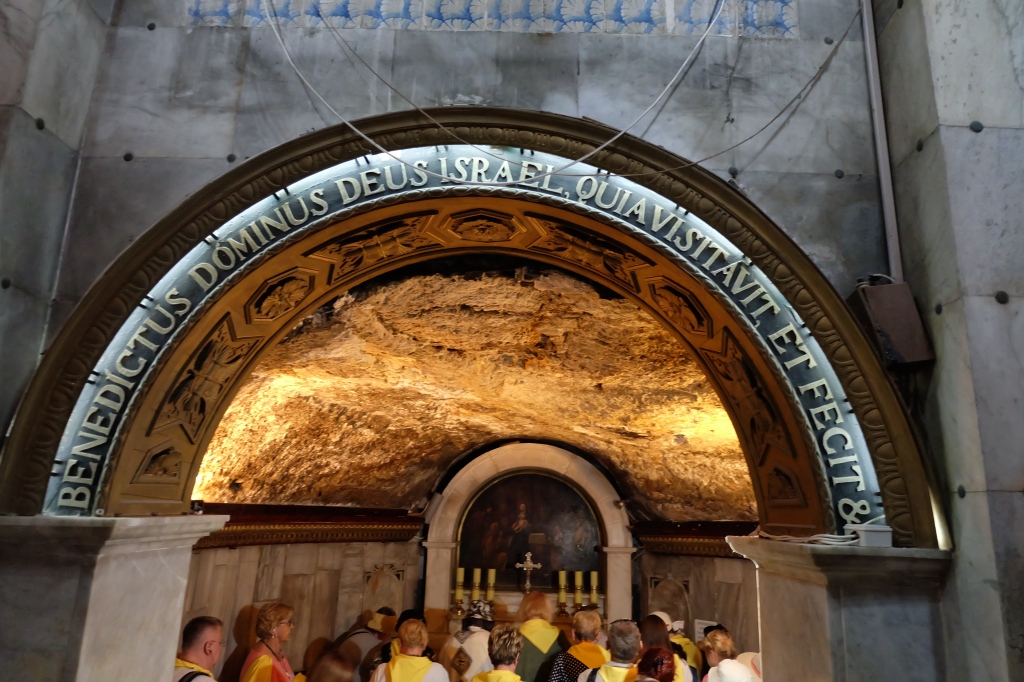
Photo by author, apse of Church of St. John the Baptist also in Ein Kerem, other side of Church of Visitation, May 2019.
In our first reading, we have heard the prophet Malachi declaring the coming of the great prophet Elijah, later understood in the time of Jesus as a reference to John the Baptist, with all the functions of a precursor of the Christ.
Malachi is the last of the prophets in the Old Testament who showed us the transition into the New Testament through John the Baptist that Luke beautifully employed in presenting Zechariah and Elizabeth as links from the Old Testament like the patriarch Abraham and Sarah as well as Elkanah and Hannah, parents of another great prophet, Samuel.
Recall the annunciation of John’s birth that was reminiscent of the annunciation of the birth of Isaac to Abraham and Sarah while the Temple setting was very similar to the annunciation of Samuel’s birth to Elkanah and Hannah who then prayed in the Lord’s tent who was mistaken for a drunk by the chief priest of that time, Eli.
That is the artistry of Luke who portrayed to us this Old Testament links of John the Baptist so that in some Eastern churches until now you find above their entrance doors murals of the Baptist followed by the Blessed Virgin Mary at the middle and then Jesus to show how St. John marked the end of the Old Testament leading to the New Testament that started with Mama Mary when she accepted Jesus in her womb. It is the reason Jesus himself acknowledged John the Baptist as the greatest person ever born by a woman.
Photo by author, altar of Church of St. John the Baptist in Ein Kerem, shortly before its closure for restoration, May 2019.
We today are prophets too when we link the past with the present by continuing the work of Jesus Christ, making him present in this world. We are all bridges, linking and linked with one another in Christ.
Furthermore, the naming of John in itself was very prophetic because his parents made it happened to be fulfilled as God planned it wherein Elizabeth insisted to her neighbors “John” would be his name while Zechariah who was mute at that time affirmed his wife by writing “John is his name.”
That is our mission in this world – to be a prophet who makes things happen by fulfilling God’s plans for us. As prophets, we must be open always to God’s work among us, to always listen to his words in people and events so that we make his words realized. When we become prophetic, we shall hear people say what Luke noted at the end of our gospel today, All who heard these things took them to heart, saying, “What, then, will this child be?” For surely the hand of the Lord was with him (Lk.1:66).
As we move closer to Christmas Day, the birth of John the Baptist reminds us of our prophetic role in this world of making that future a present reality by fulfilling God’s words and holy will in us.
If we would just persevere in our prayer life, of immersing ourselves in prayer, the more we become sensitive not only of God’s presence but also of everyone like this very short story I recently found on my friend’s wall in Facebook shared by a certain Therese Williams Hudson last December 15, 2023. She wrote….
"I heard my mother ask the neighbors for salt.
But we had salt at home.
I asked her why she asked the neighbors for salt.
And she replied: "Because our neighbors don't have much money
and they often ask us for something. From time to time
I also ask them for something small and economical,
so that they feel that we need them too.
That way, they will feel more comfortable
and it will be easier to keep asking us for everything they need.

And that's what I learned from my mother."
Photo by author, Fatima Avenue, Valenzuela City, 08 December 2023.
Lovely, is it not? The author added at the end of her story these words: “Let’s build empathetic, humble, supportive children”. Let’s join her but not just to have emphatic, humble, supportive children but most of all, prophetic ones, those with heightened sensitivity of God and of others made possible only by a deep prayer life where we can all be a “JOHN”, a graciousness of God who makes his divine plans realized. Amen.
The Lord Is My Chef Daily Recipe for the Soul by Fr. Nicanor F. Lalog II
Tuesday, Misa De Gallo IV, 19 December 2023
Judges 13:2-7, 24-25 <'[[[[>< + ><]]]]'> Luke 1:5-25
Here’s another beautiful story I got from a blogger I recently followed from Spain at wordpress.com. It is actually an analogy which may sound simple but very true.
You are holding a cup of coffee when someone comes along and bumps into you or shakes your arm, making you spill your coffee everywhere. Why did you spill the coffee?
"Because someone bumped into me!!!"
Wrong answer. You spilled the coffee because there was coffee in your cup. Had there been tea in the cup, you would have spilled tea. Whatever is inside the cup is what will spill out.
Therefore, when life comes along and shakes you - which surely happens all the time - whatever is inside you will come out. It's easy to fake it, until you get rattled. So, we have to ask ourselves, "what's in my cup?" When life gets tough, what spills over from me?
Photo by Mr. Boy Cabrido, Quiapo Church, Misa de Gallo, 17 December 2023.
My dear friends, we are now on the fourth day of our Misa de Gallo and I find that story/analogy so appropriate with our readings today.
How interesting that Zechariah with his wife Elizabeth – according to St. Luke – prayed so hard all their lives to have a child but when God was about to fulfill it, Zechariah doubted it despite being told by an angel from God. Like in that story/analogy we presented above, Zechariah was “rattled” by the angel’s good news. “What was inside Zechariah that he doubted the good news”?
Then Zechariah said to the angel, “How shall I know this? For I am an old man, and my wife is advanced in years.” And the angel said to him in reply, “I am Gabriel, who stand before God. I was sent to speak to you and to announce to you this good news. But now you will be speechless and unable to talk until the days these things take place, because you did not believe my words, which will be fulfilled at their proper time.”
Luke 1:18-20
Photo by author, Wailing Wall of Jerusalem, May 2017, the section of the remaining parts of the temple closest to the Holy of Holies where priests used to incense once a year.
Advent is the presence of God but sometimes when we are overburdened with so many things like anxieties and problems in life, frustrations and disappointments, sickness and death in the family, we become unaware of his divine presence even if we continue to pray and do our religious duties and devotions. Too often we lack the conscious awareness of God in our lives that we take him for granted, considering him more as a given than a presence and a reality.
This is exactly what we told you yesterday about some of us pretending to be real disciples of Christ when in reality we are merely dreaming in a sleepwalking existence. It is a kind of spiritual immaturity due to our lack of honesty and sincerity with one’s self and with God that we remain a spiritual dwarf. Like Zechariah who happened to be a priest who must be more attuned and rooted in God, we too hardly notice God’s coming or even doubt him and his powers because we want to hold on to our comfort zone or insist our own agenda.
God is never put off by our queries in life but what “irritates” him is when we question him, when we doubt him, when we ask about his character like Zechariah. That is a lack of faith in God, a lack of trust, and lack of personal relationship with him unlike St. Joseph in our reflection yesterday, truly a righteous man.
Contrast Zechariah with his wife Elizabeth who is presented by St. Luke in a better position despite her being barren. In the Bible, barrenness is a sign of lifelessness and absence of God’s blessings. Worst, it was seen as a punishment from God for one’s sins.
Yet in this opening scene of St. Luke’s infancy story beginning with the annunciation of John’s birth, we find God’s power at its fullest when we are most emptied which is exactly the imagery of Elizabeth being barren and old. She had nothing at all to be proud of unlike Zechariah who still had duties to perform as a priest.
As we have reflected yesterday too, we burst in great rejoicing actually in those moments filled with negativities, with a lot of “no” answers of rejections and failure. That was how Elizabeth felt after being pregnant with John.
After this time, his wife Elizabeth conceived, and she went into seclusion for five months, saying, “So has the Lord done for me at a time when he has seen fit to take away my disgrace before others.”
Luke 1:24-25
Earlier, we asked what was inside Zechariah that he doubted the good news of the angel; now, we imagine what was inside the barren Elizabeth who welcomed the good news rejoicing by voluntarily going into a seclusion?
The story of the elderly couple Zechariah and Elizabeth finally being blessed by God with a child shows us God’s consistency not only in keeping his promises but most of all in working best even in our worst conditions, in the most unusual circumstances. In these two stories, one from the Old Testament and in the New Testament, we find the importance of being filled with God always.
Recall our story/analogy above. What is inside us that comes out when we are shaken? What spills over from our cup, is it joy, gratitude, and peace? Or, anger, bitterness, harsh words and reactions long festering within?
In starting his Christmas story with the annunciation of the birth of John the Baptist, St. Luke is telling us an important aspect in celebrating this blessed season – the need to fill ourselves with God.
See how Zechariah was forced to be silent and made mute so that he could spend more time listening and rediscovering God anew in his heart, of filling himself with God. On the other hand, Elizabeth opted to go into seclusion also to contemplate God already dwelling in her though she may have never known before that is why she wanted to listen more intently to his other plans with the gift of John. Similarly like her in the first reading was the wife of Manoah who remained silent and open when a man of God told her she would bear a son to be called Samson, saying that “I did not ask him where he came from” (Jgs.3: 6). Advent invites us to simply be still to be filled by God, with God.
The other day I joined my nieces and nephew for lunch. After dropping me off at the parish, they asked for a nearby Starbuck’s because my nephew had to buy a coffee mug for his exchange gift in their class. When I asked him why he had to give a Starbuck’s mug as gift, it turned out that is now the way it is in class Christmas party – your exchange gift partner can make a wish for the gift to receive for as long as it is within the agreed budget by the class.
Anyway, our life gives us the cup or the mug. We make the decision, the choice to fill it with coffee or chocolate or tea, in the same manner we fill ourselves with joy or bitterness, anger or serenity, gratitude or complaints. Or God.
Like Zechariah in the gospel today, we could be so tired already of doing so much, of banging our heads on the wall to solve everything, to answer everything. In this final stretch before Christmas, let us empty our cups or mugs of our selves and fill it with God who alone can truly fill us with life despite our dryness and barrenness. Amen.Have a blessed Tuesday!
The Lord Is My Chef Daily Recipe for the Soul by Fr. Nicanor F. Lalog II
Friday, Homily on Solemnity of the Birth of John the Baptist, 23 June 2023
Isaiah 49:1-6 ><}}}}*> Acts 13:22-26 ><}}}}*> Luke 1:57-66.80
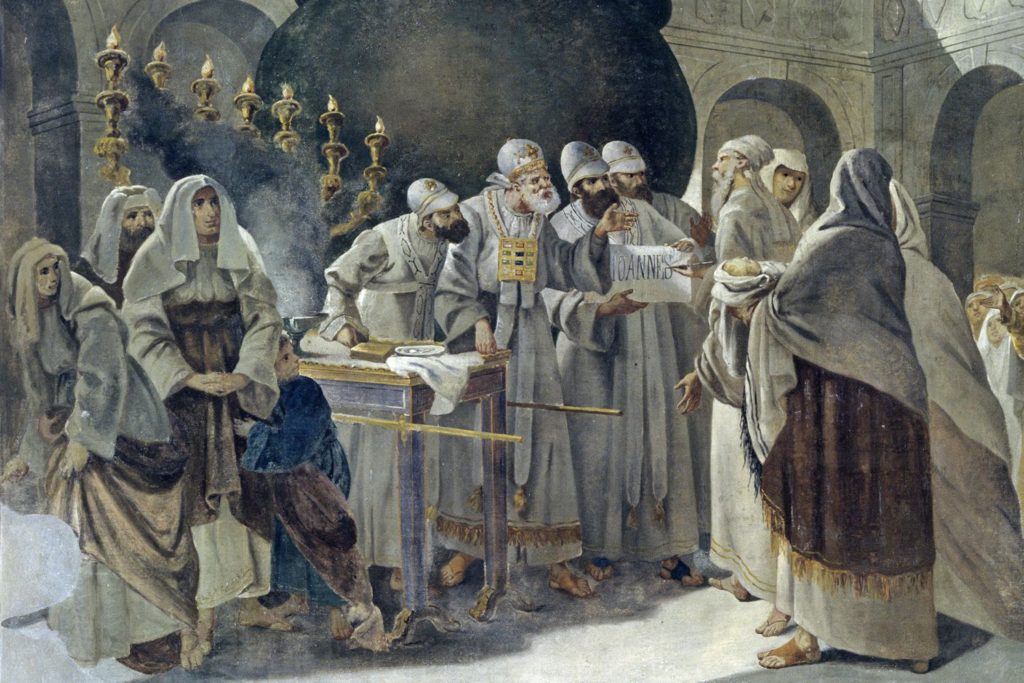
Painting of Zechariah giving name to his son John by Italian painter Riccardo Cessi (1892) from commons.wikimedia.org.
You must have heard a lot of “Dad jokes” from Instagram. Let me now share with you a “Father joke” or priest joke. The world’s first techie was the Jewish priest Zechariah, father of St. John the Baptist because he “asked for a tablet and wrote, ‘John is his name'”.
Ok. It is corny and dry but may I invite you, friends, on something wonderful about this gospel scene in celebration today of the Solemnity of the Birth of St. John the Baptist, the precursor of our Lord Jesus Christ.
Remember how Zechariah was punished by Archangel Gabriel by becoming deaf and mute after he had doubted the good news that he and his wife Elizabeth would soon have a son to be named John. Actually, Zechariah not only doubted but even questioned “how” his barren wife could still bear a child at an old age. As a result, he was forced into silence by the Lord’s angel until everything he had announced was fulfilled.
Photo by author, May 2019, Church of St. John the Baptist, Ein Karem, Israel.
When the time arrived for Elizabeth to have her child she gave birth to a son. Her neighbors and relatives heard that the Lord had shown his great mercy toward her, and they rejoiced with her. When they came on the eighth day to circumcise the child, they were going to call him Zechariah after his father, but his mother said in reply, “No. He will be called John,” But they answered her, “There is no one among your relatives who has this name.” So they made signs, asking his father what he wished him to be called. He asked for a tablet and wrote, “John is his name,” and all were amazed. Immediately his mouth was opened, his tongue freed, and he spoke blessing God.
Luke 1:57-64
Imagine the sight narrated to us by St. Luke: everybody so happy, trying to take a piece of action while Zechariah, father of the new-born child, old and deaf and mute was so silent like a nobody in a corner. In the Jewish society, it is the father who gives name to the children, especially to the son; but, due to Zechariah’s condition, nobody bothered to ask him so that their neighbors, like the typical epal or pakialamera we call in Filipino, assumed the role.
But Elizabeth the mother who had gone into a self-imposed silence upon bearing her child, declared their son would be called “John” or Jehohanan that means “God is gracious” or “graciousness of God” in Hebrew.
Finally amid all the noise and talk, Zechariah made the bold move by writing on a tablet “John is his name” to confirm and reaffirm the name given by his wife Elizabeth. It was a crucial moment when Zechariah boldly made a stand about his faith in God, obeying the angel’s instruction to name his son “John”.
Photo by author of the site believed to be the birthplace of St. John the Baptist at the side of the Church of St. John the Baptist in Ein Karem, Israel, May 2019.
What really happened was the assertion of the plan of God when Zechariah faithfully wrote “John is his name”. That’s what amazed the people so that “fear came upon the neighbors for surely the hand of the Lord was with him” (Lk.1:65, 66).
With a single stroke of hand, everyone felt God present among them as they realized something very special with the child. So amazing too as experienced by the people was when Zechariah asserted God’s plan by naming his son “John”, he was finally able to speak and hear again!
Whenever we assert the plan of God in our lives, in our community, in our family and country, new possibilities open as we break free from all obstacles and hindrances that prevent us from growing and maturing, from being joyful and fulfilled.
Whenever we assert the plan of God in our lives, in our community, in our family and country, that is when we “switch on” the grace of God, when we make God’s blessings operable among us and thus we become like John, a precursor of the Lord whose name means “God is gracious”.
Whenever we obey and assert the plan of God in our lives, in our community, in our family and country, that is when we take that leap of faith, believe again and experience God again.
Many times we could not see nor experience nor realize God’s blessings around us and within us because we do not actually believe and trust him. God’s grace is like a “switch” we have to turn on to operate like the electric light or any appliance and gadget. And the good news is, that grace and “switch” is in us already! We just have to switch it on.
Here we find anew the importance of silent, deep prayer.
Photo by author, Anvaya Cove, 19 May 2023.
The imposed silence on Zechariah made him realize how he had been held prisoner by his disappointments and frustrations over a long period of time when God did not hear his prayers for a child. Imagine their shame being childless despite their being good persons and as husband and wife. At that time, childlessness was seen as a punishment from God, a curse. It must have been a strong blow too to Zechariah’s ego as a priest consulted by everyone for advise and prayers yet could not sire his wife with a child!
All those negative feelings of humiliation and dejection could have caused Zechariah’s trust and faith in God to wane that even his priestly duties have become perfunctory that he never saw the tremendous grace and blessing of incensing the Holy of Holies of the temple. Such duty was a pure grace in itself because it happens only once a year during the holiest celebration of the Jewish of Yom Kippur or Day of Atonement. Priests went through a long process of drawing lots on who among them would incense the Holy of Holies because they were so many in number.
Many times we have been like Zechariah, numb and even indifferent to the movements and works of God in our lives following our many failures in life. Though we may be praying with many devotions doing so many religious activities, we have actually become “spiritual dwarfs” who never grew and matured in faith. Our prayers and devotions have become mere “habits hard to break” that are empty and meaningless.
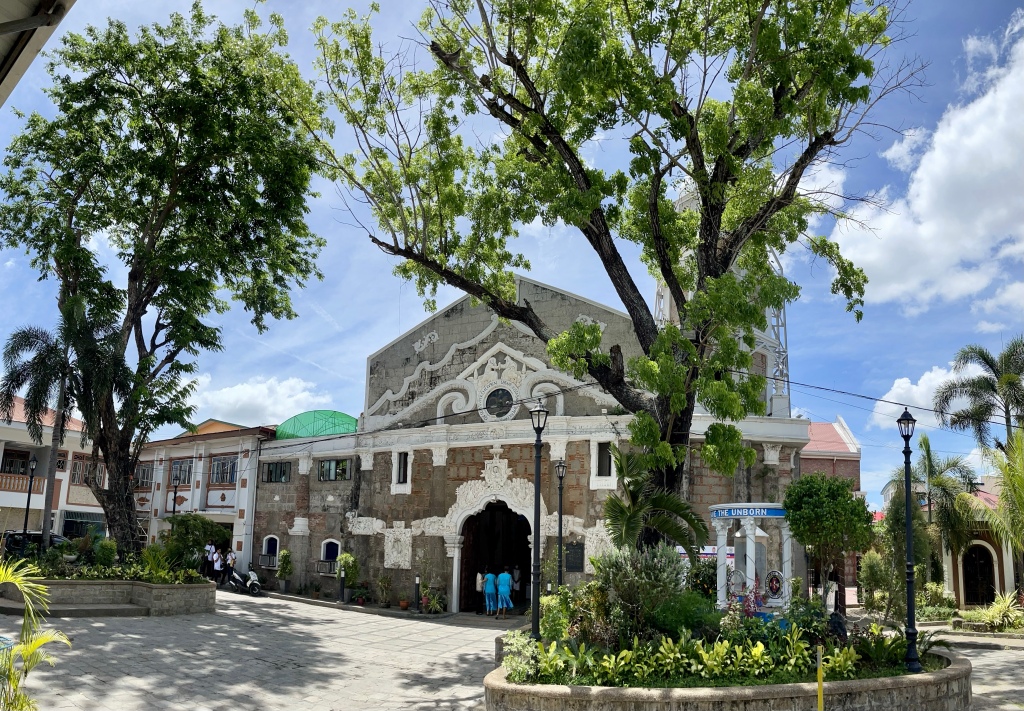
Photo by author taken in May 2022, Parish of St. John the Baptist in Calumpit, the oldest church in Bulacan province.
Today God is calling us to do a Zechariah, to take that bold step of asserting and insisting God’s plan like when Zechariah boldly declared in writing “John is his name”. The first reading beautifully reminds us of one reality we all go through by wrongly thinking God does not care at all for us when nothing seems to happen with our prayers and efforts in life, in our ministry and mission.
Hear me, O coastlands; listen, O distant peoples. The Lord called me from birth; from my mother’s womb he gave me my name. Though I thought I had toiled in vain, and for nothing, uselessly, spent my strength, yet my reward is with the Lord, my recompense is with my God.
Isaiah 49:1, 4
We cannot be another John – a graciousness of God within us and for others unless we rediscover the courage and clarity to do a Zechariah by asserting God’s command and plans entrusted specifically to us.
See also that upon regaining his sense of hearing and ability to speak, Zechariah “spoke blessing God” by singing the Benedictus in the following verses. The Benedictus is the morning hymn of praise to God we priest sing or recite daily in praying the Liturgy of the Hours. It mentions the blessedness of God and his many blessings to Israel while towards its end, we find Zechariah sending forth his son John to fulfill his mission from God in preparing the way of Jesus Christ. It is prayed in the morning to make us aware of our mission to prepare the way of the Lord Jesus.
Let us be patient, never lose hope and enthusiasm in doing the works of God even if nothing seems to happen at all. Everything we do matters a lot with God and with those around us as St. Paul explained in the second reading on the role of St. John the Baptist in salvation history.
Let us keep in mind that God remembers and keeps his promise always because he is gracious all the time. The name Zechariah in Hebrew means “God remembers” while Elizabeth is “God has promised”. John, as we have earlier said, means “God is gracious.” Let us do our part to bring Jesus into this world so fragmented and tired. Have a grace-filled weekend! Amen.
Photo by author taken in May 2022, altar of the Parish of St. John the Baptist in Calumpit, the oldest church in Bulacan province.
The Lord Is My Chef Christmas Recipe for the Soul by Fr. Nicanor F. Lalog II
Tuesday in the Christmas Weekday, Memorial of the Holy Name of Jesus, 03 January 2022
1 John 2:29-3:6     ><000'> + ><000'> + ><000'>     John 1:29-34
Keep me true to you,
God our loving Father,
and most of all true to myself
as your beloved child so I would
always recognize Jesus Christ
in our midst like John the Baptist.
See what love the Father has bestowed on us that we may be called the children of God. Yet so we are. The reason the world does not know us is that it did not know him.
1 John 3:1
How did John recognize Jesus
coming to him for baptism in
today's gospel?
I am sure that it was because
of this truth, of being your child,
loving Father;
indeed, beautiful souls
recognize beautiful souls;
John was so genuine and
Jesus was the purest
because he is truth himself
that John could boldly claim
Jesus is the lamb of God,
the one he had said as coming
though he did not know him
(cf. Jn.1:29-31).
What a beautiful scene of two
genuine souls
recognizing each other!
If we could just replicate it daily
in our lives too,
beginning in our home!
In our modern time that
is so very much like the time of Jesus
when people have turned away from you, God
including those who claim to be Christians
yet promoting abortion and same sex union
as well as priests and bishops
supposed to be the light of reason,
decency, and morality but are not,
we are so blessed with your humble servant,
Pope Emeritus Benedict XVI.
His was a genuine soul,
a most genteel person so maligned
by many especially the Western press
 and some clergymen
for his fidelity to the Lord's teachings,
truly a John the Baptist who pointed us all
to go back to Jesus Christ especially
in the light of the sex scams that have rocked
the Church;
his writings are simply the best,
in itself like the gospel exposing your
truth in words so understandable;
most of all,
he lived in all simplicity and humility
that he was able to see
eternity.
Most dearest Jesus,
grant me the grace you gave
Pope Benedict XVI:
may I also say before my death
in all sincerity and truth,
"Lord, I love you".
Let these words be
impressed on my soul
and be my guide
in life.
Amen.
The Lord Is My Chef Daily Recipe for the Soul by Fr. Nicanor F. Lalog II
Monday, Memorial of the Passion of John the Baptist, 29 August 2022
1 Corinthians 2:1-5     ><]]]]'> + <'[[[[><     Mark 6:17-29
Photo from catholicworldreport.com, “The Beheading of St. John the Baptist” (1869) by Pierre Puvis de Chevannes.
Grant me the grace,
O dear Jesus Christ,
to be like John the Baptist,
truly your precursor in being
the first to receive you
and proclaim your coming
in words and in deeds by
being the first to suffer a
similar passion and death like yours
by standing for what is true and good,
just and fair; let me be the first, O Lord,
to disturb the many Herods of our time
with your gospel's power and wonders.
Herod was the one who had John the Baptist arrested and bound in prison on account of Herodias, the wife of his brother Philip, whom he had married. John had said to Herod, “It is not lawful for you to have your brother’s wife.” Herodias harbored a grudge against him and wanted to kill him but unable to do so. Herod feared John, knowing him to be a righteous and holy man, and kept him in custody. When he heard him speak he was very much perplexed, yet he liked to listen to him.
Mark 6:17-20
Let me first be a reminder, dear Jesus,
that there is a prophet in our midst
who speaks your words for
the sake of the poor and marginalized;
let me be the first to have courage in
proclaiming the mystery of your
Cross, confronting evil in all its forms,
never toning down your message
to please the rich and powerful
Herods of today with their systematic
control of lives in its many aspects;
forgive me Jesus for failing to be a
voice in the wilderness like John
preparing your way, straightening
the paths of our lives by turning away
from evil and sin, embracing your
gospel of life and holiness.
Amen.
The Lord Is My Chef Daily Recipe for the Soul by Fr. Nicanor F. Lalog II
Thursday, Solemnity of the Nativity of John the Baptist, 23 June 2022
Isaiah 49:1-6 ><]]]]'> Acts 13:22-26 ><]]]]'> Luke 1:57-66, 80
Photo by author, the Church of St. John the Baptist at Ein Karem, Israel, 2019.
All who heard these things took them to heart, saying, “What, then, will this child be?” For surely the hand of the Lord was with him.
Luke 1:66-67
The term “hand of the Lord” is a description of God’s presence and power in the Old Testament, a vivid way of presenting God “intervening” in the daily lives of his people, saving them from all kinds of dangers like the prophets.
There was Elijah who was hunted by the soldiers of Jezebel and the “hand of the Lord was on Elijah” (1 Kgs. 18:46) that he was spared from their murderous plots. Then there was also Ezekiel who saw “the hand of the Lord” (Ez. 37:1) upon him at the vision of a valley of dry bones coming back to life.
Sometimes, the “hand the Lord” referred to God’s judgment like when King David had sinned against God in not trusting him when he ordered a census of soldiers before a battle. It angered God who asked David to choose which punishment he preferred: natural disaster or victory by his enemies or God’s judgment. David chose the third option, saying, “Let me fall into the hand of the Lord for his mercy is great…” (1 Chr. 21:13).
In narrating to us the events that transpired at the birth and circumcision of John, Luke merged the two meanings of the expression “hand of the Lord” to show that every moment of judgment is also a moment of grace as seen in the life of John the Baptist who “grew and became strong in spirit, and he was in the desert until the day of his manifestation to Israel” (Lk.1:80).
If we go back to Luke’s account of the annunciation of John’s birth, we also find the hand of God clearly at him with Elizabeth feeling vindicated with her pregnancy specially when visited by Mary. Most of all, the hand of the Lord was strongly felt at the birth, circumcision and naming of John in the most unique manner not only because no one among their relatives have such name (Lk.1:61) but most of all when Zechariah his father wrote “John is his name” and “Immediately his mouth was opened, his tongue freed, and he spoke blessing God” (Lk.1:63).
Photo by author, site of John’s birthplace underneath the Church of St. John the Baptist at Ein Karem, Israel, 2019.
What a beautiful scene of Zechariah and Elizabeth wrapped in the arms of God, basking in his tremendous blessings with the people so amazed for evidently God was present among them, working in the most special ways albeit in silence that after looking back to the past and the present moment, they wondered what more good things God has in store for the three.
The same scene happens daily in our lives as individuals, as families and communities and as a nation – of how the hand of God saving us in so many occasions like during this pandemic and recent disasters through generous people coming to our side. There lies the greatness of Zechariah and Elizabeth – through them despite their weaknesses, the hand of the Lord worked wonders not only for them but for everyone including us in this time.
We are invited today to be like John’s parents who, despite their weaknesses and shortcomings, they allowed the hand of God to work in them and manifest in them. The name Zechariah means “God remembers” while Elizabeth means “God promised”, a beautiful combination of names of a couple who tell us how God remembered his promise to them and gave them John which means “graciousness of God.”
Photo by author, 2019.
In this age when we act as though God does not exist with our emphases on the wrong notions of freedom and the “dictatorship of relativism” along with materialism and consumerism, we celebrate this Solemnity of John’s nativity to remember our calling to be prophets and precursors of Jesus like Isaiah in the Old Testament who voiced dissensions to the wrong ways of the people like “a sharp-edged sword” and “polished arrow” (Is. 49:2) even to the point of offering one’s life, truly a precursor of the coming Christ.
John’s testimony still resounds today as proclaimed by Paul in our second reading, urging everyone to repent ones sins to go back to God, always ensuring we are not the Christ but merely his messengers not worthy to unfasten his sandals.
Today is also the eve of another Solemnity, that of the Sacred Heart of Jesus as we come to close the first half of 2022. Let us not forget the COVID-19 pandemic is still with us, that we must not let our guards down lest all our gains this year go to waste. Are we willing to be used as expressions of the “hand of the Lord”?
May we keep “the hand of the Lord” with us, allowing ourselves to be used by God like Zechariah, Elizabeth, and John the Baptist in meditating where Jesus is leading us in the second half of 2022. It is enough that we lead others to Jesus. In fact, that is the only joy we have in this mission and once others have met Christ, then, like John the Baptist, we begin to disappear, leaving only the hand of the Lord. Amen.
Photo by Fr. Pop dela Cruz, San Miguel, Bulacan, 15 June 2022.






 lordmychef.com