Discipleship is facing death

The Lord Is My Chef Sunday Recipe, Wk. XIII-C, 30 June 2019
1 Kings 19:16, 19-21 >< )))*> Galatians 5:1, 13-18 >< )))*> Luke 9:51-62
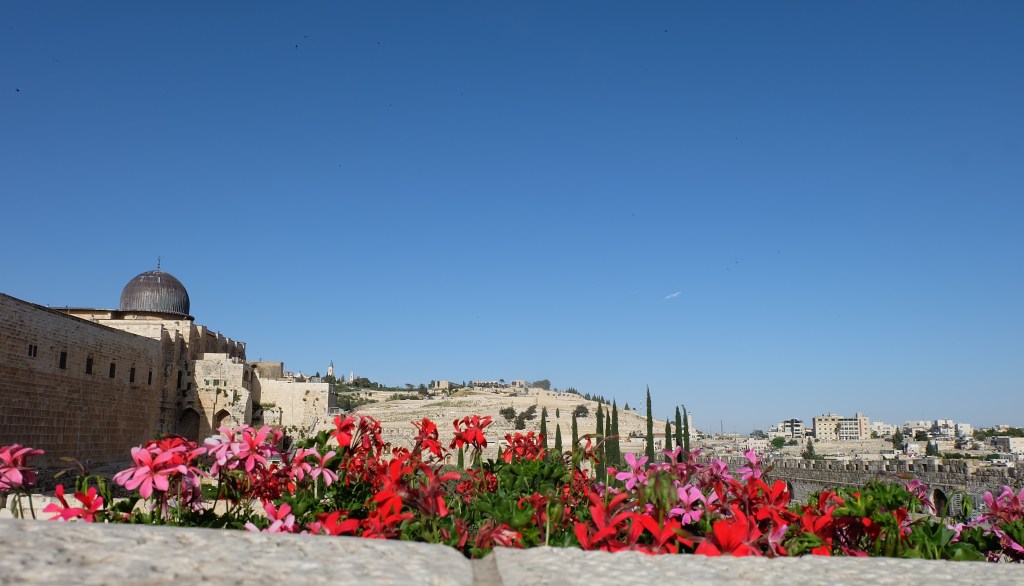
Jerusalem as seen from the Mount of Olives with a Jewish cemetery at the foreground facing its eastern wall where the Messiah is believed would pass through when he comes. It is the very route Jesus had taken more than 2000 years ago on Palm Sunday before his Passion, Death and Resurrection. Photo by author, 04 May 2019.

After all the solemnities we have celebrated since the closing of Easter Season last Pentecost Sunday, we now get into the very heart of the Ordinary Time of our liturgy with St. Luke as our guide. Feel the sobriety and hint of solemnity at the start of the second part of his gospel we have heard today which is about discipleship and facing death like Jesus.

When the days for Jesus’ being taken up were fulfilled, he resolutely determined to journey to Jerusalem.

Luke 9:51

I love the way St. Luke wrote this part about Jesus “resolutely determined to journey to Jerusalem.” In some translations, they have retained its literal equivalent from the original Greek text that says “Jesus set his face to Jerusalem”. For Jesus, Jerusalem is where he fulfills his mission from the Father by dying on the Cross. So, if we are going to be more literal with this opening sentence by St. Luke, it would be “Jesus set his face to death.”

Photo by Pixabay on Pexels.com

A friend who had inspired me about blogging has been writing about death lately. Last June 10, 2019 he wrote:

No one wants to write about death. Or dying.

To many, it’s not only a morbid topic. It is a taboo to talk about it.

Of course we’d rather talk about the joie de vivre in our daily chronicles. It is, after all, what sparks joy.

Death is a stranger to this world. Until it comes knocking at your door.

https://relativejoyforyou.wordpress.com/2019/06/10/dear-death/?fbclid=IwAR2ryu6Kou_CIRYqTz193ZTkpdS5bSabCX9-7NuhDSHM3jYcrhjNY8rta6o

His words are very true.

In fact, I have been very hesitant to write about death as a topic for my homily this Sunday because Sundays are supposed to be joyful! And that is perhaps our problem with death: we always see it as something dark and negative. (Is it not?)

Today Jesus is teaching us to see death in his perspective as something beautiful and even glorious. St. Luke saw it and is now leading us in this new approach to death as he tells us the story when “Jesus resolutely determined to journey to Jerusalem.”

One thing that strikes me during sick visitations in my parish and in Metro Manila is how we see death as an escape or an ending. Patients and relatives alike always tell me to pray for death to end all sufferings and pains.

When “Jesus resolutely determined to journey to Jerusalem,” he was not sick, physically and emotionally. He was very well and able. When he was hanging on the Cross, he did not wish death to end his pains. On the contrary, he actually faced death head on. And this is one of the very important lessons Jesus had taught and shown us: facing death, even embracing death. Recall how during his Last Supper on Holy Thursday Jesus was never caught surprised by death. He was in total control of everything.

This is the reason why Jesus accomplished so much in just three years of his ministry because he was very aware of his coming death. In coming to terms with death, Jesus lived fully even if he died at 33 years old. The same is very true with some of our saints who have died young and have accomplished so much because they have all lived to the fullest that death did not surprise them at all in their works and mission.

The “sleeping Jesus” on a bench at the entrance to Capernaum. See the wounds on his feet, markings from his crucifixion. Photo by author, 02 May 2019.

One of the new attractions at Capernaum today when you come to visit the ruins of the synagogue Jesus used to visit there during his lifetime is a park where one finds his statue sleeping on a bench at the entrance across the Franciscans’ quarters. The statue is executed artistically and realistically that passersby would drop some coins for alms in a pot near the image! The sleeping Christ on a bench depicts exactly the second part of the gospel we have heard today: there is nothing certain in this life except Jesus Christ. The sooner we come to accept and embrace this reality vis-a-vis death, the better for us.

As they were proceeding on their journey someone said to him, “I will follow you wherever you go.” Jesus answered him, “Foxes have dens and birds of the sky have nest, but the Son of Man has nowhere to rest his head.”

Luke 9:57-58

Discipleship is coming to terms with death, accepting its reality so that we stop wasting our lives with bitterness and resentments to start living joyfully and meaningfully in Christ. I have heard countless of times how most patients including relatives and friends would bargain for more time, for more life because they felt they have not lived fully. As they come face to face with death during sickness or an accident, they beg even for a little time to live fully, proving that “in the end, it is not the years in your life that count but the life in your years.”

Facing death like Jesus Christ is having God as our top priority. Unlike the second and third people Jesus had invited to follow him and asked his permission “to first bury his dead father” and “to first say goodbye to his family.” Jesus is not teaching us to turn away from our family and loved ones; he wants us to always have God and eternal life as our top priorities in life. Like Elisha in the first reading who slaughtered his oxen and cooked them using the yoke and plow as firewood to show he was foregoing everything to follow Elijah as a prophet.

Every disciple is a nomad following Christ, a pilgrim and sojourner whose true home is in heaven with the Father; hence, the importance of thinking always of things of the above, of heaven and of eternal life. St. Ignatius of Loyola calls it the “principle and foundation” in life wherein we do the things that would lead us to salvation and avoid things that would bring us to eternal damnation.

Of course, such a vision about life is not only contrary to the values of the world but even a folly. See how the world tells us to “just do it” and to “obey your thirst” so that we can have easy and comfortable lives, enjoying everything to the fullest by ensuring our security with material wealth. On the other hand, discipleship in Christ as St. Paul reminds us in the second reading is allowing the Holy Spirit to direct our lives because it is the spiritual things that truly fulfill us. What a tragedy especially among affluent nations we hear reports of increasing number of people committing suicides, feeling empty and lost despite their material wealth?!

Jesus alone is our joy and security. In him, trials and sufferings become blessings because they make us stronger and better persons. Most of all, death is neither an end nor an escape in Jesus but a passage to life in the fullest. This is not a simplification of the complex reality of death but an assurance that Jesus had conquered it and had made it into a blessing that we can now discuss and reflect about it.

I know that speaking about death is easier said than done. It may even be Quixotic. But, death is a reality of life we have to face and deal with, even befriend little by little as we age. Reflecting about death is a kind of death itself and at the same time a grace from God who enabled us to face it even in our limited abilities. Let us put our complete faith in Christ, following him resolutely to Jerusalem as his disciples so that when death finally comes to us, we find Jesus by our side. A blessed week to you! Amen.

Sacred Heart of Jesus for a heartless world

The Lord Is My Chef Recipe for the Soul
Solemnity of the Most Sacred Heart of Jesus, 28 June 2019
Ezekiel 34:11-16 >< }}}*> Romans 5:5-11 >< }}}*> Luke 15:3-7
Sacred Heart of Jesus at the Jesuits’ Sacred Heart Retreat House and Seminar Center in Novaliches, Quezon City. Photo by author July 2018.

At a glance, the powers of darkness seem to rule the world.

Pains and sufferings are all around us as we see them in the news and, worst, experience them right in our homes and community!

The other Sunday evening, one of our parish lectors was hit by two riders driving under the influence of alcohol that severely damaged her face, particularly her right eye and front teeth. She did not see the motorcycle coming because the drunk riders were going so fast opposite the one way street.

The two riders have no driver’s license and both claim to have no money to pay for the medical expenses of our parish volunteer who comes from a very poor family.

I told her story to our Sunday congregation. Right after the Mass, two ladies came to me, handing me Php 25,000.00 in cash, pledging with more money for the medical and dental bills of our lector. Tears were rolling in my eyes as I thanked the two kind ladies who refused any recognition at all.

Yes, too often we are shocked at the evil going on in the world.

But, more surprising is the fact that it is always God who has the last laugh and final say in all these pain and sufferings around us.

There is always the more powerful Sacred Heart of Jesus offsetting our seemingly heartless world today.

Jesus the Good Shepherd with a lost sheep on his shoulder. A wood carving atop the cathedra of the Minor Basilica Cathedral of the Immaculate Conception in Malolos City. Photo by Lorenzo Atienza, 12 June 2019.

Jesus addressed this parable to the Pharisees and scribes: “What man among you having a hundred sheep and losing one of them would not leave the ninety-nine in the desert and go after the lost one until he finds it? And when he does find it, he sets it on his shoulders with great joy.”

Luke 15:3-5

I love that imagery of Jesus the Good Shepherd carrying on his shoulders the lost sheep. It is so powerful and evocative of God’s immense love for us sinners.

God fulfilled his promise to Ezekiel in the first reading that he would personally come to tend and look after us his sheep by sending us his Son Jesus Christ.

For his part, Jesus showed us in teaching this parable the solicitude of the Father in going beyond his words to the prophet of not just affectionately gathering and leading his sheep to green pastures but by communing with sinners of his time. What a wonderful way by Jesus showing us the pains God is willing to go to find one lost sheep.

From Google.

Jesus knows it so well how difficult and painful to get lost that he spent time with sinners, dining with them in many occasions. He knows the fearful thoughts running through us when we were wandering in darkness and sin that he never judges us nor condemns us like the woman caught committing adultery. Most of all, Jesus knows how difficult it would be for us who were lost to find our way back home, to go back to normal life of grace that he is willing to wait like with St. Paul and with St. Augustine.

Hence, when Jesus the Good shepherd finds the lost sheep, he sets it on his shoulders with great joy. Imagine also the spontaneous reflex to clutch to oneself whatever or whomever was lost and is found. That is how intense is the love of God through Jesus for every lost sheep when finally found. He is filled with joy that he carries the lost sheep on his shoulder to hurriedly bring it to safety and comfort, never to get lost again.

Moreover, here we find the great love of God for us who have gone stray in sin: he would patiently look for the lost sheep and likewise willing to patiently carry it on his shoulders so as not to make it suffer further in going back to the fold. Absolutely, no trace at all of any disgust in God in our going stray in sins!

From Google.

Eventually, Jesus proved this intense love of the Father to us in his dying on the Cross. He showed us how true love that comes from God and rooted in God is a love that is always meek and humble. A love that is unconditional, embracing both friends and foes. Yes, it is easier said than done but doable if we love in Christ Jesus.

From Google.

To love in Christ Jesus is to trust in God’s love. Without this trust in God’s love, we will always rely on our own self, prioritizing on our love of self than love of God and others. That is when darkness comes to rule over us, making us heartless too. Then, indeed, the world becomes evil because we have become its slave.

On this Solemnity of the Most Sacred Heart of Jesus when our nation is in so much darkness, Jesus is inviting us to make his love visible by trusting in his unfailing care as our Good Shepherd. When there is a major paradigm shift in the parable of Jesus wherein there are more lost sheep who are also self-righteous in knowing everything, calling those not on their side as stupid, we are more challenged today to witness Christ’s values of dignity of persons and peace. Let us pray for more patience with the appalling governance we now have courtesy of the majority of our people whom we have denied with God’s love and care for the longest time.

From “no body” to “some body”

The Lord Is My Chef Sunday Recipe for the Soul
Solemnity of the Body and Blood of Christ, 23 June 2019
Genesis 14:18-20 >< )))*> 1 Corinthians 11:23-26 >< )))*> Luke 9:11-17
Darkness descending upon the Sinai mountain range at St. Catherine, Egypt, 07 May 2019. Photo by author.

We all fear darkness.

It is difficult to do things in darkness because our sight is always impaired. We cannot see things clearly, giving rise to many imaginations of evil lurking behind darkness.

Even in the bible, darkness means the presence of evil. And this is why the bible teems with many stories of God coming to his people in darkness. Most especially in the gospels where Jesus comes to comfort and console his disciples and the people in darkness.

But there is more sinister in darkness, a kind of darkness that envelops people and not just the world around us. It is a darkness that refuses to see the other person as a brother and a sister. This we see in our gospel on this Sunday Solemnity of the Body and Blood of Jesus Christ.

As the day was drawing to a close, the Twelve approached him and said, “Dismiss the crowd so that they can go to the surrounding villages and farms and find lodging and provisions; for we are in a deserted place here.” He said to them, “Give them some food yourselves.” They replied, “Five loaves and two fish are all we have, unless we ourselves go and buy food for all these people.”

Luke 9:12-13

It is a very classic situation we always find ourselves in when more than the darkness around us is the darkness within when we refuse to see the face of everyone as another person who needs to be cared for, who must be fed and kept warm. Most of all, assured as a brother and a sister, being our kin or one of us.

This is the tragedy that happened recently at the Recto Bank where 22 local fishermen were abandoned at sea when a Chinese fishing vessel rammed their boat while safely anchored in the dead of the night.

After several hours at sea, Vietnamese fishermen rescued the 22 Filipinos, gave them water, and fed them with rice and noodles. Despite their language barrier that was another kind of darkness, the Filipino and Vietnamese fishermen understood each other in hand gestures, repeating only three words they knew so well: “Philippines. Vietnam. Friends.”

But the scariest darkness that the 22 local fishermen went through did not happen at sea but at home under glaring lights of camera when government officials downplayed their harrowing experience, dismissing it as an ordinary maritime accident involving “ordinary folks” (i.e., fishermen) and worst of all, after barraging them with so many questions and insinuations sweetened with offers of cash and materials, they eventually succumbed to darkness that they retracted their earlier statements of the incident.

Photo from Yahoo News.

The Recto Bank incident showed us the blinding darkness we are into as a nation. It shows how as the only Christian nation in this part of the world we have been living in too much darkness within us, how we have long forgotten to see the other person as a brother or a sister, that we have stopped caring for one another despite our too many devotions and religiosity.

Like the Twelve, we always wanted to secure our own comfort when darkness comes that we keep on dismissing others away, unmindful of whatever would happen to them along the way. This we do in all sectors of society when we do not care for those next to us if there would still be enough funds or resources or infrastructures after us. This is most evident in our garbage disposal and lack of care for the environment when we think only of our own selves, regardless of the next generation.

And, so, here we are groping in darkness even in the Church when both the clergy and the laity have been blinded by edifice complex, erecting monuments for their own glory forgetting those in the margin. How can some of us in the Church hide in darkness with all kinds of abuses, sexual and financial exploitation of those entrusted to us?

Today in this Solemnity of the Body and Blood of Jesus Christ, we are invited to dispel the darkness within us by seeing again that everything we have is from God.

In the first reading we heard the mysterious person Melchizedek, king of Salem and priest of the Lord. He had blessed Abraham with bread and wine after he had won over four pagan kings. Unlike most victors in any war, Abraham refused to take all the possessions of the pagan kings he had defeated because it was very clear to him his victory was due to God’s intercession. He claimed nothing to himself and that is he gave a tenth of everything to Melchizedek who then blessed him. It is exactly what we do in every Sunday Mass when we celebrate each week with gratitude to all of God’s blessings we have received. Like Abraham, we share not only our selves but also our treasures to God through our Mass offerings.

This is what St. John Paul II called as the “cosmic character” of the Eucharist.

In his 2003 encyclical “Ecclesia de Eucharistia”, St. John Paul II described this cosmic character of the Eucharist as Christ’s saving presence in the community of the faithful everywhere (cf. Ecclesia de Eucharistia 8-9). This happens when we enter into this mystery of Christ in the Holy Communion of the Mass whereby after receiving his Body and Blood, we become his very presence in the world which St. Paul explained in our second reading today.

With this in mind now, we see the larger context of the instruction of Jesus to the Twelve in the wilderness at that time of darkness to “Give them some food yourselves” (Lk.9:13). During his last supper, Jesus took bread and said “This is my Body…this is my Blood.” You who receive me as your Teacher and Lord, see my Body in every-body. No one is a no-body.

Whenever there is a darkness within every person, there is surely a failure in recognizing this Body and Blood of Jesus. Recall how it was in the darkness of the night when Judas sold Jesus for 30 pieces of silver to the priests. It was also in the darkness of the night when he betrayed Jesus.

There was also Simon during the darkness of the night who denied Jesus thrice when he failed to see him as his Lord for fear of being arrested too.

Then there were the two disciples going back to Emmaus on the evening of Easter: they were both in the darkness of despair and loss after the Crucifixion of Jesus whom they did not recognize walking with them at sunset. And when they recognized him at the breaking of bread, despite the darkness around them, they hurriedly back to Jerusalem to inform the Apostles how they have met the Risen Lord!

The Solemnity of the Body and Blood of Christ today reminds us that despite the many darkness in the world today, even right in our very hearts, Jesus comes to dispel them so we can see more the beauty and wonder of life and every person around us.

Is there any darkness in you that needs to be dispelled by Christ’s Body and Blood? Are you ready to offer him that darkness in your heart to become his light in this dark world?

A blessed week to everyone!

Photo by Pixabay on Pexels.com

Dance with My Father

The Lord Is My Chef Sunday Recipe for the Soul
Solemnity of the Blessed Trinity, 16 June 2019
Proverbs 8:22-31 >< )))*> Romans 5:1-5 >< )))*> John 16:12-15
From Google.

I know.

You must be saying our title is from a hit song by the late Luther Vandross Jr. with Richard Marx, “Dance with My Father”.

Since its release in May 2003, I have always loved that song. Like Vandross Jr., I sometimes ask God to return my father even for a while not only for me but most especially for my mother who was celebrating her birthday when he suddenly died of a heart attack in 2000.

Though my father did not dance much like Vandross Sr., one of the things I miss so much from him were how he would discuss so many things to me especially whenever I would join him in our library. And when I could not understand everything, he would always tell me, “paglaki mo maiintindihan mo rin yan, anak” (you will understand that when you grow up, son).

Eventually those words came to sound like music to me as a I grew up until later in life I realized that indeed, I have come to understand the many things we have discussed when I was still a child! Most of all, now that I am a grown up man still having a hard time comprehending many things in life, my father’s words still soothe me. Although he is no longer around, I always tell myself when facing difficult situations or questions that someday, I’m going to understand this – “paglaki ko maiintindihan ko rin yan”.

Jesus said to his disciples: “I have much more to tell you, but you cannot bear it now. But when he comes, the Spirit of truth, he will guide you to all truth.”

John 16:12-13
Jesus during his Last Supper Discourse telling the Apostles his departure and sending of the Holy Spirit. From a depiction found on the Maesta in Siena by Duccio (1308-1311). From Google.

On this Eleventh Sunday in the continuation of our Ordinary Time after Lent and Easter, we celebrate the Solemnity of the Blessed Trinity. In the past Sundays we have been slowly introduced by the Lord in his teachings about the Holy Spirit. Today we come to full circle with this celebration of the Holy Trinity, the highest mystery in our faith that there are three Persons in One God.

For many Christians, especially Catholics, they feel that believing in One God is enough. To speak of God – Father, Son, and Holy Spirit – matters very little for them that they fail to see what the mystery of the Trinity evokes concretely in our lives.

It is true that we cannot find an explicit statement in the whole Bible telling us there is One God in Three Persons. It is a doctrine that slowly unfolded in the Sacred Scriptures reaching its highest point of revelation in Jesus Christ’s Incarnation and sending of the Holy Spirit.

This is the essence of Christ’s farewell discourse during their Last Supper together: the Holy Spirit will not introduce anything new to them. The Holy Spirit will just enlighten and bring out to the open the many dimensions of the teachings of Jesus that were mostly found also or rooted in the Old Testament. Sometimes in life, there are so many realities already present but we do not recognize right away because of so many factors that hide them from us. But the moment we discover some new dimensions of life’s truth and reality, the more we find its beauty! That is why we have to somehow understand the Trinity to fully appreciate the beauty and wonder of God in our lives.

In the Old Testament, God did not speak about himself being a Person per se, as a full, conscious relating Being like humans. Moreover, God never spoke about his being One in Three Persons to the people at that time because they would never even feel such mystery as they were surrounded by polytheistic nations. It was enough at that time to insist on the people that there is only One God who relates personally like humans, seeking intimacy.

thus says the wisdom of God: “…then was I beside him as his craftsman, and I was his delight day by day, playing before him all the while, playing on the surface of his earth; and I found delight in the human race.”

Proverbs 8:22,30-31

In the first reading, God presents himself as a person, one who relates with others personified in wisdom juxtaposed in two images equally evocative, as an artisan or creator and as a child happy and proud to be around his parent.

Here I find Luther Vandross Jr.’s “Dance with My Father” so applicable: he was seven and a half years old when his father died of complications in diabetes. But his fondest memory of him was how he would dance with his mother at home and would always pull him to dance with them!

Isn’t that beautiful, three people dancing together like one entity?

Incidentally in theology, we also have this explanation of the Trinity as a “circle dance” called perichoresis. It is a way of seeing the Trinity as action than definition. If you ahve been to Turkey, you must have visited Cappadocia where once lived great thinkers of the Church called Cappadocian Fathers who thought of perichoresis.

According to the Cappadocian Fathers, in perichoresis, each Divine Person is like a dance partner who contributes and has a specific role in the choreography so that what they do together make up the dance. The Persons like partners in the dance pull and push against one another, not in resistance or force but in support and unity. The dance is in constant motion and the partners are not focused on themselves but on the others. Likewise as we experience in “club party”, the dance circle is never closed so that more people are invited to join in the celebration until each becomes a part of the dance, sharing in the joy and unity.

From Google.

In perichoresis, the Trinity is presented more as a relationship of Persons: the Father is the Creator, the Son is the Redeemer and the Holy Spirit is the sanctifier. Applied to us, we are all children of the Father who are brothers and sisters in Jesus as indwelling of the Holy Spirit. The Blessed Trinity invites us to their dance of life and grace as we find here the gist of St. Paul’s Letter to the Romans today that through our faith in Christ, we have found the peace of God through the outpouring of so many gifts upon us by the Holy Spirit that we now have a relationship of friendship and trust in him, culminating in participation “in the glory of God” (Rom.5:2).

This Sunday, we are all invited to join in the dance of God, the dance of the Father, of the Son and of the Holy Spirit. In that dance, the Father reveals to us his hidden plans for us in Christ through the Holy Spirit of how he wants us to live to the fullest in him. It is only in dancing in him and with him can we know this mystery of God, mystery of self, and mystery of life in general. Though we cannot fully understand his mystery, God slowly unfolds to us his many dimensions that little by little, we see more of him, nmore of ourselves, and more of others.

That is when we find GUIDANCE, for God-U-and-I Dance.

When there is guidance, we find direction and do not get lost.

A blessed week ahead to everyone. Amen.

Photo by Jens Johnsson on Pexels.com

Perennial Pentecost

The Lord Is My Chef Sunday Recipe for the Soul
Solemnity of the Pentecost, 09 June 2019
Acts 2:1-11 >< }}}*> Romans 8:8-17 >< }}}*> John 14:15-16, 23-26
From Google.

Today we close the Easter Season.

After the last Mass tonight in every parish, the Paschal Candle is extinguished and from the ambo where it had stayed since the Easter Vigil, it is brought back to the baptistry to signal the start of Ordinary Time tomorrow.

As we have been reflecting these past days, life is a series of coming than of leaving. This is very true in today’s celebration of the Solemnity of the Pentecost: when Jesus ascended into heaven last Sunday, the Holy Spirit now comes to fire up the disciples to continue God’s presence in the world. Last Sunday we said the Ascension does not mean Jesus going to a particular place “up there” but his entry into a higher level of relating with us. Today is the fulfillment of that promise he made, that he would remain with us until the end of time in the power of the Holy Spirit sent by the Father.

Pentecost means fifty. After God handed to Moses the Ten Commandments at Sinai, the Israelites ratified that covenant 50 days after. Eventually when they entered the Promised Land, Pentecost became an agricultural celebration of their harvests that eventually extended into a celebration of weeks. When the Holy Spirit came on that Pentecost day in Jerusalem, it became the “coming out party” of the Church when the Apostles were emboldened to proclaim the good news of Jesus Christ to everyone.

In this evolution of the Pentecost from Sinai to Promised Land to the early Church, it has remained true to its essence as life in God. As such, we must keep in mind it is not an isolated event in the past but a reality we must allow to happen every day in our lives. If there is one thing very much missing in the Church these days, it is the Holy Spirit. We need a “perennial Pentecost” to fill us with life and zest in living the Gospel, from the bishops to the priests to every baptized Catholic. See the vibrancy among other Christian denominations. They are so alive while we Catholics as so rigid and lethargic. We need to be “fired up” by the burning fire of the Holy Spirit everyday. It is Pentecost or nothing!

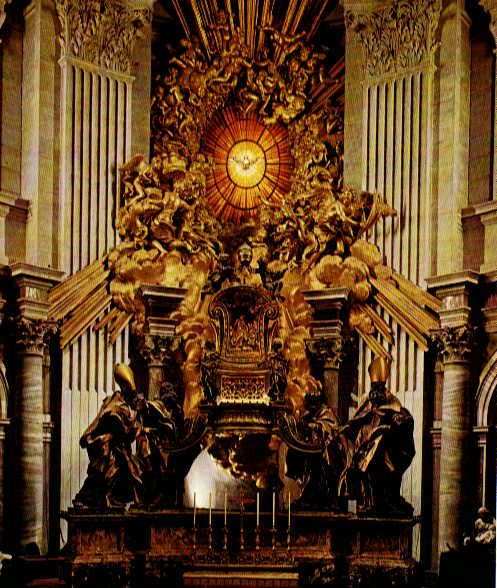
Chair of St. Peter at the High altar of St. Peter’s Basilica in Rome. From Google.

Above the Chair of St. Peter at the Vatican is a stained glass depicting the coming of the Holy Spirit like a dove. According to Pope Emeritus Benedict XVI, that is in essence the Church which is like a window where God and man get in contact. At the middle of that meeting point or contact of God and man is the Holy Spirit. Without the Holy Spirit, we can never be in touch with God and with others. The Holy Spirit is the spirit of love that binds us all with each other and with God in the same manner it unites the Three Persons of the Blessed Trinity to remain as One God. This explains why we heard again today the Gospel three Sundays ago of Jesus teaching about love at the Last Supper.

Jesus said to his disciples: “If you love me, you will keep the commandments. And I will ask the Father, and he will give you another advocate to be with you always. Whoever loves me will keep my word, and my Father will love him, and we will come to him and make our dwelling with him.”

John 14:15-16, 23

These words are repeated today to present to us the new and definite context of the Pentecost flowing from that Last Supper discourse of Jesus about love, keeping his commandments, and coming of the Holy Spirit.

During his Last Supper, Jesus clearly showed that in the new covenant sealed by his blood, the Law is more than the personification of God: obedience to his commandments and to the Father is first of all an expression of love. Jesus is the new Torah, the new law of love found in his oneness with the Father. On this Pentecost Sunday, we hear again the Last Supper discourse of Jesus to remind us that being Christian is becoming united as one in him as “indwelling of the Father and the Son.”

That can only happen when we allow ourselves to be small. See that at the Ascension, we were presented with an upward movement that called for the need to be light and powerless in order to rise above. Now, Pentecost’s downward movement shows us the need to be small in order to be mixed or fused with God and with others. Every downward push leads to spreading out, of thinning out, of getting small.

As limited beings, our greatness can only be found in our ability to share, to be small to participate and become a part of a larger whole. In our very selves, we cannot do anything. I am so amused to realize this basic truth while watching those crime shows in Netflix like Narcos and Bad Blood where even the most evil men need to be small, to band together to be powerful. We all need conversion which is very essential to be truly great!

For true conversion to happen, there has to be love, even at least, an openness to love. It is no wonder that love is always presented in the fiery shades of red and orange because almost everything is purified and broken into little particles by fire. When love is intense, expect fire to be hotter with its hues of red and orange more aglow. Only when we are willing to be subjected to love’s purifying fire can we be truly filled with the Holy Spirit and its gifts, particularly joy.

Conversion and love demand constant dying into one’s self, of living in the spirit and not in flesh that St. Paul explained in the second reading. We can never be one in Christ without conversion, without getting off our ivory tower of pride and arrogance. We need to go down, if we have to lie face down, so be it. Most of all, oneness with others is impossible without conversion because we cannot insist on ourselves on others. We need to be broken, we need to smash our high walls that keep us away from others. That is what the Holy Spirit’s fire did on that Pentecost Sunday in Jerusalem, the very same thing needed to happen these days in our Church.

Every Sunday when we gather like the Apostles at the Upper Room during the Lord’s supper, we are invited to keep his commandments in love. This can only happen when we pray for conversion through the fire of the Holy Spirit. Let us be open to receive this fire of the Holy Spirit again every Eucharistic celebration so that after our gathering, we may set the world anew in fire with Jesus Christ’s loving presence. Amen.

From Google.

“The Nearness of You” by Rod Stewart (2002)

The Lord Is My Chef Sunday Music, Ascension Sunday, 02 June 2019
Pilgrims on top of Mt. Sinai, Egypt. Photo by Atty. Grace Polaris Rivas-Beron, 07 May 2019.

Today is the Solemnity of the Ascension of Jesus Christ, the beginning of a new level of “nearness of God” with us.

And that explains the reason for our music this Sunday, “The Nearness of You” composed way back in 1938 by Hoagy Carmichael with lyrics by Ned Washington. The song debuted in 194o and since then has delighted many hearts and souls with its lovely melody and music interpreted by so many artists in every generation.

I have chosen Rod Stewart’s version taken from his 2002 album It Had to be You: The Great American Songbook because the song fits him so well. Yes, Rod is a rocker but he had matured so well that after all the noise, he has grown deeper in his art that his unique voice suddenly had acquired a depth coming not only from the heart but even from the soul. I won’t be surprised at all if one day Rod Stewart would be talking about some sort of spirituality and holiness.

Now back to our Sunday celebration of the Ascension of Jesus Christ…

15th century Greek icon of the Ascension of Jesus. From Google.

In the gospel today, St. Luke tells us that after Jesus had ascended into heave, the disciples “returned to Jerusalem filled with great joy.”

That is totally strange because whenever someone leaves, the general feeling is always sadness like when we have to change residence or old neighbors move out, when loved ones have to go abroad to work or worst, when a beloved dies. They all bring sadness.

Where did that great joy among the disciples of Jesus come from after the Lord had ascended into heaven?

From their hearts! The key to understanding and appreciating the Ascension of Jesus into heaven is not in looking up the skies or looking down on the ground where he stood. It is in looking deep into our hearts.

Anything that remains in our head or in our mind is always open to doubts. When that truth we believe in sinks into our hearts, then we get the conviction that it is really true. And that is when we experience great joy within: It is in the heart where we come to conviction that leads us into living authentically no matter how painful that truth may be. That is why there are saints and heroes – including lovers – willing to die for their beliefs because they are so convinced with the truth in their hearts.

From Google.

At the Ascension, the disciples had the conviction that Jesus is truly alive, that his going to heaven is more of coming to a new level of existence and relating with them, something no longer bounded by time and space, something always so near and so personal.

It is the same feeling we have with those we love. Even if they are not physically present with us, we feel their nearness because we love.

There lies the beauty and timelessness of the song “The Nearness of You”: nothing beats the love that brings us so close, so near with one another. Unless we have that deep conviction and love for a person, we will never rise up – or ascend – to higher level of relationship that is so near, so close.

 It's not the pale moon that excites me
That thrills and delights me, oh no
It's just the nearness of you

It isn't your sweet conversation
That brings this sensation, oh no
It's just the nearness of you

When you're in my arms
And I feel you so close to me
All my wildest dreams come true

If you can say these words to a beloved, imagine when you level this up to Jesus Christ? That would definitely be a new level of nearness with him and with others.

Look into your heart, believe, and be convinced.

The Nearness of God

The Lord Is My Chef Sunday Recipe for the Soul
Solemnity of the Ascension of the Lord Jesus Christ, 02 June 2019
Acts 1:1-11 >< }}}*> Hebrews 9:24-28; 10:19-23 >< }}}*> Luke 24:46-53
The Chapel of the Ascension believed to be the site where Jesus stood before ascending into heaven while his disciples looked at. Photo by author, 04 May 2019.

Outside the old city of Jerusalem on the Mount of Olives is the Chapel of the Ascension believed to be the site of Jesus Christ’s Ascension into heaven. Though the octagon-shaped structure is massive and very high, it is quite small inside with just one door for entrance and exit. Immediately upon entering that door on the floor is a framed slab of stone called the “Ascension Rock” venerated by pilgrims because that is where Jesus stood before going up to heaven.

The Ascension Rock. Photo by author, April 2017.

But personally, in the two occasions I have been there in 2017 and last month, my focus have always been more on the four windows of the chapel’s dome.

The rays of light coming through them have always evoked in me the beauty of Christ’s Ascension with a feeling that is so uplifting. The morning rays of the sun gently filling the room with light warms your heart as if angels are keeping you company like what we heard from the first reading during the Ascension of Jesus.

A window at the dome of the Chapel of the Ascension. Photo by author, April 2017.

As I prayed this week on the meaning of the Solemnity of the Ascension by recalling my two pilgrimages to the Holy Land in the light of our readings today, it is only now have I realized that the key to this feast is not found in looking up to the skies or looking down on where Jesus stood before going up to heaven.

It is in looking more into our hearts, looking deep inside us can we truly find the meaning of the Ascension of the Lord.

This feast is an invitation to get inside our hearts, not just into our minds and imagination to appreciate the words of Jesus Christ these past two Sundays about his “going and coming in a little while” (Jn.13:31, 33;14:25;16:16,20).

Remember how Jesus these past two weeks kept on speaking about his leaving and his coming at the same time? Of how we reflected last Sunday that in life, we do not really leave but simply come into new level of existence and new level of relating with God and with others?

Then he led them out as far as Bethany, raised his hands, and blessed them. As he blessed them he parted from them and was taken up to heaven. They did him homage and then returned to Jerusalem with great joy, and they were continually in the temple praising God.

Luke 24:50-53

Normally, it is sadness that we feel most in every leaving and departures: when kids leave home to pursue college somewhere, when a father or a mother leaves abroad to work over a long period of time, or a beloved dies. Though the cliche may be right sometimes that “parting is such a sweet, sweet sorrow”, the fact remains there is always sadness whenever we leave or somebody leaves us.

That is why St. Luke’s account of the Ascension is strange when he tells us that Christ’s disciples “then returned to Jerusalem with great joy” after the Ascension. St. Luke does not give any hint or a tinge of sadness among the disciples when Jesus left them to sit at the right hand of God almighty Father in heaven. And, the Holy Spirit has not come down yet. Where did the disciples get this great joy after Jesus had left?

Detail of a 15th century Greek Orthodox icon of the Ascension of Christ with Mary so calm while the apostles very animated, eager to proclaim the gospel. From Google.

We do not have the details at how this great shift happened that the disciples were filled with great joy after Ascension but, the Scriptures and the stories of the saints as well as those of some true heroes provide us with some answers and reasons.

According to St. Luke as well as the other evangelists, Jesus came to see his disciples for many days (40 according to Luke) after Easter. The Lord taught them with some more lessons preparing them for his coming Ascension. Most of all, Jesus made his disciples experienced his new mode of presence in his glorious body. He showed them his wounds and dined with them so often to convince them that he had really risen.

In all instances of his appearances, there was always joy among the disciples. Slowly, the disciples’ joy in knowing Jesus is risen deepened into great joy at the Ascension when this truth sank deeper into their hearts too that they have finally and truly accepted Jesus is alive!

When a truth or a reality stays only in our minds, that is always open to doubts. But, the moment that truth or reality we know is brought down to our hearts, that is only when we truly accept it as really true. And that is when we are filled with great joy because we are already convinced without any doubts of the truth or reality we have received.

Saints and heroes alike find great joy in their sufferings and death because of their convictions in their hearts that what they knew in their minds are very true. They lead “authentic” lives because what they knew in their minds was what they felt in their hearts that they eventually say and do. It is only in authentic living can we find great joy in living, no matter how painful or difficult it may be.

15th century Greek Orthodox icon of the Ascension. From Google.

And that is the great joy in the Ascension of Jesus Christ: the disciples, like us, start living authentically because we are deeply convinced that the Lord had not left us but had in fact launched a new level of nearness with us. His Ascension is the finality of the redemption he had won for us coming right into our hearts when we realize that Jesus did not simply die and rose again for a nameless mass of people. He did everything personally for each one of us.

This is what social media can never give us. Despite its great popularity, social media have left many of us still sad and even sick with various forms of mental illnesses. Everything that happens in the Net often remains up in our heads, rarely sinking into our hearts that still keep us apart despite our connections.

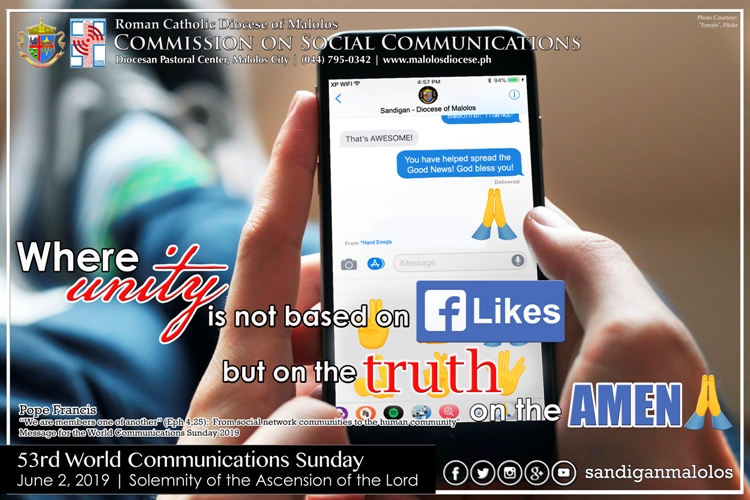
In his message for the 53rd World Communications Sunday we also celebrate today, Pope Francis invites us to connect deeper into the human community and not just in social network communities. The Holy Father stresses that interconnection must go down into personal encounters in the flesh, not just in virtual reality, calling for a shift from “likes” to “amen”.

Poster by Kendrick Ivan Panganiban.

How ironic that all these modern means of communications were invented to bring us all closer together but it seems the opposite is happening. We are growing apart and have become more impersonal than ever! We are all guilty of so often clicking the “like” button without having read the complete post or seen the photos of our relatives and friends. We rarely take time to “process” what we read and see on Facebook by people we call “friends” who often number to thousands. What an inauthentic way of living!

The Ascension of the Lord is a call to authentic living as it launched a new level of nearness of God with us and us with him and with one another. Unlike in the Old Testament as the author of the Letter to the Hebrews explained, Jesus did not enter a sanctuary made of human hands, referring to the old Temple worship that was never complete due to human imperfections. When Jesus came and went through his pasch, he brought God closest to us. We can rise up or ascend to his new level of relationship, new level of existence by rising up also from our infirmities and limitations in him who dwells in our hearts. A joyful month of June to you! Amen.
Presence in Absence

The Lord Is My Chef Sunday Recipe for the Soul, Easter Wk. VI, Yr. C, 26 May 2019
Acts 15:1-2, 22-29 >< }}}*> Revelation 21:10-14, 22-23 >< }}}*> John 14:23-29
A view from the entrance to the Temple Wall of Old Jerusalem, 04 May 2019.

Life is a series of coming and going where we never really leave at all.

I have been sharing you this quite often since Advent last year. We do not leave completely but simply come to new levels of relationships with our loved ones. When children grow up and go to college, they move into new environment, new stage in life. They never leave but come to new beginnings. Eventually, they leave home when they graduate in college and get married only to start their own family and home.

We call this series of coming and going in life as “presence in absence”. Sometimes it happens that it is after someone had left us, whether temporarily or permanently like death, that we even get closer with that person. Here we find the wonderful truth that if you want to be eternal, love. Then, a departure no longer becomes an exit but an entry to new mode of presence and relationships.

This is why Jesus commanded us last Sunday to love one another as he loved us, that is, to always love in his Father who is love himself. When we love in union with the Father, then our love is made perfect as it is God who eventually works in us.

The Lord deepens this teaching to us in our gospel today as he prepares us for the great celebration of his Ascension on Sunday, a kind of his own “leaving and coming”. Our gospel today is still part of his long discourse during his Last Supper when Thomas, Philip, and Jude asked him some questions about his impending departure that they could not really fully grasp at that time. Anyway, Jesus now answers the last question from Jude concerning his presence while at the same time prepares them for the inevitable when he has to “leave” them first for his Passion and Death and second, when he returns to the Father in heaven.

( Judas, not the Iscariot, said to him, “Master, what happened that you will reveal yourself to us and not to the world?”) Jesus said to his disciples: “Whoever loves me will keep my word, and my Father will love him, and we will come to him and make our dwelling with him. I have told you this while I am with you. The Advocate, the Holy Spirit whom the Father will send in my name — will teach you everything and remind you of all that I told you.”

John 14:22-23, 25-26
Altar of the church Dominus Flevit (the Lord Wept) with the old Jerusalem as background, April 2017.

First thing we notice in the Lord’s statement is the great honor for each of us to be the dwelling place of him and the Father. Can you imagine the kind of intimacy that means we now have with both the Son and the Father dwelling in us? It is something beyond our expectations or hopes when all we want in life is to be with him in heaven after death. But we do not have to wait for our death because right now, right here, Jesus and the Father are dwelling in us. And because of this reality, we are able to find meaning and fulfillment in life despite its many trials and difficulties, pains and tears along the way.

We have experienced the Father’s presence through the words and teachings of Jesus passed on to us through the Sacred Scriptures and the Tradition of the Church. Jesus himself stressed that his words are not really his but the Father’s. Loving the Lord and keeping his words are the same because Jesus is the Word who became flesh and dwelt among us according to St. John’s prologue to his gospel. It is for this reason that we are also able to call God “Abba” (Father) because we have that inner recognition of him deep within us in Jesus Christ.

Clouds over Sinai desert in Egypt, 07 May 2019.

Jesus continues his presence and teachings in us in our own time in the power of the Holy Spirit. This is the second part of his discourse in our gospel today, his sending of the Holy Spirit upon his return to the Father to be his apostles’ and our Advocate or defender and inner guide to all the truths he had taught us.

Christ did not say everything to the apostles. Aside from the fact that the time of his “presence” on earth was limited (33 years), it was impossible for the evangelists to report everything he had said and done (Jn.21:25). But he knew the totally different situations his disciples would be into and that includes us in the present time. Jesus knew very well the shifts and upheavals coming but, as we have seen in the past 2000 years since he went back to the Father, his Church has continued to exist despite the many predictions of its end. And that is largely due to the work of the Holy Spirit as our Advocate or defender.

From Google.

As our Advocate, the Holy Spirit acts as the “memory” of the Church like in a computer that it “processes” us disciples to act according to the Scriptures and teachings of Jesus in our own time. The Spirit powers us like a dynamo to continue to be the living presence of Jesus in his “absence” in a world that tries to delete him. This was first experienced in the first Council meeting of the Church in Jerusalem in the year 50 AD (Jesus ascended to heaven 33 AD) when the first Christians were plunged into a controversy regarding the imposition of Judaic traditions on Gentile converts. The first reading from the Acts tells us how the Apostles were guided in their proceedings by the word of God in the power of the Holy Spirit. The Holy Spirit continues to do the same in the Church when our Pope and bishops pray and reflect on the Scriptures in making its stand on the different issues now confronting us that were non-existent 100 years ago or 2000 years ago like the Internet or global warming. The Holy Spirit is the “heart and soul” of the Church’s living tradition that makes Jesus present in the world today through each one of us, its dwelling-place.

In the second reading, John tells us of the splendor of the heavenly Jerusalem where God is at the middle of everything. It is also the challenge of the gospel to us today, as the indwelling of the Father and of the Son, do we make God present in our family, in our places of work and study? Do we remain faithful to his word that we are not ashamed of praying even in a restaurant?

See that after explaining his mode of presence through us in the power of the Holy Spirit, Jesus spoke of the gift of peace. Peace is always the fruit of love when we have Jesus as basis within us in all of our undertakings. How sad that even in many families, couples and children plan on their own for their many projects and activities without including their spouses or children in the process. There is no internal unity that often leads to misunderstanding and divisions that make peace so elusive.

Last Wednesday night I was invited to guest in a radio talk show hosted by former colleagues in the news. They complained to me how the Mass is no longer holy and has become very showbiz. Lourd De Veyra complained of priests not prepared with their homily and so “in love” with their voice that they talk nonsense like TV hosts. Photojournalist Melvin Calderon formerly of TIME Magazine and Pulitzer Prize winner last year Manny Mogato of Reuters News lamented at how our churches have become to look like a studio or a stage with all the pomp and pageantry, empty of any sense of the Holy. Though their observations were painfully true, I still felt so glad for them because despite their being so immersed in the world, they all long for the peace of Jesus Christ they believe can be first found among us priests and in our churches! May we go back to the Father so we may be able to share Jesus, only Jesus, and always Jesus through the Holy Spirit. Amen.

Love and Respect in Marriage

The Lord Is My Chef Recipe for Wedding of Bryan and Catherine, 24 May 2019
St. Francis of Assisi Chapel, Fernwood Gardens, Quezon City
Ephesians 5:2a,25-32 >< }}}*> <*{{{ >< John 15:11-17
The Tamsui Lover’s Bridge, New Taipei, Taiwan. Photo by author, 29 January 2019.

Congratulations, Bryan and Catherine!

Our gospel is very clear today with Jesus telling you, “It was not you who chose me, but I who chose you” (Jn.15:16). In his infinite wisdom, God had planned this day to happen today, not last year or last month nor tomorrow or next month.

Today the Lord had chosen you Bryan and Catherine to tie the knot as husband and wife in this lovely chapel so you would be his witnesses of his immense love for us. You went through a lot of challenges in your love that is a certified “LDR” – you got me thinking for sometime what those letters mean.

As classmates in elementary until you were separated in high school when Catherine and her family moved to Marilao, you remained friends. When you pursued your dreams in college, the great distance between UP Los Banos and UST in Espana did not keep you away from each other as friends until you realized you love each other that you became sweethearts.

After graduation, Catherine had to move again with her family and this time, thousands of miles away from you Bryan when there were no free messaging apps yet like Messenger and Viber. Bryan had to make those expensive overseas calls while Catherine had to be patient with the unreliable, cheap call cards bought in Asian and Filipino stores in New Jersey.

Thanks very much to Mark Zuckerberg and you had more time seeing each other in social media that your love deepened through time and distance. But, Facebook did not resolve your main issue at that time.

It was Jesus who moved you both to realize that “No one has greater love than this, to lay down one’s life for one’s friends” (Jn.15:13).

Both of you Bryan and Cath sacrificed so much to be finally together, today and forever. Married life is not a competition in love, in seeing who loves most. Husband and wife simply love, love, and love. St. Paul said it so well in our first reading, “live in love as Christ loved us” (Eph.5:2a).

To live in love like Christ is to respect one another.

In our gospel, Jesus said “You are my friends if you do what I command you” (Jn.15:11) which is to love like him, giving up one’s self to your friend.

Bryan and Cath, you are now the bestest of friends. In the word “friend” you find a letter “r” that if you remove it, you get the new word “fiend” or enemy, the exact opposite of friend. That letter “r” in “friend” stands for respect which means in Latin “to see or look again”.

Without respect, any love will not grow. Without respect, love withers and dies. Respect deepens our love because in seeing again, in looking back to our loved ones, we remember our vows to always love.

From Google.

Three things I wish to share with you Bryan and Catherine about respect so you may live in love as the bestest of friends.

First, always look at your very selves, see yourself as the beloved of God.

God makes no mistakes. You are God’s perfect creation as he intended when he created you, Bryan and Catherine. Be proud of who you are even you have lost your hair or have had wrinkles, or gained weight to have so much “love handles” around your waist.

Bryan… Catherine… you are not only one in a million… you are a once in a lifetime.

Catherine, stay true to who you are as a woman. St. Paul never meant in our first reading that the wife must lose her identity in a relationship. Everything and everyone changes for sure, but a healthy marriage will always grow with you and never against you.

When you are apart and not together due to work, always look at each other. Always try to see the other looking at you. That is respect because in that way, you remain faithful to each other and avoid sin.

Second, always look back to your dreams, to your plans and vision in life.

The ideal man finds himself first before he finds his ideal woman, and vice versa. What do I mean? Many people have sights but not all have visions. A visionary is someone who dreams with eyes wide opened. Vision makes us see where we are going and what it will take to get us there. Like the “Mission-Vision” thing you have Bryan in Maynilad.

The moment a man/woman starts to have a vision of himself/herself with a partner in achieving that dream in the future, then he/she has become the ideal husband/wife. When you have a purpose in life and included in that is someone special, even if you have not met him/her yet, then you are the man, you are the woman.

When trials come in your lives Bryan and Catherine, look again into your vision and dreams in life. Start to work for it again with each other, together as one. If you have to start all over again, do so. Together. Pursue your dream and make it come true!

Third, every day, Bryan and Catherine, look again to God. Always see God in your life. Remember the Holy Family how every year they would go to Jerusalem to worship God. When the child Jesus was lost and they could not find him, they went back to Jerusalem and found him in the Temple. Mary and Joseph looked to God to find Jesus and they found him!

When you always look to God Bryan and Catherine, you will also find yourselves and your dreams. In that, you live in love, respecting each other always as gifts from God.

May today be the least happiest day of you life as husband and wife, Bryan and Catherine! Amen.

From Google.

Christ’s gift of love

The Lord Is My Chef Sunday Recipe for the Soul, Easter Wk. V, Yr.C, 19 May 2019
Acts 14:21-27 ><)))> Revelations 21:1-5 ><)))> John 13:31-33, 34-35
Sunrise at Lake Tiberias, the Holy Land. Photo by author, 04 May 2019.

I was sleeping soundly along with other customers at our barbershop last Thursday noon when we were jolted by a boy about four years old who shrieked and threw on tantrums as he vehemently refused to have a haircut. It was a big scene and the poor young mother was at a loss how to pacify her son who kept yelling at her “I do not want to have a haircut!”

After a couple of minutes, everybody sighed with relief – except me – when the boy finally finally cooled off to sit on the barber’s chair for his haircut. I felt no relief first because the more I pitied the young mother who had to bribe her spoiled son with a cellphone to play computer games just to behave. And secondly, I was never able to get back to my siesta due to the sounds of the boy’s computer games.

As I looked in horror with the scene, I wondered if this is the new kind of love today when gadgets and things replace persons.

When Judas had left them, Jesus said, “I give you a new commandment: love one another. As I have loved you, so you also should love one another. This is how all will know that you are my disciples, if you have love for one another.”

John 13:31, 34-35
Boat ride at the Lake of Tiberias, 04 May 2019.

It is very true that love of neighbor is not a Christian innovation. Other great religions also have love as a fundamental principle.

The newness in Jesus’ new commandment to love lies deeply in his following sentence, “As I have loved you, so you should love one another.”

To love like Jesus Christ is more than doing a higher order kind of love or a more loving way of loving by following a stricter moral standard.

To love like Jesus is to love in union with the Father who is love himself!

This newness of his commandment to love is found deep in the preceding scene of the gospel when Jesus washed the feet of his disciples. In the fourth gospel, the washing of the feet is the meaning of love expressed in the Holy Eucharist that prefigured Good Friday’s crucifixion. In relating that scene, St. John used the word “clean” three times as Jesus declared to his disciples “you are clean” (Jn.13:10).

It was in the washing the feet when Jesus first clearly showed the most unique and loving way of God coming down to us to cleanse us of our sins. Purity is always a gift from God because we cannot make ourselves clean. And like in that washing of feet of his disciples, Jesus continues to purify us in every Mass we celebrate today. The more we are “purified” by Jesus in the Eucharist, the more we learn to be like him, to love like him unconditionally and most of all, to love in union with the Father who is love himself.

And there lies the newness of Christ’s new commandment of love, for us to love like Jesus in him and with him.

We will always be imperfect and sinful, always needing to be cleansed and purified to be fitting to God. In the same manner, human love is always imperfect like us. Most often, we love for reasons that are always wrong or sometimes love in seasons that soon go off season. There will always be people and situations when our arguments and reasons not to love are not only right and proper but also justified. But when we come to realize this gift of love from Jesus, of loving like him in union with the Father, we become his extension and channel of love. Love, then, becomes pure and doable, even easier and acceptable because first of all, we experience it in us.

Franciscan Monastery, Mt. Nebo, Jordan where God let Moses view the Promised Land to be given to the Israelites. The cross with serpent prefigured the salvation to come from Christ’s death: the Israelites complained against God who punished them by sending poisonous snakes that bit and killed them. The Israelites repented and God ordered Moses to make a copper snake image to mount it on a stick that whoever looked at it was healed of the snake bite and lived (Numbers 21:6). Photo by author 03 May 2019.

To love like Jesus is totally new because it is not really us who does the loving but Jesus himself in us and with us. It is a totally new kind of love because it is a love not based on norms or rules but on God himself. It is a totally new kind of love because we allow Jesus to act in us, making God truly present among us. Thus, we all become an Emmanuel like Jesus, God-is-with-us. What a great honor for us to be a presence of God in Jesus! That despite our sins and weaknesses, Jesus continues to cleanse us so he may dwell in us and work through us. When we obey his new commandment to love like him, then his words at the end of today’s gospel are indeed fulfilled, “This is how all will know that you are my disciples, if you love one another” (Jn.13: 35). It is a love so different from the world that sets us apart from others, enabling us to make a big difference in this world marred with sin and imperfections.

This remains the great challenge among us now in our time when Jesus said “My children, I will be with you only a little while longer” (Jn.13:33) when he gave this new commandment. It is the present time where we always have that tension of the here and the not yet oriented toward Jesus who has come, is coming now and will come in the end of time. This is why until now like during the time of the apostles, we have priests or presbyters appointed to care for the flock by leading them in a life of charity and unity in the Church. Every priest as well as every Christian is supposed to be a presence of Christ, loving like Jesus in union with the Father. How sad when we, priests and lay people alike, deny this kind of love of Jesus, destroying our unity in the Father as one family of believers and followers.

Let us not waste Christ’s gift of love so unique that unites us with the Father and with everyone. Let us strive harder that despite our sinfulness and many differences of beliefs and affiliations, through Christ’s gift of purity and love, we may little by little realize “a new heaven and a new earth” as John saw in his vision at Patmos. A blessed Sunday to everyone! Amen.