Colossians 3:1-11 ><)))*> ><)))*> ><)))*> Luke 6:20-26
Petra in Jordan. Photo by author, May 2019.
Lord Jesus Christ, today your apostle Paul calls us to “Think of what is above, not of what is on earth” (Col. 3: 2).
Then, in the gospel also today, you raised your eyes toward your disciples and began your “sermon on the plain” (Lk. 6:20)
What is up there, Lord Jesus, that we have to look up, that you have to raise your eyes looking at us?
When I was young, I was so afraid of heights but I have always wanted to be on top to see the beautiful sights that I did my best climbing trees and walls, even rooftops.
Now I am older, I still yearn to be on top to enjoy the sights but too weak to climb even the stairs.
All I can do now Lord is raise my eyes up to the skies, to treetops and mountains to enjoy the moments of looking up, and most of all, wondering at all your wonderful blessings to me — right here in my heart to find you and see you looking up at me!
What a beautiful lesson today of looking up, of seeing ourselves exalted by you despite our weaknesses and sinfulness. What a wonderful teaching about our new stature as your brothers and sisters, O Jesus, redeemed and loved. What a way of teaching us of our new life in you, dearest Christ and of the need to live accordingly as Christians!
So many times, we look down at ourselves, Lord, forgetting our blessedness in being poor and hungry, weeping and rejected in the name of your love and mercy.
Teach us to realise and value our being blessed in you so that our lives and actions may conform to your beatitudes. Amen.
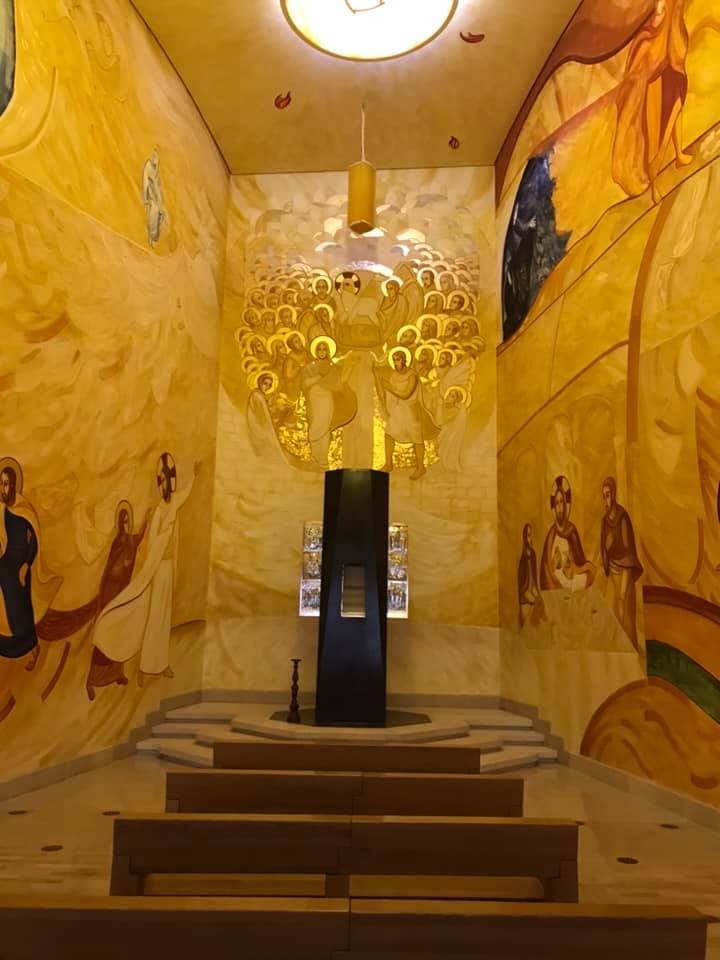
Blessed Sacrament Chapel of the Sanctuary of San Pietro Pietrelcina-Nuovo Chiesa in Italy. Photo by Rev. Fr. Gerry Pascual, February 2019.
“Brothers and sisters: As you received Christ Jesus the Lord, walk in him, rooted in him and built upon him and established in the faith as you were taught, abounding in thanksgiving. You were buried with him in baptism, in which you were also raised with him through faith in the power of God, who raised him from the dead… he brought you to life along with him.”
Colossians 2:6, 12, 13b
Praise and glory to you, our Lord Jesus Christ! Thank you for dying with us in our sins, forgiving us and raising us to new life in you in the sacrament of baptism!
Let us be immersed in you, Lord Jesus.
Let us claim our new life in you by walking with you who is our Way and Truth and Life.
To be immersed in you, O Christ, is to be free and faithful to lovingly serve you with all our mind, heart and soul. Being immersed in you is letting go of our pains and hurts in the past to start anew in you. To be immersed in you, O Christ, is to see more the goodness within each one of us because of you, the most holy one.
May we heed the call of St. Paul today not to be swayed by false beliefs and other philosophies not rooted in you, claiming elemental and dark powers here on earth.
You alone are the sovereign power here on earth and the entire universe, Lord Jesus.
And the good news is that through baptism, you have made us share in your “cosmic victory” of the Resurrection. More than a rite of initiation, our baptism is a sharing in your great power here on earth to conquer evil with good.
Let us be your modern “apostles” — an apostolein, someone sent ahead of you, someone with special relationship with you, someone truly immersed in you, very personal with you, Lord Jesus, who reign forever and ever. Amen.
What a wonderful way to start the week of work and school with you, O Lord Jesus Christ dwelling in me! St. Paul perfectly said it in today’s first reading:
“God chose to make known the riches of the glory of this mystery among the Gentiles; it is Christ in you, the hope for glory.”
Colossians 1:27
Inspire me, Jesus, like St. Paul not to be disheartened by suffering, to be filled with passion in proclaiming your gospel not only in words but most of all in deeds. Take away all the hurts and pains, insecurities and doubts within me that prevent you from reigning in me.
Remind me, Jesus, that your gospel is not a philosophy nor a collection of doctrines or of ethics but your very person so that in preaching and witnessing your gospel, I may lead others to a personal encounter with you, O Lord.
Dwell in me, Jesus Christ, and let me do something good today like what you did to the man with a withered hand on a sabbath day. Amen.
The Lord Is My Chef Sunday Recipe, Week XXIII-C, 08 September 2019
Wisdom 9:13-18 ><)))*> Philemon 9-10, 12-17 ><)))*> Luke 14:25-33
Photo by Ms. Jo Villafuerte at Atok, Benguet, 01 September 2019
“A loveless world is a dead world, and always there comes an hour when one is weary of prisons, of one’s work, and of devotion to duty, and all one craves for is a loved face, the warmth and wonder of a loving heart.”
Albert Camus, “The Plague”
I always tell people not all days are bright and sunny but, there comes a time when we are so down, when all is so dark and even hopeless that the only thing left for us is to believe, to hope, and to love.
There is really nothing we can do except to patiently wait for the storm to pass while we suffer alone and cry alone. That is when we are surprised and even shocked at how the gospel of Jesus and the commandments of God can sometimes be so rigid that we want it modified even a little because we want to get even, we want to fight back. If we are not busy thinking of revenge, we complain, asking God why me who should suffer?
But, the more we pray and submit ourselves to God, the more we realise that God’s ways are not our ways. That despite the difficulties, we feel deep inside God is with us, guiding us, leading us to something better!
“Who can know God’s counsel, or who can conceive what our Lord intends? Or who ever knew your counsel, except you had given wisdom and sent your holy spirit from on high? And thus were the paths of those on earth made straight.”
Wisdom 9:13, 17-18
Photo by Ms. Jo Villafuerte at Atok, Benguet, 01 September 2019
Here we find the importance of Christ’s teaching last Sunday, of the need to be humble, to be our true selves by being where we should be for “those who humble themselves will be exalted and those who exalt themselves shall be humbled.”
It is in our poverty, in our weakness, even in our incomprehension when the Holy Spirit works well to reveal to us the higher realities of life often wrapped in every pain and suffering we go through. And that is why sometimes in life, it is best to be unreasonable when the only explanation and justification we can have in still being loving and forgiving, merciful and understanding, kind and patient is the person of Jesus Christ.
“If any one comes to me without hating his father and mother, wife and children, brothers and sister, and even his own life, he cannot be my disciple.”
Luke 14:26
Photo by the author, Holy Family Chapel, Sacred Heart Novitiate (Novaliches), July 2016.
Our gospel today is a continuation of last Sunday when Jesus was invited to a Sabbath dinner by a Pharisee. After giving them some “table talks”, Jesus told them another parable about the great feast to stress that God’s mercy is so vast that there is room for everyone in heaven.
People started to follow him after that meal and lesson on heaven, wanting to become his followers and disciples. To further motivate them in following him, Jesus challenged them with these powerful words using a figure of speech. The word “hate” may be too strong and harsh but such is the gravity of discipleship: we have to lose our very selves even those dearest to us when we have to see everything and everyone in the person of Jesus. To “resolutely follow Jesus in his journey to Jerusalem”, we must be ready to be totally his with him alone as the basis in every decision that can be sometimes foolish like St. Paul who claimed in one of his writings he was a fool for Christ!
See the “foolishness in Christ” of this great apostle: St. Paul was in prison at Rome awaiting trial and judgement. A slave named Onesimus escaped his Christian master named Philemon. It was definitely against the law to harbor escaped slaves yet St. Paul welcomed Onesimus in his prison as his companion and servant! More than that, without really knowing him well, St. Paul baptised Onesimus to become a Christian!
Imagine St. Paul’s adherence to the gospel of Christ even to the point of being unreasonable when he could have just told Onesimus to go back or go somewhere else and spare him all the troubles! But no. It was very clear with St. Paul in asking Philemon to receive Onesimus back that he was not sticking to any moral standards or laws but solely on the person of Jesus Christ, in our communion in him as brothers and sisters.
“Perhaps this is why he was away from you for a while, that you might have him back forever, no longer as a slave but more than a slave, a brother, beloved especially to me, but even more so to you, as a man and in the Lord. So if you regard me as a partner, welcome him as you would me.”
Philemon 15-17
Photo by Ms. Jo Villafuerte at Atok, Benguet, 01 September 2019.
Next Sunday we shall hear the very long but beautiful parable of the merciful father also known as parable of the prodigal son. Like God our Father, the merciful father would reassure his two sons of his immense love for them despite their sins because of their very persons as his sons.
Today in our Sunday Eucharist, Jesus welcomes us all as persons, his brothers and sisters despite our sins and weaknesses. Like Mary whose birth we also celebrate today inspire us to receive Jesus our Savior in his total person in ourselves by receiving the persons around us in him. Amen.
1 Thessalonians 1:1-5, 8-10 ><)))*> Matthew 23:13-22
From Google.
We are now at the final stretch of the month of August, Lord, and everybody is thinking of September already, counting the days until Christmas.
How sad, O Lord, that we are so focused with the dates and we miss the event of your coming to us, of your birth. No wonder we also miss your great gift of calling us unto you, of making us your new chosen people.
St. Paul reminds us today of how you have loved us, God, of how we were chosen and called in Christ Jesus to become his body, the Church.
How sad that these days, churches and houses of worship have become more of places to meet for lovers and friends than for people to gather as a community of disciples waiting for the Lord’s coming again.
How sad that like the scribes and Pharisees of the time of Jesus, we have also become hypocrites living in the darkness of sin and self-centeredness, believing more in our selves than in you.
Lead us out anew, Lord, from the many darkness that blind us and prevent us from living a life of faith in you and love among our brothers and sisters. Amen.
Judges 6:11-24 ><)))*> ><)))*> ><)))*> Matthew 19:23-30
Tam-Awan Village, Baguio City, February 2019.
The Lord answered Gideon, “Be calm, do not fear. You shall not die.” So Gideon built there an altar to the Lord and called it Yahweh-shalom.
Judges 6:23-24
In our beautiful story today on how you have called Gideon as a judge of your people, O Lord, you have also taught us a very important lesson about discipleship – our first task is to love you!
So many times in my life, Lord, I remember how I would always refuse to follow you because of the fact that I am not really afraid of the task ahead but more of my fear for myself: of how people would measure me, of how they would laugh at me, or how I might not be able to deliver results.
Like in the story of your call to Gideon, I often look at myself rather than see you as the Almighty God, calling me, trusting me, sending me.
How funny it seems that when you send us to a mission, O Lord, it is not because of our limitations but because of our excesses: of our too much pride, too much knowledge, too much comfort, and too much self hiding in false humility.
Just when we think we have given up so much for you, God, that’s when we find it difficult to give up the little things we enjoy like recognition, “likes”, applauds, or even simple pleasures like food and drinks.
Teach us to be like your servant St. Bernard of Clairvaux who despite his wealth and greatness chose to exhaust himself in praising you in his many works of charity and praises to you and the Blessed Mother (The Memorare) in the liturgy.
Like Gideon and St. Bernard, keep us calm, always trusting you, loving you in words and in deeds.
Tuesday, Memorial of St. Pontian and St. Hippolytus, 13 August 2019
Deuteronomy 31:1-8 >< )))*> <*((( >< Matthew 18:1-5. 10. 12-14
Photo by Jim Marpa, 2018.
The disciples approached Jesus and said, “Who is the greatest in the Kingdom of heaven?” He called a child over, placed it in their midst and said, “Amen, I say to you, unless you turn and become like children, you will not enter the Kingdom of heaven. Whoever humbles himself like this child is the greatest in the Kingdom of heaven.”
Matthew 18:1-4
I must confess to you, O Lord Jesus Christ, that so often I act and think like your disciples, asking you “who is the greatest in the Kingdom of heaven?”
And it is not really to know who that person is or what kind of a person is that.
It is more about me – I want to be the greatest and be looked up to. Or, be affirmed and accepted. Especially by you.
When you called that child, you showed me how you have remained a Son of the Father, always humble and open to instructions from the Father above. Most of all, obedient to the Father’s will.
True greatness indeed is in becoming like a child, always young and willing to learn new things, raring to go and follow those above for new adventures in life like Moses and Joshua in the first reading and, St. Pontian and St. Hippolytus whose martyrdom we celebrate today.
As I prayed on that scene at Jordan where the Israelites prepared to enter the Promised Land, the imagery of Moses and Joshua came to me like children ready to take on new tasks and directions in their lives from God as Father.
The same imagery of little children submitting themselves to you, O Lord, despite their old age I have found in St. Pontian and St. Hippolytus who were both greatly at odds with each other at the beginning.
St. Pontian and St. Hippolytus. From Google.
As Pope, St. Pontian was lenient in readmitting Christians who have turned away from the faith during persecution; St. Hippolytus strongly opposed it that later he broke away from Rome to become an anti-pope as he refused to relax his rigid views of the faith.
But you found ways of bringing them together, Lord, as exiles at the island of Sardinia.
In the midst of harsh labor, the fatherly St. Pontian was able to bring back into the Church the rigorist St. Hippolytus.
Help us to keep in mind, Lord, that age is just a number, that we are forever young like children when we humbly abandon ourselves to you, holding on to these words by Moses:
It is the Lord who marches before you; he will be with you and will never fail you or forsake you. So do not fear or be dismayed.
Deuteronomy 31:8
Let me remain as your faithful and trusting child, O loving God our Father. Amen.
Friday, Memorial of St. Teresa Benedicta of the Cross, 09 August 2019
Deuteronomy 4:32-40 >< )))*> <*((( >< Matthew 16:24-28
A 1970 stained-glass window of St. Teresa Benedicta of the Cross by German artist Alois Plum at the Herz Jesu Church in Kassel, Germany. She holds a book symbolising her learning, wears a Star of David as a sign of her Jewish roots, and is consumed by flames to refer to her martyrdom at the Nazi gas chambers of Auschwitz. Photo from Google.
Praise and glory to you O Lord our God! Indeed, there is no other God except you as Moses reminds us in today’s first reading:
“Ask now of the days of old, before your time, ever since God created man upon the earth; ask from one end of the sky to the other: Did anything so great ever happen before? Was it ever heard of? Did a people ever hear the voice of God speaking from the midst of fire, as you did, and live? Or did any god venture to go and take a nation for himself from the midst of another nation, by testings, by signs and wonders, by war, with his strong hand and outstretched arm, and by great terrors, all of which the Lord, your God, did for you in Egypt before your very eyes? All this you were allowed to see that you might know the Lord is God and there is no other.”
Deuteronomy 4:32-35
And yet, O Lord, still many refuse to believe in you especially when hard times come upon us like wars and persecution.
This month of August, you gifted us with two great saints martyred at the gas chambers of Auschwitz: St. Teresa Benedicta of the Cross, also known as St. Edith Stein whose memorial we celebrate today, and, St. Maximilian Kolbe whose feast is on the 14th.
Both are modern saints whose lives and times are very close and similar with our generation. Both saints have made you present, O God, at a time when many people thought and believed you were absent.
“Those who seek the truth seek God, whether they realize it or not.” St. Edith Stein.
Born from a devout Jewish family, you showed your presence in the life of St. Teresa Benedicta with your gift of superior intellect. Although she had openly declared her being an atheist at the young age of 13, you never stopped “seducing” her in searching you in her studies of philosophy, giving her a rare chance to work closely with the leading thinkers at that time.
Slowly, she found you in her studies and in the Church that she converted to Catholicism!
And when you have caught her, O Lord, the more you inflamed her heart to seek you and be one with you by becoming a Carmelite nun through the writings of St. Teresa of Avila and St. John of the Cross.
You have revealed so much truths to her, O God, reaching its highest point in giving her the grace to join your Son Jesus Christ in losing her life as his witness in the gas chambers in 1942.
Jesus said to his disciples, “Whoever wishes to come after me must deny himself, take up his cross, and follow me. For whoever wishes to save his life will lose it, but whoever loses his life for my sake will find it.”
Matthew 16:24-25
In our present age, so many people are also thinking that you do not exist, Lord; some have already stopped believing in you, having themselves as the measure and standard of what is true, moral, and decent.
How sad that in this modern age when we are supposed to have advanced in our knowledge and thinking, we have remained so inhuman in our dealing with one another: wars and genocides of peoples continue while the weakest members of the human race, those old and sick and those helpless in their mother’s wombs, are murdered for the sake of economic well-being. How wonderful in having a woman saint so accomplished in life like St. Edith Stein when until now women are disrespected and regarded inferior to men.
Give us, Lord, the same clarity of mind and firmness of will and heart in standing for what is true like St. Teresa Benedicta of the Cross so that we may also make you present in this world. Amen.
Thursday, Feast of St. Dominic de Guzman, 08 August 2019
Numbers 20:1-13 >< )))*> <*((( >< Matthew 16:13-23
From Google.
A blessed Thursday, O Lord, especially to the Dominicans spread across the globe proclaiming your good news of salvation in words and in deeds.
Thank you very much, Lord, for the gift of St. Dominic whose name – Domini canis – literally means “hound of the Lord” or “dog of the Lord” .
Teach us to be like St. Dominic who was faithful and true to you, Jesus.
May we be like him in that dog in his mother’s dream who brought the torch of truth to dispel the great darkness of sin and evil in the world.
Today, there is a great plague of darkness infecting the modern means of communications where trolls and cyberbullies spread lies and falsehoods like fake news and misinformation to manipulate and mislead the minds of some into taking violent and truncated views about life and persons.
Make us your modern St. Dominic – Domini canes – to bring that torch of reason and decency, charity and truth to dispel this darkness engulfing us and have actually led to many forms of violence and animosities among peoples here and abroad lately.
Help us contemplate your person, Lord Jesus Christ like St. Dominic so we would know you more clearly, love you more dearly, and follow you more closely.
May we realise that whenever we fail to show who you really are, when we cannot personally confess like St. Peter that “you are the Christ, the Son of the living God” (Mt.16: 16), troubles begin to happen not only in the Church but also in the world like racism, gender inequality, and many forms of injustice.
When we your followers do not truly know you as the Christ, then we cease to become Christians when we stop respecting others who are not like us in color, creed, and culture; when we disregard the value of life, and finally, when we stop seeing each other as brothers and sisters in you.
How sad that until now, many Christians say many different things about you, Jesus, because we have miserably failed in being your faithful witnesses.
Help us Lord to “think more as God does, not as human beings do” (Mt.16:23) by imitating St. Dominic who spent much time “at the foot of your Cross.”Amen.
According to tradition, when the mother of St. Dominic was pregnant with him, she dreamt of a dog running their dark streets at night with a torch in its mouth, foretelling his future mission of bringing the light of Christ through education by founding the Order of Preachers.
Tinuturing siyang banal at makapangyarihan
Tinutulad sa Panginoong kanyang pinaglilingkuran
Kaya madalas kanyang nalilimutan
Siya ma'y tao na mahina at makasalanan.
Pinili mula sa karamihan
Hindi dahil sa pambihirang katangian
Maliban sa kabutihan ng Panginoong sinusundan
Siya ay pinag-uubra lamang.
Ikaw pari ay alagad ni Kristo
Hindi ikaw ang Kristo
Kaya huwag kang malilito
Maski ika'y naka-abito, hindi ikaw ang sasambahin ng tao!
Dumapa, nagpapakumbaba, at sumumpa
Buong buhay ilalaan, puso walang ibang laman
Kungdi si Kristo ang tanging yaman
Hindi tawag ng laman o ng sanlibutan.
Pangakong ipagdiriwang mga sakramento
Tinatalikuran kung wala o maliit matatangap na istipendo;
Umoo na ipapahayag at isasabuhay salita ng Diyos
Ngunit sa pulpito parang loro
Mga komentaryo sa radyo at peryodiko ang kabisado.
Hindi nag-aasawa upang mamuhay kaisa si Kristo
Magiging masunurin, mamumuhay ng payak
Ngunit sa kanyang mga gayak agad matitiyak
Maraming layak:   kungdi babae, lalake na kunwa'y palaki
O dili kaya'y ampon na kamukha naman paglaki!
Mula sa Google.
Ano ang nangyari at tila kaluluwa'y ipinagbili
Pari naging makasarili, puri sinasantabi
Sinasanto lamang kanyang sarili
Bawat utos hindi nababali, bawat naisin naikakatwiran?
Itong ating pintakasi ang nagsabi
Ang pari ay paalala ng Krus na siya ring ating hugis;
Alin lamang sa dalawa ang maaring mangyari:
Ika'y buong-buo sa Diyos o ika'y buong-buo sa sanlibutan?
Huwag nating kalilimutan, higit sa "tawag" ng pagpapari
Ay ang "tumatawag" sa ating Punong Pari:
Ika'y pari ni Kristo, hindi artista na kailangan ng gluta;
Sapat na ang maging pari ni Kristo, hindi kailangan ng monumento;
Higit sa lahat, hindi tayo ang aalalahanin ni gagayahin
Kungdi si Hesus na Panginoong natin.
Kayong mga madla, huwag ninyo kaming sambahin
Sapat na kami'y bigyan ng malamig na inumin,
Tanggapin, at higit sa lahat, ipanalangin;
Sapagkat kung tutuusin, kaming mga pari ay katulad ninyo rin
Mga aliping walang kabuluhan na tumutupad lamang sa tungkulin
(Lukas 17:10)!