Christmas is Reclaiming Our Being Children

Quiet Storm by Fr. Nicanor F. Lalog II, 28 December 2018

            Christmas is always regarded as for children, of being like children.  What a joy to always remember that God the Almighty chose to become human like us – who likes to always pretend being like Him and powerful – that the path to true greatness and power is in becoming small like an infant, being like a child.  The late Cardinal Hans Urs von Balthasar claims in his last book shortly before he died in 1988 that the central mystery of Christianity is our “transformation from world-wise, self-sufficient ‘adults’ into abiding children of the Father of Jesus by the grace of the Holy Spirit.  All else in the Gospel, from the Incarnation of the Lord to His hidden and public lives, His miracles and preaching, His Passion, Death and Resurrection has been for this, of becoming like a child” (Unless You Become Like This Child, Ignatius Press, 1991).

             This probably explains why we adults as we mature and age, we mellow:  we realize that we cannot simply control everything.  That it is always best to act than to react in almost every situation in life.  The gospel tells us today how King Herod reacted furiously after realizing the Magis have tricked him that he ordered the murder of every male child in Bethlehem below the age of two for fears of the “newborn king of Israel.”  Herod lived in constant fears of being deposed in power that he also had three of his sons as well as some of his ten wives killed after suspecting them of trying to overthrow him.  It is crazy but very true!  We may not be like Herod with the way we react and deal with our many fears but have the same effects: death of friendships, death of love, death of everything, the end of life and adventure.

             Fear is not totally negative; it has its good effects that have actually led mankind to every great progress in life like the discovery of new lands and territories, new medicines, new inventions and other things.  Fear becomes a liability when it prevents us to trust more like little children.  Kids and young people are often “positively” fearless because they trust so much that nobody would hurt them or that nobody would forsake them.  As we age, our fears increase because our trust decreases:  we fear so many things because we are afraid of losing the little we have, we are afraid of getting hurt, we are afraid of starting all over again.  That’s the irony of life:  we start fearing almost nothing that we grow so fast but as we age, we begin to fear everything that we stop growing and stop living.  Christmas is a beautiful reminder to be children again like God the Son Jesus Christ who entrusted Himself to us, to care Him, to love Him, to protect Him, to keep Him.  Let us reclaim that childhood again by casting away our fears so we can truly love faithfully and freely!

yoda-quote-path-to-the-darkside

Best Christmas Gift Is When We Let God Touch Our Hearts

Charles-Dickens-I-will-honor-Christmas-in-my-heart-and-try-to-keep-it-all-the-year-800x510
Quiet Storm by Fr. Nicanor F. Lalog II, 27 December 2018

            Christmas is perhaps the toughest celebration we priests always have.  More tiring and exhausting than the nine-day novena popularly known as “Simbang Gabi”, Christmas is the most emotionally challenging for us especially at this age of social media.  I felt it so strong the other night as I tried catching up with Facebook.  As I looked at everyone’s Christmas greeting with joyous photos of their families and friends, I felt some sense of bitterness within.  The pain was more intense than all the Sunday evenings after Masses I have had as I sat at my desk with my laptop, literally stuck in my parish until New Year’s Day when I would be done with all my duties to finally visit my own family, especially my sick mother and some friends.  How I wished I did not check on my Facebook that night!  But then, I also remembered my homily that Christmas is about making a conscious decision to choose Jesus Christ.  That there will always be darkness in life, people who would make life difficult for us but despite all these troubles, Christmas reminds us of our power to let God touch our hearts, to always create that room or space within us where Jesus could be born and dwell the whole year through.  The late American scholar of the Church of the Latter-Day Saints Neal A. Maxwell said it right that “Each of us is an innkeeper who decides if there is room for Jesus” in our hearts.

Indeed, the best Christmas gift we can ever have is when we open and allow our hearts to be touched by God.  Since 2011 when I arrived in this parish of the “beloved disciple”, the Lord has always revealed to me new and wonderful things not only about Christmas but about life itself.  After seven years of laboring in love with so many hardships and sacrifices, I still consider it as a failure on my part to unite my parishioners.  Majority of them refuse to cut the umbilical cord with the mother parish at the town proper or bayan where they prefer celebrating all the sacraments while others are simply divisive by nature, feeling a sense of superiority over the rest of us that they preferred celebrating Simbang Gabi and Christmas separate from the parish without realizing that the Holy Eucharist is the sacrament of unity.  It is the most painful cut, the deepest I have had in my 20 years of priesthood to see some sheep going astray led by a shepherd filled with messianic complex.  I have chosen to bear all these in silence, praying for them all as I opened my heart to Jesus to come and comfort me, eventually to heal me.

As I nursed those wounds within, Christmas Eve came when the four choirs of the parish serenaded us with some Christmas carols half an hour before our Midnight Mass.  My eyes were in tears as I listened to their angelic voices and most especially when I saw the different choir members mostly from poor families with nothing else to offer the parish but their very selves and beautiful voices.  Most moving were the poor children who came wearing simple clothes singing their hearts out for Jesus.  I felt so blessed that there are people, even kids who love our parish so much, willing to support me their pastor with their very gift of presence.  They never asked for anything during their practices, not even snacks though I tried providing them with some simple refreshments even meals when they practiced until supper time.  I have learned from them that when Jesus Christ is preached and shared with the poor, they forget their poverty that they start to share everything they have including their very selves because they have felt that they are blessed and rich.

During our Mass on the eve of the feast of our Patron Saint John the Evangelist last night, our guest celebrant Fr. Efren Basco shared in his homily how God touched his heart last Christmas after Mass at a housing project for the poor where he met a mother who could only afford one new pair of socks for her two sons – that is, one new sock for just one of their two feet!  And when Fr. Efren saw the two brothers, they even boasted to him their new socks paired with an old one!  Though Christmas is a reality, it is always a choice we have to make for we can only do as much in this world but only God can touch hearts to change the world.  Let God touch your hearts to feel His Son Jesus born in your hearts this Christmas and the whole year through.  A blessed Christmas and joyous New Year to everyone! (Photos from Google.)

50519-Christmas-Is-Opening-Hearts

“Kaya May Araw ng Pasko”

Lawiswis ng Salita ni P. Nicanor F. Lalog II
Ika-26 ng Disyembre 2018
IMG_2434


Ilang araw bago sumapit araw ng Pasko
Nakaramdam ako ng magkahalo na pagkahapo at lungkot
Dahil sa masalimuot at nakakainis na ilang tao at sitwasyon
Sinabayan pa ng maghapong pag-ulan, Biyernes hanggang Lunes.


Pilit kong nilabanan mga hindi magandang nararamdaman
Dinagdagan pahinga at tulog, higit sa lahat ang pagdulog sa Panginoon
Upang ilahad sa Kanya lahat ng aking tanong
Na banayad naman Niyang sinagot tila baga sa pag-ambon.


Hindi ba nang isinilang Siya noon, napakagulo din ng panahon?
Noon pa man hanggang sa ngayon,
May mga tao pakiramdam o paniwala na sila ang Kristo –
Tagapagligtas ng mga tao pero kung umasta, diktador at emperador?
bethlehemchristmascitystar
Kunwari’y malasakit sa mga tao ginagawa, 
pero “ego” nila ang walang pagsasawa;
Lahat ng kanilang ginagawa kunwa’y para sa madla
At marami ang natututwa na di alintana pagwasak ng buhay
Pagsira ng pagbubuklod bilang bayan, simbahan, at tahanan.


Kay sarap paglimi-limihin itong Panginoong Hesus natin
Likas na dakila at makapangyarihan, piniling maging maliit
Upang itong tao na likas na maliit at laging nagpipilit magmalaki
Mabatid na ang pinakamakapangyarihang puwersa
Ay ang pag-ibig na naroon lamang sa kababaang-loob at kahinaan.


Ito ang dahilan kaya mayroong araw ng Pasko:
Upang lagi nating maalala na ang Diyos ay naparito dahil nga sa gulo,
Isinilang ang Kristo sa gitna ng kadiliman dahil gayon ang mundo.
Ibinalot sa lampin at inihiga sa sabsaban
Dahil noon pa man hanggang ngayon, Siya ay tinatanggihan ng karamihan.


Kung ating titingnan lamang mga kaguluhan
At iba pang mga kalabisan sa mundo at buhay natin
Minsan man lamang isang araw maalala natin tuwing Pasko
Ang Diyos ay naparito upang samahan tayo sa lahat ng ito
At kung Siya patutuluyin at pananatilihin sa ating piling
Tiyak ang ibayong biyaya at pagpapala dahil laging Pasko sa atin!
(Mga larawan mula sa Google.)
BethlehemToday

“Ang Tuwa at Galak ng Pasko”

Lawiswis ng Salita ni P. Nicanor F. Lalog II
Ika-25 ng Disyembre 2018
IMG_2434
Tiyak at totoo naman ang kasabihan ng lahat
Na Pasko ang pinakamasayang panahon sa buong sangtaon
Dahil sa kapanganakan ng ating Panginoon
Bagama’t hindi naman siyang tuon ng mga pagdiriwang sa ngayon.
Tayo raw mga Filipino ang may pinakamasayang Pasko 
Dahil tayo rin ang pinakamahabang magdiwang nito
Ngunit wala naman sa mga ito kahulugan at diwa ng Pasko
Lalo na kung kasiyahan at hindi katuwaan ang usapan.
Kasiyaha’y kapag mga ngiti ay hanggang labi lamang
Kaya ito ay pansamantala at hindi pangmatagalan o palagian;
Ngunit kung mayroong kagalakan, yaring puso ang nakangiti
Maski sa gitna ng dalamhati at pighati.
Ang ganitong uri ng tuwa ay maari lamang nating mahabi
Kung  ating pinipili sa puso natin maghari at manatili
Itong si Hesu-Kristo na paulit-ulit na sumilang muli
Upang mga kadiliman at kasalanan sa budhi ay mapawi
Maging lubos ang kagalakan na matatagpuan lamang
Sa Diyos Anak na nagkatawang-tao tulad nating hamak
Upang katulad niya tayo’y makapagmahal din ng tunay at wagas.
Ang tuwa at galak ng kapaskuhan ay malayang pagpapasiya o desisyon
Ng sino man na handang magbigay ng silid at puwang sa puso at kalooban
Upang si Kristo ay muling sumilang, maghari at punan ating mga kakulangan
Na akala nati’y matatagpuan sa mga kayamanan at kagamitan
Kungdi sa ugnayan ng pagmamahalan na siyang diwa ng kapaskuhan
Nang unang dumating si Hesus doon sa sabsaban
Upang tayo ay samahan sa landas ng kabutihan at kabanalan.
48046351_342853482932872_3835136835885989888_n (1)
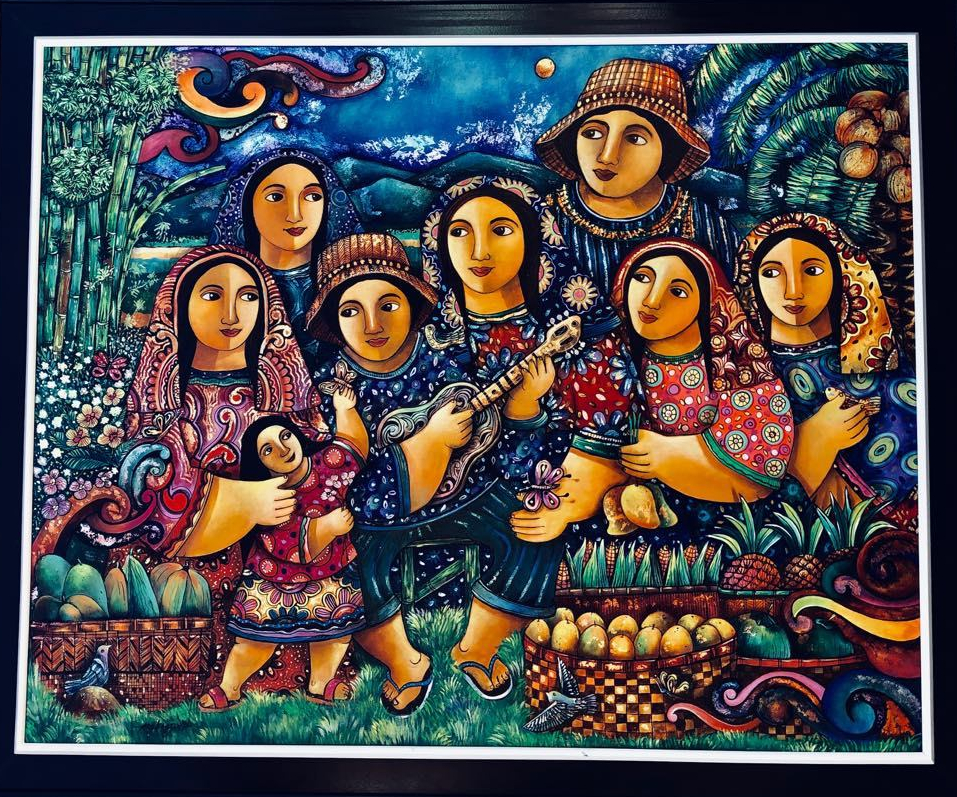
Ang larawan ay isang obra ni G. Aris Bagtas, “Musika ng Liwanag at Gabay” (4×5 ft., 2012 acrylic painting) na tumatalakay sa mabuting samahan ng pamilya at magkakamag-anak.  Araw-araw ang Pasko kung nasa puso palagi ng bawat isa ang pagmamahal at samahan ng pamilya at mga kamag-anakan.

Christmas: A Decision To Choose Jesus, Our Highest Good

belen
The Lord Is My Chef Christmas Recipe 2018
            My dearest readers,

            A blessed Christmas to you all!  Thank you very much in joining me in this journey with our Lord Jesus Christ.  Thank you very much for following and “liking” my blogs.  It is my hope that somehow you have seen a glimpse of God’s majesty and kindness in my reflections.  On this joyous day of Christmas, join me in simply praying to our Lord Jesus born on this day.  Join me in reflecting some important things I have learned about Christmas.

            These past nine days in our reflections, I have tried asking Jesus about any message for me and for you, my readers and my parishioners.  As His birthday approached, I told Him some thoughts within me about Christmas although I am very sure those were not really mine but His also.  That is prayer:  conversing with God who has always been speaking to us.  We simply respond to Him.  And here is our prayer this Christmas…

            A blessed happy birthday to you, Lord Jesus Christ!  Thank you for the gift of the Holy Spirit in enabling me to start this prayer like Zechariah, giving praise and glory to you for “coming to us to save us and set us free” (Lk.1:68).  As I prayed over the gospels for the three Masses of your birthday, there were some things that came to my mind that I wish to offer to you.  Most likely, these must have actually come also from you.

             First lesson I have realized this Christmas: there is always somebody trying to be a king or an emperor among us, even within us.  There is always somebody wishing to unseat you, even claiming to be the Messiah or the Christ.  That has always been the setting of your coming, Lord:  “In those days a decree went out from Caesar Augustus that the whole world should be enrolled.  This was the first enrollment, when Quirinius was governor of Syria.  So all went to be enrolled, each to his own town” (Lk.2:1-3).  Among those who followed that order were your parents who were poor with no choice but obey the Roman emperor who believed in himself to be a god, the savior of the world.  Until now, Lord, there are people who act like emperors by coming out with all kinds of plans and dreams of grandeur, lording it over their people with many programs that benefit the poor and the needy but in reality are just feeding on their bloated egos and twisted minds.  They are everywhere, not only in government but sadly even in the church when some priests and volunteers destroy the unity of the parish or the clergy with their liturgies and plans so everyone would come for you Jesus but actually for them.  More sadly are these people found also in many families like the perfect father who feels he had never made any mistake in life or the manipulative mother who is convinced she knows everything; the monster brother or sister who always feels as sacrificing the most when in fact the one grabbing everything even the slightest attention.  They are the “pa-bida” always feeling as the “vida” when in fact are the “contravida”, sowing divisions and animosities everywhere.

             Give us the grace of humility, to always recognize you as the great and almighty God who chose to be born like a child to show us that the greatest power in the universe lies in being small like a child and not in being big.  Remind us always that each of us is an inn keeper who must always make room for you in our hearts.  Remind us always that we are your own, that you always come to us but sadly, many of us refuse to accept you as your beloved disciple John said, “He came to what was his own , but his own people did not accept him” (Jn.1:11).  St. Luke noted that it was the first enrollment when you were born 2000 years ago, meaning, there were still others that subsequently followed that until now continues to this day with the many people claiming to be you the Messiah, acting like emperors.  As we celebrate your birth today, keep us grateful to your coming and most of all for staying with us since then, give us the grace of Joseph and Mary to brave the long and dark journey to bring you forth in this world, truly the Son of God, the Savior of the world.

             Second lesson you have taught me this Christmas Lord Jesus is the opposite of the first: there would always be those taken for granted, those ignored and rejected who are like the stone rejected by the builders who become the cornerstone of the building as you used to say in your preaching.  Of course that is clearly you, Lord Jesus!  But we thank you for making us share in your greatness.  How brilliant is the wit and humor of St. Luke who said that all went to be enrolled only to reveal later in his narration that not entirely everyone.  There were those unmindful of the census going on since the officials also did not care at all about them too like the shepherds who were among the poorest of the poor of that time.  And the funny twist is that they got the best seats on your birth!  Now there were shepherds in that region living in the fields and keeping the night watch over their flock.  The angel of the Lord appeared to them and the glory of the Lord shone around them, and they were struck with great fear.  The angel said to them, “Do not be afraid; for behold, I proclaim to you good news of great joy that will be for all the people.  For today in the city of David a savior has been born for you who is Messiah and Lord.”  And suddenly, there was a multitude of the heavenly host with the angel, praising God and saying, “Glory to God in the highest and on earth peace to those on whom his favor rests” (Lk.2:8-11,13-14).

             What a beautiful story, Lord!  Your birth echoes the song of your Mother Mary, her Magnificat where she proclaimed “He has shown the strength of his arm, and has scattered the proud in their conceit.  He has cast down the mighty from their thrones and has lifted up the lowly.  He has filled the hungry with good things and the rich he has sent away empty” (Lk.1:51-53).  Many people still don’t get it, Lord.  First with you:  in crucifying you on the Cross, you have changed entirely the course of human history.  You who have been so ridiculed and put to shame with all the false accusations until now is the only person with the most influence in the world.  The Church you have established has also gone through so many destabilization plots within and outside but still here, despite our many sins and weaknesses, and yes, amid our hypocrisies.  And many of us today celebrating your birthday have just gone through so much beatings this year but now thankful before you because you have never forsaken us.  And those fake gods and emperors?  Trying to amuse themselves with more lies as they suffer being totally alone and empty within.

             Lord Jesus Christ, it has been raining since two days ago and more rains are expected this week.  Some, including me, feel your birthday today seems sad and gloomy.  But as I prayed over the stories of St. Luke about the harsh conditions when you were born, I have learned that is what Christmas Day is for – a beacon of light to guide us in the many mountains and valleys, cliffs and ravines we travel in this journey of life.  There would always be people who would make life difficult for us, conditions everywhere that are unfavorable to us but on this day of your birth, you are asking us to stand by you, to make that conscious decision to trust you that good things and better days are ahead of us.  Christmas is about making that conscious decision to always have you, Lord Jesus Christ as our highest good in life.  As our patron saint said, “From your fullness O Lord, we have all received , grace in place of grace” (Jn.1:16).   AMEN. Fr. Nicanor F. Lalog II, Parokya ng San Juan Apostol at Ebanghelista, Gov. F. Halili Ave., Bagbaguin, Sta. Maria, Bulacan.

Photos from Google.

humbleheart

Advent is God Leading Us to New Directions in Life

48396795_474653906393673_4933836951066247168_n
The Lord Is My Chef Simbang Gabi Recipe-9
24 December 2018
2 Samuel 7:1-5, 8-12, 14, 16///Luke 1:67-79

            Finally!  It is the word of the day.

            Finally we have completed the nine-day novena of Christmas but that is not the true joy of our annual Simbang Gabi tradition.  What is most essential is in these nine days of rising early for the novena, we have rediscovered Jesus Christ in ourselves and among others while at the same time recommitted ourselves to Him again as our only fulfillment in life.  I hope that in the past nine days we have rediscovered and even brought back somehow to our lives our sense of the sacred that is now fast fading out in our very consumerist society.  Through the many religious symbolisms found in our liturgies and readings these Advent season, it is hoped that we have rediscovered God – as well as our sense of the sacred – who is the most meaningful and essential in life.  

            Finally today also, we find the only male character in St. Luke’s story of the coming of Christmas regaining his stature after being on the distaff side, Zechariah.  After disbelieving the good news of (finally) having a son through the angel Gabriel’s annunciation at the Temple when he was forced into silence by becoming mute and deaf, Zechariah was finally able to speak again after declaring his son shall be named John.  And his very first words after being silent for nine months were praises to God the Almighty like Mary during the Visitation.  Called theBenedictus, Zechariah affirmed and confirmed in himself first the reality and truth of God being present in our lives amid the many twists and turns in life, narrating His reality and fidelity to His promises from the time of the Patriarchs and the Prophets of Israel down to the birth of John who would prepare the Christ.  In effect, Zechariah had finally come into a full circle in singing the Benedictus:  like his wife Elizabeth and son still in her womb John, St. Luke tells us how Zechariah was also filled with the Holy Spirit at that instance on the naming of John when he prophesied, “Blessed be the Lord, the God of Israel” (Lk.1:68).

          Zechariah shows today the fruits of his “forced silence” that had deepened his priesthood that is very evident in the opening line of Benedictus, giving glory to God for His fidelity and mighty acts to save Israel.  It is very similar with some of the popular parts of the psalms that every Jew prays.  There are three important reasons that Zechariah tells us why God is blessed:  “for he has come to his people and set them free,  he has raised up for us a mighty Savior, born of the house of his servant David” (Lk.1:68-69).  What is amazing in the Benedictus is that the verbs are in the past tense, of the works of God being done in the past like visiting His people, setting them free or redeeming them by sending Jesus Christ.  Like the Magnificat, it is a looking back and a looking forward to more great things God has in store for us.  Zechariah is reminding how God has never stopped working wonders for us, speaking and acting through prophets so many years ago even before the coming of Christ who is the fulfillment of all His promises.

           We have mentioned how we priests and other religious and consecrated persons sing the Magnificat every evening; the Benedictus, on the other hand, is sung every morning prayers called lauds.  As we face a new day, like Zechariah at the birth of his son John, we look back and remember so that in the process we renew our faith and trust in God who never stops in working for our good.  We praise God and put our trust and confidence in Him for every new day, hoping He would continue to visit us, redeem us, and raise us up from the many challenges we are going to face. But most of all, we are reminded too by Zechariah at this time, on the eve of Christmas, to ponder in our hearts where the Lord is leading us to?  Zechariah had seen the hand of God in Israel’s history, in his own life, and could see it also present in the coming life of his son John.  It is very clear that God is our leader in life, the invisible hand who directs us.  When we come to think of it, Zechariah’s forced silence was a way for him to rediscover again his sense of God and his sense of the sacred.  So many times for us, including us priests that although we keep our prayers and devotions, they are devoid of God.  One of the things this generation is fast losing is that sense of the sacred when everything is not taken for granted and trivialized.  How I hate before the Metro Film Festival during Christmas when we as the only Christian nation in this part of the world celebrates the merriest and longest Christmas are feasting on movies about evil and horror movies.  At least these past few years, there have been marked improvements in our film industry with great movies coming out.  Last year I was able to see the adaptation of Nick Joaquin’s “Portrait of the Filipino as Artist” that was magnificent in its interpretation of the play.
 
          On these remaining hours of the day before Christmas, imitate Zechariah to get some silent moments with our self and with God to reflect on where is the Lord leading us to this Christmas?  What direction in life is He asking us to follow?  In the first reading we have heard God asking David to stop his plans of building a temple for Him.  There was nothing wrong with building a temple but it was not the plan of God for David but for his son Solomon.  The same thing with us:  no matter how good our plans are for God and for others, it is the direction God has for us?  We can never prepare the way of the Lord unless we first sub it to His plan and follow His directions.  A blessed Christmas to you! AMEN. Fr. Nicanor F. Lalog II, Parokya ng San Juan Apostol at Ebanghelista, Gov. F. Halili Ave., Bagbaguin, Sta. Maria, Bulacan.
*Photo by author, altar linen of our Parish Church.  May we follow God’s directions for our lives.

Advent is God’s Tenderness and Sweetness

49116908_550946642036661_8965409051152220160_n
The Lord Is My Chef Simbang Gabi Recipe-8
Fourth Sunday of Advent, 23 December 2018
Micah 5:1-4///Hebrews 10:5-10///Luke 1:39-45

            Christmas is a story of love, about the meeting of lovers with God as the Great Lover who gave us His only Son because of His immense love for us.  Unfortunately, this love of Christmas is often presented in the cheesy songs as romantic love like in “Pasko na Sinta Ko”and “Last Christmas”.  The word “lovers” may be too serious as a term for us to relate this with today’s gospel the Visitation of Mary to her cousin Elizabeth; but, the truth is, both women were so in love with God who clearly loved them so much with children in their womb bound to change the course of human history forever.  They in turn, were also filled with love for each other as expression of their love for God.  And when there is love, there is always tenderness and sweetness that all happen in the context of a visitation that we first try to reflect upon.

             Visit and visitation may seem to be one and the same in the sense that both have a common Latin root word, the verb to see, “vidi, videre” from which came the word video.  But, a visit is more casual and informal without intimacy because it is just “a passing by” or merely to see.  It is more concerned with the place or the location and site and not the person to be visited.   We say it clearly in Filipino as in “napadaan lang” when it just so happened you were passing by a place and even without any intentions, you tried seeing someone there.  On the other hand, visitation is more commonly used in church language like when a bishop or priests come to see the parishioners in remote places.  This is the reason a chapel is more known as a visita in our country because that is where priests visit and check on the well-being of people living in areas very far from the parish usually at the town proper.  Aside from being the venue for the celebration of Masses, the visita serves as classroom for catechism classes and other religious even social gatherings in a particular place.  Thus, visitation connotes a deeper sense in meaning because there is an expression care and concern among people, a kind of love shared by the visitator/visitor and the one visited like Mary and Elizabeth.  Visitation is more of entering into someone’s life or personhood as reported by St. Luke on Mary’s visitation to Elizabeth where Mary “entered the house of Zechariah and greeted Elizabeth” (Lk.1:40),  implying communion or the sharing of a common experience.  In this case, the two women shared the great experience of being blessed with the presence of God in their wombs!

          Visitation, therefore, is a sharing or oneness in the joys and pains of those dear to us.  The word becomes more meaningful when we try to examine its Filipino equivalent which is “pagdalaw” from the root word “dala” that can be something you bring or a verb to bring.  When we come for a visitation, we dala or bring something like food or any gift.  But most of all we bring our very selves like a gift of presence wherein we share our total selves with our time and talents, joys and sadness, and everything to those being visited.  And that is what Mary did exactly in her visitation of Elizabeth where she brought with her the Lord Jesus Christ in her womb, becoming the first monstrance of the Lord as well as His first tabernacle.  We are invited to become like Mary in the visitation of others to bring Christmas and Jesus Himself to others by allowing our very body to be the “bringer” or “taga-dala” of Christ.  The Lord Himself is the highest good we can bring as pasalubong in ever visitation we make.  And if we can only be like Mary in our visitations and dealings with one another sharing Jesus Christ, then we also bring with us God’s tenderness and sweetness to others.  In a world that admires toughness and roughness, qualities like tenderness and sweetness are so rare to find these days.  How sad, even tragic is the viral video of bullying at the Junior High School of the Ateneo last week that has spawned other forms of bullying with everybody lynching on the bully, making all kinds of jokes out of the incident while forgetting the bigger bullies we have in the halls of power these days.  See that the two most popular presidents ever elected won the hearts of many voters because of their macho image of astig or sanggano, relishing their pugnacious character and behavior with matching cuss words and street talk, exactly the bullies we often condemn?!

             Back to our topic…tenderness and sweetness in Filipino are often translated in just one word which is “malambing” from “lambing” that has no direct English translation except that it connotes a loving affection; but, both terms are more than just affections but stirrings from the heart that move us into action.  Tenderness is very much like gentleness; the former is more focused while the latter is very general attitude.  Tenderness is more than being soft and gentle but an awareness of the other person’s weaknesses, needs and vulnerabilities.  A tender person is one who tries not to add more insult to one’s injuries or rub salt onto one’s wounds so to speak.  A tender person is one who tries to soothe and calm a hurting person, trying to heal his/her wounds like God often portrayed in many instances in the bible in lovingly dealing with sinners filled with mercy.  Like God, a person filled with tenderness is one who comes to comfort and heal the sick and those taking on a lot of beatings in life.  When Jesus Christ came, He also personified this tenderness of God like when He is moved with pity and compassion for the sick, the widows, the women and the children and the voiceless in the society.  Tenderness is coming to heal the wounds of those wounded and hurt, trying to “lullaby” the restless and sleepless.  Mary visited Elizabeth because she also knew the many wounds of her cousin who for a long time bore no child, living in “disgrace before others” as she had claimed (Lk.1:25).

            Sweetness always goes with tenderness.  It is the essence of God who is love.  Anyone who loves is always sweet that always comes naturally from within, bringing out good vibes.  It is never artificial like Splenda, always flowing freely and naturally that leaves a good taste and feeling to anyone.  In the Hail Holy Queen, Mary is portrayed as “O clement, O sweet Virgin Mary” to show her sweetness as a mother.  According to the late Fr. Henri Nouwen in his book “The Return of the Prodigal Son”, we are all invited to be like God in having both the qualities of a father and mother in Him.  Basing his reflections on the painting by Rembrandt of the said parable, God has a father’s hand that is supportive, empowering and encouraging and a mother’s hand that is consoling, caressing, and comforting.  There are no pretensions and pompousness in being sweet, never needs much effort to exert in showing it for it comes out naturally and instantly.

            Tenderness and sweetness are the most God-like qualities we all have but have buried deep into our innermost selves, refusing them to come out because of our refusal to love for fears of getting hurt and left behind or, even lost.  When Mary heard about Elizabeth’s condition, she simply followed her human and motherly instincts that are in fact so Godly – she went in haste to visit her.  Tenderness and sweetness are the twin gifts of Christmas to humanity when God almighty became little and vulnerable like us so we can be great and powerful like Him in being able to love.  Let me end this long reflection with a quotation from the classic novel “The Plague” by Albert Camus:  “A loveless world is a dead world, and always there comes an hour when one is weary of prisons, of one’s work, and of devotion to duty, and all one craves for is a loved face, the warmth and wonder of a loving heart.”  Let that love in you come out this Christmas and hereafter, simply be human like the child Jesus and be surprised at its tremendous power to change the world like God Almighty.  AMEN. Fr. Nicanor F. Lalog II, Parokya ng San Juan Apostol at Ebanghelista, Gov. F. Halili Ave., Bagbaguin, Sta. Maria, Bulacan.

*Photo by the author, our Nativity scene at the side of the church with the manger still empty.  Be the Child Jesus Christ, be tender and sweet to someone going through hard times in life, to someone suffering in silence.  Let them feel Christ, let them be touched by God with your concrete love of tenderness and sweetness.

Advent is Looking Back – and Forward – to God’s Goodness

48393157_735339493505987_5673987050278223872_n (1)
The Lord Is My Chef Simbang Gabi Recipe-7
22 December 2018
1Samuel 1:24-28///Luke 1:46-56

          Mary’s prominence lies not only in giving birth to Jesus Christ but more of her being His perfect disciple, the first Christian, the first receiver and doer of the Word who became flesh in her womb.  After sharing Christ with Elizabeth in the Visitation, Mary now sings the Magnificat like the song of Hannah in the first reading when she was gifted by God with the child Samuel despite her barrenness.  It is very amazing that the Blessed Virgin Mary is the only person who has appeared most – five times – as a cover of the TIME Magazine.  Likewise, her Magnificat is said to be the only poem that has been set to music more than any other in the whole history.  Almost every great musician has worked on Mary’s canticle like Bach, Mozart, Vivaldi and Rachmaninoff while for over a thousand years it had been sung or recited in the evening in monasteries around the world following St. Benedict’s rule in the sixth century. The Magnificat is a song of praise and thanksgiving to God, Mary’s own experience of God not only in her own life but also in her cousin Elizabeth who was barren and old yet conceived a child to become the Lord’s precursor, John the Baptizer.  At the Visitation, Elizabeth praised Mary but when it was Mary’s turn to speak, she praised God instead of Elizabeth contrary to common gesture of returning her favour because it was very clear with her that every gift is from God, and the greatest gift we can all have from God is His Son Jesus Christ whose birthday we celebrate on Tuesday.

            What is so remarkable with the Magnificat is its Advent flavor:  it is not only a praise and thanksgiving to God for all the wondrous things He had done to Mary and to us all but also a song of looking forward to more blessings to come from Him!  That is what Advent is all about, a looking back to the first Christmas and a joyful waiting for the Second Coming of Jesus Christ!  This is very evident in her opening lines, “My soul proclaims the greatness of the Lord; my spirit rejoices in God my savior.  For he has looked upon his lowly servant.  From this day all generations will call me blessed:  the Almighty has done great things for me, and holy is his Name” (Lk.1:46-49).  It is definitely a fruit of her prayer or gestational silence we mentioned the other day like what Elizabeth did.  Mary took into her inmost being the message of the angel to rejoice as a highly favored one of God, acknowledging the work of grace in her despite her stature in life.  Again we find here some strong Jewish flavors of which Mary must be aware of like the expression “the Almighty has done great things for me” which has strong roots in the Old Testament experience of the Israelites and their prophets when God saved them from Egypt and so many trials.  Think of the great things God has done to you also and rejoice!  Look back to the past 12 months and here we are, still together although some badly beaten with some even bruised in life but like Mary and Elizabeth meeting together, there are so many reasons for us to celebrate and thank the Almighty for the great things He had done to us.  And the most wonderful blessing next to God is the gift of family and friends around us, like the two cousins, a beautiful imagery of two pregnant women rejoicing together, celebrating life as they looked back in their personal lives and in their nation’s history the many good things God had done to them since the time of Abraham.

           The Magnificat shows us too that most of the things Mary mentioned have not happened yet:  “He has mercy on those who fear him in every generation.  He has shown the strength of his arm, and has scattered the proud in their conceit.  He has cast down the mighty from their thrones and has lifted up the lowly.  He has filled the hungry with good things and the rich he has sent away empty.  He has come to the help of servant Israel for he has remembered his promise of mercy, the promise he made to our fathers, to Abraham and his children forever” (Lk.1:50-57).  These are a mixture of images from the Old Testament about the things God had done to Israel and to the two cousins but at the same time mention other things that would happen only upon the completion of Christ’s mission.  This is to show us that Mary’s Magnificat is also about the perfect presence of God in Jesus Christ in our lives who is the “same yesterday, today and forever” (Heb. 13:8).

             Last year I was privileged to join my former colleagues at GMA-7 News as their chaplain on a pilgrimage to the Holy Land – all for free with everything in first class!  On our flight back to Manila, we met some OFW’s and one of them was so ecstatic in meeting Ms. Jessica Soho, making a commotion like crazy at the Ben Gurion Airport which is noted for its strict security measures.  A female security officer caught our attention and held us for a while as she checked our papers and passports.  Making things worse, the crazy OFW kept telling the officer to let us go because Ms. Jessica is a celebrity in our country.  That got the Israeli’s blood boiled and turned her attention to me, the only man in our group, asking me to go with her to their office.  That was when the three women of GMA News stood for me – our SVP Ms. Marissa Flores, Ms. Jessica Soho, and newly retired VP Ms. Kelly Vergel de Dios – telling the airport official that I am their friend, a friend for over 30 years, explaining how I used to work with them until I resigned and became a priest.  I felt my world stopping momentarily like in a dream sequence:  everything happened so fast!  There was the possible delay and a lot of interviews but I also felt God’s strong arm holding me, also tenderly caressing me with His mercy when I heard the three veterans of news defending me.  It was the final blessing I got from God during that pilgrimage when the three women of GMA-7 News were like Mary and Elizabeth reminding me how God had worked in our lives all these years.  It was like a Magnificat moment for me that until now I can recall the sweet smile that incident had left me.  Try praying the Magnificatstarting tonight as you thank God for the many wondrous things He had done to you despite the many trials you have also gone.  Thank God for the faithful and wonderful friends who have visited you to see His plans for you and most of all, be open for more blessings to come from Him this Christmas.  Let us pray for the many great women who have changed our lives, the Marys and Elizabeths who visited us and brought us closer to Jesus Christ.  AMEN. Fr.NicanorF.LalogII,Parokya ng San Juan Apostol at Ebanghelista, Gov. F. Halili Ave., Bagbaguin, Sta. Maria, Bulacan

*Photos by the author:  above are the bronze statues of Mary and Elizabeth at the Church of the Visitation; below, our group photo during our Holy Land Pilgrimage last April 2017.

48398771_2164177240301796_9078224252741615616_n

Mary Is the True Miss Universe

SnGiovanniRotondo
The Lord Is My Chef Simbang Gabi Recipe-5
20 December 2018
Isaiah 7:10-14///Luke 1:26-38

            Allow me to join the jubilation over our very own Ms. Catriona Gray’s winning of the Miss Universe 2018 title last Monday in Thailand.  As usual, I did not see it but cannot resist checking the news as everybody talked about her beauty and grace, and most especially her intelligence.  Though I have not seen the other candidates and their performances, I am very convinced she rightly deserves the title especially with her answer to the final question given her.  One quality I like most with Ms. Gray is her being filled with enthusiasm that was very evident with the way she projected herself, exuding with good vibes and life.  Enthusiasm is from two Greek words “en theos” that mean to be filled with God – like the Blessed Virgin Mary who is “full of grace and the Lord is with her” (Lk.1:28).

            On this fifth day of our Simbang Gabi we hear the second story by St. Luke of how the first Christmas happened.  He tells us how six months after announcing to Zechariah the coming of their son John, the angel Gabriel went to Nazareth to announce the good news of the birth of our Savior Jesus Christ to the Blessed Virgin Mary who was betrothed to St. Joseph.  Unlike Zechariah who doubted the angel’s message, Mary was more open with her response by asking how it would all take place.  And the angel said to her in reply, “The Holy Spirit will come upon you, and the power of the Most High will overshadow you.  Therefore the child to be born will be called holy, the Son of God” (Lk.1:35).

            Last Monday we have reflected how St. Matthew ended his story of the genealogy of Jesus Christ with Mary to show her as the new beginning of everything in the world.  Through Mary’s giving birth to Jesus, we now share with Him one common origin in faith who is God as our Father so that despite our many sins and failures, we are given with a fresh start, new opportunities in life daily.  St. Luke bolsters this today with his account of the annunciation of the birth of Jesus to Mary.  As a Jew, Mary must be totally aware of the words of the angel about herself being “overshadowed by the Most High” like in the Old Testament stories of God’s presence in the cloud during their journey in the wilderness after their exodus from Egypt.  Even Moses could not enter the tent when “the cloud covered it and the glory of the Lord filled the tabernacle” (Ex.40:34-38).  To be filled and overshadowed by the presence of God is to be to be possessed by God and eventually to be transformed by God.  Remember how in the movie “The Ten Commandments” when the face of Moses was transformed after meeting God.  The three synoptic gospels record a similar incident of God’s presence in a cloud hovering with Jesus during His transfiguration at Mount Tabor witnessed by Peter, James and John.  The two great prophets of Israel were there, Elijah and Moses conversing with Jesus when a cloud overshadowed them with a voice declaring “this is my beloved Son, listen to Him.”

          Matthew, Mark and Luke tell us how the apostles were all terrified at the sight of the Transfiguration.  And we can also surmise how terrifying it must be to experience God’s presence, to be filled with God.  But that is how grace works!  After seeing our own limitations and yet we are still able to forge on, to achieve greater things, it is God working in us.  This is the reason that St. Luke tells us how the angel greeted Mary during the annunciation using the Greek words “kaire” which is to rejoice and “charis” or “karis” for grace:  “Hail (or rejoice), full of grace!  The Lord is with you” (Lk.1:28).  Wherever and whenever there is grace, surely there is rejoicing. We rejoice in the winning of Ms. Catriona Gray as Miss Universe because it is indeed a grace she had received as an individual and for us as a nation plagued with so much sufferings and miseries.  The late American spiritual writer and monk Thomas Merton rightly said, “We live in a time of no room, which is the time of the end.  The time when everyone is obsessed with lack of time, lack of space, with saving time, conquering space… The primordial blessing, ‘increase and multiply’ has suddenly become a hemorrhage of terror… In the time of the end there is no longer room for the desire to go on living.  Why?  Because they are part of a proliferation of life that is not fully alive, it is programmed for death” (Raids on the Unspeakable, pp. 70-72).

         Advent is the time to get real, to stop pretending.  Advent is the time for us to finally admit our own limitations, to create a space in our hearts and in our lives to let God fill us, to let God possess us.  Like Mary, can we allow God’s power to hover over us and do the same to renew our lives in welcoming Jesus Christ?  Like the question posed to Ms. Gray, think of the many instances in your life where you have learned your most important lessons in life and most surely like her, these were also the moments we have faced or seen many hardships and sufferings yet, instead of being down, they have inspired us, they have transformed us into better persons.  It is here where I admired most Ms. Gray when she said how the slums of Tondo made her look among the poor children for beauty, to see the silver linings, and still be grateful.  What a beautiful soul indeed – something like our Blessed Virgin Mary who told the angel, “Behold I am the handmaid of the Lord.  May it be done to me according to your word.”  Let us now open our hearts to God so the Holy Spirit may hover us, fill us with Jesus Christ.  AMEN.  Fr.NicanorF.LalogII,Parokya ng San Juan Apostol at Ebanghelista, .Gov. F. Halili Ave., Bagbaguin, Sta. Maria, Bulacan

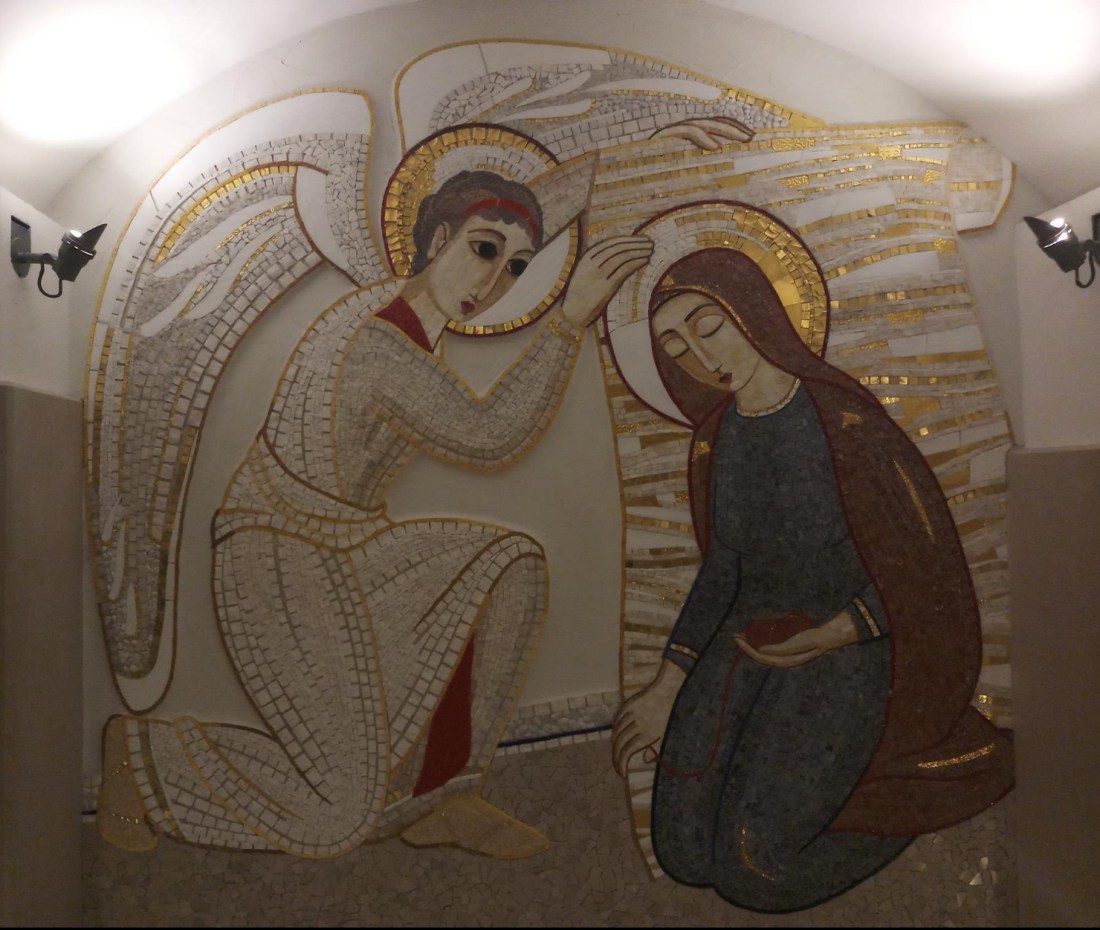
*Photo by my former student at ICSB, Arch. Philip Santiago, mosaic of the Annunciation to Mary at the San Giovanni Rotondo Church, Italy, October 2018.  Used with permission.

Christ Comes in Silence

MaiAthens
The Lord Is My Chef Simbang Gabi Recipe-4
19 December 2018
Judges 13:2-7, 24-25///Luke 1:5-25

            Going to funeral wakes can sometimes be humorous especially when people ask me all kinds of questions that sometimes I wonder if I look like the Google page.  One of the FAQ’s I always get is what is the most difficult part in the life of us priests?  Many would always burst into laughter when I tell them that it is when our back gets itchy and we have no one to scratch it, telling them about the saying “ang hapdi matitiis pero ang kati ay hindi” (pains are bearable but not itch).  This is very true that is why I keep three back scratchers made of wooden carved arm with a hand from Baguio in my room, one in the TV area, the second at my study desk and another at my bedside.  But lately I have found another big problem of living alone as a priest when I never knew I had no voice until I celebrate the Mass in the morning!  And how would I know that I do not have voice when I have nobody to talk to in my room or rectory when I wake up early morning except God who is always in silence?  Sometimes it could be embarrassing and even funny but overall, it is no big deal with me.  In fact, being silently alone in my parish is the most wonderful blessing I cherish so much in my priesthood.

            But going back to our voice, it is one of our most valued possessions as priests or even of anyone.  No wonder, the word “voice” itself connotes power in our language usage for to lose one’s voice is also to lose power and ability to lead.  Without the voice, anyone’s ability to communicate is drastically impaired as you could no longer communicate effectively to express your thoughts and your feelings, you could no longer give advice and counsel to others on many things or teach anyone.  In short, to lose one’s voice means never to be heard again.  Today in our gospel we heard the first story by Luke about Christmas, the annunciation of the birth of John the Baptizer to his father Zechariah while he was serving as a priest at the Jerusalem Temple during its most important feast.  An angel appeared to him to announce how God have heard his prayer and of his wife Elizabeth for a child but instead of being filled with joy with the good news from heaven, Zechariah doubted God.

            Then Zechariah said to the angel, “How shall I know this?  For I am an old man, and my wife is advanced in years.”  And the angel said to him in reply, “I am Gabriel, who stands before God.  I was sent to speak to you and to announce to you this good news.  But now you will be speechless and unable to talk until the day these things take place, because you did not believe my words, which will be fulfilled at their proper time.” (Lk.1:18-20)

            One of the rare commodities in the world today is perhaps silence.  Everybody is talking, even cars and elevators and other machines.  When we examine the bible and even our lives, we see that every communication by God is always preceded by silence.  Before God created everything, Genesis tells us that there was silence first.  The beloved disciple John opens his gospel by saying “In the beginning was the word” to show everything with God was in silence.  Jesus Himself was born in the silence of the night at Bethlehem while the gospel accounts tell us nothing much about His childhood except when He was lost and found three days later at the Temple of Jerusalem.  After that finding at the Temple, what we have are the hidden years of Christ when nothing is heard about Him or from Him for 30 years.  And during His brief ministry of about three years, Jesus used to withdraw to the mountains or wilderness to pray in silence.  Such is the importance of silence not only for our spiritual growth and maturity in Christ but according to experts, also for our total well being as persons.

           In starting his Christmas story with Zechariah being forced by the angel to go into silence, Luke is teaching us the essential value of silence in preparing for Christmas.  Luke described Zechariah and his wife Elizabeth coming from families of priests who must be used to speaking, to giving talks, explaining things to many people.  It seems that with his advanced age, Zechariah must be of a significant stature among his peers.  But now, he had been forced into silence by God so that he may have more time to examine things going on inside and in his life, more time for reflection and even for renewal.  His wife Elizabeth appears to be more properly disposed in receiving the good news about the birth of John with her attitude of silence when she went into seclusion for five months saying, “So has the Lord done for me at a time when he has seen fit to take away my disgrace before others” (Lk.1:24-25).  Similarly like her in the Old Testament was the wife of Manoah who remained silent when a man of God told her she would bear a son to be called Samson, “I did not ask him where he came from” (Jgs.3: 6).

             Advent is the presence of God but sometimes when we are overburdened with so many things like anxieties and problems in life, frustrations and disappointments, sickness and death in the family, we become unaware of His divine presence even if we continue to pray and do our religious duties and devotions.  Too often we lack the conscious awareness of God in our lives that we take Him for granted, considering Him more as a given than a presence and a reality.  Like Zechariah who happens to be a priest who must be more attuned and rooted in God, we hardly notice His coming or even doubt Him and His powers.  God is never put off by our questions but what “irritates” Him is when we question Him, when we doubt Him, when we ask about His character.  That is a lack of faith in Him, a lack of trust, and lack of personal relationship and constant dialogue with Him like what St. Joseph had in our reflections yesterday.  Remember, St. Joseph is the most silent person in the Bible.

          Like the stories of pregnancies we have been hearing these past days, Advent is a call for us to moments of “gestational silence” that is deeper than losing one’s voice or being quiet.  Gestational silence, or pregnant silence if you wish which is what gestation is all about, is withdrawing into ourselves not to escape but to finally face and listen more intently to the rumblings and sounds within us and around us, to listen more intently to God who is our only true voice in life.  Like Zechariah in the gospel today, we could be so tired already of doing everything, banging our heads on the wall to solve everything, to answer everything.  Let us force ourselves in these remaining days before Christmas to go into gestational silence to open ourselves to God speaking to us anew with His other other possibilities and new perspectives for us.  After all, it is only God who is our only true voice in this life in Christ. AMEN. Fr.NicanorF.LalogII,Parokya ng San Juan Apostol at Ebanghelista, .Gov. F. Halili Ave., Bagbaguin, Sta. Maria, Bulacan.

*Photo by Dra. Mai B. Dela Pena, sunset in Athens, Greece, 2016.  Used with permission.