Advent is “putting on Christ”

The Lord Is My Chef Sunday Recipe for the Soul

First Sunday of Advent-A, 01 December 2019

Isaiah 2:1-5 ><}}}*> Romans 13:11-14 ><}}}*> Matthew 24:37-44

From Google.

A blessed first Sunday of Advent to you my dear reader and follower! Today we begin another new year in our Church calendar with this season of Advent. Both the word “Advent” and its concept were borrowed from ancient Rome when provinces prepared for the coming, or “adventus” of the emperor to visit the occupied territories of his empire.

But, Jesus is more than any emperor of the world for he is true God and King of kings, the one who had come, always comes, and will be coming again at the end of time to judge us, both the living and the dead. This Season of Advent gives us the opportunities to intensely prepare for the Lord’s adventus that always begins in our hearts.

Advent has a two-fold character: beginning today until December 16, the readings and prayers set our sights to the Second Coming of Christ at the end of time or the parousia. From December 17-24, focus shifts to the first Christmas when Jesus was born in Bethlehem more than 2000 years ago.

According to St. Bernard of Clairvaux, between these two comings of Christ is his third coming that happens daily in our lives, so ordinary but very sudden like in the time of Noah.

Photo by author, sacristy of our Parish, Advent 2018.

Jesus said to his disciples: “As it was in the days of Noah, so it will be at the coming of the Son of Man. In those days before the flood, they were eating and drinking, marrying and giving in marriage, up to the day that Noah entered the ark. They did not know until the flood came and carried them all away. So will it be also at the coming of the Son of Man.

Matthew 24:37-39

Staying awake, actively waiting for the Lord.

Jesus is definitely coming at the end of time. It is useless to be concerned when that would be because it will be sudden and unexpected. What matters most is our attitude of “staying awake, actively waiting” for the Lord’s coming again.

The Lord cites to us the example of Noah whom God had instructed to build an ark in the Old Testament for the coming great flood meant to cleanse the earth of sins and evil.

To actively wait for the Lord’s parousia means to be a sign of contradiction like Noah who faithfully obeyed God’s will in building an ark and later gathering into it all the animal species of earth.

Imagine the insults Noah had to endure from people laughing at him while building the ark. Yet, he never wavered and faithfully fulfilled his task before the Lord.

From Google.

Jesus cites three other instances of displaying the right attitude in actively waiting for his Second Coming: the two men out in the field, the two women grinding, and the master of the house.

One of the two men in the field was taken while one of the two women grinding was also taken because they were responsibly fulfilling their tasks when the parousia comes; their respective counterparts were most likely doing nothing or very lazy that they were left behind.

The mini parable Jesus inserted at the end shows us the imagery of the master of the house staying awake to keep the thief from breaking into the house in the middle of the night.

These are all about having the right attitude as disciples of Jesus actively awaiting his return. From Noah to the other man in the field, the other woman grinding, and the master of the house, we find from their attitudes of active waiting budding forth their hope in God.

Generally speaking, the way we live our lives determines also how we hope in the Lord.

And this we find in St.Paul’s exhortation to the Christians of Rome:

Brothers and sisters: you know the time; it is the hour now for you to awake from sleep. For our salvation is nearer now than when we first believed; the night is advanced, the day is at hand. Let us then throw off the works of darkness and put on the armor of light; let us conduct ourselves properly as in the day, not in orgies and drunkenness, not in promiscuity and lust, not in rivalry and jealous. But put on the Lord Jesus Christ, and make no provisions for the desires of the flesh.

Romans 13:11-14
Altar table at the Parokya ng San Juan Apostol at Ebanghelista, Bagbaguin, Santa Maria, Bulacan, Advent 2018.

Putting on Christ to show his light to dispel darkness.

St. Paul wrote the Christians in Rome more than 2000 years ago to remind them of the fierce spiritual warfare between good and evil, light and darkness while they were living in the midst of a pagan world and culture.

It was a very difficult time to be truly Christians but St. Paul felt the need to remind everyone of the ever-present reality of the parousia. Like in most of his letters, he captured by the grace of the Holy Spirit the beautiful imagery of disciples with the right attitude awaiting the Second Coming as “putting on the Lord Jesus Christ”.

Putting on our Lord Jesus Christ is not just a mere call to be morally perfect persons but for us to strive in making the light of Christ shine on us so that we may manifest Jesus more in us and in our lives.

Simply put, it is becoming “Christ-like”, a true Christian who is “dead to sin but alive for God in Christ Jesus” (Rom. 6:11), one who lives differently by making Jesus more present especially in these difficult and troublesome times.

The time of St. Paul was no different with our present age with growing materialism and consumerism among peoples, including Christians afflicted with Pope Emeritus Benedict XVI’s “dictatorship of relativism” that have removed God from every aspect of human life, including Christmas itself!

See how we are so focused on Christmas countdowns than with the very reason of the Season, Jesus Christ. See how the media equate Christmas with material things, sugarcoating it with sentimental feelings as most Christmas songs nowadays indicate.

Advent is seeing more of Jesus, than of time.

On this first Sunday of Advent, our sights are redirected anew into Christ’s Second Coming with our important task of making him present in our very selves.

As children of the light, we slowly discover and realize how our definitive salvation is slowly moving towards its fullness in Christ’s parousia when everything is totally changed by God with peace finally reigning supreme over all.
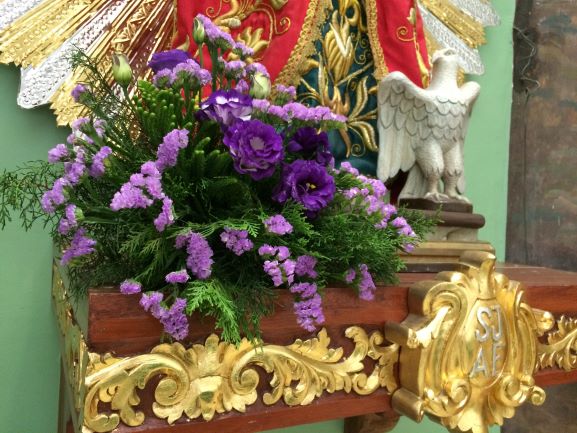
Violets on the pedestal of our Patron Saint, John the Evangelist.

This was the vision of Isaiah a long, long time ago.

It had been fulfilled in Christ’s first coming in Bethlehem over 2000 years ago and it is being fulfilled daily through people filled with hope in God’s justice and love.

In the days to come, the mountain of the Lord’s house shall be established as the highest mountain and raised above the hills. All nations shall stream toward it; many people shall come and say: “Come, let us climb the Lord’s mountain…” They shall beat their swords into plowshares and their spears into pruning hooks; one nation shall not raise the sword against another, nor shall they train for war again. O God of Jacob, come, let us walk in the light of the Lord!

Isaiah 2:2-3, 4-5

People who keep on wondering and asking when will Jesus come again are not really interested with the Lord’s Second Coming but only with themselves like the people during the time of Noah – oblivious to anything else and busy with their own pursuits.

The more we think of the WHEN, the less we think of the WHO of Advent. Let us put on the Lord Jesus Christ to be filled with his light until all darkness in life is dispelled. Amen.

Befriending Jesus

The Lord Is My Chef Breakfast Recipe for the Soul

Tuesday, Memorial of St. Teresa of Avila, 15 October 2019

Romans 1:16-25 ><)))*> ><)))*> ><)))*> Luke 11:37-41

Photo by Pixabay on Pexels.com

“If Christ Jesus dwells in a man as his friend and noble leader, that man can endure all things, for Christ helps and strengthens us and never abandon us. He is a true friend.

Many, many times I have perceived this through experience. The Lord has told it to me. I have definitely seen that we must enter by this gate if we wish his Sovereign Majesty to reveal to us great and hidden mysteries. A person should desire no other path, even if he is at the summit of contemplation… All blessings come to us through our Lord. He will teach us, for in beholding his life we find that he is the best example.

St. Teresa of Avila, from the Breviary

Many times in our lives we have always believed that holiness is just for a few people you have chosen, O God. We feel excluded from holiness, from being a saint.

Because we refuse to try to get near you, doubting you despite our belief in you as God!

“For what can be known about God is evident to them, because God made it evident to them.

They exchanged the truth of God for a lie and revered and worshipped the creature rather than the creator, who is blessed forever. Amen.”

Romans 1:19, 25

Sometimes we have tried befriending you through Jesus Christ your Son.

And like the saints, we have indeed experienced your presence, your reality, your blessedness but unfortunately we stopped striving further as St. Teresa tells us.

O dear Jesus, you always come to me, you always make me experience you but I always try explaining everything, letting my mind work more than my heart and soul that I fail to feel and experience you inside me like those Pharisees bent on finding faults in you.

Give me the grace to be silent and still in you, to wait for you as a friend full of love and trust like St. Teresa of Avila. Amen.

Going beyond the skin

The Lord Is My Chef Sunday Recipe Week XXVIII-C, 13 October 2019

2 Kings 5:14-17 ><}}}*> 2 Timothy 2:8-13 ><}}}*> Luke 17:11-19

Photo by Mr. Jim Marpa, September 2019.

This Sunday readings tell us about the skin, the healing of people afflicted with the dreaded “Hansen’s disease” or leprosy. Since ancient time, it has always been seen with deeper implications than mere wounds on the skin that scars not only the leper but also the community. At its worst, it is regarded as a divine punishment that lepers have to be separated from others to live in designated areas for their treatment.

Skin plays a major role in our social status and mobility. Being the largest organ of the human body, the skin is always the first to be seen and noticed that whatever its condition would always have a big impact on the person, for better or for worst.

This is specially true for us Filipinos who are so concerned with our skin color that we still regard being white or maputi is maganda (beautiful) and having dark skin or maitim is pangit (ugly). No wonder everybody is going crazy to get whiter skin with all those soaps and creams and medicines advertised on billboards everywhere!

In a very funny twist unknown to most Filipinos who idolise white skin, many of our popular devotions in the Catholic faith actually have dark skin like Quiapo’s Black Nazarene and Our Lady of Antipolo?!

But, that’s another story of how skin-deep we can be…..

Going back to our reflection of today’s readings, Jesus is inviting us to go deeper than the skin to realize the richer meaning of having faith in him.

As Jesus continued his journey to Jerusalem, he traveled through Samaria and Galilee. As he was entering a village, ten lepers met him. They stood at a distance from him and raised their voice, saying, “Jesus, Master! Have pity on us!” And when he saw them, he said, “Go show yourselves to the priests.” As they were going they were cleansed. And one of them, realizing he had been healed, returned, glorifying God in a loud voice; and he fell at the feet of Jesus and thanked him. He was a Samaritan.

Luke 17:11-16
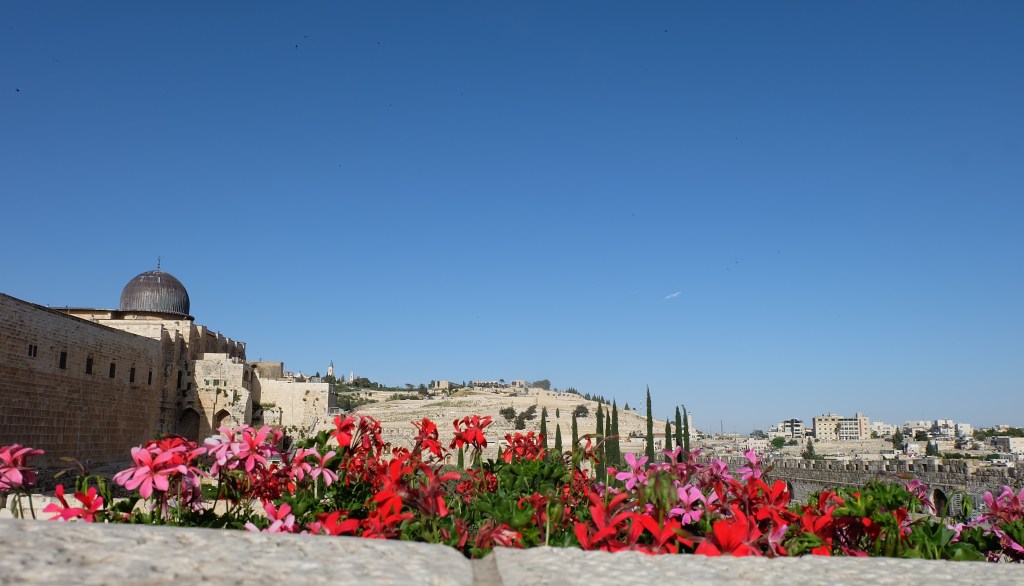
View from the walled city of ancient Jerusalem, May 2019.

Since June 30 of this year, the 13th Sunday of Ordinary Time, we have been following Jesus when “he resolutely determined to journey to Jerusalem” (Lk.9:51). More than a destination to reach, Christ’s journey to Jerusalem is about directions in life because it is spiritual and theological in nature than spatial or geographical.

It is the same truth every pilgrim to the Holy Land realizes too!

And now that Jesus is nearing Jerusalem to fulfill his mission, his teachings are getting clearer and closer to home, indicating also our own “passing over” or pasch with him with the many verbs and movements found in our gospel scene today.

Let’s try reflecting on them one by one. Please bear with me…

“As Jesus continued his journey to Jerusalem” …. Jesus never stops in his journey to Jerusalem to suffer with us, to cry with us, to die with us. He is committed in being one with us in our many struggles and battles in this life until we make it with him to heaven.

“he travelled through Samaria and Galilee.” This is beautiful. Samaria and Galilee are the regions where the poor and marginalized lived, where sinners abound. But, that is where Jesus would always come. When we are in our darkest moments in life due to sickness, failures and disappointments, especially sin – that is when Jesus comes closest to us! In the first reading, we have heard how God’s Prophet Elisha told the Syrian Army General Naaman to bath in the Jordan River to be healed of his leprosy even if he were a pagan and an enemy of Israel! God loves us all.

“As he was entering a village, ten lepers met him.” Keep in mind that Jesus came for the lost like us. Be open and ready for him for he is always passing by. Jesus surely comes to those who patiently wait for him.

“They stood at a distance from him, and raised their voice, saying, ‘Jesus, Master! Have pity on us!’ and when he saw them, he said, ‘Go show yourselves to the priests.’ As they were going they were cleansed. This episode of the healing of ten lepers can only be found in St. Luke’s gospel filled with many meaningful expressions. First is how “the lepers stood at a distance from Jesus.” This is our usual stance with the Lord when we are full of sin, so ashamed to look at him. But, it does not really matter with the Lord who looks more into is our hearts full of contrition than into our ego full of pride as we shall hear three weeks from now in the parable of the Pharisee and tax collector (Lk. 18:9-14).

The lepers cried to him, “Jesus, Master! Have pity on us!” and when Jesus saw them, he told them to see the priests and they were cleansed. This is an extraordinary profession of faith in Christ by the ten lepers who were crying out not only for pity but also mercy. There are only three instances in the gospels when Jesus is addressed in his name, once in Matthew and twice in Luke. This is the first and the second is when Dimas the thief called on him saying, “Jesus, remember me when you come into your kingdom.” To say his name “Jesus” in itself is a prayer, an admission of guilt and sin. That is why, as the ten lepers went their way to the priests, they were “cleansed” like Dimas on the cross was instantly promised with paradise.

“And one of them, realizing he had been healed, returned, glorifying God in a loud voice; and he fell at the feet of Jesus and thanked him. He was a Samaritan.”

Here we find every encounter with Jesus in prayer and the sacraments as well as in various events in our life is a passage to salvation and new life. See the transition from being cleansed into being healed: that is something deeper than the skin, so to speak. The Samaritan was not merely cleansed of his skin blemishes but most of all, his soul and inner being that Jesus later told him to “Stand up and go; your faith has saved you.”

Sometimes in life, we stop at being cleansed by the Lord; after obtaining our prayers and wishes, we never go back to him until we face another problem again. Are we willing to keep on going back to Jesus to kneel before him and to thank him?

Last Sunday we prayed to Jesus to increase our faith and today like the ten lepers from a distance, we cry out to him as our Master to have pity on us. We always have that gift of faith in us but we have to deepen and cultivate it daily in our prayer life and most especially in the Sunday Eucharist, the highest expression of giving thanks to God.

Let us live in our faith and trust in God’s gift freely given to everyone regardless of who we are. Let us rely in the words of St. Paul that

“if we have died with him we shall also live with him; if we persevere we shall also reign with him. But if we deny him he will deny us. If we are unfaithful he remains faithful, for he cannot deny himself.”

2 Timothy 2:11-13

A blessed Sunday to everyone!

Prayer to persevere

The Lord Is My Chef Breakfast Recipe for the Soul

Thursday, Week XXVII, Year I, 10 October 2019

Malachi 3:13-20 ><}}}*> ><}}}*> ><}}}*> Luke 11:5-13

Photo by Mr. Jim Marpa, September 2019.

Nothing and nobody escapes you, O God. You know very well not only what is in our hearts and in our thoughts but you can also hear what we talk and discuss. Most of all, you know what we need.

Give us the grace to persevere in your words, Lord; to remain faithful in your precepts and promises.

Let us strive to bear pains, ready to sacrifice comforts because there are no shortcuts in this life.

Let us keep in our minds and our hearts that basic truth that “life is difficult”. In this world where everything seems readily available that many have disregarded your presence and even existence, teach us Lord to persevere, to be patient in waiting for your coming to fulfill us, to grant our prayers.

Teach us to value silence more than noise.

To surrender everything to you than be manipulative.

Let us find time to be alone with you and for you than be preoccupied with people and things.

Grant us the Holy Spirit, Lord, to fill us with your love and wisdom to always persevere in life for we hold on to your promise that

“…there will arise the sun of justice with its healing rays.”

Malachi 3:20

Amen.

Girding loins and guarding self

The Lord Is My Chef Sunday Recipe for the Soul, Wk. XIX-C, 11 August 2019
Wisdom 18:6-9 >< }}}*> Hebrews 11:1-2, 8-19 >< }}}*> Luke 12:32-48
From Google.

One of the series I am following at Netflix is “Money Heist”. It is very suspenseful because unlike other crime series, its plot is unpredictable and spiced with amusing conversations. Like one episode when the lead character called Professor repeatedly mentioned to the Police Inspector during their first date of how he is not a “Basic Instinct” material, referring to Michael Douglas who starred in the movie with Sharon Stone. I felt the line anachronistic because the Professor is so young in the series to make a point reference to the 1992 erotic thriller. But it was a very good line expressing fully what the scene was all about, of a man and a woman following their basic instinct in having sex without really knowing each other so well, especially the Inspector who is a battered wife newly divorced from her husband – also a police officer- and in a relationship with her sister!

Now you see what I have been telling you… but, what I really wish to share with you is an archaic term related with “basic instinct” that Jesus used in the gospel today:

Jesus said to his disciples: “Gird your loins and light your lamps and be like servants who await their master’s return from a wedding, ready to open immediately when he comes and knocks. Blessed are those servants whom the master finds vigilant on his arrival. Amen, I say to you, he will gird himself, have the servants recline at table, and proceed to wait on them.”

Luke 12:35-37
From Google.

Loins refer to that part of our body between the lowest ribs and hipbones, the pelvic area where the genitals are also located. It is believed to be the source of erotic or procreative powers we refer to as “basic instinct” or simply guts as in gut feeling.

During the time of our Lord, men wore long clothes and they have to “gird their loins” in order to move freely when walking and working. Eventually, men ceased wearing long clothes with no need to gird their loins but still have to tighten their pants, sometimes with a belt, to move freely as well. And even if there were no more loins to gird, the expression continued to be used to mean being on guard, being ready for any emergency and situation like a military attack.

This is the whole point of the Lord’s teaching this Sunday: we have to be on guard and ready always for his coming. In fact, anything can happen instantly that could also be life-changing. Girding one’s loins, being on guard and ready for the Lord’s coming requires active faith on our part, an inclination towards God already present in us.

There are actually three parables in our gospel this Sunday but we are given the option to use only the one we have heard which is the second set. In this parable, Jesus used the imagery of being on guard like the “faithful servants waiting for their master’s arrival from a wedding feast” to indicate his coming in the Eucharistic celebrations. Every Mass is our dress rehearsal for our entrance into heaven but we always take it for granted, finding all the reasons and excuses to skip especially the Sunday Mass.

Altar table of the Church of Dominus Flevit (the Lord Wept) with the old Jerusalem at the background. Photo by author, April 2017.

The Mass is our expression of our readiness to enter heaven as we joyfully proclaim after every consecration of the bread and wine that “Christ will come again.” But, even those who regularly come for the Sunday Mass do not take it seriously, not truly present with “full and conscious participation” enunciated by Vatican II 50 years ago.

Notice how in the third parable Jesus mentioned “faithful and prudent stewards” (Lk.12:42) to emphasize the need for servants and ministers at the altar to be more prepared than anyone else for his coming. So true! How can the people pay attention to the scriptures being proclaimed if the lector’s voice is very soft or incomprehensible? How can the congregation thank God for speaking to them anew if the lector’s face and disposition are so gloomy and even horrific?

And this refers more to the priest as presider of the Mass! Much is expected from us priests not only by the congregation but also by the Lord himself! How can the people feel Christ’s coming in every Mass when the priest himself does not meet the Lord, when he is not prepared physically, mentally, emotionally and spiritually? What a shame when people complain that they hardly feel the Divine in every Eucharistic celebration! Always we find two extremes in many parishes where at one end are lethargic priests lacking the energy to lead their people into heaven during the Mass while at the other side are the showbiz priests so in love with themselves, with their voice and showmanship that the Eucharist has become a variety show.

Jesus reminds us in all his parables this Sunday that we priests and ministers at his altar of the Sacrifice of the Mass are his servants waiting for him, our Lord. We are never the focus but Jesus Christ alone! Let us not steal that honor from him.

Pyramids of Egypt, May 2019.

Speaking of stealing, Jesus added towards the end of his second parable on the need to gird one’s loins for his coming because it is like the coming of the thief at night. We must always be prepared because nobody knows when the thief strikes. And we find elucidations of this from the first and second readings we have earlier heard that speak about disposition for God.

From the Book of Wisdom, we are reminded how the liberation of the Israelites – their Exodus from Egypt – happened in the darkness of the night. Every celebration of the Mass is an active waiting for the Lord’s coming that also calls for an active faith wherein we are disposed or inclined towards God already with us. Such was the attitude of the Israelites leading to their Exodus from Egypt when Moses told them of God’s plan that every day, they were raring to go.

In the Letter to the Hebrews, the author beautifully expressed that “Faith is the realization of what is hoped for and evidence of things not seen” (Heb.11:1). He gives us Abraham as the perfect example of a truly faithful one to the Lord, always ready for his coming. In three instances, the author of the Letter to the Hebrews showed how Abraham had the perfect disposition of actively waiting for God’s fulfillment of his promises to him: journeying from Ur to the Promised Land he did not know where; being the father of nations as numerous as the stars of the sky when he and Sarah were still childless at their age of 90; and, in obediently offering Isaac to God.

Girding our loins, being on guard also means having the discipline of waiting for God. It is not enough to wait; we need discipline, we need to follow certain things to stay focused. As we have mentioned earlier, the loins is the region of our basic instinct. So many opportunities have been missed by many men and women simply because of small mistakes, of being caught off-guard in simple instances when everything snaps in an instant when they followed the lower basic instinct, forgetting the higher ideals.

Abraham girded his loins so well that he never wavered in his faith in God until his promises were fulfilled because he always had that disposition for him. This Sunday, Jesus is reminding us to be patient in waiting for him, to have the discipline to stay focused with him and our dreams and aspirations in life for he will fulfill them in his time. It is very important that like Abraham and the faithful servants in his parable, we are always present when he comes to seize his blessings! A blessed week ahead with you! Amen.