Life, sometimes, is a series of “good news-bad news” situation like the Beatitudes preached by Jesus during His sermon on the plain last week: the blessings are the good news while the woes are the bad news.
But, wait…! Such a view is the way of the world, not of Christ’s disciples!
As we have reflected last Sunday, the Beatitudes are the paradoxical happiness of the disciples of Christ because they all run directly against the ways of the world. Today we hear more paradoxical teachings from Jesus that are actually His “win-win” solution for our many problems like wars and other forms of enmities. Unfortunately, we have never given them a try because we always complain the ways of the Lord as being far from realities of life, impossible to imitate because He is God and we are not.
Today let us set aside all these reservations and arguments to reflect on this new set of paradoxical teachings by the Lord: Jesus said to his disciples: “To you who hear I say, love your enemies.od to those who hate you, bless those who curse, pray for those who mistreat you… But rather, love your enemies and do good to them. Be merciful, just as your Father is merciful. For the measure with which you measure will in turn be measured out to you” (Lk.6:27-28, 35, 36, 38).
It is very striking that Jesus repeated twice His call to “love your enemies”.
Does He not care about us who have to bear with the sins of evil people? What a good news to those who hate us, curse us, and mistreat us! Suwerte sila! We would surely say they must be so lucky, even blessed with us who strive to heed the calls of Jesus to love them our enemies.
But, on deeper reflections, we are actually more blessed when we try to love our enemies because that is when we elevate – or “level up” as kids would say – our hearts to be merciful like God. Experts claim that the best way to exact revenge against people who have hurt us is to shower them with good deeds and kindness from us they have offended. According to these experts in counselling and psychology, evil people get disappointed and angrier with themselves when their evil plots fail especially when their targets do not react negatively. They sound understandable because evil people derive joy in making people miserable. So, why be miserable?
Far from being their “punching bag”, the Lord simply wants us to teach our enemies to respect us, to be kind to us by not being like themselves. In loving our enemies, we teach evil people that more powerful than sin is the power of love. Sin and evil consume a person while love and kindness make a person grow and mature and bloom to fullness.
Far from being passive, to love our enemies by returning evil with good is always the most active method in fighting sins. When Jesus asked us to offer the other side of our cheeks to those who slap our face or when we give them our tunic when they demand our cloak, we are showing these evil people that love is never exhausted unlike evil. Love is boundless and the more we love, the more we have it, the more we keep on doing it. Evil, on the other hand, reaches a saturation point that we get fed up with it, then we we stop doing it because it is exhausting and worst, consumes us within that in the
process destroys us. Think of the most evil person you have known and surely, you find that person so ugly, so zapped of life and energy, eaten up from within by a festering wound. Evil people will never have peace and joy within, glow on their face and skin because they are rotting inside like zombies.
In the first reading we heard how David as a type of Christ foregoing vengeance by holding on to God, trusting Him completely that he chose not to strike King Saul who was then trying to kill him out of jealousy. As disciples of the Lord, we have to trust in the Word of God that can transform our hearts of stone into natural hearts filled with love and mercy like Him. This is the point being explained by St. Paul in the second reading wherein Christ as the “second Adam from heaven” had made us bear the “heavenly image”despite our “earthly image” that is weak and sinful having come from the “first Adam from earth”. Through Baptism, we have been endowed with all the necessary grace from God, transforming us into better persons of heaven.
One of my favorite sayings came from the desk of a friend of mine I used to visit in their office that says “If you have love in your heart, you have been blessed by God; if you have been loved, you have been touched by God.”
See how God has loved us so immensely without measure! Remember that scene two Sundays ago when Jesus borrowed the boat of Simon as He would do with our voice, with our hands, with our total selves? Who are we or what do we really have and own that the almighty God would borrow from us? Nothing! Yet, Jesus comes to us daily with all His love without measure to bless us with everything we need. So, who are we now to love by measuring everything, loving only those who love us, lending only to those who could repay us?
Imagine how astonishingly disproportionate is the love of God with our kind of love. It is in this light must we see the meaning of Christ’s final lesson this Sunday: “For the measure with which you measure will in turn be measured out to you.” So paradoxical and provocative yet so true! This Sunday, may we share God’s love in our hearts with others, especially with our enemies so they may also experience the loving and merciful touch of God. Then we begin to realize too the “win-win” solution of Christ to humanity. Amen.Have a blessed week!Fr. Nicanor F. Lalog II, Parokya ng San Juan Apostol at Ebanghelista, Gov. F. Halili Ave., Bagbaguin, Sta. Maria, Bulacan.
Side garden of the Church of the Beatitudes with the Lake of Galilee at the background. Photo by the author, April 2017.
My dearest God and Father, today you remind me of the beautiful story of Noah, of how you had promised through him never again to destroy earth.
What a joy always to my eyes to see your rainbow, its beautiful colors without any definitive origin nor end, reminding me of how you have given us more than a promise but a covenant.
When I was a child, I always heard that at the end of every rainbow is a pot of gold that would make anyone who would find it very wealthy. As I matured, I realized O God that the pot of gold of your rainbow is your Son Jesus Christ our Lord: whoever finds Him becomes wealthy indeed!
Like the song of the psalmist today, “From heaven the Lord looks down on the earth”, Jesus became your rainbow, your new covenant who stretched His arms on the Cross to save us.
Give me the grace O God to think like Jesus as the Christ who willed to suffer and die for us in accordance with your Holy Will.
Give me the grace O God to think like Jesus as the Christ so that my life and those around me are enriched in your love and mercy. Amen. Fr. Nicanor F. Lalog II, Parokya ng San Juan Apostol at Ebanghelista, Gov. F. Halili Ave., Bagbaguin, Sta. Maria, Bulacan.
Buds starting to grow on one of the many Cherry blossoms of Taiwan’s Yangming National Park near Taipei. Photo by the author, 28 January 2019.
The Lord Is My Chef Breakfast Recipe for the Soul
Tuesday, 19 February 2019, Week VI, Year I
Genesis 6:5-8;7:1-5, 10///Mark 8:14-21
Thank you very much Lord Jesus Christ for your patience and fidelity in bearing with my mindlessness and lack of understanding in reading your signs in my life.
So many times, despite your many blessings and very presence in my life, I still don’t get it like your disciples that I can feel as so real, O Lord, your seeming desperation, asking me, “Do you still not understand?” (Mk.8:21)
There are times Lord that my mind wanders far into other concerns like the material “bread” being offered by the world that I easily forget the wondrous signs of far more important things you have been showing me like love and mercy, kindness and compassion.
Cleanse my heart, dear Jesus, especially when all I desire are evil like the people during the time of Noah. Let me be on guard against the leaven and understanding of the world that is fleeting and temporary. Amen.Fr. Nicanor F. Lalog II, Parokya ng San Juan Apostol at Ebanghelista, Gov. F. Halili Ave., Bagbaguin, Sta. Maria, Bulacan.
A paradox is a statement that seems contradictory but may be true in fact. From the Greek words para for beyond and doxa for opinion, a paradox promotes critical thinking and deep introspection or reflections. Christian living is a life of paradoxes as we often hear Jesus our Lord telling us to lose our lives in order to gain it. St. Francis of Assisi knew it so well that in his prayer to be an instrument of peace, he rightly claimed that “it is in giving that we receive, it is in pardoning that we are pardoned and it is in dying that we are born into eternal life.” We shall have a taste of some paradoxical teachings by Jesus Christ beginning today until the next two Sundays before we get into the Season of Lent as we listen from the account by St. Luke of the Lord’s “Sermon on the Plain”. For this Sunday, we hear the centerpiece of His sermon on that day, the Beatitudes.
And raising his eyes toward his disciples, he said: “Blessed are you who are poor, for the kingdom of God is yours. Blessed are you who are now hungry, for you will be satisfied. Blessed are you who are now weeping, for you will laugh. Blessed are you when people hate you, and when they exclude and insult you, and denounce your name as evil on account of the Son of Man. Rejoice and leap for joy on that day! Behold, your reward will be great in heaven” (Lk.6:20-23).
Beatitudes are words of promise that have a strong link from the long line of tradition of Old Testament teachings like the one we heard from the first reading today from Jeremiah: “Blessed is the one who trusts in the Lord, whose hope is the Lord” (Jer.17:7). Recall how last Sunday Jesus called His first four disciples led by Simon whom He had asked to be “fishers of men” (Luke chapter 5). As Jesus went around Galilee preaching and healing the sick, He gained some disciples or followers. In chapter six, St. Luke tells us Jesus departed to a mountain to pray for the night and upon coming down the following morning, He chose 12 men among His disciples whom He called apostles. This is now the setting of our gospel today when a vast crowd have followed Jesus, many of whom are poor people with some pagans from Tyre and Sidon who all wish to listen to Him about the word of God and to be healed from their sickness.
Speaking to His community of disciples that include us now, the Beatitudes by Jesus express the meaning of discipleship which is paradoxical because they run directly against the values of the world. For Jesus Christ, true blessedness and the way of happiness for us His disciples is being poor, hungry, weeping, and hated. What a paradox indeed! Yet, we know deep in our hearts, in our love for Christ and for others especially to those dear to us, we are willing to live with these promise of trials and sufferings because it is the only way to follow Jesus who said “anyone who wishes to follow Him must deny himself, take up his cross daily and follow Him” (Lk.9:23). The paradox becomes deeper and more paradoxical that we are willing to go through all pains and trials for our love for Jesus and others because we trust in the Lord’s promise that “He will provide us with wisdom in arguing with our enemies… and most of all, not a hair on our head will be destroyed. By our perseverance we shall secure our lives” (Lk.21:14-19). We forge on with the Beatitudes because we are convinced in the words of Jesus about the complete reversal of fortunes when that “day” comes for our “rewards in heaven shall be great!” (Lk.6:23) And that “day” is the “now” when the scriptures are fulfilled in our hearing, when despite the many hardships we go through, we have that firm assurance within of meaning and joy in life because like St. Paul, we firmly believe in our resurrection in Jesus Christ. Every day we die in our sins, in our sufferings, we share in the passion and death of Jesus; but every day too, we experience rising to new life in Christ in this little deaths we go through in daily living.
It is along this line that we discover how the Beatitudes reveal to us the mystery of Jesus Christ Himself who calls us into communion with Him and in Him. When we examine the Beatitudes, we find Christ being referred to as the one who is poor, hungry, weeping, and hated for He is the first to be so blessed and filled with God when we recall His baptism at Jordan. In His life, Jesus showed us true blessedness as prophesied by Jeremiah, the one “who trusts and hopes in the Lord… like a tree planted beside waters that despite drought, it shows no stress and still bears fruit” (Jer.18:8). Without doubt, Jesus was the first to go through all the sufferings and pains of the Beatitudes and the first to resurrect from the dead as St. Paul insisted to the Corinthians. In following the Beatitudes, we become true fishers of men who catch nothing all night without Christ; but, with Jesus, despite our many losses in life, we continue to cast our nets into the deep so our lives may be fulfilled in Him always. Life is a mystery, filled with paradoxes that make it so wonderful and beautiful in God. A blessed week ahead to you! Amen. Fr. Nicanor F. Lalog II, Parokya ng San Juan Apostol at Ebanghelista, Gov. F. Halili Ave., Bagbaguin, Sta. Maria, Bulacan.
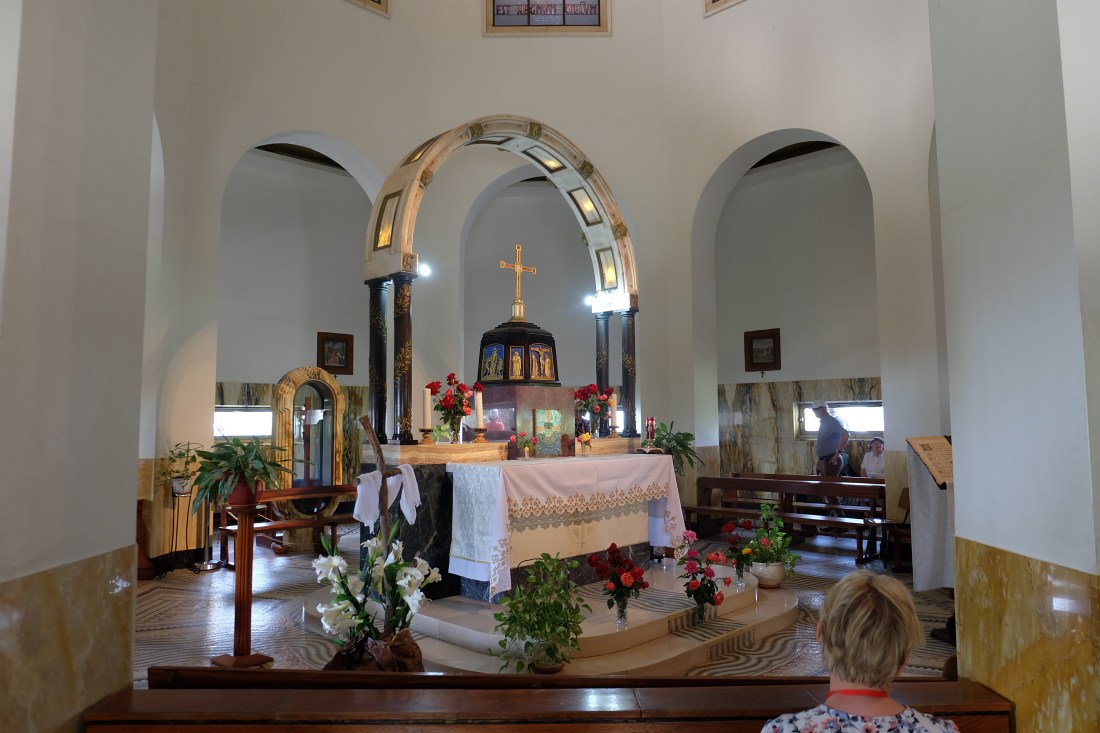
Sanctuary and altar of the Church of the Beatitudes in Israel. Photo by the author, April 2017.
O God our loving Father, you know so well how we all desire to be good and holy like you. But so often, we look outside for what would make us pure and clean before you, as well as for what defiles us before you.
Thank for reminding us today how from the very start when you created everything including us, we have always been good within. Even from without, everything is good. We just have to look inside our hearts for what is true and good, false and evil.
How sad that until now, we keep on looking outside, searching for more we can have, for more we can know when clearly we are limited: “You are free to eat from any of the trees of the garden except the tree of knowledge of good and evil. From that tree you shall not eat; the moment you eat from it you are surely doomed to die” (Gen.2:16-17).
Teach us, O Lord Jesus Christ to understand that “Nothing that enters one from the outside can defile that person; but the things that come out from within are what defile… From within the man, from his heart, come evil thoughts, unchastity, theft, murder, adultery, greed, malice, deceit, licentiousness, envy, blasphemy, arrogance, folly” (Mk.7:15, 21-22).
May we always look inside our hearts, O Jesus, where you reign supreme when we keep on doing your holy will, avoiding sin. Amen. Fr. Nicanor F. Lalog II, Parokya ng San Juan Apostol at Ebanghelista, Gov. F. Halili Ave., Bagbaguin, Sta. Maria, Bulacan.
Shifen Waterfall in Pingxi District, New Taipei City, Taiwan. Photo by the author, 29 January 2019.
The Lord Is My Chef Breakfast Recipe for the Soul
Tuesday, 12 February 2019, Week V, Year I
Genesis 1:20-2:4///Mark 7:1-13
Everyday O God we praise you in our prayers and most especially when we see your majesty in nature. You never fail to remind us of your presence in your wonderful creation as we have heard in the first reading today (Gen.1:20-31). Indeed like the psalmist, we always exult of “how wonderful your name in all the earth” (Ps.8).
However, too often like the Pharisees and some scribes in the gospel today, we tend to look for what is missing or lacking that we perceive to be not good: When the Pharisees with some scribes who had come from Jerusalem gathered around Jesus, they observed that some of his disciples ate their meals with unclean, that is, unwashed, hands (Mk.7:1-2).
Like those Pharisees and scribes, we “nullify the word of God in favor of our tradition that we have handed on.” And yes, Jesus, it is so true with us today like the Pharisees and scribes, “we have many such things” (Mk.7:13). We make so many rules and precepts, traditions and beliefs that eventually supersede your Laws and worst, have even replaced you O God!
Forgive us O Lord in worshiping traditions and other practices than You.
Forgive us O Lord in disregarding persons, the crown of your creation, and giving more importance with our beliefs and other concepts so detached from You.
Teach us O Lord to see more of you our God and Creator by seeing more of what is good around us and among us. Amen.Fr. Nicanor F. Lalog II, Parokya ng San Juan Apostol at Ebanghelista, Gov. F. Halili Ave., Bagbaguin, Sta. Maria, Bulacan.
The “amazing” rock formations at Yehliu Geopark in Taiwan: one may see so many images for as long one’s eyes and minds are open. Photo by the author, 30 January 2019.
The Lord Is My Chef Breakfast Recipe for the Soul
Wednesday, 06 February 2019, Week IV, Year I
Hebrews 12:4-7, 11-15///Mark 6:1-6
How amazing O Lord Jesus Christ is the word “amazed” used today in the gospel.
When you came to your native synagogue at Nazareth, the people were amazed or “astonished” with your speech that immediately they doubted where you have learned so many things when you were just one of them, a son of Joseph the carpenter.
As a result O Lord, you were “amazed at their lack of faith” in you that you did not perform many miracles among them.
To be amazed is a feeling borne out of being surprised that could either lead one to see more or see less. Being amazed is never enough. Amazement leads to more wonder and curiosity, to deeper conviction and faith, to more love and appreciation. But when amazement leads to doubts and skepticism even unbelief, then, we were not really amazed but simply surprised because we simply felt but did not see at all.
Teach us Lord Jesus Christ today not to be contented with being surprised and amazed with you and other things. Open our eyes and our hearts to see more of the bigger picture, more of the details of every scene that comes in our lives, be it good or not so good like those moments we have to go through many trials and difficulties that have disciplined and made us into better persons in you (Heb.12:5-7). Amen. Fr. Nicanor F. Lalog II, Parokya ng San Juan Apostol at Ebanghelista, Gov. F. Halili Ave., Bagbaguin, Sta. Maria, Bulacan.
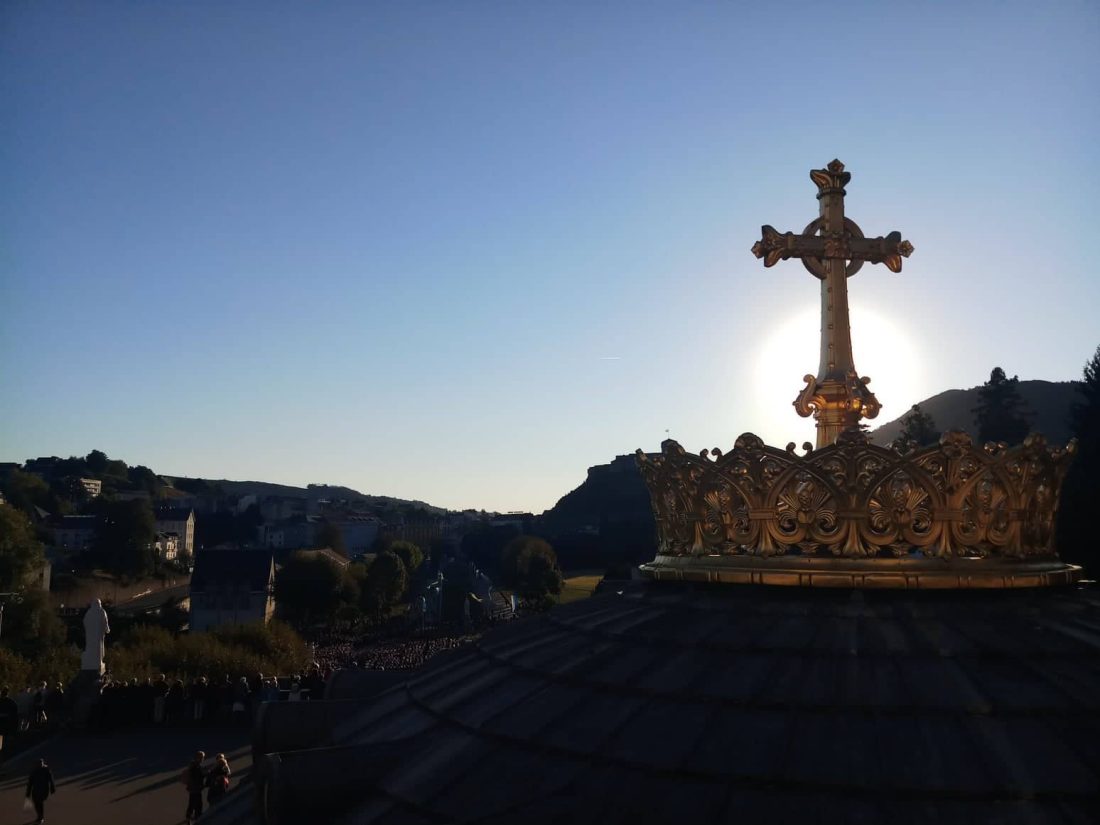
The Cross of Christ atop the church of our Lady of Lourdes in France. Photo by my former student Philip Santiago during his pilgrimage, September 2018.
We had a rare weekend yesterday in the Feast of the Presentation of the Lord that wonderfully complemented our gospel on this Fourth Sunday in Ordinary Time. Recall that last Sunday we were told how Jesus went home to Nazareth, entering the synagogue on a day of rest. Everybody was amazed with His “gracious words” in proclaiming the word of God that we ended the gospel with a very positive note when Jesus declared “Today this Scripture passage is fulfilled in your hearing” (Lk.4:22). Our gospel today repeated this line as its take off point to continue the story of Jesus at the synagogue but, this time Luke tells us of a twist from the very positive “all spoke highly of him” to their skeptical “Isn’t this the son of Joseph?” (Lk.4:22). The mood deteriorated further after Jesus had spoken so that “the people at the synagogue were filled with fury. They rose up, drove him out of the town, and led him to the brow of the hill on which their town had been built, to hurl him down headlong” (Lk.4:28-29)!
What and how did this sudden turn of events happen? Here we find the complementing Feast of the Presentation yesterday based on the infancy narratives of Christmas by St. Luke when Simeon told Mary the mother of Jesus, “Behold, this child is destined for the fall and rise of many in Israel, and to be a sign that will be contradicted – and you yourself a sword will pierce you – so that the thoughts of many hearts may be revealed” (Lk.2:34-35). See how Jesus at the inauguration of His ministry at their Nazareth synagogue last week proclaiming the word of God would now start to be seen as a sign of contradiction among His people as prophesied by Simeon to His mother yesterday. That would reach its highest point 33 years later in Jerusalem where He was presented to the Temple 40 days after Epiphany after resolutely going there to offer or present Himself to the Father on the Cross. This explains why Jesus merely “passed through the midst of them and went away” when the people at the synagogue tried to hurl Him down headlong because His time of final offering had not yet come. But very clearly here at the synagogue of Nazareth, Christ is indeed the sign of contradiction not only to His people but also to us in this generation when we would also speak highly of Jesus, shouting Amen with clapping of hands and suddenly hit people near us with harsh and nasty words or even brutal force. Most of all, like the Lord, we too have experienced being a sign of contradiction when people would speak highly of us then suddenly or over time, turn against us and speak ill of us, betraying us like what Judas did to Jesus on Holy Thursday.
My dear friends in Christ, it is our calling and our life too in living out the word of God through our life of witnessing His immense love in service and mercy for those in the margins. Every time we gather for the Sunday Mass like when Jesus entered the synagogue of Nazareth on a day of rest, He invites us to follow Him to be a prophet by entering Him more than merely the church building. Being a sign of contradiction like Jesus is our prophetic mission in Him. So unlike what most people think, a prophet is not a fortune teller or a seer of the future. As the spokesperson of God, a prophet is one who makes God’s word happen or fulfilled in every here and now. Keep in mind that one feature of Luke’s gospel is the pre-eminence of “listening and doing” the word of God like when he reported how Jesus declared Isaiah’s prophecy fulfilled in their hearing that led into the sharp and sudden shifting in the reaction of people against the Lord, from approval to rejection.
First of all, those reactions were most evidently from His claiming to be the Messiah referred to in Isaiah’s prophecy on whom the “Spirit of the Lord rests upon.” He was the one who proclaimed the word and if we have truly immersed ourselves into this beautiful scene in the synagogue on that Sabbath day, we would really feel Jesus is in fact the one Isaiah is speaking of as being “anointed to bring glad tidings to the poor, liberty to captives, sight to the blind, freedom to those oppressed, and to usher in a year acceptable to the Lord” (Lk.4: 18-19). Salvation decisively begins in Christ and through Christ whenever we enter Him in His words. That “today” in Nazareth synagogue is also the today of our own time that continues to provoke astonishment among others when we try to be Christ’s witnesses of authentic love for others. That is perhaps the sad reality of these days when it becomes big news when people do something genuinely good and beautiful like the woman who impulsively rented 20 hotel rooms in Chicago so the homeless could escape the deep freeze this week in the US Midwest; her deed snowballed into other strangers doing the same! That is essentially the meaning of Paul’s lofty words on love being the greatest of all gifts because it makes God most present in our midst. To truly love like Christ is essentially being a sign of contradiction in this world where the norm is selfishness and self-centeredness often masked in different in lofty terms and ideals bereft of any love at all.
Along this line of self-centeredness we find Luke reminding us in this scene at the Nazareth synagogue of the persisting problem self-entitlement among people then and now when we prophetically live out our mission of making Christ present. People always look down and frown upon those who try to be good and holy by striving to do what is right and just while the holier-than-thou sanctimoniously feel they are the only ones anointed to do such things because they are entitled. They are the modern Gnostics according to Pope Francis in his latest encyclical about holiness in our modern time (Gaudete et Exsulatate)” who feel as the only ones gifted in knowing what is right or wrong, true and good as if they are God. Like those people at the synagogue in Nazareth, they refused to accept Jesus of being more knowledgeable because He is the son of Joseph who was a carpenter. Jesus would strike at the very core of their self- entitlement when He told them “Amen, I say to you, no prophet is accepted in his native place” (Lk.4:24), citing how Elijah and Elisha of the Old Testament days were both sent by God to help pagan peoples and not the Jews who have turned away from Him exactly like them. That filled them with fury against Jesus, wanting to hurl Him down the hill headlong. It is the same feeling those people around us experience like our relatives and friends who could not accept we are better than them that they start spreading all kinds of lies and nasty talks against us as they see their self-entitlement slowly eroding. Such is our life as a prophet like Jeremiah, always going against the flow of the people, choosing Christ to be a sign of contradiction and give way to the fulfilment of God’s word among us. Amen.Fr. Nicanor F. Lalog II, Parokya ng San Juan Apostol at Ebanghelista, Gov. F. Halili Ave., Bagbaguin, Sta. Maria, Bulacan.
Lord Jesus Christ, your gospel today is so simple and so meaningful, making me wonder why would you even bother to enter the synagogue when you are the Lord of Sabbath, the Son of God, our Eternal High Priest in the line of Melchizedek?
How wonderful is that imagery of you always entering the synagogue to remind us of something deeper than praying and obeying your laws and that is the need to enter more the person of God. To enter the synagogue like you Jesus is to enter the Father and be one with Him in His love and mercy.
So sad that too often, we enter only your thoughts and calling, your words and your laws that have all come to replace your very Person within us. We have worshiped things about you but never yourself! No wonder so many of us choose to remain silent than answer your question “Is it lawful to do good on the Sabbath than to evil, to save life rather than destroy it?” (Mk.3:4) when facing real life situations between what we believe and what we feel as a person.
To enter the synagogue is to first of all enter you, God – and be one with you in your love and mercy. When we fail to enter you God our Father, then we also fail to enter our very selves that we are detached from others and from life itself. To enter God is to enter our hearts and to feel one with others, especially the sick and the suffering. To enter God is to be like you, Jesus, our priest forever in the line of Melchizedek who is full of holiness and peace. Amen. Fr. Nicanor F. Lalog II, Parokya ng San Juan Apostol at Ebanghelista, Gov. F. Halili Ave., Bagbaguin, Sta. Maria, Bulacan.
Loving Father, lately I was again hurting deep inside, feeling alone and forgotten, even taken for granted but, after praying and remembering the immense love of your Son Jesus for me, for us all, I felt so consoled because I am no longer alone. I felt relieved and lighter at how your Son Jesus who is sinless bore all our sins by suffering and dying on the Cross to renew forever our relationship with you, opening for us a fount of constant joy and comfort within us.
“In the days when he was in the Flesh, he offered prayers and supplications with loud cries and tears to the one who was able to save him from death, and he was heard because of his reverence. Son though he was, he learned obedience from what he suffered; and when he was made perfect, he became the source of eternal salvation for all who obey him” (Heb.5:7-8).
Remind us always to remember this great truth, of how you have made Christ your Son as our sole mediator, designating Him our eternal High Priest who offered for us the most perfect sacrifice for our salvation. Make us your new piece of cloth, your new wineskin so others may experience your refreshing presence in the world today where many of us have become technical rather than personal, hiding in traditions and rituals long renewed in Jesus Christ, always asking “Why do the disciples of John and the disciples of the Pharisees fast, but your disciples do not fast?” (Mk.2:18).
Give us the courage O Lord like St. Agnes to be firm in our faith, vibrant in our hope in your presence among us in Christ. Refresh us in your abiding love so we may be renewed as a people, as disciples. Amen.Fr. Nicanor F. Lalog II, Parokya ng San Juan Apostol at Ebanghelista, Gov. F. Halili Ave., Bagbaguin, Sta. Maria, Bulacan.
Photo above by the author, Dominican Hill, Baguio City, 18 January 2019.