God is gracious

The Lord Is My Chef Simbang Gabi Recipe, 23 December 2019

Malachi 3:1-4, 23-24 ><)))*> ><)))*> ><)))*> Luke 1:57-66
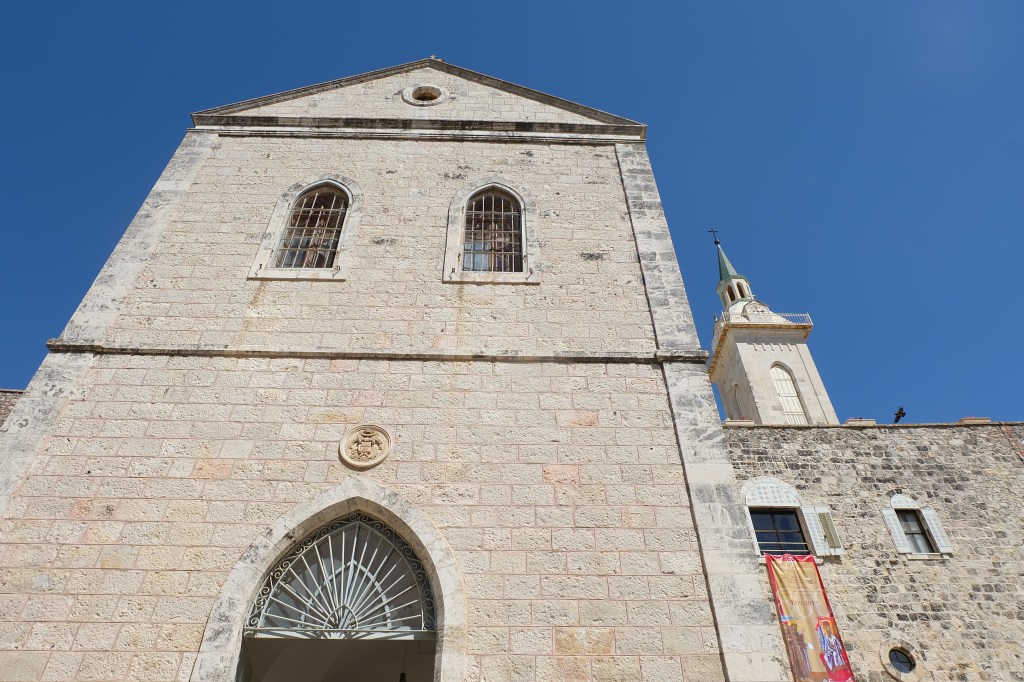
Facade of the Church of St. John the Baptist in Eim Karen where the precursor of the Lord was born. Not to be confused with Church of the Visitation at its other side in the same town. Photo by author, May 2019

Two days before Christmas, St. Luke brings us back to the continuation of his first story about Christmas: the birth of John the Baptizer.

When the time arrived for Elizabeth to have her child she gave birth to a son. Her neighbors and relatives heard that the Lord had shown his great mercy toward her, and they rejoiced with her. When they came on the eighth day to circumcise the child, they were going to call him Zechariah after his father, but his mother said in reply, “No. He will be called John.” But they answered her, “There is no one among your relatives who has this name.” So they made signs, asking his father what he wished him to be called. He asked for a tablet and wrote, “John is his name,” and all were amazed. Immediately his mouth was opened, his tongue freed, and he spoke blessing God.

Luke 1:57-64
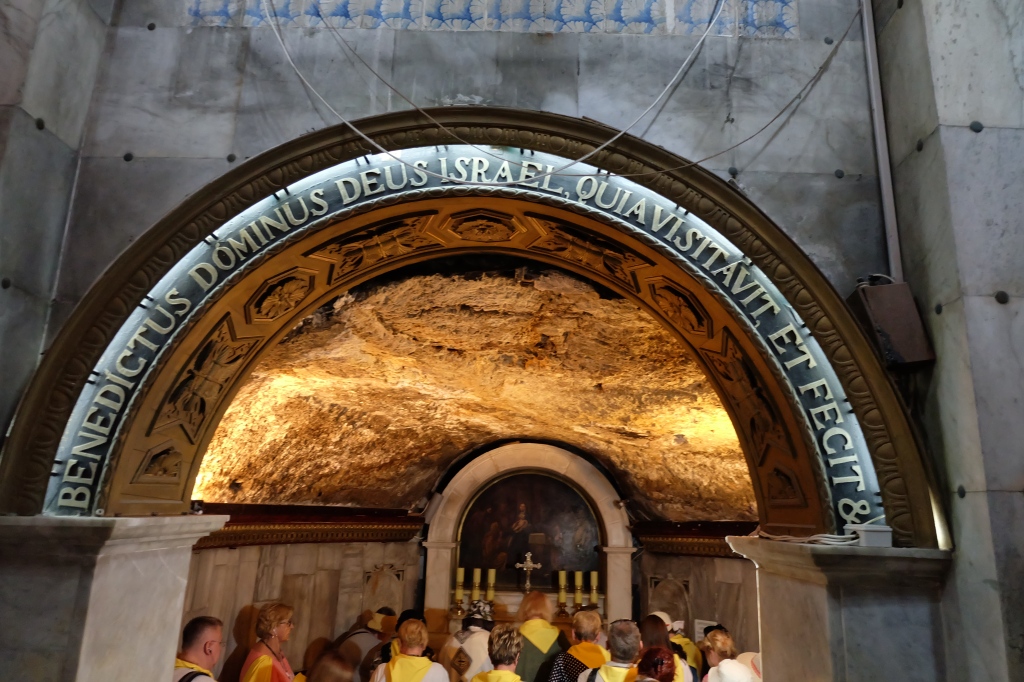
Site where St. John the Baptist is believed to have been born. Photo by author, May 2019.

Where is God leading me?

Christmas is almost here. And it is not yet too late in these last two days of Advent that we try some “last ditch efforts” to spiritually prepare ourselves for this joyous season by asking just one question following the story of John’s birth:

“Where is God leading me?”

See the artistry of St. Luke, at how he began his Christmas story with the annunciation of the birth of John to his father Zechariah while incensing the Holy of Holies of the Temple in Jerusalem.

He doubted the good news and he was silenced by the angel until John was born.

Today, after three days, or nine months to be exact, St. Luke brings him back into the scene set free from his punishment. Zechariah was able to speak again when he concurred with his wife’s desire to name their child John by writing it on a tablet.

The name John in Hebrew is Jehohan which means “God is gracious” or “graciousness of God”.

Advent and Christmas are a story of how each one of us is a John, a graciousness of God, of us people so blessed by God to fulfill his promise of salvation in Jesus Christ.

But do we realize the many blessings we have from God?
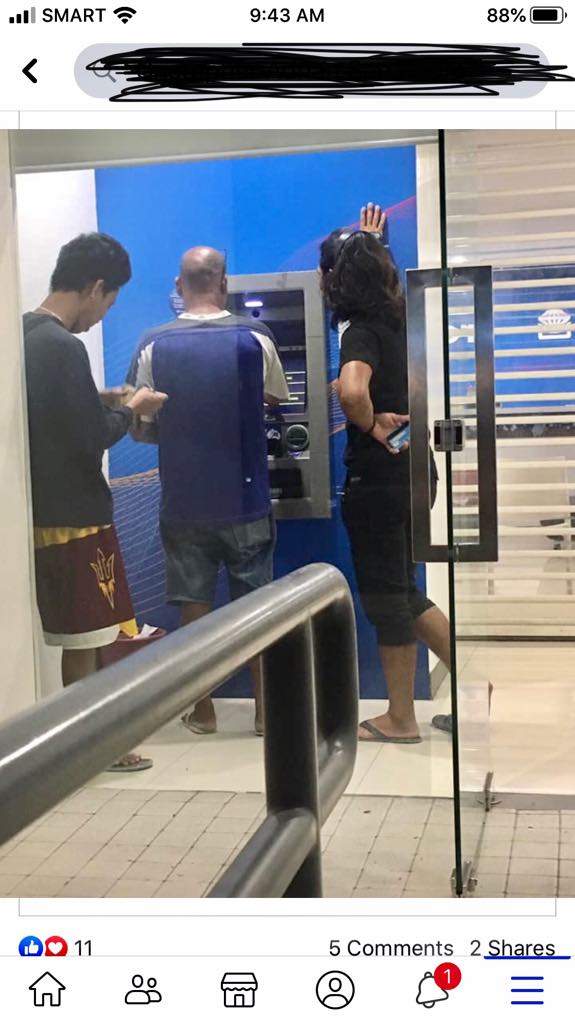
The other night I saw an interesting post on Facebook from one of my former students in high school. It was from a woman sharing her experience while waiting in line at an ATM that has now gone viral.

She claimed that at first, she felt so bad at what was taking three people so long at the ATM to withdraw their cash. But when she got nearer, she overheard their conversations.

It turned out the three were given a bonus of Php 2000.00 each by their boss.

And they were extremely happy, so thankful, telling each other how they would prepare spaghetti and fruit salad on Christmas eve!

And the woman who posted the photo realized how those simple folks were so thankful for Php 2000.00 bonus when she and others like her who get more than that amount still complain?!

Very nice reflection!

Advent gives us four weeks to remember God’s graciousness to us this past year. The bountiful blessings we have had which we take for granted. Worst, we even complain with!

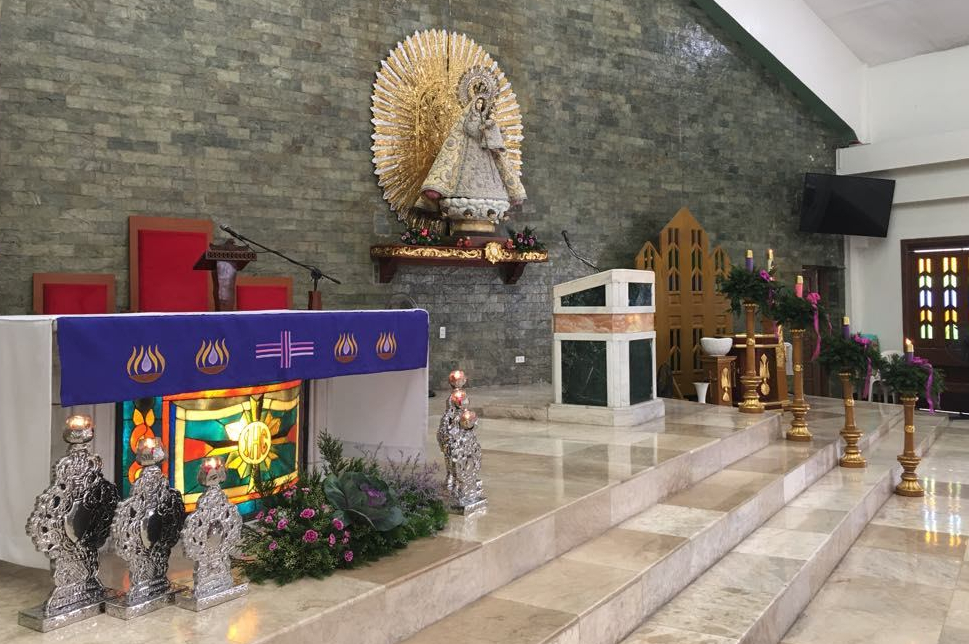
Altar of the Church of St. John the Baptist, Israel. When we came there last May, it was being closed for major restorations expected to last for years.

Whenever we see and count our blessings, do we ever thank God and ask him too where he is leading us to?

Zechariah was already old, had a great chance of incensing the Holy of Holies at their most important feast, doubted God’s grace but eventually still received it after nine months of silence.

By his action, Zechariah had shown how he had grown in faith during those nine months of “forced silence”, of how he had start to believe again in God, hope again, and practically live life anew!

Tremendous graces in just nine months being silent. Imagine that.

And we can have more grace today until tomorrow being silent, reflecting, praying as we count one by one the many blessings we have received this year.

Call it ageing gracefully, a grace in itself wherein as we grow old, we continue to find direction in life, we continue to find God leading us to him, for a specific mission to fulfill.

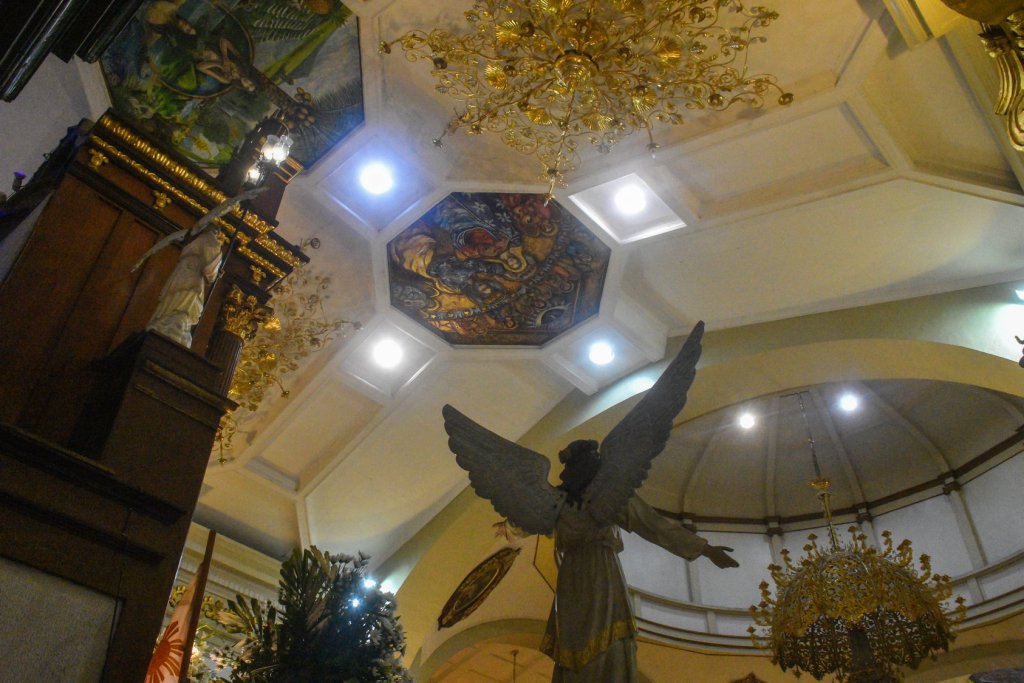
Dome of the Church of St. John the Baptist in Israel. Photo by author, May 2019.

Yesterday we have reflected that we are like St. Joseph entrusted with a special mission from God. That God “needs” us to bring Jesus, to care and protect Jesus here in the world. Each of us has a special part or role to play in God’s Divine plan in Jesus Christ.

Never lose hope in life. No matter what is our situation in life, God continues to work in us, working for us, inviting us to work with him.

It is interesting to know that the name Zechariah means “God remembers” while Elizabeth means “God has promised or vowed”.

If their names are brought together, we can see the complete picture why St. Luke started his Christmas story with Zechariah, Elizabeth, and John and not with Jospeh or Mary right away: they all mean “God is gracious because he remembers his promise always”!

May we always trust God and ask him where he is leading each of us this Christmas no matter what is our status in life. Amen.

Transforming presence of God

The Lord Is My Chef Simbang Gabi Recipe, 20 December 2019

Isaiah 7:10-14 ><)))*> ><)))*> ><)))*> Luke 1:26-38

Manor House, Camp John Hay, December 2017. Photo by author.

One reason Christmas is the most favorite time of the year is its colors. From houses to malls and almost every building, one can find a spectacular display of different colors and lights that brighten everyone.

But everything changes when one enters the church.

Advent is so different. Color is violet near the deep blue shade to signify the importance of conversion and penance that lead into transformation while the colors of the world found in malls are about money and material things.

Our parish sanctuary area, Advent 2019.

God takes initiative

We have seen yesterday in St. Luke’s first Christmas story how God entered through human activities and history for the coming of Jesus Christ by first announcing the birth of his precursor, St. John the Baptizer.

But today, in his second Christmas story which is the Annunciation of the birth of Jesus to the Blessed Virgin Mary, St. Lukes shows us how God is now acting on his own. Of course, God always takes the initiatives in life being the “prime mover”.

But in announcing the birth of Jesus, God went “out of his way” so to speak to bring us this tremendous grace of Christmas as he would always do in many instances in our lives.

In the sixth month, the angel Gabriel was sent from God to a town of Galilee called Nazareth, to a virgin betrothed to man named Joseph, of the house of David, and the virgin’s name was Mary. And coming to her, he said, “Hail, full of grace! The Lord is with yo.” But she was greatly troubled at what was said and pondered what sort of greeting this might be. Then the angel said to her, “Do not be afraid, Mary, for you have found favor with God. Behold, you will conceive in your womb and and bear a son, and you shall name him Jesus .”

Luke 1:26-31
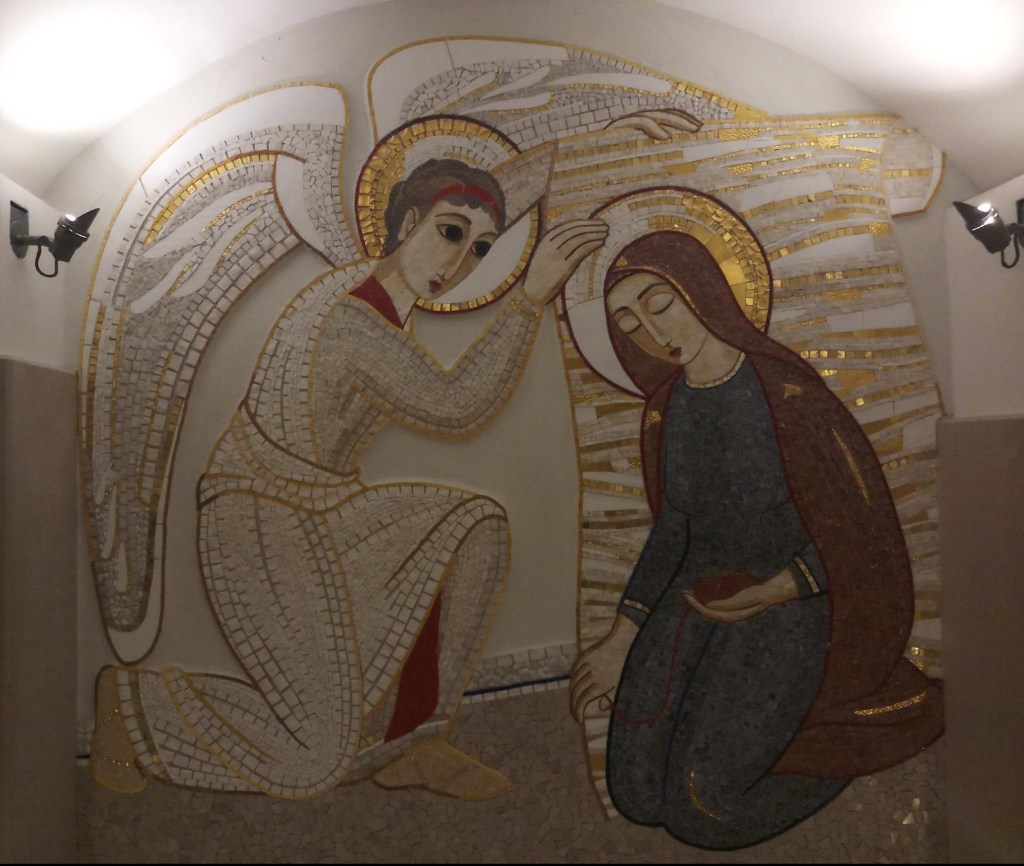
Mosaic of the Annunciation to Mary at the Shrine of St. Padre Pio at Rotondo, Italy. Photo by Arch. Philip Santiago, 2018.

So different from yesterday’s story of the annunciation of the birth of John the Baptizer to Zechariah, let us see how God took the initiative in the annunciation in the birth of Jesus to Mary.

  1. Zechariah was a priest while Mary was a commoner. It was natural for God to work through his ministers but in choosing Mary an ordinary woman was something else not because of any special quality she had but simply because God is good. The angel clearly told this to Mary, “you have found favor with God”. God does not call the qualified but he qualifies the call!
  2. God used the setting of the Temple of Jerusalem in yesterday’s account because that is where he is supposed to dwell but today, everything happened in a very simple house in Nazareth, the only place of significance and importance in the New Testament never mentioned in the Old Testament. It was a place looked down upon by many like St. Bartholomew asking Philip, “can anyone good come from Nazareth?”
  3. There was a major feast going on, the Yom Kippur, with a lot of people present when Zechariah was informed of the birth of John; Mary was alone in her house when the angel came to announce to her the birth of Jesus on the six months after going to Zechariah.

Intense Presence of God and of Mary

Usually, as we have seen yesterday in the annunciation of the birth of John, God always acted in silence and hiddenness. He blends and flows with world history as well as with our own personal histories.

But, there are times even in our own experiences when God really pulls something extraordinary, a miracle to bless us, to save us.

That was the case in the Annunciation to Mary. God “freely acted on his own” for the good news to happen, regardless of whoever was the king of Judea or emperor of Rome. He set the stage and everything for the fulfillment of his plan of salvation for us.

And the very good thing here is we find a perfect congruence or an equilibrium wherein, God was intensely present and so was Mary.

In the annunciation of John’s birth, God was very much present answering the prayers of his parents but Zechariah was miserably absent, doubting the good news!

Mary said, “Behold, I am the handmaid of the Lord. May it be done to me according to your word.” Then the angel departed from her.

Luke 1:38

God is always coming to us in many instances and persons who come to our lives. Are we present to him?

Notice how she entered into a dialogue with the angel Gabriel in explaining how things would happen. She was so open and so absorbed too as if the Holy Spirit must have had a perfect landing on her that she became pregnant with Jesus!

It sounds funny but that was how it happened because tomorrow, we would hear St. Luke telling us how Mary hurriedly went off to see her cousin Elizabeth, meaning there was a transforming change that occurred in Mary right away!

And that is how God truly works – if we can be truly open like Mary with God’s intense presence, we can experience overnight conversion and transformation that we have heard experienced by many unbelievers, sinners, addicts of all kinds. All they could say was there was a very brief moment when they felt God so intensely present and boom! everything changed for the best.

Mary believed

Mary was not only open to God but most of all, she has always believed in him. See how St. Luke tells us after the Annunciation, “then the angel departed from her”, never to come again to inform her of special messages from God unlike St. Joseph.

After the Annunciation, Mary was left on her own in the sense that all she had was her firm faith in God through Jesus Christ her Son.

Mary believed in everything that was spoken to her! It was all she had up to the foot of the Cross when Christ died, when she waited with the apostles in Jerusalem for the Pentecost and in all her other apparitions later. She has always believed in Jesus her Son.

Today, we complain a lot of people no longer believing in God, leaving the Church, refusing to pray and celebrate the sacraments.

Perhaps it is about time for us to ask our very selves too, especially us your priests and pastors as well as the parents: do we truly believe what we are doing, what we are practicing as Catholics?

It is always easy to say we believe in God like King Ahaz in the first reading who refused to ask God for signs that Israel would be delivered from the advancing Babylonians.

It was merely a “show” because Ahaz had already entered into alliance with small kingdoms to fight the Babylonian invaders. He had never believed God or his Prophet Isaiah; hence, Israel was conquered and crushed as a nation, thrown into exile in Babylon for a long time.

A Filipino painting of the Annunciation to Mary on a wall facing the Basilica of the Annunciation in Nazareth. Photo by author May 2017.

God’s power and his intense presence can only work in proportion with the faith we have. This is what Jesus had told the apostles when they asked him to “increase their faith”: “If you have the faith the size of a mustard seed, you would say to the mulberry tree, ‘Be uprooted and panted in the sea,’ and it would obey you” (Lk.17:5-6).

In another instance, the apostles failed to cast away the demon possessing the son of a certain man. After Jesus had driven away the evil spirit, his apostles came to him in private to ask, “Why could we not cast it out? And Jesus said to them, ‘Because of your little faith'” (Mt.17:19).

Like Mary, let us believe wholly to God by giving our whole selves to him. Let us create a room in ourselves for God so he can be present in us and transform us like Mary. Amen.

What is in a name?

The Lord Is My Chef Simbang Gabi Recipe, 17 December 2019

Genesis 49:2.8-10 ><)))*> ><)))*> ><)))*> Matthew 1:1-17

Parokya ng Banal na Mag-Anak, Violeta Village, Guiguinto, Bulacan. Photo by Arch. Philip Santiago.

Today we shift our focus in our Advent preparations to the first coming of Jesus Christ when he was born in Bethlehem more than 2000 years ago. Strictly speaking, the Christmas countdown officially starts only today especially with our very long but beautiful gospel from Matthew.

Maybe you are wondering what’s good with our gospel today when it is all about names that mostly sound very funny.

Importance of names: origin and mission

In ancient time, giving name to children was a very serious matter among peoples, especially the Jews.

For them, a name indicates two very important things about a person: one’s origin and mission in life, something parents of today have entirely forgotten, even ignorant because they are more concerned with fad and being unique in naming their children that always end up as a joke as it is always bizarre and weird.

And their poor kid suffers for the rest of his/her life like that man named “Fantastic”. All his life he felt so sad being called Fantastic that he told his wife when he dies, never put his name on his tombstone.

Eventually Mr. Fantastic died and the wife kept her promise not to put his name on his marker. But she felt the need to honor her beloved husband who was so good and honest that in lieu of his name, she asked a tribute written to honor him.

It said, “Here lies a very gentle and loving husband and father who never looked at other women except his wife.”

Every time passersby see and read that tribute, they would always exclaim “Fantastic!”

From Google.

Going back to the importance of giving names….

Corporations are more serious than parents in choosing names and trademarks to their products and services. Every trademark and brand always evokes deeper meanings than just being a product or entity that some of them have entered the vocabulary of many languages like Google, Xerox, and Frigidaire.

And the sad thing about this is how many babies are now being named to follow things and products than the other way around, giving more value to things than human beings!

The book of the genealogy of Jesus Christ, the son of David, the son of Abraham. Abraham became the father of Isaac, Isaac the father of Jacob, Jacob the father of Judah and his brothers.

Matthew 1:1-2
Detail of the ceiling of Parokya ng Banal na Mag-anak after the front or main door: the genealogy of Jesus Christ that starts with Abraham. Great concept by the Parish Priest, Fr. Ed Rodriguez. Photo by Arch. Philip Santiago.

Genealogy of Jesus as direction of Matthew’s Gospel

St. Matthew opens his gospel account with the genealogy of Jesus to settle right at the very start the question about the origin and mission of Jesus Christ.

Here we find the artistry and genius of St. Matthew, some 2000 years ahead of the late Stephen Covey’s third habit of highly effective people: “begin with an end in mind.”

By starting his genealogy with Abraham and David, St. Matthew gives us the whole gospel message in a glance because they are the two key figures in the beginning and realization of God’s promise to send Jesus Christ who would save us all.

Let us just focus on Abraham which means “he who is the father of many.”

It was to him that the story of God’s promise began after the dispersal of mankind following the collapse of the Tower of Babel.

From then on, Abraham points to what is ahead in God’s divine plan, not only for himself but also for the whole mankind for it is through him that blessings come to all. His journey from his birthplace of Ur into Canaan is symbolic of his journey from the present into the future, walking in faith following the Lord’s path and divine plan.

In Abraham we find God starting anew the history of mankind after the Fall that leads up to Jesus Christ who came to lead us all back into the Father.

With Abraham as the main header of Christ’s genealogy, we find not only the beginning but also the end of St. Matthew’s gospel which is the universality of God’s plan of salvation with Jesus telling his disciples to make disciples of all nations (Mt.28:19).

Detail of the ceiling near the sanctuary of Parokya ng Banal na Mag-Anak, the culmination of the genealogy of Jesus. Photo by Arch. Philip Santiago.

Imitating Abraham into our time

Last December 10 was a very important date for me and my parish: it was the ordination date of our first priest.

While waiting for the start of the Mass at the front door (which is actually the back of the Cathedral or any church), I just prayed in silence thinking about my role in the ordination of Fr. RA Valmadrid.

While I marveled at the beautiful renovations of our Cathedral, my sight was slowly moved towards the altar.

It was like an “Abraham experience” in Matthew’s genealogy for me: a wayfarer on a journey into the future, towards God, walking in faith.

In a quick glance, I kind of saw the future glory of every faithful coming to the altar to receive Jesus Christ in the sacraments especially the Holy Eucharist.

I just felt the beauty of entering the Cathedral, or any church which is more than stepping into a building but more of entering God himself, our point of origin and final destination.

Do we realize this tremendous blessing and grace of being baptized, of being a child of God, not only given with a name but most of all, of being counted into the family of God our Father?

In the first reading we have heard Jacob calling his 12 sons. What is so striking here is the blessing Jacob had bestowed upon Judah, instead of Joseph who was the best of all his sons, the holiest and most intelligent.

Like Abraham and Judah, or anyone in the genealogy of Jesus Christ, we can find our own selves too not as the vida or contravida but simply being called to be God’s instrument in fulfilling his plan in sending his Son Jesus Christ.

Truth is, God always comes in the most unexpected situations and peoples most of the time.

In Christ Jesus through our Baptism and faith, we find our genealogy – our origin and mission – as children of God.

If you want to get a feel of this reality, try reading aloud, very slowly, the genealogy of Jesus Christ. At the end, include your self, mention your name, your mother and father. Then close your eyes and let your life flash back in silence.

In the silence of your heart, do you find God coming more to you than you to God?

So amazing, is it not? We are all part of Christ’s genealogy. Let’s bring him forth into the world in our life of faithful witnessing like Abraham. Amen.

Malolos Cathedral. Photo by author.

Advent calls us to believe again

The Lord Is My Chef Breakfast Recipe for the Soul

Thursday, Feast of Our Lady of Guadalupe, 12 December 2019

Zechariah 2:14-17 ><)))*> ><)))*> ><)))*> Luke 1:39-47

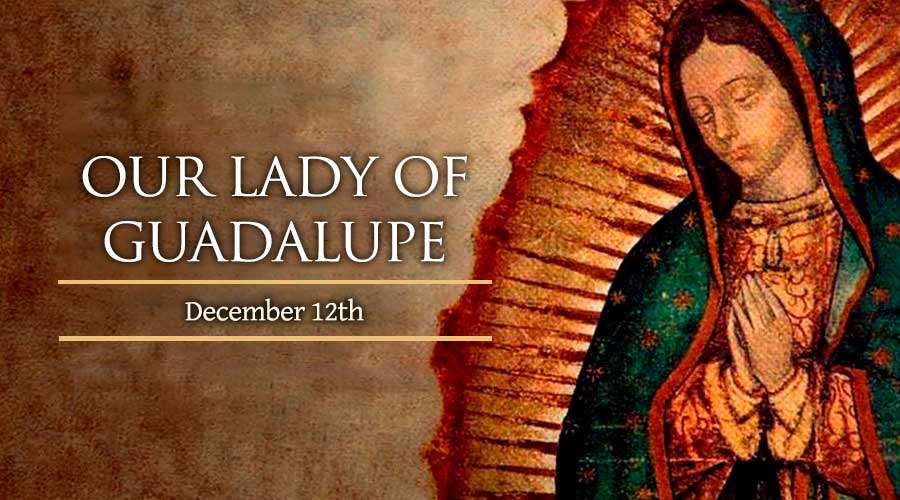
From Catholic News Agency

Praise and glory to you, O God our loving Father in heaven who has given us along with your Son Jesus Christ our Savior his beloved Mother the Blessed Virgin Mary.

Thank you in giving us Mother Mary as our guide in this Season of Advent, along with the Prophet Isaiah and St. John the Baptist.

And the most wonderful thing about Mary as our guide in Advent is the fact she lived Advent because she was the first to truly believe in Jesus!

Renew our faith in you, O God especially in this age when we tend to believe more to our selves, to science and technology.

Strengthen our faith also so that like Mary, we may be blessed as we believe your words O God will be fulfilled in us.

Detail of painting at the Basilica of St. Juan Diego receiving roses from the Blessed Virgin Mary.

“Blessed are you who believed that what was spoken to you by the Lord would be fulfilled.”

Luke 1:45

Let us firmly believe like Mary, your Mother, Lord Jesus!

Let us give you our daily “Amen” like Mary who gave her total self to your service, Lord.

Fill us with the Holy Spirit, Father, like Mary who has continued to share your Son Jesus Christ with others, not only to Elizabeth at that time but also to St. Juan Diego at Guadalupe, St. Bernadette at Lourdes, and to the children at Fatima. Amen.

Believing like Mary

The Lord Is My Chef Breakfast Recipe for the Soul

Monday, Solemnity of the Immaculate Conception, 09 December 2019

Genesis 3:9-15, 20 ><}}}*> Ephesians 1:3-6, 11-12 ><}}}*> Luke 1:26-38

Every year, O Lord Jesus Christ, we celebrate on your birth month the Solemnity of the Immaculate Conception of your Most Blessed Mother Mary who was conceived without the stain of original sin.

Until now, many are still confused with this feast especially when our Gospel speaks about the annunciation of your birth, dear Jesus.

Nonetheless, it is the single most important part of your lives both that truly give us a valuable lesson about Mary’s blessedness – later to be expressed by Elizabeth at the visitation, “Blessed is she who believed that the words spoken to hear will be fulfilled”.

Her Immaculate Conception teaches us the importance of faith especially at this time when we face a great crisis in faith in the Church.

And so, we pray to you O Lord for the gift of faith like that of your Mother Mary, a faith that is deeply personal yet communal.

The first is subjective and the second is objective.

Mary said, “Behold, I am the handmaid of the Lord. May it be done to me according to your word.” Then the angel departed from her.

Luke 1:38
Malolos Cathedral, June 2019.

Unlike Eve in the first reading, Mary had always believed in God.

Her faith is a total entrusting of herself to God on a person-to-person relationship. It is subjective faith where emphasis is on believing itself than on what is believed.

However, Mary did not believe in a purely subjective manner as if God is a personal God detached from others and exclusively revealing only himself to her in secret.

Mary’s faith is also objective because when the angel explained everything to her, she believed the good news proclaimed to her is part of the bigger whole, of the coming new covenant, of the fulfillment of the promise of God made to Abraham and the fathers of Israel as she would later express in her Magnificat.

It is only in believing like Mary can we truly give ourselves to you, Jesus, to the Church so that what we believe may truly be fulfilled in us like Mary. Amen.

Malolos Cathedral, June 2019.

Fighting the “beasts” among us

The Lord Is My Chef Breakfast Recipe for the Soul

Friday, Week XXXIV, Year I, 29 November 2019

Daniel 7:2-14 ><)))*> ><)))*> ><)))*> Luke 21:29-33

Praise and glory to you, O God! Thank for this blessed Friday, the last working day of November 2019. Most of all, thank you for keeping us safe always in your protection despite our sins and being stubborn.

Like the vision of Prophet Daniel in the first reading, so many “beasts” have tried destroying us. In fact, these “beasts” are so “horrible” that so many people have come to believe them, accepting them and all their lies and malice.

Red Wednesday 2019, Parokya ng San Juan Apostol at Ebanghelista, Bagbaguin, Santa Maria, Bulacan.

There are times that we lose hope, fearing that everything is going to nothing.

Sometimes, it is so difficult to find meaning in life at all amidst all the sufferings and miseries around us and even within us!

May we always trust in your Word, Jesus Christ who became flesh to be with us.

In the many trials and tribulations that come our way, may we always hold on to his assurance:

“Heaven and earth will pass away, but my words will not pass away.”

Luke 21:33

Keep our sights fixed always to you, Jesus.

To never lose hope, to always trust you.

Most of all, to always follow you.

Amen.

We Remember

The Lord Is My Chef Breakfast Recipe for the Soul

Red Wednesday in Memory of Persecuted Christians, 27 November 2019

Revelation 15:1-4 ><)))*> ><)))*> ><)))*> Luke 21:12-19

From Google.

Today, O dear Jesus, we gather as one nation to remember the 300 million Christians worldwide who are persecuted in various forms because of their faith in you: those who were denied of work, housing, liberty, and most especially, life.

We remember and pray for our Christian brothers and sisters who were unjustly tortured and murdered because of carrying a cross and confessing their love for you, Jesus Christ.

Jesus said to the crowd: “You will be hated by all because of my name, but not a hair of your head will be destroyed. By your perseverance you will secure your lives.”

Luke 21:17-19

May those who have suffered and those still suffering be consoled with your love and peace, Lord.

Have mercy on their persecutors, let them realize that religion should bring us together and not apart.

Most especially, Lord Jesus, teach us to remember in carrying and embracing our crosses in the midst of these persecutions. Wash away our sins of indifference. Give us courage to follow promptings of your Holy Spirit in working for genuine peace and justice.

Empty ourselves of hatred and mistrust of one another to always remember we are all brothers and sisters in the Father. Amen.

Red Wednesday poster of Bacolod Diocese last year.

“Never Existed Before” by Minnie Riperton (1979)

The Lord Is My Chef Sunday Music, 03 November 2019

My cousin Joyce Pollard-Lopez with Tony during their honeymoon 40 years ago in Greece, still together and very much in love with each other!

It’s the end of a long weekend of bonding and prayers for the All Saints’ Day and All Souls’ Day that ushered in the penultimate month of every year that is November.

Let us not forget that on these days dedicated for our departed loved ones, we are also reminded to remember more of God and those people he sends us to experience his immense love for us.

They are the people who have profoundly changed us into who we are today, that made us live like we never existed before…

So you ask me what do I see
When I look in your eyes
I see things that have never existed before
Shall I tell you all that I find
In those beautiful eyes I can try
But it never existed before
The silvery moon… a walk in the park
The tunnel of love… a kiss in the dark
The light of the stars… the clouds in the sky
The fireworks on the fourth of july
And you ask me what do I hear
When you whisper my name
Music plays that has never existed before
Oh, and I don’t know why
But it’s there just the same
And it’s plain that it never existed before
The song of the rain the flowers in spring
The wind in the willow trees murmuring
The laughter that falls the children at play
Like church bells that call all the people to pray
So you ask me why do I glow
Well, I think you should know
I’m in love and I never existed before

Minnie Riperton co-wrote this song released in May 9, 1979 as part of her fifth and final album called Minnie.

Two months later, Minnie died of cancer at the age of 31.

Never Existed Before speaks so well of how Minnie had experienced the great love of her husband Richard Rudolph especially in her long struggle against cancer.

The song leaves no trace of her great sufferings as Minnie herself was filled with joy by actively working for her advocacies in cancer prevention and research.

Beautiful voice, beautiful woman, and beautiful song.

Just like Zacchaeus.

He only had one desire – to see Jesus who surprised him by coming into his house as a guest!

It is a story of faith, no matter how little it may be for as long as there is that desire for God.

Jesus comes first in our hearts, to those who truly seek him in their hearts.

And the mark of being saved and loved by Jesus is to be filled with joy like Zacchaeus who promised to change his life and even repay those he had cheated.

Truly, any encounter with the Lord Jesus Christ can change us deeply to live differently, like we never existed before.

Meeting Jesus our Saviour

The Lord Is My Chef Sunday Recipe, Week XXXI-C, 03 November 2019

Wisdom 11:22-12:2 ><}}}*> 2 Thessalonians 1:11-2:2 ><}}}*> Luke 19:1-10

A giant sycamore tree at the center of Jericho, the world’s oldest city. Photo by author, May 2019.

Jesus is now on the final leg of his “resolute journey to Jerusalem” as he passed by the world’s oldest city of Jericho. Next week, he would be teaching at the Temple area in Jerusalem where his enemies would gang up against him, eventually sending him to death as we shall hear on the 24th of this month, the Solemnity of Christ the King.

Today we find a very interesting story that is in stark contrast with last Sunday’s parable of the Pharisee and tax collector praying at the Temple.

And this time, our story is not a fiction but an event found only in St. Luke’s gospel about a real tax collector named Zacchaeus, a very wealthy man indeed.

The fictional Pharisee Jesus narrated in his parable last week was a very proud one, of high stature literally and figuratively speaking that he would always stand and pray inside the Temple to be seen by everyone.

He was a self-righteous man who despised everyone else, especially tax collectors.

But, according to Jesus, the Pharisee’s prayer was not heard by God because he was not really seeking God but seeking adulation for himself!

Treetop of a sycamore tree in Jericho today.

Contrast that Pharisee with the chief tax collector in Jericho named Zacchaeus: he was of small stature, literally and figuratively speaking, that he had to climb a sycamore tree in order to see “who Jesus was” (Lk.19:3).

We can safely surmise that from St. Luke’s narration, nobody loved Zacchaeus in Jericho: he must be really so small in their eyes that he is hardly noticed maybe except when people paid taxes.

And that is why when he learned Jesus of Nazareth was passing by their city, he went to climb a sycamore tree to have a glimpse of the man he must have heard so often performing miracles and doing all good things for sinners like him.

Then, a strange thing happened…

When he reached the place, Jesus looked up and said, “Zacchaeus, come down quickly, for today I must stay at your house.” And he came down quickly and received him with joy. When they all saw this, they began to grumble, saying, “He has gone to stay at the house of a sinner.” But Zacchaeus stood there and said to the Lord, “Behold, half of my possessions, Lord, I shall give to the poor, and if I have extorted anything from anyone I shall repay it four times over.” And Jesus said to him, “Today salvation has come to this house because this man too is a descendant of Abraham. For the Son of Man has come to seek and to save what was lost.”

Luke 19:5-10

Was it serendipity or divine destiny?

Jesus was just passing through Jericho while Zacchaeus was merely interested in seeing the Lord. Never in his wildest dream, so to speak, did he intend to meet him personally.

From Google.

But, as we all believe and have realised, there are no coincidences or accidents in life.

Everything that happens in our lives has a purpose, a meaning that may either make us or unmake us.

It all depends on us whether we make the right decision in making the most out of whatever life offers us, of what comes to us. Either we become better or bitter – so choose wisely.

More so with salvation from God who never stops coming to us everywhere, anytime like with Zacchaeus when Jesus suddenly came to meet him.

The Catholic Parish Church in Jericho run by the Franciscans, May 2019.

Here we find again a story about faith that leads to conversion and salvation or justification.

It does not really matter how little faith we have like when the Apostles asked Jesus on the first Sunday of October, “Lord, increase our faith in God” (Lk. 17:5,Wk. 27). What matters is that we always have that option for God, a desire for God.

This is specially true as St. Paul assures us in the second reading that Christ will come again at the end of time. Nobody knows when or how he will come again but like Zacchaeus, we must have that desire for Jesus who first comes into our hearts before entering into our homes or churches, no matter how grandiose they may be.

Every desire for God in itself is an expression of faith in him. And God comes to those who truly seek him because that is how great God is: not in his power to do everything but to be small and forgiving!

Before the Lord, the whole universe is as a grain from a balance, or a drop of morning dew come down upon the earth. But you have mercy on all, because you can do all things; and you overlook people’s sins that they may repent. But you spare all things, because they are yours, O Lord and lover of souls.

Wisdom 11:22-23, 26
Inside the Catholic Parish of the Good Shepherd in Jericho, May 2019.

Like in the parable of the persevering widow and judge as well as that of the Pharisee and tax collector praying at the temple last Sunday, today’s story of Zacchaeus meeting Jesus shows us how God never abandons us his children, always ready to grant our desires and wishes even beyond what we are asking for — if we have faith in him.

Our salvation depends solely in our faith to God in Christ Jesus, like Abraham in the Old Testament that we can now rightly be called as his children like Zacchaeus.

No one is excluded from this tremendous grace of God brought to us through Jesus Christ who had come to seek those who are lost.

Like Zacchaeus upon receiving salvation from the Lord on that simple day, may we joyfully turn away from sins and most of all, cheerfully rid ourselves of so many other things that hamper us from following Jesus resolutely to Jerusalem. Amen.

“Love On a Two Way Street” by The Moments (1968)

The Lord Is My Chef Sunday Music, 27 October 2019

Photo by d0n mil0 on Pexels.com

We have reflected last week that prayer is an expression of our faith by citing Dione Warwick’s 1967 hit, “I Say a Little Prayer”.

When there is faith expressed in prayer, there is also love.

And when there are faith, prayer and love, then we have a relationship like family and friends, and community.

Today in our gospel, Jesus tells us the right attitude we must have in maintaining our relationships, not only with him but also with others.

Jesus addressed this parable to those who were convinced of their own righteousness and despised everyone else. “Two people went up to the temple area to pray; one was a Pharisee and the other was a tax collector. The Pharisee took up his position and spoke this prayer to himself, ‘O God, thank that I am not like the rest of humanity – greedy, dishonest, adulterous – or even like this tax collector.’ But the tax collector stood off at a distance and would not even raise his eyes to heaven but beat his breast and prayed, ‘O God, be merciful to me, a sinner.’ I tell you, the latter went home justified, not the former.”

Luke 18:9-11, 13-14

From Dione Warwick’s 1967 “I Say a Little Prayer”, we move to the following year when Sylvia Robinson and Bert Keyes composed Love on a Two-Way Street recorded by The Moments as a filler for their 1968 album Not on the Outside, But the Inside, Strong!

It did not fare well in the charts and was released again as a single in 1970 when it spent five weeks at number one on Billboard’s Soul Singles chart. It become one of the greatest R&B song of that year that was later covered by other artists.

In 1981, 14-year-old Staci Lattisaw did a cover of the song that became so popular that others have thought it as her original.

But with all due respect to Staci, I have also always felt her version very cheesy that I prefer the originals singing it because they give more character and soul to the song.

I found love on a two way street and lost it on a lonely highway
Love on a two way street and lost it on a lonely highway

There was no specific experience behind the composition of Love on a Two-Way Street except that it was just a product of a play on words and poetry by Robinson supported by Keyes’ music.

The moment we become convinced of our righteousness that we despise everyone else (cf. Lk.18:9), then we shut ourselves in and leave no space for others even God.

Photo by Alex Powell on Pexels.com

Love as a two-way street based on today’s parable by Jesus requires three attitudes so our relationships would mature and grow deeper: a sense of sinfulness, self-surrender, and self-offering.

No love and faith would ever grow on a lonely highway, with no one else to relate with. That’s when we stop communicating and relating until we break up with others and end up alone and isolated.

That is when we become a “lonely highway” with nobody else but I, me, and myself.

Go back to the two-way street of God and others.

Though crowded with some traffic jams, there is always a space for everyone.