The Lord Is My Chef Breakfast Recipe for the Soul, Memorial of St. Catherine of Siena, Virgin and Doctor of the Church, 29 April 2020
Acts of the Apostles 8:1-8 ><)))*> 000 <*(((>< John 6:35-40
Our empty church since March 17, 2020.
Once again, O Lord Jesus Christ, your Body the Church is facing severe trials and difficulties at this moment of history with the pandemic COVID-19 that have closed churches worldwide even in Rome, Italy which is one of the worst hit countries of the corona disease.
Since the martyrdom of St. Stephen, the Church has always been persecuted but never defeated. On the contrary, it was during the persecutions when your Church had really grown beyond leaps and bounds, so to speak.
St. Catherine lived at that time when she was able to unite warring factions in Europe as well as in the Church with her counsels while through her, many individuals found directions in life with her holiness, teachings and directions.
And while churches remain closed with dim prospects of opening soon, you never fail to send us men and women full of devotion to you who continue to work tirelessly in building your Body, the Church.
One of them is Fr. Jun Villanueva from the Diocese of Balanga in Bataan who was infected with COVID-19 while serving in New York.
As he recovered from the deadly disease celebrating Mass in his parish, he had a wonderful realization that many of us priests have seem to forget:
“Then I realized that the Mass is not a show but our union with Jesus, whether there are people or none… from then on I started to look at the situation from that perspective”.
CBCP News, 27 April 2020
In the first reading we are told of the zeal of Saul in destroying the early church alongside the devotion of the early disciples in keeping the young church alive.
Devout men buried Stephen and made a loud lament over him.
Acts of the Apostles 8:2
Only St. Luke used that adjective “devout” in the New Testament to describe people of “good heart, ready to believe, and then act openly and with courage” according to Timothy Clayton of the book “Exploring Advent with Luke”.
Devout people make thing happen for God like St. Stephen and the early Christians.
From Google.
Devout people give themselves to God wholly like St. Catherine and all the saints who remained attuned with the Holy Spirit like Philip in the first reading today, ready to follow its promptings and leads.
Give us the same gift of devotion to you, Jesus, the “Bread of Life” who had come down from heaven so we can build up your Church as your body here on earth.
Help us avoid the pitfalls of pride and self-centeredness that tend to destroy the unity of your Body, the Church.
Most specially, keep us devoted to you in the Blessed Sacrament like St. Catherine of Siena with whom you have shown in a vision while she was sick the celebration of the Eucharist in their chapel making her a patroness of those in television. Amen.
Quiet Storm by Fr. Nicanor F. Lalog II, 26 April 2020
This is for my brother priests and fellow communicators in the church who might be failing to recognize Jesus Christ along the way and sadly, stuck at Emmaus.
That very day, the first day of the week, two of Jesus’ disciples were going to a village seven miles from Jerusalem called Emmaus, and they were conversing about all the tings that had occurred. And it happened that while they were conversing and debating, Jesus himself drew near and walked with them, but their eyes were prevented from recognizing him.
Luke 24:13-16
We live our faith today in a mass-mediated culture.
Media is all around us.
Vatican II tells us that these modern means of communications are gifts from God that are “necessary for the formation of Christians and for pastoral activity” (Inter Mirifica, 3).
Communication is a sharing in the power of God who created everything by just saying “Let there be…”. When this power to communicate is mishandled and eventually abused, sooner or later, it can blind us and prevent us from recognizing Jesus in our midst.
And sadly, it is already happening.
Even before the start of the enhanced community quarantine, many of us were already using the various platforms of social media proclaiming the good news of Jesus Christ.
But, are our hearts still burning deep inside in him and for him?
Is Jesus still the One we are proclaiming, or are we now trying to be like the so-called “influencers” of the secular world that we are more preoccupied and focused with gimmicks and antics, shows and bravaduras for the sake of followers and likes?
Are our hearts still burning with the Sacred Scriptures or the words of the world that we have made our ambos and altars like studios and stage complete with all the props to tickle the bones of people than build up their faith and experience Jesus?
On the road to Emmaus, after Cleopas had expressed their feelings and thoughts to Jesus, he and his companion fell silent and simply listened to Jesus explaining the Sacred Scriptures. No need to shout or mimic voices.
No need to keep on clapping hands like in a circus or even dance like Salome who later asked for the head of St. John the Baptist.
It is sad that on the road to Emmaus, it has become our monologue, our show that Jesus can no longer speak.
Remember that “in the beginning was the word, and the word became flesh”: God’s communication is always preceded by silence.
Even in the road to Emmaus, there was total silence when Jesus spoke that the two disciples were silent that they felt their hearts burning.
As they approached the village to which they were going, he gave the impression that he was going on farther. But they urged him, “Stay with us, for it is nearly evening and the day is almost over.” So he went to stay with them. And it happened that, while he was with them at table, he took bread, said the blessing, broke it, and gave it to them. With that their eyes were opened and they recognized him, but he vanished from their sight. Then they said to each other, “Were not our hearts burning within us while he spoke to us on the way and opened the Scriptures to us?” So they set out at once and returned to Jerusalem where they found gathered together the eleven and those with them…
Luke 24:28-33
The Mass and our Priesthood are both a mystery so unique especially for us. It is something beyond explanation without much physical descriptions but more of inner recognition.
Exactly like Easter: the moment we recognize Jesus in the Scriptures and in the Eucharist, he vanishes because he is more than enough than anybody or anything else in the Mass and in our ministry in general.
Even in our very own lives!
St. Mother Teresa asked us priests long ago to “always give (them) Jesus, only Jesus”. And that will always be valid until the end of time when Jesus comes again.
And here lies the great lesson for us from Emmaus: the more we try harder, insisting on giving “physical appearances” of Jesus in our celebrations with our showbiz kind of preaching complete with a song and dance number to the excessive use of modern means of communications like slide presentations during homilies to our “creative liturgies” that are very distracting to other trappings of overdoing everything called “triumphalism” — that is when we BANISH Jesus from the scene.
In Emmaus, Jesus vanished when the disciples’ eyes were opened.
In some Masses today, unfortunately, Jesus is banished and many eyes are not only left closed but sadly, even blinded.
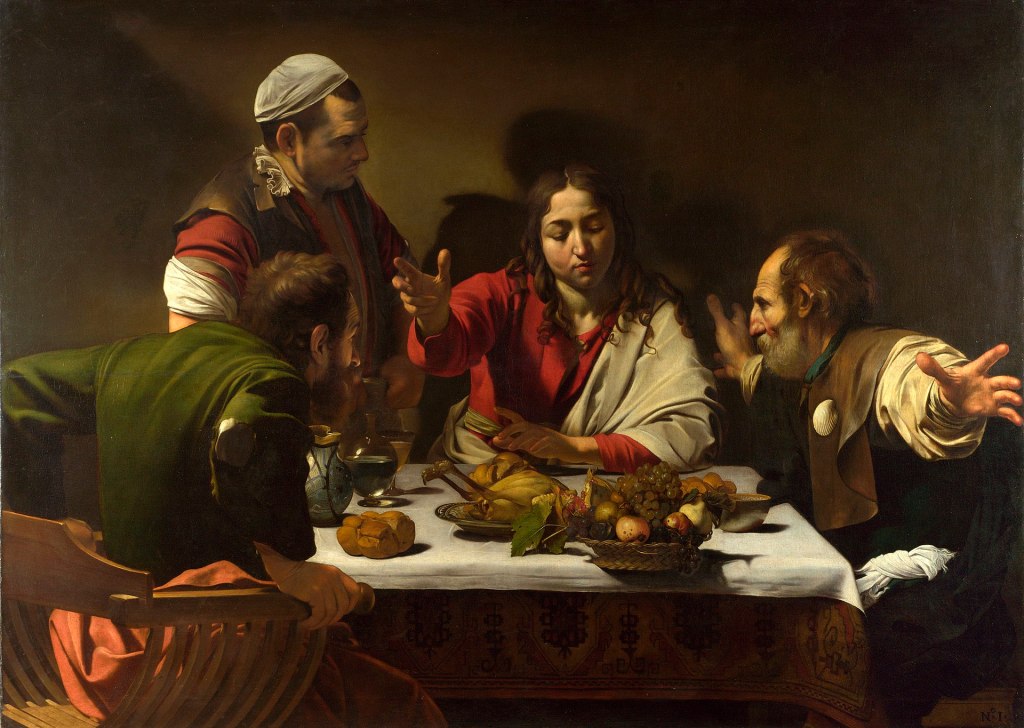
“Supper at Emmaus” by Caravaggio.
We are priests called to preside the celebration of the Eucharist in persona Christi.
We priests do not own the Mass and we cannot insist on whatever we want to do, even if it is very pleasing and delighting to the senses of the people.
Do away wit all those “styles” and gimmicks.
Jesus saved us not with activities; Jesus saved us by dying on the Cross.
If all we are concerned with is to “feel good”, to tickle our bones and senses, our eyes – and those of the people we serve and bring closer to God would never be opened to recognize Jesus Christ.
Our Masses and other celebrations need only Jesus, always Jesus.
There is no need to put our pictures in every tarpaulin or announcement. Rest assured that every disciple of Jesus is always good-looking and handsome. Believe. And stop bragging it.
Let us have him always and let others recognize him from within. If there is no inner recognition of Jesus, maybe we have never met him at all. Neither in Emmaus nor in Jerusalem nor in our selves.
A blessed week ahead of you, my brother priests and fellow communicators of Christ, in Christ.
The Lord Is My Chef Sunday Recipe, Easter Week III-A, 26 April 2020
Acts of the Apostles 2:14.22-33 ><)))*> 1 Peter 1:17-21 ><)))*> Luke 24:13-35
Photo by author, sunset at Laguna de Bay (Los Banõs), February 2020.
I am sure all of us can identify with the two disciples going home to Emmaus on that evening of Easter. And surely, as we accept with a heavy heart the extension of this enhanced community quarantine (ECQ) until May 15, we pray like them, saying, “Stay with us, Lord.”
As they approached the village to which they were going, he (Jesus) gave the impression that he was going on farther. But they urged him, “Stay with us, for it is nearly evening and the day is almost over.” So he went in to stay with them. And it happened that, while he was with them at table, he took bread, said the blessing, broke it, and gave it to them. With that their eyes were opened and they recognized him, but he vanished from their sight. Then they said to each other, “Were not our hearts were burning within us while he spoke to us on the way and opened the Scriptures to us?”
Jesus always walking with us, without us recognizing him
Once again we see the presence of darkness in this story of Easter found only in St. Luke’s gospel. And that is the beauty of Easter – like Christmas – showing us the immense love of God for us that he sent us his Son Jesus Christ in the darkest moments of our lives to lead us to light and life.
And it always happens when we least expect it like that Easter evening when Cleopas and his companion were on their way to Emmaus.
Jesus comes to us as a stranger and most of all, joins us in the “wrong direction” to bring us back to the right path we must take especially when things go against our plans and expectations.
Until now, we cannot still believe how these things are happening to us: the lockdown, the sufferings and uncertainty of life when everything is on a “wait-and-see” situation especially in business and education while houses of worship remain closed and mass gatherings prohibited to control the spread of COVID-19.
But, if we look back and see how we are today, do we not also feel our “hearts burning within” that despite all the sickness and deaths almost everywhere, we are still here, alive, forging on in darkness, and most of all, somehow being led by Jesus even though we do not recognize him right away to be always on our side?
Yes, we worry, we ache deep inside but, more than these, we hope, we love, we live because we firmly believe in the Risen Lord present in us, present among us.
Deep in our hearts we experience Jesus with us, feeling with us, listening to our cries and worries just like that Easter evening to Emmaus. As we would say in Filipino, “ah basta!” that means without doubt, we are certain of someone or something from deep within not visibly seen.
“Supper at Emmaus” by renowned painter Caravaggio. See the emotion depicted by Caravaggio with his trademark of masterful play of light and shadows. At the center is the Risen Lord blessing the bread that caught the two disciples who are seated in disbelief, one outstretching his arms and the others pushing back in his chair. The third character in the painting is the innkeeper unaware of the significance of the gesture of Jesus. It was at this instance that the two disciples recognized Christ as the travelling man with them to Emmaus.
Our inner recognition of Christ in the breaking of bread
Notice that in all resurrection stories, the followers of Jesus did not recognize him immediately. There is always that feeling within them, like what we feel when we see somebody and we try to recall where we have met him/her, trying to dig into our memories when and how did we get to know the seemingly not “stranger” before us.
It is a funny feeling that is finally resolved with a very simple memory of an instance long ago or a small detail that leads into an “inner recognition” of the person before us.
This is how the disciples of Jesus recognized him — not through his external appearances but more from within like when Cleopas and his companion invited him into their home in Emmaus or when the seven apostles led by Simon Peter met him by the shore of the lake when no one would dare ask who he is because deep within, they knew it was the Lord (Jn.21;12-14).
And this happens always in the context of a meal, a table fellowship when Jesus instituted the Sacrament of the Eucharist on Holy Thursday evening before he was arrested to be crucified.
Here we find the mystery of this sign left to us by Jesus to be his very presence among us in his Body and Blood under the perceptible signs of bread and wine as well as the Sacred Scriptures proclaimed in every liturgical gathering: the more we do not see his outward appearances, the more we recognize Jesus!
Every time we celebrate the Mass and listen to the scriptures proclaimed, we realize within us like the people of Jerusalem in the first reading that this Jesus of Nazareth is a true person present in our lives fulfilling his works of salvation despite our sinfulness.
Like some people we meet, we recognize Jesus Christ not with the outward appearances but from within, from what we have experienced beyond explanations that gives us always a sense of awe because as St. Peter tells us in the second reading, “he had ransomed us from our futile conduct with his most precious blood” (1 Pt. 1:18-19) which is affirmed to us in every celebration of the Holy Eucharist.
The Easter mystery of recognizing Jesus when he vanishes
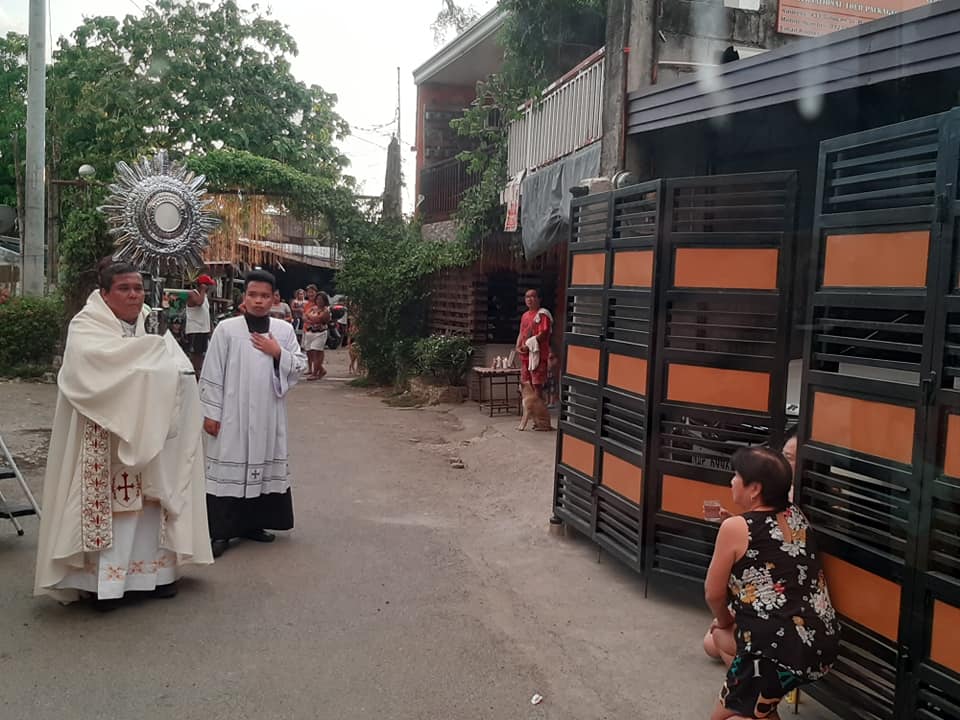
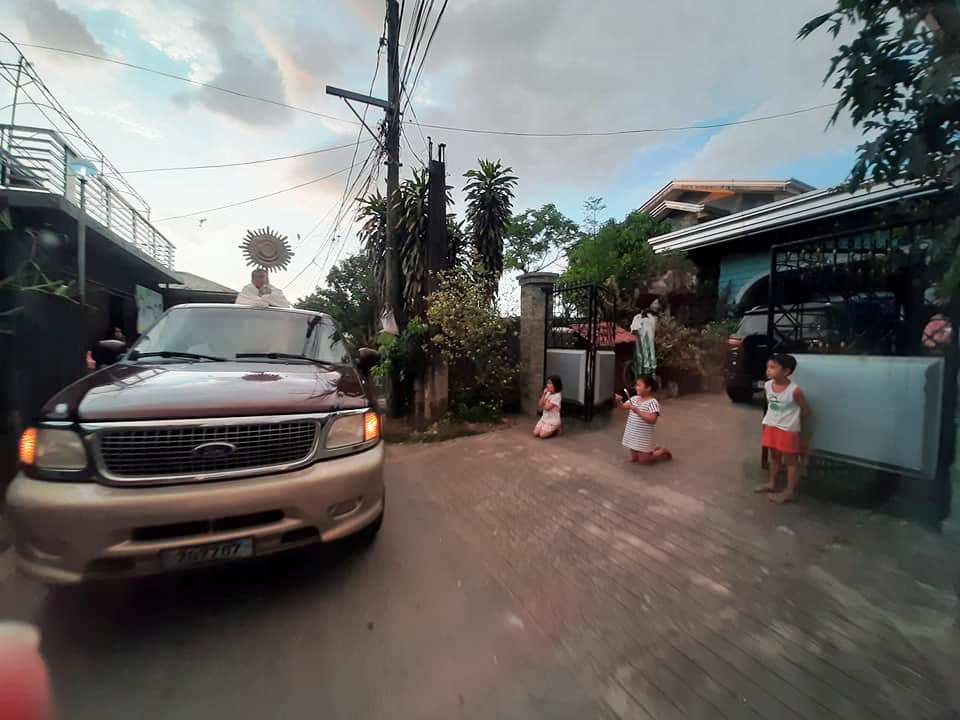
Every Sunday afternoon since this lockdown began due to COVID-19, we have been bringing the Blessed Sacrament around our Parish to remind the people of Christ’s presence among us.
And every Sunday, I am amazed at the faith of the people who would kneel on the side of the road, totally believing that it is Jesus himself who visits them in the Blessed Sacrament.
The sight is so moving with people from all walks of life bowing their heads or raising their hands, recognizing Jesus in the Blessed Sacrament as they pray in silence with others crying. The few motorists passing by stop at the side of the road to see Jesus and be blessed while others get near our truck for a blessing.
Here lies the great mystery of Easter: Jesus need not appear to us in person because as he vanishes in the Blessed Sacrament, that is when we recognize him!
In the most simple gestures of the Mass under the most simple signs of bread and wine, Jesus vanishes from our outward view and through this vanishing our interior or inner recognition opens up that we “see” him in the many instances he had touched us especially in our “heart-breaking” experiences in the past.
We know with certainty that “it is the Lord” – Dominus est – present in every breaking of bread because part of the Easter mystery tells us deep within that it is only in his vanishing that he truly becomes recognizable to us.
What a shame and a tragedy especially in these days of live television or internet Mass when priests do all the gimmicks and antics to wow the people as if they are audience in a show than faithful in a sacred gathering.
May we not forget this mystery of Easter that, the more Jesus vanishes, the more we recognize him because Jesus is more than enough than anybody or anything else especially in the Mass. And when we pray “Stay with us, Lord”, we actually ask for more faith to believe in him to see him in his vanishing. Amen.
A blessed week ahead to everyone! Stay safe, stay in the Lord.










 lordmychef.com