Isaiah 29:17-24 ><)))*> ><)))*> ><)))*> Matthew 9:27-31
Advent in our parish, 2019.
Time flies so fast, O Lord, and we are almost over with the first week of Advent! How reassuring are your words today especially in the first reading of the wonderful things coming soon, in fact happening now in Jesus Christ’s coming.
Thus says the Lord God: but a very little while, and Lebanon shall be changed into an orchard, and the orchard be regarded as a forest! On that day the deaf shall hear the words of a book; and out of gloom and darkness, the eyes of the blind shall see. The lowly will ever find joy in the Lord, and the poor rejoice in the Holy One of Israel…
Isaiah 29:17-19
I know, Lord, and yes, I can see clearly now that great things are coming for us who faithfully await your coming. There shall be joy and justice, healing and consolation for those who suffer and cry.
Keep our eyes opened, remove our blindness to see the more essential things in life especially you so we may always experience your presence, your coming. Amen.
Isaiah 26:1-6 ><)))*> ><)))*> ><)))*> Matthew 7:21, 24-27
Chandelier of the Malolos Cathedral, 04 December 2019.
Let me stay in your “house”, O Lord, and help me keep your house rules, too. I am sorry when most of the time I simply want to rest and drop by your “house” with no plans of really living there, of listening to your words and doing your will.
Jesus said to his disciples: “Not everyone who says to me, ‘Lord, Lord,’ will enter the Kingdom of heaven, but only the one who does the will of my Father in heaven.”
Matthew 7:21
Forgive me Lord when I have become so complacent as your disciple, as a Christian, relying solely on my name and affiliation with you without working so hard to be like you.
Help me to be holy like God our Father, listening to your words intently and faithfully acting on it at all time so that I may be wise and most of all, be filled with your peace:
A nation of firm purpose you keep in peace; in peace, for its trust in you. Trust in the Lord forever! For the Lord is an eternal Rock!
Isaiah 26:3-4
So many times, Lord Jesus, we take you for granted… just like the people in our own homes. But when things go wrong, they are the only people we can count on to receive us, to love us, and to forgive us. Very much like you, Jesus.
May this Season of Advent make us more open to you not only to receive you but also to keep you. Amen.
Isaiah 25:6-10 ><)))*> ><)))*> ><)))*> Matthew 15:29-37
The Manor House, Camp John Hay, Baguio City, 2017.
Praise and glory to you, O Lord Jesus Christ for coming to us, in fulfilling our lives, in making our joy complete. Unfortunately, no one seem to be waiting for you or worst, we live as if you have not come at all.
How sad, O Lord, that often even if we are so excited with Christmas, it does not necessarily mean we are excited of you as a person coming to us. Even if we love to sing and hear that carol “Joy to the World”, we are not really joyful because our hearts are far from you.
Forgive us, Jesus, in being focused with time and dates, than with your person and with your coming.
The more we get focused with dates and gifts and carols and other trimmings of Christmas, the less we think of you and of others too.
Open our hearts to receive you in us.
On that day it will be said: “Behold our God, to whom we looked to save us! This is the Lord for whom we looked; let us rejoice and be glad that he has saved us!” For the hand of the Lord will rest on this mountain.
Isaiah 25:9-10
Open our hearts to you, Jesus, that you are more than enough than anything we could wish for.
Make us desire more of you than of things so we may always have an abundance of you as our “bread” or everything in this life. Amen.
Tuesday, Advent Week I, Memorial of St. Francis Xavier, 03 December 2019
Isaiah 11:1-10 ><)))*> ><)))*> ><)))*> Luke 10:21-24
What a blessed Tuesday we have today, O Lord, despite the threat of a super typhoon approaching us!
Your words console us, assure us of your protection and grace.
You give us today two beautiful images of greatness in being small which is the true spirit of Christmas, of you our God coming to us a child born in Bethlehem more than 2000 years ago.
First image is the “shoot shall sprout from the stump of Jesse, and from its roots a bud shall blossom” (Is.11:1).
Every great thing always starts small. Most of all, they always happen where we least expect them like shoots sprouting from the stump of a tree! Help us to keep this in mind especially when we are losing hope.
How sad that in today’s world, people insist that “size always matter” that we always want to be the biggest in everything.
Second image, O Lord, that you have given us today of greatness in smallness is being childlike, your favorite:
Jesus rejoiced in the Holy Spirit and said, “I give you praise, Father, Lord of heaven and earth, for although you have hidden these things from the wise and the learned you have revealed them to the childlike. Yes, Father, such has been your gracious will.
Luke 10:21
Photo by Mr. Jim Marpa, 2018.
Being like a child is the very essence of your life and teachings, O Lord Jesus which we seem to fail to grasp and accept. All our lives we have always insisted on being so wise and learned that have often led us to more problems and disunity among us.
Teach us to be childlike, full of trust and confidence in you and most especially, with that sense of awe.
Like our Saint for today, that great child in faith of St. Ignatius of Loyola, St. Francis Xavier who kept that spirit of being childlike in his going to mission as far as China and Japan working tirelessly for the faith.
O blessed St. Francis Xavier, pray for us to remain small and simple before God our Master like you so that his greatness and majesty be seen more in us. Amen.
Isaiah 4:2-6 ><)))*> ><)))*> ><)))*> Matthew 8:5-11
Sunrise at the Lake of Galilee, the Holy Land, 2017.
O God our loving Father, who among is truly worthy to receive you under our roofs?
Who among us is truly worthy of receiving you in our sinful selves?
No one, O dear God!
Yet, you still sent us your only Son Jesus Christ to live among us, to dwell among us sinners so that unworthy as we are, we may be worthy to receive him.
Just say the word, Lord, like with the centurion’s request to you in today’s gospel.
Cleanse us, our minds, our lips, and our hearts so that we may be worthy to receive you into our lives in your daily coming. Most especially in your Second Coming, Lord Jesus.
Unworthy as we are, let us come to you with clean hearts and receive you Jesus in your sacred banquet of the Holy Eucharist, the foretaste of that banquet in the Kingdom of heaven.
For over all, the Lord’s glory will be shelter and protection; shade from the parching heat of day, refuge and cover from storm and rain.
Isaiah 4:6
Come, Lord Jesus! Amen.
Trees at the Sacred Heart Novitiate in Novaliches, Quezon City, 2017.
The Lord Is My Chef Sunday Music, 01 December 2019
Photo by Mr. Jim Marpa, 2018.
A blessed Sunday to you my dear follower and reader!
It’s the first day of December, the final month of the year but at the same time the start of a new year in our Church calendar with the Season of Advent, the four Sundays before Christmas.
From the Latin adventus that means coming, Advent has a two-fold character on the two comings of Jesus Christ: beginning today until December 16, all readings and prayers are focused on his Second Coming; from December 17 to the 24th, we shift our sights to the first Christmas when Christ was born in Bethlehem 2000 years ago.
Jesus said to his disciples: “As it was in the days of Noah, so it will be at the coming of the Son of Man. In those days before the flood, they were eating and drinking, marrying and giving in marriage, up to the day that Noah entered the ark. They did not know until the flood came and carried them all away. So will it be also at the coming of the Son of Man.”
Matthew 24:37-39
Nobody knows when Jesus Christ is coming again but he assures us that it will be sudden and unexpected like in the days of Noah. It is useless to know exactly when it would be because it may be any time. According to St. Bernard of Clairvaux, between the two comings of Christ is his third coming – that is, in every moment of our lives.
Contrary to common beliefs, the Second Coming of Christ at the end of time known as parousia will not necessarily be catastrophic. It all depends to our attitude: if we are negligent of our Christian duties to love and serve those in need, then we end in disaster like what Jesus tells us in the gospel today.
Jesus is coming again not to destroy the world but to bring it to perfection, into new heaven and new earth. What he is asking us is to be like him, Christ-like, to be his presence by allowing us to let his light shine through our words and deeds.
Here to inspire us to glimpse Christ’s coming to our daily lives is Johnny Nash in his 1972 hit “I Can See Clearly Now”.
Composed and produced by Nash himself, I Can See Clearly Now evokes a very Advent spirit of active waiting and vigilance. Its musical arrangement laced with reggae influences from Nash’s earlier collaborations with Bob Marley gives the song with some touch of solemnity that makes it so perfect for this First Sunday of Advent.
Happy listening and may the song open your eyes too to Jesus Christ’s love for you!
Isaiah 2:1-5 ><}}}*> Romans 13:11-14 ><}}}*> Matthew 24:37-44
From Google.
A blessed first Sunday of Advent to you my dear reader and follower! Today we begin another new year in our Church calendar with this season of Advent. Both the word “Advent” and its concept were borrowed from ancient Rome when provinces prepared for the coming, or “adventus” of the emperor to visit the occupied territories of his empire.
But, Jesus is more than any emperor of the world for he is true God and King of kings, the one who had come, always comes, and will be coming again at the end of time to judge us, both the living and the dead. This Season of Advent gives us the opportunities to intensely prepare for the Lord’s adventus that always begins in our hearts.
Advent has a two-fold character: beginning today until December 16, the readings and prayers set our sights to the Second Coming of Christ at the end of time or the parousia. From December 17-24, focus shifts to the first Christmas when Jesus was born in Bethlehem more than 2000 years ago.
According to St. Bernard of Clairvaux, between these two comings of Christ is his third coming that happens daily in our lives, so ordinary but very sudden like in the time of Noah.
Photo by author, sacristy of our Parish, Advent 2018.
Jesus said to his disciples: “As it was in the days of Noah, so it will be at the coming of the Son of Man. In those days before the flood, they were eating and drinking, marrying and giving in marriage, up to the day that Noah entered the ark. They did not know until the flood came and carried them all away. So will it be also at the coming of the Son of Man.
Matthew 24:37-39
Staying awake, actively waiting for the Lord.
Jesus is definitely coming at the end of time. It is useless to be concerned when that would be because it will be sudden and unexpected. What matters most is our attitude of “staying awake, actively waiting” for the Lord’s coming again.
The Lord cites to us the example of Noah whom God had instructed to build an ark in the Old Testament for the coming great flood meant to cleanse the earth of sins and evil.
To actively wait for the Lord’s parousia means to be a sign of contradiction like Noah who faithfully obeyed God’s will in building an ark and later gathering into it all the animal species of earth.
Imagine the insults Noah had to endure from people laughing at him while building the ark. Yet, he never wavered and faithfully fulfilled his task before the Lord.
From Google.
Jesus cites three other instances of displaying the right attitude in actively waiting for his Second Coming: the two men out in the field, the two women grinding, and the master of the house.
One of the two men in the field was taken while one of the two women grinding was also taken because they were responsibly fulfilling their tasks when the parousia comes; their respective counterparts were most likely doing nothing or very lazy that they were left behind.
The mini parable Jesus inserted at the end shows us the imagery of the master of the house staying awake to keep the thief from breaking into the house in the middle of the night.
These are all about having the right attitude as disciples of Jesus actively awaiting his return. From Noah to the other man in the field, the other woman grinding, and the master of the house, we find from their attitudes of active waiting budding forth their hope in God.
Generally speaking, the way we live our lives determines also how we hope in the Lord.
And this we find in St.Paul’s exhortation to the Christians of Rome:
Brothers and sisters: you know the time; it is the hour now for you to awake from sleep. For our salvation is nearer now than when we first believed; the night is advanced, the day is at hand. Let us then throw off the works of darkness and put on the armor of light; let us conduct ourselves properly as in the day, not in orgies and drunkenness, not in promiscuity and lust, not in rivalry and jealous. But put on the Lord Jesus Christ, and make no provisions for the desires of the flesh.
Romans 13:11-14
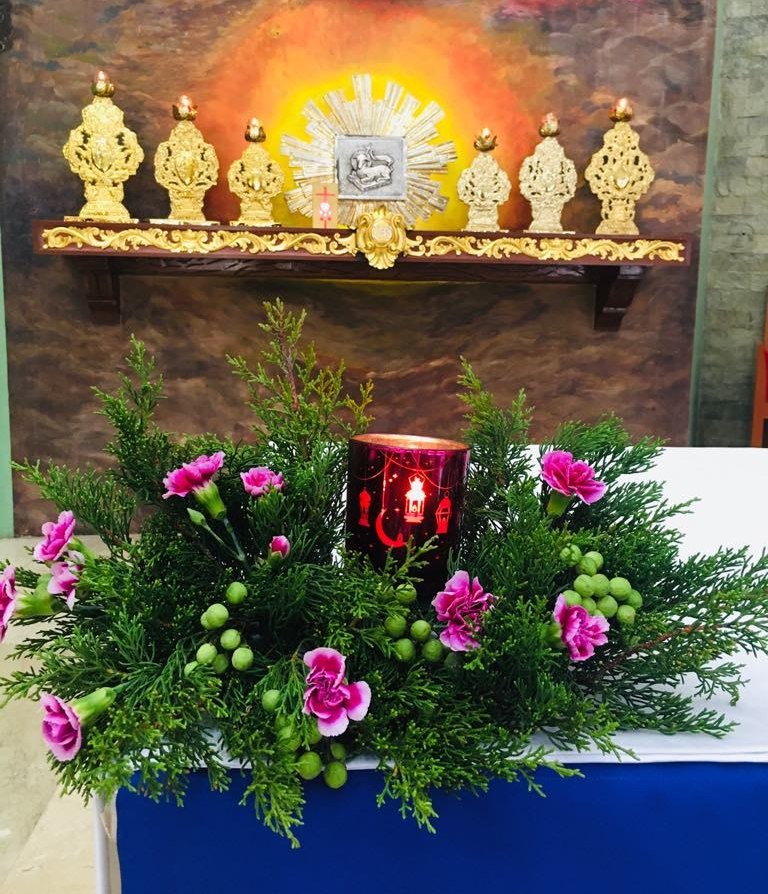
Altar table at the Parokya ng San Juan Apostol at Ebanghelista, Bagbaguin, Santa Maria, Bulacan, Advent 2018.
Putting on Christ to show his light to dispel darkness.
St. Paul wrote the Christians in Rome more than 2000 years ago to remind them of the fierce spiritual warfare between good and evil, light and darkness while they were living in the midst of a pagan world and culture.
It was a very difficult time to be truly Christians but St. Paul felt the need to remind everyone of the ever-present reality of the parousia. Like in most of his letters, he captured by the grace of the Holy Spirit the beautiful imagery of disciples with the right attitude awaiting the Second Coming as “putting on the Lord Jesus Christ”.
Putting on our Lord Jesus Christ is not just a mere call to be morally perfect persons but for us to strive in making the light of Christ shine on us so that we may manifest Jesus more in us and in our lives.
Simply put, it is becoming “Christ-like”, a true Christian who is “dead to sin but alive for God in Christ Jesus” (Rom. 6:11), one who lives differently by making Jesus more present especially in these difficult and troublesome times.
The time of St. Paul was no different with our present age with growing materialism and consumerism among peoples, including Christians afflicted with Pope Emeritus Benedict XVI’s “dictatorship of relativism” that have removed God from every aspect of human life, including Christmas itself!
See how we are so focused on Christmas countdowns than with the very reason of the Season, Jesus Christ. See how the media equate Christmas with material things, sugarcoating it with sentimental feelings as most Christmas songs nowadays indicate.
Advent is seeing more of Jesus, than of time.
On this first Sunday of Advent, our sights are redirected anew into Christ’s Second Coming with our important task of making him present in our very selves.
As children of the light, we slowly discover and realize how our definitive salvation is slowly moving towards its fullness in Christ’s parousia when everything is totally changed by God with peace finally reigning supreme over all.
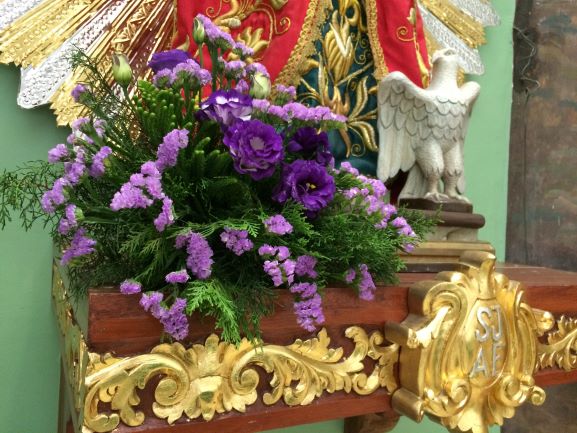
Violets on the pedestal of our Patron Saint, John the Evangelist.
This was the vision of Isaiah a long, long time ago.
It had been fulfilled in Christ’s first coming in Bethlehem over 2000 years ago and it is being fulfilled daily through people filled with hope in God’s justice and love.
In the days to come, the mountain of the Lord’s house shall be established as the highest mountain and raised above the hills. All nations shall stream toward it; many people shall come and say: “Come, let us climb the Lord’s mountain…” They shall beat their swords into plowshares and their spears into pruning hooks; one nation shall not raise the sword against another, nor shall they train for war again. O God of Jacob, come, let us walk in the light of the Lord!
Isaiah 2:2-3, 4-5
People who keep on wondering and asking when will Jesus come again are not really interested with the Lord’s Second Coming but only with themselves like the people during the time of Noah – oblivious to anything else and busy with their own pursuits.
The more we think of the WHEN, the less we think of the WHO of Advent. Let us put on the Lord Jesus Christ to be filled with his light until all darkness in life is dispelled. Amen.
Finally we have completed the nine-day novena of Christmas but that is not the true joy of our annual Simbang Gabi tradition. What is most essential is in these nine days of rising early for the novena, we have rediscovered Jesus Christ in ourselves and among others while at the same time recommitted ourselves to Him again as our only fulfillment in life. I hope that in the past nine days we have rediscovered and even brought back somehow to our lives our sense of the sacred that is now fast fading out in our very consumerist society. Through the many religious symbolisms found in our liturgies and readings these Advent season, it is hoped that we have rediscovered God – as well as our sense of the sacred – who is the most meaningful and essential in life.
Finally today also, we find the only male character in St. Luke’s story of the coming of Christmas regaining his stature after being on the distaff side, Zechariah. After disbelieving the good news of (finally) having a son through the angel Gabriel’s annunciation at the Temple when he was forced into silence by becoming mute and deaf, Zechariah was finally able to speak again after declaring his son shall be named John. And his very first words after being silent for nine months were praises to God the Almighty like Mary during the Visitation. Called theBenedictus, Zechariah affirmed and confirmed in himself first the reality and truth of God being present in our lives amid the many twists and turns in life, narrating His reality and fidelity to His promises from the time of the Patriarchs and the Prophets of Israel down to the birth of John who would prepare the Christ. In effect, Zechariah had finally come into a full circle in singing the Benedictus: like his wife Elizabeth and son still in her womb John, St. Luke tells us how Zechariah was also filled with the Holy Spirit at that instance on the naming of John when he prophesied, “Blessed be the Lord, the God of Israel” (Lk.1:68).
Zechariah shows today the fruits of his “forced silence” that had deepened his priesthood that is very evident in the opening line of Benedictus, giving glory to God for His fidelity and mighty acts to save Israel. It is very similar with some of the popular parts of the psalms that every Jew prays. There are three important reasons that Zechariah tells us why God is blessed: “for he has come to his people and set them free, he has raised up for us a mighty Savior, born of the house of his servant David” (Lk.1:68-69). What is amazing in the Benedictus is that the verbs are in the past tense, of the works of God being done in the past like visiting His people, setting them free or redeeming them by sending Jesus Christ. Like the Magnificat, it is a looking back and a looking forward to more great things God has in store for us. Zechariah is reminding how God has never stopped working wonders for us, speaking and acting through prophets so many years ago even before the coming of Christ who is the fulfillment of all His promises.
We have mentioned how we priests and other religious and consecrated persons sing the Magnificat every evening; the Benedictus, on the other hand, is sung every morning prayers called lauds. As we face a new day, like Zechariah at the birth of his son John, we look back and remember so that in the process we renew our faith and trust in God who never stops in working for our good. We praise God and put our trust and confidence in Him for every new day, hoping He would continue to visit us, redeem us, and raise us up from the many challenges we are going to face. But most of all, we are reminded too by Zechariah at this time, on the eve of Christmas, to ponder in our hearts where the Lord is leading us to? Zechariah had seen the hand of God in Israel’s history, in his own life, and could see it also present in the coming life of his son John. It is very clear that God is our leader in life, the invisible hand who directs us. When we come to think of it, Zechariah’s forced silence was a way for him to rediscover again his sense of God and his sense of the sacred. So many times for us, including us priests that although we keep our prayers and devotions, they are devoid of God. One of the things this generation is fast losing is that sense of the sacred when everything is not taken for granted and trivialized. How I hate before the Metro Film Festival during Christmas when we as the only Christian nation in this part of the world celebrates the merriest and longest Christmas are feasting on movies about evil and horror movies. At least these past few years, there have been marked improvements in our film industry with great movies coming out. Last year I was able to see the adaptation of Nick Joaquin’s “Portrait of the Filipino as Artist” that was magnificent in its interpretation of the play.
On these remaining hours of the day before Christmas, imitate Zechariah to get some silent moments with our self and with God to reflect on where is the Lord leading us to this Christmas? What direction in life is He asking us to follow? In the first reading we have heard God asking David to stop his plans of building a temple for Him. There was nothing wrong with building a temple but it was not the plan of God for David but for his son Solomon. The same thing with us: no matter how good our plans are for God and for others, it is the direction God has for us? We can never prepare the way of the Lord unless we first sub it to His plan and follow His directions. A blessed Christmas to you! AMEN. Fr. Nicanor F. Lalog II, Parokya ng San Juan Apostol at Ebanghelista, Gov. F. Halili Ave., Bagbaguin, Sta. Maria, Bulacan.
*Photo by author, altar linen of our Parish Church. May we follow God’s directions for our lives.
Christmas is a story of love, about the meeting of lovers with God as the Great Lover who gave us His only Son because of His immense love for us. Unfortunately, this love of Christmas is often presented in the cheesy songs as romantic love like in “Pasko na Sinta Ko”and “Last Christmas”. The word “lovers” may be too serious as a term for us to relate this with today’s gospel the Visitation of Mary to her cousin Elizabeth; but, the truth is, both women were so in love with God who clearly loved them so much with children in their womb bound to change the course of human history forever. They in turn, were also filled with love for each other as expression of their love for God. And when there is love, there is always tenderness and sweetness that all happen in the context of a visitation that we first try to reflect upon.
Visit and visitation may seem to be one and the same in the sense that both have a common Latin root word, the verb to see, “vidi, videre” from which came the word video. But, a visit is more casual and informal without intimacy because it is just “a passing by” or merely to see. It is more concerned with the place or the location and site and not the person to be visited. We say it clearly in Filipino as in “napadaan lang” when it just so happened you were passing by a place and even without any intentions, you tried seeing someone there. On the other hand, visitation is more commonly used in church language like when a bishop or priests come to see the parishioners in remote places. This is the reason a chapel is more known as a visita in our country because that is where priests visit and check on the well-being of people living in areas very far from the parish usually at the town proper. Aside from being the venue for the celebration of Masses, the visita serves as classroom for catechism classes and other religious even social gatherings in a particular place. Thus, visitation connotes a deeper sense in meaning because there is an expression care and concern among people, a kind of love shared by the visitator/visitor and the one visited like Mary and Elizabeth. Visitation is more of entering into someone’s life or personhood as reported by St. Luke on Mary’s visitation to Elizabeth where Mary “entered the house of Zechariah and greeted Elizabeth” (Lk.1:40), implying communion or the sharing of a common experience. In this case, the two women shared the great experience of being blessed with the presence of God in their wombs!
Visitation, therefore, is a sharing or oneness in the joys and pains of those dear to us. The word becomes more meaningful when we try to examine its Filipino equivalent which is “pagdalaw” from the root word “dala” that can be something you bring or a verb to bring. When we come for a visitation, we dala or bring something like food or any gift. But most of all we bring our very selves like a gift of presence wherein we share our total selves with our time and talents, joys and sadness, and everything to those being visited. And that is what Mary did exactly in her visitation of Elizabeth where she brought with her the Lord Jesus Christ in her womb, becoming the first monstrance of the Lord as well as His first tabernacle. We are invited to become like Mary in the visitation of others to bring Christmas and Jesus Himself to others by allowing our very body to be the “bringer” or “taga-dala” of Christ. The Lord Himself is the highest good we can bring as pasalubong in ever visitation we make. And if we can only be like Mary in our visitations and dealings with one another sharing Jesus Christ, then we also bring with us God’s tenderness and sweetness to others. In a world that admires toughness and roughness, qualities like tenderness and sweetness are so rare to find these days. How sad, even tragic is the viral video of bullying at the Junior High School of the Ateneo last week that has spawned other forms of bullying with everybody lynching on the bully, making all kinds of jokes out of the incident while forgetting the bigger bullies we have in the halls of power these days. See that the two most popular presidents ever elected won the hearts of many voters because of their macho image of astig or sanggano, relishing their pugnacious character and behavior with matching cuss words and street talk, exactly the bullies we often condemn?!
Back to our topic…tenderness and sweetness in Filipino are often translated in just one word which is “malambing” from “lambing” that has no direct English translation except that it connotes a loving affection; but, both terms are more than just affections but stirrings from the heart that move us into action. Tenderness is very much like gentleness; the former is more focused while the latter is very general attitude. Tenderness is more than being soft and gentle but an awareness of the other person’s weaknesses, needs and vulnerabilities. A tender person is one who tries not to add more insult to one’s injuries or rub salt onto one’s wounds so to speak. A tender person is one who tries to soothe and calm a hurting person, trying to heal his/her wounds like God often portrayed in many instances in the bible in lovingly dealing with sinners filled with mercy. Like God, a person filled with tenderness is one who comes to comfort and heal the sick and those taking on a lot of beatings in life. When Jesus Christ came, He also personified this tenderness of God like when He is moved with pity and compassion for the sick, the widows, the women and the children and the voiceless in the society. Tenderness is coming to heal the wounds of those wounded and hurt, trying to “lullaby” the restless and sleepless. Mary visited Elizabeth because she also knew the many wounds of her cousin who for a long time bore no child, living in “disgrace before others” as she had claimed (Lk.1:25).
Sweetness always goes with tenderness. It is the essence of God who is love. Anyone who loves is always sweet that always comes naturally from within, bringing out good vibes. It is never artificial like Splenda, always flowing freely and naturally that leaves a good taste and feeling to anyone. In the Hail Holy Queen, Mary is portrayed as “O clement, O sweet Virgin Mary” to show her sweetness as a mother. According to the late Fr. Henri Nouwen in his book “The Return of the Prodigal Son”, we are all invited to be like God in having both the qualities of a father and mother in Him. Basing his reflections on the painting by Rembrandt of the said parable, God has a father’s hand that is supportive, empowering and encouraging and a mother’s hand that is consoling, caressing, and comforting. There are no pretensions and pompousness in being sweet, never needs much effort to exert in showing it for it comes out naturally and instantly.
Tenderness and sweetness are the most God-like qualities we all have but have buried deep into our innermost selves, refusing them to come out because of our refusal to love for fears of getting hurt and left behind or, even lost. When Mary heard about Elizabeth’s condition, she simply followed her human and motherly instincts that are in fact so Godly – she went in haste to visit her. Tenderness and sweetness are the twin gifts of Christmas to humanity when God almighty became little and vulnerable like us so we can be great and powerful like Him in being able to love. Let me end this long reflection with a quotation from the classic novel “The Plague” by Albert Camus: “A loveless world is a dead world, and always there comes an hour when one is weary of prisons, of one’s work, and of devotion to duty, and all one craves for is a loved face, the warmth and wonder of a loving heart.” Let that love in you come out this Christmas and hereafter, simply be human like the child Jesus and be surprised at its tremendous power to change the world like God Almighty. AMEN. Fr. Nicanor F. Lalog II, Parokya ng San Juan Apostol at Ebanghelista, Gov. F. Halili Ave., Bagbaguin, Sta. Maria, Bulacan.
*Photo by the author, our Nativity scene at the side of the church with the manger still empty. Be the Child Jesus Christ, be tender and sweet to someone going through hard times in life, to someone suffering in silence. Let them feel Christ, let them be touched by God with your concrete love of tenderness and sweetness.
Mary’s prominence lies not only in giving birth to Jesus Christ but more of her being His perfect disciple, the first Christian, the first receiver and doer of the Word who became flesh in her womb. After sharing Christ with Elizabeth in the Visitation, Mary now sings the Magnificat like the song of Hannah in the first reading when she was gifted by God with the child Samuel despite her barrenness. It is very amazing that the Blessed Virgin Mary is the only person who has appeared most – five times – as a cover of the TIME Magazine. Likewise, her Magnificat is said to be the only poem that has been set to music more than any other in the whole history. Almost every great musician has worked on Mary’s canticle like Bach, Mozart, Vivaldi and Rachmaninoff while for over a thousand years it had been sung or recited in the evening in monasteries around the world following St. Benedict’s rule in the sixth century. The Magnificat is a song of praise and thanksgiving to God, Mary’s own experience of God not only in her own life but also in her cousin Elizabeth who was barren and old yet conceived a child to become the Lord’s precursor, John the Baptizer. At the Visitation, Elizabeth praised Mary but when it was Mary’s turn to speak, she praised God instead of Elizabeth contrary to common gesture of returning her favour because it was very clear with her that every gift is from God, and the greatest gift we can all have from God is His Son Jesus Christ whose birthday we celebrate on Tuesday.
What is so remarkable with the Magnificat is its Advent flavor: it is not only a praise and thanksgiving to God for all the wondrous things He had done to Mary and to us all but also a song of looking forward to more blessings to come from Him! That is what Advent is all about, a looking back to the first Christmas and a joyful waiting for the Second Coming of Jesus Christ! This is very evident in her opening lines, “My soul proclaims the greatness of the Lord; my spirit rejoices in God my savior. For he has looked upon his lowly servant. From this day all generations will call me blessed: the Almighty has done great things for me, and holy is his Name” (Lk.1:46-49). It is definitely a fruit of her prayer or gestational silence we mentioned the other day like what Elizabeth did. Mary took into her inmost being the message of the angel to rejoice as a highly favored one of God, acknowledging the work of grace in her despite her stature in life. Again we find here some strong Jewish flavors of which Mary must be aware of like the expression “the Almighty has done great things for me” which has strong roots in the Old Testament experience of the Israelites and their prophets when God saved them from Egypt and so many trials. Think of the great things God has done to you also and rejoice! Look back to the past 12 months and here we are, still together although some badly beaten with some even bruised in life but like Mary and Elizabeth meeting together, there are so many reasons for us to celebrate and thank the Almighty for the great things He had done to us. And the most wonderful blessing next to God is the gift of family and friends around us, like the two cousins, a beautiful imagery of two pregnant women rejoicing together, celebrating life as they looked back in their personal lives and in their nation’s history the many good things God had done to them since the time of Abraham.
The Magnificat shows us too that most of the things Mary mentioned have not happened yet: “He has mercy on those who fear him in every generation. He has shown the strength of his arm, and has scattered the proud in their conceit. He has cast down the mighty from their thrones and has lifted up the lowly. He has filled the hungry with good things and the rich he has sent away empty. He has come to the help of servant Israel for he has remembered his promise of mercy, the promise he made to our fathers, to Abraham and his children forever” (Lk.1:50-57). These are a mixture of images from the Old Testament about the things God had done to Israel and to the two cousins but at the same time mention other things that would happen only upon the completion of Christ’s mission. This is to show us that Mary’s Magnificat is also about the perfect presence of God in Jesus Christ in our lives who is the “same yesterday, today and forever” (Heb. 13:8).
Last year I was privileged to join my former colleagues at GMA-7 News as their chaplain on a pilgrimage to the Holy Land – all for free with everything in first class! On our flight back to Manila, we met some OFW’s and one of them was so ecstatic in meeting Ms. Jessica Soho, making a commotion like crazy at the Ben Gurion Airport which is noted for its strict security measures. A female security officer caught our attention and held us for a while as she checked our papers and passports. Making things worse, the crazy OFW kept telling the officer to let us go because Ms. Jessica is a celebrity in our country. That got the Israeli’s blood boiled and turned her attention to me, the only man in our group, asking me to go with her to their office. That was when the three women of GMA News stood for me – our SVP Ms. Marissa Flores, Ms. Jessica Soho, and newly retired VP Ms. Kelly Vergel de Dios – telling the airport official that I am their friend, a friend for over 30 years, explaining how I used to work with them until I resigned and became a priest. I felt my world stopping momentarily like in a dream sequence: everything happened so fast! There was the possible delay and a lot of interviews but I also felt God’s strong arm holding me, also tenderly caressing me with His mercy when I heard the three veterans of news defending me. It was the final blessing I got from God during that pilgrimage when the three women of GMA-7 News were like Mary and Elizabeth reminding me how God had worked in our lives all these years. It was like a Magnificat moment for me that until now I can recall the sweet smile that incident had left me. Try praying the Magnificatstarting tonight as you thank God for the many wondrous things He had done to you despite the many trials you have also gone. Thank God for the faithful and wonderful friends who have visited you to see His plans for you and most of all, be open for more blessings to come from Him this Christmas. Let us pray for the many great women who have changed our lives, the Marys and Elizabeths who visited us and brought us closer to Jesus Christ. AMEN. Fr.NicanorF.LalogII,Parokya ng San Juan Apostol at Ebanghelista, Gov. F. Halili Ave., Bagbaguin, Sta. Maria, Bulacan
*Photos by the author: above are the bronze statues of Mary and Elizabeth at the Church of the Visitation; below, our group photo during our Holy Land Pilgrimage last April 2017.











 lordmychef.com