Lawiswis ng Salita ni P. Nicanor F. Lalog II, Ika-11 ng Pebrero 2020
Larawan kuha ni G. Jay Javier, 09 Enero 2020 sa Quiapo, Maynila.
Deboto ang tawag sa isang tao
na malapit at namimintuho
Kay Kristong Nazareno o Sto. Niño
kasama na mga Santo at Santa
sa pangunguna ng Birheng Maria.
Kaya dapat bawat deboto totoo
uliran at huwaran sa pamumuhay
taglay ay kabanalan nang sa kanya'y
mabanaagan larawan ng kabutihan
ng Diyos sa kanyang kadakilaan.
Kay laking katatawanan at kahangalan
kung ang debosyon ng sino man
ay haggang simbahan lamang
nakikita paminsan-minsan
tuwing kapistahan at mga prusisyon sa lansangan.
Larawan kuha ni G. Jay Javier, 09 Enero 2020 sa Quiapo, Maynila.
Anong kahulugan at saysay
ng mga pagpupugay
sa Diyos at kanyang mga banal
kung sa kapwa nama'y manhid
walang malasakit at pakialam?
Nag-aalaga ng mga Poon
binibihisan tila laruan
ngunit pag-uugali at katauhan
malayo sa katuwiran at katarungan
ganyang debosyon dapat tigilan!
Ang tunay na deboto
puso ay malapit kay Kristo
at sa kanyang Ina at mga Santo
may pagmamahal, malasakit
sa kapwa tao na kanyang nirerespeto.
Larawan kuha ni G. Jay Javier, 09 Enero 2016 sa Quiapo, Maynila.
Ano mang debosyon
iyong nakagawian o nakahiligan
araw-araw itong sinasabuhay
pinaninindigan at tinutularan
aral at buhay ng sinusundang banal.
Sa dami ng mga deboto
bakit ganito pa rin tayo
walang pag-asenso
buhay ay kasing gulo
ng eksena sa senakulo.
Ay naku!
Ano nga ba tayo,
mga deboto o debobo
asal demonyo, sobrang gulo
pinapako nating muli si Kristo!
Photo from catholicworldreport.com, “The Beheading of St. John the Baptist” (1869) by Pierre Puvis de Chevannes.
Your gospel today, O Lord, is so appropriate and timely: while we were busy, albeit foolishly discussing the novel coronavirus in every fora, a technical committee in the House of Representatives has approved three measures seeking to legalize divorce in the country.
We do not know what have really happened but it is so sad that no one among the Catholic and Christian lawmakers there made a solid stand against these measures like St. John the Baptist who was imprisoned on account of his objection to Herod’s taking of his brother’s wife Herodias.
So many times, Lord, we are so afraid and worried of what others might say against us when we make a stand for what is right and just, for what is proper and decent, for what is right and good, for what is your will.
Worst, O Lord, many of us are like Herodias who have prostituted our very selves in the service of the worldly allures of sex, fame, and wealth, choosing to be silent with all the many immoralities going on in government, in the society, and even in the church!
Give us the same courage, Lord, you have given your precursor St. John the Baptist to be prophets in this modern age, to be a voice in the wilderness, making a stand for what is holy, true, and just.
Like David, may we always seek your ways, ask for your grace to do your will against the giants and monsters of this world who ram into us every modern thought and idea that disregard the sanctity of life, the value of every person, as well as the sanctity of marriage.
Let us not be silent anymore with the growing impunity of many in their arrogant display of authority, throwing their weight around us with their cuss words and fallacious arguments that dignify their truncated egos and pride for the sake of progress and modernity. Amen.
The Lord Is My Chef Simbang Gabi Recipe, 18 December 2019
Jeremiah 23:5-8 ><)))*> ><)))*> ><)))*> Matthew 1:18-24
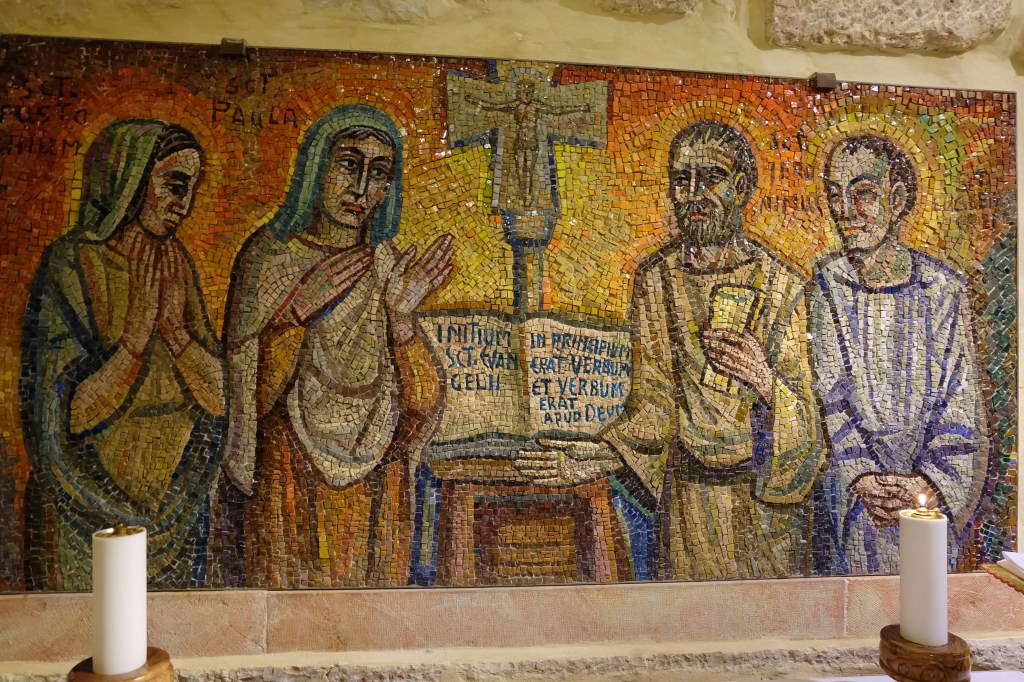
Mosaic at the Chapel of St. Jerome, underneath the Basilica of the Nativity in Bethlehem where St. Jerome lived while studying and translating the Bible into Latin. It is believed to be the place where St. Joseph received in a dream the message of the angel for him to take Mary as his wife. Photo by the author, May 2017.
First, we were told for a very long time the importance of IQ or “Intelligence Quotient” for anyone’s success in life.
Then came the EQ or “Emotional Quotient” this past decade that experts claim has more impact in determining one’s success in life than the IQ.
Now, scientists are claiming that more important than the IQ and the EQ is “AQ” or “Adversarial Quotient”, our ability to respond to various adversarial situations in life.
According to the proponents of AQ, the better we are able to deal with life’s troublesome situations like handling crises involving our many forms of relationships, the better we are equipped in having a more fuller life.
Dream of St. Joseph (Oil on canvas) by Francisco Goya. From Google.
Today we hear the story of St. Joseph facing an extremely adversarial situation when Mary who was betrothed to him was found pregnant with a baby not his!
This is how the birth of Jesus Christ came about. When his mother Mary was betrothed to Joseph, but before they lived together, she was found with child through the Holy Spirit. Joseph her husband, since he was a righteous man, yet unwilling to expose her to shame, decided to divorce her quietly. Such was his intention when, behold, the angel of the Lord appeared to him in a dream and said, “Joseph, son of David, do not be afraid to take Mary your wife into your home. For it is through the Holy Spirit that this child has been conceived in her.”
Matthew 1:18-20
IQ + EQ + AQ = HQ
St. Matthew describes St. Joseph a “righteous man” or, in Jewish thought, a holy man, a saint who lives his life according to the word of God. Also known as a zaddik in Hebrew, a righteous man delights in the Torah (Law), entrusting everything to God.
According to the Book of Psalms’ first chapter, a righteous man or a zaddik is like a tree planted near a river bank that symbolizes God’s words, growing into maturity with good fruits because he is filled with God, putting into practice the Sacred Scriptures and the Laws.
That is precisely what holiness is all about: being filled with God, not being sinless!
Though holiness means being perfect and whole as its Greek origin tells us, holiness as preached by Jesus Christ is an ongoing process when he commanded us to “be perfect as your heavenly Father is perfect” (Mt.5:48).
Holiness does not happen overnight; it takes time and a lot of cultivation on our part.
(One rule of thumb, though, that we must keep in mind: if you think or feel you are holy, definitely you are not. Saints do not know they are saints.)
IQ, EQ, and now AQ are in a sense, scientific expressions of holiness, of being filled with God to become better persons.
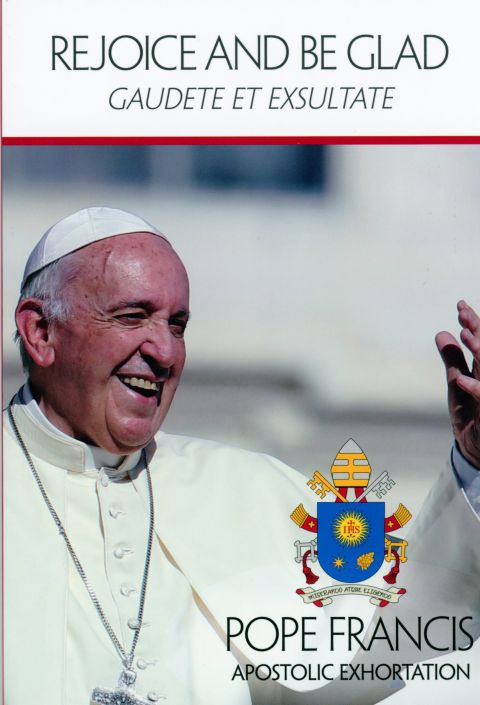
During the Solemnity of St. Joseph last year, Pope Francis issued “Gaudete et Exsultate” to reiterate Vatican II’s universal call to holiness by proposing practical ways in our modern time on how to be holy based on the beatitudes of Jesus Christ.
The Lord asks everything of us, and in return he offers us true life, the happiness for which we were created. He wants us to be saints and not to settle for a bland and mediocre existence. The call to holiness is present in various ways from the very first pages of the Bible. We see it expressed in the Lord’s words to Abraham: “Walk before me, and be blameless” (Gen 17:1).
Gaudete et Exsultate, 1
Very interesting in our Simbang Gabi is how the Pope mentions Abraham, the very beginning of Jesus Christ’s genealogy, as a model of holiness now being expressed in our gospel by the last person in that genealogy, St. Joseph!
St. Joseph bridged faith and practice
St. Joseph is exactly that kind of Jewish zaddik who lived in constant dialogue with God in praying the Scriptures, concretely living it minus the legalisms of the Pharisees and scribes of his time.
For him, the Torah was a good news meant to make life better, not bitter by applying it to daily living which is to love by preserving life.
In dealing with his extremely adversarial situation, St. Joseph did the most important step we have totally disregarded these days: silently pray to God for guidance and grace.
As a man, one can just imagine the many thoughts running through St. Joseph’s mind and heart when the woman he loves so much is found with a baby not his.
Sunrise at Atok, Benguet. Photo by Ms. Jo Villafuerte, September 2019.
His decision to silently leave Mary was due to his great love for her, not in disregarding the letters of the Law that declares that any woman betrothed to a man who bears a child not his must be stoned to death.
Read again St. Matthew’s account we have quoted above and you will feel the solemnity of the scene, of “how the birth of Jesus Christ came about” according to St. Matthew.
There was no sense of agitation or any other negative vibes, purely positive.
Very clear, St. Joseph’s holiness was not merely due to his bloodline or genealogy but his decision to bridge his faith and religion with his life and daily practice.
St. Joseph must be so purely absorbed in prayer that even at his sleep, there was his continuing communing with God that when he woke up, “he did as the angel of the Lord had commanded him and took his wife into his home. He had no relations with her until she bore a son, and he named him Jesus” (Mt.1:24-25).
Finding holiness in adversarial situations
Almost every month we find in social media so many videos and reports of road rage and people freaking out everywhere.
Sometimes I think that with the presence of too many CCTV’s and prevalence of smart phones around, people should be more well behaved, more kind. But the exact opposite is happening!
Life has become one big, giant TV show with everybody grandstanding, artificially creating their own limelight of fame that usually turns into five minutes of shame and notoriety.
Everybody wants to be on TV or Youtube but unknown to many, television screens tend to bring out the worst in us.
Whenever I would see people with their smartphones taking pictures, “talking alone” and doing all those crazy scenes, I fear how most of us have drifted away from our real gounding in life, God.
The story of St. Joseph reminds us of the need to resolve every issues in our lives by going back to our roots and grounding, God. And this happens by being deeply in touch with life and its realities! He was truly grounded and knew what could happen to Mary.
The more we experience life in each other, the more we experience God.
And the more we look at God, the more we see others.
Such was the holiness of St. Joseph that in bridging his faith with his daily life, the deeper his love for God and Mary grew! In looking up to God, the more he saw Mary and so Jesus Christ came too!
Photo from Forbes.com via FB, June 2019.
This is the problem of our time: we keep on looking outside, somewhere else to find meaning and life, answers to our many questions.
We just have to look inside our hearts where God truly dwells like St. Joseph.
His being “whole” as a righteous man is the reason why he could sleep soundly in the midst of many crises in life as he completely trusted God. Indeed, St. Joseph’s silence is his most remarkable sign of holiness that even in his sleep, he is filled with God.
There are four instances in the gospel of St. Matthew when the angel spoke to St. Joseph to deliver messages from God. He can sleep soundly because he never dilly-dallied with important decisions in life like secretly divorcing Mary.
We cannot sleep not because we have big problems but because we refuse to make decisions about them.
The word crisis is from the Greek krisis that means “requiring decision”; hence, critical situations require decisions.
St. Joseph was decisive because he was always grounded in God, discerning always his holy will.
Photo by GMA News editor Ms. JJ Jimeno of a man losing his head in prayer at the UP Diliman Parish, June 2019.
In the first reading we heard the prophecy of the coming Christ who shall be called “the Lord our justice” (Jer.22:6). Again, in Jewish thought, justice is not merely giving what is due but also means holiness.
The coming Christ is the Holy One of God, one who would completely entrust himself to the Father on the Cross. Very much like his foster father, St. Joseph who trusted God completely.
Sleeping and dying are essentially the same in the closing of our eyes when we entrust ourselves to God completely without knowing what will happen next, if we would still wake up or, in the case of death, really rise again.
Christmas happens, Jesus comes to us when like St. Joseph we abandon everything to God, especially our “adversarial situations” and go to sleep to be ready and prepared for new, unexpected, and even incredible things in this life. Sleep tight, and be surprised by the Lord! Amen.
Lauterbrunnen Valley, Switzerland. Photo by Fr. Gerry Pascual, August 2019.
This is the will of God, your holiness: that you refrain from immorality.
1 Thessalonians 4:3
On this last Friday of August while so many people today await September for their silly Christmas countdown and carols, I pray, Lord, that we may value your call to holiness which is simply to become wise and practical, of staying out of troubles by being close to you.
How absurd that while everybody is so eager for Christmas, nobody is interested with its message and essence of being like you, of being holy and divine that is now more doable since your Son Jesus Christ became human like us.
Teach us, Lord, to be wise like those five virgins in your parable today.
To be wise and holy is first of all to be “reasonable”, that is, to always search and follow and stand by what is true. In this age of fake news and misplaced nationalism and rights, it has become so normal to be carried away by emotions, totally disregarding facts and reason.
Secondly, teach us O Lord to be orderly in our living, not only in “decluttering” our rooms and drawers of so many trash but most especially our very being. Where there is reason, there is always order. Chaos and disorder, confusions and mess happen when we become unreasonable as we fail to see the more essential things in life.
Last but not least, Lord, give us the gift of vision of the future which is always a result of being reasonable and orderly in life. Not just the gift of sight, O Lord which is a mere ability to see things. Grant us vision which is the grace to see beyond time and physical realities, to project and work on the future now.
The wise virgins have vision that they brought extra oil as they have anticipated the delay in the arrival of the groom; the other virgins were foolish because they lived only in the present, on what is physical just like most of us today. Amen.
Saturday, Feast of St. Lawrence Deacon and Martyr, 10 August 2019
2 Corinthians 9:6-10 >< }}}*> <*{{{ >< John 12:24-26
“Martyrdom of Saint Lawrence, with Two Benedictine Nuns” by Jacobello del Fiero (1425) who introduced “International Gothic” painting style in Venice using elegant and bright colors. The two Benedictine “witnesses” are nuns believed to belonged to the San Lorenzo convent in Venice who commissioned del Fiero to paint the scene. Photo from Rijksmuseum via useum.org.
Praise and glory to you, God our loving Father for the gift of humor.
Yes, Lord, thank you in giving us funny bones, for enabling us to laugh – and be holy!
Each must do as already determined, without sadness or compulsion, for God loves a cheerful giver.
2 Corinthians 9:7
Keep us cheerful always, Lord, like St. Lawrence, Deacon and Martyr, patron saint of chefs and comedians.
It was pure grace of love for Jesus Christ and his Church that St. Lawrence suffered so much with a lot of sense of humor and joy.
When Emperor Valerian asked your deacon St. Lawrence to bring him all the treasures of the Church of Rome he was tasked to safeguard, he asked permission to leave jail to gather them.
And he was so witty and courageous that when he returned, he came with the poor as “treasures of the Church” that made the emperor so furious and ordered St. Lawrence be roasted to death on a giant gridiron.
Again, in the midst of intense pain while being roasted alive, St. Lawrence never lost that spark of wit and humor when he told his tormentors to “turn me over, I am done on this side…have a bite.”
As a deacon, teach us, O Lord, to serve like St. Lawrence with a deep sense of dedication and passion plus a lot of smiles and joy!
Everybody is so stressed out these days, Lord, for so many reasons like traffic and lousy services everywhere, including in our parishes.
Thanks be to you, O God, we do not have to suffer so much like St. Lawrence.
Give us the grace of wearing always a warm smile and cheerful face to serve those in pain and suffering.
Let us laugh a lot, Lord, to share with others the real fruits of our work in you. Amen.
Deacon’s dalmatic and stole. Photo by Lorenzo Atienza, 12 June 2019, Malolos City.
Exodus 16:1-5, 9-15 >< }}}*> <*{{{ >< Matthew 13:1-9
Clouds over the Egyptian desert, May 2019.
The Lord spoke to Moses and said, “I have heard the grumbling of the children of Israel. Tell them: in the evening twilight you shall eat flesh and in the morning you shall have your fill of bread, so that you may know that I, the Lord , am your God.” In the evening, quail came up and covered the camp. In the morning, a dew lay all about the camp, and when the dew evaporated, there on the surface of the desert were fine flakes like hoarfrost on the ground.
Exodus 16:11-14
Like the psalmist, so often I wonder O God when I see the heavens the work of your hands, I ask what are we humans that you are mindful of us, mere mortals that you care for us (Ps. 8:4-5)?
You could have remained there in the heavens, O Lord, and yet you choose to stoop down upon us, listening to our voices, even to our cries and senseless grumblings.
Most wonderful of all, you have blessed us and our land when you decided to be one with us on the ground with the coming of our Savior Jesus Christ, the Word who became flesh and dwelt among us.
You have never stopped like the sower in the parable patiently sowing your seeds of love and mercy among us.
Open us, O Lord, and make us like the fertile ground so your word may grow and bear fruit abundantly in us with good works.
Make us fertile ground for your seed that we may become your presence and bring your healing and justice on your people who until now grumble, refusing to pause in silence to experience your presence on these hallowed grounds we have desecrated with wars and hate. Amen.
The Lord Is My Chef Breakfast Recipe, Holy Monday, 15 April 2019
Isaiah 42:1-7///John 12:1-11
Dominican Hills, Baguio City, January 2019 by the author.
This Monday is supposed to be different from all the other Mondays of the year for it is supposed to be holy. It is a step to your Paschal Triduum, Lord Jesus Christ, that begins on Holy Thursday evening leading to the glory of your Easter Sunday.
Being holy, O Lord, is being filled with you, being like you, Isaiah’s “Suffering Servant”:
Here is my servant whom I uphold…upon whom I have put my Spirit; he shall bring forth justice to the nations, not crying out, not shouting, not making his voice heard in the street. A bruised reed he shall not break, and a smoldering wick he shall nto quench, until he establishes justice on the earth.
Isaiah 42:1-4
Yesterday I found a beautiful quotation from the Facebook page of the Franciscans that I strongly feel making it my prayer this Holy Monday. It is easier said than done, Lord, but it is doable with your grace.
From Be Like Francis/FB
Give us the courage and grace Lord Jesus this Holy Monday to break the cycle of evil in our midst, to act not like some of those people of your time who tried to plot not only against you but also against your friend Lazarus whom you have raised from the dead.
It is very difficult, and even crazy but it is your way as the Suffering Servant, our Christ who broke our cycle of hate and violence. Amen.
40 Shades of Lent, Tuesday, 19 March 2019
Solemnity of St. Joseph, Spouse of Mary
2 Samuel 7:4-5, 12-14, 16//Romans 4:13, 16-18, 22//Matthew 1:16, 18-24
The original site of the workplace of St. Joseph found at the basement of the church in his honor in Nazareth. Photo by the author, April 2017.
How was your sleep last night? And what did you dream about?
Too often, our dreams make our sleep more wonderful and meaningful no matter what we have dreamt. Our dreams are the means in uncovering the impulses and feelings suppressed in our waking state that reveal our unconscious state. And the kind of dreams we experience depend on the kind of waking stage we have. Some say that disturbing, recurring dreams reveal some problems within while wholesome dreams generally indicate everything is most likely going fine with your life. This we find very true in our celebration of the Solemnity of St. Joseph, Husband of Mary.
St. Joseph is the most silent person in the bible without any words uttered ascribed to him. In his silence, he was so filled with God and that is why he is considered holy or “just” and “righteous” according to Matthew. Most of all, St. Joseph has the most enviable distinction of always sleeping soundly while in the midst of serious problems with great dreams where angels delivered him with messages from God – not once or twice but thrice!
Contrary to common beliefs, St. Joseph was able to sleep soundly in the midst of great problem after learning Mary was pregnant with a child because right away, he faced and confronted it with a decision. Being a just or holy man, he had decided to silently divorce Mary so as not to subject her to public humiliation. It must have been a very difficult choice for St. Joseph to make because he loved Mary so much which was also an expression of his great love for God. The love of God was the sole basis of his decision that put him into peaceful sleep.
Such was his intention when, behold, the angel of the Lord appeared to him in a dream and said, “Joseph, son of David, do not be afraid to take Mary your wife into your home. For it is through the Holy Spirit that this child has been conceived in her. She will bear a son and you are to name him Jesus, because he will save his people from their sins.” When Joseph awoke, he did as the angel of the Lord had commanded him and took his wife into his home.
Matthew 1:20-21, 24
For St. Joseph to dream of receiving messages from God like in our gospel today shows his deep and profound disposition for God and His will. He made the right decision of silently leaving Mary behind to go on with her pregnancy because he loved her so much. When the angel revealed to him the reason behind Mary’s virginal conception through the Holy Spirit, his decision was perfected as he found himself an essential link, a connector, in the the plan of God! Being from the lineage of King David, he saw the important connection with him to marry the Blessed Virgin Mary so that her Son Jesus Christ would thus become the fulfillment of God’s promise through the Prophet Nathan.
“When your time comes and you rest with your ancestors, I will raise up your heir after you, sprung from your loins, and I will make his kingdom firm… Your house and your kingdom shall endure forever before me; your throne shall stand firm forever.”
2 Samuel 7:12, 16
So often, the very reason why we cannot sleep when we are beset with a problem is our failure or refusal to make a decision. It is not the problem that keeps us awake but our inaction and indecision. St. Joseph shows us the healthy link and connection of one’s self with God and with reality, with the present and the future. Just like the other great patriarchs in the Old Testament that included Abraham (second reading) and Jacob, they all received messages from God in a dream along with Peter in the Acts of the Apostles where they saw the interconnection of everything and especially of one’s self in God. Break away from this connection, sin and disorder happen.
Likewise, we also see how in the development of devotions to St. Joseph through history where he has always been linked or connected with the Blessed Virgin Mary. Compared with Marian devotions and other saints, veneration of St. Joseph started very late in the Church. One is the obvious reason that Mary is the Mother of God. The earliest record celebrating this March 19 feast of St. Joseph as Husband of Mary dates back to the year 800 that also indicates how devotion to him has always been linked with the veneration of the the Blessed Virgin. Devotions to St. Joseph spread later in the 12th century when the crusaders built a church in his honor in Nazareth when the Christians soon realized the many links and connections in our lives that our Lord’s foster father pointed us to. In 1621, Pope Gregory XV made this feast an obligatory and 270 years later, Pope Pius IX named St. Joseph patron of the Universal Church. Devotion to St. Joseph gained a big push in 1962 when Pope St. John XXIII introduced his name into the Roman canon which Pope Francis emulated, making it to be officially followed in every Mass after he assumed the papacy in March 13, 2013.
This unique role of St. Joseph being the link with Christ’s Davidic ancestry as well as direct correlation and connection of his love for God and for Mary and eventually, for us all in naming her Son Jesus that means “God saves”, perfectly jibe with the motif of Lent we celebrate this month of March: our interconnectedness with God and with one another in Jesus Christ our Savior. St. Joseph teaches us the basic truth about holiness which literally means being “whole” where there is a direct link or connection with our waking stage and inner self expressed in our dreams during deep sleep.
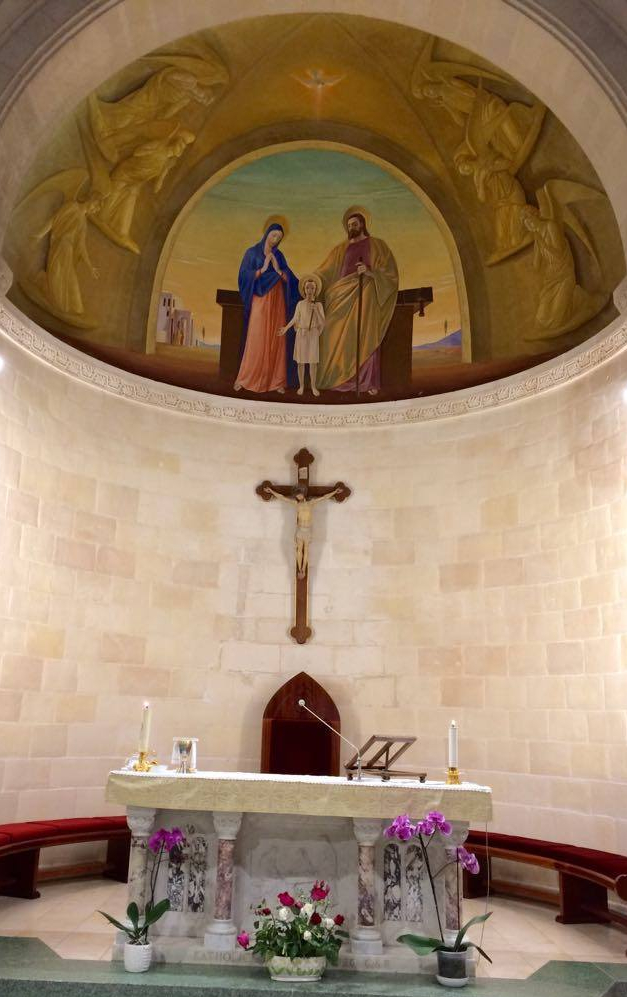
Main altar of the Church of St. Joseph in Nazareth originally built by the Crusaders in the 12th century above the site believed to be the home of the Holy Family. Photo by the author, April 2017.
Lastly, St. Joseph teaches us today in his dreams and decisions, in his life of silence and holiness what most people say about two kinds of dreamers: those who dream with eyes shut and those who dream with eyes wide opened. Those who dream with closed eyes are those who merely daydream and live in fantasies; those who dream with eyes wide opened are the visionaries, those who work to fulfill their dreams to make it a reality. St. Joseph belonged to that kind of dreamer, a visionary of God who strove hard with patience, protecting Mary and the child Jesus so that God’s plan of salvation is fulfilled. Amen.
O God our loving Father, you know so well how we all desire to be good and holy like you. But so often, we look outside for what would make us pure and clean before you, as well as for what defiles us before you.
Thank for reminding us today how from the very start when you created everything including us, we have always been good within. Even from without, everything is good. We just have to look inside our hearts for what is true and good, false and evil.
How sad that until now, we keep on looking outside, searching for more we can have, for more we can know when clearly we are limited: “You are free to eat from any of the trees of the garden except the tree of knowledge of good and evil. From that tree you shall not eat; the moment you eat from it you are surely doomed to die” (Gen.2:16-17).
Teach us, O Lord Jesus Christ to understand that “Nothing that enters one from the outside can defile that person; but the things that come out from within are what defile… From within the man, from his heart, come evil thoughts, unchastity, theft, murder, adultery, greed, malice, deceit, licentiousness, envy, blasphemy, arrogance, folly” (Mk.7:15, 21-22).
May we always look inside our hearts, O Jesus, where you reign supreme when we keep on doing your holy will, avoiding sin. Amen. Fr. Nicanor F. Lalog II, Parokya ng San Juan Apostol at Ebanghelista, Gov. F. Halili Ave., Bagbaguin, Sta. Maria, Bulacan.
Thursday after Epiphany of the Lord, 10 January 2019
1 John 4:19-5:4///Luke 4:14-22
Every nation on earth shall adore you, O God our loving Father because you are just and holy!
Through your Son Jesus Christ, you call us everyday to be like you, holy. And that is, to always love you through one another for“whoever loves God must also love his brother and sister” (1Jn.4:19).
Holiness is being filled with you, O God, “the Spirit of the Lord is upon me” (Lk.4:18). Holiness is perfecting our imperfect love by loving one another. That is your only vocation, your only calling to us all: to be holy like you.
Help to us to sustain your call by always being close to you in prayer through Jesus who showed us that the “strength of the vocation lies in prayer” (Pope Francis in 2016). Teach us to always come home to you like Jesus in the gospel today, to always immerse in your words. Most of all, like Jesus Christ “the word who became flesh”, make us your true prophets who do not merely speak your words but fulfill them in every hearing, making them happen, realized and actualized in our witnessing in love. AMEN.Fr. Nicanor F. Lalog II, Parokya ng San Juan Apostol at Ebanghelista, Gov. F. Halili Ave., Bagbaguin, Sta. Maria, Bulacan.
*Photo by Mr. Raffy Tima of GMA7 News during Yolanda coverage in Ormoc City, 2014. Used with permission.









 lordmychef.com