Yehliu Geopark in Taiwan with “mushroom” rock formations at the background. Photo by the author, 30 January 2019.
The Lord Is My Chef Sunday Music, 17 February 2019
Every year when Valentine’s comes, I only think of one song: Dennis Lambert’s “Of All the Things”. It is probably the ultimate love song of all time especially for us die-hard romantic Filipinos that even Sr. Bubbles Bandojo, rc covered it for a Jesuit CD of popular songs often sung in weddings in the country. No wonder, Dennis Lambert gained a cult following in the country for that song he released in 1972 from the album “Bags and Things”.
Another cut from that great album is “Ashes to Ashes” which I find as a perfect match for our gospel this Sunday about the Beatitudes preached by Jesus Christ during His sermon on the plain based on St. Luke’s gospel. In the Beatitudes, Jesus tells us true blessedness and happiness in following Him is being poor, hungry, weeping, and hated by others. They are paradoxical because they run directly against the values of the world and yet, we know deep in our hearts how they are very true! Life is not about having and amassing but giving and sharing. Dennis Lambert reminds us that in the end, we are all “ashes to ashes, dust to dust.” And there lies the great paradox in this life that Jesus has always reminded us, “Whoever seeks to preserve his life will lose it, but whoever loses it will save it” (Lk.17:33). The saints who have followed the Lord knew it so well and lived it through as well as poets, writers and musicians like Lambert wrote about it too. A blessed Sunday to you!
A paradox is a statement that seems contradictory but may be true in fact. From the Greek words para for beyond and doxa for opinion, a paradox promotes critical thinking and deep introspection or reflections. Christian living is a life of paradoxes as we often hear Jesus our Lord telling us to lose our lives in order to gain it. St. Francis of Assisi knew it so well that in his prayer to be an instrument of peace, he rightly claimed that “it is in giving that we receive, it is in pardoning that we are pardoned and it is in dying that we are born into eternal life.” We shall have a taste of some paradoxical teachings by Jesus Christ beginning today until the next two Sundays before we get into the Season of Lent as we listen from the account by St. Luke of the Lord’s “Sermon on the Plain”. For this Sunday, we hear the centerpiece of His sermon on that day, the Beatitudes.
And raising his eyes toward his disciples, he said: “Blessed are you who are poor, for the kingdom of God is yours. Blessed are you who are now hungry, for you will be satisfied. Blessed are you who are now weeping, for you will laugh. Blessed are you when people hate you, and when they exclude and insult you, and denounce your name as evil on account of the Son of Man. Rejoice and leap for joy on that day! Behold, your reward will be great in heaven” (Lk.6:20-23).
Beatitudes are words of promise that have a strong link from the long line of tradition of Old Testament teachings like the one we heard from the first reading today from Jeremiah: “Blessed is the one who trusts in the Lord, whose hope is the Lord” (Jer.17:7). Recall how last Sunday Jesus called His first four disciples led by Simon whom He had asked to be “fishers of men” (Luke chapter 5). As Jesus went around Galilee preaching and healing the sick, He gained some disciples or followers. In chapter six, St. Luke tells us Jesus departed to a mountain to pray for the night and upon coming down the following morning, He chose 12 men among His disciples whom He called apostles. This is now the setting of our gospel today when a vast crowd have followed Jesus, many of whom are poor people with some pagans from Tyre and Sidon who all wish to listen to Him about the word of God and to be healed from their sickness.
Speaking to His community of disciples that include us now, the Beatitudes by Jesus express the meaning of discipleship which is paradoxical because they run directly against the values of the world. For Jesus Christ, true blessedness and the way of happiness for us His disciples is being poor, hungry, weeping, and hated. What a paradox indeed! Yet, we know deep in our hearts, in our love for Christ and for others especially to those dear to us, we are willing to live with these promise of trials and sufferings because it is the only way to follow Jesus who said “anyone who wishes to follow Him must deny himself, take up his cross daily and follow Him” (Lk.9:23). The paradox becomes deeper and more paradoxical that we are willing to go through all pains and trials for our love for Jesus and others because we trust in the Lord’s promise that “He will provide us with wisdom in arguing with our enemies… and most of all, not a hair on our head will be destroyed. By our perseverance we shall secure our lives” (Lk.21:14-19). We forge on with the Beatitudes because we are convinced in the words of Jesus about the complete reversal of fortunes when that “day” comes for our “rewards in heaven shall be great!” (Lk.6:23) And that “day” is the “now” when the scriptures are fulfilled in our hearing, when despite the many hardships we go through, we have that firm assurance within of meaning and joy in life because like St. Paul, we firmly believe in our resurrection in Jesus Christ. Every day we die in our sins, in our sufferings, we share in the passion and death of Jesus; but every day too, we experience rising to new life in Christ in this little deaths we go through in daily living.
It is along this line that we discover how the Beatitudes reveal to us the mystery of Jesus Christ Himself who calls us into communion with Him and in Him. When we examine the Beatitudes, we find Christ being referred to as the one who is poor, hungry, weeping, and hated for He is the first to be so blessed and filled with God when we recall His baptism at Jordan. In His life, Jesus showed us true blessedness as prophesied by Jeremiah, the one “who trusts and hopes in the Lord… like a tree planted beside waters that despite drought, it shows no stress and still bears fruit” (Jer.18:8). Without doubt, Jesus was the first to go through all the sufferings and pains of the Beatitudes and the first to resurrect from the dead as St. Paul insisted to the Corinthians. In following the Beatitudes, we become true fishers of men who catch nothing all night without Christ; but, with Jesus, despite our many losses in life, we continue to cast our nets into the deep so our lives may be fulfilled in Him always. Life is a mystery, filled with paradoxes that make it so wonderful and beautiful in God. A blessed week ahead to you! Amen. Fr. Nicanor F. Lalog II, Parokya ng San Juan Apostol at Ebanghelista, Gov. F. Halili Ave., Bagbaguin, Sta. Maria, Bulacan.
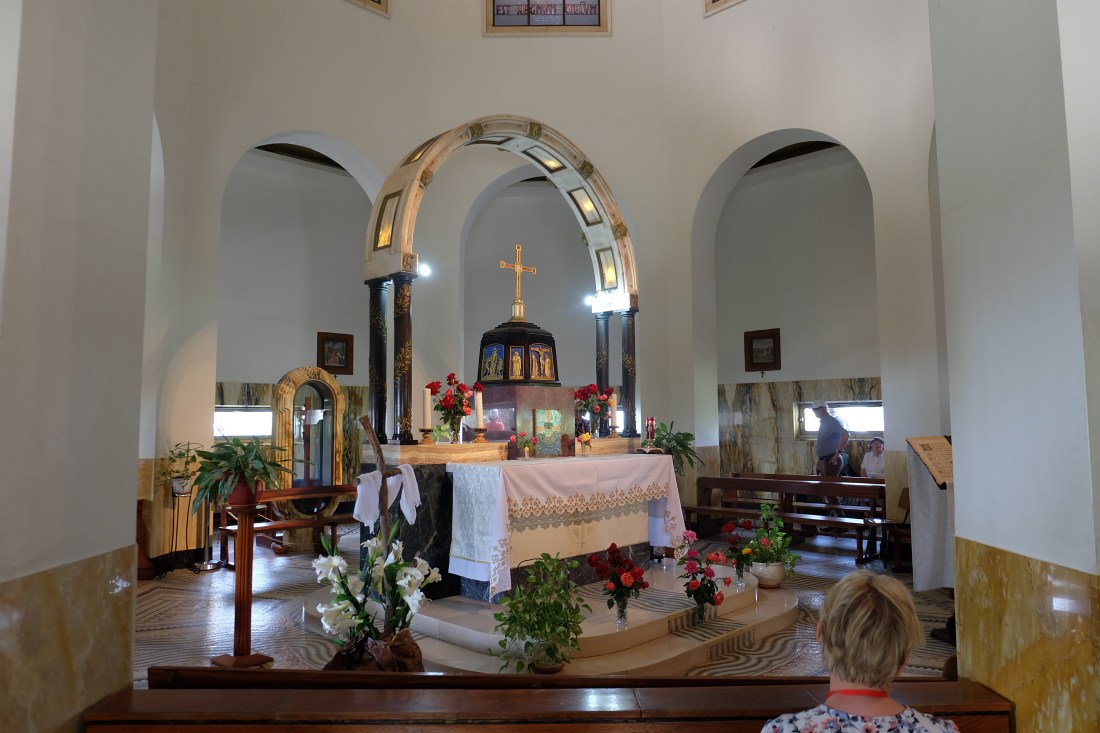
Sanctuary and altar of the Church of the Beatitudes in Israel. Photo by the author, April 2017.
The Lord Is My Chef Sunday Music, 10 February 2019
It is a very lovely Sunday despite the very warm weather. Perfect for listening to the music of Seawind with vocals by Fil-Am Ms. Pauline Wilson who would surely touch your heart and delight your soul with “Still in Love” from their self-titled album “Seawind” released in 1980.
How lovely to realize that after all these years, you are still loved by someone you have loved. Exactly the kind of love of Jesus Christ to us all. In the gospel today, we find Jesus calling His first apostles while preaching by the shores of Lake Gennesaret after being rejected at their synagogue in Nazareth. That is how true and faithful Jesus is with His mission to reach out to everyone proclaiming His good news of salvation. Jesus is the only one who would always still be in love with us no matter how often we turn away from Him or reject Him.
Are you still in love with someone special? Or with Jesus?
Rejoice because most likely, you are still loved by that someone.
For the past three weeks we have seen how Luke had been true to his intent of writing in an “orderly sequence” the events in the life of Jesus Christ so we may realize the “certainty of the teachings” handed down to us by the apostles (Lk.1:3-4, Jan. 28). Taking off from the scene at the Nazareth synagogue, Luke showed us how Jesus is the “word who became flesh” when He told the people, “Today this Scripture passage is fulfilled in your hearing” (Lk.4:21). And like those people in the synagogue, we too are so amazed with the words of Jesus but likewise disturbed, even mad when He hits a soft spot within us. That is how Jesus does His mission, always inviting us to listen and act on His word that is fulfilled in the “today” like in the calling of the first four apostles, the brothers Simon and Andrew, James and John. After driving Him out of their synagogue, Jesus went to preach to the crowd who followed Him along the shores of Gennesaret.
While the crowd was pressing in on Jesus and listening to the word of God, he was standing by the Lake of Gennesaret. He saw two boats there alongside the lake; the fishermen had disembarked and were washing their nets. Getting into one of the boats, the one belonging to Simon, he asked him to put out a short distance from the shore. Then he sat down and taught the crowds from the boat (Lk.5:1-3).
What a lovely sight to behold, my dear readers, of Jesus Christ borrowing the boat of Simon to preach to the people. Imagine the Son of God, through whom everything was created, borrowing the boat of Peter? Imagine how that boat of Simon must have looked like. It must be so ordinary and most likely, even with some holes with nothing so outstanding – just like us! Yet, here is the King of kings borrowing that boat from Simon. Luke is showing us here a “parable in action” of how the Gospel is to be preached to all people with no exception. It is a beautiful imagery of the Church gathered around our Lord and Master with Simon – like us – in supporting role. Today, it is the boat of Simon being borrowed but later on, it would be his voice, his total self that Jesus would borrow, very similar with us too.
After he had finished speaking, he said to Simon, “Put out into deep water and lower your nets for a catch.” Simon said in reply, “Master, we have worked hard all night and have caught nothing, but at your command I will lower the nets.” When they had done this, they caught a great number of fish and their nets were tearing. When Simon Peter saw this, he fell at the knees of Jesus and said, “Depart from me, Lord, for I am a sinful man.” Jesus said to Simon, “Do not be afraid; from now on you will be catching men.” When they brought their boats to the shore, they left everything and followed him (Lk.5:4-6,8,10-11).
This is the climax not only of our gospel scene today but also of the whole series these three Sundays that started on a day of rest inside the synagogue of Nazareth when Jesus came to proclaim the word of God. The actualizing power of the word of Jesus Christ fulfilled in every “today” when proclaimed and heard and accepted. See how Simon was filled with fear that he fell into his knees after seeing the bountiful catch after obeying the words of Jesus, “Master, we have worked hard all night and have caught nothing, but at your command I will lower the nets.” Of course, the fish is always in the sea; the key to their great catch was the presence of Jesus Christ. It is the same with our own lives when we work so hard in our jobs or career and in our studies and other pursuits but we are still left empty. But after finding Jesus, we are so overwhelmed with so much blessings not really in material form but something more deeper and lasting. The word of God is His very presence and its effect is always in the here and now, not later. Like the other Sunday, we said it is not enough to enter the church but we enter the person of Jesus Christ. And the moment we enter Jesus, we then become like Simon, filled with His presence that we no longer address Christ as Master or Teacher but also Lord. Like Simon, we also experience a deepening in our recognition and relationship with Jesus: at first, we relate to Him more as a Master and Teacher but later, we realize that He alone is our Lord.
See how by placing the miraculous catch, the call of Simon and his companions, and their response at the beginning, Luke is teaching us the spirit that must guide us in proclaiming and listening to the Gospel Jesus Christ. In these three Sundays, we have seen Jesus Christ as the central figure for He alone is our Master and Lord. He alone is the one calling us all to be fishers of men and to follow Him means to leave everything behind like Simon and company.
Here lies our problem today when we forget Jesus our Master and Lord. So many times we in the Church, especially us priests and those in the hierarchy as well as some laypeople forget Jesus, usurping His Lordship that we speak and act like God. Luke reminds us in this scene at the Gennesaret that we do not replace Christ! In the first place, remember that people come for Jesus in the first place and only Him, always Him whom we must share to everyone. How sad that so often, consciously or unconsciously, some priests create cults around their very selves, we become the standard of everything, we claim everything that people look up to us more than to Christ. Like Simon who would be called as Peter later, our job is to lend our boat and our voice to Jesus and not to replace Him. Like the prophet Isaiah, we are being sent forth by the Lord to bring Him among people, to make Him present among them. As Paul explained also these past three weeks in his first letter to the Corinthians, the Church is the living body of Christ that we all build together. There is the diversity of graces, gifts, and ministries that come from the Holy Spirit to complement each other. Most of all, in proclaiming and listening to the word of God, there must always be love for without it, nothing would have value at all. And that alone proves to us the centrality of Jesus Christ who alone is our Master and Lord, who calls us despite our many defects like Simon. Jesus alone is the one we must love and serve, His very person and not only His call and teachings. A blessed week to you! Amen. Fr. Nicanor F. Lalog II, Parokya ng San Juan Apostol at Ebanghelista, Gov. F. Halili Ave., Bagbaguin, Sta. Maria, Bulacan.
Photo by Mr. Raffy Tima of GMA-7 News, Sampaloc Cove in Subic, Zambales, 20 January 2019. Used with permission.
The Lord Is My Chef Sunday Music, 03 February 2019
As I was telling you in my last blog, we had a unique weekend yesterday when we celebrated the Feast of the Presentation of the Child Jesus in the Temple because its gospel reading complements our gospel this Sunday. Recall how yesterday we have heard Simeon telling Mary the Mother of Jesus, “Behold, this child is destined for the fall and rise of many in Israel, and to be a sign that will be contradicted – and you yourself a sword will pierce you – so that the thoughts of many hearts may be revealed” (Lk.2:34-35). Today in our gospel we have seen the fulfillment of Simeon’s prophecy of Jesus being a sign of contradiction when people at their synagogue were amazed at His “gracious words” in proclaiming the word of God on a Sabbath. Then suddenly, the same people became skeptical of Him, wondering where or how He got such wisdom, asking “is he not the son of Joseph the carpenter?” This deteriorated more when the people became furious of Jesus, trying to hurl Him down headlong a ravine after He had explained to them the meaning of the word of God that revealed their hypocrisies.
So many times we go through the same experiences like Jesus in His own hometown when family and relatives and friends would speak highly of us but later put us down with their gossips and nasty words. Like Jesus when we try to be true and just with everyone, there are those would feel insecure that they would backstab us and even worse, betray us like Judas to Jesus. These are all a part of our being a prophet like Jesus Christ. A prophet is more than being a spokesman of God but someone who makes the word of God happen and fulfilled in every here and now like Jesus declaring in the synagogue on that Sabbath day, “Today this Scripture passage is fulfilled in your hearing” (Lk.4:21). Sometimes, the more we try to truly love, the more we try to truly care and be kind with others, the more we are maligned and disliked by others. Indeed, no prophet is accepted in his own native place.
And that is why I remembered this beautiful song originally sang and recorded in 1970 by the Chicago soul family group called the Five Stairsteps. This song was originally meant to be the B-side of the Five Stairsteps’ version of another song but due to its meaningful and soothing message of hope and love, it became an instant hit at that time. There have been so many versions of this song that has become timeless as it assures everyone in every generation of how things would get better despite the many obstacles and setback in life. It is the very same assurance of God to us all who try to follow His Son Jesus Christ in being a sign of contradiction in this world where the norm nowadays is selfishness and self-centeredness masquerading as love and service. A blessed Sunday to you!
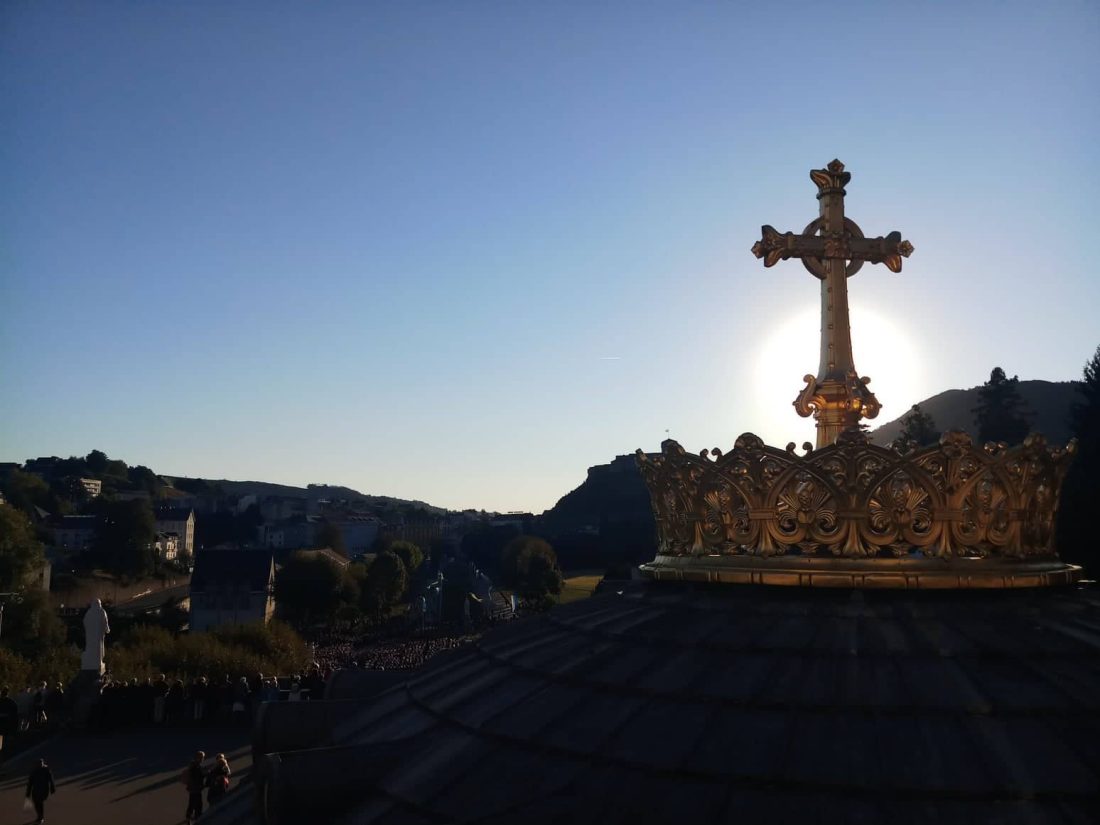
The Cross of Christ atop the church of our Lady of Lourdes in France. Photo by my former student Philip Santiago during his pilgrimage, September 2018.
We had a rare weekend yesterday in the Feast of the Presentation of the Lord that wonderfully complemented our gospel on this Fourth Sunday in Ordinary Time. Recall that last Sunday we were told how Jesus went home to Nazareth, entering the synagogue on a day of rest. Everybody was amazed with His “gracious words” in proclaiming the word of God that we ended the gospel with a very positive note when Jesus declared “Today this Scripture passage is fulfilled in your hearing” (Lk.4:22). Our gospel today repeated this line as its take off point to continue the story of Jesus at the synagogue but, this time Luke tells us of a twist from the very positive “all spoke highly of him” to their skeptical “Isn’t this the son of Joseph?” (Lk.4:22). The mood deteriorated further after Jesus had spoken so that “the people at the synagogue were filled with fury. They rose up, drove him out of the town, and led him to the brow of the hill on which their town had been built, to hurl him down headlong” (Lk.4:28-29)!
What and how did this sudden turn of events happen? Here we find the complementing Feast of the Presentation yesterday based on the infancy narratives of Christmas by St. Luke when Simeon told Mary the mother of Jesus, “Behold, this child is destined for the fall and rise of many in Israel, and to be a sign that will be contradicted – and you yourself a sword will pierce you – so that the thoughts of many hearts may be revealed” (Lk.2:34-35). See how Jesus at the inauguration of His ministry at their Nazareth synagogue last week proclaiming the word of God would now start to be seen as a sign of contradiction among His people as prophesied by Simeon to His mother yesterday. That would reach its highest point 33 years later in Jerusalem where He was presented to the Temple 40 days after Epiphany after resolutely going there to offer or present Himself to the Father on the Cross. This explains why Jesus merely “passed through the midst of them and went away” when the people at the synagogue tried to hurl Him down headlong because His time of final offering had not yet come. But very clearly here at the synagogue of Nazareth, Christ is indeed the sign of contradiction not only to His people but also to us in this generation when we would also speak highly of Jesus, shouting Amen with clapping of hands and suddenly hit people near us with harsh and nasty words or even brutal force. Most of all, like the Lord, we too have experienced being a sign of contradiction when people would speak highly of us then suddenly or over time, turn against us and speak ill of us, betraying us like what Judas did to Jesus on Holy Thursday.
My dear friends in Christ, it is our calling and our life too in living out the word of God through our life of witnessing His immense love in service and mercy for those in the margins. Every time we gather for the Sunday Mass like when Jesus entered the synagogue of Nazareth on a day of rest, He invites us to follow Him to be a prophet by entering Him more than merely the church building. Being a sign of contradiction like Jesus is our prophetic mission in Him. So unlike what most people think, a prophet is not a fortune teller or a seer of the future. As the spokesperson of God, a prophet is one who makes God’s word happen or fulfilled in every here and now. Keep in mind that one feature of Luke’s gospel is the pre-eminence of “listening and doing” the word of God like when he reported how Jesus declared Isaiah’s prophecy fulfilled in their hearing that led into the sharp and sudden shifting in the reaction of people against the Lord, from approval to rejection.
First of all, those reactions were most evidently from His claiming to be the Messiah referred to in Isaiah’s prophecy on whom the “Spirit of the Lord rests upon.” He was the one who proclaimed the word and if we have truly immersed ourselves into this beautiful scene in the synagogue on that Sabbath day, we would really feel Jesus is in fact the one Isaiah is speaking of as being “anointed to bring glad tidings to the poor, liberty to captives, sight to the blind, freedom to those oppressed, and to usher in a year acceptable to the Lord” (Lk.4: 18-19). Salvation decisively begins in Christ and through Christ whenever we enter Him in His words. That “today” in Nazareth synagogue is also the today of our own time that continues to provoke astonishment among others when we try to be Christ’s witnesses of authentic love for others. That is perhaps the sad reality of these days when it becomes big news when people do something genuinely good and beautiful like the woman who impulsively rented 20 hotel rooms in Chicago so the homeless could escape the deep freeze this week in the US Midwest; her deed snowballed into other strangers doing the same! That is essentially the meaning of Paul’s lofty words on love being the greatest of all gifts because it makes God most present in our midst. To truly love like Christ is essentially being a sign of contradiction in this world where the norm is selfishness and self-centeredness often masked in different in lofty terms and ideals bereft of any love at all.
Along this line of self-centeredness we find Luke reminding us in this scene at the Nazareth synagogue of the persisting problem self-entitlement among people then and now when we prophetically live out our mission of making Christ present. People always look down and frown upon those who try to be good and holy by striving to do what is right and just while the holier-than-thou sanctimoniously feel they are the only ones anointed to do such things because they are entitled. They are the modern Gnostics according to Pope Francis in his latest encyclical about holiness in our modern time (Gaudete et Exsulatate)” who feel as the only ones gifted in knowing what is right or wrong, true and good as if they are God. Like those people at the synagogue in Nazareth, they refused to accept Jesus of being more knowledgeable because He is the son of Joseph who was a carpenter. Jesus would strike at the very core of their self- entitlement when He told them “Amen, I say to you, no prophet is accepted in his native place” (Lk.4:24), citing how Elijah and Elisha of the Old Testament days were both sent by God to help pagan peoples and not the Jews who have turned away from Him exactly like them. That filled them with fury against Jesus, wanting to hurl Him down the hill headlong. It is the same feeling those people around us experience like our relatives and friends who could not accept we are better than them that they start spreading all kinds of lies and nasty talks against us as they see their self-entitlement slowly eroding. Such is our life as a prophet like Jeremiah, always going against the flow of the people, choosing Christ to be a sign of contradiction and give way to the fulfilment of God’s word among us. Amen.Fr. Nicanor F. Lalog II, Parokya ng San Juan Apostol at Ebanghelista, Gov. F. Halili Ave., Bagbaguin, Sta. Maria, Bulacan.
It is still Christmas this Sunday here in the Philippines as we celebrate today the Feast of the Child Jesus known as Señor Sto. Niño. The feast reminds us of the most central teaching of Jesus Christ which is to be like a child for He said that “unless you become like children, you shall never inherit the kingdom of heaven.”
One distinct quality of being a child like Jesus Christ is to be always filled with love for everyone. In this age of modern technologies, how sad that we have become more technical than personal that slowly, real love has become so rare among us. Too often love is not only abused and misused but also misunderstood as mere feelings alone. No! Love is always a decision, a choice we make after the interplay of our mind and heart that leads to growth and maturity. And the more we stand on that decision and choice to love, the more it is deepened and perfected in God. So often, love is symbolized by the heart but its truest meaning can only be found in the great sign of the Cross of Jesus where we can find the perfect expression of Christian “childlikeness” and Christian maturity when we choose whatever is more painful and more difficult because we have found someone to love more than our self.
This is the child-like love that Dianne Reeves tells us in her 1987 crossover hit “Better Days” also known as the “Grandma Song” where she spoke of her grandmother not only teaching her but making her experience love that leads to better days. We find in the song her grandmother somehow portraying to us what we have said as Christian “childlikeness” and Christian maturity so that in the end, she peacefully joined God because she had always been faithful and loving as a child of the Father like Christ. That is also the challenge to us of this Feast of the Sto. Niño: to remain children of God even as adults like Jesus Christ. Or Dianne’s grandmother. If only we can be child-like like Jesus or Dianne’s Grandma, we can be assured of better days too not only here but in eternity.
Photo by the author, Dominican Hill, Baguio City, 18 January 2019.
Sometimes when we look at our religious celebrations we get the impression that we as a people seem to be very ritualistic and even fanatics. But, on deeper examinations, we find in these feasts the expressions of our deep faith nurtured through our history and culture as a nation by God’s invisible hand. A perfect example is today’s Feast of the Sto. Nino celebrated every third Sunday of January that is proper only to our country in recognition of the important role played by the image of the Child Jesus in our Christianization almost 500 years ago. All the readings and prayers of today’s Mass are taken from Christmas Season even if we are already in the Second Sunday of Ordinary Time because the Sto. Nino is an extension of Christmas. Recall also that two weeks ago right after the Epiphany of the Lord we have celebrated the Traslacion in Quiapo featuring the adult Jesus Christ carrying the Cross more known as the Black Nazarene. They are the two most popular Christ devotions in our country that every region and province, town and barrio up to the smallest sitio has its own version of celebrating Traslacion and/or Sto. Nino. In both devotions we find the finest examples of our vibrant faith in Jesus Christ who became like us in everything except sin in order to save us, heal us, and bring us closer with one another as one big family with God as our Father. And in both devotions too, Christ calls us to continue living into our adulthood as God’s little children like Him the Sto. Nino and the Black Nazarene.
After three days of searching, Mary and Joseph found the 12 year-old child Jesus at the Temple and he said to them, “Why were you looking for me? Did you not know that I must be in my Father’s house?” But they did not understand what he said to them. He went down with them and came to Nazareth, and was obedient to them; and his mother kept all these things in her heart. And Jesus advanced in wisdom and age and favor before God and man (Lk. 2:51-52).
From His childhood into His adulthood, Jesus remained a child of His heavenly Father and of His parents Mary and Joseph. In this scene on His finding at the temple, we again see the centrality of Christ’s teaching of remaining like a child in order to belong to the kingdom of heaven. And it was not only Him who showed it in this short account by St. Luke but also Mary and Joseph who “both did not understand” what Jesus had told them but still took care of Him very well as “He advanced in wisdom and age and favor before God and man.” Here we find the importance of love in remaining children of God as shown by the deep love among the members of the Holy Family that is rooted in the Father’s love. Notice how in this age of so much advancement in technologies that we have become more technical than personal, love has also suffered so greatly. It is not only abused and misused but most of all, misunderstood. Love has become a commodity that people think could be had simply and instantly like anything in a store or a vending machine, forgetting that love is more than a feeling but a decision we must keep. Most of all, love is a choice we make by choosing what is most painful and most difficult because true love is found only on the Cross of Christ.
This is what I am telling you at the beginning, the seemingly funny or weird flow of our celebrations after Christmas: Traslacion and then Sto. Nino that are both anchored on love of God that did not merely happen in Christ’s birth and coming but most of all in His suffering and death on the Cross. Love is often symbolized by the heart but its total meaning can only be found in the great sign of the Cross where we can find the perfect expression of Christian “childlikeness” and Christian maturity. Recall how Jesus on the Cross remained a child of the Father to whom He entrusted His total self while at the same time remained faithful to His mission, resolutely going to Jerusalem to face His fate as a matured adult. That is love when we can be tender and docile to our beloved and at the same time stand our ground to keep our promise, no matter what or how painful it could be. It is a love until the end that is always willing to share and give, never thinking of anything in return.
To be able to love like a child and remain loving as a matured adult like Jesus Christ, we need to always live in the present moment. God revealed Himself to Moses as “I AM WHO AM” while in the gospels particularly in John’s, we find Jesus always declaring the great “I AM” as the Resurrection and life, the way, the truth and the life, as well as the good shepherd and the true vine. God is love because He is always in the here and now, the present, not in the past and not in the future. See how a child always has a time to take time as it comes, one day at a time, so calmly without advance planning and thinking or greedy hoarding of time. Unlike us adults, we need planners and schedules to follow, finding or making time like a sausage to be sliced into portions to be eaten at a desired time. Kids always live in the fullness of time like a cup of milk or water that has everything that for them, any time is a time to sleep, a time to eat, a time to play. And that is why they love all the time! We adults are so pressured and stressed that even in loving others and especially God, we always bargain with time as if it can be done. We love to postpone time because we are not yet ready, even refusing to move on as we dwell with our painful past. Remember the warning of Jesus that nobody knows the time when He shall come that we must always be on guard and ready for that time by always loving God and others all the time. Recall our quotation last week that says, “For people who rush, time is fast; for people who wait, time is slow; but, for people who love, time is not.” A child of God lives in the present because he knows, like Jesus Christ, every moment is the fullness of time we must receive with gratitude because in every present moment we have everything. This is totally different from the young people’s concept of “YOLO” that is actually about living in the future now being advanced without realizing the beautiful present moment.
To be a child of God like the Senor Sto. Nino is to walk in the “great light” of Christ, our “Wonder-counselor, God-hero, Father-forever, and Prince of Peace” (Is.9:1,5) who calls us to love every moment of our lives by living in the present. May Jesus “enlighten the eyes of our hearts that we may know what is the hope that belongs to his call, what are the riches of glory in his inheritance among the holy ones” (Eph.1:18).AMEN.Fr. Nicanor F. Lalog II, Parokya ng San Juan Apostol at Ebanghelista, Gov. F. Halili Ave., Bagbaguin, Sta. Maria, Bulacan.
*Photo is a painting of Sto. Nino devotees by Bulakenyo artist Aris Bagtas. Used with permission.
Today is the last Sunday of the Christmas season that closes with the Feast of the Baptism of the Lord. But that does not mean we stop celebrating the coming of Jesus Christ. In fact, this feast of His baptism reminds us of the great importance of praying daily to celebrate His coming the whole year through.
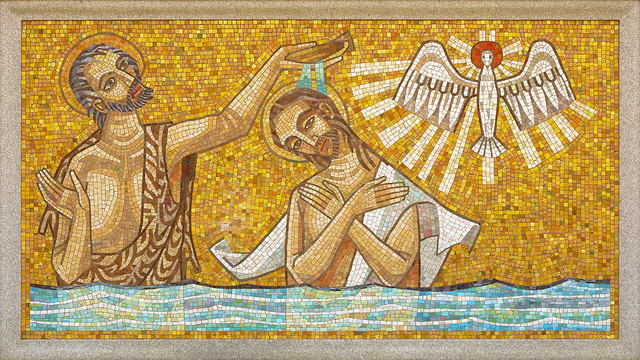
The people were filled with expectation… After all the people had been baptized and Jesus had also been baptized and was praying, heaven was opened and the Holy Spirit descended upon him in bodily form like a dove. And a voice came from heaven, “You are my beloved Son; with you I am well pleased” (Lk.3:15, 21-22).
One thing we shall notice this year when St. Luke guides us in our gospel every Sunday is how he always presents Jesus Christ at prayer like here at His baptism. Only St. Luke records this detail that Jesus was praying after His baptism when the “heaven was opened.” That is the meaning of Christmas, the opening of heaven for us through Christ’s coming after it was closed when Adam and Eve were banished following their Fall. See how St. Luke situated the Lord’s baptism like his Christmas story to show us that Jesus lived at a specific time and period in history, that He had really come! “In the fifteenth year of the reign of Tiberius Caesar, when Pontius Pilate was governor of Judea, and Herod was tetrarch of Galilee, and his brother Philip tetrarch of the region of Iturea and Trachonitis, and Lysanias was tetrarch of Abilene, during the high priesthood of Annas and Caiaphas” (Lk.3:1-2).
The same is very true today in our own time. In this specific period when everything seems to be so dark and in disarray, when we are filled with expectation after a long period when God had seemed forgotten us, suddenly there comes a voice in the wilderness, not in the desert of Jordan but right here inside our hearts of new hope, new beginnings this 2019! Jesus had opened heaven with His coming to us more than 2000 years ago and He continues to call us to come to Him, to be one with Him and be in Him. He is here inside our hearts inviting us to open up with Him, to converse with Him, to speak to Him and to hear Him in the context of prayer. This feast of the Baptism of the Lord reminds us of that invitation from God for us to open up to Him too because He is now more accessible to us than ever in Christ. In becoming human like us in everything except in sin, Jesus brought God nearer to us that we can converse with Him to air our concerns and innermost feelings to Him. Most of all, experience in prayer God’s great love for us when we listen to His voice and heed His calls to discover far more great things in this life than we have ever imagined! Why waste this great grace in Him?
Second reason why we need to handle life with prayer is because it purifies us, cleanses us like the waters of the river. Jesus need not be baptized because He has no sins; but, He chose to be baptized by John to show His solidarity with us sinners. This is the main point of the prophecy by Isaiah in the first reading as well as the letter of St. Paul to Titus: Jesus is the mercy of the Father to us sinners who had come to expiate our sins by taking upon Himself – the sinless one – our sins. It is very sad that fewer people are now praying in the real sense because many of us have lost that sense of sinfulness. Everything has become relative especially morality as if everything is now acceptable and therefore, nothing is sinful. When people refuse to see and accept their sinfulness, when they feel being sinless, then they start acting like God, even claiming to be the Messiah and stop praying altogether. We pray because we are sinful, because we have failed in doing what is right and what is good. We pray to be cleansed of our sinfulness so we can be with Jesus to follow and imitate Him. Real prayer happens when we admit before God our sins to be purified in Him.
Most of all, we have to pray always because life is difficult. After the scene of the baptism of Jesus at Jordan, the next chapter tells us about His temptation by the devil in the wilderness. After the long Christmas vacation, almost everybody had gone back to “reality of life”, of work and studies, of constant struggles and sufferings as well as sacrifices. Jesus came to the world to help us in this life, calling us to come to Him for His yoke is easy and His burden is light. That is the beautiful symbolism of Jesus plunging into Jordan. For the Jewish thought, bodies of water like the sea, the lake and the river are symbols of the nether world, of the powers of darkness and evil. When Jesus plunged into Jordan River and when He walked on water, they both mean the power of Jesus over darkness and sins. That is why we pray to be purified, to be cleansed from our sins. Now, flowing river is symbolic of life in the Old Testament as attested by the Nile in Egypt, the Tigris-Euphrates in Babylonia, and the Jordan in Israel. There is always the danger of losing one’s life in the river especially when it is swollen but at the same time, there is also the abundance of life from its waters that nourish plants and teem with marine life. Jesus choosing to be baptized at Jordan River tells us His coming to us in our lives marked with many dangers as well as with opportunities. In fact, right in His baptism at Jordan, Jesus was already giving us a hint at the inauguration of His ministry about His coming Passion, Death and Resurrection symbolized by the river. We all know this too for sure that great opportunities await us this 2019 but we all know we can attain these all if we are willing to take the plunge and meet head on the many challenges that would entail sacrifices and pains on our part. Life is very much like a river and the good news is Jesus is here with us to help us and assure us of being fruitful if we can open to God in prayer.
Every morning when we wake up, the heavens open with the Father telling us that due to the oneness of Christ with us, we too are His beloved children with whom He is well pleased. Noteworthy in this part how St. Luke inserted after Christ’s baptism his version of the genealogy of Jesus, starting it backwards to end up with Adam, “the son of God” (Lk.3:38). Aside from showing us the humanity of Jesus, St. Luke fittingly closed his baptism account of reminding us how in the Lord we have become God’s children too. And that is enough reason for us to always pray not only because God converses with us and we need to be purified of our sins but most of all because we are the children of the Father in Christ Jesus. With that in our minds and in our hearts, 2019 looks so promising indeed!AMEN.Fr. Nicanor F. Lalog II, Parokya ng San Juan Apostol at Ebanghelista, Gov. F. Halili Ave., Bagbaguin, Sta. Maria, Bulacan.
It’s the first Sunday of 2019 and we are celebrating in the Church today the Solemnity of the Epiphany of the Lord used to be known as feast of the Three Kings. From the Greek word epiphanes that means appearance or manifestation, today’s celebration reminds us that Jesus came for everyone especially those forgotten and unloved, the poor and marginalized, the sinner and those lost. Most of all, Christ became human like us except in sin so that it would be easier for us to find God. In fact, it is actually God who searches for us and always finds us. Whenever we think we are looking for God and have found Him, it was actually God who first sought us and found us.
While praying over the scriptures for today’s celebration, one song kept playing at the back of my mind, “Waiting for Love” by Sergio Mendes and the Brazil ’77. Composed by Randy McNeill, it is from their 1974 album “Vintage 74” that features for the second time around the vocals by Gracinha Leporace and Bonnie Bowden. It is a very beautiful song with a haunting music because it is so true with many of us who are so afraid to love, afraid to follow our stars, and perhaps afraid to fail and get hurt in life. “Waiting for Love” challenges us like the Epiphany if who among us are wise enough to recognize and follow Jesus appearing daily in our lives in many occasions and circumstances? Surely, there were other people who have seen the bright star of Bethlehem when Christ was born but why only the three magi from the East came to follow it and search for Jesus? Matthew tells us how the whole Jerusalem along with Herod were greatly troubled upon hearing the magi looking for the newborn king of the Jews as indicated by the bright star! This is what the song “Waiting for Love” is saying, of how often that “(And) it seems I’ve spent my whole life, Waiting for love, And when it comes, I always run away.” This 2019, stop being “afraid of being close where I need to be the most” – follow and believe in the bright star of Jesus Christ! Cheers to more love this 2019!









 lordmychef.com