Monday, Wk. XVI, Yr. I, Feast of St. Mary Magdalene, 22 July 2019
2 Corinthians 5:14-17 >< }}}*> >< }}}*> John 20:1-2, 11-18
Jesus telling Mary Magdalene not to touch him in a painting at the Basilica of St. Francis of Assisi in Italy. Photo from Google.
What a beautiful way to start our week of work and studies today with the feast of St. Mary Magdalene, O Lord!
In St. Mary Magdalene we see, O Jesus, your infinite love and mercy and forgiveness no matter how dark is our past. In St. Mary Magdalene we also see, O Jesus, our new life and relationship with you especially when you called her by her name “Mary” on that Easter morning.
Open our hearts every morning, especially when we feel everything is lost, when everything is so dark to that we too may hear your sweet voice calling us by name.
One beautiful lesson we have learned from St. Mary Magdalene is the need to remain in you, Jesus. After being converted, Mary never left your side along with the other women who have come to follow you and help you in your needs.
On the Cross when your disciples have left you, St. Mary Magdalene remained at your foot along with your Mother and beloved disciple John.
On the first day of the week, it was also St. Mary Magdalene who remained faithful to you by coming to your tomb to bring spices and perfume; and, when she found it empty, she was the one who remained faithful to your teachings by informing St. Peter of the situation.
Most of all, during that dark morning at the empty tomb, it was St. Mary Magdalene who remained outside, remaining faithful to you, waiting in tears for developments as she asked everyone around in the hope of finding and retrieving your missing body.
The scene may be funny, Lord, but embarrassing and shameful to us your disciples who always leave you especially when the cross becomes too heavy and bloody! And when everything is dark and empty, unlike St. Mary Magdalene, we are nowhere to be found.
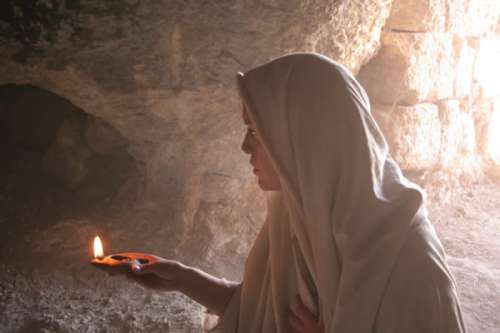
From Google.
Let us remain in you, Jesus, like St. Mary Magdalene especially when everybody else is leaving or had left you at the cross or the empty tomb.
Let us boldly proclaim not only in words but most especially in deeds like St. Mary Magdalene that we have seen you, that we are now a new creation in you. Amen.
Solemnity of the Most Sacred Heart of Jesus, 28 June 2019
Ezekiel 34:11-16 >< }}}*> Romans 5:5-11 >< }}}*> Luke 15:3-7
Sacred Heart of Jesus at the Jesuits’ Sacred Heart Retreat House and Seminar Center in Novaliches, Quezon City. Photo by author July 2018.
At a glance, the powers of darkness seem to rule the world.
Pains and sufferings are all around us as we see them in the news and, worst, experience them right in our homes and community!
The other Sunday evening, one of our parish lectors was hit by two riders driving under the influence of alcohol that severely damaged her face, particularly her right eye and front teeth. She did not see the motorcycle coming because the drunk riders were going so fast opposite the one way street.
The two riders have no driver’s license and both claim to have no money to pay for the medical expenses of our parish volunteer who comes from a very poor family.
I told her story to our Sunday congregation. Right after the Mass, two ladies came to me, handing me Php 25,000.00 in cash, pledging with more money for the medical and dental bills of our lector. Tears were rolling in my eyes as I thanked the two kind ladies who refused any recognition at all.
Yes, too often we are shocked at the evil going on in the world.
But, more surprising is the fact that it is always God who has the last laugh and final say in all these pain and sufferings around us.
There is always the more powerful Sacred Heart of Jesus offsetting our seemingly heartless world today.
Jesus the Good Shepherd with a lost sheep on his shoulder. A wood carving atop the cathedra of the Minor Basilica Cathedral of the Immaculate Conception in Malolos City. Photo by Lorenzo Atienza, 12 June 2019.
Jesus addressed this parable to the Pharisees and scribes: “What man among you having a hundred sheep and losing one of them would not leave the ninety-nine in the desert and go after the lost one until he finds it? And when he does find it, he sets it on his shoulders with great joy.”
Luke 15:3-5
I love that imagery of Jesus the Good Shepherd carrying on his shoulders the lost sheep. It is so powerful and evocative of God’s immense love for us sinners.
God fulfilled his promise to Ezekiel in the first reading that he would personally come to tend and look after us his sheep by sending us his Son Jesus Christ.
For his part, Jesus showed us in teaching this parable the solicitude of the Father in going beyond his words to the prophet of not just affectionately gathering and leading his sheep to green pastures but by communing with sinners of his time. What a wonderful way by Jesus showing us the pains God is willing to go to find one lost sheep.
From Google.
Jesus knows it so well how difficult and painful to get lost that he spent time with sinners, dining with them in many occasions. He knows the fearful thoughts running through us when we were wandering in darkness and sin that he never judges us nor condemns us like the woman caught committing adultery. Most of all, Jesus knows how difficult it would be for us who were lost to find our way back home, to go back to normal life of grace that he is willing to wait like with St. Paul and with St. Augustine.
Hence, when Jesus the Good shepherd finds the lost sheep, he sets it on his shoulders with great joy. Imagine also the spontaneous reflex to clutch to oneself whatever or whomever was lost and is found. That is how intense is the love of God through Jesus for every lost sheep when finally found. He is filled with joy that he carries the lost sheep on his shoulder to hurriedly bring it to safety and comfort, never to get lost again.
Moreover, here we find the great love of God for us who have gone stray in sin: he would patiently look for the lost sheep and likewise willing to patiently carry it on his shoulders so as not to make it suffer further in going back to the fold. Absolutely, no trace at all of any disgust in God in our going stray in sins!
From Google.
Eventually, Jesus proved this intense love of the Father to us in his dying on the Cross. He showed us how true love that comes from God and rooted in God is a love that is always meek and humble. A love that is unconditional, embracing both friends and foes. Yes, it is easier said than done but doable if we love in Christ Jesus.
From Google.
To love in Christ Jesus is to trust in God’s love. Without this trust in God’s love, we will always rely on our own self, prioritizing on our love of self than love of God and others. That is when darkness comes to rule over us, making us heartless too. Then, indeed, the world becomes evil because we have become its slave.
On this Solemnity of the Most Sacred Heart of Jesus when our nation is in so much darkness, Jesus is inviting us to make his love visible by trusting in his unfailing care as our Good Shepherd. When there is a major paradigm shift in the parable of Jesus wherein there are more lost sheep who are also self-righteous in knowing everything, calling those not on their side as stupid, we are more challenged today to witness Christ’s values of dignity of persons and peace. Let us pray for more patience with the appalling governance we now have courtesy of the majority of our people whom we have denied with God’s love and care for the longest time.
Sunrise at Lake Tiberias, the Holy Land, 02 May 2019. Photo by the author.
Our Sunday music on this Solemnity of the Body and Blood of Jesus Christ is an original composition by Daryl Hall of the dynamic duo “Hall and Oates” included in their “Abandoned Luncheonette” album released in 1973. Two years later, the upcoming rock group who called themselves “Kalapana” based in Hawaii did a cover of the Hall composition that became a hit that many thought it to be their original.
What I like with Kalapana is how they can make sad songs sound good like “When the Morning Comes” or their more popular hit “The Hurt”.
There is too much darkness in their songs, of disappointments but, the way they sang them you forget all their sad messages.
Went down town to see my little lady She stood me up and I stood there waiting It’ll be alright, When the morning comes
Well now I’m up in the air with the rain in my hair Got nowhere to go I can go anywhere It’ll be alright When the morning comes
I’m just passin’ and I’m not askin’ that you be anyone but you When you come home, try to come home alone It’s so much better with two
Well now I’m out in the cold and I’m growin’ old Standing here waiting on you It’ll be alright When the morning comes
Ooh ooh ooh ooh When the morning comes Ooh ooh ooh ooh When the morning comes
There will always be darkness in our lives.
And that is why Jesus came, not really to remove darkness but, to accompany us so we can make it through the night until the morning comes.
But most of all, on this Solemnity of His Body and Blood, Jesus invites us to be his presence in the world plunged in darkness by always trying to see him in the face of everyone we meet.
As most people say, darkness ends and morning comes the moment we come to recognize the face of another person as our brother or sister.
Happy listening to everyone and enjoy your Sunday!
Darkness descending upon the Sinai mountain range at St. Catherine, Egypt, 07 May 2019. Photo by author.
We all fear darkness.
It is difficult to do things in darkness because our sight is always impaired. We cannot see things clearly, giving rise to many imaginations of evil lurking behind darkness.
Even in the bible, darkness means the presence of evil. And this is why the bible teems with many stories of God coming to his people in darkness. Most especially in the gospels where Jesus comes to comfort and console his disciples and the people in darkness.
But there is more sinister in darkness, a kind of darkness that envelops people and not just the world around us. It is a darkness that refuses to see the other person as a brother and a sister. This we see in our gospel on this Sunday Solemnity of the Body and Blood of Jesus Christ.
As the day was drawing to a close, the Twelve approached him and said, “Dismiss the crowd so that they can go to the surrounding villages and farms and find lodging and provisions; for we are in a deserted place here.” He said to them, “Give them some food yourselves.” They replied, “Five loaves and two fish are all we have, unless we ourselves go and buy food for all these people.”
Luke 9:12-13
It is a very classic situation we always find ourselves in when more than the darkness around us is the darkness within when we refuse to see the face of everyone as another person who needs to be cared for, who must be fed and kept warm. Most of all, assured as a brother and a sister, being our kin or one of us.
This is the tragedy that happened recently at the Recto Bank where 22 local fishermen were abandoned at sea when a Chinese fishing vessel rammed their boat while safely anchored in the dead of the night.
After several hours at sea, Vietnamese fishermen rescued the 22 Filipinos, gave them water, and fed them with rice and noodles. Despite their language barrier that was another kind of darkness, the Filipino and Vietnamese fishermen understood each other in hand gestures, repeating only three words they knew so well: “Philippines. Vietnam. Friends.”
But the scariest darkness that the 22 local fishermen went through did not happen at sea but at home under glaring lights of camera when government officials downplayed their harrowing experience, dismissing it as an ordinary maritime accident involving “ordinary folks” (i.e., fishermen) and worst of all, after barraging them with so many questions and insinuations sweetened with offers of cash and materials, they eventually succumbed to darkness that they retracted their earlier statements of the incident.
Photo from Yahoo News.
The Recto Bank incident showed us the blinding darkness we are into as a nation. It shows how as the only Christian nation in this part of the world we have been living in too much darkness within us, how we have long forgotten to see the other person as a brother or a sister, that we have stopped caring for one another despite our too many devotions and religiosity.
Like the Twelve, we always wanted to secure our own comfort when darkness comes that we keep on dismissing others away, unmindful of whatever would happen to them along the way. This we do in all sectors of society when we do not care for those next to us if there would still be enough funds or resources or infrastructures after us. This is most evident in our garbage disposal and lack of care for the environment when we think only of our own selves, regardless of the next generation.
And, so, here we are groping in darkness even in the Church when both the clergy and the laity have been blinded by edifice complex, erecting monuments for their own glory forgetting those in the margin. How can some of us in the Church hide in darkness with all kinds of abuses, sexual and financial exploitation of those entrusted to us?
Today in this Solemnity of the Body and Blood of Jesus Christ, we are invited to dispel the darkness within us by seeing again that everything we have is from God.
In the first reading we heard the mysterious person Melchizedek, king of Salem and priest of the Lord. He had blessed Abraham with bread and wine after he had won over four pagan kings. Unlike most victors in any war, Abraham refused to take all the possessions of the pagan kings he had defeated because it was very clear to him his victory was due to God’s intercession. He claimed nothing to himself and that is he gave a tenth of everything to Melchizedek who then blessed him. It is exactly what we do in every Sunday Mass when we celebrate each week with gratitude to all of God’s blessings we have received. Like Abraham, we share not only our selves but also our treasures to God through our Mass offerings.
This is what St. John Paul II called as the “cosmic character” of the Eucharist.
In his 2003 encyclical “Ecclesia de Eucharistia”, St. John Paul II described this cosmic character of the Eucharist as Christ’s saving presence in the community of the faithful everywhere (cf. Ecclesia de Eucharistia 8-9). This happens when we enter into this mystery of Christ in the Holy Communion of the Mass whereby after receiving his Body and Blood, we become his very presence in the world which St. Paul explained in our second reading today.
With this in mind now, we see the larger context of the instruction of Jesus to the Twelve in the wilderness at that time of darkness to “Give them some food yourselves” (Lk.9:13). During his last supper, Jesus took bread and said “This is my Body…this is my Blood.” You who receive me as your Teacher and Lord, see my Body in every-body. No one is a no-body.
Whenever there is a darkness within every person, there is surely a failure in recognizing this Body and Blood of Jesus. Recall how it was in the darkness of the night when Judas sold Jesus for 30 pieces of silver to the priests. It was also in the darkness of the night when he betrayed Jesus.
There was also Simon during the darkness of the night who denied Jesus thrice when he failed to see him as his Lord for fear of being arrested too.
Then there were the two disciples going back to Emmaus on the evening of Easter: they were both in the darkness of despair and loss after the Crucifixion of Jesus whom they did not recognize walking with them at sunset. And when they recognized him at the breaking of bread, despite the darkness around them, they hurriedly back to Jerusalem to inform the Apostles how they have met the Risen Lord!
The Solemnity of the Body and Blood of Christ today reminds us that despite the many darkness in the world today, even right in our very hearts, Jesus comes to dispel them so we can see more the beauty and wonder of life and every person around us.
Is there any darkness in you that needs to be dispelled by Christ’s Body and Blood? Are you ready to offer him that darkness in your heart to become his light in this dark world?
The Our Father Church outside Jerusalem where Jesus is believed to have taught his disciples the “Lord’s Prayer”. Photo by author, 05 May 2019.
For the second straight day, Lord, I could identify with St. Paul in his feelings deep within, the urge to brag something in your name!
Brothers and sisters: if only you would put up with a little foolishness from me! Please put up with me. For I think that I am not in any way inferior to these “super apostles.” Even if I am untrained in speaking, I am not so in knowledge; in every way we have made this plain to you in all things.
2 Corinthians 11:1, 5-6
You know it so well, Lord Jesus why I have been complaining a lot lately as I have told you yesterday: I feel so tired in life because I feel shortchanged. Not that I am asking anything in return but like St. Paul, it pains me so much when some people miss the love and dedication we pour upon our ministry.
Until now, Lord, we have those “super apostles” St. Paul called, preying on your sheep as false servants who seduce people like the snake only to feed on their egos and fatten their wallets.
They are everywhere, Lord. Not only among priests but also among other professionals.
It is so consoling to hear St. Paul today in our first reading of how we sometimes need to brag a little, to be proud of our efforts so the people may know and realize the sacrifices we make for them because, we love them.
We pray Jesus for all the silent workers, the silent servants who continue to lovingly serve you in others. Send them your proverbial “pat on the shoulder” to console them, O Lord, in their darkness and anguish. Let them shine in their true colors in you! Amen.
Santorini, Greece. Photo by Dra. Mai Dela Pena, 2017.
The Lord Is My Chef Easter Sunday Recipe, 21 April 2019
Photo from Google.
During our morning prayer (lauds) at the parish today, I invited my parishioners to “internalize” the meaning of Jesus being buried, being “dead” this Saturday. I love the word “internalize” that evokes the imagery of Jesus “descending into the dead” while we his disciples go inside our very selves, probing deeper our heart and soul to examine our faith in the Risen Jesus Christ.
Internalize. I think this is the keyword this Easter Sunday. To internalize means to go into the dark, to befriend darkness. Unless we have gone through the darkness of Good Friday, we shall never fully appreciate the brightness of Easter Sunday. How sad that so many of us went through all liturgical celebrations and other devotional practices of Palm Sunday into Holy Thursday and Good Friday only to be absent this Easter Sunday which is the most important celebration of our faith, the very foundation of our being Christians. All those five weeks of Lent plus the Holy Week are preparations for Easter which covers more than 50 days beginning today until Pentecost. And those 50 days are counted as one big day because Easter is the Mother of all feasts in the Church!
And if Christ has not been raised, then empty too is our preaching; empty, too, your faith.
1 Corinthians 15:14
Recent events demand that we as a Church, the Body of the Risen Lord, internalize our being Christians. You must have seen that viral photo of Antipolo pilgrims who have turned the Cathedral into a huge trash bin during Holy Thursday’s visita iglesia. It was the same sight in many churches and pilgrimage sites last week that make us wonder if Jesus is really alive in us? Or, Jesus has risen but we have remained dead in our sins and indifference, in our own “do-it-yourself” kind of religion or cafeteria Catholicism when we choose to believe only in certain teachings and beliefs that suit our tastes and well-being.
Photo by Kae Rivera via GMA News.
Problem is not only with the faithful but also with us priests when we have forgotten or even disregarded Jesus our Lord and Master, giving more emphasis on our own beliefs and concepts of what is true, good and beautiful that our celebrations and practices have become more of a show than expressions of faith. See how repositories on Holy Thursday have become more like a stage for “Asia’s Got Talent” or any variety show that have robbed Christ of the dignity and honor because people have become more focused with the glitz and glamour of the stage design and production. Sorry to say, it has become more of a show than a devotion as people leave talking about the spectacle than Jesus being present. And the sad part is how we priests have misled the people away from Christ but consciously or unconsciously, closer to us.
Now see my dear readers how in our gospel accounts this Easter Sunday that the prevailing mood and scenery are of darkness.
At daybreak on the first day of the week… On the first day of the week, Mary of Magdala came to the tomb early in the morning, while it was still dark… That very day, the first day of the week, two of Jesus’ disciples were going to a village seven miles from Jerusalem called Emmaus…As they approached the village to which they were going, they urged Jesus, “Stay with, for it is nearly evening and the day is almost over.”
Luke 24:1… John 20:1…Luke 24:13, 28-29
From Google.
Jesus rose in the dead of the night to bring light and life. Recall how the evangelists unanimously tell us that when Jesus died, there was widespread darkness to remind us that our darkest moments in life are our finest ones when we are with him. His first appearances were all in the darkness of dawn, dusk, and evening. There is something in darkness that Jesus invites us to come to him and meet him. It is only in the dark when we truly enter into a new and deeper level of friendship and relationship, of intimacy with him or with anyone else like married couples because it is in darkness when we truly trust and believe the other person. In the darkness of the night we muster all our faith and trust, strength and courage to await the breaking of a new day filled with hope and joy.
In this age of social media when everybody has the whole world as a stage, we always live in the brightness of so many artificial lights, stage lights for performances or palabas as we call them. We no longer have what Paul Simon sings “Hello darkness my old friend, I’ve come to talk with you again…” Jesus conquered darkness so we can befriend it to find our selves and others better. Darkness is the light that leads us to Easter! Life need not be always bright because the sun does not shine on all days.
The tragedy of forgetting darkness, of always living in artificial lights is that the more we fail to see ourselves, others, God, and the world around us. The more we fail, the more we are sad, the more we are unfulfilled. Worst, the more we do not see despite all the lights! Don’t you find that ironic, even absurd? And that explains why we have so many undeserving elected leaders today. This Easter, let the darkness of the dawn, of the empty tomb be our light in following Jesus. Be not afraid to walk in the dark like the two disciples going to Emmaus because Jesus always walks with us, listens to us, shares with us in the darkness of our lives. Jesus is alive and he loves you very much! Amen.