Our Sabbath faith

Lord My Chef Sunday Recipe for the Soul, 12 October 2025
Twenty-Eighth Sunday in Ordinary Time, Cycle C
2 Kings 5:14-17 ><}}}}*> 2 Timothy 2:8-13 ><}}}}*> Luke 17:11-19
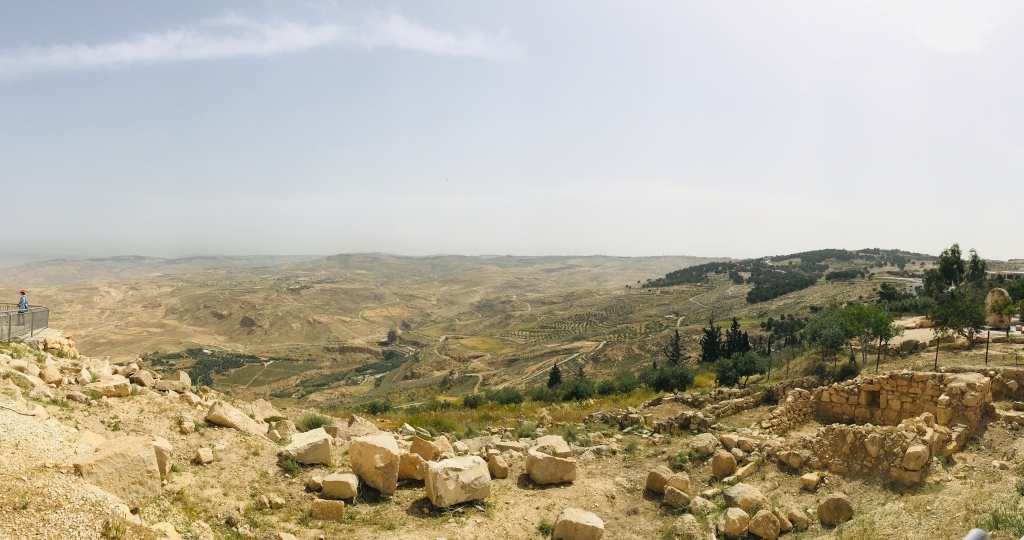
Photo by author, view of Israel from Mt. Nebo, Jordan, May 2019.

Our gospel setting this Sunday strikes a deep lasting impression on anyone who had been on a Holy Land pilgrimage: of those vast expanse of desert in Israel where dusty roads have been replaced by modern concrete or asphalted roads.

Perhaps the feelings remain the same today and during the time of Jesus when he and the Twelve were near the border between Samaria and Galilee, several figures who turned out to be ten lepers appeared at a distance, waving their hands to the Lord. It must have been a surprising sight, then and now, of being found in the desert. Imagine the desperation in their voices of those ten lepers, “Jesus, Master! Have pity on us!” (Lk.17:13).

Jesus right away told them to go show themselves to the priests, and as they went, they were healed. But only one—a Samaritan—returned to thank Jesus who wondered aloud: “Ten were cleansed, were they not? Where are the the other nine? Has none but this foreigner returned to give thanks to God?” Then he said to him, “Stand up and go; your faith has saved you” (Lk.17:17-19).

“The Healing of Ten Lepers” painting by James Tissot en.wikipedia.org

Last Sunday we reflected that faith is primarily a relationship with God; hence, its powers or efficacy will work only when aligned with God and his Holy Will. We will never know how strong we have grown in faith until we get into tests and trials. That is why, the need for us to imitate the Twelve in praying to Jesus, “Increase our faith” (Lk.17:5).

We grow best in faith when we worship God with our fellow believers in the celebration of the Holy Mass especially on Sundays which is our Sabbath. More than a day of rest, Sabbath is a day of restoration to God, with others and most of all, with one’s self. It is a return to Eden, a dress rehearsal of our entry into heaven to dwell in God’s presence eternally.

This is where lies the beauty and significance of this healing of ten lepers – they were not only restored to health but restored in God, to their families, and to their community and fellow believers.

Photo by author, Jerusalem, May 2017.

Those ten lepers have never known any rest at all since getting afflicted with the disease for they were cut off from homes, worship, and community. That is why they could not get near Jesus as they have to keep their distance from everyone according to their laws in order to prevent infecting others and spreading the disease. Likewise, it was the very reason that anyone healed of leprosy or any serious sickness must first present themselves to the priests who have the sole authority to declare one has been healed and therefore may be allowed to reintegrate with their family and community or society in general. Being declared as healed of sickness like leprosy at that time meant the restoration of one’s rights to worship in the temple or synagogue especially on Sabbath.

When Jesus healed them, he restored more than just their bodies and physical health. In sending them to the priests, Jesus invited them into the wholeness of what the Sabbath really is like peace, inclusion, and dignity. 

Or, salvation in short.

Sad to say, only one realized this when he returned to thank Jesus. The healed Samaritan leper knew and felt a deeper healing had taken place within him that he responded with heartfelt gratitude to God in Jesus. There was a deepening of his faith in Jesus when he decided to return to thank the Lord that also expressed his desire to enter into a relationship with Jesus.

Photo by author, Sacred Heart Novitiate, Novaliches, QC, 20 March 2025.

Whenever we thank people for their kindness no matter how little that may be, it is more than acknowledging the other person but most of all, of expressing our links with them as well as our desire to be one with them, especially with God who showers us with good things daily. That is why the Mass is also called Eucharist – from the Greek eucharistia meaning “thanksgiving”. After his skin was cleansed of leprosy in the first reading, Naaman the Syrian Army General declared before the Prophet Elisha that he would worship the Lord alone as he returned to his home with two mule-loads of Israeli soil.

Sorry to say but whenever we refuse to celebrate the Mass on Sundays, it means that we are one of those nine ungrateful lepers healed by Jesus! Don’t you feel being called like the Samaritan to return and give thanks to Jesus for the many blessings you have received this Sunday?

See how in this age of faith in a mass-mediated culture that we have become so impersonal, trusting more our gadgets and all those apps like Siri and Waze as if we have already lost faith in the human person. And God.

Photo by Mr. Nicko Timbol, Chapel of the Angel of Peace, OLFU-RISE, Valenzuela City, 03 October 2025.

We spend practically our entire days in front of all kinds of screens than with the face of a human person. Again, this sadly extends to the way we worship with many still stuck in the pandemic mode of online Masses not realizing the important and irreplaceable aspect of personal encounter of Jesus in the actual Mass with other believers.

God remains God even if we do not go to Mass every Sunday. It is us who are losing greatly whenever we skip Sunday Masses, our Sabbath. God specifically made his third commandment to “Remember to keep holy the sabbath day” because Sabbath reminds us that life itself is holy in the first place, a sharing in the life of God. What a tremendous blessing still that even if we forget God or disregard God every Sunday, Paul reminds us today of the beautiful truth and reality that “If we have died with Jesus we shall also live with him; if we persevere we shall also reign with him. But if we deny him he will deny us. If we are unfaithful he remains faithful, for he cannot deny himself” (2Tim.2:11-13).

Can you imagine that? If we are unfaithful to Jesus, he remains faithful?

Every Sunday, Jesus tells us to “Stand up and go; your faith has saved you” despite, in spite of our many sins and absences from the Sunday Masses in the past because he wants us to experience the deeper wholeness that comes with faith and gratitude as experienced by that Samaritan leper he had healed. As we continue to journey with Jesus toward Jerusalem facing many trials and sufferings along the way, he calls us to come to him in the Sunday Mass to deepen our faith by resting in his presence.

Is there a space in your life at this stage that you feel like one of those lepers, longing for healing and restoration? In the silence of this Sabbath day in our Sunday Mass, speak to Jesus especially after receiving him Body and Blood in the Holy Communion. Amen. Have a blessed week ahead! Fr. Nicanor F. Lalog II, Our Lady of Fatima University, Valenzuela City (lordmychef@gmail.com).
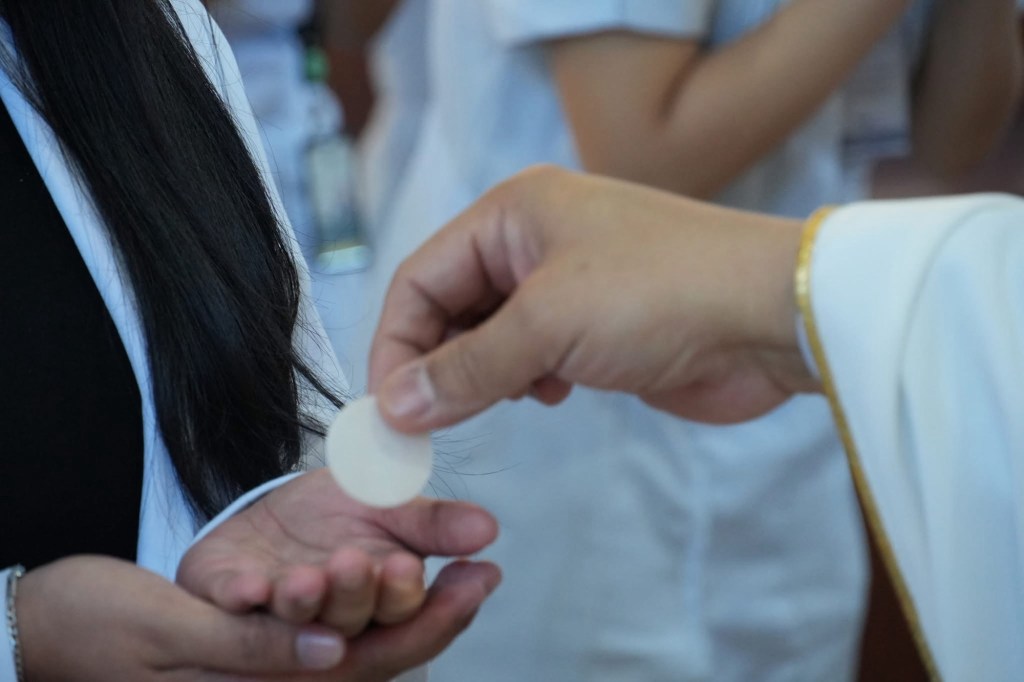
Our Lady of Fatima University-Valenzuela, June 2025.

Job, St. Francis of Assisi, and… Pocahontas

The Lord Is My Chef Daily Recipe for the Soul by Fr. Nicanor F. Lalog II
Friday, Memorial of St. Francis of Assisi, 04 October 2024
Job 38:1, 12-21; 40:3-5 <*{{{{>< + ><}}}}*> Luke 10:13-16
Photo by Fr. Bien Miguel, Diocese of Antipolo, 25 September 2024.

This is actually a rejoinder to our prayer earlier published today on the Memorial of St. Francis of Assisi. And how I love the first reading today, of God’s “speech” to Job’s lamentations that remind us all of the wonder and majesty of creation St. Francis of Assisi highly regarded in his life and teachings.

The Lord addressed Job out of the storm and said: “Have you ever in your lifetime commanded the morning and shown the dawn its place for taking hold of the ends of the earth, till the wicked are shaken from its surface? Have you entered into the sources of the sea, or walked about in the depths of the abyss? have the gates of death been shown to you, or have you seen the gates of darkness? Have you comprehended the breadth of the earth? Tell me, if you know all” (Job 38:1, 12-13, 16-18).

How interesting too these words written about 2700 years ago in the Middle East are echoed in our own time in theme song of the Disney movie Pocahontas, “The Color of the Wind”:

Have you ever heard the wolf cry to the blue corn moon
Or asked the grinning bobcat why he grinned?
Can you sing with all the voices of the mountain?
Can you paint with all the colors of the wind?
Photo by author, Sacred Heart Novitiate, Novaliches, QC, 20 March 2024.

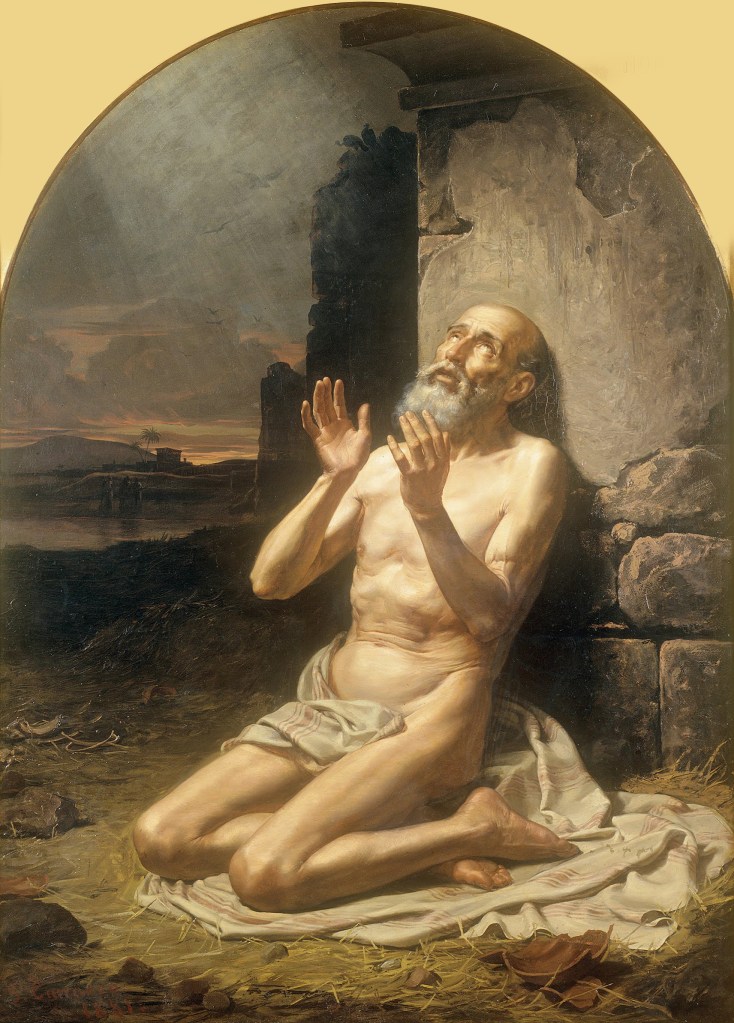
Like Job, who was a fictional character, Pocahontas went through a lot of great sufferings beyond explanations which is the aim of the authors of the Book of Job – to reflect on the mystery of human sufferings and misery amid a loving God.

It is easy to understand our sufferings in life when we are the ones who have caused them like making wrong choices and decisions or simply not exerting enough efforts to our endeavors or projects.

The most painful sufferings that are really bothersome are those we feel “undeserved” at all like getting a rare cancer and disease, being offended by someone close to us despite our being good to them, or like Pocahontas who was then living in peace and quiet until the English colonizers came to America who kidnapped and gang raped her.

I have never seen that Disney movie Pocahontas that is loosely based on the life of a native American Indian woman Pocahontas whose actual name was Matoaka; she was the daughter of the Chief of the Powhatan tribe in Chesapeake, Virginia during the early 1600’s.

According to historians, there was really no romance at all between Pocahontas and the British colonizer Captain John Smith as portrayed in the Disney movie. After getting pregnant from that gangrape, Pocahontas was forced to marry the English explorer John Rolfe as a condition for her release that only made her life filled with great sufferings and humiliations until her death.

Though a work of fiction but a fruit of prayerful reflections about life’s realities unlike the Disney movie Pocahontas, Job suffered severely when he lost his children, properties and livestock in a single day. Worst of all, he was stricken with a rare disease and left to the care of a “nagging” wife and three friends who wanted him to curse God or admit his guilt for a sin for which God was punishing him.

But Job’s conscience was clear, remaining faithful to God throughout all his sufferings. His complaints and cries were actually a voicing out of his inner pains to God, an expression of his trust in Him, “But as for me, I know that my Vindicator lives, and that he will at last stand forth upon the dust… And from my flesh I shall see God; my inmost being is consumed with longing” (Job 19:25, 27).

Job like us today was not seeking any answer nor explanation at all for his sufferings; he cries to God like us because we believe only God can save us. We do not cry or air our pains to someone we do not trust or believe in; the same is true why we cry and complain to God!

God’s response to Job’s laments remind us today of the need for us to see the whole picture we are into in this vast universe, of how everyone and everything is interconnected in God through His own Son Jesus Christ.

Notice how the author structured the speech of God of seeming opposites in life: commanding the morning and being shown the dawn in verse 12; sources of the sea and depths of the abyss in verse 16; and, gates of death and gates of darkness in verse 17. Jewish thought at that time was so structured that they saw everything distinctly different like morning and dawn, sea and abyss, death and darkness. That explains why they were so strict with the letters of the law that they eventually forgot the primacy of the human person which Jesus tried to emphasized to them in His teachings and healings. Jesus came to show us how everything and everyone in this whole creation is linked together, interrelated in God through Him.

This He did when He died on the Cross.

Photo by Fr. Gerry Pascual of the fresco at the Assisi Basilica, Italy, 2019.

It is sad that St. Francis of Assisi is often “romanticized” by many nature lovers even by some “new agers” for his love for nature and animals. More than sentimental reasons, St. Francis’ love and concern for nature and animals were all the result of his deep love and devotion to Jesus Christ crucified found daily in the celebration of the Holy Eucharist.

St. Francis realized and experienced the interconnectedness of everything and everyone in his own sufferings and pains in life he humbly embraced and accepted as we see in that verse we pray at every Station of the Cross he had composed:

V. We adore You, O Lord Jesus Christ, and we bless you. R. Because by Your holy Cross, You have redeemed the world. 

For his love for the Cross and his own sufferings, Jesus blessed St. Francis with the stigmata, His five wounds at His crucifixion.

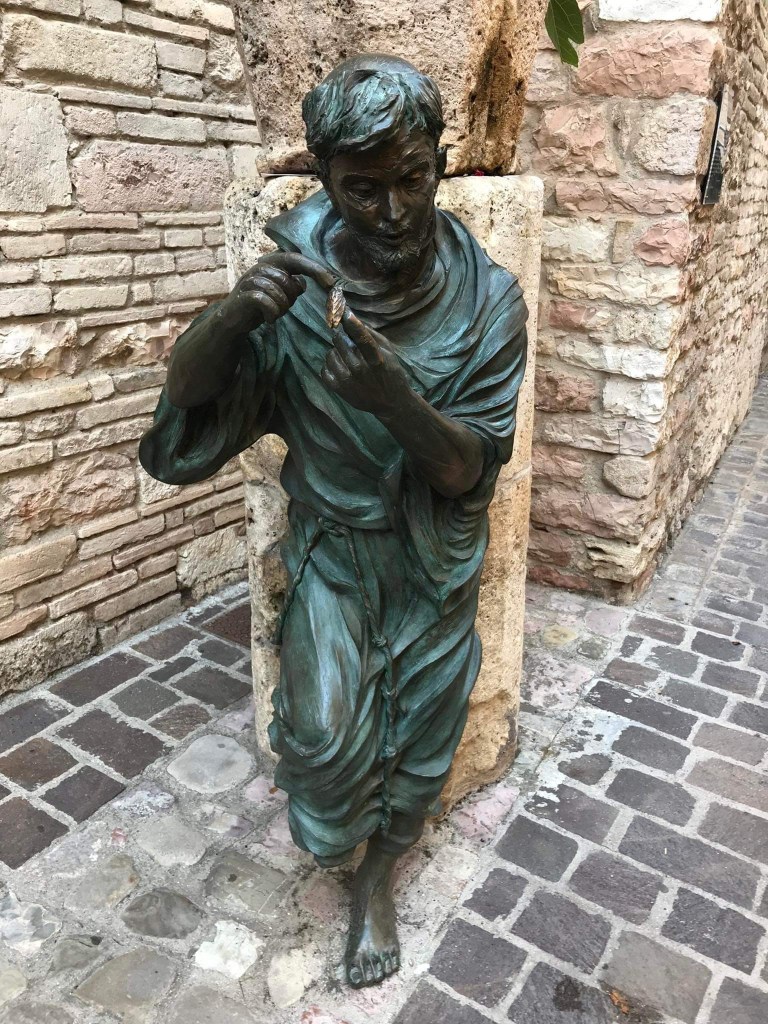
Photo by Fr. Gerry Pascual, Sculpture of the young St. Francis in Assisi, Italy, 2019.

After receiving those wounds, St. Francis was blinded as he went through severe sufferings after going through well-intentioned surgeries that went so bad. He was in his 40’s at that time and despite his great sufferings, it was during that period when he produced so many great writings we all cherish until now, notably the Canticle of the Sun where we find his famous expressions “brother sun, sister moon, and cousin death” – the very same things God expressed to Job in that speech out of the storm in our first reading today that is echoed by Disney’s Pocahontas in the theme “The Color of the Wind”.

But unlike that Disney movie that sugarcoats life’s realities of sufferings and pains, both Job and St. Francis of Assisi remind us today that the more we embrace our pains and sufferings in life like them, the more we see life’s wholeness, our oneness in God and the rest of His creations when seen in the light of the Cross of Jesus Christ.

When we see this oneness and interconnectedness in life, that is when we actually grow and mature, become fruitful as we find fulfillment in life despite the difficulties and pains we go through. Have a blessed weekend everyone! Happy feast day too to our Franciscan brothers and sisters!


From YouTube.com.

Avoiding factions

The Lord Is My Chef Daily Recipe for the Soul by Fr. Nicanor F. Lalog II
Thursday in the Twenty-second Week in Ordinary Time, 01 September 2022
1 Corinthians 3:18-23     ><]]]]'> + ><]]]]'> + ><]]]]'>     Luke 5:1-11
Photo by author, February 2020.
"To the Lord belongs the earth and all that fills it."
-Responsorial Psalm for today
How often do we forget
or disregard this truth,
God our loving Father
that prevents us from
maturing in our spirituality
and relationship with you 
and one another as we follow
the wisdom of the world
that puts premiums on wealth
and power, fame and success
that create factions 
and divisions among us.
Forgive us when what we pursue
is often the ways of the world 
which is dominance over others, 
of having and possessing, 
of being served than of serving:

For the wisdom of this world is foolishness in the eyes of God, for it is written: God catches the wise in their own ruses, and again: The Lord knows the thoughts of the wise, that they are vain. So let no one boast about human beings, for everything belongs to you.

1 Corinthians 3:19-21
Teach us to be fools for you, 
Jesus Christ, in whom everything
was created, things visible and
invisible (Col. 1:16) yet,
had to borrow a boat from Simon;
teach us to be fools like Simon and
company who listened and obeyed
Jesus, a carpenter, to cast their
nets into the deep;
many times, O Lord, we are
so divided within ourselves,
there are many factions inside
and outside of us that we get
separated from you our unity
and whole.  Amen.