Lawiswis ng Salita ni P. Nicanor F. Lalog II, Ika-17 ng Setyembre 2019
Relasyon at ugnayan
hindi emosyon at damdamin
ang sabi natin na pangunahin turo sa atin
ng talinhaga ng alibughang anak.
Kay gandang larawan ng Diyos
ang nakintal sa ating puso't isipan
nang ilahad ng mahabaging ama sa dalawang anak niya
na sila ay iisang pamilya, binibigkis ng buhay na mula sa kanya.
Ano mang kasalanan ay mapapatawad
maging kamatayan ay malalampasan
nitong habag at awa ng Diyos na ibinuhos
kay Kristo Hesus para sa ating mga alibughang anak niya.
Ganyan ang habag at awa ng Diyos bilang Ama
na dumadaloy din mula sa kanyang pagiging ina
nang mawika niya, "hindi kita malilimutan kailanman
katulad ng isang ina sa kanyang anak na mula sa kanyang sinapupunan."
Para sa kanilang kaisipan,
ang habag at awa ay "hesed" ---
damdaming napaka-lalim gaya ng pag-ibig
nagpapahiwatig ng maka-amang katapatan at pananalig.
Nagmumula ito sa sinapupunan o "raham" ---
yaong matris ng kababaihan na siyang kanlungan
ng simula ng buhay, lundo ng katuwaan pagsapit ng kagampan
kapag napawi mga agam-agam, pagsilang ng bagong buhay.
Kapag umiiral habag at awa sa ating buhay
doon tayo buong-buo sa pagkatao
nagiging ganap at banal tulad ng Diyos
puno ng buhay at pagmamahal.
Kaya't kapag mga patayan ay naglipana
at pagkitil sa buhay ang nakikitang paraan
upang lunasan maraming kasalanan at kasamaan
nasisira ating kapatiran, di maglalaon, tayo ang mababaon.
Lawiswis ng Salita ni P. Nicanor F. Lalog II, Ika-16 ng Setyembre 2019
Maraming salamat, Rdo. LA Bautista sa kanyang pagninilay para sa Misa kahapon.
Ang Pagbabalik ng Alibughang Anak ni Rembrandt. Mula sa Google.
Hindi ko pa rin mapigilan
pagnilayan at namnamin
kahulugan ng talinhaga ng
alibughang anak at ama niyang mahabagin.
Ugnayan at relasyon, hindi emosyon
batayan ng Mabathalang awa at habag
ang siyang tinuturo ng Panginoon
dapat sana tayo ay magkaroon.
Kapag namamalas natin tanawing hindi nakagigiliw
tulad ng mukhang nahahapis at tumatangis,
kapansanang nakahihindik o kapalarang mapait
ating damdami'y naaantig, kaya tayo ay naaawa.
Ngunit, wala naman tayong magawa kungdi lumuha
at kung mayroon man maibibigay, kaunting barya ay tama na;
kaya naman kung hapis sa kalooban ang tinitiis
hindi natin ito pansin kaya kahirapan ng iba ating pang diniriin.
Ito ang masaklap nating nakakalimutan
Katulad ng magkapatid sa talinhaga na kapwa alibugha:
Dahil sa kanilang pagkagumon sa mga kayamanan
Ugnayan nila sa ama at isa't-isa, nawalang tuluyan.
Masdan at namnamin, sinasabi ng Ama sa atin,
"Anak, lagi kitang kapiling; lahat ng akin ay sa iyo rin.
Dapat tayo magsaya at magalak kapag inyong kapatid
Ay nagsisisi at nagbabalik" (Lk.15:31).
Ang Diyos ay ipinakilala sa atin bilang Ama
sapagkat buhay nating lahat sa kanya buhat
na tulad ng sino mang ama, sinisikap itaguyod at pangalagaan
protektahan at ipaglaban kung sakaling pagbantaan.
Relasyon at hindi emosyon ang batayan
at pinagmumulan ng awa at habag sa atin ng Diyos nating Ama
kaya naman kahit ito ay mawala at mamatay
kanyang hihintayin, hahanapin, at bubuhayin pa rin!
Our gospel this Sunday of the parable of the prodigal son speaks so well of what we may describe as the “wildness and wideness” of God’s love and mercy for each one of us, especially the lost and rejected. It is a love that goes “time after time”….
Lying in my bed I hear the clock tick And think of you Caught up in circles Confusion is nothing new Flashback, warm nights Almost left behind Suitcase of memories Time after
Sometimes you picture me I’m walking too far ahead You’re calling to me, I can’t hear What you’ve said Then you say, go slow I fall behind The second hand unwinds
If you’re lost, you can look and you will find me Time after time If you fall, I will catch you, I will be waiting Time after time
Written and originally performed by Cyndi Lauper, “Time After Time” is her second single she co-wrote with Rob Hyman that was released in January 24, 1984. It was an instant hit and earned very positive reviews for Lauper.
It is a story of unconditional love despite its being over.
The lover promises to continue loving her beloved despite their separation.
It is a kind of love that is so divine like the merciful father in the parable of the prodigal son. A love so true as it recognises the other person as a “somebody”, a part of the lover. A love that persists time after time because we remain a family despite our separation of distance or even of feelings.
We have chosen the 1988 cover by the jazz duo of husband and wife Tuck and Patti because of its more solemn rendition. The guitar and voice ensemble of the duo for me is one of the music world’s great treasure we are so thankful not only in delighting our senses but most of all in making us experience some of the most beautiful songs of our time.
The Lord Is My Chef Sunday Recipe, Week XXIV-C, 15 September 2019
Exodus 32:7-11, 13-14 ><)))*> 1Timothy 1:12-17 ><)))*> Luke 15:1-32
Camp John Hay, Baguio City, 23 August 2019.
Today we conclude the series of “table talks” by Jesus with three parables narrated while dining; but, unlike the other Sunday when he was with prominent people, this time we find the Lord among the notorious ones of his time.
Tax collectors and sinners were all drawing near to listen to Jesus, but the Pharisees and scribes began to complain, saying, “This man welcomes sinners and eats with them.”
Luke 15:1-2
It is the perfect setting where Jesus bared what we may call as “the wildness and wideness” of God’s love and mercy for everyone, especially the lost and rejected. This explains why Luke 15:1-32 is the “heart” of the third gospel also known as the Gospel of Divine Mercy. So, please bear with me reflecting today’s long but lovely gospel.
The first two parables are about things – a sheep and a coin – that were lost and later found. There is nothing extraordinary about losing things that we also experience today. But, in narrating these parables, Jesus ended both with a saying to explain their meanings and significance to introduce the third parable of the lost son.
“I tell you, in just the same way there will be more joy in heaven over one sinner who repents than over ninety-nine righteous people who have no need of repentance.”
“In just the same way, I tell you, there will be rejoicing among the angels of God over one sinner who repents.”
Luke 15: 7, 10
Photo by Ms. Jo Villafuerte, Atok, Benguet, 01 September 2019.
For the past two Sundays, we have been reflecting about the importance of our personhood, of how God comes first to our very persons, of the need for us to be true and humble because God meets us right in our weaknesses and sinfulness. Jesus warned us the other Sunday that “for everyone who exalts himself will be humbled, but the one who humbles himself will be exalted” (Lk.14:11). As they say, bloom wherever you are planted for God’s grace is more than enough for each one of us!
Such is God’s love us that Jesus demands total faith in him that “if anyone comes to me without hating his father and mother, wife and children, brothers and sisters, and even his own life, he cannot be my disciple” (Lk.14: 26). In our lives as his disciples, there would be countless times when no explanations, no reasons are enough why we choose to love and forgive, to be kind and understanding except the very person of Jesus Christ. That is what we call as communion, oneness with the Lord, of always preferring Jesus above anyone and anything!
This is the very reason why the Pharisees and scribes were complaining against him: the tax collectors and sinners were turning to Jesus and not to the Laws they represent! And that continues to happen in our time when some people insist more on religion and vocation, roles and rituals, totally forgetting and even disregarding the very person of God who calls us to himself in Christ!
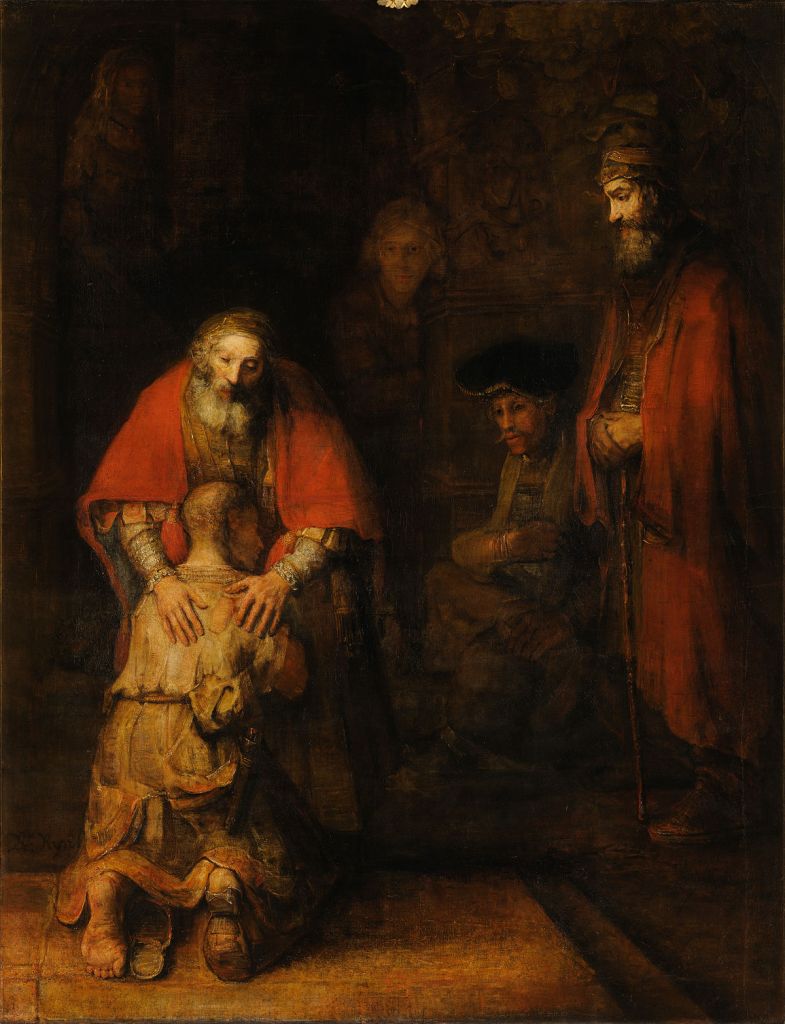
The Return of the Prodigal Son by Rembrandt (c.1661-1669). From Google.
Then he said, “A man had two sons, and the younger son said to his father, ‘Father, give me the share of your estate that should come to me.’ So the father divided the property between them. After a few days, the younger son collected all his belongings and set off to a distant country where he squandered his inheritance on a life of dissipation.”
Luke 15:11-13
Feel the solemnity of Jesus in introducing this parable, shifting from lost sheep and lost coin to lost son, from things to persons because the elder son is also lost. It is the father who eventually restored the lost personhood of the two sons when he lavished them with his love and mercy towards the end of the story. And that is why this parable is so lovely as it reminds us of how unconsciously we are “dumping” our own personhood despite our bloated egos. Slowly we are becoming robots or worst, even zombies without feelings and personal relations with others and with one’s self.
Just like the two sons in our parable who both define sonship in terms of servile obligations that is utilitarian and contractual in relationships, not as a family.
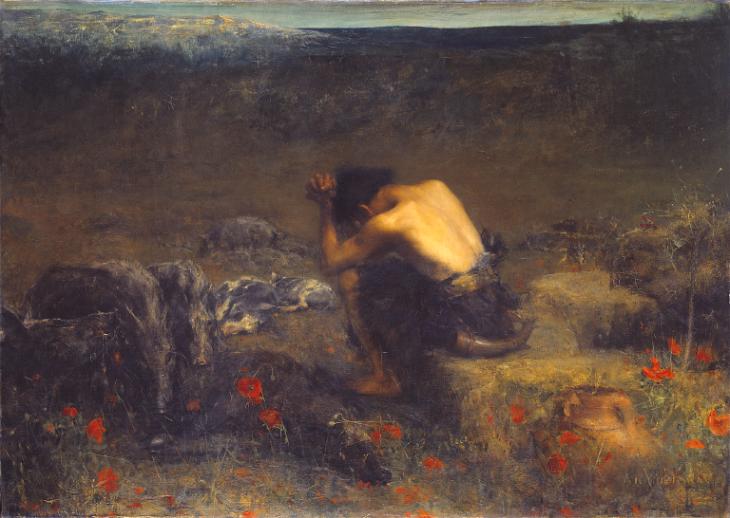
The Prodigal Son by John Macallan Swan, 1888. From Google.
Coming to his senses he thought, ‘How many of my father’s hired workers have more than enough food to eat, but here I am, dying from hunger. I shall get up and go to my father and I shall say to him, “Father, I have sinned against heaven and against you. I no longer deserve to be called your son; treat me as you would treat one of your hired workers.”
He (elder son) said to his father in reply, “Look, all these years I served you and not once did I disobey your orders; yet you never gave me even a young goat to feast on with my friends. But when your son returns who swallowed up your property with prostitutes, for him you slaughtered the fattened calf.”
Luke 15:17-19, 29-30
The prodigal son remembered his father when he was starving, thinking more of the food he could have if he returns home as a servant, not as a son. See how in the midst of sin, he never thought of his father as his parent, of himself as a son. He was convinced that the path to reconciliation with his father was becoming a hired worker, forgetting the very fact he is the youngest son.
The same is true with the elder son who refused to join the celebration when his brother had returned home, feeling so bad that his long years of service to his father deserve him a reward. In a sense, he is worst than the prodigal son: no father, no brother – just himself alone!
Both sons have a slanted view of their father, a very truncated one that is self-isolating, very constricting like the Pharisees and scribes who have forgotten their being persons, of being interrelated with one another in God. Very much like us today that slowly as the ties that bind us as family and friends are slowly being severed by so many things, we also start to lose many of our values like “malasakit” or concern for one another.
The father redefined their – and ours, too – relationships as family that lead to joy and celebration.
He (father) said to him, “My son, you are here with me always; everything I have is yours. But now we must celebrate and rejoice, because your brother was dead and has come to life again; he was lost and has been found.”
Luke 15:31-32
Santorini. Photo by Dra. Mai Dela Pena, 2016.
Today, Jesus reminds us, and assures us too that no matter what happens with us, we will always be his brothers and sisters, beloved and forgiven children of the Father.
We call and relate with God as Father because as his children, he is our giver and keeper of life.
And should this life get lost, God as our Father, can also be so “prodigal” to “wastefully” love us and bring back this life to us for we are more valuable than anything else in this universe. That’s how wild and wide is his love and mercy. Amen.
Colossians 3:12-17 ><)))*> ><)))*> ><)))*> Luke 6:27-38
Sacred Heat Novitiate (Novaliches), July 2016.
It is only Thursday, Lord Jesus Christ, but suddenly your Most Sacred Heart came to mind, especially this beautiful hymn:
Heart of Jesus, meek and mild Hear, O hear, Thy feeble child, When the tempest’s most severe, Heart of Jesus, hear!
Sweetly we’ll rest on Thy Sacred Heart, Never from Thee, oh let us part, Hear then Thy loving children’s pray’r, O Heart of Jesus, Heart of Jesus, hear!
Everyday, Lord, we think of the clothes we would wear and too often, our choices seem endless, taking so much of our time so we would always look good to others.
Today, O Lord, I pray, you clothe me with your person: through your “compassion, kindness, humility, gentleness, and patience, may everything I do be done in your most holy name, O Jesus”, (Col. 3:12, 17).
From Google.
To be clothed in you, O Lord Jesus, means to see the good in others than to see myself as the only one good.
To be clothed in you, O Jesus, is to get into the very heart of your gospel message of “loving our enemies” (Lk.6:27). It is the most radical words in your preaching that seems so impossibly hard for us to follow – unless we are clothed in you, O Christ.
That is why it is very important for us to be clothed in you, Jesus, because loving our enemies is the clearest expression we are your disciples, that is, Christians in the truest sense.
Help us to take off our clothes of pride and selfishness, our clothes of greed and insecurities that make us want more than what we have and what we need, and thus lead to our making enemies because we try to possess and defend.
Instead, let us be clothed in you, Jesus, so that we become poor like you with nothing to keep except everything to give and share.
In that manner, we become open and hospitable instead of being hostile with others. Amen.
The Lord Is My Chef Sunday Music, 08 September 2019
Photo by Ms. Jo Villafuerte at Atok, Benguet, 01 September 2019
Our gospel today is so personal.
Sometimes, we have to be unreasonable — and be personal — when the only explanation and justification we can have for continuing to love and forgive, to care and accept people is “because of Jesus Christ”.
“If any one comes to me without hating his father and mother, wife and children, brothers and sisters, and even his own life, he cannot be my disciple.”
Luke 14:26
There are times in our lives when we are so down and everything is so dark when all we need is the warmth of a loving heart and a loving face of another person. No ifs, no buts but just because of you.
This is the reason Jesus is very clear today with his words, “hate” one’s self as well as those closest to us to stress that when things get worst, our only reason is him alone. We love, we forgive, we care despite all the pains and hurts because of our communion in Jesus Christ.
Jesus is the only one who would really stand us, offering himself up on the Cross for you and for me.
That is why for this Sunday we have chosen Beng E. King’s 1961 hit “Stand By Me” that was rereleased in 1986 as theme of a movie with the same title.
The song speaks of the undying love and fidelity of a man to the woman he loves. It is partly the same story of the friendship of those for boys in the said movie.
King’s music has been covered by so many other artists over the years for its reflective music and poetry that evoke deep personal love that transcends reason and conventions. No wonder, it was sang at the wedding last year of Prince Harry and American Meghan Merkle, a true-to-life love story that seems can only happen in Hollywood.
But that is the beauty of the song and Christ’s gospel: everything can happen when we are willing to give up everything including our very selves in the name of love for another person.
The Lord Is My Chef Sunday Recipe, Week XXIII-C, 08 September 2019
Wisdom 9:13-18 ><)))*> Philemon 9-10, 12-17 ><)))*> Luke 14:25-33
Photo by Ms. Jo Villafuerte at Atok, Benguet, 01 September 2019
“A loveless world is a dead world, and always there comes an hour when one is weary of prisons, of one’s work, and of devotion to duty, and all one craves for is a loved face, the warmth and wonder of a loving heart.”
Albert Camus, “The Plague”
I always tell people not all days are bright and sunny but, there comes a time when we are so down, when all is so dark and even hopeless that the only thing left for us is to believe, to hope, and to love.
There is really nothing we can do except to patiently wait for the storm to pass while we suffer alone and cry alone. That is when we are surprised and even shocked at how the gospel of Jesus and the commandments of God can sometimes be so rigid that we want it modified even a little because we want to get even, we want to fight back. If we are not busy thinking of revenge, we complain, asking God why me who should suffer?
But, the more we pray and submit ourselves to God, the more we realise that God’s ways are not our ways. That despite the difficulties, we feel deep inside God is with us, guiding us, leading us to something better!
“Who can know God’s counsel, or who can conceive what our Lord intends? Or who ever knew your counsel, except you had given wisdom and sent your holy spirit from on high? And thus were the paths of those on earth made straight.”
Wisdom 9:13, 17-18
Photo by Ms. Jo Villafuerte at Atok, Benguet, 01 September 2019
Here we find the importance of Christ’s teaching last Sunday, of the need to be humble, to be our true selves by being where we should be for “those who humble themselves will be exalted and those who exalt themselves shall be humbled.”
It is in our poverty, in our weakness, even in our incomprehension when the Holy Spirit works well to reveal to us the higher realities of life often wrapped in every pain and suffering we go through. And that is why sometimes in life, it is best to be unreasonable when the only explanation and justification we can have in still being loving and forgiving, merciful and understanding, kind and patient is the person of Jesus Christ.
“If any one comes to me without hating his father and mother, wife and children, brothers and sister, and even his own life, he cannot be my disciple.”
Luke 14:26
Photo by the author, Holy Family Chapel, Sacred Heart Novitiate (Novaliches), July 2016.
Our gospel today is a continuation of last Sunday when Jesus was invited to a Sabbath dinner by a Pharisee. After giving them some “table talks”, Jesus told them another parable about the great feast to stress that God’s mercy is so vast that there is room for everyone in heaven.
People started to follow him after that meal and lesson on heaven, wanting to become his followers and disciples. To further motivate them in following him, Jesus challenged them with these powerful words using a figure of speech. The word “hate” may be too strong and harsh but such is the gravity of discipleship: we have to lose our very selves even those dearest to us when we have to see everything and everyone in the person of Jesus. To “resolutely follow Jesus in his journey to Jerusalem”, we must be ready to be totally his with him alone as the basis in every decision that can be sometimes foolish like St. Paul who claimed in one of his writings he was a fool for Christ!
See the “foolishness in Christ” of this great apostle: St. Paul was in prison at Rome awaiting trial and judgement. A slave named Onesimus escaped his Christian master named Philemon. It was definitely against the law to harbor escaped slaves yet St. Paul welcomed Onesimus in his prison as his companion and servant! More than that, without really knowing him well, St. Paul baptised Onesimus to become a Christian!
Imagine St. Paul’s adherence to the gospel of Christ even to the point of being unreasonable when he could have just told Onesimus to go back or go somewhere else and spare him all the troubles! But no. It was very clear with St. Paul in asking Philemon to receive Onesimus back that he was not sticking to any moral standards or laws but solely on the person of Jesus Christ, in our communion in him as brothers and sisters.
“Perhaps this is why he was away from you for a while, that you might have him back forever, no longer as a slave but more than a slave, a brother, beloved especially to me, but even more so to you, as a man and in the Lord. So if you regard me as a partner, welcome him as you would me.”
Philemon 15-17
Photo by Ms. Jo Villafuerte at Atok, Benguet, 01 September 2019.
Next Sunday we shall hear the very long but beautiful parable of the merciful father also known as parable of the prodigal son. Like God our Father, the merciful father would reassure his two sons of his immense love for them despite their sins because of their very persons as his sons.
Today in our Sunday Eucharist, Jesus welcomes us all as persons, his brothers and sisters despite our sins and weaknesses. Like Mary whose birth we also celebrate today inspire us to receive Jesus our Savior in his total person in ourselves by receiving the persons around us in him. Amen.
Tuesday, Memorial of St. Gregory the Great, 03 September 2019
1 Thessalonians 5:1-6, 9-11 ><)))*> ><)))*> Luke 4:31-37
Photo by Jo Villafuerte, Atok, Benguet, 31 August 2019.
“For God did not destine us for wrath, but to gain salvation through our Lord Jesus Christ, who died for us, so that whether we are awake or asleep we may live together with him. Therefore, encourage one another and build one another up, as indeed you do.”
1 Thessalonians 5:9-11
Dearest God our Father: Yesterday your words moved me to pray for consolation, to accompany those “alone”. Today, your words call me to “encourage one another and build up one another.”
How beautiful and wonderful indeed are your words, so powerful and fulfilling, indicating your very presence!
In this highly competitive world, it is not enough that we encourage people but also to build them up. From the Latin words “en” and “cor”, literally meaning to hearten or strengthen the heart, there are times that encouragement without community can be misleading and even destructive too.
Encouragement is going within every person, right into one’s heart like in your Son’s exorcism of a man possessed by “unclean demon” who “left the man without harming him” (Lk.4:35). From the heart, true encouragement moves outward to touch others’ hearts to form a community. Every time you heal the sick, Lord, people are moved to build up their families and community.
Encouragement is not pushing people to do and achieve things. Encouragement is bringing others closer to you through Jesus Christ our Lord. It is actually Jesus Christ who encourages for it is him alone who touches hearts and moves them to build up a person, families, and communities.
Like your servant St. Gregory the Great he encouraged not only Christians but also pagans to work for unity and to pursue so many efforts that built up not only persons and families, nations and tribes, monasteries and churches but most of all, an entire civilization now slowly turning away from you.
Fill us with more courage and wisdom, holiness and patience in encouraging one another to build up communities as we await for your joyful coming again. Amen.
While praying over today’s gospel during the week, I came across this photo of Ms. Rosa Parks in my Facebook feed saying something like, “Rosa Parks made a stand for her rights by refusing to give up her seat in a bus 60 years ago.”
I love the caption and the play of words of the photo that convey the same message of our Sunday gospel: it is not where we seat but where we stand that matters most.
On a sabbath, Jesus went to dine at the home of one of the leading Pharisees, and the people there were observing him carefully. He told a parable to those who had been invited, noticing how they were choosing the places of honor at the table.
Luke 14:1, 7
For the next three Sundays beginning today while Jesus resolutely decided to journey to Jerusalem, he will be teaching us with some “table talks” as he spoke about the heavenly banquets as expressions of God’s vast ocean of mercy where everyone is welcomed. But, more than lessons on table manners and etiquette, Jesus is also teaching us of finding our own places in his kingdom here on earth where everybody is welcomed just like in heaven.
Key to appreciating our gospel today is found in the first reading:
My child, conduct your affairs with humility, and you will be loved more than a giver of gifts. Humble yourself the more, the greater you are, and you will find favor with God.
Sirach 3:17-18
From Google.
Remember that very central in the teaching of Jesus is the need to be like a child when he would always remind us that “unless you become like a child, you will never inherit the kingdom of heaven.” Being like a child is being humble and obedient, being open to learning new things that are all necessary in building relationships that lead to communion with God and with others. Heaven is the perfect communion of God and everyone but it has to start here on earth among us.
Jesus lived at a time when society and people were so fragmented, just like now. Everybody feels being entitled to heaven and on earth, to every position and honor everywhere even in the church.
While at a sabbath dinner hosted by a Pharisee, Jesus took the occasion to teach the people of the need to be humble to be accepted anywhere. According to St. Teresa of Avila, humility is walking in truth. Humility is being real!
“For everyone who exalts himself will be humbled, but the one who humbles himself will be exalted.”
Luke 14:11
Photo by Jim Marpa, 2018.
Jesus is telling us that for his grace and mercy to truly work on us, we have to be really who we are. In this age when life has been replaced with lifestyle and people have usurped the power and authority of God as well as the natural order of things, everybody feels entitled to everything insisting on their rights forgetting their responsibilities. Homosexuality is not a sin; what is sinful are homosexual acts. The challenge is for the person to accept his/her true self as a beloved child of God doing his/her best to be the bestest person. No need to alter one’s body nor be somebody else he/she is not. Homosexuality is not about insisting on something just for the sake of insisting or making a statement for one’s self regardless of others like in the use of toilets. We have a Tagalog expression that perfectly captures the Lord’s lesson, “lumagay ka sa dapat mong kalagyan”. Loosely translated, it means simply be where you are supposed to be.
Last Wednesday we celebrated the memorial of St. Augustine, one of the most famous and colorful saints of the Church. His life is a gospel in itself, showing us that nobody is too late to change and be a better person. Most of all, nothing is too late for God. Like St. Augustine, we must first accept who we are, be humble for our weaknesses for it is only when we accept that we start to grow and everything follows like acceptance by others. How can we expect others to accept us if we cannot accept first our very selves? This is the most beautiful mark of humility of children that make them so irresistible to adults: they have no guile, all-natural and no plasticity or synthetic fronts to be loved and appreciated.
More than table manners and etiquette, Jesus is teaching us that if we can be humble and accept who we are, we can definitely find our place in the kingdom of God, here on earth and in heaven. God loves us so much he has a plan for each on of us if we play our roles wholeheartedly. We will never experience his mercy and grace unless we become humble.
Photo by Reuters, 2018.
“Rather, when you hold a banquet, invite the poor, the crippled, the lame, the blind; blessed indeed will you be because of their inability to repay you. For you will be repaid at the resurrection of the righteous.”
Luke 14:13-14
To further ensure the lesson of his parable about each of us having a place in his kingdom here on earth, Jesus reminds us too while in the context of his sabbath dinner that for us to be able to establish a more humane society, we have to guard against stereotypes of peoples that we tend to box them into categories.
Jesus is asking us to radically change our prevailing social mores, suggesting a very different value-system in the here-and-now kingdom of God. Far from the cries of the communists for a classless society, Jesus tells us to see the value of every person rather than focusing on the few powerful, wealthy, and influential people we always deal with in exchange of so many favors.
It is a patronage system so prevalent everywhere especially in politics and in our social relationships like the compradazo system of getting ninong and ninang who are rich and famous to get influence and other perks and rewards. It is so unfortunate that some clergymen are so guilty of this that the Church’s credibility has eroded so much for the mistakes and sins of a few.
In this manner of patronage system, the poor and the weak are always left out to the margins, forgotten and even disregarded. What kind of Christianity do we have when we are so concerned with Christmas carols and counting the days before Christmas and be oblivious to the plight of the farmers and fishermen?
Lorenzo Atienza, June 2019.
What Jesus is telling us today is that those who have less in life should have more of God because, truly in the end, they are the ones who shall be exalted!
In these parable and admonition by Jesus, St. Luke our guide these Sundays is not only giving us an advice on how to prepare for the end times but also on how to live according to the Lord’s vision of a just and humane society in our imperfect world.
We in the Church play a very vital role in bringing about this change by witnessing the gospel that often brings about a reversal of fortunes in the end.
The author of the Letter to the Hebrews reminds us that the ultimate goal of our Christian life is communion with God made possible by Christ’s offering of himself on the Cross. Do our Sunday Mass celebrations and Parish set-ups witness to the gospel values of a just and a humane city of God here on earth?
Thank you very much, dear God, for this weekend rest.
And as we rest from work or studies, let us also pray for the gift of remembering.
Like in the first reading when Joshua asked the Israelites to always remember the many wondrous things you have done to them so they may remain faithful to you, make us remember too that there is no other God except you who personally relates with us, blessing us with everything that we need even without our asking.
You have created us to always remember but we are also “beings of forgetfulness” who always forget everything and everyone, especially you and those dearest to us. We are easily distracted with so many other things and people that we always forget those who are truly good to us.
When life becomes nice and easy for us, when we have everything we need, that is when we forget. And sadly, when we forget, when we do not remember, that is when we also break away, we go apart.
Because, to “remember” literally means to make a member or part again, “re” + “member”.
When we remember you, O God, we affirm your presence in us and among us.
When we remember our loved ones, whether away or gone forever, we make them a part again of our lives here and now, the present moment. The same thing is true with events in the past, whether good or bad.
Thank you so much O God for this gift of remembering!
Make us like the children in today’s gospel who came to you, wanting to be one with you, wanting to be your member and part too! Amen.












 lordmychef.com