Advent & Christmas are a love story

The Lord Is My Chef Daily Recipe for the Soul by Fr. Nicanor F. Lalog II
Simbang Gabi-6 Homily, 21 December 2024
Zephaniah 3:14-18 ><}}}*> + ><}}}*> + ><}}}*> Luke 1:39-45
From Clergy Coaching Network, posted on Facebook 13 December 2023.

Advent and Christmas are a story of love of God’s love for us all that “He gave us His only Son.”  No wonder, it is on this blessed Season when we share gifts, and most of all, our gift of self to others. 

My youngest sister Bing works as an area manager of a Jollibee franchise in Bulacan.  A few years ago before Christmas during our family conversations over dinner, she told us of a story shared by the Jollibee manager at NLEX.  According to her story, two nuns entered their store there with some Dumagats with their driver.  Right away, the store manager noticed how the two nuns were busy “calculating” the meal they have to take until settling for the cheapest, a rice meal of shanghai rolls.  Obviously, the religious sisters have limited budget which did not escape the intuition of the lady manager who offered to treat them to a ChickenJoy meal for free.  But the nuns felt shy and refused the manager’s offer, asking her not to be bothered at all until another woman with two kids in tow interrupted them, giving them ChickenJoy buckets with extra rice enough for the religious sisters and their companions!  The woman refused to be identified and simply said that she too had noticed the nuns trying to budget their limited money that she ordered right away the food.  For her part, the kind manager treated them instead for desserts to complete their meal. 

That’s when my sister said “talagang Pasko na nga” (it’s really Christmas).

From Facebook, 10 December 2024.

Since the start of Advent, we have been advocating that we also remember on those not feeling merry and bright this Christmas for various reasons like having family problems, financial woes, grieving for loved ones, dealing with mental issues or serious sickness of a loved one (see https://lordmychef.com/2024/12/13/advent-is-journeying-like-joseph-mary-to-bring-jesus-in-darkness/).

Yesterday in our reflection on the annunciation of the birth of Christ, we said of the need for us to enter in a dialogue with others to let Christmas happen. Dialogue is not just about improving relationships with others by thinking through issues and problems but more of a way of being with others, of being present with others to experience and feel their situations, exactly what Jesus did in being human like us in everything except sin.

At the annunciation of the Lord’s birth, Mary dialogued with Gabriel unlike Zechariah who was eventually silenced in order to be open to God. True dialogue as an incarnation like Jesus with God and with others can only happen when we are convinced of God’s love for us. Mary went in haste to visit Elizabeth because she felt God’s love in her that she wanted to share it with her cousin right away.

Mary set out in those days and travelled to the hill country in haste to a town of Judah, where she entered the house of Zechariah and greeted Elizabeth (Luke 1:39).
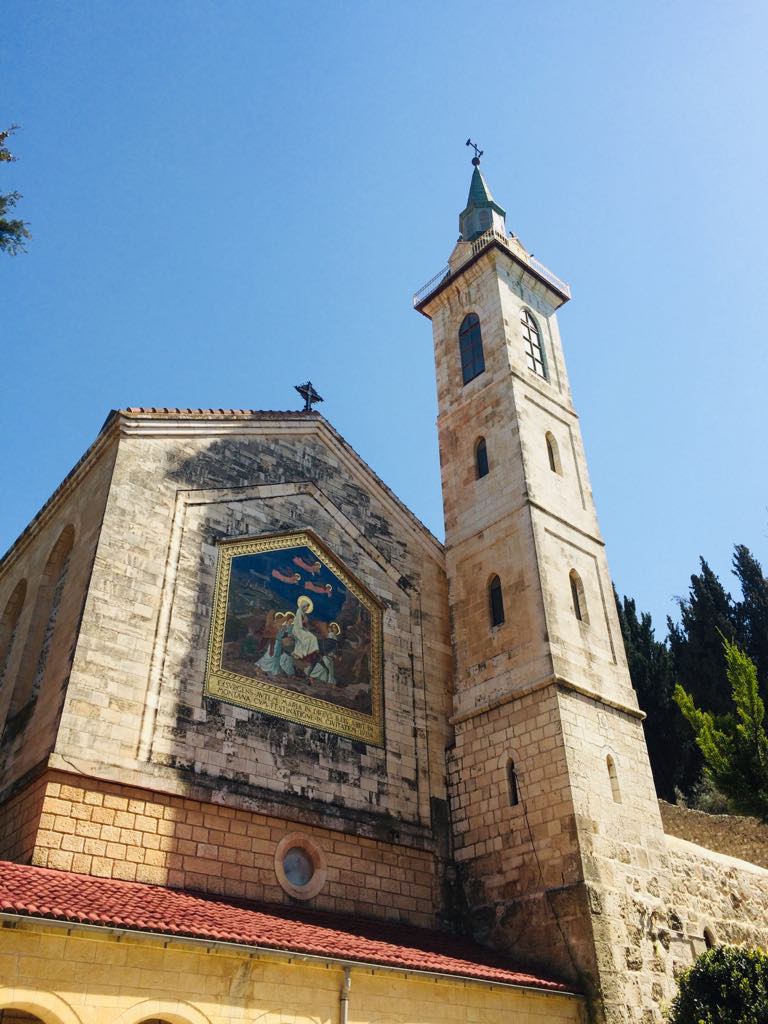
Photo by author, Church of the Visitation, the Holy Land, May 2017.

Try imagining that scene of Mary’s Visitation of Elizabeth. What did you feel? Did you feel some sense of tenderness, of being loved, of being touched by God?

While praying over this scene as I recalled my second pilgrimage to the Holy Land when we went to the Church of Visitation, I remembered my early years in the ministry when I always felt ashamed accepting invitations for dinners because I could not bring a gift.

Maybe part of our upbringing, I have always felt inadequate coming to another home bringing nothing. That is why I keep cards and stampitas in my desk along with some chocolates so that when I visit families, I could bring a little something for them. 

It was only in 2011 after being assigned to a parish of my own when I was able to let go of this feeling of inadequacy after a parishioner told me how they deeply appreciated priests visiting them at home, sharing in their meal because they felt so blessed. That is why most of us priests are fat – we always get invited to meals and gatherings that sometimes I wonder if people really love me when they “force” me to eat more of their cholesterol-laden food and sugary desserts they serve! 

It was during these home visitations especially of the sick and for simple meals I felt “rootedness” or oneness with people, of being “a member of each family yet belonging to none” as the famous French Dominican Fr. Lacordaire said a hundred years ago about priesthood.  The more I visit families, bidden or unbidden, the more I feel the joy of my priesthood because of the family and community that I belong to. That is when I realized too that celibacy is lived in a community both of priests and laity.

For 26 years in schools and the parish and now the hospital, the more I felt Jesus present in me as a priest as I live among brother priests and lay people. Tenderness and intimacy take on a new dimension that is spiritual in nature because I don’t just touch people but am also being touched by them.  Every time they thank me, I also thank them for blessing me with their warm welcome. It is like Mary and Elizabeth during the Visitation blessed abundantly by God and still sharing that same blessing with each other. 
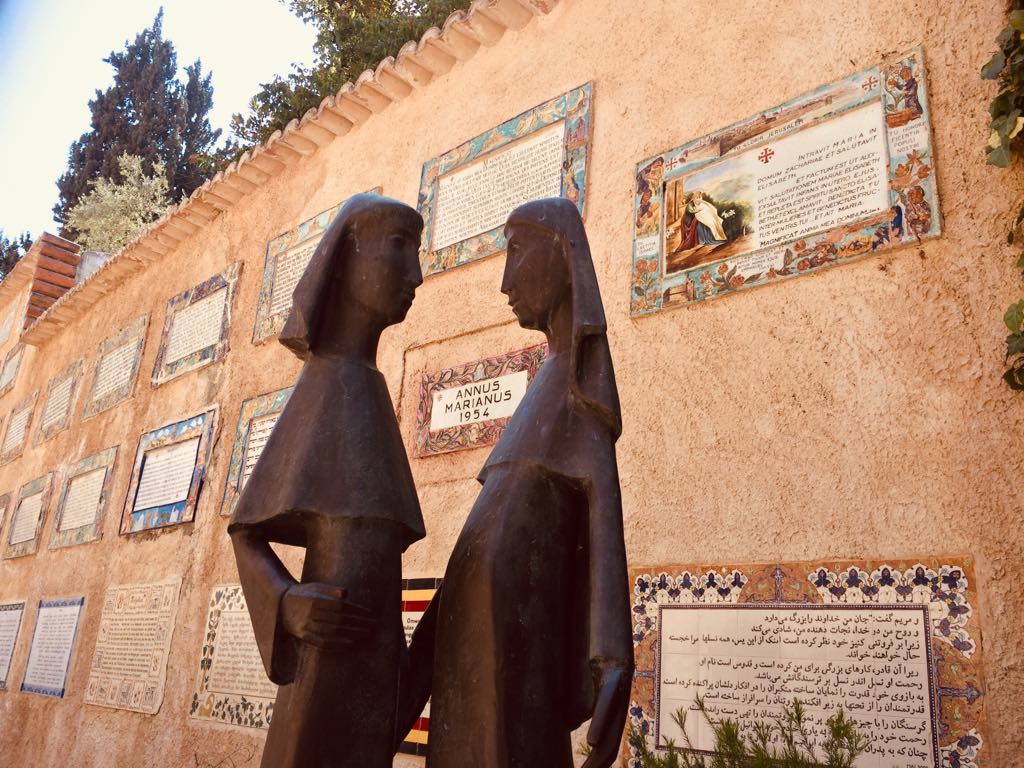
Photo by author, bronze statues of Mary and Elizabeth at the patio of the Church of Visitation, May 2017.

That is the meaning and significance of the Visitation: inasmuch as Christ comes to us individually, He behooves us to share Him also with others to form a community. 

Mary visited Elizabeth not merely to help her out in her pregnancy nor to confirm what Gabriel had told her but simply because she was so convinced of God’s love that she wanted to share it with her cousin. 

Mary visited Elizabeth because she felt touched by God in the Annunciation and wanted so much her cousin to be touched also by the Lord!  And indeed when Luke wrote that “When Elizabeth heard Mary’s greeting, the infant leaped in her womb, and Elizabeth, filled with the Holy Spirit, cried out in a loud voice and said, ‘Most blessed are you among women, and blessed is the fruit of your womb'” (Lk.1:41-42).

Faith in Christ leads to love that moves us to bond with one another to form Christ’s body, a community of believers, a community of beloved, a community of lovers. 

After receiving Jesus, like Mary, we have to move to the Visitation and share Him with others.  To be able to do this, we must first be convinced that God loves us so much like what the Prophet Zephaniah said in the first reading and what Elizabeth told Mary in the Visitation, “Blessed are you who believed that what was spoken to you by the Lord would be fulfilled” (Lk.1:45).

There’s a saying, “If you have love in your heart, you have been blessed by God; if you have been loved, you have been touched by God.”

Let God touch somebody today with your visitation… believe and feel the love of Jesus! Amen.

Advent as a dialogue leading to Christmas, the presence of God

The Lord Is My Chef Daily Recipe for the Soul by Fr. Nicanor F. Lalog II
Simbang Gabi-5 Homily, 20 December 2024
Isaiah 7:10-14 <*((((>< + ><))))*> Luke 1:26-38
Photo by Mr. Boy Cabrido, National Shrine of Our Lady of Mt. Carmel, QC, 16 December 2024.

Last Monday at the start of Simbang Gabi, one of our priests became viral when at the recessional of their Mass while the choir was joyfully singing “Pasko na! Pasko na!”, he sarcastically sang “Hindi pa! Hindi pa!”

Many people laughed at the viral video with some commenting that Father was right because it wasn’t Christmas yet while a liturgist advised choirs to check the many choices of Advent songs now available online. But, sad to say, the people missed the whole point of the incident.

What our brother-priest did was not funny at all in putting to shame his own choir members and most of all, in destroying the solemnity of the Mass.

And the problem was not really the choir at all but the priest himself. What the priest did at the end of the Mass was a self-indictment of his lack of formation for his choir members and of any dialogue at all.

Photo by author, Advent in previous parish, 2018.

Advent is a dialogue between God and humans that led to the presence of God among us in Jesus Christ on Christmas. It is a process that continues in our own time as we are all called to be open to God and with others for dialogue like Mary in the annunciation of Christ’s birth by Archangel Gabriel.

Dialogue is more than conversing to improve relationships among people in a community or organization but a way of being with others as opposed to a way of thinking through issues and problems only. Dialogue is being present with others, of giving one’s self to feel and listen and experience the other person.

Luke shows us in his second Christmas story today how this true meaning of dialogue between God and Mary happened.

In the sixth month, the angel Gabriel was sent from God to a town of Galilee called Nazareth, to a virgin betrothed to a man named Joseph, of the house of David, and the virgin’s name was Mary. And coming of her, he said, “Hail, full of grace! Then Lord is with you.” But she was greatloy troubled at what was said and pondered what sort of greeting this might be. Then the angel said to her, “Do not be afraid, Mary, for you have found favor with God… But Mary said to the angel, “How can this be, since I have no relations with a man?” And the angel said to her in reply, “The Holy spirit will come upon you, and the power of the Most High will overshadow you. Therefore the child to be born will be called holy, the Son of God. And behold, Elizabeth, your relative, has also conceived a son in her old age, and this is the sixth month for her who was called barren; for nothing will be impossible for God” (Luke 1:26-30, 34-37).

“Cestello Annunciation” by Botticelli painted in 1490; from en.wikipedia.org.

See the artistry and genius of Luke as a storyteller. Yesterday he presented to us the annunciation of the birth of John the Baptist to his father Zechariah while incensing the Holy of Holies in the temple of Jerusalem.

Notice the great differences in the flow of conversations and dialogue in the two annunciations narrated by Luke. Both Zechariah and Mary were troubled at the coming of the angel. And who would not be in a such unprecedented event? However, there is one minute detail we find in Luke’s narration of the two annunciations that reveal something so big and deep in meaning.

According to Luke, “Zechariah was troubled by what he saw, and fear came upon him” (Lk. 1:12) while Mary “was greatly troubled at what was said and pondered what sort of greeting this might be” (Lk. 1:29). Both were troubled which is normal but their reactions differed so great with Zechariah becoming proud while Mary was humbled.

I believe that it was more than their age and differences in social status that Zechariah was simply “troubled” while Mary was “greatly troubled” but it was largely due to their dispositions and openness to God.

Zechariah was proud of his stature and of his intelligence, trying to take hold and control of everything that is why he was seized with fear. When he told the angel, “How shall I know this? For I am an old man, and my wife is advanced in years” (Lk.1:18), Zechariah was troubled and fearful because he felt challenged as a priest much respected in the community, choosing to stand proud of his position and intelligence as if having a child is all an effort of man and woman alone! There was no dialogue as Zechariah was proud that is why he was made mute by the angel. He had forgotten all about God!

Photo by author, Basilica of the Annunciation, Nazareth, Israel, May 2019.

Compare Mary’s reaction to the annunciation, “But she was greatly troubled at what was said and pondered what sort of greeting this might be.”

Luke always portrayed Mary as the listener and doer of the word, the one who ponders at the words spoken to her not only by the angel here but later at the birth of Jesus those spoken by the shepherds, then by Simeon at the Presentation and by Jesus Himself at the wedding in Cana. Mary has always been open to dialogue, to feeling the other person conversing with her. She was not concerned only with the news and information but with the persons involved.

In that sense, there is her remarkable humility and great courage at the same time. True humility is not really about being submissive but most of all being filled with courage, not with fear. Mary as the very young virgin from a poor family in a town nobody gave importance stood fearless before the angel as she took hold of herself to ponder on the words spoken to her. Despite the very unprecedented moment with an angel, Mary had that inner engagement with the words she had just heard without any violent reactions.

Photo by author, December 2018.

Unlike Zechariah, Mary was the one actually in control of herself and of her emotions. The Jedi Master Yoda of Star Wars said it so well, “fear leads to anger, anger leads to destruction”. Zechariah was afraid of losing power and control but Mary was not bothered at all. In fact, she faced the challenge head on, reflecting deep in her what is this going on? Am I awake, is this a dream would most likely be the words playing in her mind and heart. Mary had presence as she tried to feel the angel and later God that no wonder, Jesus came to her womb and we have Christmas!

The humility and courage of Mary became more evident when she said to the angel, “How can this be, since I have no relations with a man?”

She was not afraid at all to be become the Mother of God! There was already her willingness to submit, as if telling the angel, “OK let’s do it but tell me how?” whereas Zechariah was argumentative, trying to escape responsibilities? Such was the attitude too of Ahaz in the first reading, denying he won’t test God when in fact he had already aligned with other kings in the region as he feared the invading enemies near his borders.

It was at this moment when the good news became most closest to us through Mary when the angel explained of the coming of the Holy Spirit, of how the power of God would overshadow her, assuring her that nothing is impossible with God.

How wonderful is this scene for us to emulate Mary so that we experience Christmas daily in our lives, not only of God coming but being present in us and among us. Can we dare to be open before God like Mary? Have a blessed Friday!

Photo by author, Fatima Avenue, Valenzuela City, December 2024.